REVIEW 3 major objections 4 minor 1 cited by
Coloring in anyon superconductivity
T0 review · 3 major / 4 minor · reviewed 2026-08-01 · deepseek-v4-flash
Pith's one-line read The many superconducting and metallic phases proposed for the doped ν=2/3 fractional quantum anomalous Hall state are unified as competing instabilities of a single parent 'quark metal' of charge-e/3 fermions.
desk verdict A technically rich unification proposal for anyon-driven phases near ν=2/3 FQAH, with new topological superconductors and careful calculations — but the parent quark metal rests on a finite-density level-rank duality that the authors themselves flag as unproven. read the letter →
The pith
A machine-rendered reading of the paper's core claim, the machinery that carries it, and where it could break.
The reading
What carries the argument
The central object is the level-rank duality pairing the abelian U(1)_3 Chern-Simons-Ginzburg-Landau theory of quasiholes with an SU(3)_{-1} Chern-Simons-matter theory of charge-e/3 fermions ('quarks'). Doping fills three color-degenerate valley pockets, forming the 'quark metal'. Two competing instabilities carry the argument: color superconductivity (Cooper pairing that Higgses the gauge group) and itinerant color ferromagnetism (spontaneous color polarization that generates emergent flux), with charge-2e/3 bound-state formation as a third route. The SU(3) color degree of freedom makes anyon fusion transparent while preserving abelian braiding, which is what lets previously separate mechan
What would settle it
Measure the thermal Hall conductance (chiral central charge) of the superconductor obtained by hole-doping the ν=2/3 FQAH plateau in twisted MoTe2: the quark-metal theory predicts a specific discrete set, including c_-=5/2 for the uniform color-valley-locked topological superconductor, so a value outside that set, or an intervening phase not reproducible as a color superconducting, ferromagnetic, or bound-state instability, would rule out the parent theory.
Extended reading notes
Core claim
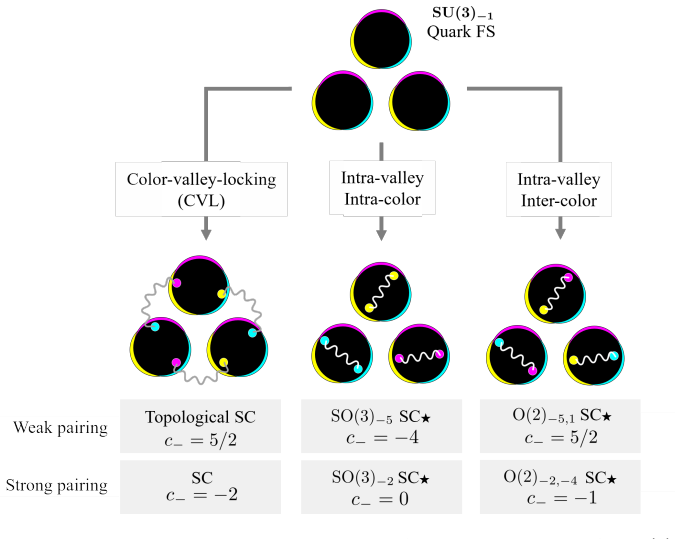
On its own terms, the central discovery is that the conventional U(1)_3 Chern-Simons-Ginzburg-Landau theory describing quasihole fluctuations of the ν=2/3 FQAH state is level-rank dual to a theory of charge-e/3 fermionic 'quarks' coupled to an SU(3)_{-1} Chern-Simons gauge field. When lattice translation symmetry is implemented projectively, each quark color forms three valleys, and doping fills a Fermi sea — the quark metal. Pairing of quarks across colors and valleys Higgses the gauge group in stages: a color-valley-locked p+ip condensate gives a uniform topological superconductor with chiral central charge c_-=5/2; intra-valley color-symmetric pairing gives SC* phases with SO(3)_{-5} or O
Load-bearing premise
The load-bearing premise is that the mathematical equivalence between the standard abelian theory of quasiholes and the alternative 'quark metal' description—a Fermi sea of charge-e/3 quarks coupled to a non-abelian gauge field—continues to hold after doping, finite density, and the lattice's three-valley enrichment; if that equivalence fails at low doping, the quark metal need not be the correct parent.
Editorial extensions
If this is right
- A single parent theory now organizes the known anyonic phases at ν=2/3+δ, including the c_-=-2 chiral superconductor, the c_-=5/2 topological superconductor, the secondary composite Fermi liquids, and the Z3 orthogonal metals, all as instabilities of the same quark Fermi surface.
- New phases are predicted that were not previously proposed, including a p+ip color-valley-locked topological superconductor with c_-=5/2 and SC* superconductors carrying SO(3)_{-5} or O(2)_{-5,1} topological order.
- The normal state proximate to the superconducting dome is a distinct metal of charge-e/3 quasiparticles with both a large Hall angle and a Drude weight, distinguishing it from the conventional composite Fermi liquid.
- Scenarios based on charge-2e/3 anyons, including Laughlin's mechanism and the charge-4e SC*, are recovered as bound states of two quarks within the same model, making their relationship to charge-e/3 anyon physics explicit.
- Selection among phases is governed by competition between gauge-mediated pairing attraction and Stoner-like color polarization, with screening of Coulomb repulsion favoring color superconductivity and bound-state formation.
Reading between the lines
- If the finite-density duality holds beyond mean field, the same SU(k)_1 quark-metal construction should generalize to other Laughlin-derived states, such as a doped semion gas, yielding a broader classification of anyon superconductivity from level-rank duality; the paper only sketches this.
- A clean way to test the unification is to measure the chiral central charge of the superconductor developing from the doped ν=2/3 plateau: the predicted discrete set is narrow enough that one thermal Hall measurement could discriminate the quark-metal parent from conventional BCS alternatives.
- The color-valley-locking mechanism suggests that approximate SU(3) valley symmetry, tunable by twist angle or displacement field, may act as a control knob selecting the c_-=5/2 phase over competing orders — an experimentally testable consequence the paper does not emphasize.
- The quark metal predicts a specific combination of fractional charge and two-carrier transport in the normal state, so shot-noise or tunneling experiments above the superconducting dome could directly check whether charge-e/3 quasiparticles survive to finite doping.
Signed reviews
Editorial analysis
A structured set of objections, weighed in public.
Referee Report
Summary. The manuscript proposes that the anyon-driven phases obtained by doping the ν=2/3 FQAH state in twisted MoTe2 can be organized as instabilities of a single parent state: a Fermi surface of charge-e/3 fermions in the fundamental of SU(3), coupled to an SU(3)_{-1} Chern-Simons gauge field and enriched by a Z_3×Z_3 lattice translation symmetry. This 'quark metal' is presented as the level-rank dual of the conventional U(1)_3 Chern-Simons–Ginzburg-Landau theory of charge-e/3 quasiholes. From this parent the authors derive color superconductors (a p+ip color-valley-locked state with c_-=5/2, and SC* phases with SO(3)_{-5} and O(2)_{-5,1} topological order), color ferromagnets (secondary composite Fermi liquids, Z_3 orthogonal metals, and a c_-=5/2 topological superconductor), and phases driven by charge-2e/3 bound states (a c_-=-2 chiral superconductor and a charge-4e SC* phase). The paper includes detailed appendices tracking counterterms, tree-level pairing-channel signs, Majorana path integrals, and BdG edge-mode counts.
Significance. If the central assumption holds, the paper offers a valuable unification: it maps a large collection of independent proposals onto one parent theory, identifies explicit order parameters, and predicts new phases with concrete topological invariants. The execution is unusually transparent: Appendix A carefully tracks counterterms, Appendix B computes the tree-level signs in the pairing channels, and Appendix F gives a detailed BdG accounting of Majorana modes. The authors also clearly flag the main limitation of their construction. The value of the framework, however, is conditional on extending level-rank duality to a finite-density, non-relativistic, symmetry-enriched regime; this extension is not proven in the manuscript. I view the work as a strong candidate for publication after this load-bearing point is addressed and a few technical bookkeeping issues are clarified.
major comments (3)
- [Sec. 2.3–2.4; Eq. (2.7); footnote 4] The paper's central claim — that the SU(3)_{-1} quark metal is the parent of the previously proposed ν=2/3+δ anyonic phases — rests on extending level-rank duality from the TQFT level to a non-relativistic, finite-density, symmetry-enriched setting. The manuscript is explicit about the gap: footnote 4 states that level-rank duality is expected to break down as the density approaches g^2_YM, and the experimentally relevant regime δ ≪ g^2_YM is the strong-coupling regime where the duality is least controlled. Section 2.4 then concedes that the only way to preserve the duality across the Chern-number-changing transition is a conjecture about valley-symmetry breaking, not a derivation. Since the quark Fermi surface itself is defined through this finite-density duality, the claimed unification is conditional. I ask the authors to supply a more controlled derivation (e.g., a microscopic parton
- [Sec. 3.3.2, Eq. (3.18), and App. F.1] The chiral central charge bookkeeping for the SC* phases appears to double-count. In Eq. (3.18) the SO(3)_{-5} TQFT is assigned c=+5/2. In App. F.1, integrating out the weakly paired quarks produces -3 L_{SO(3)_1} - 9 CS_g; the -9 CS_g is attributed to the same nine Majorana edge modes later counted as -9/2 in Sec. 3.3.2. If these MZMs are the edge modes of the SO(3)_{-5} theory, their contribution should already be contained in c(SO(3)_{-5}), and Eq. (3.19) would overcount by 9/2. If they are separate, the text should explain how a non-abelian Chern-Simons level and a Majorana edge spectrum can coexist without double counting. The same question applies to the O(2)_{-5,1} phase around Eqs. (3.23)–(3.24).
- [Sec. 3.4.3, Eq. (3.48)] The U(2)_{2,0} theory in Eq. (3.48) is claimed to describe a c_-=5/2 topological superconductor with an SU(2)_2 neutral sector. The derivation integrates out one Landau level per valley of the ψ doublet. The level pair (2,0) is unusual, and the text does not explicitly show that no additional neutral modes are present that would change c_- from 5/2. A short derivation of the central charge of this U(2)_{2,0} theory, or a precise citation for the level/convention used, would close this gap and make the c_-=5/2 claim easier to verify.
minor comments (4)
- [Eq. (3.30)] In the three charge-flux relations, the second and third lines use ν_c^I in the expressions for ρ_m^I and ρ_y^I; presumably these should be ν_m^I and ν_y^I, respectively.
- [Footnote 4 and Sec. 2.3] The comparison δ ≪ g^2_YM is dimensionally awkward unless the authors specify that g^2_YM is being used as a mass/density scale. Also, in Sec. 2.3, '1/relectrostatic interactions' appears to be a typo for '1/r electrostatic interactions.'
- [Sec. 3.1, Eq. (3.1)] The term '2 CS_g' should be written as '2CS_g' for consistency with the notation used elsewhere.
- [Sec. 3.5.1, Eq. (3.62)] The choice of the valley-symmetric Halperin K-matrix is natural but somewhat ad hoc; a sentence explaining why this is the minimal translation-invariant state for the Φ_y bosons would improve readability.
Circularity Check
No significant circularity: the quark metal rests on externally cited level-rank duality, and the new color-superconducting phases are derived rather than fitted or renamed.
full rationale
I walked the claimed derivation chain: the SU(3)_{-1} quark metal is introduced in Sec. 2.3 by applying level-rank duality (Eq. 2.7) to the U(1)_{-3} Chern-Simons-Ginzburg-Landau theory, with the duality itself cited to external works (Refs. [38-42,47-51,69]) rather than to the present authors. The subsequent identifications of color-ferromagnetic phases with earlier proposals are explicit consistency checks, not fitted predictions: e.g., Sec. 3.4.2 states 'The resulting theory is none other than the composite fermion theory introduced in Ref. [16,22]', and Sec. 3.5.1 reproduces the c_-=-2 superconductor of Ref. [13] via an explicit effective Lagrangian. These are dictionary identifications after solving the Higgsed Lagrangians, not inputs renamed as outputs. The genuinely new phases (CVL with c_-=5/2, Eq. 3.14; SO(3)_{-5} and O(2)_{-5,1} SC* phases, Eqs. 3.18-3.24) are obtained from explicit BdG/Majorana computations. The finite-density limitation admitted in footnote 4 and the conjecture in Sec. 2.4 are unproven assumptions about the validity of level-rank duality away from long wavelengths; that is a correctness risk, not a circular reduction. The paper's self-citations (e.g., Ref. [17]) appear only in peripheral transport/thermodynamic remarks and are not load-bearing. I therefore find no step in which a prediction is equivalent by construction to an input.
Assumptions & free parameters
free parameters (3)
- Z_2^m gauge theory level in O(2) SC* phase =
-4 (mod 8)
- Valley-symmetric Halperin K-matrix for 2e/3 bound state phase =
K = [[0,1,1],[1,0,1],[1,1,0]], q = (1,1,1)
- Color-polarization filling fractions in ferromagnetic phases =
monochromatic: 3/2 total; trichromatic: 0 net flux; dichromatic: 1 per valley
assumptions (7)
- domain assumption Level-rank duality U(1)_{-k} ⇄ SU(k)_1 for Chern-Simons-matter theories
- domain assumption Extension of level-rank duality to multiple matter species/valleys
- ad hoc to paper Conjecture: valley-symmetry-breaking arrests the Chern-number-changing transition
- domain assumption Local charge (baryon) formation is energetically costlier than fractionalization
- domain assumption Weak-coupling instability analysis of the quark Fermi surface applies to the doping regime of interest
- domain assumption Tree-level gauge-mediated interaction (linearized Gauss law) sets the pairing channel
- domain assumption Read-Green weak/strong pairing dichotomy and real order parameter in BdG analysis
invented entities (1)
-
SU(3)-colored charge-e/3 quarks and the 'quark metal' Fermi surface
independent evidence
Cite this review
Pith. "Pith review of Coloring in anyon superconductivity." pith.science (2026). https://pith.science/paper/JRWYLWQW
@misc{pith2026260719470,
  author       = {Pith},
  title        = {Pith review of: Coloring in anyon superconductivity},
  year         = {2026},
  howpublished = {\url{https://pith.science/paper/JRWYLWQW}},
  note         = {Machine review of arXiv:2607.19470}
}
abstract
The recently observed signatures of superconductivity proximate to a fractional quantum anomalous Hall (FQAH) state in a twisted MoTe$_2$ bilayer has revitalized interest in quantum phases of matter induced by anyon dynamics. Here we show how a panoply of anyon-driven phases associated with doping the lattice ${\nu=2/3}$ FQAH state can be realized as competing instabilities of a Fermi surface of charge-$e/3$ ``quarks'' coupled to a $\mathrm{SU}(3)_{-1}$ Chern-Simons gauge field, which is dual to the more conventional $\mathrm{U}(1)_3$ Chern-Simons-Ginzburg-Landau theory of quasiholes. For example, a range of electronic superconductors emerge from \emph{color superconductivity}, under which the Fermi surface experiences a pairing instability mediated by gauge fluctuations. These include SC$\star$ phases -- where superconductivity coexists with topological order -- as well as topological superconductors displaying half-integer chiral central charges when the quarks are weakly paired. One example is a $p+ip$ ``color-valley-locked'' superconductor, a topological analogue of the color superconductor familiar in quantum chromodynamics. On the other hand, both superconducting and non-Fermi liquid phases can emerge when the quarks form an itinerant ferromagnet, polarizing the Fermi surface to a particular combination of colors. Finally, our framework naturally accommodates the possibility of anyonic bound state formation, allowing access to phases induced by doping anyons of charge $2e/3$ as opposed to $e/3$ within the same model. Our work unifies many earlier proposed anyonic phases as instabilities of a single parent \emph{quark metal} phase, distilling their emergence into a competition between superconductivity and itinerant color ferromagnetism.
Figures


Figures from the paper (1 more)

Forward citations
Cited by 1 Pith paper
-
Charge-6e superconductivity from doping SU(3) spin liquids
Doping SU(3) spin liquids can yield charge-6e superconductors, including a non-Abelian chiral version with h/(6e) vortices.
Reference graph
Works this paper leans on
-
[13]
Doping a fractional quantum anomalous hall insulator,
Z. D. Shi and T. Senthil, “Doping a fractional quantum anomalous hall insulator,” Phys. Rev. X15, 031069 (2025), arXiv:2409.20567 [cond-mat.str-el]
arXiv 2025
-
[21]
Phases of itinerant anyons in laughlin’s quantum hall states on a lattice,
T. Lotriˇ c and S. H. Simon, “Phases of itinerant anyons in laughlin’s quantum hall states on a lattice,” (2026), arXiv:2603.22389 [cond-mat.str-el]
arXiv 2026
-
[1]
Signatures of fractional quantum anomalous hall states in twisted mote2,
J. Cai, E. Anderson, C. Wang, X. Zhang, X. Liu, W. Holtzmann, Y. Zhang, F. Fan, T. Taniguchi, K. Watanabe, Y. Ran, T. Cao, L. Fu, D. Xiao, W. Yao, and X. Xu, “Signatures of fractional quantum anomalous hall states in twisted mote2,” Nature 622, 63 (2023)
2023
-
[2]
Thermodynamic evidence of fractional chern insulator in moir´ e mote2,
Y. Zeng, Z. Xia, K. Kang, J. Zhu, P. Knuppel, C. Vaswani, K. Watanabe, T. Taniguchi, K. F. Mak, and J. Shan, “Thermodynamic evidence of fractional chern insulator in moir´ e mote2,” Nature622, 69 (2023)
2023
-
[3]
Observation of integer and fractional quantum anomalous hall effects in twisted bilayer mote 2,
F. Xu, Z. Sun, T. Jia, C. Liu, C. Xu, C. Li, Y. Gu, K. Watanabe, T. Taniguchi, B. Tong, J. Jia, Z. Shi, S. Jiang, Y. Zhang, X. Liu, and T. Li, “Observation of integer and fractional quantum anomalous hall effects in twisted bilayer mote 2,” Phys. Rev. X 13, 031037 (2023)
2023
-
[4]
Observation of fractionally quantized anomalous hall effect,
H. Park, J. Cai, E. Anderson, Y. Zhang, J. Zhu, X. Liu, C. Wang, W. Holtzmann, C. Hu, Z. Liu, T. Taniguchi, K. Watanabe, J.-H. Chu, T. Cao, L. Fu, W. Yao, C.-Z. Chang, D. Cobden, D. Xiao, and X. Xu, “Observation of fractionally quantized anomalous hall effect,” Nature622, 74 (2023)
2023
-
[5]
Fractional quantum anomalous Hall effect in multilayer graphene,
Z. Lu, T. Han, Y. Yao, A. P. Reddy, J. Yang, J. Seo, K. Watanabe, T. Taniguchi, L. Fu, and L. Ju, “Fractional quantum anomalous Hall effect in multilayer graphene,” Nature 626, 759 (2024)
2024
-
[6]
Superconductivity with intrinsic topological order induced by pure coulomb interaction and time-reversal symmetry breaking,
E. Tang and X.-G. Wen, “Superconductivity with intrinsic topological order induced by pure coulomb interaction and time-reversal symmetry breaking,” Phys. Rev. B88, 195117 (2013)
2013
Show all 84 references
-
[7]
Anyon dispersion from non-uniform mag- netic field on the sphere,
M.-L. Schleith, T. Soejima, and E. Khalaf, “Anyon dispersion from non-uniform mag- netic field on the sphere,” arXiv [cond-mat.str-el] (2025), arXiv:2506.11211 [cond- mat.str-el]
2025 arXiv
-
[8]
Spinless and spinful charge excitations in moir´ e fractional chern insulators,
M. Gon¸ calves, J. F. Mendez-Valderrama, J. Herzog-Arbeitman, J. Yu, X. Xu, D. Xiao, B. A. Bernevig, and N. Regnault, “Spinless and spinful charge excitations in moir´ e fractional chern insulators,” arXiv preprint arXiv:2506.05330 (2025)
2025 arXiv
-
[9]
Anyon dispersion in Aharonov-Casher bands and implications for twisted mote2,
Z. Yan, Q. Li, T. Soejima, and E. Khalaf, “Anyon dispersion in Aharonov-Casher bands and implications for twisted mote2,” arXiv preprint arXiv:2512.15863 (2025)
2025 arXiv
-
[10]
Dispersion of anyon bloch bands,
K. Iyer, A. Feuerpfeil, V. Cr´ epel, N. Regnault, and C. Mora, “Dispersion of anyon bloch bands,” (2026), arXiv:2604.24859 [cond-mat.mes-hall]
2026 arXiv
-
[11]
Measuring anyon dispersion with tunneling probes,
T. Wang and T. Senthil, “Measuring anyon dispersion with tunneling probes,” (2026), arXiv:2605.29017 [cond-mat.mes-hall] . 66
2026 arXiv
-
[12]
Topological chiral superconductivity beyond pairing in a fermi liquid,
M. Kim, A. Timmel, L. Ju, and X.-G. Wen, “Topological chiral superconductivity beyond pairing in a fermi liquid,” Physical Review B111, 014508 (2025)
2025
-
[14]
Anyon superconductivity from topological criticality in a hofstadter–hubbard model,
S. Divic, V. Cr´ epel, T. Soejima, X.-Y. Song, A. J. Millis, M. P. Zaletel, and A. Vish- wanath, “Anyon superconductivity from topological criticality in a hofstadter–hubbard model,” Proceedings of the National Academy of Sciences122, e2426680122 (2025), arXiv:2410.18175 [cond...
2025 arXiv
-
[15]
Doping lattice non-abelian quantum hall states,
Z. D. Shi, C. Zhang, and T. Senthil, “Doping lattice non-abelian quantum hall states,” SciPost Physics19, 150 (2025), arXiv:2505.02893 [cond-mat.str-el]
2025 arXiv
-
[16]
Holon metal, charge-density-wave and chiral superconductor from doping fractional chern insulator and su(3)1 chiral spin liquid,
Y.-H. Zhang, “Holon metal, charge-density-wave and chiral superconductor from doping fractional chern insulator and su(3)1 chiral spin liquid,” (2025), arXiv:2506.00110 [cond- mat.str-el]
2025
-
[17]
Thermodynamics of dilute anyon gases from fusion constraints,
Y. Nakajima, U. Mehta, and H. Goldman, “Thermodynamics of dilute anyon gases from fusion constraints,” J. Stat. Mech.2026, 063101 (2026), arXiv:2508.14961 [cond- mat.str-el]
2026 arXiv
-
[18]
Microscopic mechanism of anyon superconductivity emerging from fractional chern insulators,
F. Pichler, C. Kuhlenkamp, M. Knap, and A. Vishwanath, “Microscopic mechanism of anyon superconductivity emerging from fractional chern insulators,” Newton (2025)
2025
-
[19]
Non-Abelian topological superconductivity from melting Abelian fractional Chern insulators,
Z. D. Shi and T. Senthil, “Non-Abelian topological superconductivity from melting Abelian fractional Chern insulators,” (2025), arXiv:2512.17996 [cond-mat.str-el]
2025 arXiv
-
[20]
A Unified Categorical Description of Quantum Hall Hierarchy and Anyon Superconductivity,
D. Seo, T. Lee, and G. Y. Cho, “A Unified Categorical Description of Quantum Hall Hierarchy and Anyon Superconductivity,” (2026), arXiv:2602.03848 [cond-mat.str-el]
2026
-
[22]
Hidden weak-pairing superconductivity of non-interacting anyons obeying 1 3 statistics,
Z.-D. Fan, A. Vishwanath, and Z. Wang, “Hidden weak-pairing superconductivity of non-interacting anyons obeying 1 3 statistics,” (2026), arXiv:2605.19036 [cond-mat.str-el]
2026 arXiv
-
[23]
Topological superconductivity from Abelian fractional Chern insulators,
T. Wang, “Topological superconductivity from Abelian fractional Chern insulators,” (2026), arXiv:2605.29034 [cond-mat.str-el]
2026 arXiv
-
[24]
Superconductivity and non-Fermi liquid metals in a charge- 1/3 anyon fluid,
Z. D. Shi and T. Senthil, “Superconductivity and non-Fermi liquid metals in a charge- 1/3 anyon fluid,” (2026), arXiv:2606.20403 [cond-mat.str-el]
2026 arXiv
-
[25]
Fractionalized metals from doped anyons: Application to tmote2,
T. Senthil, “Fractionalized metals from doped anyons: Application to tmote2,” (2026), arXiv:2607.11484 [cond-mat.str-el]
2026 arXiv
-
[26]
Single-component twistedZ 3 orthogonal metal in ane/3-anyon fluid,
Z. Han, A. Vishwanath, and E. Khalaf, “Single-component twistedZ 3 orthogonal metal in ane/3-anyon fluid,” (2026), arXiv:2607.15274 [cond-mat.str-el] . 67
2026 arXiv
-
[27]
Color superconductors and holon metals from doping a fractional chern insulator,
Y.-H. Zhang, “Color superconductors and holon metals from doping a fractional chern insulator,” (2026), arXiv:2607.18238 [cond-mat.str-el]
2026 arXiv
-
[28]
Superconducting ground state of noninteracting particles obeying frac- tional statistics,
R. B. Laughlin, “Superconducting ground state of noninteracting particles obeying frac- tional statistics,” Phys. Rev. Lett.60, 2677–2680 (1988)
1988
-
[29]
Random-phase approximation in the fractional-statistics gas,
A. L. Fetter, C. B. Hanna, and R. B. Laughlin, “Random-phase approximation in the fractional-statistics gas,” Phys. Rev. B39, 9679–9681 (1989)
1989
-
[30]
On Anyon Superconductivity,
Y.-H. Chen, F. Wilczek, E. Witten, and B. I. Halperin, “On Anyon Superconductivity,” Int. J. Mod. Phys. B3, 1001 (1989)
1989
-
[31]
Anyon superconductivity and the fractional quantum hall effect,
D.-H. Lee and M. P. A. Fisher, “Anyon superconductivity and the fractional quantum hall effect,” Phys. Rev. Lett.63, 903–906 (1989)
1989
-
[32]
Superfluidity of the lattice anyon gas and topological invariance,
E. Fradkin, “Superfluidity of the lattice anyon gas and topological invariance,” Phys. Rev. B42, 570–586 (1990)
1990
-
[33]
Signatures of unconventional superconductivity near reentrant and fractional quantum anomalous hall insulators,
F. Xu, Z. Sun, J. Li, C. Zheng, C. Xu, J. Gao, T. Jia, K. Watanabe, T. Taniguchi, B. Tong, L. Lu, J. Jia, Z. Shi, S. Jiang, Y. Zhang, Y. Zhang, S. Lei, X. Liu, and T. Li, “Signatures of unconventional superconductivity near reentrant and fractional quantum anomalous hall insul...
2025 arXiv
-
[34]
Anyon delocalization transitions out of a disordered fractional quantum anomalous hall insulator,
Z. D. Shi and T. Senthil, “Anyon delocalization transitions out of a disordered fractional quantum anomalous hall insulator,” Proceed- ings of the National Academy of Sciences122, e2520608122 (2025), arXiv:https://www.pnas.org/doi/pdf/10.1073/pnas.2520608122 [cond-mat.str-el]
2025 doi
-
[35]
Anyon superconductivity and plateau transitions in doped fractional quantum anomalous hall insulators,
P. A. Nosov, Z. Han, and E. Khalaf, “Anyon superconductivity and plateau transitions in doped fractional quantum anomalous hall insulators,” Phys. Rev. Lett.136, 106501 (2026), arXiv:2506.02108 [cond-mat.str-el]
2026 arXiv
-
[36]
From fractionalization to chiral topological superconductivity in a flat chern band,
D. Guerci, A. Abouelkomsan, and L. Fu, “From fractionalization to chiral topological superconductivity in a flat chern band,” (2025), arXiv:2506.10938 [cond-mat.supr-con]
2025
-
[37]
Topological superconductivity with emergent vortex lattice in twisted semiconductors,
D. Guerci, A. Abouelkomsan, and L. Fu, “Topological superconductivity with emergent vortex lattice in twisted semiconductors,” (2026), arXiv:2602.15106 [cond-mat.supr-con]
2026
-
[38]
Group-level duality in WZW models and chern-simons theory,
S. G. Naculich, H. A. Riggs, and H. J. Schnitzer, “Group-level duality in WZW models and chern-simons theory,” Phys. Lett. B246, 417–422 (1990)
1990
-
[39]
Duality Between SU(N)-k and SU(k)-NWZW Models,
S. G. Naculich and H. J. Schnitzer, “Duality Between SU(N)-k and SU(k)-NWZW Models,” Nucl. Phys. B347, 687–742 (1990). 68
1990
-
[40]
The LargeNLimit of Chern-Simons Gauge Theory,
M. Camperi, F. Levstein, and G. Zemba, “The LargeNLimit of Chern-Simons Gauge Theory,” Phys. Lett. B247, 549–554 (1990)
1990
-
[41]
On monopole operators in supersymmetric chern-simons-matter theories,
O. Aharony, P. Narayan, and T. Sharma, “On monopole operators in supersymmetric chern-simons-matter theories,” arXiv [hep-th] (2015), arXiv:1502.00945 [hep-th]
2015 arXiv
-
[42]
Level/rank Duality and Chern-Simons-Matter Theories,
P.-S. Hsin and N. Seiberg, “Level/rank Duality and Chern-Simons-Matter Theories,” JHEP09, 095 (2016), arXiv:1607.07457 [hep-th]
2016 arXiv
-
[43]
Effective-field-theory model for the fractional quantum hall effect,
S. C. Zhang, T. H. Hansson, and S. Kivelson, “Effective-field-theory model for the fractional quantum hall effect,” Phys. Rev. Lett.62, 82–85 (1989)
1989
-
[44]
Superconductivity by long-range color magnetic interaction in high-density quark matter,
D. T. Son, “Superconductivity by long-range color magnetic interaction in high-density quark matter,” arXiv [hep-ph] (1998), arXiv:hep-ph/9812287 [hep-ph]
1998 arXiv
-
[45]
The condensed matter physics of qcd,
K. RAJAGOPAL and F. WILCZEK, “The condensed matter physics of qcd,” inAt The Frontier of Particle Physics(WORLD SCIENTIFIC, 2001) p. 2061–2151
2001
-
[46]
Color superconductivity in dense quark matter,
M. G. Alford, A. Schmitt, K. Rajagopal, and T. Sch¨ afer, “Color superconductivity in dense quark matter,” Rev. Mod. Phys.80, 1455–1515 (2008)
2008
-
[47]
D=3 bosonic vector models coupled to chern-simons gauge theories,
O. Aharony, G. Gur-Ari, and R. Yacoby, “D=3 bosonic vector models coupled to chern-simons gauge theories,” arXiv [hep-th] (2011), arXiv:1110.4382 [hep-th]
2011 arXiv
-
[48]
Chern- Simons Theory with Vector Fermion Matter,
S. Giombi, S. Minwalla, S. Prakash, S. P. Trivedi, S. R. Wadia, and X. Yin, “Chern- Simons Theory with Vector Fermion Matter,” Eur. Phys. J. C72, 2112 (2012), arXiv:1110.4386 [hep-th]
2012 arXiv
-
[49]
The Ther- mal Free Energy in Large N Chern-Simons-Matter Theories,
O. Aharony, S. Giombi, G. Gur-Ari, J. Maldacena, and R. Yacoby, “The Ther- mal Free Energy in Large N Chern-Simons-Matter Theories,” JHEP03, 121 (2013), arXiv:1211.4843 [hep-th]
2013 arXiv
-
[50]
Baryons, monopoles and dualities in chern-simons-matter theories,
O. Aharony, “Baryons, monopoles and dualities in chern-simons-matter theories,” J. High Energy Phys.2016(2016), 10.1007/jhep02(2016)093
2016 doi
-
[51]
Non-abelian 3d bosonization and quantum hall states,
D. Radicevic, D. Tong, and C. Turner, “Non-abelian 3d bosonization and quantum hall states,” arXiv [hep-th] (2016), 10.1007/JHEP12(2016)067, arXiv:1608.04732 [hep-th]
2016 arXiv
-
[52]
Singlet quantum hall effect and chern-simons theories,
A. Balatsky and E. Fradkin, “Singlet quantum hall effect and chern-simons theories,” Phys. Rev. B43, 10622–10634 (1991)
1991
-
[53]
Landau-ginzburg theories for non-abelian quantum hall states,
E. Fradkin, C. Nayak, and K. Schoutens, “Landau-ginzburg theories for non-abelian quantum hall states,” Nuclear Physics B546, 711–730 (1999)
1999
-
[54]
Landau-Ginzburg Theories of Non-Abelian Quantum Hall States from Non-Abelian Bosonization,
H. Goldman, R. Sohal, and E. Fradkin, “Landau-Ginzburg Theories of Non-Abelian Quantum Hall States from Non-Abelian Bosonization,” Phys. Rev. B100, 115111 (2019), arXiv:1906.00983 [cond-mat.str-el]
2019 arXiv
-
[55]
Non-Abelian Fermionization and the Land- scape of Quantum Hall Phases,
H. Goldman, R. Sohal, and E. Fradkin, “Non-Abelian Fermionization and the Land- scape of Quantum Hall Phases,” Phys. Rev. B102, 195151 (2020), arXiv:2009.00011 69 [cond-mat.str-el]
2020 arXiv
-
[56]
Emergent qcd 3 quantum phase transitions of fractional chern insulators,
R. Ma and Y.-C. He, “Emergent qcd 3 quantum phase transitions of fractional chern insulators,” Phys. Rev. Res.2, 033348 (2020), 2003.05954
2020 arXiv
-
[57]
Composite particle construction of the Fibonacci fractional quantum Hall state,
H. Goldman, R. Sohal, and E. Fradkin, “Composite particle construction of the Fibonacci fractional quantum Hall state,” Phys. Rev. B103, 235118 (2021), arXiv:2012.11611 [cond-mat.str-el]
2021 arXiv
-
[58]
Doping the chiral spin liquid: Topo- logical superconductor or chiral metal,
X.-Y. Song, A. Vishwanath, and Y.-H. Zhang, “Doping the chiral spin liquid: Topo- logical superconductor or chiral metal,” Phys. Rev. B.103, 165138 (2021)
2021
-
[59]
Quantum field theory and the jones polynomial,
E. Witten, “Quantum field theory and the jones polynomial,” Commun. Math. Phys. 121, 351–399 (1989)
1989
-
[60]
Two loop analysis of nonAbelian Chern- Simons theory,
W. Chen, G. W. Semenoff, and Y.-S. Wu, “Two loop analysis of nonAbelian Chern- Simons theory,” Phys. Rev. D46, 5521–5539 (1992), arXiv:hep-th/9209005 [hep-th]
1992 arXiv
-
[61]
Theory of the half-filled landau level,
B. I. Halperin, P. A. Lee, and N. Read, “Theory of the half-filled landau level,” Phys. Rev. B47, 7312–7343 (1993)
1993
-
[62]
Gifts from anomalies: Exact results for Landau phase transitions in metals,
Z. D. Shi, H. Goldman, D. V. Else, and T. Senthil, “Gifts from anomalies: Exact results for Landau phase transitions in metals,” SciPost Phys.13, 102 (2022), arXiv:2204.07585 [cond-mat.str-el]
2022 arXiv
-
[63]
Electromagnetic response of a half-filled chern band near topological criticality,
X. Yue, F. Pichler, M. Knap, and A. Stern, “Electromagnetic response of a half-filled chern band near topological criticality,” (2026), arXiv:2602.02428 [cond-mat.str-el]
2026
-
[64]
Dense Chern-Simons Matter with Fermions at Large N,
M. Geracie, M. Goykhman, and D. T. Son, “Dense Chern-Simons Matter with Fermions at Large N,” JHEP04, 103 (2016), arXiv:1511.04772 [hep-th]
2016 arXiv
-
[65]
Transport in chern-simons-matter theories,
G. Gur-Ari, S. Hartnoll, and R. Mahajan, “Transport in chern-simons-matter theories,” J. High Energy Phys.2016, 1–34 (2016), arXiv:1605.01122 [hep-th]
2016 arXiv
-
[66]
Translational symmetry and microscopic constraints on symmetry-enriched topological phases: A view from the surface,
M. Cheng, M. Zaletel, M. Barkeshli, A. Vishwanath, and P. Bonderson, “Translational symmetry and microscopic constraints on symmetry-enriched topological phases: A view from the surface,” (2016), 10.1103/PhysRevX.6.041068
2016 doi
-
[67]
Filling constraints on fermionic topological order in zero magnetic field,
N. Bultinck and M. Cheng, “Filling constraints on fermionic topological order in zero magnetic field,” Phys. Rev. B.98, 161119 (2018)
2018
-
[68]
Filling-enforced constraint on the quan- tized hall conductivity on a periodic lattice,
Y.-M. Lu, Y. Ran, and M. Oshikawa, “Filling-enforced constraint on the quan- tized hall conductivity on a periodic lattice,” Annals of Physics413, 168060 (2020), arXiv:1705.09298 [cond-mat.str-el]
2020 arXiv
-
[69]
Strong-Weak Chern-Simons-Matter Dualities from a Lattice Construction,
J.-Y. Chen and M. Zimet, “Strong-Weak Chern-Simons-Matter Dualities from a Lattice Construction,” JHEP08, 015 (2018), arXiv:1806.04141 [hep-th]
2018 arXiv
-
[70]
A symmetry breaking scenario for QCD 3,
Z. Komargodski and N. Seiberg, “A symmetry breaking scenario for QCD 3,” arXiv 70 [hep-th] (2017), arXiv:1706.08755 [hep-th]
2017 arXiv
-
[71]
Anyonic molecules in atomic fractional quantum hall liquids: A quantitative probe of fractional charge and anyonic statistics,
A. Mu˜ noz de las Heras, E. Macaluso, and I. Carusotto, “Anyonic molecules in atomic fractional quantum hall liquids: A quantitative probe of fractional charge and anyonic statistics,” Phys. Rev. X10, 041058 (2020)
2020
-
[72]
Molecular anyons in the fractional quantum hall effect,
M. Gattu and J. K. Jain, “Molecular anyons in the fractional quantum hall effect,” Phys. Rev. Lett.135, 236601 (2025), 2505.22782
2025
-
[73]
Dynamics of anyon clusters in fractional quantum hall fluids,
Q. Xu, G. Ji, Y. Wang, H. Q. Trung, and B. Yang, “Dynamics of anyon clusters in fractional quantum hall fluids,” Phys. Rev. B112, 235112 (2025)
2025
-
[74]
Bound states of anyons: a geometric quantization approach,
Q. Li, P. A. Nosov, T. Wang, and E. Khalaf, “Bound states of anyons: a geometric quantization approach,” (2026), arXiv:2603.24701 [cond-mat.str-el]
2026
-
[75]
New directions in the pursuit of majorana fermions in solid state systems,
J. Alicea, “New directions in the pursuit of majorana fermions in solid state systems,” Reports on Progress in Physics75, 076501 (2012), 1202.1293
2012 arXiv
-
[76]
Chern-simons-matter dualities withsoanduspgauge groups,
O. Aharony, F. Benini, P.-S. Hsin, and N. Seiberg, “Chern-simons-matter dualities withsoanduspgauge groups,” arXiv [cond-mat.str-el] (2016), arXiv:1611.07874 [cond- mat.str-el]
2016 arXiv
-
[77]
Global symmetries, counterterms, and duality in chern-simons matter theories with orthogonal gauge groups,
C. C´ ordova, P.-S. Hsin, and N. Seiberg, “Global symmetries, counterterms, and duality in chern-simons matter theories with orthogonal gauge groups,” SciPost Phys. , 021 (2018), 1711.10008
2018 arXiv
-
[78]
Charge-4esuperconductor with parafermionic vortices: A path to universal topological quantum computation,
Z. D. Shi, Z. Han, S. Raghu, and A. Vishwanath, “Charge-4esuperconductor with parafermionic vortices: A path to universal topological quantum computation,” (2026), arXiv:2602.06963 [cond-mat.str-el]
2026
-
[79]
Integer quantum hall effect for bosons,
T. Senthil and M. Levin, “Integer quantum hall effect for bosons,” Phys. Rev. Lett. 110, 046801 (2013), arXiv:1206.1604 [cond-mat.str-el]
2013 arXiv
-
[80]
s-duality ofu(1) gauge theory withθ=πon non-orientable manifolds: Applications to topological insulators and superconductors,
M. A. Metlitski, “s-duality ofu(1) gauge theory withθ=πon non-orientable manifolds: Applications to topological insulators and superconductors,” arXiv [hep-th] (2015), arXiv:1510.05663 [hep-th]
2015 arXiv
-
[81]
Non-abelian anyon superconductivity,
W. Bishara and C. Nayak, “Non-abelian anyon superconductivity,” Physical Review Let- ters99(2007), 10.1103/physrevlett.99.066401, arXiv:cond-mat/0703097 [cond-mat.str- el]
2007 arXiv
-
[82]
Equivalence of the resonating-valence-bond and fractional quantum hall states,
V. Kalmeyer and R. B. Laughlin, “Equivalence of the resonating-valence-bond and fractional quantum hall states,” Phys. Rev. Lett.59, 2095–2098 (1987)
-
[83]
Chiral spin states and superconductivity,
X. G. Wen, F. Wilczek, and A. Zee, “Chiral spin states and superconductivity,” Phys. Rev. B39, 11413–11423 (1989)
1989
-
[84]
Paired states of fermions in two dimensions with breaking of parity and time-reversal symmetries and the fractional quantum hall effect,
N. Read and D. Green, “Paired states of fermions in two dimensions with breaking of parity and time-reversal symmetries and the fractional quantum hall effect,” Phys. Rev. 71 B Condens. Matter61, 10267–10297 (2000), arXiv:cond-mat/9906453 [cond-mat.mes- hall] . 72
2000 arXiv
Reviewed August 1, 2026 · model on record in the stance chip above.
Discussion (0). Continue with ORCID to comment.