REVIEW 4 major objections 4 minor 80 references
A pipeline that mines the full text of scientific preprints and patent applications with large language models identifies retrieval-augmented generation and conversational agents as the two emerging transformative technologies as of 2024.
Reviewed by Pith at T0; open to challenge. T0 means a machine referee read the full paper against a public rubric. the ladder, T0–T4 →
T0 review · deepseek-v4-flash
2026-08-04 07:31 UTC pith:JRXI77TT
load-bearing objection A genuinely large and competently assembled pipeline, but the emergence-detection claim is under-validated: the Jaccard signal is computed over triples, not papers, and the RAG–conversational-agent finding is a retrospective hit with no baselines or significance tests. the 4 major comments →
Monitoring Transformative Technological Convergence Through LLM-Extracted Semantic Entity Triple Graphs
The pith
A machine-rendered reading of the paper's core claim, the machinery that carries it, and where it could break.
Core claim
The paper's central discovery is a pipeline that can identify emerging transformative technologies at scale from raw full text alone, without curated ontologies or expert panels. Language models extract semantic triples, a string-similarity step groups near-synonymous technology terms into topics, and a time series of Jaccard similarity between topic pairs reveals convergence: a rise in the ratio of shared triples to total triples. On two corpora — scientific preprints and US patent applications — the pipeline reproduces known LLM-era trends and, as of 2024, identifies retrieval-augmented generation and conversational agents as the two technologies whose convergence with the broader LLM fiel
What carries the argument
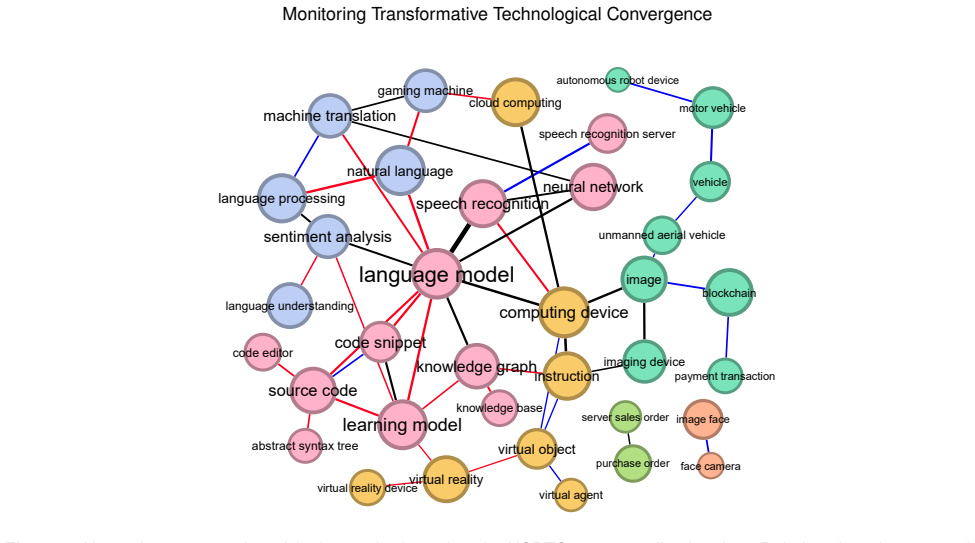
Semantic triple graph: each sentence is reduced to (subject, predicate, object) triples by an LLM, connecting technology-designating nouns. Noun stapling: a soft-Dice string similarity measure that groups terms like 'retrieval augmented' and 'retrieval augmentation' into one topic, so naming variation does not hide merges. Jaccard similarity time series: for each pair of topics, the ratio of triples shared by both to triples appearing in either is computed per time slice; the paper's load-bearing rule is that a rise in this ratio over time marks technological convergence. The pipeline also uses community detection to find established clusters and term-frequency trend decomposition to separat
Load-bearing premise
The load-bearing premise is that an increase in Jaccard similarity between two topics' triple sets reflects true technological convergence rather than artifacts of publishing volume, naming overlap, or LLM hallucination — and this link is asserted in the paper without being tested against a known set of historically convergent technologies.
What would settle it
Run the pipeline on texts from a past era with a well-documented convergence — for example, the melt of neural networks into speech recognition during the 2010s — and check whether the Jaccard curve for those two topics rises at the historically observed time. If it stays flat or rises only after the merger is obvious in hindsight, the proposed signal fails as an early indicator.
If this is right
- Technology forecasters can run the pipeline on any large text corpus — news, blogs, reports — without expert-curated taxonomies, and get early convergence warnings.
- The two named outputs, retrieval-augmented generation and conversational agents, are presented as concrete candidates for transformative technologies as of 2024, testable against subsequent developments.
- Because the method works on patents as well as preprints, it can connect early scientific signals to downstream commercial adoption timelines.
- The scale of triple extraction (23.8 million triples) sets a new baseline for full-text bibliometric analysis, beyond metadata- and citation-based methods.
Where Pith is reading between the lines
- If the Jaccard signal is validated against historical convergences, the same pipeline could be run retrospectively on decades of literature to build a verified library of convergence curves, turning this from a case study into a forecasting instrument.
- The method's dependence on LLM-extracted triples means hallucinated or redundant triples could inflate co-occurrence; a natural extension is to weight triples by extraction confidence or to filter through factuality checks before computing similarity.
- The Jaccard metric treats all triples equally and does not normalize for corpus growth, so a spurious rise after a hype event like a major product release is possible; a normalized or background-subtracted version could make the signal more robust to such shocks.
- The paper leaves open whether the two flagged technologies will bear out; if they do, the method offers a template for identifying future convergences in other ICT subfields.
Editorial analysis
A structured set of objections, weighed in public.
Referee Report
Summary. The paper proposes a full-text pipeline for technology forecasting. It extracts semantic triples from 278,625 arXiv preprints and 9,793 USPTO patent applications using a few-shot-prompted Llama-3-8B model, after benchmarking spaCy and several LLMs on a hand-labeled dataset built from a survey of LLMs. The triples are post-processed, filtered, grouped into technology topics via a string-similarity 'noun stapling' method, and analyzed with Louvain clustering, edge trend classification, and Jaccard-similarity time series. The paper's central claim is that the pipeline can identify both established and emerging convergence patterns, and specifically that retrieval-augmented generation and conversational agents were emerging transformative technologies as of end 2024.
Significance. If valid, the contribution is significant: it moves bibliometric forecasting from title/abstract metadata to full text, at a scale (about 23.8 million triples) beyond typical co-word studies, and it makes a concrete, falsifiable forecast. The pipeline is carefully engineered, the extraction benchmark is transparent, and the data/code repository is a strength. The main weakness is that the convergence signal itself is not validated: the interpretation of Eq. (6) as technology convergence is asserted rather than tested, and no baseline or null model is provided. The headline findings are therefore plausible but not yet supported by sufficient evidence.
major comments (4)
- [Section 4.8, Eq. (6) / Section 5.2.4] The text in §5.2.4 describes Figure 7 as the 'topic co-publication frequency,' but Eq. (6) is computed on sets of triples, not sets of papers. Table 5 shows that the chosen LLM extracts up to 15.3 triples per paragraph, so one broad survey paper in the 2023–24 LLM corpus can place many triples into the intersection of two topic sets and inflate J(A,B). The post-ChatGPT surge in exactly such high-yield survey/position papers is thus an alternative, non-convergence explanation for the observed Jaccard increases. A document-level Jaccard (paper as the unit) or a null model that preserves per-paper triple counts and topic margins is required before the RAG–conversational-agent finding can be accepted.
- [Section 4.8 / Figure 7] The paper asserts that 'a technology convergence will be identifiable by an increase in the Jaccard similarity' but provides no validation against known technological convergences, no comparison with the co-word [17] or LDA [13] baselines cited in Section 2, and no significance tests or confidence intervals. Since Figure 7 displays the ten pairs with the largest observed increase, the upward trends are guaranteed by the selection rule; the informative quantity is whether those increases exceed what a null model or a baseline method would produce. The early years (2018–2021) have very small triple counts, making yearly Jaccard estimates high-variance; without uncertainty bounds the 2018 baseline is not interpretable.
- [Section 4.6, Eq. (5)] The noun-stapling threshold (0.85) is the mechanism that maps surface terms to topics, and every downstream analysis inherits its errors. The threshold is justified only by the assertion that 'one can be relatively certain' above it; no precision/recall evaluation against a labeled term-similarity set and no comparison with embedding-based grouping are reported. Given that topic labels such as 'Retrieval Augmented' are themselves the output of this clustering, the stability of the Figure 7 findings should be checked under reasonable threshold variations, e.g. 0.80–0.90.
- [Section 3.1 / Section 5.1 / Conclusion] The two component validations are both drawn from inside the target domain: the triple-extraction golden set comes from a single LLM survey paper [74], and the abbreviation benchmark comes from a co-authored cyber-defense report [47]. This is not formal circularity, but it means the model choice and all empirical cutoffs (Sections 4.4–4.6) are tuned to LLM/security discourse. The abstract and conclusion claim a 'scalable and generalizable framework' across domains and data sources; that claim is not supported by the current held-out evidence. A hold-out domain (e.g., a non-LLM technology area in the same arXiv categories) should be added.
minor comments (4)
- [Throughout] Typos include 'Entrepeneurship,' 'prepring(s),' 'te USPTO,' 'semantinc graph analysis,' and 'rawn text.' A careful proofreading pass is needed.
- [Table 2] The text says three abbreviation detection algorithms are compared, but the table lists four (Schwartz-Hearst, scispaCy, NLPRe, and fine-tuned RoBERTa).
- [Table 6] The caption says 20 topics but the table lists 21 rows.
- [Figure 7] The caption contains the duplicated phrase 'largest increase between in the Jaccard similarity,' and the plot appears to omit axis labels and units, making the yearly scale hard to interpret.
Circularity Check
Convergence is operationalized as Jaccard increase and the triple-extraction benchmark is drawn from the LLM-survey domain being forecast, so the headline 'emerging transformative technologies' is partly the selection metric renamed, with no independent validation.
specific steps
-
self definitional
[§4.8 Eq. (6); §5.2.4, Fig. 7; §6]
"Let A(t) and B(t) be the sets of triplets that are related to topics A and B at time t, respectively. Then, the Jaccard similarity between the topics A and B at time t is defined as ... A technology convergence will be identifiable by an increase in the Jaccard similarity. ... we can designate retrieval augmentation and conversational agents as emerging transformative technologies in the field of LLMs, as of end 2024, based on research preprints published on arXiv."
The 'emerging transformative technology' finding is produced by taking the topic pairs with the largest increase in Eq. (6) and re-labeling them as convergence/transformative. Because the preceding sentence defines a technology convergence as an increase in that same Jaccard similarity, the reported result is the selection criterion restated: the top-increase pair is designated as convergence by construction. No independent ground truth (known convergences, expert forecasts, downstream impact, or a null model) is used to confirm that Jaccard increase means transformation. The paper itself states 'We leave to future research the task of validating the identified transformative technologies,' so the forecast content of the headline result is the Eq. (6) metric itself, renamed.
-
fitted input called prediction
[§3.1; §4.1; §5.2.1; §6]
"we manually construct a training dataset based on the paper A Survey of Large Language Models [74]. We chose this paper given our focus on the LLMs transformative technology, since it is a comprehensive and general review of LLM component technologies. ... we extract key terms from those papers related to LLMs ... we were able to identify two emerging transformative technologies as of 2024: retrieval-augmented generation and conversational agents."
The LLM used for triple extraction is few-shot/fine-tuned and evaluated on a golden dataset built from a survey of LLM component technologies, which is the same domain from which the case study then 'identifies' retrieval-augmented generation and conversational agents. The prompt examples and the survey text supply the LLM-related vocabulary used downstream, so the pipeline is tuned on the very domain it is asked to forecast. This does not mechanically force the time trend, but it means the claimed discovery is seeded by the benchmark input, and the 'scalable and generalizable framework' claim is not tested outside the tuning domain. This closes part of the validation loop rather than providing an independent test.
full rationale
The pipeline's formal derivation is largely self-contained: text is preprocessed, triples are extracted, terms are stapled and clustered, and Eq. (6) computes a well-defined triple-set Jaccard statistic. No equation literally fits a parameter and then re-predicts that parameter, and the triple-extraction comparison does include a manually labeled 20% holdout, so not everything is circular. However, the central forecasting claim is construct-circular in two related ways. First, 'technology convergence' is defined as an increase in Eq. (6), and the paper's headline result is obtained by taking the pairs with the largest such increase and calling them 'emerging transformative technologies'; no external benchmark validates that the metric corresponds to genuine transformation. Second, the only extraction benchmark and the few-shot/fine-tuning examples are drawn from an LLM survey, i.e., from the target domain, so the vocabulary that generates the RAG/conversational-agent finding is partly an input rather than an independent discovery. The abbreviation-detection benchmark uses a co-author's report (ref [47]), but this choice is not load-bearing for the convergence analysis, so it does not raise the score further. Overall, the result has independent computational content, but the 'prediction' label is attached to the metric's output without external validation, giving a partial circularity score of 4.
Axiom & Free-Parameter Ledger
free parameters (9)
- noun stapling similarity threshold =
0.85
- bookcorpus score cutoff =
top 10%
- frequency filter threshold =
f_cc,t < 5 removed
- subject/object length cutoff =
6 words
- minimum word length =
3 characters
- Louvain resolution =
0.85
- KeyBERT terms per abstract =
10
- edge color thresholds =
70% occurrences in 2022+ (red) / 70% in 2021− (blue)
- topic pairs displayed in Figure 7 =
10 pairs with largest Jaccard increase
axioms (6)
- domain assumption An increase in Jaccard similarity between topics' triple sets signals genuine technological convergence
- domain assumption LLM-extracted triples are factually reliable at scale
- ad hoc to paper String similarity at threshold 0.85 groups semantically similar technology terms
- domain assumption The arXiv category subset plus LLM seed terms adequately delimits the field of interest
- domain assumption arXiv preprints lead patent applications as early technology signals
- domain assumption The author-annotated golden triples are ground truth for extraction quality
Cite this review
Pith. "Pith review of Monitoring Transformative Technological Convergence Through LLM-Extracted Semantic Entity Triple Graphs." pith.science (2026). https://pith.science/paper/JRXI77TT
@misc{pith2026251025370,
  author       = {Pith},
  title        = {Pith review of: Monitoring Transformative Technological Convergence Through LLM-Extracted Semantic Entity Triple Graphs},
  year         = {2026},
  howpublished = {\url{https://pith.science/paper/JRXI77TT}},
  note         = {Machine review of arXiv:2510.25370}
}
read the original abstract
Forecasting transformative technologies remains a critical but challenging task, particularly in fast-evolving domains such as Information and Communication Technologies (ICTs). Traditional expert-based methods struggle to keep pace with short innovation cycles and ambiguous early-stage terminology. In this work, we propose a novel, data-driven pipeline to monitor the emergence of transformative technologies by identifying patterns of technological convergence. Our approach leverages advances in Large Language Models (LLMs) to extract semantic triples from unstructured text and construct a large-scale graph of technology-related entities and relations. We introduce a new method for grouping semantically similar technology terms (noun stapling) and develop graph-based metrics to detect convergence signals. The pipeline includes multi-stage filtering, domain-specific keyword clustering, and a temporal trend analysis of topic co-occurence. We validate our methodology on two complementary datasets: 278,625 arXiv preprints (2017--2024) to capture early scientific signals, and 9,793 USPTO patent applications (2018-2024) to track downstream commercial developments. Our results demonstrate that the proposed pipeline can identify both established and emerging convergence patterns, offering a scalable and generalizable framework for technology forecasting grounded in full-text analysis.
Figures


Reference graph
Works this paper leans on
-
[1]
arXiv preprint server
, . arXiv preprint server. https://info.arxiv.org. Accessed: 2025-04-28
2025
-
[2]
biorXiv preprint server
, . biorXiv preprint server. https://www.biorxiv.org/ content/about-biorxiv. Accessed: 2025-04-28
2025
-
[3]
medXiv preprint server
, . medXiv preprint server. https://www.medrxiv.org/ content/about-medrxiv. Accessed: 2025-04-28
2025
-
[4]
PubMed Central online publications archive
, . PubMed Central online publications archive. https://pmc. ncbi.nlm.nih.gov/about/intro/. Accessed: 2025-04-28
2025
-
[5]
Technology forecasting: A case study of computational technologies
Adamuthe, A.C., Thampi, G.T., 2019. Technology forecasting: A case study of computational technologies. Technological Forecasting and Social Change 143, 181–189. URL: https://www.sciencedirect.com/science/ article/pii/S0040162518302890, doi: https: //doi.org/10.1016/j.techfore.2019.03.002
-
[6]
Llama 3 model card URL: https://github
AI@Meta, 2024. Llama 3 model card URL: https://github. com/meta-llama/llama3/blob/main/MODEL_CARD.md
2024
-
[7]
Artifex, 2024. Pymupdf. https://pypi.org/project/ PyMuPDF/. Accessed: 2024-02-29
2024
-
[8]
Constitutional ai: Harmlessness from ai feedback
Bai, Y ., Kadavath, S., Kundu, S., Askell, A., Kernion, J., Jones, A., Chen, A., Goldie, A., Mirhoseini, A., McKinnon, C., Chen, C., Olsson, C., Olah, C., Hernandez, D., Drain, D., Ganguli, D., Li, D., Tran-Johnson, E., Perez, E., Kerr, J., Mueller, J., Ladish, J., Landau, J., Ndousse, K., Lukosuite, K., Lovitt, L., Sellitto, M., Elhage, N., Schiefer, N.,...
Pith/arXiv arXiv 2022
-
[9]
Gephi: An open source software for exploring and manipulating net- works
Bastian, M., Heymann, S., Jacomy, M., 2009. Gephi: An open source software for exploring and manipulating net- works. URL: http://www.aaai.org/ocs/index.php/ ICWSM/09/paper/view/154
2009
-
[10]
Bastos, A., Nadgeri, A., Singh, K., Mulang, I.O., Shekarpour, S., Hof- fart, J., Kaul, M., 2021. Recon: Relation extraction using knowledge graph context in a graph neural network, in: Proceedings of the Web Conference 2021, Association for Computing Machinery, New York, NY , USA. p. 1673–1685. URL: https://doi.org/10.1145/ 3442381.3449917, doi:10.1145/34...
arXiv 2021
-
[11]
Scibert: Pretrained language model for scientific text, in: EMNLP
Beltagy, I., Lo, K., Cohan, A., 2019. Scibert: Pretrained language model for scientific text, in: EMNLP. arXiv:arXiv:1903.10676
Pith/arXiv arXiv 2019
-
[12]
The semantic web: A new form of web content that is meaningful to computers will unleash a revolution of new possibilities
Berners-Lee, T., Hendler, J., Lassila, O., 2001. The semantic web: A new form of web content that is meaningful to computers will unleash a revolution of new possibilities. ScientificAmerican.com
2001
-
[13]
Latent dirichlet allocation
Blei, D.M., Ng, A.Y ., Jordan, M.I., 2003. Latent dirichlet allocation. J. Mach. Learn. Res. 3, 993–1022
2003
-
[14]
Fast unfolding of communities in large networks
Blondel, V .D., Guillaume, J.L., Lambiotte, R., Lefebvre, E., 2008. Fast unfolding of communities in large networks. Journal of statisti- cal mechanics: theory and experiment 2008, P10008. Sternfeld, A. et al.: Preprint submitted to Elsevier Page 17 of 21 Monitoring Transformative Technological Convergence
2008
-
[15]
Language models are few-shot learners, in: Larochelle, H., Ranzato, M., Hadsell, R., Balcan, M., Lin, H
Brown, T.B., Mann, B., Ryder, N., Subbiah, M., Kaplan, J., Dhariwal, P., Neelakantan, A., Shyam, P., Sastry, G., Askell, A., Agarwal, S., Herbert-V oss, A., Krueger, G., Henighan, T., Child, R., Ramesh, A., Ziegler, D.M., Wu, J., Winter, C., Hesse, C., Chen, M., Sigler, E., Litwin, M., Gray, S., Chess, B., Clark, J., Berner, C., McCandlish, S., Radford, A...
2020
-
[16]
Technology Forecasting: Recent Trends and New Methods
Calleja-Sanz, G., Nadal, J., Solé-Parellada, F., 2020. Technology Forecasting: Recent Trends and New Methods. pp. 45–69. doi: 10. 1007/978-3-030-40896-1_3
2020
-
[17]
From translations to problematic networks: An introduction to co-word analysis
Callon, M., Courtial, J.P., Laville, F., 1983. From translations to problematic networks: An introduction to co-word analysis. Social Science Information 22, 191–235
1983
-
[18]
Massive open index of scholarly papers launches
Chawla, D.S., 2022. Massive open index of scholarly papers launches. Nature URL: https://api.semanticscholar. org/CorpusID:246278314
2022
-
[19]
The innovator’s dilemma: When new technologies cause great firms to fail
Christensen, C.M., 1997. The innovator’s dilemma: When new technologies cause great firms to fail. Harvard Business School Press, Boston
1997
-
[20]
Cohan, A., Feldman, S., Beltagy, I., Downey, D., Weld, D.S.,
-
[21]
Persistent Forecasting of Disruptive Technologies" Report 2
Council, N.R., on Engineering, D., Sciences, P., on Forecasting Future Disruptive Technologies, C., 2010. Persistent Forecasting of Disruptive Technologies" Report 2. National Academies Press
2010
-
[22]
Digital transformations: new tools and methods for mining technological intelligence
Daim, T., Yalçin, H., 2022. Digital transformations: new tools and methods for mining technological intelligence. Edward Elgar Publishing
2022
-
[23]
Anticipat- ing future innovation pathways through large data analysis
Daim, T.U., Chiavetta, D., Porter, A.L., Saritas, O., 2016. Anticipat- ing future innovation pathways through large data analysis. Springer
2016
-
[24]
An experimental study of group opinion: the delphi method
Dalkey, N., 1969. An experimental study of group opinion: the delphi method. Futures 1, 408–426
1969
-
[25]
PubMed 200k RCT: a dataset for sequential sentence classification in medical abstracts, in: Kondrak, G., Watanabe, T
Dernoncourt, F., Lee, J.Y ., 2017. PubMed 200k RCT: a dataset for sequential sentence classification in medical abstracts, in: Kondrak, G., Watanabe, T. (Eds.), Proceedings of the Eighth International Joint Conference on Natural Language Processing (V olume 2: Short Papers), Asian Federation of Natural Language Processing, Taipei, Taiwan. pp. 308–313. URL...
2017
-
[26]
Technological paradigms and technological trajec- tories: A suggested interpretation of the determinants and directions of technical change
Dosi, G., 1982. Technological paradigms and technological trajec- tories: A suggested interpretation of the determinants and directions of technical change. Research Policy 11, 147–162. URL: https: //api.semanticscholar.org/CorpusID:16840352
1982
-
[27]
Identifying potentially disruptive trends by means of keyword network analysis
Dotsika, F., Watkins, A., 2017. Identifying potentially disruptive trends by means of keyword network analysis. Technological Forecasting and Social Change 119, 114–127. URL: https://www.sciencedirect.com/science/ article/pii/S0040162517303517, doi: https: //doi.org/10.1016/j.techfore.2017.03.020
-
[28]
Span-based joint entity and rela- tion extraction with transformer pre-training, in: Giacomo, G.D., Catalá, A., Dilkina, B., Milano, M., Barro, S., Bugarín, A., Lang, J
Eberts, M., Ulges, A., 2020. Span-based joint entity and rela- tion extraction with transformer pre-training, in: Giacomo, G.D., Catalá, A., Dilkina, B., Milano, M., Barro, S., Bugarín, A., Lang, J. (Eds.), ECAI 2020 - 24th European Conference on Artificial Intelligence, 29 August-8 September 2020, Santiago de Compostela, Spain, August 29 - September 8, 2...
2020
-
[29]
Organization strategy and structural differences for radical versus incremental innovation
Ettlie, J.E., Bridges, W.P., O’keefe, R.D., 1984. Organization strategy and structural differences for radical versus incremental innovation. Management Science 30, 682–695. URL: https: //api.semanticscholar.org/CorpusID:154030756
1984
-
[30]
Falissard, L., Guigue, V ., Soulier, L., 2023. Improving generalization in large langue model by learning prefix subspaces, in: Bouamor, H., Pino, J., Bali, K. (Eds.), Findings of the Association for Computational Linguistics: EMNLP 2023, Association for Computational Linguistics, Singapore. pp. 11474–11483. URL: https://aclanthology.org/2023.findings-emn...
-
[31]
Fergadis, A., Pappas, D., Karamolegkou, A., Papageorgiou, H., 2021. Argumentation mining in scientific literature for sustainable development, in: Al-Khatib, K., Hou, Y ., Stede, M. (Eds.), Proceedings of the 8th Workshop on Argument Mining, Association for Computational Linguistics, Punta Cana, Dominican Republic. pp. 100–111. URL: https://aclanthology.o...
-
[32]
A simple substitution model of technological change
Fisher, J.C., Pry, R.H., 1971. A simple substitution model of technological change. Technological forecasting and social change 3, 75–88
1971
-
[33]
Gali, N., Mariescu-Istodor, R., Hostettler, D., Fränti, P.,
-
[34]
Keybert: Minimal keyword extraction with bert
Grootendorst, M., 2020. Keybert: Minimal keyword extraction with bert. URL: https://doi.org/10.5281/zenodo. 4461265, doi:10.5281/zenodo.4461265
doi:10.5281/zenodo 2020
-
[35]
Technology futures analysis: Toward integration of the field and new methods
Group, T.F.A.M.W., et al., 2004. Technology futures analysis: Toward integration of the field and new methods. Technological Forecasting and Social Change 71, 287–303
2004
-
[36]
Forecasting technology emergence using large-scale knowledge graphs and link prediction
Gu, M., Liu, X., Zhang, L., Wang, J., 2024. Forecasting technology emergence using large-scale knowledge graphs and link prediction. Scientometrics In press
2024
-
[37]
Hogan, A., Blomqvist, E., Cochez, M., D’amato, C., Melo, G.D., Gutierrez, C., Kirrane, S., Gayo, J.E.L., Navigli, R., Neumaier, S., Ngomo, A.C.N., Polleres, A., Rashid, S.M., Rula, A., Schmelzeisen, L., Sequeda, J., Staab, S., Zimmermann, A., 2021. Knowledge graphs. ACM Computing Surveys 54, 1–37. URL: http://dx. doi.org/10.1145/3447772, doi:10.1145/3447772
doi:10.1145/3447772 2021
-
[38]
spaCy: Industrial-strength Natural Language Processing in Python doi:10.5281/zenodo.1212303
Honnibal, M., Montani, I., Van Landeghem, S., Boyd, A., 2020. spaCy: Industrial-strength Natural Language Processing in Python doi:10.5281/zenodo.1212303
-
[39]
Lora: Low-rank adaptation of large language models
Hu, E.J., Shen, Y ., Wallis, P., Allen-Zhu, Z., Li, Y ., Wang, S., Wang, L., Chen, W., 2021. Lora: Low-rank adaptation of large language models. arXiv:2106.09685
Pith/arXiv arXiv 2021
-
[40]
Extracting core claims from scientific articles
Jansen, T., Kuhn, T., 2017. Extracting core claims from scientific articles. CoRR abs/1707.07678. URL: http://arxiv.org/ abs/1707.07678, arXiv:1707.07678
Pith/arXiv arXiv 2017
-
[41]
Technological forecasting in perspective
Jantsch, E., 1967. Technological forecasting in perspective. Number 21,931 in OECD Publications, OECD, Paris
1967
-
[42]
Jiang, A.Q., Sablayrolles, A., Mensch, A., Bamford, C., Chaplot, D.S., de las Casas, D., Bressand, F., Lengyel, G., Lample, G., Saulnier, L., Lavaud, L.R., Lachaux, M.A., Stock, P., Scao, T.L., Lavril, T., Wang, T., Lacroix, T., Sayed, W.E., 2023. Mistral 7b. arXiv:2310.06825
Pith/arXiv arXiv 2023
-
[43]
A novel approach to forecast promising technology through patent analysis
Kim, G., Bae, J., 2017. A novel approach to forecast promising technology through patent analysis. Technological Forecasting and Social Change 117, 228–237. URL: https://www.sciencedirect.com/science/ article/pii/S0040162516307661, doi: https: //doi.org/10.1016/j.techfore.2016.11.023
-
[44]
Technology fusion and the new r&d
Kodama, F., 1992. Technology fusion and the new r&d. Harvard business review , 70–78
1992
-
[45]
Forecasting re- search trends using dynamic graph representations: The science4cast 2023 challenge
Krenn, M., Bollen, J., Stojanovski, J., et al., 2023. Forecasting re- search trends using dynamic graph representations: The science4cast 2023 challenge. arXiv preprint arXiv:2301.03589 . Sternfeld, A. et al.: Preprint submitted to Elsevier Page 18 of 21 Monitoring Transformative Technological Convergence
Pith/arXiv arXiv 2023
-
[46]
From deep neural language models to llms, in: Large Language Models in Cybersecurity: Threats, Exposure and Mitigation
Kucharavy, A., 2024. From deep neural language models to llms, in: Large Language Models in Cybersecurity: Threats, Exposure and Mitigation. Springer, pp. 3–17
2024
-
[47]
Fundamentals of generative large language models and perspectives in cyber-defense
Kucharavy, A., Schillaci, Z., Maréchal, L., Würsch, M., Dolamic, L., Sabonnadiere, R., David, D.P., Mermoud, A., Lenders, V ., 2023. Fundamentals of generative large language models and perspectives in cyber-defense. arXiv:2303.12132
Pith/arXiv arXiv 2023
-
[48]
Scientific discourse tagging for evidence extraction, in: Merlo, P., Tiedemann, J., Tsarfaty, R
Li, X., Burns, G.A., Peng, N., 2021. Scientific discourse tagging for evidence extraction, in: Merlo, P., Tiedemann, J., Tsarfaty, R. (Eds.), Proceedings of the 16th Conference of the European Chapter of the Association for Computational Linguistics: Main V olume, EACL 2021, Online, April 19 - 23, 2021, Association for Compu- tational Linguistics. pp. 255...
-
[49]
Li, X., Fan, M., Zhou, Y ., Fu, J., Yuan, F., Huang, L., 2020. Monitoring and forecasting the development trends of nanogenerator technology using citation analysis and text mining. Nano Energy 71, 104636. URL: https://www.sciencedirect. com/science/article/pii/S2211285520301932, doi:https://doi.org/10.1016/j.nanoen.2020. 104636
-
[50]
A novel integrated approach for quantifying the convergence of disruptive technologies from science to technol- ogy
Li, X., Wang, Y ., 2024. A novel integrated approach for quantifying the convergence of disruptive technologies from science to technol- ogy. Technological Forecasting and Social Change URL: https: //api.semanticscholar.org/CorpusID:273569421
2024
-
[51]
Liu, L., Omidvar, A., Ma, Z., Agrawal, A., An, A., 2022. Un- supervised knowledge graph generation using semantic similar- ity matching, in: Cherry, C., Fan, A., Foster, G., Haffari, G.R., Khadivi, S., Peng, N.V ., Ren, X., Shareghi, E., Swayamdipta, S. (Eds.), Proceedings of the Third Workshop on Deep Learning for Low-Resource Natural Language Processing...
2022
-
[52]
A survey of link prediction in complex networks
Martínez, V ., Berzal, F., Cubero, J.C., 2016. A survey of link prediction in complex networks. ACM Computing Surveys (CSUR) 49, 1–33
2016
-
[53]
context2vec: Learning generic context embedding with bidirectional LSTM, in: Riezler, S., Goldberg, Y
Melamud, O., Goldberger, J., Dagan, I., 2016. context2vec: Learning generic context embedding with bidirectional LSTM, in: Riezler, S., Goldberg, Y . (Eds.), Proceedings of the 20th SIGNLL Con- ference on Computational Natural Language Learning, Associa- tion for Computational Linguistics, Berlin, Germany. pp. 51–61. URL: https://aclanthology.org/K16-1006...
2016
-
[54]
Quantitative analysis of culture using millions of digitized books
Michel, J.B., Shen, Y .K., Aiden, A.P., Veres, A., Gray, M.K., Team, G.B., Pickett, J.P., Hoiberg, D., Clancy, D., Norvig, P., et al., 2011. Quantitative analysis of culture using millions of digitized books. science 331, 176–182
2011
-
[55]
Distributed representations of words and phrases and their composi- tionality, in: Neural Information Processing Systems
Mikolov, T., Sutskever, I., Chen, K., Corrado, G.S., Dean, J., 2013. Distributed representations of words and phrases and their composi- tionality, in: Neural Information Processing Systems. URL:https: //api.semanticscholar.org/CorpusID:16447573
2013
-
[56]
Neumann, M., King, D., Beltagy, I., Ammar, W., 2019. ScispaCy: Fast and robust models for biomedical natural language processing, in: Demner-Fushman, D., Cohen, K.B., Ananiadou, S., Tsujii, J. (Eds.), Proceedings of the 18th BioNLP Workshop and Shared Task, Association for Computational Linguistics, Florence, Italy. pp. 319–327. URL: https://aclanthology....
-
[57]
Triplet extraction leveraging sentence transformers and dependency parsing
Ottersen, S.G., Pinheiro, F., Bação, F., 2024. Triplet extraction leveraging sentence transformers and dependency parsing. Array 21, 100334. URL: https://www.sciencedirect. com/science/article/pii/S2590005623000590, doi:https://doi.org/10.1016/j.array.2023. 100334
-
[58]
Training language models to follow instructions with human feedback
Ouyang, L., Wu, J., Jiang, X., Almeida, D., Wainwright, C., Mishkin, P., Zhang, C., Agarwal, S., Slama, K., Ray, A., et al., 2022. Training language models to follow instructions with human feedback. Ad- vances in neural information processing systems 35, 27730–27744
2022
-
[59]
Percia David, D., Maréchal, L., Lacube, W., Gillard, S., Tsesmelis, M., Maillart, T., Mermoud, A., 2023. Measuring security development in information technologies: A scientometric framework using arxiv e-prints. Technological Forecasting and Social Change 188, 122316. URL: https://www.sciencedirect. com/science/article/pii/S004016252300001X, doi:https://...
-
[60]
Technology forecasting based on semantic and citation analysis of patents: A case of robotics domain
Qiu, Z., Wang, Z., 2022. Technology forecasting based on semantic and citation analysis of patents: A case of robotics domain. IEEE Transactions on Engineering Management 69, 1216–1236. doi: 10. 1109/TEM.2020.2978849
arXiv 2022
-
[61]
Improving language understanding by generative pre-training
Radford, A., Narasimhan, K., Salimans, T., Sutskever, I., et al., 2018. Improving language understanding by generative pre-training
2018
-
[62]
Economic theory and entrepreneurial his- tory, in: Clemence, R
Schumpeter, J.A., 1949. Economic theory and entrepreneurial his- tory, in: Clemence, R. (Ed.), Essays on Entrepreneurs, Innovations, Business Cycles, and the Evolution of Capitalism. New Jersey: Transaction Publishers, pp. 272–286
1949
-
[63]
A simple algorithm for identifying abbreviation definitions in biomedical text, in: Altman, R.B., Dunker, A.K., Hunter, L., Klein, T.E
Schwartz, A.S., Hearst, M.A., 2003. A simple algorithm for identifying abbreviation definitions in biomedical text, in: Altman, R.B., Dunker, A.K., Hunter, L., Klein, T.E. (Eds.), Proceedings of the 8th Pacific Symposium on Biocomputing, PSB 2003, Lihue, Hawaii, USA, January 3-7, 2003, pp. 451–
2003
-
[64]
Citation analysis
Smith, L.C., 1981. Citation analysis
1981
-
[65]
Llm-resilient bibliometrics: Factual consistency through entity triplet extraction, in: Zhang, C., Zhang, Y ., Mayr, P., Lu, W., Suominen, A., Chen, H., Ding, Y
Sternfeld, A., Kucharavy, A., David, D.P., Mermoud, A., Jang- Jaccard, J., 2024. Llm-resilient bibliometrics: Factual consistency through entity triplet extraction, in: Zhang, C., Zhang, Y ., Mayr, P., Lu, W., Suominen, A., Chen, H., Ding, Y . (Eds.), Proceed- ings of Joint Workshop of the 5th Extraction and Evaluation of Knowledge Entities from Scientifi...
2024
-
[66]
Travis Hoppe, H.B., 2024. Nlpre. https://github.com/ NIHOPA/NLPre. Accessed: 2024-04-15
2024
-
[67]
A knowledge-based information extraction prototype for data-rich documents in the information technology domain
Vargas, S.G.J., 2008. A knowledge-based information extraction prototype for data-rich documents in the information technology domain. Diss. National University of Columbia, Bogota
2008
-
[68]
New trends in bibliometric apis: A com- parative analysis
Velez-Estevez, A., Pérez, I.J., García-Sánchez, P., Moral-Munoz, J.A., Cobo, M.J., 2023. New trends in bibliometric apis: A com- parative analysis. Inf. Process. Manag. 60, 103385. URL: https: //api.semanticscholar.org/CorpusID:258730412
2023
-
[69]
Early identification of breakthrough technologies: Insights from science-driven innovations
Wang, D., Zhou, X., Zhao, P., Pang, J., Ren, Q., 2025. Early identification of breakthrough technologies: Insights from science-driven innovations. Journal of Informetrics 19, 101606. URL: https://www.sciencedirect. com/science/article/pii/S1751157724001184, doi:https://doi.org/10.1016/j.joi.2024.101606
arXiv 2025
-
[70]
Claimdistiller: Scientific claim extraction with supervised contrastive learning, in: Zhang, C., Zhang, Y ., Mayr, P., Lu, W., Suominen, A., Chen, H., Ding, Y
Wei, X., Hoque, M.R.U., Wu, J., Li, J., 2023. Claimdistiller: Scientific claim extraction with supervised contrastive learning, in: Zhang, C., Zhang, Y ., Mayr, P., Lu, W., Suominen, A., Chen, H., Ding, Y . (Eds.), Proceedings of Joint Workshop of the 4th Extraction and Evaluation of Knowledge Entities from Scientific Documents (EEKE2023) and the 3rd AI +...
2023
-
[71]
Llm- based entity extraction is not for cybersecurity, in: Zhang, C., Zhang, Y ., Mayr, P., Lu, W., Suominen, A., Chen, H., Ding, Y
Würsch, M., Kucharavy, A., David, D.P., Mermoud, A., 2023. Llm- based entity extraction is not for cybersecurity, in: Zhang, C., Zhang, Y ., Mayr, P., Lu, W., Suominen, A., Chen, H., Ding, Y . (Eds.), Proceedings of Joint Workshop of the 4th Extraction and Evaluation of Knowledge Entities from Scientific Documents (EEKE2023) and the 3rd AI + Informetrics ...
2023
-
[72]
Llms perform poorly at concept extraction in cyber-security research liter- ature
Würsch, M., Kucharavy, A., David, D.P., Mermoud, A., 2023. Llms perform poorly at concept extraction in cyber-security research liter- ature. arXiv:2312.07110
Pith/arXiv arXiv 2023
-
[73]
You, H., Li, M., Hipel, K.W., Jiang, J., Ge, B., Duan, H., 2017. Development trend forecasting for coherent light generator technology based on patent citation network anal- ysis. Scientometrics 111, 297–315. URL: https:// doi.org/10.1007/s11192-017-2252-y , doi: 10.1007/ S11192-017-2252-Y
-
[74]
Zhao, W.X., Zhou, K., Li, J., Tang, T., Wang, X., Hou, Y ., Min, Y ., Zhang, B., Zhang, J., Dong, Z., Du, Y ., Yang, C., Chen, Y ., Chen, Z., Jiang, J., Ren, R., Li, Y ., Tang, X., Liu, Z., Liu, P., Nie, J.Y ., Wen, J.R.,
-
[75]
Starling-7b: Improving llm helpfulness & harmlessness with rlaif
Zhu, B., Frick, E., Wu, T., Zhu, H., Ganesan, K., Chiang, W.L., Zhang, J., Jiao, J., 2023. Starling-7b: Improving llm helpfulness & harmlessness with rlaif
2023
-
[76]
Zilio, L., Saadany, H., Sharma, P., Kanojia, D., Or ˘asan, C., 2022. PLOD: An abbreviation detection dataset for scientific documents, in: Calzolari, N., Béchet, F., Blache, P., Choukri, K., Cieri, C., Declerck, T., Goggi, S., Isahara, H., Maegaard, B., Mariani, J., Mazo, H., Odijk, J., Piperidis, S. (Eds.), Proceedings of the Thirteenth Language Re- sour...
2022
-
[462]
URL: http://psb.stanford.edu/psb-online/ proceedings/psb03/schwartz.pdf
-
[2019]
Expert Systems with Applications 129, 169–185
Framework for syntactic string similarity measures. Expert Systems with Applications 129, 169–185. URL: https://www.sciencedirect.com/science/ article/pii/S0957417419302222, doi: https: //doi.org/10.1016/j.eswa.2019.03.048
-
[2020]
URL: https://arxiv.org/ abs/2004.07180, arXiv:2004.07180
Specter: Document-level representation learning using citation-informed transformers. URL: https://arxiv.org/ abs/2004.07180, arXiv:2004.07180
Pith/arXiv arXiv 2004
- [2023]
discussion (0)
Sign in with ORCID, Apple, or X to comment. Anyone can read and Pith papers without signing in.