REVIEW 4 major objections 5 minor 90 references
The paper argues that a low-cost 3D-printed quadruped, built as a physical counterpart to a popular simulated benchmark, lets reinforcement learning agents learn competent walking directly on hardware in roughly an hour.
Reviewed by Pith at T0; open to challenge. T0 means a machine referee read the full paper against a public rubric. the ladder, T0–T4 →
T0 review · deepseek-v4-flash
2026-08-01 15:16 UTC pith:JSMDA3SZ
load-bearing objection A useful open-source quadruped that credibly learns to walk on hardware in about an hour; the main caveats are unvalidated camera tracking and loose statistical reporting, but neither sinks the platform contribution. the 4 major comments →
The Open Ant: A Robot Platform for Reinforcement Learning Research
The pith
A machine-rendered reading of the paper's core claim, the machinery that carries it, and where it could break.
Core claim
The central claim is that competent walking is reachable within approximately one hour of direct physical interaction for two substantially different algorithms: SARSA(λ) with tile coding and hand-designed motion primitives, and SAC with layer normalization and reward scaling. Learning is non-episodic: a back-and-forth task with a reward-direction switching rule keeps the robot inside a small arena without human resets, and the instantaneous reward is the projection of the robot's planar displacement onto the current goal direction, measured by an overhead camera. The paper also reports that policies learned in a physics-based simulation transfer to reality without any fine-tuning, and that
What carries the argument
The load-bearing object is the Open Ant hardware–simulation pair. The physical robot is about one-third the scale of the simulated benchmark, uses eight commercial servo motors (two per leg), is powered from an AC outlet and connected by USB to an external computer, and is tracked by an overhead camera with fiducial markers. The simulation is system-identified to match the hardware by measuring motor damping, stiffness, velocity gain, foot friction, and contact parameters. The non-episodic back-and-forth task with its reward-direction switching rule is what makes hour-long learning runs feasible without manual resets.
Load-bearing premise
The reward signal relies on overhead camera position estimates that the paper does not validate for accuracy, latency, or failure; if those estimates are unreliable, the learning curves and sim-to-real comparisons may not measure true physical walking progress.
What would settle it
Run the same SAC training protocol while simultaneously measuring the robot's position with a calibrated motion-capture system; if the average-reward curves from the camera-based reward differ materially from the motion-capture ground truth, or if the learned policies fail to walk when evaluated under accurate tracking, the central claim about one-hour learning on hardware would be undermined.
If this is right
- RL researchers can include physical robot experiments in their evaluations without months of robotics setup.
- Two algorithm families (linear on-policy and deep off-policy) both succeed on hardware, suggesting the platform is algorithm-agnostic.
- Sim-to-real transfer works for SAC-trained policies, so researchers can pre-train in simulation and then validate on hardware, even though policy rankings change.
- The open-source, 3D-printed design with commercial components means repairs can be made in minutes to hours, supporting long-duration learning experiments.
Where Pith is reading between the lines
- If the one-hour learning claim holds across more algorithms and tasks, hardware-in-the-loop evaluation could become a standard complement to simulation benchmarks rather than a rare final validation.
- The reported ranking inversion between simulated and physical policies implies that sim-to-real evaluation with a handful of policies may mislead model selection; a testable implication is that the platform could serve as a low-cost tool for measuring the sim-to-real gap before scale-up.
- The unvalidated camera tracking and manual resets are the main threats; a natural extension is to replace the overhead camera with a motion-capture ground truth or onboard odometry to disentangle reward-signal quality from the learning algorithm's progress.
Editorial analysis
A structured set of objections, weighed in public.
Referee Report
Summary. The paper introduces the Open Ant, an open-source quadruped robot platform intended to lower the barrier to physical-robot experiments for RL researchers. The robot mirrors the Gymnasium Ant morphology, is powered and connected via cables, and is accompanied by a MuJoCo simulation. The authors define a non-episodic back-and-forth task with a progress reward computed from overhead AprilTag tracking, and claim that both SARSA(λ) and SAC can learn competent walking from scratch on the physical robot in approximately one hour. They also report that SAC policies trained in simulation transfer to the physical robot, and provide qualitative evidence of the platform's usability through multi-site assembly and a winter-school deployment.
Significance. If the main claims hold, this is a genuinely useful contribution: an affordable ($500–$2200), repairable, AC-powered robot with a matching simulation, released open-source, could make real-hardware RL experiments practical for simulation-centric laboratories. The paper's strengths include open hardware/software, five independent hardware trials per algorithm, supplementary ablations with 30 seeds, detailed system identification, failure-mode and thermal analysis, and a candid discussion of reward drops and simulator exploits. The demonstration that two very different RL algorithms can learn locomotion directly from physical experience is encouraging. However, the central quantitative claims rest on an unvalidated camera-tracking subsystem and a manual-intervention protocol whose effects are not quantified; these issues must be addressed before the reliability and repeatability claims can be fully accepted.
major comments (4)
- [§3.2, Eq. (1); §14] The reward r_t and the performance metric in Eq. (3) are computed entirely from the planar position p_t obtained by overhead AprilTag tracking. The paper reports no calibration of this tracking: no static or dynamic accuracy, no latency measurement, no failure-handling statistics. Section 14 itself lists 'camera processing latency' as a topic that 'deserves further analysis.' Because r_t = (p_t − p_{t−1})^T u_t, a lagged or noisy p_t directly biases the learning signal and the cm/s curves in Figures 3–5, and can also trigger the direction flip in Eq. (2) at the wrong time. Moreover, the heading vector used in the observation (Section 3.2) is derived from the same tracking. The authors should supply a validation of the tracking subsystem (e.g., known-translation tests, latency/jitter quantification, dropout rates) and discuss how residual error affects the reported reward curves and the s
- [§5, Common Methodology] The learning protocol involves manual interventions: when cables become entangled, the experimenter pauses the experiment, disentangles the robot, and resets it to the start configuration. The paper does not report how often this occurred per trial, how long pauses lasted, or how the reset interacts with the reward computation. If p_t changes discontinuously during a pause/resume, Eq. (1) may credit or penalize the manual displacement unless the reset is explicitly excluded from the reward. More broadly, frequent resetting to a fixed start configuration is an episodic element that qualifies the 'non-episodic / learn forever' framing of Section 3.2. The authors should quantify interventions (count, duration, timing) and demonstrate that learning is not shaped by the resets.
- [§5, Figs. 3–4] The repeatability claim ('in every trial, the agent achieved slow yet competent walking behaviors... within approximately one hour') is based on five single-trial curves per condition, with no error bars, no summary statistic at the one-hour mark, and no operational definition of 'competent.' A reader cannot tell whether the reported 2–4 cm/s is meaningfully above a no-movement baseline or whether trial-to-trial variability is small. Please report aggregate statistics (e.g., median and quartiles at fixed time points), define the competence threshold a priori, and give per-trial intervention counts. The same applies to Figure 4, where the claim that 'all trials exhibit stable, visually plausible walking' is hard to verify without quantitative summaries.
- [§5, Fig. 5 and §11] The sim-to-real transfer experiment evaluates each policy on a single 10-minute hardware run, yet draws conclusions about transfer success and rank changes. With one run per policy, the differences in Figure 5 may be within hardware or tracking noise; repeated evaluations (at least for a subset of policies) are needed. The text is also internally inconsistent: it says 'ten policies' but then labels policies 1 to 11, and Section 11 says 6,912 policies were trained while Section 5 says 2,304. Please reconcile these numbers and report the exact policy-selection procedure. The caveat that the sim-to-real policies are not directly comparable to the hardware-learning setting is appreciated but weakens the general transfer claim.
minor comments (5)
- [§7.1, §10.1] Typos: 'our the robot can continue walking' in §7.1; 'Physical Ant Light' in §10.1 should be 'Physical Ant Lite.'
- [§5, Fig. 5] The policy numbering is inconsistent: the text says 'ten policies' but refers to 'policies 1 to 11.' Please clarify.
- [§11, Table 5] The number of trained policies is given as 2,304 in Section 5 and 6,912 in Section 11. The product of the listed sweep dimensions does not obviously yield 6,912; please provide the exact count and configuration list.
- [§8, Table 4] The XC430-W240 hip motor used in the Physical Ant is omitted from the system-identification table. If its parameters were not measured, state this explicitly rather than deferring to 'a similar analysis can be performed.'
- [§4.2, §5] The reward scaling factor was changed to 100 after an initial hardware failure at scale 1.0. Please clarify the timeline: was the final setting selected before the reported five hardware trials, and were the failed runs recorded? Reporting them would improve transparency.
Circularity Check
No significant circularity: the paper's claims are empirical hardware demonstrations, not derivations from fitted inputs or self-cited theorems.
full rationale
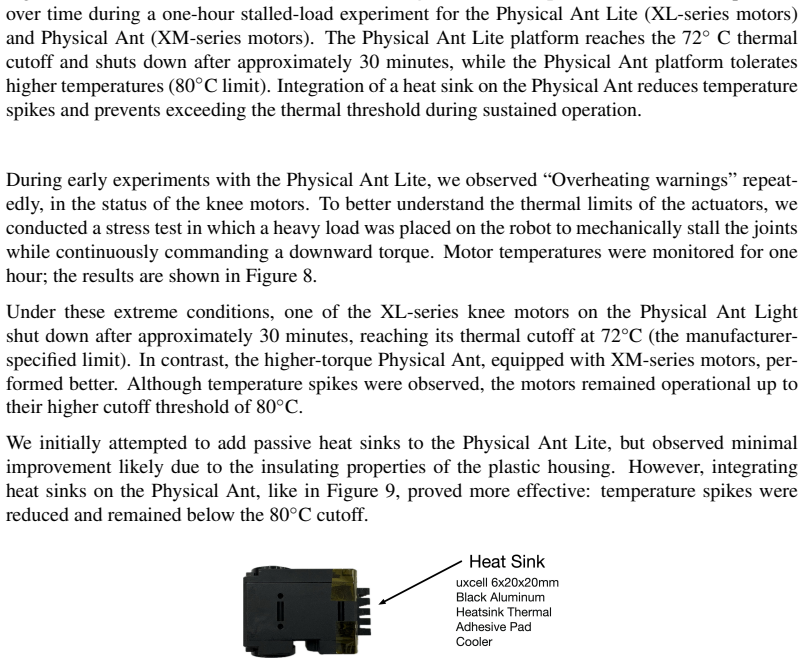
The paper makes no derivation in the sense required for circularity analysis. Its central claims are empirical demonstrations that SARSA(lambda) and SAC can learn walking policies on a physical robot in about one hour, and that some simulated policies transfer to hardware. The reward in Eq. 1 and the performance metric in Eq. 3 do share the same camera-derived position signal, and the paper explicitly notes camera processing latency and timing as open concerns (Section 14). However, this is a measurement-validity issue, not a circular reduction: the reported result is an observed time series of rewards, not a predicted quantity obtained from a fitted parameter that was itself fit to that quantity. The use of the authors' own simulation to tune SAC components is calibration, not circularity; the sim-to-real transfer is an independent, falsifiable test, and the paper reports that rankings changed and that policies can exploit simulator inaccuracies, which is exactly the kind of outcome that would not occur if the transfer claim were true by construction. The one citation to co-authored prior work (De Asis & Sutton 2024) is used to modify the SAC return definition, but the hardware-learning result does not rest on the validity of that modification, and no uniqueness theorem or ansatz is imported via self-citation. No fitted input is renamed as a prediction, and no known result is merely re-labeled. The paper also discloses limitations such as manual resets for cable entanglement, motor overheating, and simulator exploitation, which further supports treating the empirical results as honest demonstrations rather than constructed equivalences. Overall, no step in the paper reduces, by the paper's own equations or by load-bearing self-citation, to its own inputs.
Axiom & Free-Parameter Ledger
free parameters (4)
- SAC reward scaling factor =
100.0
- SARSA(λ) hyperparameter set =
δt=0.5s, λ=0.964, γ=0.998, ε=0.255, α=0.0001, 4 tiles/dim, 192 tilings, table size 225
- SAC learning-start and action bounds =
learning start 2000 steps; knee 20° range at 50° offset; hip 45° range at 0° offset
- Simulator system-ID parameters (Kv, time constant, solref/solimp) =
Kv=2.5 (XL430), 1.5 (XM430); 0.12s motor time constant; adjusted solver parameters
axioms (4)
- standard math SARSA(λ) and SAC behave as described in the cited literature and converge in this setting (Sutton & Barto 2018; Haarnoja et al. 2018)
- domain assumption The MuJoCo simulation with identified parameters adequately models the Physical Ant's dynamics for policy transfer
- domain assumption The overhead AprilTag tracking yields accurate position p_t at the control rate for the reward in Equation 1
- domain assumption Manual interventions (pausing, untangling, resetting to start) do not provide a learning signal
Cite this review
Pith. "Pith review of The Open Ant: A Robot Platform for Reinforcement Learning Research." pith.science (2026). https://pith.science/paper/JSMDA3SZ
@misc{pith2026260718488,
  author       = {Pith},
  title        = {Pith review of: The Open Ant: A Robot Platform for Reinforcement Learning Research},
  year         = {2026},
  howpublished = {\url{https://pith.science/paper/JSMDA3SZ}},
  note         = {Machine review of arXiv:2607.18488}
}
read the original abstract
Reinforcement learning (RL) research has demonstrated success in both physical and simulated domains; however, the predominant methodology remains rooted in simulations. The predominance of simulations makes translating research to physical reality uncertain for both algorithms and researchers. We propose a physical platform that is designed to simplify the transition. In this paper, we present the Open Ant: a physical variant of the commonly used Gymnasium Ant environment, along with a simulation. We demonstrate that competent walking policies can be learned from scratch in approximately one hour directly from the physical robot's experience for two substantially different RL algorithms: SARSA($\lambda$) and Soft Actor-Critic (SAC). Separately, we show policies that were learned in simulation transfer to reality. We also examine how well the platform supports a nimble experimental ecosystem. Specifically, we observe the speed with which new users from diverse backgrounds achieve their first success with the platform, and how easily the platform can be repaired and updated when hardware issues arise. Both the hardware design and software are available as open-source on GitHub for ease of customization. In summary, we advocate for the use of the Open Ant for RL researchers who frequently use simulated environments, so they can more easily include robot experiments in their evaluations.
Figures




Reference graph
Works this paper leans on
-
[1]
2018 , publisher=
Reinforcement Learning: An Introduction , author=. 2018 , publisher=
2018
-
[2]
Temporal difference learning and
Tesauro, Gerald , journal=. Temporal difference learning and
-
[3]
Nature , volume=
Magnetic control of tokamak plasmas through deep reinforcement learning , author=. Nature , volume=. 2022 , publisher=
2022
-
[4]
LeCun, Yan , title =
-
[5]
, title =
Sutton, Richard S. , title =
-
[6]
and Naddaf, Yavar and Veness, Joel and Bowling, Michael , journal=
Bellemare, Marc G. and Naddaf, Yavar and Veness, Joel and Bowling, Michael , journal=. The
-
[7]
Mastering the game of
Silver, David and others , journal=. Mastering the game of. 2016 , publisher=
2016
-
[8]
2025 , eprint=
Gymnasium: A Standard Interface for Reinforcement Learning Environments , author=. 2025 , eprint=
2025
-
[9]
Nature , volume=
Autonomous navigation of stratospheric balloons using reinforcement learning , author=. Nature , volume=. 2020 , publisher=
2020
-
[10]
and Bellemare, Marc G
Machado, Marlos C. and Bellemare, Marc G. and Talvitie, Erik and Veness, Joel and Hausknecht, Matthew and Bowling, Michael , journal=. Revisiting the
-
[11]
Brockman, Greg and Cheung, Vicki and Pettersson, Ludwig and Schneider, Jonas and Schulman, John and Tang, Jie and Zaremba, Wojciech , journal=
-
[12]
and Sutton, Richard S
Barto, Andrew G. and Sutton, Richard S. and Anderson, Charles W. , journal=. Neuronlike adaptive elements that can solve difficult learning control problems , year=
-
[13]
Journal of Neuroscience , volume=
A framework for mesencephalic dopamine systems based on predictive Hebbian learning , author=. Journal of Neuroscience , volume=. 1996 , publisher=
1996
-
[14]
Science , volume=
A neural substrate of prediction and reward , author=. Science , volume=. 1997 , publisher=
1997
-
[15]
and Adams, James L
Houk, James C. and Adams, James L. and Barto, Andrew G. , title =
-
[16]
AAAI , pages=
Machine learning for fast quadrupedal locomotion , author=. AAAI , pages=
-
[17]
Sebastian , booktitle=
Tedrake, Russ and Zhang, Teresa Weirui and Seung, H. Sebastian , booktitle=. Stochastic policy gradient reinforcement learning on a simple 3. 2004 , volume=
2004
-
[18]
Todorov, Emanuel and Erez, Tom and Tassa, Yuval , booktitle=
-
[19]
Conference on Robot Learning , pages=
Daydreamer: World models for physical robot learning , author=. Conference on Robot Learning , pages=
-
[20]
Tassa, Yuval and others , journal=. Deep
-
[21]
and others , journal=
Wurman, Peter R. and others , journal=. Outracing champion. 2022 , publisher=
2022
-
[22]
The 10th International Conference on Autonomous Agents and Multiagent Systems-Volume 2 , pages=
Horde: A scalable real-time architecture for learning knowledge from unsupervised sensorimotor interaction , author=. The 10th International Conference on Autonomous Agents and Multiagent Systems-Volume 2 , pages=
-
[23]
, booktitle=
Deisenroth, Marc and Rasmussen, Carl E. , booktitle=
-
[24]
Martin, John and Wang, Jinkun and Englot, Brendan , booktitle=. Sparse
-
[25]
The International Journal of Robotics Research , volume=
Reinforcement learning in robotics: A survey , author=. The International Journal of Robotics Research , volume=. 2013 , publisher=
2013
-
[26]
arXiv preprint arXiv:2110.15245 , year=
From machine learning to robotics: Challenges and opportunities for embodied intelligence , author=. arXiv preprint arXiv:2110.15245 , year=
-
[27]
International Conference on Machine Learning , pages=
Settling the reward hypothesis , author=. International Conference on Machine Learning , pages=. 2023 , organization=
2023
-
[28]
Brush-Type
General Dynamics , howpublished =. Brush-Type. 2020 , url =
2020
-
[29]
An application of
Abbeel, Pieter and Coates, Adam and Quigley, Morgan and Ng, Andrew , journal=. An application of
-
[30]
Proceedings 2001 ICRA
Autonomous helicopter control using reinforcement learning policy search methods , author=. Proceedings 2001 ICRA. IEEE International Conference on Robotics and Automation (Cat. No. 01CH37164) , volume=. 2001 , organization=
2001
-
[31]
, journal=
Eysenbach, Ben and Levine, Sergey and Salakhutdinov, Russ R. , journal=. Replacing rewards with examples:
-
[32]
2019 , journal=
Striving for simplicity in off-policy deep reinforcement learning , author=. 2019 , journal=
2019
-
[33]
International conference on machine learning , pages=
Off-policy deep reinforcement learning without exploration , author=. International conference on machine learning , pages=. 2019 , organization=
2019
-
[34]
and Silver, David , year=
Sutton, Richard S. and Silver, David , year=. Welcome to the
-
[35]
2017 IEEE/RSJ International Conference on Intelligent Robots and Systems , pages=
Domain randomization for transferring deep neural networks from simulation to the real world , author=. 2017 IEEE/RSJ International Conference on Intelligent Robots and Systems , pages=
2017
-
[36]
Richard S. Sutton and Marlos C. Machado and G. Zacharias Holland and David Szepesvari and Finbarr Timbers and Brian Tanner and Adam White , keywords =. Reward-respecting subtasks for. Artificial Intelligence , volume =. 2023 , issn =. doi:https://doi.org/10.1016/j.artint.2023.104001 , url =
arXiv 2023
-
[37]
International Conference on Robotics and Automation , pages=
Reinforcement learning for robust parameterized locomotion control of bipedal robots , author=. International Conference on Robotics and Automation , pages=
-
[38]
Blind Bipedal Stair Traversal via Sim-to-Real Reinforcement Learning , doi =
Siekmann, Jonah and Green, Kevin and Warila, John and Fern, Alan and Hurst, Jonathan , year =. Blind Bipedal Stair Traversal via Sim-to-Real Reinforcement Learning , doi =
-
[39]
David Hoeller and Nikita Rudin and Dhionis Sako and Marco Hutter , title =. Science Robotics , volume =. 2024 , doi =. https://www.science.org/doi/pdf/10.1126/scirobotics.adi7566 , abstract =
-
[40]
Journal of Machine Learning Research , year =
Shengyi Huang and others , title =. Journal of Machine Learning Research , year =
-
[41]
Achiam, Joshua , title =
-
[42]
Tuomas Haarnoja and Aurick Zhou and Pieter Abbeel and Sergey Levine , title =. CoRR , volume =. 2018 , url =. 1801.01290 , timestamp =
Pith/arXiv arXiv 2018
-
[43]
and Li, Weiping , year =
Slotine, Jean-Jacques E. and Li, Weiping , year =. Applied nonlinear control , isbn =
-
[44]
1996 , publisher=
Robust adaptive control , author=. 1996 , publisher=
1996
-
[45]
1995 , publisher=
Nonlinear and adaptive control design , author=. 1995 , publisher=
1995
-
[46]
2012 , publisher=
Stable adaptive systems , author=. 2012 , publisher=
2012
-
[47]
and Alindogan, Jedidiah and Anderson, Matthew and Chung, Soon-Jo , journal=
Lupu, Elena Sorina and Xie, Fengze and Preiss, James A. and Alindogan, Jedidiah and Anderson, Matthew and Chung, Soon-Jo , journal=. MAGIC-VFM -. 2025 , volume=
2025
-
[48]
doi:10.1126/scirobotics.abm6597 , url =
Michael O'Connell and others , title =. doi:10.1126/scirobotics.abm6597 , url =
-
[49]
2022 , eprint=
A Walk in the Park: Learning to Walk in 20 Minutes With Model-Free Reinforcement Learning , author=. 2022 , eprint=
2022
-
[50]
Rinu Boney and Jussi Sainio and Mikko Kaivola and Arno Solin and Juho Kannala , title =. 2020 , url =. 2011.03085 , timestamp =
Pith/arXiv arXiv 2020
-
[51]
Nature Machine Intelligence , volume=
Maximum diffusion reinforcement learning , author=. Nature Machine Intelligence , volume=. 2024 , publisher=
2024
-
[52]
2025 , month =
De Asis, Kris , title =. 2025 , month =
2025
-
[53]
Policy gradient reinforcement learning for fast quadrupedal locomotion , year=
Kohl, Nate and Stone, Peter , booktitle=. Policy gradient reinforcement learning for fast quadrupedal locomotion , year=
-
[54]
Nature , volume =
Robots that can adapt like animals , author =. Nature , volume =. 2015 , doi =
2015
-
[55]
Jordan and Pieter Abbeel , journal=
John Schulman and Philipp Moritz and Sergey Levine and Michael I. Jordan and Pieter Abbeel , journal=. High-Dimensional Continuous Control Using. 2015 , volume=
2015
-
[56]
Gavin Adrian Rummery and Mahesan Niranjan , year=. On-line
-
[57]
Sutton and Doina Precup and Satinder Singh , keywords =
Richard S. Sutton and Doina Precup and Satinder Singh , keywords =. Between. Artificial Intelligence , volume =. 1999 , issn =. doi:https://doi.org/10.1016/S0004-3702(99)00052-1 , url =
-
[58]
Nicklas Hansen and Hao Su and Xiaolong Wang , booktitle=
-
[59]
Temporal Difference Learning for
Nicklas Hansen and Xiaolong Wang and Hao Su , booktitle=. Temporal Difference Learning for
-
[60]
Wu, Philipp and Escontrela, Alejandro and Hafner, Danijar and Goldberg, Ken and Abbeel, Pieter , journal=
-
[61]
2024 , howpublished =
Leslie Kaelbling , title =. 2024 , howpublished =
2024
-
[62]
and Honig, Wolfgang and Sukhatme, Gaurav S
Preiss, James A. and Honig, Wolfgang and Sukhatme, Gaurav S. and Ayanian, Nora , booktitle=. Crazyswarm: A large nano-quadcopter swarm , year=
-
[63]
2025 , eprint=
Fast Non-Episodic Adaptive Tuning of Robot Controllers with Online Policy Optimization , author=. 2025 , eprint=
2025
-
[64]
2016 , eprint=
Layer Normalization , author=. 2016 , eprint=
2016
-
[65]
Science Robotics , volume =
Steven Macenski and Tully Foote and Brian Gerkey and Chris Lalancette and William Woodall , title =. Science Robotics , volume =. 2022 , doi =
2022
-
[66]
The MNIST Database of Handwritten Digit Images for Machine Learning Research [Best of the Web] , year=
Deng, Li , journal=. The MNIST Database of Handwritten Digit Images for Machine Learning Research [Best of the Web] , year=
-
[67]
Proceedings of the 25th ACM SIGKDD International Conference on Knowledge Discovery & Data Mining , pages =
Akiba, Takuya and Sano, Shotaro and Yanase, Toshihiko and Ohta, Takeru and Koyama, Masanori , title =. Proceedings of the 25th ACM SIGKDD International Conference on Knowledge Discovery & Data Mining , pages =. 2019 , doi =
2019
-
[68]
Olson, Edwin , booktitle=. April. 2011 , volume=
2011
-
[69]
2018 , eprint=
Setting up a Reinforcement Learning Task with a Real-World Robot , author=. 2018 , eprint=
2018
-
[70]
Rupam Mahmood and Dmytro Korenkevych and Gautham Vasan and William Ma and James Bergstra , title =
A. Rupam Mahmood and Dmytro Korenkevych and Gautham Vasan and William Ma and James Bergstra , title =. CoRR , volume =. 2018 , url =. 1809.07731 , timestamp =
Pith/arXiv arXiv 2018
-
[71]
Learning From Delayed Rewards , url =
Watkins, Christopher , year =. Learning From Delayed Rewards , url =
-
[72]
2024 , eprint=
Streaming Deep Reinforcement Learning Finally Works , author=. 2024 , eprint=
2024
-
[73]
Sutton , title =
Richard S. Sutton , title =. 2025 , howpublished =
2025
-
[74]
2025 , howpublished =
Leslie Kaelbling , title =. 2025 , howpublished =
2025
-
[75]
Action Space Design in Reinforcement Learning for Robot Motor Skills , booktitle =
Julian E. Action Space Design in Reinforcement Learning for Robot Motor Skills , booktitle =. 2024 , publisher =
2024
-
[76]
Co-Reyes and Suvansh Sanjeev and Glen Berseth and Abhishek Gupta and Sergey Levine , title =
John D. Co-Reyes and Suvansh Sanjeev and Glen Berseth and Abhishek Gupta and Sergey Levine , title =. arXiv preprint arXiv:2006.12478 , year =
Pith/arXiv arXiv 2006
-
[77]
Allen and Josh Tenenbaum and Leslie Pack Kaelbling , title =
Tom Silver and Kelsey R. Allen and Josh Tenenbaum and Leslie Pack Kaelbling , title =. CoRR , volume =. 2018 , url =. 1812.06298 , timestamp =
Pith/arXiv arXiv 2018
-
[78]
Transactions of the ASME Journal of Dynamic Systems , url =
James Albus , title =. Transactions of the ASME Journal of Dynamic Systems , url =. 1975 , month =
1975
-
[79]
Generalization in Reinforcement Learning: Successful Examples Using Sparse Coarse Coding , url =
Sutton, Richard S , booktitle =. Generalization in Reinforcement Learning: Successful Examples Using Sparse Coarse Coding , url =
-
[80]
Joshua Tobin and Rachel Fong and Alex Ray and Jonas Schneider and Wojciech Zaremba and Pieter Abbeel , title =. CoRR , volume =. 2017 , url =. 1703.06907 , timestamp =
Pith/arXiv arXiv 2017
discussion (0)
Sign in with ORCID, Apple, or X to comment. Anyone can read and Pith papers without signing in.