REVIEW 3 major objections 2 minor 68 references
Reviewed by Pith at T0; open to challenge.
T0 means a machine referee read the full paper against a public rubric. The mark states how deep the mechanical check went, never who wrote it. the ladder, T0–T4 →
T0 review · grok-4.3
In 229Th ions the electron shell and nuclear states exchange energy coherently over long times without exact resonance, enabling a nuclear quantum battery under laser drive.
2026-07-02 04:50 UTC pith:JT6SNYL3
load-bearing objection The paper frames 229Th ions as a nuclear quantum battery via off-resonant coherent electron bridge but supplies no calculation showing the coupling overcomes detuning and damping. the 3 major comments →
Long Time Energy Oscillation Between Electron Shell and Nucleus in ²²⁹Th Ions and Coherent Electron Bridge for Nuclear Quantum Battery
The pith
A machine-rendered reading of the paper's core claim, the machinery that carries it, and where it could break.
Core claim
In 229Th ions the electron shell with its M1 transition at 8.4 eV and the nuclear ground-state doublet form spatially nested qubits. Relative proximity of the transition energies together with the sizable interaction between electron and nuclear currents produces weakly damped oscillations in which excitation energy moves repeatedly from shell to nucleus and back. The shell therefore breathes in size periodically. The same mechanism extends the usable energy window for isomer excitation via the electron bridge and, under coherent laser illumination, converts the ion into a nuclear quantum battery that can be charged by first driving the shell and then transferring the energy coherently to th
What carries the argument
Coherent energy oscillation between the electron-shell qubit and the nuclear qubit, driven by their mutual current interaction without requiring resonance within level widths.
Load-bearing premise
The energies of the electron-shell and nuclear transitions are close enough and their interaction strong enough for weakly damped oscillations without exact resonance.
What would settle it
Absence of periodic modulation in scattered-light intensity from trapped 229Th ions at the frequency set by the energy difference between the two transitions would falsify the long-time oscillation prediction.
If this is right
- The energy range for 229mTh isomer excitation via the electron bridge is extended beyond exact resonance.
- Exposure to coherent laser radiation turns the ion into a nuclear quantum battery.
- The battery is charged by coherent excitation of the electron shell followed by coherent transfer of energy to the nucleus.
- The breathing of the electron shell produces observable changes in scattered-light intensity inside an ion trap.
Where Pith is reading between the lines
- Varying laser frequency or intensity could map how the effective coupling strength depends on detuning from the shell transition.
- The oscillation period itself offers a direct readout of the shell-nucleus interaction energy in a single trapped ion.
- Similar nested-qubit behavior might appear in other ions where an atomic transition lies near a low-energy nuclear transition.
Editorial analysis
A structured set of objections, weighed in public.
Referee Report
Summary. The manuscript claims that in ^{229}Th ions the 8.4 eV M1 electron-shell transition and the nuclear ground-state doublet transition, being energetically proximate, permit weakly damped coherent energy oscillations (multiple transfers) between the electron shell and nucleus without requiring resonance within the level widths, owing to a relatively high electron-nuclear current interaction. This extends the usable energy range for ^{229m}Th(3/2^+, 8.4 eV) isomer excitation via an electron bridge. The system is further proposed to function as a nuclear quantum battery when driven by coherent laser radiation, charged by coherent electron-shell excitation followed by coherent transfer to the nucleus; the effect is said to be observable via scattered light intensity in an ion trap.
Significance. If the central claims were quantitatively substantiated, the work would extend the parameter space for nuclear-isomer excitation and introduce a nuclear-scale quantum battery concept accessible with current laser technology. No such substantiation (matrix elements, coupling-to-detuning ratios, or efficiency estimates) is supplied, so the potential significance remains speculative and cannot be evaluated against existing electron-bridge or quantum-battery literature.
major comments (3)
- [Abstract] Abstract: the assertion that oscillations occur 'due to the relatively high interaction energy of the electron and nuclear currents' and 'does not require resonant coincidence within the width of the levels' is unsupported; no matrix element, no comparison of interaction strength V to detuning Δ or widths Γ_e, Γ_n, and no estimate of the resulting Rabi period or damping are provided.
- [Abstract] The manuscript supplies neither rate equations nor a master-equation treatment that would demonstrate weakly damped, multi-cycle coherent transfer; consequently the transformation into a 'nuclear quantum battery' and the charging protocol via coherent electron bridge rest on unquantified assumptions.
- [Abstract] No numerical estimate or derivation of the electron-nuclear coupling (e.g., M1-M1 magnetic interaction via electron density at the nucleus) is given, leaving the claim that the interaction is 'relatively high' and sufficient for off-resonant oscillations unverifiable.
minor comments (2)
- [Abstract] The term 'nuclear quantum battery' is introduced without reference to the existing quantum-battery literature, which may confuse readers.
- [Abstract] Notation for the nuclear state (^{229m}Th(3/2^+,8.4 eV)) is used without defining the isomer energy or confirming consistency with accepted values.
Simulated Author's Rebuttal
We thank the referee for the careful review and constructive criticism. We address each major comment below, agreeing that quantitative support is currently lacking and outlining revisions to provide it.
read point-by-point responses
-
Referee: [Abstract] Abstract: the assertion that oscillations occur 'due to the relatively high interaction energy of the electron and nuclear currents' and 'does not require resonant coincidence within the width of the levels' is unsupported; no matrix element, no comparison of interaction strength V to detuning Δ or widths Γ_e, Γ_n, and no estimate of the resulting Rabi period or damping are provided.
Authors: We acknowledge that the current manuscript, as a concise conceptual proposal, does not supply explicit matrix elements or comparisons of V to Δ and the widths. In the revised version we will add order-of-magnitude estimates of the M1-M1 coupling derived from the nuclear magnetic moment and the electron probability density at the nucleus, together with a comparison showing that multiple coherent cycles remain possible for detunings several times larger than the level widths. revision: yes
-
Referee: [Abstract] The manuscript supplies neither rate equations nor a master-equation treatment that would demonstrate weakly damped, multi-cycle coherent transfer; consequently the transformation into a 'nuclear quantum battery' and the charging protocol via coherent electron bridge rest on unquantified assumptions.
Authors: We agree that a dynamical treatment is needed to substantiate the claims. The revised manuscript will include a simple coherent two-qubit model (electron shell and nuclear states) under the interaction Hamiltonian, with estimates of the Rabi period and damping from spontaneous emission, thereby supporting the proposed charging protocol for the nuclear quantum battery. revision: yes
-
Referee: [Abstract] No numerical estimate or derivation of the electron-nuclear coupling (e.g., M1-M1 magnetic interaction via electron density at the nucleus) is given, leaving the claim that the interaction is 'relatively high' and sufficient for off-resonant oscillations unverifiable.
Authors: This overlaps with the first comment. We will add a brief derivation and numerical estimate of the coupling strength in the revision, showing that the interaction is large enough relative to the energy mismatch in 229Th to permit the off-resonant oscillations described. revision: yes
Circularity Check
No circularity; conceptual proposal without load-bearing derivation chain
full rationale
The visible text consists of qualitative assertions about energy oscillations enabled by 'relatively high interaction energy' between electron and nuclear currents, without any equations, fitted parameters, or explicit derivations. No self-citations, ansatzes, or uniqueness theorems are invoked in a load-bearing way. The central claims (weakly damped oscillations without resonance, coherent electron bridge for nuclear quantum battery) are presented as physical consequences of known level proximity rather than results derived from the paper's own inputs. This matches the default case of a self-contained conceptual suggestion with no reduction of predictions to fitted quantities or self-referential steps.
Axiom & Free-Parameter Ledger
free parameters (1)
- energy detuning between electron and nuclear transitions
axioms (1)
- domain assumption Quantum mechanics permits coherent energy exchange between electron currents and nuclear currents when transition energies are proximate
invented entities (1)
-
nuclear quantum battery
no independent evidence
read the original abstract
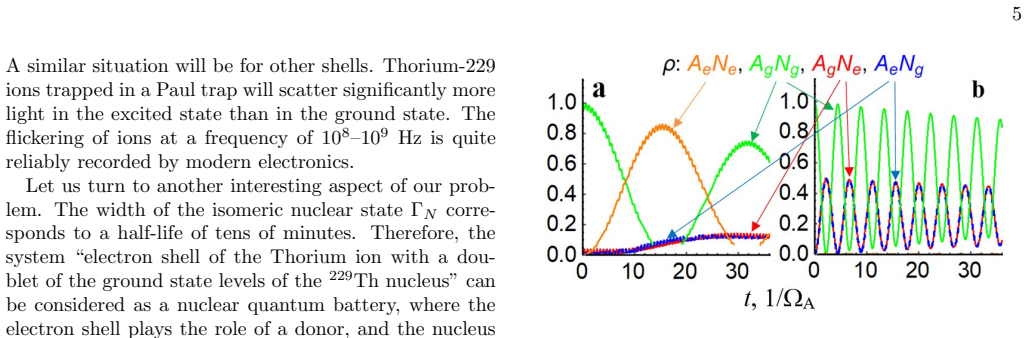
The electron shell of the Thorium ion with the $M$1(8.4~eV) transition between levels and the doublet of the $^{229}$Th nucleus ground state with the similar transition represent two qubits spatially inserted one within the other. In the case of relative proximity of the energies of these transitions, weakly damped energy oscillations can be excited between qubits, namely, multiple coherent energy transfer from the electron shell to the nucleus and vice versa. This process in the $^{229}$Th ions does not require resonant (within the width of the levels) coincidence of the transition energies due to the relatively high interaction energy of the electron and nuclear currents. The electron shell ``breathes'', periodically decreasing and increasing in size. The effect can be observed in an ion trap by the intensity of light scattered by thorium-229 ions. This extends the energy range for the $^{229m}$Th$(3/2^+,8.4$~eV) isomer excitation via an electron bridge. Furthermore, the system under consideration is transformed into a nuclear quantum battery when exposed to coherent laser radiation. To ``charge'' the battery, i.e. to excite $^{229m}$Th, one can use developed methods for charging quantum batteries, in particular, coherent excitation of the electron shell followed by coherent transfer of excitation energy to the nucleus (the coherent electron bridge). This opens the way for the design of the $^{229}$Th nuclear quantum battery at the current level of technological development.
Figures


Reference graph
Works this paper leans on
-
[1]
This value of the matrix element can be considered reliable: similar calculations reproduces the experimen- tal data on the probability of internal electron conversion for the isomer 229mTh [58, 59]. Thus, the coherent part of the interaction energyg AN =ℜ[E int]≃10 −6 eV, that is, the same order of magnitude as in the Th 39+ ion. The incoherent part of t...
-
[2]
L. A. Kroger and C. W. Reich, Features of the low-energy level scheme of 229Th as observed in theα-decay of 233U., Nucl. Phys. A259, 29 (1976)
work page 1976
-
[3]
C. W. Reich and R. G. Helmer, Energy separation of the doublet of intrinsic states at the ground state of 229Th, Phys. Rev. Lett.64, 271 (1990)
work page 1990
-
[4]
R. G. Helmer and C. W. Reich, An excited state of 229Th at 3.5 eV, Phys. Rev. C49, 1845 (1994)
work page 1994
-
[5]
B. R. Beck, J. A. Becker, P. Beiersdorfer, G. V. Brown, K. J. Moody, J. B. Wilhelmy, F. S. Porter, C. A. Kil- bourne, and R. L. Kelley, Energy splitting of the ground- state doublet in the nucleus 229Th, Phys. Rev. Lett.98, 142501 (2007)
work page 2007
-
[6]
B. Seiferle, L. von der Wense, P. V. Bilous, I. Amersdorf- fer, C. Lemell, F. Libisch, S. Stellmer, T. Schumm, C. E. Dullmann, A. Palffy, and P. G. Thirolf, Energy of the 229Th nuclear clock transition, Nature573, 243 (2019)
work page 2019
-
[7]
S. Kraemer, J. Moens, M. Athanasakis-Kaklamanakis, S. Bara, K. Beeks, P. Chhetri, K. Chrysalidis, A. Claessens, T. E. Cocolios, J. G. M. Correia, H. D. Witte, R. Ferrer, S. Geldhof, R. Heinke, N. Hosseini, M. Huyse, U. Koster, Y. Kudryavtsev, M. Laatiaoui, R. Lica, G. Magchiels, V. Manea, C. Merckling, L. M. C. Pereira, S. Raeder, T. Schumm, S. Sels, P. G...
work page 2023
-
[8]
J. Tiedau, M. Okhapkin, K. Zhang, J. Thielk- ing, G. Zitzer, E. Peik, F. Schaden, T. Proneb- ner, I. Morawetz, L. Col, F. Schneider, A. Leitner, M. Pressler, G. Kazakov, K. Beeks, T. Sikorsky, and T. Schumm, Laser excitation of the th-229 nucleus, Phys. Rev. Lett.132, 182501 (2024)
work page 2024
- [9]
-
[10]
A. Yamaguchi, Y. Shigekawa, H. Haba, H. Kikunaga, K. Shirasaki, M. Wada, and H. Katori, Laser spec- troscopy of triply charged 229Th isomer for a nuclear clock, Nature.629, 62 (2024)
work page 2024
- [11]
- [12]
-
[13]
E. V. Tkalya, Spontaneous emission probability forM1 transition in a dielectric medium: 229mTh (3/2+,3.5±1.0 eV) decay, JETP Lett.71, 311 (2000)
work page 2000
-
[14]
E. V. Tkalya, A. N. Zherikhin, and V. I. Zhudov, Decay of the low-energy nuclear isomer 229mTh (3/2+,3.5±1.0 eV) in solids, dielectrics and metals: A new scheme of experimental research, Phys. Rev. C61, 064308 (2000)
work page 2000
-
[15]
E. V. Tkalya, V. O. Varlamov, V. V. Lomonosov, and S. A. Nikulin, Processes of the nuclear isomer 229mTh (3/2+,3.5±1.0 eV) resonant excitation by optical pho- tons, Phys. Scr.53, 296 (1996)
work page 1996
-
[16]
E. Peik and C. Tamm, Nuclear laser spectroscopy of the 3.5 eV transition in Th-229, Europhys. Lett.61, 181 (2003)
work page 2003
-
[17]
W. G. Rellergert, D. DeMille, R. R. Greco, M. P. Hehlen, J. R. Torgerson, and E. R. Hudson, Constraining the evo- lution of the fundamental constants with a solid-state optical frequency reference based on the 229Th nucleus, Phys. Rev. Lett.104, 200802 (2010)
work page 2010
-
[18]
C. J. Campbell, A. G. Radnaev, A. Kuzmich, V. A. Dzuba, V. V. Flambaum, and A. Derevianko, Single-ion nuclear clock for metrology at the 19th decimal place, Phys. Rev. Lett.108, 120802 (2012)
work page 2012
-
[19]
E. Peik and M. Okhapkin, Nuclear clocks based on res- onant excitation ofγ-transitions, C. R. Phys.16, 516 (2015)
work page 2015
- [20]
-
[21]
E. V. Tkalya, Proposal for a nuclear gamma-ray laser of optical range, Phys. Rev. Lett.106, 162501 (2011)
work page 2011
-
[22]
E. V. Tkalya and L. P. Yatsenko, Creation of inverse population in the 229Th ground-state doublet by means of 7 a narrowband laser, Laser Phys. Lett.10, 105808 (2013)
work page 2013
-
[23]
V. V. Flambaum, Enhanced effect of temporal variation of the fine structure constant and the strong interaction in 229Th, Phys. Rev. Lett.97, 092502 (2006)
work page 2006
-
[24]
E. Litvinova, H. Feldmeier, J. Dobaczewski, and V. Flam- baum, Nuclear structure of lowest 229Th states and time- dependent fundamental constants, Phys. Rev. C79, 064303 (2009)
work page 2009
-
[25]
J. C. Berengut, V. A. Dzuba, V. V. Flambaum, and S. G. Porsev, Phys. Rev. Lett.102, 210801 (2009)
work page 2009
-
[26]
M. S. Safronova, D. Budker, D. DeMille, D. F. J. Kimball, A. Derevianko, and C. W. Clark, Search for new physics with atoms and molecules, Rev. Mod. Phys.90, 025008 (2018)
work page 2018
-
[27]
E. Peik, T. Schumm, M. Safronova, A. Palffy, J. Weiten- berg, and P. G. Thirolf, Nuclear clocks for testing funda- mental physics, Quantum Sci. Technol.6, 034002 (2021)
work page 2021
-
[28]
A. M. Dykhne, N. V. Eremin, and E. V. Tkalya, Alpha decay of the first excited state of the Th-229 nucleus, JETP Lett.64, 345 (1996)
work page 1996
-
[29]
K. Pachucki, S. Wycech, J. Zylicz, and M. Pfutzner, Nuclear-spin mixing oscillations in 229Th89+, Phys. Rev. C64, 064301 (2001)
work page 2001
-
[30]
E. V. Tkalya, Anomalous magnetic hyperfine structure of the 229Th ground-state doublet in muonic atoms, Phys. Rev. A94, 012510 (2016)
work page 2016
-
[31]
E. V. Tkalya, Decay rate of the nuclear isomer 229Th (3/2+,7.8 eV) in a dielectric sphere, thin film, and metal cavity, Phys. Rev. Lett.120, 122501 (2018)
work page 2018
-
[32]
E. V. Tkalya, Theory of the nuclear excitation by electron transition process near the K edge, Phys. Rev. A75, 022509 (2007)
work page 2007
-
[33]
M. Morita, Nuclear excitation by electron transition and its application to Uranium 235 separation, Progr. Theor. Phys.49, 1574 (1973)
work page 1973
-
[34]
E. V. Tkalya, Accelerated decay of nuclear isomers during atomic-shell ionization, JETP Lett.60, 627 (1994)
work page 1994
-
[35]
V. A. Dzuba and V. V. Flambaum, Resonance nuclear excitation of the 229Th nucleus via electronic bridge pro- cess in Th II , Phys. Rev. A111, L041103 (2025)
work page 2025
-
[36]
V. A. Dzuba and V. V. Flambaum, Using the Th III ion for a nuclear clock and searches for new physics, Phys. Rev. A111, 053109 (2025)
work page 2025
-
[37]
S. Yu, X. Hua, X. Tong, C. Li, and S. Lei, Highly charged 229Th6+ ions as the candidate platform for nuclear clock, Chin. Phys. Lett.42, 120302 (2025)
work page 2025
-
[38]
K. Koziol and J. Rzadkiewicz, Nuclear excitation by near-resonant electron transition in 229Th39+ ions, Phys. Rev. C111, 064302 (2025)
work page 2025
-
[39]
E. V. Tkalya, Excitation of low-lying isomer level of the nucleus 229Th by optical photons, JETP Lett.55, 211 (1992)
work page 1992
-
[40]
E. V. Tkalya, Cross section for excitation of the low-lying (<5 eV) 229Th isomer with laser radiation by the inverse electron bridge, Sov. J. Nucl. Phys.55, 1611 (1992)
work page 1992
-
[41]
P. Kalman and T. Keszthelyi, Laser-driven inverse elec- tronic bridge process: An optical tool for determining low-energy separation of nearby nuclear station., Phys. Rev. C49, 324 (1994)
work page 1994
-
[42]
S. G. Porsev, V. V. Flambaum, E. Peik, and C. Tamm, Excitation of the isomeric 229mTh nuclear state via an electronic bridge process in 229Th+, Phys. Rev. Lett. 105, 182501 (2010)
work page 2010
-
[43]
F. F. Karpeshin and M. B. Trzhaskovskaya, Bound in- ternal conversion versus nuclear excitation by electron transition: Revision of the theory of optical pumping of the 229mTh isomer, Phys. Rev. C95, 034310 (2017)
work page 2017
-
[44]
P. V. Bilous, E. Peik, and A. Palffy, Laser-induced elec- tronic bridge for characterization of the 229mTh→229Th nuclear transition with a tunable optical laser, New J. Phys.20, 013016 (2018)
work page 2018
-
[45]
P. V. Borisyuk, N. N. Kolachevsky, A. V. Taichenachev, E. V. Tkalya, I. Y. Tolstikhina, and V. I. Yudin, Exci- tation of the low-energy 229mTh isomer in the electron bridge process via the continuum, Phys. Rev. C100, 044306 (2019)
work page 2019
-
[46]
P. V. Bilous, H. Bekker, J. C. Berengut, B. Seiferle, L. von der Wense, P. G. Thirolf, T. Pfeifer, J. R. C. Lopez-Urrutia, and A. Palffy, Electronic bridge excita- tion in highly charged 229Th ions, Phys. Rev. Lett.124, 192502 (2020)
work page 2020
-
[47]
A. Y. Dzyublik, Excitation of 229mTh in the electron bridge via continuum, as a scattering process, Phys. Rev. C102, 024604 (2020)
work page 2020
-
[48]
Y. Shigekawa, A. Yamaguchi, K. Tokoi, N. Sato, H. Kiku- naga, K. Shirasaki, Y. Kasamatsu, M. Wada, and H. Haba, Lifetime of the singly charged 229Th nuclear isomer, Nat. Phys. https://doi.org/10.1038/s41567-026- 03251-1 (2026)
-
[49]
von der Wense, Thorium-229 lifetime locked down, Nat
L. von der Wense, Thorium-229 lifetime locked down, Nat. Phys. https://doi.org/10.1038/s41567-026-03310-7 (2026)
-
[50]
Z. Ficek and R. Tanas, Entangled states and collective nonclassical effects in two-atom systems, Phys. Rep.372, 369 (2002)
work page 2002
-
[51]
A. Gonzalez-Tudela, D. Martin-Cano, E. Moreno, L. Martin-Moreno, C. Tejedor, and F. Garcia-Vidal, En- tanglement of two qubits mediated by one-dimensional plasmonic waveguides, Phys. Rev. Lett.106, 020501 (2011)
work page 2011
-
[52]
J. Ren, T. Chen, B. Wang, and X. Zhang, Ultrafast coherent energy transfer with high efficiency based on plasmonic nanostructures, J. Chem. Phys.146, 144101 (2017)
work page 2017
-
[53]
L. Novotny and B. Hecht,Principles of Nano-Optics (Cambridge University Press, New York, 2006)
work page 2006
-
[54]
E. V. Tkalya, Nuclear excitation in atomic transitions (NEET process analysis), Nucl. Phys. A539, 209 (1992)
work page 1992
-
[55]
E. V. Tkalya, Probability of nonradiative excitation of nuclei in transitions of an electron in an atomic shell, Sov. Phys. JETP75, 200 (1992)
work page 1992
-
[56]
E. V. Tkalya, Dynamical effect of finite nuclear size in the nuclear excitation process during electron transitions in an atomic shell, JETP78, 239 (1994)
work page 1994
-
[57]
A. Y. Dzyublik, Photo-induced nuclear excitation by electron transition, JETP Lett.93, 489 (2011)
work page 2011
-
[58]
A. Y. Dzyublik, General theory of nuclear excitation by electron transitions, Phys. Rev. C188, 054616 (2013)
work page 2013
-
[59]
V. F. Strizhov and E. V. Tkalya, Decay channel of low- lying isomer state of the 229Th nucleus. possibilities of experimental investigation, Sov. Phys. JETP72, 387 (1991)
work page 1991
-
[60]
B. Seiferle, L. von der Wense, and P. G. Thirolf, Lifetime measurement of the 229Th nuclear isomer, Phys. Rev. Lett.118, 042501 (2017)
work page 2017
-
[61]
G. H. Gossel, V. A. Dzuba, and V. V. Flambaum, Calcu- lation of strongly forbidden M1 transitions and g-factor anomalies in atoms considered for parity-nonconservation 8 measurements, Phys. Rev. A88, 034501 (2013)
work page 2013
-
[62]
I. M. Savukov, A. Derevianko, H. G. Berry, and W. R. Johnson, Large contributions of negative-energy states to forbidden magnetic-dipole transition amplitudes in alkali-metal atoms, Phys. Rev. Lett.83, 2914 (1999)
work page 1999
-
[63]
D. A. Varshalovich, A. N. Moskalev, and V. K. Kher- sonslii,Quantum Theory of Angular Momentum(World Scientific Publ., London, 1988)
work page 1988
- [64]
-
[65]
C. L. Cortes, W. Sun, and Z. Jacob, Fundamental ef- ficiency bound for quantum coherent energy transfer in nanophotonics, Optics Express30, 34725 (2022)
work page 2022
-
[66]
C. A. Downing, E. del Valle, and A. I. Fernandez- Dominguez, Resonance fluorescence of two asymmetri- cally pumped and coupled two-level systems, Phys. Rev. A107, 023717 (2023)
work page 2023
- [67]
-
[68]
L. von der Wense and B. Seiferle, The 229Th isomer: prospects for a nuclear optical clock, Eur. Phys. J. A 56, 277 (2020)
work page 2020
discussion (0)
Sign in with ORCID, Apple, or X to comment. Anyone can read and Pith papers without signing in.