REVIEW 6 major objections 4 minor 36 references
Robust Watermarks Leak: Channel-Aware Feature Extraction Enables Adversarial Watermark Manipulation
T0 review · 6 major / 4 minor · reviewed 2026-08-08 · deepseek-v4-flash
Pith's one-line read Robust watermarks leak: a single image enables removal and forgery
desk verdict A genuinely novel single-image no-box attack with strong empirical results on robust watermarks, but the leakage story is over-sold and the channel-selection mechanism needs a control. read the letter →
The pith
A machine-rendered reading of the paper's core claim, the machinery that carries it, and where it could break.
The reading
What carries the argument
The load-bearing mechanism is channel-aware leakage localization. The watermarked image is passed through DenseNet, a pre-trained convolutional feature extractor; the channel maps are clustered, and the two smallest clusters define a binary mask $W$ that picks out feature channels where watermark patterns concentrate. All attack stages are optimizations on masked features: Eq. 1 minimizes $L(W\cdot F(I_{wm}), W\cdot F(I_{wm}+\delta))$ under an $\ell^\infty$ budget for evasion, Eq. 2 does the same to extract the transferable watermark, and Eq. 3 aligns the non-watermark channels of the forged image with a clean target $I'$ so the transplanted watermark looks semantically natural. The supporting theory views an image's feature space as a direct sum $P_r \oplus P_c$ of watermark-ready and content channels; the encoder implicitly projects embeddings into $P_r$, and robustness beyond the threshold $C(I)$ forces spillover into $P_c$, which is what the mask detects.
What would settle it
Compare the attack's success when the mask $W$ is chosen by the two-smallest-clusters rule against the same optimization with $W$ set to random channel subsets of equal size. If random masks match the clustered mask's success rate, the leakage-localization mechanism is not doing the work. Separately, train a robust watermark whose encoder deliberately spreads the signal evenly over all channels: the claimed localized leakage should disappear and DAPAO's success should drop.
Extended reading notes
Core claim
At its core, the paper claims a robustness–stealthiness trade-off: to stay decodable under JPEG, noise, and screen-shooting distortions, learning-based watermarkers spread or amplify the watermark signal, and the decoder amplifies its attention to that signal. The authors formalize this as pressure on an embedding capacity $C(I)$, the largest watermark-to-image energy ratio that keeps visual quality above a threshold. Once robustness demands exceed $C(I)$, the encoder must carry watermark information in feature channels it would normally leave to image content, creating artifacts and cross-image pattern leakage that a pre-trained network can see. DAPAO exploits this by clustering the channel maps of one watermarked image, selecting the two smallest clusters as the leak-containing mask $W$, and then running Projected Gradient Descent to maximize feature distance on those masked channels. The resulting perturbation both removes the watermark on its own image (evasion) and, combined with a second-stage semantic alignment for strongly content-bound watermarks, transfers the watermark to a clean image (forgery).
Load-bearing premise
The attack's key assumption is that watermark leakage is concentrated in a small, identifiable set of DenseNet feature channels, namely the two smallest clusters of one image's channel maps, and that this set is consistent enough to optimize against.
Editorial extensions
If this is right
- An attacker with no access to the encoder, decoder, or original image can defeat all seven tested post-processing watermarking schemes, including learned ones that survive JPEG, noise, and screen-shooting distortions.
- Watermark removal and watermark forgery become two uses of a single extracted perturbation, so a leaked watermark can be scrubbed from one image and re-embedded on another at essentially the same cost.
- Watermarking schemes that bind the watermark tightly to image semantics, such as in-processing methods like Tree-Ring, are expected to resist this attack, but those schemes cannot watermark existing real-world images.
- Selecting only the two smallest feature clusters, rather than optimizing over all channels, is what preserves image quality; using all channels raises success but collapses SSIM and PSNR.
- Because the attack requires only one image, dynamic or time-varying watermarks that change per image may still be exposed if their leakage is channel-concentrated.
Reading between the lines
- Editorial: If the capacity-based proof is correct, the leakage is a quantitative consequence of pushing robustness past the embeddable threshold, so any future robust watermark will leak at some distortion level; the paper's mask-finding procedure is one practical detector of that leak.
- Editorial: The same channel-clustering signal could be used defensively: measuring how concentrated the leak is across DenseNet channels might serve as a cheap audit that a watermark has crossed its safe embedding capacity.
- Editorial: Stage II suggests a more general transplant attack: if leaked watermark features can be aligned onto arbitrary content, an attacker could forge watermarks across many images from one source image, not just one target.
- Editorial: A natural extension is to test DAPAO with other feature extractors or with multiple leaked images; success there would show the phenomenon is not a quirk of DenseNet channel statistics.
Editorial analysis
A structured set of objections, weighed in public.
Referee Report
Summary. The paper proposes DAPAO, an attack framework against post-processing robust image watermarking schemes. The attack operates in a no-box setting: given a single watermarked image, it uses a pre-trained DenseNet as a feature extractor, clusters the resulting channel maps to identify a small set of feature channels believed to contain watermark leakage, and then optimizes a perturbation on those channels. The same extracted signal is used both to evade watermark detection (by perturbing the watermarked image) and to forge a watermark (by transferring the learned perturbation to a clean image). The authors report high success rates on seven watermarking schemes, including learning-based and classical ones, and claim 60% improvement in evasion success rate and 51% improvement in forgery accuracy over state-of-the-art methods. A theoretical argument in Sec. 4.2 is offered to explain why robust watermarks necessarily leak information.
Significance. If the central claim is correct, the paper identifies a practically relevant vulnerability: robust post-processing watermarks can be removed or forged from a single image without querying the encoder or decoder. The manuscript has real strengths: it evaluates against seven independent watermarking schemes, including robust learning-based methods; the attack success is measured against independently trained decoders, so the main result is not an artifact of fitting to the target model; and the ablation study begins to isolate the role of feature extraction. However, the significance is currently limited by an internally inconsistent theoretical section, an unvalidated and under-specified channel-selection mechanism, and quantitative claims that do not match the reported tables. The core empirical phenomenon may well be real, but the manuscript as written does not yet establish that the proposed channel-selection step is responsible for the attack's success, rather than generic feature-space perturbation.
major comments (6)
- [Sec. 4.2 / Appendix C] The proof of Proposition 4.3 is internally inconsistent. In Definition 4.1, E(I, wm) is defined using phi(I, wm), while phi(I, wm) is defined by minimizing an objective that itself calls E(p, wm); this circularity makes the formal model incoherent. In the main text the capacity condition is written as ϵ||W|| ≤ sqrt((2^{2H(wm)} − 1)δη²), but the correct implication from R ≥ H(wm) is ϵ||W|| ≥ sqrt((2^{2H(wm)} − 1)δη²). The proof in Appendix C derives the inequality in the opposite direction from the main text. Because Proposition 4.3 is the stated theoretical basis for the robustness–stealthiness paradox, this section must be corrected, or the proposition should be explicitly labeled as a heuristic rather than a proof.
- [Sec. 4.3 / Algorithm 1] The channel-selection mechanism is load-bearing but under-specified and unvalidated. The text says the method selects 'the two clusters with the smallest number of samples,' whereas Algorithm 1 says 'find the k clusters,' and neither k, the clustering algorithm, the DenseNet layer used, nor the number of selected channels is reported anywhere in the paper. More importantly, there is no ablation comparing W to a random subset of channels of equal size, no variation of k or of the clustering algorithm, and no analysis of whether the selected channel positions are stable across different images watermarked by the same scheme. Because W is computed per image from the attacked image itself, it may be dominated by content-dependent outlier channels rather than watermark leakage. Without such controls, the claim that watermark information 'leaks' specifically into a small identifiable channel subset is not established; the visual-fidelity improvement in Table 4 could equally come from perturbing a small number of arbitrary channels.
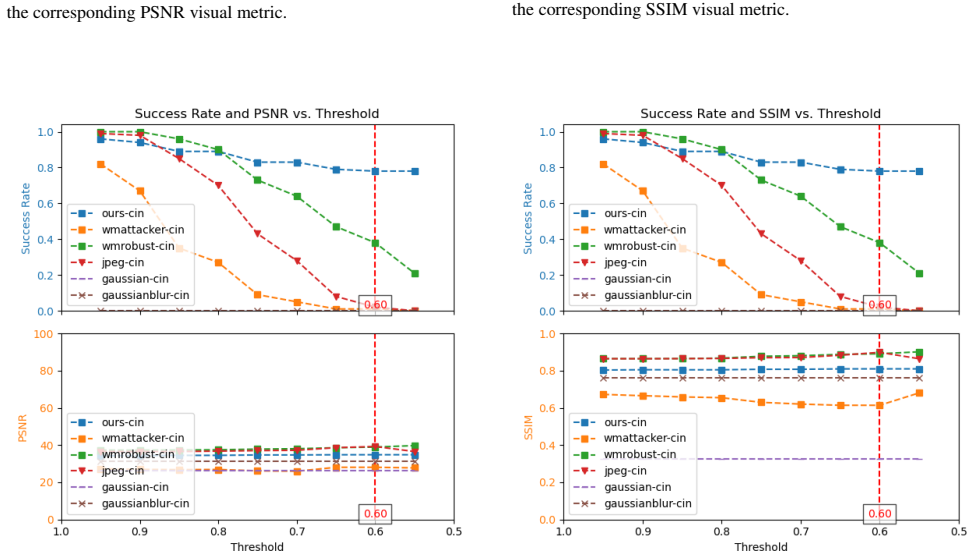
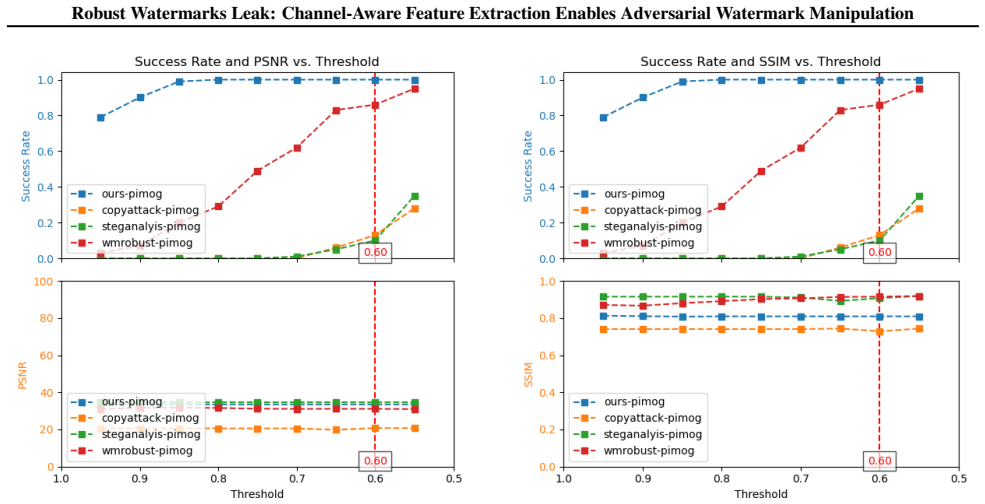
- [Sec. 5.2 / Tables 1–3] The headline performance gains do not match the reported tables. In Table 1, the average absolute improvement over the best baseline success rate per scheme is about 0.49 on COCO, not 0.60, and for DwtDct and DwtDctSvd the gain over the JPEG baseline is only 0.03 and 0.08, respectively. In Table 3, the average absolute gain over WmRobust is about 0.14, not 0.51; the 51% figure only appears plausible when averaging over CopyAttack and Steganalysis, which have very low success rates. If '60%' and '51%' are meant as relative improvements, the denominator must be stated explicitly. The manuscript should report exact definitions of the improvement and align the abstract, Sec. 5.2, and the tables.
- [Sec. 5.1 / Sec. 5.2] The evaluation uses only 100 images per dataset with no error bars, confidence intervals, or repeated runs. With n=100, the standard error of a success rate near 0.5 is 0.05, so several claimed advantages are within statistical noise: for example, in Table 1 the DwtDct row shows Ours 0.96 versus JPEG 0.93, a difference of 0.03, and in Table 3 the RivaGan row shows Ours 0.18 versus WmRobust 0.08. To support the quantitative claims, the authors should report the number of independent runs, standard deviations or exact binomial confidence intervals, and significance tests where relevant.
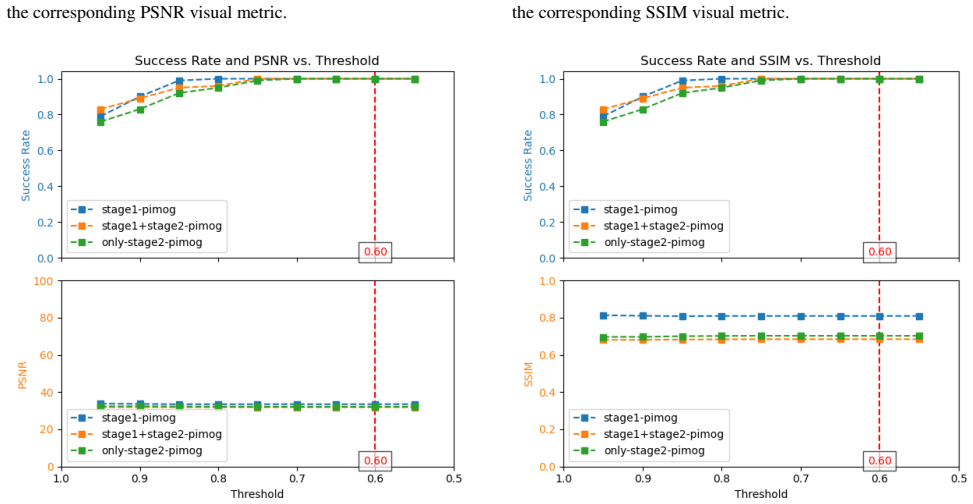
- [Sec. 5.3 / Table 4] The ablation study does not control for the perturbation budget. Neither the value of ϵ nor the number of PGD steps is reported in Sec. 5.1 or in the algorithm descriptions. In Table 4, the w/o W, w/o F row reaches SR 1.0 on PIMoG and 0.62 on DwtDct at PSNR ≈ 27.5, while the full method reaches high SR at PSNR ≈ 34–36; these results are not directly comparable because the methods operate at different distortion levels. The authors should compare methods at matched perturbation budgets or matched PSNR values and explicitly state the values of ϵ and m used in all experiments.
- [Sec. 4.4 / Algorithm 2] The mathematical objective of Stage I in the forgery attack is unclear. Equation (2) is exactly the evasion objective of Eq. (1), namely minimizing −L(W·F(Iwm), W·F(Iwm+δ)), but the forgery stage is supposed to extract watermark information, not merely distort it. Algorithm 2 shows a different update rule with a leading minus sign on the gradient, and the final output is I' − δ. The authors should clarify the sign convention in the optimizer update, define what objective is actually being optimized in Stage I, and explain why a perturbed watermarked image yields a watermark pattern that can be transferred to a clean image.
minor comments (4)
- [Tables 1–3] The table entries are typeset without column separators (e.g., '0.32 0.628 25.0260 0.715 27.586'), making the tables very difficult to read. Please reformat the tables with proper vertical alignment.
- [Sec. 5.1 / Algorithm 1] Several key hyperparameters are not reported: the perturbation budget ϵ, the number of PGD steps m, the DenseNet layer from which features are extracted, the clustering algorithm, and the value of k. These are necessary for reproduction.
- [Sec. 4.1 / Figure 4] The feasibility study claims that leakage patterns are 'similar across different images' and that 'not all features contain such leakage,' but no quantitative metric is given. Please provide a numerical measure of channel-wise leakage and of cross-image similarity.
- [Sec. 7.1] The statement that DAPAO exhibits 'limited performance' on Tree-Ring is not supported by any experiment. Either report the quantitative result or clearly label this as a conjecture.
Circularity Check
No circularity: the attack's success is measured against independently trained watermark decoders, and no load-bearing claim reduces by construction to its own inputs.
full rationale
The paper's central claim—that robust watermarks leak and that this leakage enables single-image no-box evasion and forgery—is tested against seven publicly available watermark decoders (DwtDctSvd, DwtDct, RivaGAN, StegaStamp, HiDDeN, PIMoG, CIN) using bit accuracy and success rate. These are external targets that the attack never queries or optimizes against, so the empirical result is not fitted to the benchmark. The channel mask W is indeed derived from the attacked image itself by clustering DenseNet feature channels and taking the two smallest clusters, but W is an input to the attack's feature-space objective, not a parameter fitted to the decoder. The optimization in Eq. (1)–(3) maximizes or minimizes distances between masked features; the reported outcome (decoder bit accuracy) is independent of that objective, so the derivation does not reduce to its own definition. The theoretical discussion in Sec. 4.2 is heuristic and informal; the notational circularity between E and phi in Definition 4.1 is not load-bearing because Proposition 4.3 and its proof rely on C(I) and a channel-capacity inequality rather than on that recursive mapping. There are no load-bearing self-citations: references to prior watermarking work are external, and no 'uniqueness theorem' or prior result by the same authors is invoked to force the chosen method. The paper itself notes an explicit limitation in Sec. 7.1 (limited performance on in-processing watermarks such as Tree-Ring), and its own Table 4 ablation shows that the all-channel variant 'w/o W' already reaches high success rates at lower PSNR, indicating that the mask mainly improves visual fidelity rather than guaranteeing attack success. These are correctness and generalizability concerns, not circularity. Because the central evaluation is self-contained against external decoders, the appropriate circularity finding is no significant circularity.
Assumptions & free parameters
free parameters (4)
- cluster count k
- number of selected channels =
not reported
- perturbation budget epsilon =
not reported
- PGD steps and loss weights =
not reported
assumptions (4)
- domain assumption The decoder must implicitly disentangle image content from watermark, and the encoder's feature space splits into Pr and Pc subspaces.
- ad hoc to paper Robustness training increases watermark redundancy, expanding embedding regions into Pc and causing leakage.
- ad hoc to paper Watermark-related leakage is concentrated in a small number of feature channels identifiable by clustering.
- standard math The channel capacity formula R = 1/2 log(1 + epsilon^2||W||^2/delta^2) applies to the watermark decoding problem.
Cite this review
Pith. "Pith review of Robust Watermarks Leak: Channel-Aware Feature Extraction Enables Adversarial Watermark Manipulation." pith.science (2026). https://pith.science/paper/JTTOKFTB
@misc{pith2026250206418,
  author       = {Pith},
  title        = {Pith review of: Robust Watermarks Leak: Channel-Aware Feature Extraction Enables Adversarial Watermark Manipulation},
  year         = {2026},
  howpublished = {\url{https://pith.science/paper/JTTOKFTB}},
  note         = {Machine review of arXiv:2502.06418}
}
read the original abstract
Watermarking plays a key role in the provenance and detection of AI-generated content. While existing methods prioritize robustness against real-world distortions (e.g., JPEG compression and noise addition), we reveal a fundamental tradeoff: such robust watermarks inherently improve the redundancy of detectable patterns encoded into images, creating exploitable information leakage. To leverage this, we propose an attack framework that extracts leakage of watermark patterns through multi-channel feature learning using a pre-trained vision model. Unlike prior works requiring massive data or detector access, our method achieves both forgery and detection evasion with a single watermarked image. Extensive experiments demonstrate that our method achieves a 60\% success rate gain in detection evasion and 51\% improvement in forgery accuracy compared to state-of-the-art methods while maintaining visual fidelity. Our work exposes the robustness-stealthiness paradox: current "robust" watermarks sacrifice security for distortion resistance, providing insights for future watermark design.
Figures


Figures from the paper (20 more)








Reference graph
Works this paper leans on
-
[1]
write newline
" write newline "" before.all 'output.state := FUNCTION n.dashify 't := "" t empty not t #1 #1 substring "-" = t #1 #2 substring "--" = not "--" * t #2 global.max substring 't := t #1 #1 substring "-" = "-" * t #2 global.max substring 't := while if t #1 #1 substring * t #2 global.max substring 't := if while FUNCTION format.date year duplicate empty "emp...
-
[2]
URL https://www.midjourney.com/home
Midjourney, 2024. URL https://www.midjourney.com/home
work page 2024
- [3]
-
[4]
and Timofte, R
Agustsson, E. and Timofte, R. Ntire 2017 challenge on single image super-resolution: Dataset and study. In The IEEE Conference on Computer Vision and Pattern Recognition (CVPR) Workshops, July 2017
2017
-
[5]
Combined dwt-dct digital image watermarking
Al-Haj, A. Combined dwt-dct digital image watermarking. Journal of computer science, 3 0 (9): 0 740--746, 2007
work page 2007
-
[6]
Benchmarking the robustness of image watermarks
An, B., Ding, M., Rabbani, T., Agrawal, A., Xu, Y., Deng, C., Zhu, S., Mohamed, A., Wen, Y., Goldstein, T., et al. Benchmarking the robustness of image watermarks. arXiv preprint arXiv:2401.08573, 2024
arXiv 2024
-
[7]
Lsb based digital image watermarking for gray scale image
Chopra, D., Gupta, P., Sanjay, G., and Gupta, A. Lsb based digital image watermarking for gray scale image. IOSR Journal of Computer Engineering, 6 0 (1): 0 36--41, 2012
work page 2012
-
[8]
Diane Bartz, K. H. Openai, google, others pledge to watermark ai content for safety, white house says, 2024. URL https://www.reuters.com/technology/openai-google-others-pledge-watermark-ai-content-safety-white-house-2023-07-21/
work page 2024
Show all 36 references
-
[9]
PIMoG : An Effective Screen-shooting Noise-Layer Simulation for Deep-Learning-Based Watermarking Network
Fang, H., Jia, Z., Ma, Z., Chang, E.-C., and Zhang, W. PIMoG : An Effective Screen-shooting Noise-Layer Simulation for Deep-Learning-Based Watermarking Network . In Proceedings of the 30th ACM International Conference on Multimedia , pp.\ 2267--2275, Lisboa Portugal, October 2022. ACM
2022
-
[10]
Denoising diffusion probabilistic models
Ho, J., Jain, A., and Abbeel, P. Denoising diffusion probabilistic models. Advances in neural information processing systems, 33: 0 6840--6851, 2020
2020
-
[11]
A transfer attack to image watermarks
Hu, Y., Jiang, Z., Guo, M., and Gong, N. A transfer attack to image watermarks. arXiv preprint arXiv:2403.15365, 2024
2024 arXiv
-
[12]
Huang, G., Liu, Z., van der Maaten, L., and Weinberger, K. Q. Densely connected convolutional networks. In Proceedings of the IEEE Conference on Computer Vision and Pattern Recognition, 2017
2017
-
[13]
Jiang, Z., Zhang, J., and Gong, N. Z. Evading watermark based detection of ai-generated content. In Proceedings of the 2023 ACM SIGSAC Conference on Computer and Communications Security, pp.\ 1168--1181, 2023
2023
-
[14]
Jiang, Z., Guo, M., Hu, Y., and Gong, N. Z. Watermark-based detection and attribution of ai-generated content. arXiv preprint arXiv:2404.04254, 2024
2024
- [15]
-
[16]
Kayleen Devlin, J. C. Fake trump arrest photos: How to spot an ai-generated image, 2024. URL https://www.bbc.com/news/world-us-canada-65069316
2024
-
[17]
V., and Herrigel, A
Kutter, M., Voloshynovskiy, S. V., and Herrigel, A. Watermark copy attack. In Security and Watermarking of Multimedia Contents II, volume 3971, pp.\ 371--380. SPIE, 2000
2000
-
[18]
Lin, T.-Y., Maire, M., Belongie, S., Hays, J., Perona, P., Ramanan, D., Doll \'a r, P., and Zitnick, C. L. Microsoft coco: Common objects in context. In Computer Vision--ECCV 2014: 13th European Conference, Zurich, Switzerland, September 6-12, 2014, Proceedings, Part V 13, pp....
2014
-
[19]
A novel two-stage separable deep learning framework for practical blind watermarking
Liu, Y., Guo, M., Zhang, J., Zhu, Y., and Xie, X. A novel two-stage separable deep learning framework for practical blind watermarking. In Proceedings of the 27th ACM International Conference on Multimedia, MM '19, pp.\ 1509–1517, New York, NY, USA, 2019. Association for Compu...
2019
-
[20]
Decoupled weight decay regularization
Loshchilov, I. Decoupled weight decay regularization. arXiv preprint arXiv:1711.05101, 2017
2017 arXiv
-
[21]
Leveraging optimization for adaptive attacks on image watermarks
Lukas, N., Diaa, A., Fenaux, L., and Kerschbaum, F. Leveraging optimization for adaptive attacks on image watermarks. In The Twelfth International Conference on Learning Representations, 2024. URL https://openreview.net/forum?id=O9PArxKLe1
2024
-
[22]
Towards Blind Watermarking : Combining Invertible and Non-invertible Mechanisms
Ma, R., Guo, M., Hou, Y., Yang, F., Li, Y., Jia, H., and Xie, X. Towards Blind Watermarking : Combining Invertible and Non-invertible Mechanisms . In Proceedings of the 30th ACM International Conference on Multimedia , pp.\ 1532--1542, Lisboa Portugal, October 2022. ACM. doi:1...
2022
-
[23]
Towards deep learning models resistant to adversarial attacks
M a dry, A., Makelov, A., Schmidt, L., Tsipras, D., and Vladu, A. Towards deep learning models resistant to adversarial attacks. stat, 1050 0 (9), 2017
2017
-
[24]
A., Ajay, M
Navas, K. A., Ajay, M. C., Lekshmi, M., Archana, T. S., and Sasikumar, M. DWT-DCT-SVD based watermarking. In 2008 3rd International Conference on Communication Systems Software and Middleware and Workshops ( COMSWARE '08) , pp.\ 271--274. IEEE, January 2008
2008
-
[25]
Dalle3, 2024
OpenAI. Dalle3, 2024. URL https://openai.com/index/dall-e-3/
2024
-
[26]
S., Rezaei, K., Kumar, A., Chegini, A., Wang, W., and Feizi, S
Saberi, M., Sadasivan, V. S., Rezaei, K., Kumar, A., Chegini, A., Wang, W., and Feizi, S. Robustness of ai-image detectors: Fundamental limits and practical attacks. arXiv preprint arXiv:2310.00076, 2023
2023 arXiv
-
[27]
Stegastamp: Invisible hyperlinks in physical photographs
Tancik, M., Mildenhall, B., and Ng, R. Stegastamp: Invisible hyperlinks in physical photographs. In Proceedings of the IEEE/CVF conference on computer vision and pattern recognition, pp.\ 2117--2126, 2020
2020
-
[28]
and buley
Wang, Q. and buley. Invisible watermark. https://github.com/ ShieldMnt/invisible- watermark., 2020. Online; accessed 27-Jan-2025
2020
-
[29]
C., Sheikh, H
Wang, Z., Bovik, A. C., Sheikh, H. R., and Simoncelli, E. P. Image quality assessment: from error visibility to structural similarity. IEEE transactions on image processing, 13 0 (4): 0 600--612, 2004
2004
-
[30]
Tree-ring watermarks: Fingerprints for diffusion images that are invisible and robust
Wen, Y., Kirchenbauer, J., Geiping, J., and Goldstein, T. Tree-ring watermarks: Fingerprints for diffusion images that are invisible and robust. arXiv preprint arXiv:2305.20030, 2023
2023 arXiv
-
[31]
Yang, P., Ci, H., Song, Y., and Shou, M. Z. Steganalysis on digital watermarking: Is your defense truly impervious?, 2024. URL https://arxiv.org/abs/2406.09026
2024 arXiv
-
[32]
Artificial Fingerprinting for Generative Models : Rooting Deepfake Attribution in Training Data
Yu, N., Skripniuk, V., Abdelnabi, S., and Fritz, M. Artificial Fingerprinting for Generative Models : Rooting Deepfake Attribution in Training Data . In 2021 IEEE / CVF International Conference on Computer Vision ( ICCV ) , pp.\ 14428--14437, Montreal, QC, Canada, October 2021...
2021
-
[33]
S., and Fritz, M
Yu, N., Skripniuk, V., Chen, D., Davis, L. S., and Fritz, M. Responsible disclosure of generative models using scalable fingerprinting. In International Conference on Learning Representations, 2021 b
2021
-
[34]
A., Xu, L., Cuesta-Infante, A., and Veeramachaneni, K
Zhang, K. A., Xu, L., Cuesta-Infante, A., and Veeramachaneni, K. Robust invisible video watermarking with attention. arXiv preprint arXiv:1909.01285, 2019
1909 arXiv
-
[35]
Invisible image watermarks are provably removable using generative ai
Zhao, X., Zhang, K., Su, Z., Vasan, S., Grishchenko, I., Kruegel, C., Vigna, G., Wang, Y.-X., and Li, L. Invisible image watermarks are provably removable using generative ai. arXiv preprint arXiv:2306.01953, 2023
2023 arXiv
-
[36]
Hidden: Hiding data with deep networks
Zhu, J., Kaplan, R., Johnson, J., and Fei-Fei, L. Hidden: Hiding data with deep networks. In Proceedings of the European conference on computer vision (ECCV), pp.\ 657--672, 2018
2018
Reviewed August 8, 2026 · model on record in the stance chip above.
Discussion (0). Continue with ORCID to comment.