REVIEW 2 major objections 4 minor 27 references
Learning Taxonomic Trees with Hierarchical Representation Regularization for Large Multimodal Models
T0 review · 2 major / 4 minor · reviewed 2026-07-12 · grok-4.5
Pith's one-line read A plug-and-play regularizer makes large multimodal models organize internal visual features as taxonomic trees, raising hierarchical recognition consistency without extra parameters.
desk verdict Solid plug-and-play regularizer for LMM hierarchical consistency; gains are real under the reported protocol, but the 4-choice setup is the main soft spot. read the letter →
The pith
A machine-rendered reading of the paper's core claim, the machinery that carries it, and where it could break.
The reading
What carries the argument
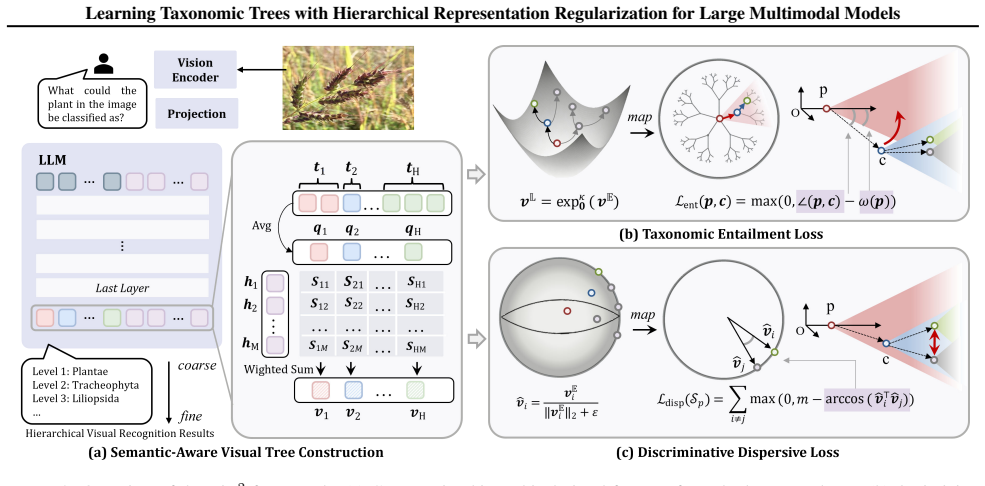
Hierarchical Representation Regularization (HiR²): non-parametric cross-attention builds a semantic visual tree from last-layer image tokens guided by textual hierarchy names; a Lorentz-model entailment loss then enforces parent-child cones while a unit-sphere dispersive loss separates siblings angularly, leaving radial hierarchy untouched.
What would settle it
Train the same LMM on iNat-Animal with and without HiR² under identical SFT; if Hierarchical Consistent Accuracy on novel classes fails to rise by the reported margin while leaf accuracy stays flat or falls, the claim that the dual geometric regularizer reliably captures taxonomy is falsified.
Extended reading notes
Core claim
The central claim is that intermediate visual representations inside large multimodal models can be regularized into taxonomic trees by a lightweight pair of geometric losses—hyperbolic entailment for hierarchy and spherical dispersion for sibling separation—yielding consistent gains in hierarchical visual recognition without adding parameters or altering the primary language-modeling objective.
Load-bearing premise
The method assumes that non-parametric attention of category names onto last-layer image tokens produces Euclidean features whose radius and angle can be independently regularized by hyperbolic cones and spherical repulsion without harming language modeling.
Editorial extensions
If this is right
- Any LMM fine-tuned with next-token loss can receive HiR² as an additive term and improve strict hierarchical accuracy on both seen and unseen taxa.
- Hyperbolic radial depth becomes a usable proxy for taxonomic rank inside generative multimodal models.
- Sibling discrimination can be improved by pure angular losses without undoing the hierarchy encoded by radius.
- The same construction applies to other hierarchical label sets (e.g., product taxonomies or medical ontologies) once textual level names are available.
Reading between the lines
- Because the regularizer never touches the language head, it could be applied at inference time via test-time adaptation or as a post-hoc geometry regularizer on frozen checkpoints.
- The radial-angular split suggests a general design pattern for any generative model that must respect both hierarchy and fine discrimination.
- If last-layer features already contain coarse-to-fine information, earlier layers may be under-used; multi-layer versions of the same losses could further tighten consistency.
Editorial analysis
A structured set of objections, weighed in public.
Referee Report
Summary. The paper proposes Hierarchical Representation Regularization (HiR^{2}), a parameter-free plug-and-play regularizer for large multimodal models (LMMs). It constructs a semantic-aware visual tree by non-parametric cross-attention of textual hierarchy names onto image-token hidden states (typically the last LLM layer), then applies two complementary losses: a taxonomic entailment loss that enforces parent–child containment via hyperbolic cones in the Lorentz model, and a discriminative dispersive loss that increases angular separation of siblings on the unit sphere while leaving radial hierarchy untouched. The total objective is simply the language-modeling loss plus weighted regularizers. Extensive experiments on Qwen2.5-VL, InternVL, LLaVA-OV and Qwen2-VL under both SFT and DFT, on iNat-Plant, iNat-Animal and CUB-200, report consistent gains on HCA, POR, S-POR and TOR for base and novel classes; ablations and three theorems justify the geometric design.
Significance. If the claimed gains transfer beyond the evaluation protocol, HiR^{2} supplies a lightweight, model-agnostic mechanism for injecting taxonomic structure into generative LMMs—something currently missing from standard next-token fine-tuning. The multi-model, multi-taxonomy, multi-protocol empirical support, the clean radial-invariance theorems (4.1–4.3), the public code, and the absence of extra learnable parameters are genuine strengths that make the work immediately usable and falsifiable. The contribution sits at the useful intersection of hyperbolic representation learning and LMM fine-tuning and would be of clear interest to the hierarchical-vision and multimodal communities.
major comments (2)
- [Appendix B.2, Tables 2–4] Appendix B.2 (and every number in Tables 2–4) evaluates hierarchical consistency exclusively under a closed-set four-choice VQA protocol whose distractors are the top-3 SigLIP-similar labels at the same taxonomy level. Because the model only emits a letter and every option is forced to the identical depth, improvements in HCA/POR/S-POR/TOR can arise from better local sibling discrimination alone; they do not demonstrate that the learned Lorentz cones and spherical geometry produce coherent free-form root-to-leaf taxonomic answers or open-set leaf accuracy. The central generality claim therefore rests on an untested transfer assumption. At minimum the authors should report free-generation or open-set hierarchical metrics (or a controlled ablation that removes the SigLIP pre-filtering) so that the load-bearing claim can be assessed.
- [§4.1, Table 6] Section 4.1 and the layer ablation in Table 6 show that the non-parametric cross-attention readout works best on the final LLM layer and degrades when applied to earlier layers or to all layers. The paper’s narrative nevertheless repeatedly frames the method as extracting “coarse-to-fine visual features from intermediate LLM layers.” This mismatch between the stated motivation and the empirically optimal design choice needs either a clearer theoretical justification or a revised claim that the last-layer readout is sufficient.
minor comments (4)
- [§4.3] The memory-bank size, update frequency and eviction policy for the parent-aware dispersive loss (Eq. 19) are never stated; these implementation details affect reproducibility.
- [Table 1 / §4.4] Table 1 lists four alternative dispersive geometries but the main text never reports their computational overhead relative to the spherical version; a short runtime column would be useful.
- [§4.1–4.2, Appendix B.3] Curvature κ = 0.05, cone constant γ = 0.1 and target-radius ratio ρ appear only in the appendix or as “default”; a single hyper-parameter table in the main text would improve clarity.
- [Figure 3] Figure 3 (right) qualitative examples are hard to read at print size; larger fonts or an additional high-resolution panel would help.
Circularity Check
No circularity: HiR^{2} is an empirical plug-and-play regularizer whose losses and geometry are independently defined, then measured on held-out hierarchical metrics that are not algebraic identities of the training objectives.
full rationale
The paper’s derivation chain is: (1) extract hierarchy-aligned Euclidean visual features via non-parametric cross-attention of textual category names onto last-layer image tokens (Eqs. 9–11); (2) map them into the Lorentz model after curvature-aware scaling and apply a standard hyperbolic entailment-cone loss (Eqs. 15–17, citing Ganea/Desai); (3) add a spherical angular dispersive loss on unit-normalized siblings (Eqs. 18–20) whose radial-invariance is proved in Theorems 4.1–4.3 (Appendix A). The total objective is simply L_LM + λ_ent L_ent + λ_disp L_disp. Evaluation uses four path-consistency metrics (HCA, POR, S-POR, TOR) defined on free-form VQA predictions (Appendix B.1) that are not algebraic rearrangements of either regularizer. Hyper-parameters are grid-searched (Table 7) but the reported gains on base/novel splits of iNat and CUB are ordinary empirical improvements, not forced identities. Self-citations (Tan et al. 2026, He et al. 2025/2026) supply motivation and related FGVR observations; none supplies a uniqueness theorem or ansatz that the present construction merely renames. Consequently the central claim does not reduce by construction to its inputs.
Assumptions & free parameters
free parameters (6)
- λ_ent =
0.1
- λ_disp =
0.01
- κ (curvature) =
0.05
- γ (cone aperture constant) =
0.1
- ρ (target radius ratio)
- margin m
assumptions (3)
- domain assumption Hyperbolic space with exponential volume growth is a suitable geometry for tree-structured taxonomies.
- ad hoc to paper Last-layer (or intermediate) image-token hidden states of an LMM already contain coarse-to-fine visual information that can be read out by non-parametric cross-attention with textual hierarchy names.
- standard math Spherical angular separation of siblings does not induce radial gradients in the corresponding hyperbolic embeddings (Theorem 4.2).
invented entities (2)
-
Semantic-aware visual tree construction (non-parametric cross-attention readout)
-
HiR² composite regularizer (entailment + dispersive)
Cite this review
Pith. "Pith review of Learning Taxonomic Trees with Hierarchical Representation Regularization for Large Multimodal Models." pith.science (2026). https://pith.science/paper/JUD344YK
@misc{pith2026260702909,
  author       = {Pith},
  title        = {Pith review of: Learning Taxonomic Trees with Hierarchical Representation Regularization for Large Multimodal Models},
  year         = {2026},
  howpublished = {\url{https://pith.science/paper/JUD344YK}},
  note         = {Machine review of arXiv:2607.02909}
}
abstract
Taxonomies provide key information about the semantic relationships between concepts and the inherent organization of vision and language. Despite their impressive capabilities, large multimodal models (LMMs) often lack taxonomic knowledge, leading to low hierarchical visual recognition (HVR) consistency. These models typically only rely on language modeling objectives during fine-tuning and lack explicit taxonomy-aware regularization. To address this, we propose Hierarchical Representation Regularization ($HiR^2$), a simple plug-and-play regularizer that improves hierarchical consistency in LMMs. Specifically, we introduce a semantic-aware visual tree construction framework that extracts coarse-to-fine visual features from intermediate LLM layers guided by textual cues. The regularizer combines two complementary objectives: a taxonomic entailment loss that enforces hierarchy via hyperbolic entailment cones in the Lorentz model, and a discriminative dispersive loss that promotes angular separation of semantically similar embeddings on the unit sphere without disturbing the radial hierarchical structure. Extensive experiments demonstrate that $HiR^2$ effectively captures taxonomic structures across diverse LMMs and fine-tuning methods. Code is available at https://github.com/PKU-ICST-MIPL/HiR2_ICML2026.
Figures


Reference graph
Works this paper leans on
-
[1]
Qwen2.5-vl technical report.arXiv preprint arXiv:2502.13923,
Bai, S., Chen, K., Liu, X., Wang, J., Ge, W., Song, S., Dang, K., Wang, P., Wang, S., Tang, J., Zhong, H., Zhu, Y ., Yang, M., Li, Z., Wan, J., Wang, P., Ding, W., Fu, Z., Xu, Y ., Ye, J., Zhang, X., Xie, T., Cheng, Z., Zhang, H., Yang, Z., Xu, H., and Lin, J. Qwen2.5-vl technical report.arXiv preprint arXiv:2502.13923,
-
[2]
L., Roohi, S., Granroth-Wilding, M., and Cucchiara, R
Caffagni, D., Sarto, S., Cornia, M., Baraldi, L., Dovesi, P. L., Roohi, S., Granroth-Wilding, M., and Cucchiara, R. Seeing beyond words: Self-supervised visual learning for multimodal large language models.arXiv preprint arXiv:2512.15885,
-
[3]
Chen, H., Wang, J., Tan, Z., and Li, H. SARA: Structural and adversarial representation alignment for training-efficient diffusion models.arXiv preprint arXiv:2503.08253,
-
[4]
On large multimodal models as open-world image classifiers.arXiv preprint arXiv:2503.21851,
Conti, A., Mancini, M., Fini, E., Wang, Y ., Rota, P., and Ricci, E. On large multimodal models as open-world image classifiers.arXiv preprint arXiv:2503.21851,
-
[5]
Hyperbolic geometric graph representation learning for hierarchy-imbalance node classification
Fu, X., Wei, Y ., Sun, Q., Yuan, H., Wu, J., Peng, H., and Li, J. Hyperbolic geometric graph representation learning for hierarchy-imbalance node classification. InProceedings of the ACM Web Conference 2023, pp. 460–468,
2023
-
[6]
Geigle, G., Timofte, R., and Glava ˇs, G. African or euro- pean swallow? benchmarking large vision-language mod- els for fine-grained object classification.arXiv preprint arXiv:2406.14496,
-
[7]
Geng, S., Yuan, J., Tian, Y ., Chen, Y ., and Zhang, Y . Hiclip: Contrastive language-image pretraining with hierarchy- aware attention.arXiv preprint arXiv:2303.02995,
-
[8]
He, H., Li, G., Geng, Z., Xu, J., and Peng, Y . Analyzing and boosting the power of fine-grained visual recognition for multi-modal large language models.arXiv preprint arXiv:2501.15140, 2025a. 9 Learning Taxonomic Trees with Hierarchical Representation Regularization for Large Multimodal Models He, H., Li, G., Geng, Z., Xu, J., and Peng, Y . Analyzing an...
Show all 27 references
-
[9]
Lee, J.-Y ., Cha, B., Kim, J., and Ye, J. C. Aligning text to image in diffusion models is easier than you think.arXiv preprint arXiv:2503.08250,
-
[10]
Geometry-aware distance measure for diverse hierarchical structures in hyperbolic spaces.arXiv preprint arXiv:2506.18533, 2025a
Li, P., Wu, Y ., Gao, Z., Fan, X., Wu, W., Lu, Z., Jia, Y ., and Harandi, M. Geometry-aware distance measure for diverse hierarchical structures in hyperbolic spaces.arXiv preprint arXiv:2506.18533, 2025a. Li, W., Yang, Z., Han, W., Man, H., Wang, X., and Fan, X. Hyperbolic-co...
-
[11]
F., Zhao, Z., Feng, X., and Sun, M
Ma, X., Ding, Z., Luo, Z., Chen, C., Guo, Z., Wong, D. F., Zhao, Z., Feng, X., and Sun, M. Karl: Knowledge-aware reasoning and reinforcement learning for knowledge-intensive visual grounding.arXiv preprint arXiv:2503.12797,
-
[12]
Pal, A., van Spengler, M., di Melendugno, G. M. D., Fla- borea, A., Galasso, F., and Mettes, P. Compositional entailment learning for hyperbolic vision-language mod- els.arXiv preprint arXiv:2410.06912,
-
[13]
Y ., Beery, S., and Huang, J
10 Learning Taxonomic Trees with Hierarchical Representation Regularization for Large Multimodal Models Park, S., Zhang, Y ., Stella, X. Y ., Beery, S., and Huang, J. Visually consistent hierarchical image classification. InThe Thirteenth International Conference on Learning R...
2025
-
[14]
Hyperbolic neural networks++.arXiv preprint arXiv:2006.08210,
Shimizu, R., Mukuta, Y ., and Harada, T. Hyperbolic neural networks++.arXiv preprint arXiv:2006.08210,
2006 arXiv
-
[15]
Taxonomy-aware evaluation of vision-language models.arXiv preprint arXiv:2504.05457,
Snæbjarnarson, V ., Du, K., Stoehr, N., Belongie, S., Cot- terell, R., Lang, N., and Frank, S. Taxonomy-aware evaluation of vision-language models.arXiv preprint arXiv:2504.05457,
-
[16]
The llm bottleneck: Why open-source vision llms struggle with hierarchical visual recognition.arXiv preprint arXiv:2505.24840,
Tan, Y ., Qing, Y ., and Gong, B. The llm bottleneck: Why open-source vision llms struggle with hierarchical visual recognition.arXiv preprint arXiv:2505.24840,
-
[17]
The caltech-ucsd birds-200-2011 dataset
Wah, C., Branson, S., Welinder, P., Perona, P., and Belongie, S. The caltech-ucsd birds-200-2011 dataset. Jul
2011
-
[18]
Qwen2-vl: Enhancing vision-language model’s perception of the world at any resolution.arXiv preprint arXiv:2409.12191, 2024a
Wang, P., Bai, S., Tan, S., Wang, S., Fan, Z., Bai, J., Chen, K., Liu, X., Wang, J., Ge, W., et al. Qwen2-vl: Enhancing vision-language model’s perception of the world at any resolution.arXiv preprint arXiv:2409.12191, 2024a. Wang, W., Gao, Z., Gu, L., Pu, H., Cui, L., Wei, X....
-
[19]
Wang, Y ., Chen, Y ., Yan, W., Fang, A., Zhou, W., Jamieson, K., and Du, S. S. Cliploss and norm-based data selection methods for multimodal contrastive learning.Advances in Neural Information Processing Systems, 37:15028– 15069, 2024b. Wang, Y ., Li, Y ., and Wang, S. Gˆ3-lq:...
-
[20]
Modality alignment across trees on heterogeneous hyperbolic manifolds.arXiv preprint arXiv:2510.27391,
Wei, W., Fan, X., Wu, Y ., Gao, Z., Li, P., Jia, Y ., and Harandi, M. Modality alignment across trees on heterogeneous hyperbolic manifolds.arXiv preprint arXiv:2510.27391,
-
[21]
On the general- ization of sft: A reinforcement learning perspective with reward rectification.arXiv preprint arXiv:2508.05629,
11 Learning Taxonomic Trees with Hierarchical Representation Regularization for Large Multimodal Models Wu, Y ., Zhou, Y ., Ziheng, Z., Peng, Y ., Ye, X., Hu, X., Zhu, W., Qi, L., Yang, M.-H., and Yang, X. On the general- ization of sft: A reinforcement learning perspective wi...
-
[22]
Hgclip: exploring vision-language models with graph representations for hierarchical understanding.arXiv preprint arXiv:2311.14064,
Xia, P., Yu, X., Hu, M., Ju, L., Wang, Z., Duan, P., and Ge, Z. Hgclip: exploring vision-language models with graph representations for hierarchical understanding.arXiv preprint arXiv:2311.14064,
-
[23]
Visual representation alignment for multimodal large language models.arXiv preprint arXiv:2509.07979,
Yoon, H., Jung, J., Kim, J., Choi, H., Shin, H., Lim, S., An, H., Kim, C., Han, J., Kim, D., et al. Visual representation alignment for multimodal large language models.arXiv preprint arXiv:2509.07979,
-
[24]
Bench- marking large vision-language models on fine-grained image tasks: A comprehensive evaluation.arXiv preprint arXiv:2504.14988, 2025a
Yu, H.-T., Wei, X.-S., Peng, Y ., and Belongie, S. Bench- marking large vision-language models on fine-grained image tasks: A comprehensive evaluation.arXiv preprint arXiv:2504.14988, 2025a. Yu, P., Wu, Y ., Gao, Z., Fan, X., Yang, S., and Jia, Y . Hy- perbolic dual feature au...
-
[25]
Learning struc- tured representations by embedding class hierarchy with fast optimal transport.arXiv preprint arXiv:2410.03052,
Zeng, S., Du, S., Yamada, M., and Zhao, H. Learning struc- tured representations by embedding class hierarchy with fast optimal transport.arXiv preprint arXiv:2410.03052,
-
[26]
Theoretical Analysis of Dispersive Loss In this section, we provide a rigorous theoretical analysis of different variants of the dispersive loss under hyperbolic geometry
12 Learning Taxonomic Trees with Hierarchical Representation Regularization for Large Multimodal Models A. Theoretical Analysis of Dispersive Loss In this section, we provide a rigorous theoretical analysis of different variants of the dispersive loss under hyperbolic geometry...
2024
-
[27]
× bY j=a 1 fθ(xi;Y j) =y i j i .(39) This stricter definition penalizes isolated correct predictions and emphasizes full-path consistency within the hierarchy. Top Overlap Ratio (TOR).Following (Wu et al., 2024), TOR evaluates local hierarchical consistency by considering adja...
2024
Reviewed July 12, 2026 · model on record in the stance chip above.
Discussion (0). Continue with ORCID to comment.