REVIEW 3 major objections 6 minor 51 references
ReLATE: Learning Efficient Sparse Encoding for High-Performance Tensor Decomposition
T0 review · 3 major / 6 minor · reviewed 2026-08-05 · deepseek-v4-flash
Pith's one-line read ReLATE uses reinforcement learning to find sparse tensor layouts that beat hand-tuned formats, with up to 2x speedup on large tensors.
desk verdict A credible systems contribution with a genuinely new RL formulation for constructing tensor encodings, but the headline speedup is currently the training objective's best-of-N result and needs independent validation. read the letter →
The pith
A machine-rendered reading of the paper's core claim, the machinery that carries it, and where it could break.
The reading
What carries the argument
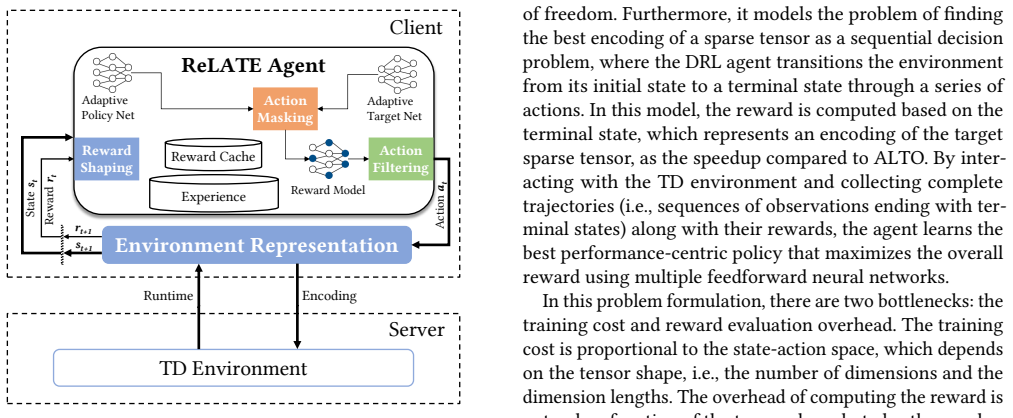
The environment state is an N-by-ell(p) one-hot matrix: each column, corresponding to one bit position of the packed linear index, carries the mode whose next low bit is placed there, and a state is terminal once all ell(p) columns are filled. The action space has N actions, one per mode, and validity masking forbids taking more than ell(n) bits from mode n, so the agent searches only interleavings of the mode bit-sequences rather than all permutations. The reward is the log of measured speedup relative to the baseline linearized format, distributed uniformly back over the episode's actions, and a prioritized replay buffer trains a CNN policy network with a slower-updated target network. To
What would settle it
Enumerate or randomly sample the restricted interleaving space on the paper's test tensors and measure kernel time: if random search matches the reported 1.4x geometric-mean speedup, the learned policy adds nothing beyond the search space. Alternatively, relax the restriction to allow intra-mode bit permutations and find an encoding that clearly beats the best restricted interleaving on any test tensor, showing the restriction is the bottleneck.
Extended reading notes
Core claim
The central claim is that choosing a sparse tensor layout is a tractable sequential decision problem if the search is over bit interleavings: each step picks one mode whose next low-order bit goes into the packed linear index, and a full sequence defines the layout. ReLATE encodes the current partial layout as a one-hot matrix and uses a deep Q-network policy with validity masking, so the searched space is the multinomial number of interleavings, not all permutations. Terminal layouts are executed against a baseline linearized format, and the measured speedup (on a log scale) is the reward, shaped back across all actions. The learned layouts outperform the best expert formats on all ten real
Load-bearing premise
The search space is restricted to interleavings that preserve the low-to-high bit order inside each mode index; if the fastest encoding for some tensor requires permuting bits within a mode, ReLATE cannot find it.
Editorial extensions
If this is right
- Large, low-density tensors—the hardest cases—gain the most, up to 2x over the best expert format.
- The same storage footprint as the mode-agnostic linearized baseline is kept, since only the bit-interleaving order changes.
- Speedups persist on randomly permuted tensors (1.46x geometric mean), so learned encodings adapt to data distribution, not just tensor shape.
- Reward modeling and action filtering keep worst-case performance during learning at the level of a mode-specific format, making the method usable before training fully converges.
Reading between the lines
- The same MDP formulation would apply to other sparse kernels, such as sparse matrix-vector or matrix-matrix multiplication, with only the reward function changed, since it learns an ordering policy that is kernel-agnostic.
- Because the search preserves each mode's internal bit order, the reported results upper-bound what interleavings alone achieve; allowing intra-mode bit swaps or block-level reversals could expand the space and may yield further gains on skewed tensors.
- The reward-model switch suggests a path to online adaptation: if a tensor's nonzero distribution drifts over time, the agent could re-select an encoding from cached or model-predicted options without full retraining.
- The fact that shuffled tensors also speed up indicates that bit interleaving exploits residual distributional structure even after random permutation, not merely shape asymmetries.
Editorial analysis
A structured set of objections, weighed in public.
Referee Report
Summary. The paper introduces ReLATE, a reinforcement-learning framework that constructs vectorized sparse-tensor encodings for MTTKRP-based tensor decomposition on multi-core CPUs. Encoding construction is formulated as an MDP over bit-interleaving actions: the agent chooses which mode contributes its next bit to the linearized position, with rule-driven masking to guarantee valid encodings. ReLATE combines double DQN with a learned reward model, reward shaping, a reward cache, and a decoupled server-client setup. The framework is evaluated on all ten FROSTT tensors on an Intel Emerald Rapids 128-thread system, reporting geometric-mean speedups of 1.40–1.46x over ALTO (up to 2x, and up to 16.9x over SPLATT) while using the same storage as ALTO.
Significance. If the empirical claim holds, the paper makes a practical contribution: it demonstrates that learned, data-adaptive bit-interleaving can outperform expert-designed linearized tensor formats for sparse MTTKRP, a kernel central to tensor decomposition. The MDP formulation, action masking, reward cache, and the use of a hybrid model-based/model-free agent are reasonable design choices, and evaluation over the full FROSTT suite is a strength. The paper provides no machine-checked proofs or code artifact; its contribution is empirical. The key evidence, however, is not yet conclusive because the reported speedup is the same quantity used as the training reward, is selected as the best of many noisy samples, and is not compared with blind search baselines over the same action space.
major comments (3)
- [§4.1.3, §4.2, Algorithm 1 line 20] The headline speedup is the direct training objective. §3.3.4 defines the reward as the measured speedup over ALTO, and Algorithm 1 (line 20) retains the encoding with the highest reward seen during training. Thus the reported 1.40–1.46x geomean is a best-of-selected result over potentially thousands of noisy runtime measurements. §4.1.3 says tensors with fewer than 1B nonzeros are repeated 10 times; amazon, patents, and reddit are not, and Figure 5 shows no error bars or confidence intervals. Given the HPC noise acknowledged in §3.1, the maximum over noisy samples is biased upward. Please provide an independent validation protocol: repeated interleaved re-measurements of the selected ReLATE encoding and the baselines on all tensors, per-tensor confidence intervals, and a clear statement of whether the encoding selection was finalized before those validation runs.
- [§4.2, Algorithm 1] The paper attributes the speedups to the learned agent, but no comparison is made against random or greedy search over the same action space of multinomial bit interleavings (Eq. 1). Since the algorithm evaluates many candidates and returns the fastest, some or all of the advantage could come from the search itself rather than from the learned value/policy. Please add ablations with matched evaluation budgets: random sampling of interleavings, greedy per-bit hill climbing, and, for the smaller tensors, exhaustive search over the restricted space. This is necessary to support the 'automatically constructs efficient encodings' claim as a learning result.
- [§3.3.2, Eq. (1)] The MDP restricts the search to interleavings that preserve each mode's low-to-high internal bit order, reducing the space from ℓ(p)! to the multinomial count in Eq. (1). This is a strong structural assumption: an optimal linearization might interleave within-mode bits, use higher bits before lower bits, or otherwise break the 'next low bit' rule. The paper motivates the restriction by tractability but gives no evidence that the optimal encoding lies in this subspace. Please add a sensitivity analysis or, at minimum, a direct argument that intra-mode bit order is irrelevant to the cache/parallel behavior of linearized MTTKRP.
minor comments (6)
- [Abstract, §4.2, Figure 5] The abstract and contributions report speedup 'over the best sparse format,' but Figure 5's y-axis is 'Speedup over ALTO' and the geomean labels 1.40/1.46 appear to be computed against ALTO. Please specify whether the per-tensor best baseline is always ALTO for these datasets, and if not, report the geomean against the per-tensor best baseline separately.
- [§4.2] The claimed maxima ('up to 2x' and 'up to 16.9x') are not tied to specific tensors. Please state which tensors yield these extreme values, and mention the corresponding measured runtimes.
- [§4.1.3] Training is subject to a 6-hour timeout, but no actual training wall-clock time or number of terminal reward evaluations per tensor is reported. Reporting these would help judge the practical cost of the approach.
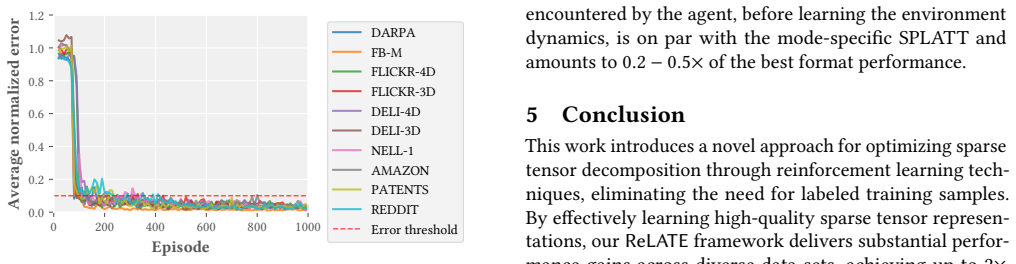
- [Figure 8, Table 2] Figure 8 reports the reward model's normalized error and mentions an error threshold, but the threshold is not drawn or quantified in the text beyond the 'Min. accuracy 90%' row in Table 2. Please make the threshold explicit in the figure or text.
- [Algorithm 1, line 21] The reward-shaping formula 'r_t ← log(r_{ℓ(p)-1})/ℓ(p)' is ambiguous: log of a speedup ratio is usually signed, but the notation suggests a scalar division. Please clarify the exact shape and sign convention, especially for the 'slowdown' case discussed in §3.4.
- [General] No code, configuration files, or artifact link for ReLATE is provided. Since the contribution is empirical, releasing the agent implementation and the exact evaluation scripts would materially improve reproducibility.
Circularity Check
Headline speedup is the optimized reward: ReLATE reports best-of-search speedup vs ALTO on the same tensors used for training.
-
fitted input called prediction
[§3.3.4 Reward Function; Algorithm 1 line 20; §4.2 Performance Results]
"the reward function 𝑅(𝑠𝑡,𝑎𝑡) generates a high-fidelity, differential reward signal as the speedup compared to the ALTO-based encoding [16] ... 𝑝∗← UPDATE_ENCODING(𝑠ℓ(𝑝),𝑟ℓ(𝑝)− 1) ⊲ Best encoding ... Specifically, ReLATE realizes a geometric-mean speedup of 1.4− 1.46×, and up to 2× speedup, over the best expert-designed format."
Algorithm 1 returns the encoding with the best terminal reward, and §3.3.4 defines that reward as speedup versus ALTO. The final evaluation in §4.2 reports the same speedup metric on the same tensors used for training, with no held-out set. Thus the headline 1.4–1.46× geometric-mean speedup and the up-to-2× figure are the maximum (over evaluated candidates) of the training objective, not an independent or out-of-sample validation. This is not a tautology—the search could fail to beat ALTO—but the reported result is a selected best-of-search value. On a noisy HPC platform (§3.1), selecting the maximum over many noisy evaluations further biases the estimate upward. The comparison is also dominated by ALTO, the same baseline used in the reward function.
full rationale
The core learning formulation—the MDP, the restricted interleaving action space, action masking, and the reward model—is self-contained and not circular in itself. The significant circularity is that the central empirical claim, the speedup over expert formats, is exactly the quantity the agent is trained to maximize, measured on the same tensors used for training. Because Algorithm 1 explicitly keeps the highest-reward encoding, the reported 1.4–1.46× geomean and up-to-2× speedups are best-of-search values rather than independent predictions. The paper partially mitigates this by comparing against a strong ALTO baseline and by repeating smaller runs 10×, but no held-out tensors or confidence intervals are provided for the headline numbers, and the paper itself acknowledges HPC run-to-run variability. The restricted bit-order-preserving search space is an ansatz, not a circular step. Overall, the result is not an identity, since training could fail, but the evaluation reduces to the optimized reward signal, warranting a score of 6.
Assumptions & free parameters
free parameters (5)
- epsilon-greedy exploration schedule =
initial 1.0, min 0.1 (Table 2)
- learning rate schedule =
initial 0.001, min 0.0001 (Table 2)
- reward model accuracy threshold =
90% (Table 2, Section 3.4)
- max episodes and training timeout =
5000 episodes, 6-hour timeout (Table 2, Section 4.1.3)
- CNN architecture sizes =
16 and 32 feature maps, 3x3 filters (Section 3.4)
assumptions (4)
- domain assumption The performance of a linearized sparse tensor encoding is determined by the bit-interleaving pattern; all interleavings are functionally correct tensor encodings.
- domain assumption Speedup over the ALTO format is a reliable and sufficient reward signal for optimizing MTTKRP performance.
- domain assumption Intermediate actions in an episode can be assigned zero reward and the terminal reward can be uniformly distributed across all actions (reward shaping).
- domain assumption The 10 FROSTT tensors listed in Table 1 are representative of general sparse tensor workloads.
Cite this review
Pith. "Pith review of ReLATE: Learning Efficient Sparse Encoding for High-Performance Tensor Decomposition." pith.science (2026). https://pith.science/paper/JUJFFJHQ
@misc{pith2026250900280,
  author       = {Pith},
  title        = {Pith review of: ReLATE: Learning Efficient Sparse Encoding for High-Performance Tensor Decomposition},
  year         = {2026},
  howpublished = {\url{https://pith.science/paper/JUJFFJHQ}},
  note         = {Machine review of arXiv:2509.00280}
}
read the original abstract
Tensor decomposition (TD) is essential for analyzing high-dimensional sparse data, yet its irregular computations and memory-access patterns pose major performance challenges on modern parallel processors. Prior works rely on expert-designed sparse tensor formats that fail to adapt to irregular tensor shapes and/or highly variable data distributions. We present the reinforcement-learned adaptive tensor encoding (ReLATE) framework, a novel learning-augmented method that automatically constructs efficient sparse tensor representations without labeled training samples. ReLATE employs an autonomous agent that discovers optimized tensor encodings through direct interaction with the TD environment, leveraging a hybrid model-free and model-based algorithm to learn from both real and imagined actions. Moreover, ReLATE introduces rule-driven action masking and dynamics-informed action filtering mechanisms that ensure functionally correct tensor encoding with bounded execution time, even during early learning stages. By automatically adapting to both irregular tensor shapes and data distributions, ReLATE generates sparse tensor representations that consistently outperform expert-designed formats across diverse sparse tensor data sets, achieving up to 2X speedup compared to the best sparse format, with a geometric-mean speedup of 1.4-1.46X.
Figures


Figures from the paper (5 more)



Reference graph
Works this paper leans on
-
[1]
Byung Hoon Ahn, Prannoy Pilligundla, and Hadi Esmaeilzadeh. 2019. Reinforcement Learning and Adaptive Sampling for Optimized DNN Compilation. arXiv:1905.12799 [cs.LG] https://arxiv.org/abs/1905. 12799
work page Pith review arXiv 2019
-
[2]
Warren Armstrong and Alistair P Rendell. 2008. Reinforcement Learning for Automated Performance Tuning: Initial Evaluation for Sparse Matrix Format Selection. In 2008 IEEE International Con- ference on Cluster Computing . IEEE, IEEE, USA, 411–420. DOI: 10.1109/CLUSTR.2008.4663802
-
[3]
Max S Bennett. 2023. A Brief History of Intelligence: Evolution, AI, and The Five Breakthroughs That Made Our Brains . HarperCollins, USA
work page 2023
-
[4]
Jou-An Chen, Hsin-Hsuan Sung, Xipeng Shen, Nathan Tallent, Kevin Barker, and Ang Li. 2023. Accelerating Matrix-Centric Graph Process- ing on GPUs through Bit-Level Optimizations. J. Parallel and Distrib. Comput. 177 (2023), 53–67. DOI: 10.1016/j.jpdc.2023.02.013
-
[5]
Jee Choi, Xing Liu, Shaden Smith, and Tyler Simon. 2018. Blocking Optimization Techniques for Sparse Tensor Computation. In2018 IEEE International Parallel and Distributed Processing Symposium (IPDPS) . IEEE, USA, 568–577. DOI: 10.1109/IPDPS.2018.00066
arXiv 2018
-
[6]
Ruiz, Julian Schrittwieser, Grzegorz Swirszcz, et al
Alhussein Fawzi, Matej Balog, Aja Huang, Thomas Hubert, Bernardino Romera-Paredes, Mohammadamin Barekatain, Alexander Novikov, Francisco J R. Ruiz, Julian Schrittwieser, Grzegorz Swirszcz, et al. 2022. Discovering Faster Matrix Multiplication Algorithms with Reinforce- ment Learning. Nature 610, 7930 (2022), 47–53. DOI: 10.1038/s41586- 022-05172-4
doi:10.1038/s41586- 2022
-
[7]
Jianhua Gao, Weixing Ji, Jie Liu, Yizhuo Wang, and Feng Shi. 2024. Revisiting Thread Configuration of SpMV Kernels on GPU: A Machine Learning Based Approach. J. Parallel and Distrib. Comput. 185 (2024), 104799. https://doi.org/10.1016/j.jpdc.2023.104799
arXiv 2024
-
[8]
Thomas Gruber, Jan Eitzinger, Georg Hager, and Gerhard Wellein. 2024. LIKWID. DOI: 10.5281/zenodo.14364500
Show all 51 references
-
[9]
Yan Gu, Zhaoze Liu, Shuhong Dai, Cong Liu, Ying Wang, Shen Wang, Georgios Theodoropoulos, and Long Cheng. 2025. Deep Reinforce- ment Learning for Job Scheduling and Resource Management in Cloud Computing: An Algorithm-Level Review. arXiv:2501.01007 [cs.DC] https://arxiv.org/ab...
2025 arXiv
-
[10]
Hado van Hasselt, Arthur Guez, and David Silver. 2016. Deep Reinforce- ment Learning with Double Q-Learning. In Proceedings of the Thirtieth AAAI Conference on Artificial Intelligence (Phoenix, Arizona) (AAAI’16). AAAI Press, USA, 2094–2100. DOI: 10.1609/aaai.v30i1.10295
2016 doi
-
[11]
Helal, Jan Laukemann, Fabio Checconi, Jesmin Jahan Tithi, Teresa Ranadive, Fabrizio Petrini, and Jeewhan Choi
Ahmed E. Helal, Jan Laukemann, Fabio Checconi, Jesmin Jahan Tithi, Teresa Ranadive, Fabrizio Petrini, and Jeewhan Choi. 2021. ALTO: Adaptive Linearized Storage of Sparse Tensors. In Proceedings of the 35th ACM International Conference on Supercomputing (Virtual Event, USA) (IC...
2021
-
[12]
Matteo Hessel, Joseph Modayil, Hado van Hasselt, Tom Schaul, Georg Ostrovski, Will Dabney, Dan Horgan, Bilal Piot, Mohammad Azar, and David Silver. 2018. Rainbow: Combining Improvements in Deep Reinforcement Learning. InProceedings of the Thirty-Second AAAI Con- ference on Art...
2018
-
[13]
Teruyoshi Kobayashi, Anna Sapienza, and Emilio Ferrara. 2018. Ex- tracting The Multi-Timescale Activity Patterns of Online Financial Markets. Scientific Reports 8, 1 (2018), 1–11. DOI: 10.1038/s41598-018- 29537-w
2018 doi
-
[14]
Kolda and Brett W
Tamara G. Kolda and Brett W. Bader. 2009. Tensor Decompositions and Applications. SIAM Rev. 51, 3 (2009), 455–500. DOI: 10.1137/07070111X
2009 doi
-
[15]
Sadayappan
Süreyya Emre Kurt, Saurabh Raje, Aravind Sukumaran-Rajam, and P. Sadayappan. 2022. Sparsity-Aware Tensor Decomposition. In2022 IEEE International Parallel and Distributed Processing Symposium (IPDPS) . IEEE, USA, 952–962. DOI: 10.1109/IPDPS53621.2022.00097
2022
-
[16]
Helal, S
Jan Laukemann, Ahmed E. Helal, S. Isaac Geronimo Anderson, Fabio Checconi, Yongseok Soh, Jesmin Jahan Tithi, Teresa Ranadive, Brian J. Gravelle, Fabrizio Petrini, and Jee Choi. 2025. Accelerating Sparse Tensor Decomposition Using Adaptive Linearized Representation.IEEE Transac...
2025
-
[17]
Jiajia Li, Jimeng Sun, and Richard Vuduc. 2018. HiCOO: Hierarchical Storage of Sparse Tensors. In SC18: International Conference for High Performance Computing, Networking, Storage and Analysis . ACM, USA, 238–252. DOI: 10.1109/SC.2018.00022
2018
-
[19]
Shangzhi Liu and Götz Trenkler. 2008. Hadamard, Khatri-Rao, Kro- necker, and Other Matrix Products.International Journal of Information and Systems Sciences 4, 1 (2008), 160–177
2008
-
[20]
Xingyi Liu and Keshab K. Parhi. 2023. Tensor Decomposition for Model Reduction in Neural Networks: A Review [Feature]. IEEE Circuits and Systems Magazine 23, 2 (2023), 8–28. DOI: 10.1109/MCAS.2023.3267921
2023
-
[21]
Rahim Mammadli, Ali Jannesari, and Felix Wolf. 2020. Static Neu- ral Compiler Optimization via Deep Reinforcement Learning. In 2020 IEEE/ACM 6th Workshop on the LLVM Compiler Infrastructure in HPC (LLVM-HPC) and Workshop on Hierarchical Parallelism for Exascale Computing (HiPa...
2020
-
[22]
Sudheer Mangalampalli, Ganesh Reddy Karri, MV Ratnamani, Sachi Nandan Mohanty, Bander A Jabr, Yasser A Ali, Shahid Ali, and Barno Sayfutdinovna Abdullaeva. 2024. Efficient Deep Reinforcement Learning Based Task Scheduler in Multi Cloud Environment. Scientific Reports 14, 1 (20...
2024 doi
-
[23]
Daniel J Mankowitz, Andrea Michi, Anton Zhernov, Marco Gelmi, Marco Selvi, Cosmin Paduraru, Edouard Leurent, Shariq Iqbal, Jean- Baptiste Lespiau, Alex Ahern, et al. 2023. Faster Sorting Algorithms Discovered Using Deep Reinforcement Learning. Nature 618, 7964 (2023), 257–263....
2023 doi
-
[24]
Michael Mitzenmacher and Sergei Vassilvitskii. 2022. Algorithms with Predictions. Commun. ACM 65, 7 (2022), 33–35. DOI: 10.1145/3528087
2022 doi
-
[25]
Volodymyr Mnih, Koray Kavukcuoglu, David Silver, Alex Graves, Ioan- nis Antonoglou, Daan Wierstra, and Martin Riedmiller. 2013. Playing Atari with Deep Reinforcement Learning. arXiv:1312.5602 [cs.LG] https://arxiv.org/abs/1312.5602
2013 arXiv
-
[26]
Volodymyr Mnih, Koray Kavukcuoglu, David Silver, Andrei A Rusu, Joel Veness, Marc G Bellemare, Alex Graves, Martin Riedmiller, An- dreas K Fidjeland, Georg Ostrovski, et al. 2015. Human-Level Control through Deep Reinforcement Learning. nature 518, 7540 (2015), 529–
2015
-
[28]
Sadayappan
Israt Nisa, Jiajia Li, Aravind Sukumaran-Rajam, Prasant Singh Rawat, Sriram Krishnamoorthy, and P. Sadayappan. 2019. An Efficient Mixed- Mode Representation of Sparse Tensors. In Proceedings of the Interna- tional Conference for High Performance Computing, Networking, Stor- ag...
2019
-
[29]
Sadayappan
Israt Nisa, Jiajia Li, Aravind Sukumaran-Rajam, Richard Vuduc, and P. Sadayappan. 2019. Load-Balanced Sparse MTTKRP on GPUs. In 2019 IEEE International Parallel and Distributed Processing Symposium (IPDPS). IEEE, USA, 123–133. DOI: 10.1109/IPDPS.2019.00023
2019
-
[30]
Yannis Panagakis, Jean Kossaifi, Grigorios G Chrysos, James Oldfield, Mihalis A Nicolaou, Anima Anandkumar, and Stefanos Zafeiriou. 2021. Tensor Methods in Computer Vision and Deep Learning. Proc. IEEE 109, 5 (2021), 863–890. DOI: 10.1109/JPROC.2021.3074329
2021
-
[31]
Giuseppe Peano. 1890. Sur une courbe, qui remplit toute une aire plane. Math. Ann. 36, 1 (March 1890), 157–160. DOI: 10.1007/BF01199438
-
[32]
Tom Schaul, John Quan, Ioannis Antonoglou, and David Silver. 2016. Prioritized Experience Replay. arXiv:1511.05952 [cs.LG] https://arxiv. org/abs/1511.05952
2016 arXiv
-
[33]
Sidiropoulos, Lieven De Lathauwer, Xiao Fu, Kejun Huang, Evangelos E
Nicholas D. Sidiropoulos, Lieven De Lathauwer, Xiao Fu, Kejun Huang, Evangelos E. Papalexakis, and Christos Faloutsos. 2017. Tensor De- composition for Signal Processing and Machine Learning. IEEE Transactions on Signal Processing 65, 13 (2017), 3551–3582. https: //doi.org/10....
2017
-
[34]
Choi, Jiajia Li, Richard Vuduc, Jongsoo Park, Xing Liu, and George Karypis
Shaden Smith, Jee W. Choi, Jiajia Li, Richard Vuduc, Jongsoo Park, Xing Liu, and George Karypis. 2017. FROSTT: The Formidable Repository of Open Sparse Tensors and Tools. http://frostt.io/
2017
-
[35]
Shaden Smith and George Karypis. 2015. Tensor-Matrix Products with a Compressed Sparse Tensor. In Proceedings of the 5th Workshop on Irregular Applications: Architectures and Algorithms (Austin, Texas) (IA3 ’15). Association for Computing Machinery, New York, NY, USA, Article ...
2015
-
[36]
Shaden Smith and George Karypis. 2017. Accelerating the Tucker Decomposition with Compressed Sparse Tensors. In Euro-Par 2017: Parallel Processing , Francisco F. Rivera, Tomás F. Pena, and José C. Cabaleiro (Eds.). Springer International Publishing, Cham, 653–668. DOI: 10.1007...
2017 doi
-
[37]
Sidiropoulos, and George Karypis
Shaden Smith, Niranjay Ravindran, Nicholas D. Sidiropoulos, and George Karypis. 2015. SPLATT: Efficient and Parallel Sparse12 Tensor-Matrix Multiplication. In 2015 IEEE International Parallel and Distributed Processing Symposium . IEEE, USA, 61–70. DOI: 10.1109/IPDPS.2015.27
2015 doi
-
[38]
Helal, Fabio Checconi, Jan Laukemann, Jesmin Jahan Tithi, Teresa Ranadive, Fabrizio Petrini, and Jee W
Yongseok Soh, Ahmed E. Helal, Fabio Checconi, Jan Laukemann, Jesmin Jahan Tithi, Teresa Ranadive, Fabrizio Petrini, and Jee W. Choi
-
[39]
Richard P Stanley. 2011. Enumerative Combinatorics, Second Edition . Vol. 1. Cambridge University Press, USA
2011
-
[40]
Christodoulos Stylianou and Michele Weiland. 2023. Optimizing Sparse Linear Algebra through Automatic Format Selection and Machine Learning. In 2023 IEEE International Parallel and Distributed Processing Symposium Workshops (IPDPSW) . IEEE, IEEE, USA, 734–743. DOI: 10.1109/IPD...
2023
-
[41]
Qingxiao Sun, Yi Liu, Ming Dun, Hailong Yang, Zhongzhi Luan, Lin Gan, Guangwen Yang, and Depei Qian. 2020. SpTFS: Sparse Tensor Format Selection for MTTKRP via Deep Learning. In SC20: Interna- tional Conference for High Performance Computing, Networking, Storage and Analysis. ...
2020 arXiv
-
[42]
Qingxiao Sun, Yi Liu, Hailong Yang, Ming Dun, Zhongzhi Luan, Lin Gan, Guangwen Yang, and Depei Qian. 2021. Input-Aware Sparse Tensor Storage Format Selection for Optimizing MTTKRP. IEEE Trans. Comput. 71, 8 (2021), 1968–1981. DOI: 10.1109/TC.2021.3113028
2021
-
[43]
Panagiotis Symeonidis. 2016. Matrix and Tensor Decomposition in Recommender Systems. In Proceedings of the 10th ACM Conference on Recommender Systems. Association for Computing Machinery, New York, NY, USA, 429–430. DOI: 10.1145/2959100.2959195
2016
-
[44]
Ozan Tuncer, Emre Ates, Yijia Zhang, Ata Turk, Jim Brandt, Vitus J Leung, Manuel Egele, and Ayse K Coskun. 2017. Diagnosing Perfor- mance Variations in HPC Applications using Machine Learning. In High Performance Computing: 32nd International Conference, ISC High Performance 2...
2017 doi
-
[45]
Samuel Williams, Andrew Waterman, and David Patterson. 2009. Roofline: An insightful Visual Performance Model for Multicore Architectures. Commun. ACM 52, 4 (2009), 65–76. DOI: 10.1145/1498765.1498785
2009
-
[46]
Guoqing Xiao, Tao Zhou, Yuedan Chen, Yikun Hu, and Kenli Li. 2024. Machine Learning-Based Kernel Selector for SpMV Optimization in Graph Analysis. ACM Transactions on Parallel Computing 11, 2 (2024), 1–25. DOI: 10.1145/3652579
2024 doi
-
[47]
Zhen Xie, Guangming Tan, Weifeng Liu, and Ninghui Sun. 2019. IA- SpGEMM: an Input-Aware Auto-Tuning Framework for Parallel Sparse Matrix-Matrix Multiplication. In Proceedings of the ACM International Conference on Supercomputing (Phoenix, Arizona) (ICS ’19). Associa- tion for ...
2019
-
[48]
Pranjul Yadav, Michael Steinbach, Vipin Kumar, and Gyorgy Simon
-
[49]
Serif Yesil, José E Moreira, and Josep Torrellas. 2022. Dense Dynamic Blocks: Optimizing SpMM for Processors with Vector and Matrix Units using Machine Learning Techniques. In Proceedings of the 36th ACM International Conference on Supercomputing . ACM, USA, 1–14. DOI: 10.1145...
2022
-
[50]
Yue Zhao, Jiajia Li, Chunhua Liao, and Xipeng Shen. 2018. Bridging the Gap between Deep Learning and Sparse Matrix Format Selection. In Proceedings of the 23rd ACM SIGPLAN Symposium on Principles and Practice of Parallel Programming (Vienna, Austria) (PPoPP ’18). Association f...
2018
-
[533]
DOI: 10.1038/nature14236
-
[2018]
ACM Computing Surveys (CSUR) 50, 6 (2018), 1–40
Mining Electronic Health Records (EHRs) A Survey. ACM Computing Surveys (CSUR) 50, 6 (2018), 1–40. DOI: 10.1145/3127881
2018 doi
-
[2023]
In 2023 IEEE International Paral- lel and Distributed Processing Symposium (IPDPS)
Dynamic Tensor Linearization and Time Slicing for Efficient Factorization of Infinite Data Streams. In 2023 IEEE International Paral- lel and Distributed Processing Symposium (IPDPS) . IEEE, USA, 402–412. DOI: 10.1109/IPDPS54959.2023.00048
2023
Reviewed August 5, 2026 · model on record in the stance chip above.
Discussion (0). Sign in to comment.