REVIEW 6 minor 18 references
Zero-energy orbits of a singular central force are hyperbolic-plane geodesics whose supporting circles leave the force center outside.
Reviewed by Pith at T0; open to challenge. T0 means a machine referee read the full paper against a public rubric. the ladder, T0–T4 →
T0 review · grok-4.5
2026-07-14 16:20 UTC pith:JVWHYPIW
load-bearing objection Solid completion of the hyperbolic off-center problem: full orbit classification, inversion duality, and a clean magnetic Casimir threshold, all proved by direct calculation.
Hyperbolic Completion of Newton's Off-Center Orbit Problem: SO(2,1) Symmetry, Inversion Duality, and Magnetic Classification
The pith
A machine-rendered reading of the paper's core claim, the machinery that carries it, and where it could break.
Core claim
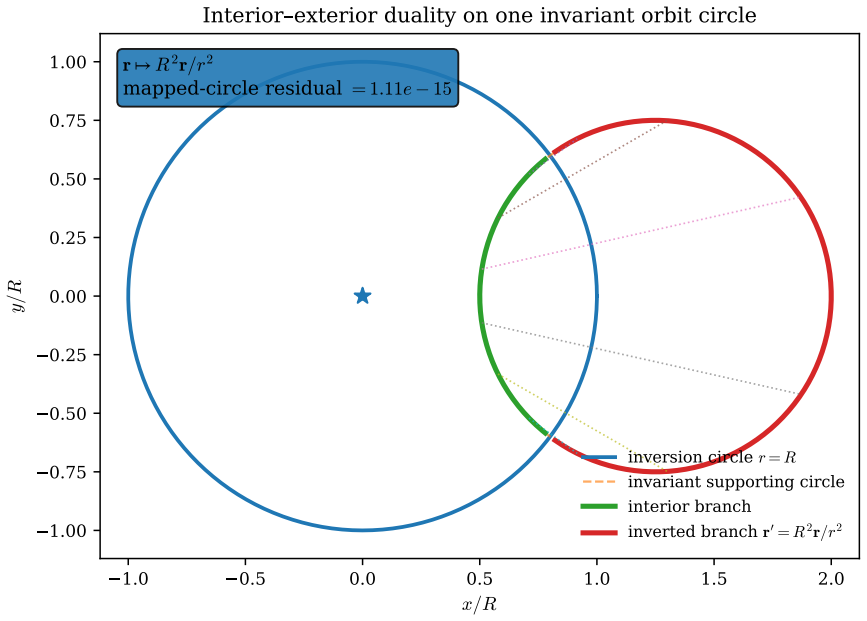
For the Hamiltonian H=p^{2}/2m−α/(R^{2}−r^{2})^{2} every nonradial zero-energy trajectory, restricted to either the interior or exterior component, is a connected arc of a Euclidean circle orthogonal to the singular circle r=R whose center and radius satisfy |rc|^{2}=ρ^{2}+R^{2}, so the force center lies strictly outside the supporting circle; radial trajectories lie on lines through the origin. The conserved Runge–Lenz-type vector and angular momentum close into so(2,1) whose Casimir is the hyperbolic geodesic Hamiltonian, and circular inversion intertwines the interior and exterior zero-energy flows.
What carries the argument
The Runge–Lenz-type moment map K=Lz r+(r·p)ez imes r−R^{2} ez imes p, which is conserved on the zero-energy surface, generates the so(2,1) algebra, yields the algebraic orbit equation K·r=Lz(r^{2}+R^{2}), and remains invariant under the cotangent lift of circular inversion.
Load-bearing premise
The magnetic field must be chosen to be exactly the radial profile B(r)=−Q/(r^{2}−R^{2})^{2}; any other radial profile would destroy the closed so(2,1) algebra that produces the circle–horocycle–hypercycle classification.
What would settle it
Integrate Hamilton’s equations at zero energy with the stated initial data and check whether the trajectory residual |r^{2}−2a·r+R^{2}| stays at machine precision while the numerical values of Lz and K remain constant up to the singular-boundary cutoff; any systematic drift falsifies the claimed conservation laws and orbit equation.
Editorial analysis
A structured set of objections, weighed in public.
Referee Report
Summary. The paper completes the hyperbolic counterpart of Newton’s off-center circular-orbit problem for the singular potential V=−α/(R^{2}−r^{2})^{2}. At zero energy the Jacobi metric has constant negative curvature on both the interior disk and the exterior; the interior is a constant multiple of the Poincaré disk, while circular inversion maps the exterior isometrically onto the punctured disk. All zero-energy trajectories are classified: nonradial orbits are arcs of Euclidean circles orthogonal to r=R with the force center lying strictly outside every supporting circle, while radial orbits lie on lines through the origin. An explicit Runge–Lenz-type vector closes into an on-shell so(2,1) algebra whose Casimir is the hyperbolic geodesic Hamiltonian. The cotangent lift of inversion preserves the generators and intertwines the zero-energy flows up to positive time reparametrization. The singular circle is reached in finite Newtonian time but lies at infinite Jacobi distance. Quantum mechanically the paper separates the Stäckel coupling transform from genuine unitary equivalence of the Laplace–Beltrami operator and identifies the continuum edge with the Hardy/oscillation threshold of the inverse-square boundary model. A radial magnetic field that preserves the algebra becomes a constant intrinsic field on H^{2}; its shifted Casimir yields the circle–horocycle–hypercycle trichotomy with transition at Q^{2}=8mαR^{2}, and inversion becomes a charge-reversing duality. High-precision nume
Significance. If the results hold, the manuscript supplies a complete classical and magnetic resolution of the hyperbolic off-center problem that was only sketched by Olshanii. The central classical classification (Theorem 1.1) rests on direct Poisson-bracket identities and elementary Euclidean geometry rather than on an assumed geometric picture; the same algebraic machinery yields a clean inversion duality and an exact embedding of the hyperbolic Landau trichotomy inside a singular Newtonian Hamiltonian. The careful separation of Stäckel versus unitary quantum statements and the explicit coupling dictionary Q^{2}=8mαR^{2} are useful clarifications for the singular-potential and magnetic-geometry communities. Strengths include fully algebraic proofs of the load-bearing identities, an explicit charge-reversing magnetic inversion theorem, and reproducible high-precision DOP853 residuals (orbit residual ~10^{-14}, symmetry residuals ~10^{-12}). The work therefore constitutes a solid, self-contained completion of a natural classical problem with clear geometric and magnetic extensions.
minor comments (6)
- In the abstract and again in §1 the phrase “hyperbolic completion” is used without a one-sentence definition; a brief parenthetical (“i.e., the constant-negative-curvature Jacobi geometry dual to Olshanii’s spherical case”) would help non-specialist readers.
- Figure 1 caption and the surrounding text in §4 both state |C|^{2}=R^{2}+ρ^{2}; the same relation appears as Eq. (4) and again as Eq. (34). A single cross-reference would avoid the impression of three independent derivations.
- Proposition 6.3 gives the asymptotic r(t)∼(3√(2α/m) t)^{1/3}; the constant of integration is omitted. Adding “up to a finite time shift” (already present later in the same paragraph) at the display equation itself would make the statement self-contained.
- In §8 the operator AE is written both as −Ω^{-1}ΔΩ^{-1} and in expanded form (80). The expanded expression contains a first-order term whose coefficient is written R^{2}−r^{2}/R^{4}; a brief remark that this is the Euclidean expression of the hyperbolic connection would clarify why the operator is not the naïve flat Schrödinger operator.
- Reference [11] (Plyushchay) and [12] (Bykov–Krivorol) are cited as arXiv preprints dated 2026; if they remain unpublished at the time of final revision, the journal’s policy on preprint-only citations should be checked.
- The numerical section (§11) reports residuals for a single initial condition. A short sentence stating that the same residuals were obtained for several randomly chosen Lz and phases would strengthen the claim of generic confirmation.
Circularity Check
No significant circularity: classical orbit classification and so(2,1) moment map are derived by direct Poisson-bracket computation from the given Hamiltonian; magnetic B(r) is an explicit modeling choice, not a hidden fit.
specific steps
-
self citation load bearing
[Introduction, paragraph on magnetic contribution; also §10 (Thm. 10.1 and surrounding text)]
"Likewise, the radial magnetic field and removable central term continue the mechanism of [2]; the new content is its hyperbolic realization, complete orbit classification, and a charge-reversing inversion theorem that exchanges Q with −Q while preserving the shifted moment map and Casimir."
The magnetic construction is presented as the hyperbolic continuation of the author’s own spherical monopole paper [2]. While the algebra is re-derived here, the choice of the radial profile B(r)=−Q/(r^{2}−R^{2})^{2} and the affine-shift device that restores so(2,1) are imported from that prior work rather than forced by an independent uniqueness argument. This is a mild, non-central self-citation: it does not underwrite Theorem 1.1 (the non-magnetic classification) and is scoped as a modeling choice, so it raises the score only to 1.
full rationale
The load-bearing classical claim (Theorem 1.1) follows from identities obtained by direct differentiation of the generators defined in (14)–(16): conservation of K on H=0 (Prop. 3.1), closure of the so(2,1) brackets (Prop. 3.2), the Casimir identity C = 2R^{2} H_geo (Prop. 3.3), and the algebraic orbit equation K·r = Lz(r^{2}+R^{2}) that immediately yields the Euclidean circles orthogonal to r=R with |rc|^{2}=ρ^{2}+R^{2} (Prop. 4.1–Cor. 4.2). Radial Lz=0 cases reduce to diameters/rays by angular-momentum conservation alone. Canonical inversion (Thm. 5.1) and the magnetic extension (Thms. 10.1–10.7) are likewise algebraic; the radial profile B(r)=−Q/(r^{2}−R^{2})^{2} is stated explicitly as the form that preserves the generators after an affine shift of Lz, so the subsequent circle–horocycle–hypercycle classification is a consequence of that modeling choice rather than a circular prediction. Self-citations to the author’s spherical predecessor [2] and to Olshanii [1] supply context and the complementary potential, but the hyperbolic identities are re-derived independently and corroborated by high-precision numerical residuals. No fitted input is renamed a prediction, and no uniqueness theorem is imported solely by self-citation to force the result. Score 1 reflects only the minor, non-load-bearing self-citation pattern typical of a sequel paper.
Axiom & Free-Parameter Ledger
axioms (4)
- standard math Jacobi metric ds_J²=2m(E−V)ds_Eucl² converts constant-energy orbits into geodesics (Arnold, Mathematical Methods of Classical Mechanics).
- standard math The Poincaré disk of curvature −1/R² has geodesics that are Euclidean circles orthogonal to the boundary (or diameters).
- standard math The positive Laplace–Beltrami operator on the complete hyperbolic plane is essentially self-adjoint on C_c^∞ and has spectrum [1/(4R²),∞).
- ad hoc to paper A radial magnetic field of the precise form B=−Q/(r²−R²)² is chosen so that the generators close into so(2,1) after an affine shift.
read the original abstract
We resolve the hyperbolic off-center-orbit problem for the singular potential $$ V(r)=-\frac{\alpha}{(R^2-r^2)^2},\qquad \alpha>0. $$ At zero energy, the Jacobi metric has constant negative curvature on both components separated by $r=R$. The interior is a constant multiple of the Poincar\'e disk metric, while circular inversion maps the exterior isometrically to the punctured disk. We classify all zero-energy trajectories: nonradial orbits are arcs of Euclidean circles orthogonal to $r=R$, radial trajectories lie on lines through the origin, and the force center lies outside every nonradial supporting circle. A Runge--Lenz-type moment map closes into $\mathfrak{so}(2,1)$, whose Casimir equals the hyperbolic geodesic Hamiltonian. Canonical inversion preserves the symmetry generators and intertwines the zero-energy flows up to positive time reparametrization. In the magnetic problem, inversion becomes a charge-reversing $Q\leftrightarrow -Q$ duality preserving the shifted moment map and Casimir. The singular circle is reached in finite Newtonian time but lies at infinite Jacobi distance. Quantum mechanically, we distinguish the St\"ackel coupling transform from genuine unitary equivalence and show that the bottom of the hyperbolic continuum maps to the Hardy/oscillation threshold of the inverse-square boundary model. Finally, the symmetry-preserving radial magnetic field becomes a constant intrinsic field on the hyperbolic plane. Its shifted Casimir classifies trajectories as magnetic circles, horocycles, or hypercycles, with a transition at $Q^2=8m\alpha R^2$. Numerical integrations confirm the orbit equations and conserved quantities.
Figures



Reference graph
Works this paper leans on
-
[1]
A Novel Potential Featuring Off-Center Circular Orbits,
M. Olshanii, “A Novel Potential Featuring Off-Center Circular Orbits,”SIGMA19(2023), 001, 8 pages, doi:10.3842/SIGMA.2023.001, arXiv:2207.09606
-
[2]
Newton’s Off-Center Circular Orbits and the Magnetic Monopole,
D. Bhandari and M. Crescimanno, “Newton’s Off-Center Circular Orbits and the Magnetic Monopole,”SIGMA19(2023), 099, 10 pages, doi:10.3842/SIGMA.2023.099, arXiv:2307.15222
-
[3]
V. I. Arnold,Mathematical Methods of Classical Mechanics, 2nd ed., Graduate Texts in Mathematics, Vol. 60, Springer, New York, 1989, doi:10.1007/978-1-4757-2063-1
-
[4]
Helgason,Groups and Geometric Analysis: Integral Geometry, Invariant Differential Op- erators, and Spherical Functions, Pure and Applied Mathematics, Vol
S. Helgason,Groups and Geometric Analysis: Integral Geometry, Invariant Differential Op- erators, and Spherical Functions, Pure and Applied Mathematics, Vol. 113, Academic Press, Orlando, 1984
1984
-
[5]
Coupling Constant Metamorphosis and Nth-Order Symmetries in Classical and Quantum Mechanics,
E. G. Kalnins, W. Miller Jr., and S. Post, “Coupling Constant Metamorphosis and Nth-Order Symmetries in Classical and Quantum Mechanics,”J. Phys. A: Math. Theor.43(2010), 035202, doi:10.1088/1751-8113/43/3/035202, arXiv:0908.4393
-
[6]
Classical and Quantum Superintegrability with Ap- plications,
W. Miller Jr., S. Post, and P. Winternitz, “Classical and Quantum Superintegrability with Ap- plications,”J. Phys. A: Math. Theor.46(2013), 423001, doi:10.1088/1751-8113/46/42/423001, arXiv:1309.2694
-
[7]
Essential Self-Adjointness of Powers of Generators of Hyperbolic Equations,
P. R. Chernoff, “Essential Self-Adjointness of Powers of Generators of Hyperbolic Equations,” J. Funct. Anal.12(1973), 401–414, doi:10.1016/0022-1236(73)90003-7
-
[8]
Effective Action on the Hyperbolic Plane in a Constant External Field,
A. Comtet and P. J. Houston, “Effective Action on the Hyperbolic Plane in a Constant External Field,”J. Math. Phys.26(1985), 185–191, doi:10.1063/1.526781
doi:10.1063/1.526781 1985
-
[9]
On the Landau Levels on the Hyperbolic Plane,
A. Comtet, “On the Landau Levels on the Hyperbolic Plane,”Ann. Phys.173(1987), 185–209, doi:10.1016/0003-4916(87)90098-4
-
[10]
The Gauss–Landau–Hall Problem on Riemannian Surfaces,
M. Barros, A. Romero, J. L. Cabrerizo, and M. Fern´ andez, “The Gauss–Landau–Hall Problem on Riemannian Surfaces,”J. Math. Phys.46(2005), 112905, doi:10.1063/1.2136215, arXiv:math- ph/0404060
-
[11]
Morse Bridge between Planar Kepler and Hyperbolic Landau Dynamics,
M. S. Plyushchay, “Morse Bridge between Planar Kepler and Hyperbolic Landau Dynamics,” arXiv:2607.01778 [hep-th] (2026)
Pith/arXiv arXiv 2026
-
[12]
Holomorphic Quantization in Constant Curvature Backgrounds,
D. Bykov and V. Krivorol, “Holomorphic Quantization in Constant Curvature Backgrounds,” arXiv:2602.22984 [hep-th] (2026). 24
arXiv 2026
-
[13]
On the Spectral Theory of Schr¨ odinger and Dirac Operators with Strongly Singular Potentials,
H. Kalf, U.-W. Schmincke, J. Walter, and R. W¨ ust, “On the Spectral Theory of Schr¨ odinger and Dirac Operators with Strongly Singular Potentials,” in W. N. Everitt (ed.),Spectral Theory and Differential Equations, Lecture Notes in Mathematics, Vol. 448, Springer, Berlin, 1975, pp. 182–226, doi:10.1007/BFb0067087
-
[14]
K. M. Case, “Singular Potentials,”Phys. Rev.80(1950), 797–806, doi:10.1103/PhysRev.80.797
-
[15]
D. M. Gitman, I. V. Tyutin, and B. L. Voronov,Self-Adjoint Extensions in Quantum Mechanics: General Theory and Applications to Schr¨ odinger and Dirac Equations with Singular Potentials, Progress in Mathematical Physics, Vol. 62, Birkh¨ auser, Boston, 2012, doi:10.1007/978-0-8176- 4662-2
-
[16]
J. L. V´ azquez and E. Zuazua, “The Hardy Inequality and the Asymptotic Behaviour of the Heat Equation with an Inverse-Square Potential,”J. Funct. Anal.173(2000), 103–153, doi:10.1006/jfan.1999.3556
-
[17]
SciPy 1.0: Fundamental Algorithms for Scientific Computing in Python,
P. Virtanen, R. Gommers, T. E. Oliphant, et al., “SciPy 1.0: Fundamental Algorithms for Scientific Computing in Python,”Nat. Methods17(2020), 261–272, doi:10.1038/s41592-019- 0686-2, arXiv:1907.10121
-
[18]
Matplotlib: A 2D Graphics Environment,
J. D. Hunter, “Matplotlib: A 2D Graphics Environment,”Comput. Sci. Eng.9(2007), 90–95, doi:10.1109/MCSE.2007.55. 25
discussion (0)
Sign in with ORCID, Apple, or X to comment. Anyone can read and Pith papers without signing in.