REVIEW 2 major objections 6 minor 53 references
This paper proves that treating Bayesian update rules as competing experts, weighted by their predictive losses, makes Bayesian online learning adaptive: the aggregate attains adaptive conformal coverage and minimax-rate Gaussian process re
Reviewed by Pith at T0; open to challenge. T0 means a machine referee read the full paper against a public rubric. the ladder, T0–T4 →
T0 review · deepseek-v4-flash
2026-08-01 10:23 UTC pith:JW3FMHRR
load-bearing objection The conformal half is genuinely new and solid, but the GP adaptation rate leans on an unproved small-ball lemma and the experiments test a different threshold than the theorems cover. the 2 major comments →
Adaptive Bayesian Online Learning via Expert Aggregation
The pith
A machine-rendered reading of the paper's core claim, the machinery that carries it, and where it could break.
Core claim
On the paper's own terms, the discovery is that posterior aggregation is a modular transfer device for Bayesian online learning: once individual Bayesian experts satisfy single-expert guarantees, exponential-weights aggregation over their predictive distributions inherits the best expert's performance up to a meta-level cost that depends only on the scoring rule. With mean-loss scoring, the cost is O(sqrt(T log K)); with annealed-loss scoring, the mixture map q maps to exp(-gamma Lambda(q)) is affine in q, so the potential telescopes and the cost drops to O(log K). The main application is the annealed-loss mixture of Gaussian process experts with different inverse bandwidths: the aggregated
What carries the argument
The central object is the exponential-weights meta-learner over a grid of Bayesian experts, with two scoring rules. The annealed loss, Lambda(q) = -gamma^{-1} log E_{theta~q}[exp(-gamma ell(theta))], is the key mechanism: under log loss with gamma=1 it equals the posterior predictive log-loss, and the map q maps to exp(-gamma Lambda(q)) is affine in the mixture, so a mixture of experts attains the mix loss with equality and the regret bound telescopes to log(1/omega_{1,k})/gamma. The mean loss L(q) = E_q[ell(theta)] is affine only in the first moment, so the same argument leaves a quadratic residual of order gamma times the loss variance, forcing the sqrt(T) rate. The GP application addition
Load-bearing premise
The strongest rate claim (Theorem 9) rests on a small-ball concentration bound for rescaled squared-exponential Gaussian process priors that is cited rather than proved; if that bound's a^d log^{1+d}(a/epsilon) form is off, the adaptive rate fails, and the main theorem also assumes the noise variance is known.
What would settle it
The central claim would be settled by checking the prior-concentration step: if the small-ball probability of the rescaled squared-exponential GP prior around a beta-Hölder function does not behave like a^d log^{1+d}(a/epsilon), the single-expert rate (26) and hence Theorem 9 collapse. Empirically, running the aggregated GP with known noise variance and comparing cumulative predictive KL to the predicted T^{-2 beta/(2 beta+d)} curve on a dense dyadic grid would expose any missing logarithmic or polynomial factor.
If this is right
- If Theorem 9 is correct, online GP regression can adapt to unknown smoothness over [0,1]^d at the minimax rate T^{-2 beta/(2 beta+d)} up to logarithms, with no continuous hyperprior on the bandwidth.
- If Theorem 6 is correct, a fixed-share mixture of smoothed ACI experts attains long-run randomized conformal coverage alpha under arbitrary distribution shift, even when the best expert changes over time.
- The fast O(log K) aggregation cost for annealed-loss scoring means the meta-level overhead is negligible compared with the statistical rate, so a grid of K=log T experts is essentially free.
- The mean-loss versus annealed-loss distinction shows the right aggregation rule depends on the target: posterior mean functionals pay the slow rate, while predictive densities pay the fast rate.
- The oracle inequality means the aggregate's cumulative predictive KL risk is bounded by the best expert's risk plus log(1/omega_{1,k}), so no oracle selection of bandwidth or noise level is needed.
Where Pith is reading between the lines
- If the GP claim holds, sequential predictive weighting could replace hierarchical hyperpriors in many Bayesian online settings: the grid plus exponential weights acts as a working hyperprior updated by performance rather than by marginal likelihood.
- The annealed loss's variance-dependent behavior—it rewards dispersed experts when residuals are large—suggests a principled defense against over-confident predictive distributions under misspecification; the paper's appendix hints at this, and a direct theoretical comparison under misspecification would be a natural test.
- The dyadic-grid argument suggests a general prescription: any one-dimensional hyperparameter whose optimal value scales polynomially in T can be adapted by O(log T) experts with negligible regret, so the framework may extend to learning rates, tempering temperatures, and variational-family parameters beyond the two applications.
- A testable extension is whether the fixed-share step can be replaced by strongly adaptive or tracking regret bounds to handle multiple regime changes better, which the paper lists as future work.
Editorial analysis
A structured set of objections, weighed in public.
Referee Report
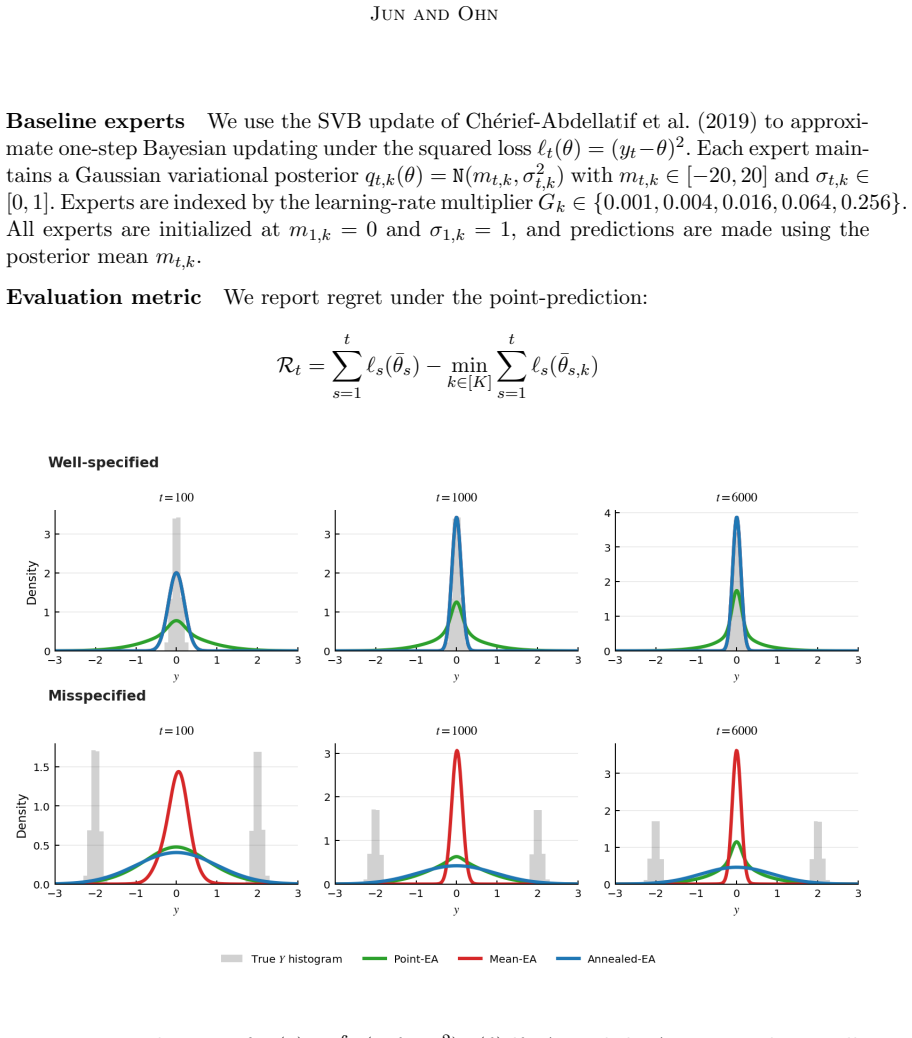
Summary. The paper proposes a two-level online learning framework in which Bayesian update rules (exact, generalized, or variational) are treated as distribution-valued experts and combined by exponential weights. Two scoring rules are studied: mean-loss, which yields O(sqrt(T log K)) aggregation regret, and annealed-loss, which yields O(log K) regret. The framework is instantiated in online conformal inference (Bayes-ACI and Bayes-DtACI) and in online Gaussian-process regression with a bandwidth grid. The main theoretical results are long-run randomized coverage for the conformal methods (Theorems 5–6) and, for the GP application, an oracle inequality in cumulative predictive KL risk plus an adaptive rate T^{-2β/(2β+d)} log^{1+d}(T) for unknown Hölder smoothness (Corollary 8 and Theorem 9). Experiments on variational benchmarks, conformal calibration, and GP regression illustrate that the aggregate tracks strong experts without oracle selection.
Significance. If the claimed results hold, the paper provides a useful modular device: it converts single-expert Bayesian online guarantees into aggregate guarantees with a logarithmic meta-cost for log-loss, which is what makes bandwidth aggregation over a finite grid rate-optimal. The oracle KL inequality for aggregated GP predictive densities is clean, and the aggregation proofs are transparent and do not hide constants. The conformal coverage arguments also correctly adapt the ACI analysis to smoothed updates. The main caveat is that the GP adaptation rate rests on a cited-but-unproved small-ball lemma; the conclusions are conditional on that estimate. Overall, the contribution is a solid synthesis with two concrete applications rather than a new abstract regret inequality, and it should be of interest to the journal's readership.
major comments (2)
- [Section 6, Lemma 15, Theorems 7–9] Lemma 15 is the load-bearing step for the GP rate: the single-expert rate (26) and hence the adaptive rate (30) are obtained by balancing T^{-1}a^d with a^{-2β}, which is exactly the exponent a^d log^{1+d}(a/ε) in (48). The lemma is not proved; the proof is delegated to Section 5.1 of van der Vaart and van Zanten (2009). As stated, the lemma concerns balls in L^2(P_X) for an arbitrary P_X, but the cited small-ball results are normally stated for sup-norm or Lebesgue-L^2 balls and typically require a condition on P_X (e.g., a density bounded away from zero). If the small-ball exponent were a^p log^{1+q}(a/ε) rather than a^d log^{1+d}(a/ε), the balance point and the claimed rate in (30) would change. Please provide a proof of Lemma 15 for the L^2(P_X) norm (or a precise statement of the cited result plus the transfer argument), and state the required assumption on P_X in Theorems 7 and 9;
- [Section 7.2, Theorems 5–6] Theorems 5 and 6 bound the long-run average of E_{θ∼q_t}[1(r_t>θ)], i.e., they concern randomized-threshold coverage. In the experiments, Section 7.2 explicitly uses the posterior mean θ̄_t = E_{θ∼q_t}[θ] as the conformal threshold, and Figure 3 reports the resulting deterministic intervals' coverage. The deterministic version is not covered by the theorems: the smoothed update (20) uses Φ((r_t−ψ_{t,k})/τ_k), and the average of the unsmoothed indicators 1(r_t>ψ_{t,k}) can differ from α even when the average smoothed error is α. Please either randomize the threshold in the experimental protocol or state clearly that the mean-threshold variant is a heuristic not guaranteed by Theorems 5–6.
minor comments (6)
- [Section G.2, Eq. (50)] There is a formatting error in Lemma 15's display: '≤ ε_T(a)}' is duplicated. Correct the formula.
- [Theorem 1, Eq. (11)] The optimized choice of γ in (11) requires knowledge of Σ_{t∈I} L̄^2(t) over the whole interval, so (11) is a comparison bound rather than an adaptive online regret bound. Please state this explicitly, since Algorithm 1 as written uses a fixed γ.
- [Remark 10] The product-grid extension for unknown noise level is covered at the level of the oracle inequality (29), but no rate theorem analogous to Theorem 9 is proved for unknown ς. The sentence 'This is covered by the theory' should be qualified to avoid overclaiming.
- [Section 4.4] The transfer to posterior means compares Σℓ_t(θ̄_t) with min_k ΣL_t(q_{t,k}) or min_k ΣΛ_t(q_{t,k}), not with the best point expert's cumulative point loss min_k Σℓ_t(θ̄_{t,k}). The text should clarify the benchmark, especially since Figure 1 defines the oracle by point loss.
- [Theorem 6 and Algorithm 1] Theorem 6 uses time-varying γ_t and σ_t, whereas Algorithm 1 and Eqs. (5)–(6) use constants. Harmonize the notation and explicitly define the modified algorithm before the theorem.
- [Section 7.2] The sentence 'heavy-tailed errors, abrupt changes in the residual scale' has a typo ('..' after 'errors'). Also, it would help to specify precisely when the threshold is sampled versus set to the posterior mean.
Circularity Check
No significant circularity: the derivation chain is built from standard online-learning inequalities and externally cited GP small-ball estimates; the lone self-citation is an experimental detail.
full rationale
The general aggregation regret bounds (Theorems 1, 2, 3) are proved directly from elementary inequalities (exp(-x) ≤ 1 - x + x^2 and the affine-in-q identity exp(-γΛ_t(q_t)) = Σ ω_{t,k} exp(-γΛ_{t,k})), not from the conclusions they are used to establish. The conformal coverage theorems (5 and 6) follow from the SVB update closed form and telescoping sums over the coverage deviation; no fitted constant is relabeled as a prediction. The GP result is the only place where an external result is load-bearing: Theorem 7 invokes Lemma 15, a prior-concentration bound stated in the paper and delegated to Section 5.1 of van der Vaart and van Zanten (2009). That citation is to prior external work, not to the authors' own results, and it is the kind of externally checkable mathematical fact that can support a derivation. The adaptive rate in Theorem 9 combines Theorem 7 with the oracle inequality of Corollary 8 and a dyadic grid argument; the log K aggregation cost is O(log log T) and is dominated by the statistical rate. There is one self-citation, Jun and Ohn (2026), used only for the sliding-window design in Section 7.3/Appendix D.2; it does not support any theorem. The paper itself flags two limitations relevant to assessing Theorem 9: Lemma 15's proof is not included, and the unknown-noise extension in Remark 10 is not backed by a rate theorem. These are correctness/completeness concerns, not circularity: the claimed rate would fail or require modification if the cited small-ball exponent were wrong, but the argument does not assume what it purports to prove. Overall, no predicted quantity is equivalent by construction to an input, and no load-bearing premise reduces to a self-citation.
Axiom & Free-Parameter Ledger
free parameters (5)
- Meta-rate γ =
Theoretical: γ ≍ sqrt(log(|I|K)/Σ \bar L^2(t)) (oracle, uses future losses); experiments: rolling-window formula or γ=1
- Sharing parameter σ =
1/|I| in theory; 0.001 in Section 7.1; Gibbs-Candès schedule in Section 7.2
- Sliding window W =
250
- SVB smoothing scale τ_k =
Grid {0.5, 1}
- Learning-rate grid G =
10^-4 * 2^j, j=0..7
axioms (4)
- domain assumption Small-ball concentration bound for rescaled squared-exponential GP: -log π_a(B(ε)) ≲ a^d log^{1+d}(a/ε) (Lemma 15)
- domain assumption Data generating process for GP: Y_t = f*(X_t) + ε_t i.i.d. with ε_t ~ N(0, ς²), f* ∈ C^β, ∥f*∥∞ ≤ B, ς known (Equation 24)
- domain assumption Bounded conformity scores r_t ∈ [0,R] and initial thresholds in a specified interval (Theorem 5-6)
- standard math Standard exponential-weights inequality e^{-x}≤1-x+x² and the Donsker-Varadhan variational formula
read the original abstract
Bayesian online learning promises uncertainty-aware prediction on data streams, but its performance hinges on inferential choices, including learning rates, prior distributions and variational families, which are usually fixed before seeing the stream. We address this by treating Bayesian update rules as experts and aggregating the Bayesian experts according to sequential predictive losses. We prove that the resulting aggregate competes with the best expert in hindsight at an aggregation cost determined by how each expert's per-round performance is evaluated. We instantiate the framework in online conformal inference and Gaussian process regression. The conformal inference application yields a smoothed Bayesian counterpart of adaptive conformal inference with long-run randomized coverage, while the Gaussian process application gives an oracle inequality in cumulative predictive Kullback-Leibler risk and adaptation to unknown H\"older smoothness up to logarithmic factors. Experiments show that the aggregate tracks strong experts without oracle expert selection.
Figures



Reference graph
Works this paper leans on
-
[1]
Prediction, Learning, and Games , publisher =
Cesa-Bianchi, Nicol. Prediction, Learning, and Games , publisher =
-
[2]
Journal of Computer and System Sciences , volume =
Vovk, Vladimir , title =. Journal of Computer and System Sciences , volume =
-
[3]
, title =
Herbster, Mark and Warmuth, Manfred K. , title =. Machine Learning , volume =
-
[4]
Asian conference on machine learning , pages=
A generalization bound for online variational inference , author=. Asian conference on machine learning , pages=. 2019 , organization=
2019
-
[5]
International conference on machine learning , pages=
Variational boosting: Iteratively refining posterior approximations , author=. International conference on machine learning , pages=. 2017 , organization=
2017
-
[6]
Learning for Dynamics and Control Conference , pages=
Adaptive regret for control of time-varying dynamics , author=. Learning for Dynamics and Control Conference , pages=. 2023 , organization=
2023
-
[7]
Journal of Machine Learning Research , volume=
Conformal inference for online prediction with arbitrary distribution shifts , author=. Journal of Machine Learning Research , volume=
-
[8]
Advances in Neural Information Processing Systems , volume=
Online pac-bayes learning , author=. Advances in Neural Information Processing Systems , volume=
-
[9]
Foundations and Trends in Machine Learning , volume=
User-friendly introduction to PAC-Bayes bounds , author=. Foundations and Trends in Machine Learning , volume=. 2024 , publisher=
2024
-
[10]
International Conference on Machine Learning , pages=
Non-exponentially weighted aggregation: regret bounds for unbounded loss functions , author=. International Conference on Machine Learning , pages=. 2021 , organization=
2021
-
[11]
Foundations and Trends in Optimization , volume=
Introduction to online convex optimization , author=. Foundations and Trends in Optimization , volume=. 2016 , publisher=
2016
-
[12]
International Conference on Machine Learning , pages=
Improved online conformal prediction via strongly adaptive online learning , author=. International Conference on Machine Learning , pages=. 2023 , organization=
2023
-
[13]
Conference on Learning Theory , pages=
Achieving all with no parameters: Adanormalhedge , author=. Conference on Learning Theory , pages=. 2015 , organization=
2015
-
[14]
International Conference on Artificial Intelligence and Statistics , pages=
Predictive variational Bayesian inference as risk-seeking optimization , author=. International Conference on Artificial Intelligence and Statistics , pages=. 2022 , organization=
2022
-
[15]
Transactions on Machine Learning Research , issn=
Bayesian Ensembling: Insights from Online Optimization and Empirical Bayes , author=. Transactions on Machine Learning Research , issn=. 2026 , url=
2026
-
[16]
arXiv preprint arXiv:2506.10616 , year=
Non-stationary Online Learning for Curved Losses: Improved Dynamic Regret via Mixability , author=. arXiv preprint arXiv:2506.10616 , year=
-
[17]
International Conference on Algorithmic Learning Theory , pages=
The safe Bayesian: learning the learning rate via the mixability gap , author=. International Conference on Algorithmic Learning Theory , pages=. 2012 , organization=
2012
-
[18]
Artificial Intelligence and Statistics , pages=
Provable Bayesian inference via particle mirror descent , author=. Artificial Intelligence and Statistics , pages=. 2016 , organization=
2016
-
[19]
Advances in neural information processing systems , volume=
Streaming variational bayes , author=. Advances in neural information processing systems , volume=
-
[20]
Artificial Intelligence and Statistics , pages=
Conjugate-computation variational inference: Converting variational inference in non-conjugate models to inferences in conjugate models , author=. Artificial Intelligence and Statistics , pages=. 2017 , organization=
2017
-
[21]
The Thirty Seventh Annual Conference on Learning Theory , pages=
Better-than-KL PAC-Bayes bounds , author=. The Thirty Seventh Annual Conference on Learning Theory , pages=. 2024 , organization=
2024
-
[22]
Proceedings of the 41st International Conference on Machine Learning , pages =
Online conformal prediction with decaying step sizes , author =. Proceedings of the 41st International Conference on Machine Learning , pages =. 2024 , editor =
2024
-
[23]
Advances in Neural Information Processing Systems , volume=
Adaptive conformal inference under distribution shift , author=. Advances in Neural Information Processing Systems , volume=
-
[24]
arXiv preprint arXiv:2501.08330 , year=
Gradient equilibrium in online learning: Theory and applications , author=. arXiv preprint arXiv:2501.08330 , year=
-
[25]
Bernoulli , volume=
Gibbs posterior concentration rates under sub-exponential type losses , author=. Bernoulli , volume=. 2023 , publisher=
2023
-
[26]
Journal of Econometrics , volume=
Smoothed quantile regression with large-scale inference , author=. Journal of Econometrics , volume=. 2023 , publisher=
2023
-
[27]
Bayesian Analysis , volume =
Inconsistency of Bayesian Inference for Misspecified Linear Models, and a Proposal for Repairing It , author =. Bayesian Analysis , volume =. 2017 , doi =
2017
-
[28]
Bayesian Analysis , volume =
A Comparison of Learning Rate Selection Methods in Generalized Bayesian Inference , author =. Bayesian Analysis , volume =. 2023 , doi =
2023
-
[29]
Biometrika , pages=
Sequential Gibbs posteriors with applications to principal component analysis , author=. Biometrika , pages=. 2026 , publisher=
2026
-
[30]
International workshop on artificial intelligence and statistics , pages=
Online bagging and boosting , author=. International workshop on artificial intelligence and statistics , pages=. 2001 , organization=
2001
-
[31]
International symposium on intelligent data analysis , pages=
Adaptive learning from evolving data streams , author=. International symposium on intelligent data analysis , pages=. 2009 , organization=
2009
-
[32]
Journal of the Royal Statistical Society Series B: Statistical Methodology , volume=
AMF: Aggregated Mondrian forests for online learning , author=. Journal of the Royal Statistical Society Series B: Statistical Methodology , volume=. 2021 , publisher=
2021
-
[33]
Machine Learning , volume=
Adaptive random forests for evolving data stream classification , author=. Machine Learning , volume=. 2017 , publisher=
2017
-
[34]
, author=
Adaptive random forests for data stream regression. , author=. ESANN , year=
-
[35]
The Annals of Statistics , volume=
Adaptive Bayesian estimation using a Gaussian random field with inverse Gamma bandwitdh , author=. The Annals of Statistics , volume=. 2009 , publisher=
2009
-
[36]
IEEE Transactions on Information Theory , volume=
Information consistency of nonparametric Gaussian process methods , author=. IEEE Transactions on Information Theory , volume=. 2008 , publisher=
2008
-
[37]
The Annals of Statistics , volume=
Mars via lasso , author=. The Annals of Statistics , volume=. 2024 , publisher=
2024
-
[38]
SIAM/ASA Journal on Uncertainty Quantification , volume=
Sparse online variational Bayesian regression , author=. SIAM/ASA Journal on Uncertainty Quantification , volume=. 2022 , publisher=
2022
-
[39]
The Annals of Statistics , volume=
Adaptive nonparametric Bayesian inference using location-scale mixture priors , author=. The Annals of Statistics , volume=. 2010 , publisher=
2010
-
[40]
The Annals of Statistics , volume=
Asymptotic behaviour of the empirical Bayes posteriors associated to maximum marginal likelihood estimator , author=. The Annals of Statistics , volume=
-
[41]
Advances in Neural Information Processing Systems , volume=
Online Bounds for Bayesian Algorithms , author=. Advances in Neural Information Processing Systems , volume=
-
[42]
Foundations and Trends
Online learning and online convex optimization , author=. Foundations and Trends. 2012 , publisher=
2012
-
[43]
International Conference on Machine Learning , pages=
Adaptive conformal predictions for time series , author=. International Conference on Machine Learning , pages=. 2022 , organization=
2022
-
[44]
International conference on artificial intelligence and statistics , pages=
Kernel interpolation for scalable online Gaussian processes , author=. International conference on artificial intelligence and statistics , pages=. 2021 , organization=
2021
-
[45]
Advances in Neural Information Processing Systems , volume=
Adaptive hedge , author=. Advances in Neural Information Processing Systems , volume=
-
[46]
Proceedings of the twenty-ninth annual ACM symposium on Theory of computing , pages=
Using and combining predictors that specialize , author=. Proceedings of the twenty-ninth annual ACM symposium on Theory of computing , pages=
-
[47]
Proceedings of the 20th International Conference on Artificial Intelligence and Statistics , pages =
Improved Strongly Adaptive Online Learning using Coin Betting , author =. Proceedings of the 20th International Conference on Artificial Intelligence and Statistics , pages =. 2017 , volume =
2017
-
[48]
Advances in Neural Information Processing Systems , volume =
Dual Adaptivity: A Universal Algorithm for Minimizing the Adaptive Regret of Convex Functions , author =. Advances in Neural Information Processing Systems , volume =
-
[49]
Proceedings of the 39th International Conference on Machine Learning , pages =
A Simple yet Universal Strategy for Online Convex Optimization , author =. Proceedings of the 39th International Conference on Machine Learning , pages =. 2022 , volume =
2022
-
[50]
Advances in Neural Information Processing Systems , volume=
Flexible mean field variational inference using mixtures of non-overlapping exponential families , author=. Advances in Neural Information Processing Systems , volume=
-
[51]
International Conference on Artificial Intelligence and Statistics , pages=
Online linearized lasso , author=. International Conference on Artificial Intelligence and Statistics , pages=. 2023 , organization=
2023
-
[52]
Journal of the American Statistical Association , volume=
Variational Bayes for high-dimensional linear regression with sparse priors , author=. Journal of the American Statistical Association , volume=. 2022 , publisher=
2022
-
[53]
Pattern Recognition , volume =
Online conformal inference with retrospective adjustment for faster adaptation to distribution shift , author =. Pattern Recognition , volume =. 2026 , doi =
2026
discussion (0)
Sign in with ORCID, Apple, or X to comment. Anyone can read and Pith papers without signing in.