REVIEW 4 major objections 5 minor 33 references
Strong-coupling limit of the driven dissipative light-matter interaction
T0 review · 4 major / 5 minor · reviewed 2026-08-14 · deepseek-v4-flash
Pith's one-line read The paper claims that in the strong-coupling thermodynamic limit of the open driven Jaynes–Cummings oscillator, photon blockade persists with multi-photon resonances at $\Delta\omega/g=\pm 1/\sqrt{n}$, while on resonance a second-order…
desk verdict A competent but modest extension of Carmichael's strong-coupling program; the phase-transition claim needs a finite-size scaling analysis before it can be taken as demonstrated. read the letter →
The pith
A machine-rendered reading of the paper's core claim, the machinery that carries it, and where it could break.
The reading
What carries the argument
The carrying object is the strong-coupling scaling parameter $n_{\mathrm{sc}}=g^2/(4\kappa^2)$, which defines the thermodynamic limit through the neoclassical steady-state equation for $|\alpha_{\mathrm{ss}}|^2$ whose nonlinearity enters through the ratio $|\alpha_{\mathrm{ss}}|^2/n_{\mathrm{sc}}$. The argument proceeds by contrasting exact solutions of the master equation, via Liouvillian diagonalization and quantum trajectories, against this neoclassical scaling law. In the blockade regime the relevant object is the discrete JC ladder, with $n$-photon resonances at $\Delta\omega=\pm g/\sqrt{n}$; in the bistable regime it is the pair of neoclassical roots $|\alpha_{\mathrm{ss},\pm}|^2\approx[(g\pm 2\varepsilon_d)/(2\Delta\omega)]^2$; on resonance it is the zero quasi-energy eigenstate and the quasi-frequency $\Omega_{m,\pm}=\pm\sqrt{mg}\,[1-(2\varepsilon_d/g)^2]^{3/4}$, which collapses at the critical drive $\varepsilon_d=g/2$.
What would settle it
Scan the steady-state photon number against detuning at fixed small $\varepsilon_d/g$ while increasing $g/\kappa$: the claim requires the $n$-photon peaks at $\Delta\omega/g=\pm 1/\sqrt{n}$ to remain resolvable and sharpen toward width $\kappa$, and requires the steady-state $Q$ function on resonance below threshold to become bimodal for large enough $g/\kappa$; the absence of either signature would falsify the central claims.
Extended reading notes
Core claim
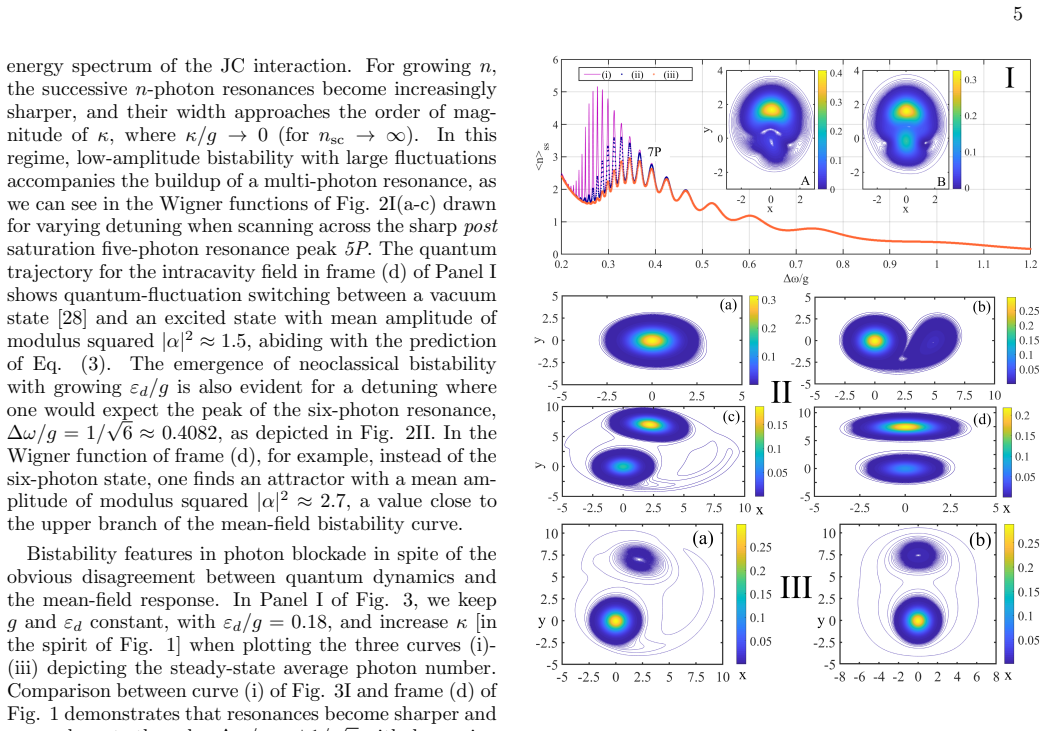
The central claim is that the strong-coupling thermodynamic limit of the open driven JC model is not a classical limit. As $n_{\mathrm{sc}}=g^2/(4\kappa^2)\to\infty$ at fixed $\varepsilon_d/g$ and $\Delta\omega/g$, the scaled semiclassical amplitude $|\alpha_{\mathrm{ss}}|^2/n_{\mathrm{sc}}$ vanishes, yet the quantum steady state keeps displaying the discrete JC spectral structure: $n$-photon resonances at $\Delta\omega/g=\pm 1/\sqrt{n}$ whose widths approach $\kappa$, accompanied by quantum-fluctuation switching between vacuum-like and excited metastable states. In the regime $\varepsilon_d\sim g\gg|\Delta\omega|$, quantum fluctuations organize the neoclassical bistability into complex-amplitude bimodality, gradually aligning the quantum and semiclassical pictures. On resonance, the quasi-energy spectrum collapses at $\varepsilon_d=g/2$, and the master equation yields a bimodal steady-state distribution below threshold, in contrast to the zero neoclassical amplitude at the critical point. The paper's discovery is therefore a two-sided correspondence: quantum fluctuations both preserve blockade against mean-field expectations and realize the critical behavior that the mean-field treatment only foreshadows.
Load-bearing premise
The whole three-regime picture rests on defining the thermodynamic limit as $n_{\mathrm{sc}}=g^2/(4\kappa^2)\to\infty$ at fixed $\varepsilon_d/g$ and $\Delta\omega/g$; if the relevant limit instead involves the spontaneous-emission rate $\gamma$ or a different combination of parameters, the persistence of photon blockade and the phase-transition claim would need revision.
Editorial extensions
If this is right
- In the limit $n_{\mathrm{sc}}\to\infty$ with small $\varepsilon_d/g$, increasing the coupling-to-loss ratio reveals more and sharper multi-photon resonances instead of a smooth classical response; the vacuum Rabi resonance saturates at roughly $\langle a^\dagger a\rangle_{\mathrm{ss}}\approx 1/4$.
- For drive amplitudes comparable to $g$, bistability provides the bridge between quantum and neoclassical pictures, and above threshold on resonance the cavity occupation grows as $|\alpha_{\mathrm{ss}}|^2=(g^2/4\kappa^2)[(2\varepsilon_d/g)^2-1]$, so a single strongly coupled emitter can reach arbitrarily large photon numbers.
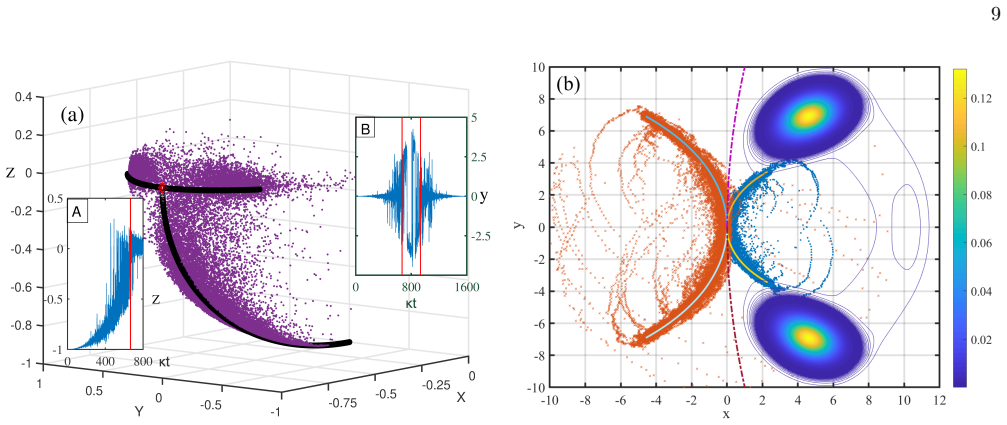
- At the critical point $\varepsilon_d=g/2$, the quasi-energy spectrum collapses and quantum fluctuations produce a bimodal steady state below threshold, meaning the zero-amplitude mean-field state is stabilized only by fluctuations.
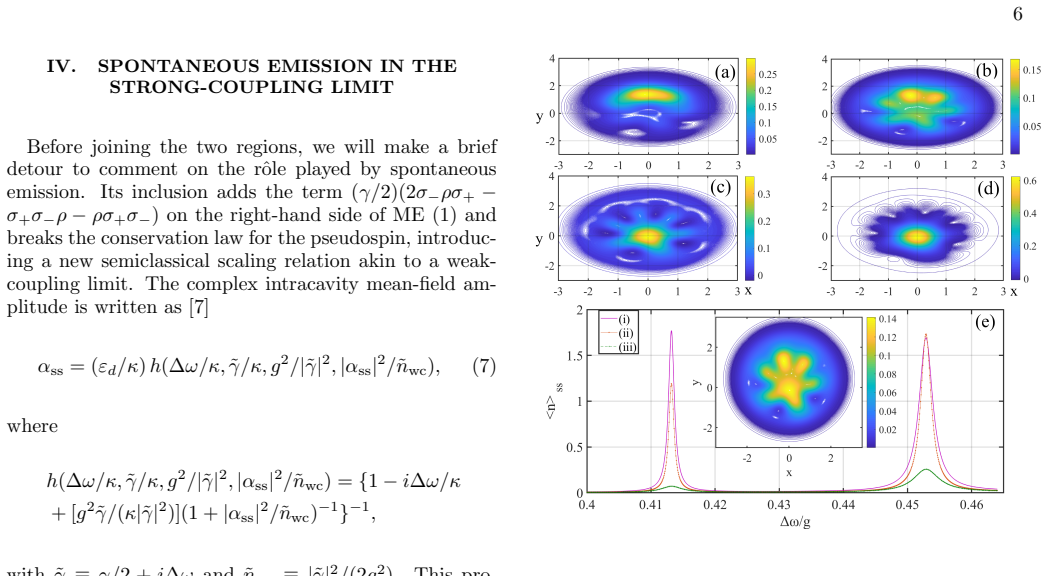
- Spontaneous emission, even when weak, introduces a competing weak-coupling scaling based on $\gamma^2/(8g^2)$ and progressively erases the higher-order multi-photon resonances, so the persistence of blockade is tied to keeping this second decoherence channel small.
- The strong-coupling thermodynamic limit can be reached with one emitter alone; the paper indicates that the same picture extends to generalized JC-Rabi models through a renormalized drive amplitude, so many emitters are not required for high excitation.
Reading between the lines
- Editorial extension: if one accepts $n_{\mathrm{sc}}\to\infty$ with fixed ratios as the correct thermodynamic limit, the resonance transition at $\varepsilon_d=g/2$ becomes a concrete candidate for a genuine zero-dimensional dissipative quantum phase transition; a quantitative signature is that the steady-state photon-number distribution below threshold should become bimodal as $g/\kappa$ grows.
- Editorial extension: the linewidth of the $n$-photon resonances is a direct experimental discriminator; the paper's claim implies each peak sharpens toward order $\kappa$ as $\kappa/g\to 0$ while retaining quantum-fluctuation-driven bimodal switching, which distinguishes blockade persistence from the semiclassical split-Lorentzian response.
- Editorial extension: the one-emitter result suggests the same critical phenomenology should be sought in ultrastrong-coupling JC-Rabi settings without the rotating-wave approximation; the paper cites the renormalized drive for that extension but does not itself work out the phase-transition behavior there.
Signed reviews
Editorial analysis
A structured set of objections, weighed in public.
Referee Report
Summary. This paper studies the open driven Jaynes-Cummings (JC) oscillator in the strong-coupling thermodynamic limit defined by nsc = g^2/(4κ^2) → ∞, with the ratios εd/g and Δω/g held fixed. The author reports three regimes of operation: (i) persistence of photon blockade, with multi-photon resonances at Δω/g = ±1/√n that remain visible as nsc grows; (ii) a bistability region in which quantum-fluctuation switching resolves a neoclassical complex-amplitude bimodality, associated with a first-order dissipative phase transition; and (iii) on resonance, a second-order dissipative quantum phase transition at εd = g/2, where the master equation predicts a bimodal steady-state distribution below threshold, in contrast to the neoclassical zero-amplitude prediction. The methods are the neoclassical scaling law of Eq. (3), exact diagonalization of the master equation in a truncated Hilbert space, and quantum-state-diffusion trajectories. The paper connects these results to the quasi-energy spectrum and to effective models such as the Kerr oscillator and the anharmonic ladder.
Significance. If the central claims hold, the paper offers a useful phenomenological map of the strong-coupling limit of a foundational driven-dissipative model, with concrete, falsifiable predictions for resonance positions and steady-state photon-number scalings. Its strengths include the systematic interconnection of photon blockade, bistability, and resonance criticality; the explicit asymptotic expressions such as Eqs. (5), (8), and (11); and the use of both master-equation and quantum-trajectory evidence. However, the paper is largely a numerical and asymptotic exploration built on the framework of prior work [7], [19], [20], [23]. The most important claim, the second-order dissipative quantum phase transition, is supported only by finite-size signatures, and the paper does not provide the scaling analysis needed to establish a genuine singular limit in nsc. Because of this, the significance is currently conditional on additional numerical and analytic support.
major comments (4)
- [Sec. VI (Fig. 6; Eq. (11))] The central claim of a second-order dissipative quantum phase transition at εd = g/2 is supported only by finite-nsc evidence: the Q-function bimodality in Fig. 6(c) for g/κ = 100 and the single switching trajectory in Fig. 6(d). The paper does not provide a finite-size scaling analysis in nsc = g^2/(4κ^2), does not compute a Liouvillian gap or an order-parameter cumulant, and does not derive a below-threshold scaling law analogous to Eq. (11). The conceptual difficulties cited from [6] and the finite-size peak-height versus peak-area distinction cited from [30] are not implemented as checks. Without such an analysis, one cannot distinguish a genuine second-order transition in the nsc → ∞ limit from a finite-size precursor that collapses to a single squeezed state in the limit. This gap is load-bearing for the paper's most important claim and needs to be addressed before the transition can be considered established.
- [Sec. II (Eq. (3))] The strong-coupling thermodynamic limit is defined solely by nsc = g^2/(4κ^2) → ∞ with fixed εd/g and Δω/g. The paper does not justify that this is the exhaustive or most relevant scaling for the driven dissipative JC model, and it does not address the concerns in [6] about defining dissipative phase transitions with non-conserved particle number. Since the limit also takes g/κ → ∞, one should show that the steady state is independent of the order of limits, for example by comparing the κ → 0 limit at fixed nonzero γ with the γ → 0 limit at finite κ, or by verifying that finite-κ corrections do not alter the qualitative conclusions. As written, the 'three regimes' classification and the phase-transition claim depend on this unexamined definition of the thermodynamic limit.
- [Numerical methods (Sec. I; Figs. 2-6)] All master-equation results are obtained by 'exact diagonalization in a truncated Hilbert space' (Sec. I), but the truncation dimension is never stated and no convergence checks are reported. For the largest values of nsc used here (g/κ = 5000 or 10^4, with ⟨n⟩_ss up to about 43, e.g., Fig. 3II(d)), an insufficient truncation cutoff could substantially alter the quasi-probability distributions and the apparent bimodality in Figs. 2, 3, and 6. The authors should report the truncation cutoff and demonstrate convergence of steady-state quantities with increasing cutoff for at least the representative parameter points of Figs. 6 and 3II. This is particularly relevant because the phase-transition evidence rests on the shapes of these distributions.
- [Sec. V (Fig. 3II; Fig. 5; Ref. [30])] The characterization of a first-order dissipative quantum phase transition in Sec. V uses the criterion of equal peak heights in the Q function to define the boundary value nsc,b. In light of footnote [30], which explicitly notes that equal peak areas do not imply equal peak heights at finite size, the text is ambiguous about which measure defines the phase boundary. A scaling analysis in nsc is required to substantiate the existence and location of the first-order transition; as written, 'the boundary' is an arbitrary finite-size definition rather than a demonstrated transition point.
minor comments (5)
- [Sec. V (Eq. (9))] The substitution Δω = g/√⟨n⟩ with ⟨n⟩ treated as a continuous variable is an ansatz; the paper should present it as such and, ideally, justify it by a controlled asymptotic expansion rather than presenting Eq. (9) as a derived self-consistency relation.
- [Sec. V (Fig. 5; Ref. [30])] The phrase 'equiprobable metastable states' is ambiguous because equal peak areas and equal peak heights are not equivalent at finite nsc; the text should specify which criterion is used for the histogram in Fig. 5.
- [References (footnote [30])] The inline reference to Bonifacio et al., Phys. Rev. A 18, 2266 (1978), in footnote [30] is not included in the reference list; this should be fixed.
- [Introduction and abstract] There are several typographical errors, such as 'experimantally' in the Introduction and 'rˆole' in the abstract; these should be corrected in a final version.
- [General] No code or data availability statement is provided; the authors should indicate whether the simulation scripts used to produce the figures are available, to aid reproducibility.
Circularity Check
No significant circularity: the central master-equation results are computed independently, and the cited scaling/spectrum results are external inputs used for comparison.
full rationale
The paper's central claims are supported by independent numerical solution of the master equation (1) and unravelled quantum trajectories (Sec. II and note [17]), not by curve-fitting or by redefinition. The photon-blockade resonance positions Δω/g=±1/√n follow from the explicitly stated JC dressed-state spectrum and are verified in Figs. 1–3; they are not extracted from the data. The strong-coupling parameter nsc=g²/(4κ²) and the neoclassical law Eq. (3) are adopted from prior work ([7] and references therein) as a comparison baseline, and the quasi-energy collapse and bifurcation at εd=g/2 are cited from [19,20,21,23]; these are external analytical results, not conclusions manufactured by the paper's own numerics. The bimodal Q functions below threshold (Fig. 6) and the switching trajectories (Fig. 7) are direct ME outputs. The evidentiary gap—no Liouvillian-gap or finite-size scaling in nsc near the critical point—is a correctness or completeness concern about whether a true thermodynamic-limit phase transition exists, not a circular reduction of the claim to its inputs. Heavy citation of Carmichael and Alsing-Carmichael works reflects an acknowledged research lineage but does not, on the quoted equations, force the paper's conclusions.
Assumptions & free parameters
assumptions (5)
- domain assumption The Born-Markov, rotating-wave, and zero-temperature reservoir approximations describe the driven cavity-atom system.
- domain assumption The neoclassical scaling law, Eq. (3), from Carmichael 2015 [7] is an appropriate semiclassical baseline.
- domain assumption The strong-coupling thermodynamic limit is attained by nsc = g^2/(4κ^2) → ∞ with εd/g and Δω/g fixed.
- domain assumption The quasi-energy spectrum Ω_{m,±} = ±√m g [1 - (2εd/g)^2]^{3/4} at resonance is valid.
- ad hoc to paper Truncation of the Hilbert space and the quantum-state-diffusion unravelling faithfully represent the exact Liouvillian dynamics.
Cite this review
Pith. "Pith review of Strong-coupling limit of the driven dissipative light-matter interaction." pith.science (2026). https://pith.science/paper/JW7DQWR7
@misc{pith2026190803754,
  author       = {Pith},
  title        = {Pith review of: Strong-coupling limit of the driven dissipative light-matter interaction},
  year         = {2026},
  howpublished = {\url{https://pith.science/paper/JW7DQWR7}},
  note         = {Machine review of arXiv:1908.03754}
}
read the original abstract
We approach the strong-coupling thermodynamic limit in the response of the open driven Jaynes-Cummings (JC) oscillator. We do so by highlighting the role of quantum fluctuations against the semiclassical response in three distinct regimes of operation. We begin by demonstrating the persistence of photon blockade, predicted in [H. J. Carmichael, Phys. Rev. X 5, 031028 (2015)], as a manifestation of the inherently-quantum and nonlinear JC spectrum revealed for vanishing dissipation. We then proceed to discuss the importance of bistability, which, despite being present in photon blockade, is able to provide an alignment between the semiclassical nonlinearity and quantum dynamics only for a driving amplitude having the same order of magnitude as the light-matter coupling strength. This resolution brings us to the critical point of the well-known quantum phase transition of second order on resonance, where the quantum and semiclassical pictures are once more contrasted for a varying participation of the two coherent interactions when going through the collapse of the quasi-energy spectrum.
Figures


Figures from the paper (4 more)


Reference graph
Works this paper leans on
-
[30]
3 sets in for ∆ω/g ≈ 0.59, past the first few resonances —compare with Fig
Semiclassical bistability in Panel I of Fig. 3 sets in for ∆ω/g ≈ 0.59, past the first few resonances —compare with Fig. 1(d). We also note that for a given (nonzero) value of ∆ω/g and a large enough nsc, the neoclassical bistability curve againstεd/g is not affected by a further decrease of the dissipation rate, as Eq. (8) suggests for higher excitation
-
[6]
Klaers, J
J. Klaers, J. Schmitt, F. Vewinger, and M. Weitz, Nature 468, 545 (2010)
2010
-
[7]
Minganti, A
F. Minganti, A. Biella, N. Bartolo, and C. Ciuti, Phys. Rev. A 98, 042118 (2018)
2018
-
[19]
R. Schack and T. A. Brun, Computer Physics Commu- nications 102, 210 (1997)
work page 1997
-
[20]
P. Alsing and H. J. Carmichael, Quantum Optics: Jour- nal of the European Optical Society Part B 3, 13 (1991)
work page 1991
-
[23]
R. Guti´ errez-J´ auregui and H. J. Carmichael, Phys. Rev. A 98, 023804 (2018)
work page 2018
-
[1]
In the same limit, the Bloch vector fluctuates max- imally between the attractors ( X = 0,Y =±1) on the equatorial plane. When quantum fluctuations are taken into account, the separation between the two distributions of phase bi- modality in the phase space of the cavity field decreases when lowering nsc; in the extreme case where g/κ≈ 1, they merge to produ...
-
[2]
Carusotto, D
I. Carusotto, D. Gerace, H. E. Tureci, S. De Liberato, C. Ciuti, and A. Imamoˇ glu, Phys. Rev. Lett.103, 033601 (2009)
2009
Show all 33 references
-
[3]
Kilda and J
D. Kilda and J. Keeling, Phys. Rev. Lett. 122, 043602 (2019)
2019
-
[4]
Hannukainen and J
J. Hannukainen and J. Larson, Phys. Rev. A 98, 042113 (2018)
2018
-
[5]
Baumann, C
K. Baumann, C. Guerlin, F. Brennecke, and T. Esslinger, Nature 464, 1301 (2010)
2010
-
[8]
H. J. Carmichael, Phys. Rev. X 5, 031028 (2015)
2015
-
[9]
E. T. Jaynes and F. W. Cummings, Proceedings of the IEEE 51, 89 (1963)
1963
-
[10]
Carmichael, Statistical Methods in Quantum Op- tics 1: Master Equations and FokkerPlanck Equations (Springer, Berlin, 1999)
H. Carmichael, Statistical Methods in Quantum Op- tics 1: Master Equations and FokkerPlanck Equations (Springer, Berlin, 1999)
1999
-
[11]
H. J. Carmichael and C. Noh, Physica E: Low- dimensional Systems and Nanostructures 42, 399 (2010), Proceedings of FQMT ’08. 11
2010
-
[12]
C. M. Savage and H. J. Carmichael, IEEE Journal of Quantum Electronics 24, 1495 (1988)
1988
-
[13]
Imamoˇ glu, H
A. Imamoˇ glu, H. Schmidt, G. Woods, and M. Deutsch, Phys. Rev. Lett. 79, 1467 (1997)
1997
-
[14]
J. M. Fink, A. Dombi, A. Vukics, A. Wallraff, and P. Domokos, Phys. Rev. X 7, 011012 (2017)
2017
-
[15]
Vukics, A
A. Vukics, A. Dombi, J. M. Fink, and P. Domokos, Quantum 3, 150 (2019)
2019
-
[16]
J. M. Fink, M. G¨ oppl, M. Baur, R. Bianchetti, P. J. Leek, A. Blais, and A. Wallraff, Nature 454, 315 EP (2008)
2008
-
[17]
L. S. Bishop, J. M. Chow, J. Koch, A. A. Houck, M. H. Devoret, E. Thuneberg, S. M. Girvin, and R. J. Schoelkopf, Nature Physics 5, 105 (2008)
2008
-
[18]
We use the Quantum Optics Toolbox in Matlab for exact diagonalization of the Liouvillian, and the QSD C++ library for the generation of quantum trajectories (quan- tum state diffusion with adaptive stepsize)
-
[21]
Carmichael, Statistical Methods in Quantum Optics 2: Non-Classical Fields (Springer, Berlin, 2008)
H. Carmichael, Statistical Methods in Quantum Optics 2: Non-Classical Fields (Springer, Berlin, 2008)
2008
-
[22]
Alsing, D.-S
P. Alsing, D.-S. Guo, and H. J. Carmichael, Phys. Rev. A 45, 5135 (1992)
1992
-
[24]
Guti´ errez-J´ auregui and H
R. Guti´ errez-J´ auregui and H. J. Carmichael, Physica Scripta 93, 104001 (2018)
2018
-
[25]
Dimer, B
F. Dimer, B. Estienne, A. S. Parkins, and H. J. Carmichael, Phys. Rev. A 75, 013804 (2007)
2007
-
[26]
P. D. Drummond and D. F. Walls, Journal of Physics A: Mathematical and General 13, 725 (1980)
1980
-
[27]
S. S. Shamailov, A. Parkins, M. J. Collett, and H. J. Carmichael, Optics Communications 283, 766 (2010)
2010
-
[28]
Tian and H
L. Tian and H. J. Carmichael, Phys. Rev. A 46, R6801 (1992)
1992
-
[29]
Also frequently called dim state , as its photon average can be very small in comparison to that of the excited state yet nonzero
-
[31]
VIII of [Bonifacio R
The qualification of equal probability is used in a loose sense here, since the condition of equal areas under the two peaks in the quasi-probability distribution does not also mean equal peak heights in the presence of quan- tum fluctuations for a finite-size scaling —see Sec. V...
1978
-
[32]
Kerckhoff, M
J. Kerckhoff, M. A. Armen, and H. Mabuchi, Opt. Ex- press 19, 24468 (2011)
2011
-
[33]
(16.203) of [20]
We note that in the limit of weak excitation within a dressed-state formulation, where εd/g≪ 1, the photon number average differs from zero by ⟨a†a⟩ss≈ 2(εd/g)4 —see Eq. (16.203) of [20]
Reviewed August 14, 2026 · model on record in the stance chip above.
Discussion (0). Continue with ORCID to comment.