Velocity-Controlled Directional Readout of Single Photons
Pith reviewed 2026-05-21 04:34 UTC · model grok-4.3
The pith
Uniform motion of a Glauber detector converts single-photon propagation direction into a detection bias via Doppler shift and finite bandwidth.
A machine-rendered reading of the paper's core claim, the machinery that carries it, and where it could break.
Core claim
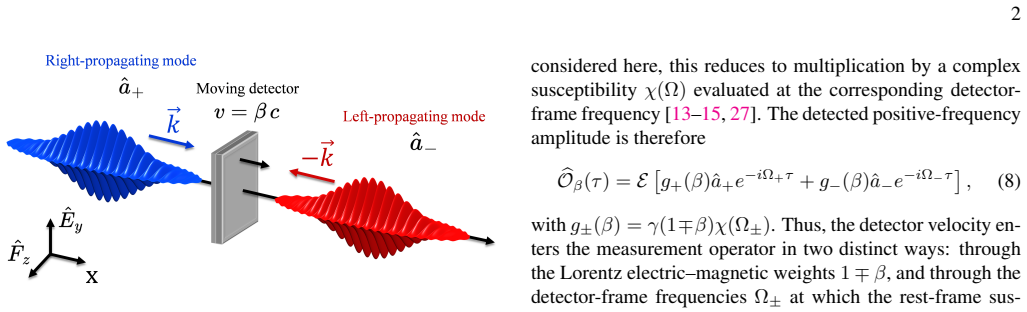
Uniform motion of an electric Glauber detector changes the single-click POVM realized on two counterpropagating single-photon modes. Motion Doppler-shifts the alternatives in the detector frame; finite bandwidth then converts propagation direction into a detection bias without decohering the photon. For a Lorentzian response near one Doppler branch, the readout crosses from phase-sensitive to direction-sensitive with a quality-factor-enhanced onset. Finite-time integration adds Doppler-beat visibility loss, separating passive covariance from measurement change.
What carries the argument
The Doppler-shifted single-click POVM realized by a finite-bandwidth detector, specifically a Lorentzian response near one Doppler branch that converts direction into detection bias.
Load-bearing premise
The detector response is modeled as Lorentzian near one Doppler branch.
What would settle it
Measure whether single-click probabilities for counterpropagating photons become unequal under detector motion at velocities where the Doppler branches separate within the detector bandwidth, and check that the imbalance vanishes when the detector is stationary or when bandwidth is made infinite.
Figures


read the original abstract
Photodetection is usually treated in the frame in which the detector is at rest relative to the optical apparatus. We show that uniform motion of an electric Glauber detector changes the single-click POVM realized on two counterpropagating single-photon modes. Motion Doppler-shifts the alternatives in the detector frame; finite bandwidth then converts propagation direction into a detection bias without decohering the photon. For a Lorentzian response near one Doppler branch, the readout crosses from phase-sensitive to direction-sensitive with a quality-factor-enhanced onset. Finite-time integration adds Doppler-beat visibility loss, separating passive covariance from measurement change.
Editorial analysis
A structured set of objections, weighed in public.
Referee Report
Summary. The manuscript claims that uniform motion of an electric Glauber detector modifies the single-click POVM acting on two counterpropagating single-photon modes. Doppler shifts in the detector frame, combined with finite detector bandwidth, convert propagation direction into a detection bias without decohering the photon state. For a Lorentzian response centered near one Doppler branch, the readout transitions from phase-sensitive to direction-sensitive with a quality-factor-enhanced onset; finite-time integration introduces additional Doppler-beat visibility loss that separates passive covariance from the measurement change itself.
Significance. If the central derivation holds, the result is significant for relativistic quantum optics: it demonstrates an explicit mechanism by which detector motion alone can engineer a directional bias in single-photon detection while preserving the photon's quantum state. The separation of passive Lorentz covariance from an active change in the realized POVM is a clean conceptual contribution. The grounding in standard Glauber detection theory and explicit treatment of finite bandwidth and integration time are strengths that make the claim falsifiable and potentially relevant to moving-frame quantum communication or sensing protocols.
major comments (1)
- The directional-bias claim and the quality-factor enhancement are derived under the explicit assumption of a Lorentzian detector response near one Doppler-shifted frequency branch. The manuscript should state whether the same qualitative crossover from phase-sensitive to direction-sensitive readout persists for other physically plausible lineshapes (e.g., Gaussian or flat-top) or whether the effect is an artifact of the Lorentzian pole structure; this is load-bearing for the generality of the result.
minor comments (1)
- The abstract and introduction would benefit from a single sentence clarifying the relation between the finite-time integration window and the Doppler-beat visibility loss, to help readers distinguish the two mechanisms at a glance.
Simulated Author's Rebuttal
We thank the referee for their positive assessment and constructive comment, which helps strengthen the generality of our claims. We address the point below and will update the manuscript accordingly.
read point-by-point responses
-
Referee: The directional-bias claim and the quality-factor enhancement are derived under the explicit assumption of a Lorentzian detector response near one Doppler-shifted frequency branch. The manuscript should state whether the same qualitative crossover from phase-sensitive to direction-sensitive readout persists for other physically plausible lineshapes (e.g., Gaussian or flat-top) or whether the effect is an artifact of the Lorentzian pole structure; this is load-bearing for the generality of the result.
Authors: We agree that generality merits explicit discussion. The directional bias arises because uniform motion Doppler-shifts the two counterpropagating modes relative to the detector’s finite bandwidth, so that one mode overlaps the response function more than the other; this separation of branches is independent of the precise functional form of the lineshape. The Lorentzian was chosen solely for analytic tractability, yielding closed-form expressions that make the quality-factor enhancement transparent. For other common responses (Gaussian, flat-top, or even rectangular), the same qualitative crossover from phase-sensitive to direction-sensitive readout occurs whenever the bandwidth is finite and centered near one Doppler branch, although the precise onset sharpness and visibility loss will differ quantitatively. The pole structure is therefore a calculational convenience, not the origin of the effect. We will add a short clarifying paragraph (and a footnote) in the revised manuscript stating this robustness and noting that the core mechanism—Doppler-induced differential overlap with a finite-bandwidth detector—remains operative for any physically plausible response function. revision: yes
Circularity Check
No circularity: derivation uses external standard models and explicit assumptions
full rationale
The paper's central claim follows from applying Lorentz transformations to the detector frame and standard Glauber photodetection theory to counterpropagating modes, with finite bandwidth converting Doppler shifts into detection bias. The Lorentzian response is introduced as an explicit modeling choice for one Doppler branch rather than derived from or fitted to the target result. No equations reduce the directional POVM change to a self-citation chain, a parameter fit renamed as prediction, or a definitional loop. The derivation remains self-contained against external benchmarks of quantum optics and special relativity, consistent with the absence of load-bearing self-references or ansatz smuggling.
Axiom & Free-Parameter Ledger
axioms (2)
- domain assumption Glauber coherent-state detector model for single-photon POVM
- domain assumption Finite-bandwidth Lorentzian response function
Reference graph
Works this paper leans on
-
[1]
R. J. Glauber, Physical Review130, 2529 (1963)
work page 1963
-
[2]
P. L. Kelley and W. H. Kleiner, Physical Review136, A316 (1964)
work page 1964
-
[3]
L. Mandel and E. Wolf,Optical Coherence and Quantum Op- tics(Cambridge University Press, Cambridge, 1995)
work page 1995
-
[4]
Loudon,The Quantum Theory of Light, 3rd ed
R. Loudon,The Quantum Theory of Light, 3rd ed. (Oxford Uni- versity Press, Oxford, 2000)
work page 2000
-
[5]
J. D. Jackson,Classical Electrodynamics, 3rd ed. (Wiley, Hobo- ken, NY , 2009)
work page 2009
-
[6]
N. D. Birrell and P. C. W. Davies,Quantum Fields in Curved Space, 1st ed. (Cambridge University Press, 1982)
work page 1982
- [7]
-
[8]
Hawton, Physical Review A87, 042116 (2013)
M. Hawton, Physical Review A87, 042116 (2013)
work page 2013
-
[9]
Tanimura, Physica ScriptaT160, 014039 (2014)
S. Tanimura, Physica ScriptaT160, 014039 (2014)
work page 2014
-
[10]
M. Hatifi and B. Stout, Basis- and Channel-Selective Quantum Photodetection (2026)
work page 2026
-
[11]
E. B. Davies and J. T. Lewis, Communications in Mathematical Physics17, 239 (1970)
work page 1970
-
[12]
J. Polo-Gómez, L. J. Garay, and E. Martín-Martínez, Physical Review D105, 065003 (2022)
work page 2022
-
[13]
A. A. Clerk, M. H. Devoret, S. M. Girvin, F. Marquardt, and R. J. Schoelkopf, Reviews of Modern Physics82, 1155 (2010)
work page 2010
-
[14]
S. J. Van Enk, Physical Review A96, 033834 (2017)
work page 2017
-
[15]
T. B. Propp and S. J. Van Enk, Physical Review A100, 033836 (2019)
work page 2019
-
[16]
T. J. Kippenberg and K. J. Vahala, Science321, 1172 (2008)
work page 2008
- [17]
-
[18]
K. Fang, Z. Yu, and S. Fan, Nature Photonics6, 782 (2012)
work page 2012
-
[19]
S. R. Sathyamoorthy, T. M. Stace, and G. Johansson, Comptes Rendus. Physique17, 756 (2016)
work page 2016
-
[20]
D. L. Sounas and A. Alù, Nature Photonics11, 774 (2017)
work page 2017
- [21]
-
[22]
L. Yuan, Q. Lin, M. Xiao, and S. Fan, Optica5, 1396 (2018)
work page 2018
- [24]
-
[25]
M. K. Akhlaghi, E. Schelew, and J. F. Young, Nature Commu- nications6, 8233 (2015)
work page 2015
-
[26]
Hatifi, Physical Review A113, 022204 (2026)
M. Hatifi, Physical Review A113, 022204 (2026)
work page 2026
-
[27]
S. M. Young, M. Sarovar, and F. Léonard, Physical Review A 98, 063835 (2018)
work page 2018
-
[28]
M. Srinivas and E. Davies, Optica Acta: International Journal of Optics28, 981 (1981)
work page 1981
-
[29]
C. W. Helstrom, ed.,Quantum Detection and Estimation The- ory, Mathematics in Science and Engineering No. v. 123 (Aca- demic Press, New York, 2010)
work page 2010
-
[30]
W. K. Wootters and W. H. Zurek, Physical Review D19, 473 (1979)
work page 1979
-
[31]
D. M. Greenberger and A. Yasin, Physics Letters A128, 391 (1988)
work page 1988
- [32]
-
[33]
Englert, Physical Review Letters77, 2154 (1996)
B.-G. Englert, Physical Review Letters77, 2154 (1996)
work page 1996
-
[34]
M. N. Bera, T. Qureshi, M. A. Siddiqui, and A. K. Pati, Physical Review A92, 012118 (2015)
work page 2015
-
[35]
C. W. Gardiner and M. J. Collett, Physical Review A31, 3761 (1985)
work page 1985
-
[36]
C. W. Gardiner and P. Zoller,Quantum Noise: A Handbook of Markovian and Non-Markovian Quantum Stochastic Methods with Applications to Quantum Optics, 3rd ed., Springer Series in Synergetics (Springer, Berlin Heidelberg, 2010)
work page 2010
-
[37]
D. F. Walls and G. J. Milburn,Quantum Optics, 2nd ed., Springer eBook Collection (Springer Berlin Heidelberg, Berlin, Heidelberg, 2008)
work page 2008
-
[38]
A. Blais, R.-S. Huang, A. Wallraff, S. M. Girvin, and R. J. Schoelkopf, Physical Review A69, 062320 (2004)
work page 2004
-
[39]
A. Wallraff, D. I. Schuster, A. Blais, L. Frunzio, R.-S. Huang, J. Majer, S. Kumar, S. M. Girvin, and R. J. Schoelkopf, Nature 431, 162 (2004)
work page 2004
-
[40]
M. Aspelmeyer, T. J. Kippenberg, and F. Marquardt, Reviews of Modern Physics86, 1391 (2014)
work page 2014
-
[41]
I. Holzman and Y . Ivry, Advanced Quantum Technologies2, 1800058 (2019)
work page 2019
-
[42]
E. Galiffi, R. Tirole, S. Yin, H. Li, S. Vezzoli, P. A. Huidobro, M. G. Silveirinha, R. Sapienza, A. Alù, and J. B. Pendry, Ad- vanced Photonics4, 10.1117/1.AP.4.1.014002 (2022)
-
[43]
A. C. Harwood, S. Vezzoli, T. V . Raziman, C. Hooper, R. Ti- role, F. Wu, S. A. Maier, J. B. Pendry, S. A. R. Horsley, and R. Sapienza, Nature Communications16, 5147 (2025)
work page 2025
discussion (0)
Sign in with ORCID, Apple, or X to comment. Anyone can read and Pith papers without signing in.