Lessons from the Adoption and Deprecation of the Privacy Sandbox Web APIs
Pith reviewed 2026-06-26 01:05 UTC · model grok-4.3
The pith
Privacy Sandbox APIs saw limited and uneven adoption by web actors before deprecation.
A machine-rendered reading of the paper's core claim, the machinery that carries it, and where it could break.
Core claim
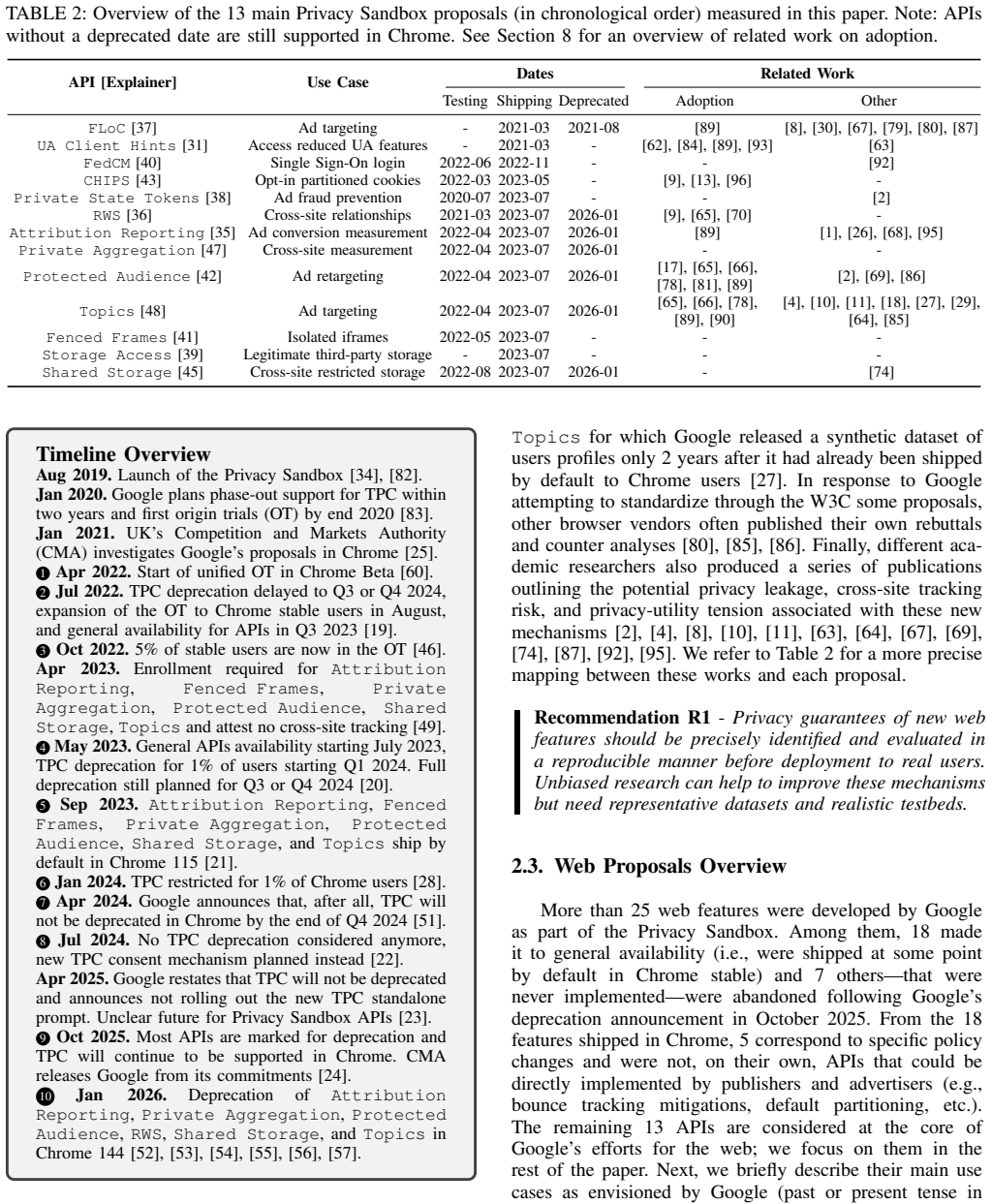
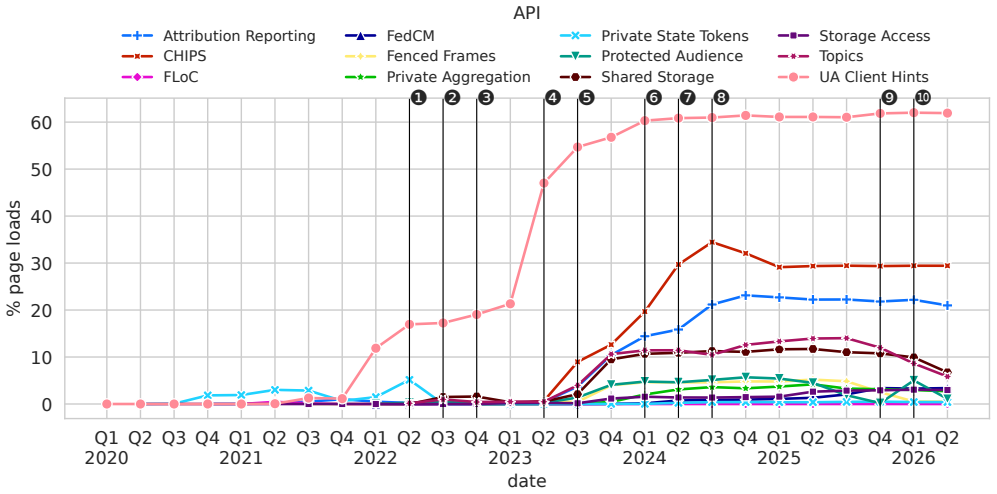
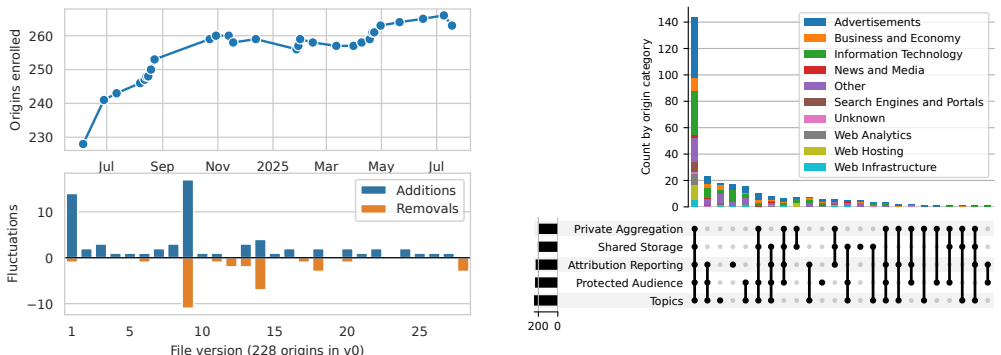
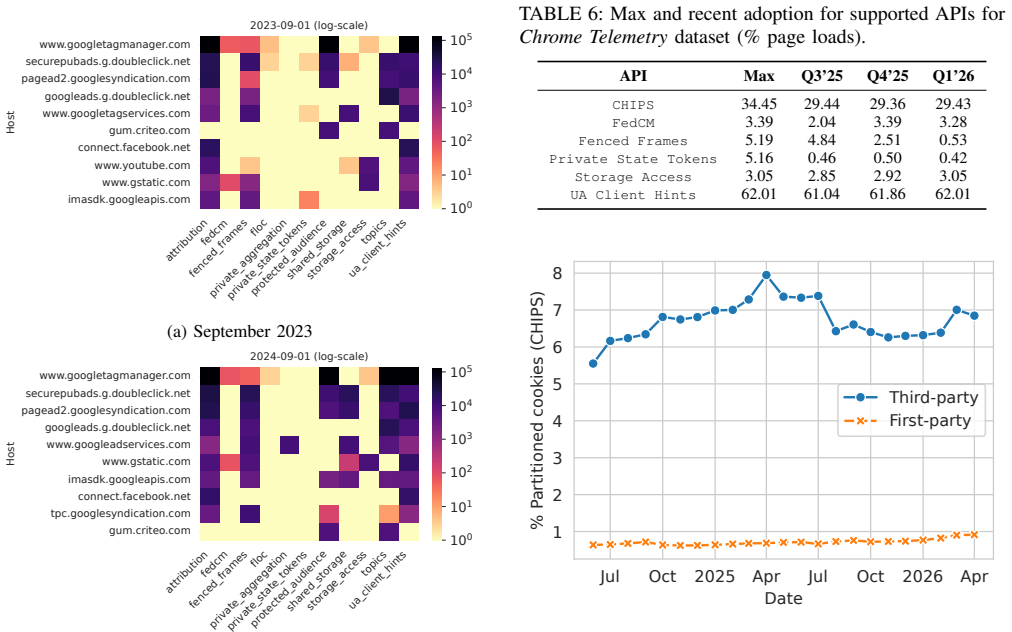
The Privacy Sandbox initiative introduced several web APIs to replace third-party cookies for advertising and other uses while protecting privacy. Our longitudinal study of their prevalence on the top 100,000 websites and in Chrome user telemetry shows that adoption remained limited and uneven across the years. Only few web actors implemented very specific APIs, and in disparate manners. We interpret these results through the lens of incentives and risks for web actors, and provide recommendations for future proposals. The findings also highlight limitations of browser-based approaches to privacy, as seen in differing implementations across browsers.
What carries the argument
Longitudinal measurement of API prevalence using historical HTTP Archive crawls and public Chrome telemetry data on CrUX top 100k sites.
If this is right
- Actionable recommendations for the next generation of web privacy proposals can be derived from the observed adoption patterns and actor incentives.
- Tracking and third-party cookie limitations in Chrome remain largely opt-in, while other browsers have enabled them by default.
- Disparities across browsers limit the effectiveness of browser-based privacy remedies.
Where Pith is reading between the lines
- Future privacy proposals may need to reduce resource and timeline barriers for smaller web actors to improve uptake.
- The observed risks around legal exposure and competitive trade-offs could explain why most sites avoided the APIs even when available.
- Coordinated standards enforced across multiple browsers might produce higher and more uniform adoption than single-browser initiatives.
Load-bearing premise
The historical HTTP Archive crawls and public Chrome telemetry data accurately characterize the prevalence of each Privacy Sandbox feature on popular websites and as experienced by Chrome users.
What would settle it
A large-scale source-code audit of CrUX top sites revealing widespread active use of the APIs in patterns not shown by the telemetry data would challenge the limited-adoption finding.
Figures
read the original abstract
While several web actors have been trying to reduce web tracking for years, it remains unclear how to achieve both desirable levels of utility and privacy. In 2019, Google launched the Privacy Sandbox initiative to balance that trade-off and find privacy alternatives to common use cases such as advertising. Yet, in late 2025, Google canceled the project and deprecated most of the newly introduced APIs. Despite its end, the Privacy Sandbox represents a unique opportunity to learn about how the ecosystem reacted to the proposed changes and make observations about why and how it failed. In this paper, we present a longitudinal measurement and analysis study of the Privacy Sandbox APIs to characterize their adoption and deprecation over the past seven years by different web actors. Leveraging historical HTTP Archive crawls and public Chrome telemetry data, we offer the largest study of its kind into the prevalence of each Privacy Sandbox feature, during their entire respective lifetime (5+ years for some), on popular websites (CrUX top 100k), and as experienced by Chrome users during their browsing journey. Our results showcase an adoption that remained limited and uneven across the years; only few web actors implemented very specific APIs, and in disparate manners. We motivate our interpretation of these results by considering the incentives (interest, resources, timeline, etc.) and risks (potential trade-offs, privacy violations, and legal exposure, etc.) for these actors. Finally, our analysis also yields actionable recommendations for the next generation of web privacy proposals. More broadly, the Privacy Sandbox illustrates the limitations and disparities across browsers of ``fix it in the browser'' remedies: today, tracking and third-party cookies limitations in Chrome still remain largely opt-in, while they have been enabled by default on other browsers like Brave, Firefox, or Safari.
Editorial analysis
A structured set of objections, weighed in public.
Referee Report
Summary. The paper conducts a longitudinal measurement study of Google's Privacy Sandbox APIs (2019-2025) using historical HTTP Archive crawls and public Chrome telemetry. It measures prevalence of each API on CrUX top-100k sites across their full lifetimes, reports limited and uneven adoption by few actors in disparate ways, analyzes incentives/risks for web actors, and derives recommendations for future privacy proposals while noting cross-browser disparities in third-party cookie handling.
Significance. If the adoption measurements are reliable, the study supplies a rare empirical case study of a large-scale, multi-year browser privacy intervention that was ultimately deprecated. The use of public longitudinal datasets spanning 5+ years per API is a clear strength, enabling observations about ecosystem response that could guide the next generation of web privacy standards.
major comments (2)
- [Data Sources / Measurement section] Data Sources / Measurement section: The central claim of 'limited and uneven adoption' rests on HTTP Archive scripted crawls and aggregated Chrome telemetry without any validation, sensitivity analysis, or discussion of under-detection for conditional/third-party/gesture-dependent calls (e.g., Topics, Protected Audience). The skeptic concern lands directly here; the reported prevalence figures are therefore unquantified lower bounds whose distance from true deployment rates is unknown, undermining the load-bearing conclusion.
- [Results section] Results section: No quantitative metrics, error bars, confidence intervals, or details on how adoption was operationalized (e.g., exact detection heuristics, handling of CrUX top-100k selection bias) are provided, despite the abstract's high-level description of the data sources. This absence prevents assessment of the 'uneven across the years' and 'disparate manners' claims.
minor comments (1)
- [Abstract] Abstract and introduction could more explicitly state the exact set of Privacy Sandbox APIs examined and their individual deprecation timelines.
Simulated Author's Rebuttal
We thank the referee for their detailed and constructive feedback. The comments highlight important aspects of measurement validity and presentation that we address below. We have revised the manuscript to incorporate additional discussion, heuristics, and analysis where feasible.
read point-by-point responses
-
Referee: [Data Sources / Measurement section] The central claim of 'limited and uneven adoption' rests on HTTP Archive scripted crawls and aggregated Chrome telemetry without any validation, sensitivity analysis, or discussion of under-detection for conditional/third-party/gesture-dependent calls (e.g., Topics, Protected Audience). The skeptic concern lands directly here; the reported prevalence figures are therefore unquantified lower bounds whose distance from true deployment rates is unknown, undermining the load-bearing conclusion.
Authors: We agree that HTTP Archive crawls provide observable lower bounds rather than exhaustive coverage, particularly for APIs invoked conditionally or via gestures. The manuscript already notes reliance on public longitudinal datasets as a strength, but we have added a new subsection in Data Sources explicitly discussing under-detection risks, the nature of scripted crawls versus real-user behavior, and why Chrome telemetry is aggregated. We performed a limited sensitivity analysis by re-running detection with relaxed heuristics on a sample of sites and report the variance in an appendix. While full validation against ground truth is not possible with public data alone, the relative trends and actor-specific patterns remain robust for the paper's interpretive claims about incentives and ecosystem response. revision: yes
-
Referee: [Results section] No quantitative metrics, error bars, confidence intervals, or details on how adoption was operationalized (e.g., exact detection heuristics, handling of CrUX top-100k selection bias) are provided, despite the abstract's high-level description of the data sources. This absence prevents assessment of the 'uneven across the years' and 'disparate manners' claims.
Authors: We have expanded the Results section with a dedicated 'Measurement Operationalization' paragraph detailing the exact JavaScript and header-based detection heuristics for each API, including how we handled CrUX top-100k snapshots and potential selection effects. We now report year-over-year prevalence with basic trend metrics and note where sample sizes permit simple binomial confidence intervals (added to key figures). A brief discussion of CrUX bias (e.g., popularity skew toward large sites) has been included, with the observation that our findings on limited adoption are conservative given the focus on high-traffic domains. revision: yes
Circularity Check
No circularity: purely observational measurement from external datasets
full rationale
The paper performs a longitudinal measurement study that directly reports prevalence statistics drawn from two external public data sources (historical HTTP Archive crawls and aggregated Chrome telemetry). No equations, fitted parameters, predictions, or derivations appear in the provided text. The central claim of limited and uneven adoption is presented as an empirical observation rather than a result derived from any internal model or self-citation chain. No load-bearing steps reduce to the paper's own inputs by construction.
Axiom & Free-Parameter Ledger
axioms (1)
- domain assumption Historical HTTP Archive crawls and public Chrome telemetry data are representative of API prevalence on popular websites and user browsing experience.
Reference graph
Works this paper leans on
-
[1]
Hidayet Aksu, Badih Ghazi, Pritish Kamath, Ravi Kumar, Pasin Manurangsi, Adam Sealfon, and Avinash V . Varadarajan. Summary Reports Optimization in the Privacy Sandbox Attribution Report- ing API.Proceedings on Privacy Enhancing Technologies, 2024. https://doi.org/10.56553/popets-2024-0132
-
[2]
Mir Masood Ali, Binoy Chitale, Mohammad Ghasemisharif, Chris Kanich, Nick Nikiforakis, and Jason Polakis. Navigating Murky Waters: Automated Browser Feature Testing for Uncovering Tracking Vectors.In Proceedings 2023 Network and Distributed System Security Symposium. 2023. https://doi.org/10.14722/ndss.2023.24072
-
[3]
Bissyand ´e, Jacques Klein, and Yves Le Traon
Kevin Allix, Tegawend ´e F. Bissyand ´e, Jacques Klein, and Yves Le Traon. AndroZoo: Collecting Millions of Android Apps for the Research Community.In Miryung Kim, Romain Robbes, and Chris- tian Bird, editors, Proceedings of the 13th International Conference on Mining Software Repositories, MSR 2016. 2016. https://doi.org/ 10.1145/2901739.2903508
-
[4]
Alvim, Natasha Fernandes, Annabelle McIver, and Gabriel H
M ´ario S. Alvim, Natasha Fernandes, Annabelle McIver, and Gabriel H. Nunes. The Privacy-Utility Trade-off in the Topics API.In Proceedings of the 2024 on ACM SIGSAC Conference on Computer and Communications Security. 2024. https://doi.org/ 10.1145/3658644.3670368
-
[5]
Tracking Prevention in WebKit, 2020
Apple. Tracking Prevention in WebKit, 2020. https://webkit.org/ tracking-prevention/
2020
-
[6]
The HTTP Archive, 2010
HTTP Archive. The HTTP Archive, 2010. https://httparchive.org/
2010
-
[7]
Methodology|The Web Almanac by HTTP Archive,
HTTP Archive. Methodology|The Web Almanac by HTTP Archive,
-
[8]
https://almanac.httparchive.org/en/2025/methodology
2025
-
[9]
Alex Berke and Dan Calacci. Privacy Limitations of Interest-Based Advertising on The Web: A Post-Mortem Empirical Analysis of Google’s FLoC.In Proceedings of the 2022 ACM SIGSAC Con- ference on Computer and Communications Security, CCS ’22. 2022. https://doi.org/10.1145/3548606.3560626
-
[10]
Yohan Beugin, Sam Dutton, Yana Dimova, Rowan Merewood, and Barry Pollard. The 2024 Web Almanac: Cookies. In The 2024 Web Almanac. 2024. https://doi.org/10.5281/zenodo.14065903
-
[11]
Yohan Beugin and Patrick McDaniel. Interest-disclosing Mechanisms for Advertising are Privacy-Exposing (not Preserving).Proceedings on Privacy Enhancing Technologies Symposium (PETS), 2024. https: //doi.org/10.56553/popets-2024-0004
-
[12]
Yohan Beugin and Patrick McDaniel. A Public and Reproducible Assessment of the Topics API on Real Data.In IEEE Security and Privacy Workshop on Designing Security for the Web (SecWeb). 2024. https://doi.org/10.48550/arXiv.2403.19577
-
[13]
Technical Report: The Need for a (Research) Sandstorm through the Privacy Sandbox, 2025
Yohan Beugin and Patrick McDaniel. Technical Report: The Need for a (Research) Sandstorm through the Privacy Sandbox, 2025. https: //doi.org/10.48550/arXiv.2512.03207
-
[14]
The 2025 Web Almanac: Cook- ies
Yohan Beugin, Jannis Rautenstrauch, Martina Kraus, Chris B ¨ottger, Brian Smith, and Barry Pollard. The 2025 Web Almanac: Cook- ies. In The 2025 Web Almanac. 2026. https://doi.org/10.5281/ zenodo.18246755
2025
-
[15]
Fingerprint Randomization, 2020
Brave. Fingerprint Randomization, 2020. https://brave.com/privacy- updates/3-fingerprint-randomization/
2020
-
[16]
Fingerprinting Defenses 2.0, 2020
Brave. Fingerprinting Defenses 2.0, 2020. https://brave.com/privacy- updates/4-fingerprinting-defenses-2.0/
2020
-
[17]
Ephemeral Third-Party Site Storage, 2021
Brave. Ephemeral Third-Party Site Storage, 2021. https://brave.com/ privacy-updates/7-ephemeral-storage/
2021
-
[18]
Fledg- ing Will Continue Until Privacy Improves: Empirical Analysis of Google’s Privacy-Preserving Targeted Advertising.In 33rd USENIX Security Symposium (USENIX Security 24)
Giuseppe Calderonio, Mir Masood Ali, and Jason Polakis. Fledg- ing Will Continue Until Privacy Improves: Empirical Analysis of Google’s Privacy-Preserving Targeted Advertising.In 33rd USENIX Security Symposium (USENIX Security 24). 2024. https:// www.usenix.org/conference/usenixsecurity24/presentation/calderonio
2024
-
[19]
C. J. Carey, Travis Dick, Alessandro Epasto, Adel Javanmard, Josh Karlin, Shankar Kumar, Andres Munoz Medina, Vahab Mirrokni, Gabriel Henrique Nunes, Sergei Vassilvitskii, and Peilin Zhong. Measuring Re-Identification Risk, 2023. https://doi.org/10.48550/ arXiv.2304.07210
arXiv 2023
-
[20]
Expanding Testing for the Privacy Sandbox for the Web, 2022
Anthony Chavez. Expanding Testing for the Privacy Sandbox for the Web, 2022. https://blog.google/products-and-platforms/products/ chrome/update-testing-privacy-sandbox-web/
2022
-
[21]
The next Stages of Privacy Sandbox: General Availability and Supporting Scaled Testing, 2023
Anthony Chavez. The next Stages of Privacy Sandbox: General Availability and Supporting Scaled Testing, 2023. https://privacysandbox.google.com/blog/the-next-stages-of-privacy- sandbox-general-availability
2023
-
[22]
Privacy Sandbox for the Web Reaches General Availability, 2023
Anthony Chavez. Privacy Sandbox for the Web Reaches General Availability, 2023. https://privacysandbox.google.com/blog/privacy- sandbox-for-the-web-reaches-general-availability
2023
-
[23]
A New Path for Privacy Sandbox on the Web, 2024
Anthony Chavez. A New Path for Privacy Sandbox on the Web, 2024. https://privacysandbox.google.com/blog/privacy-sandbox-update
2024
-
[24]
Next Steps for Privacy Sandbox and Tracking Protections in Chrome, 2025
Anthony Chavez. Next Steps for Privacy Sandbox and Tracking Protections in Chrome, 2025. https://privacysandbox.google.com/ blog/privacy-sandbox-next-steps
2025
-
[25]
Update on Plans for Privacy Sandbox Technologies,
Anthony Chavez. Update on Plans for Privacy Sandbox Technologies,
-
[26]
https://privacysandbox.google.com/blog/update-on-plans-for- privacy-sandbox-technologies
-
[27]
Investigation into Google’s ‘Privacy Sandbox’ Browser Changes, 2025
Competition and Markets Authority. Investigation into Google’s ‘Privacy Sandbox’ Browser Changes, 2025. https://www.gov.uk/cma- cases/investigation-into-googles-privacy-sandbox-browser-changes
2025
-
[28]
John Delaney, Badih Ghazi, Charlie Harrison, Christina Ilvento, Ravi Kumar, Pasin Manurangsi, Martin P ´al, Karthik Prabhakar, and Mariana Raykova. Differentially Private Ad Conversion Mea- surement.Proceedings on Privacy Enhancing Technologies, 2024. https://doi.org/10.56553/popets-2024-0044
-
[29]
Travis Dick, Alessandro Epasto, Adel Javanmard, Josh Karlin, Andr´es Mu ˜noz Medina, Vahab Mirrokni, Sergei Vassilvitskii, and Peilin Zhong. Differentially Private Synthetic Data Release for Topics API Outputs.In Proceedings of the 31st ACM SIGKDD Conference on Knowledge Discovery and Data Mining V .2, KDD ’25. 2025. https://doi.org/10.1145/3711896.3737391
-
[30]
Third-Party Cookies Restricted by Default for 1% of Chrome Users, 2024
Sam Dutton. Third-Party Cookies Restricted by Default for 1% of Chrome Users, 2024. https://privacysandbox.google.com/blog/ cookie-countdown-2024jan
2024
-
[31]
Measures of Cross-Site Re-Identification Risk: An Analysis of the Topics API Proposal, 2022
Alessandro Epasto, Andres Munoz Medina, Christina Ilvento, and Josh Karlin. Measures of Cross-Site Re-Identification Risk: An Analysis of the Topics API Proposal, 2022. https://github.com/patcg- individual-drafts/topics/blob/main/topics analysis.pdf
2022
-
[32]
Alessandro Epasto, Andr ´es Mu ˜noz Medina, Steven Avery, Yijian Bai, Robert Busa-Fekete, CJ Carey, Ya Gao, David Guthrie, Subham Ghosh, James Ioannidis, Junyi Jiao, Jakub Lacki, Jason Lee, Arne Mauser, Brian Milch, Vahab Mirrokni, Deepak Ravichandran, Wei Shi, Max Spero, Yunting Sun, Umar Syed, Sergei Vassilvitskii, and Shuo Wang. Clustering for Private ...
arXiv 2021
-
[33]
WICG/Ua-Client-Hints
Google. WICG/Ua-Client-Hints. Web Incubator CG, 2018. https: //github.com/WICG/ua-client-hints
2018
-
[34]
Chromium Docs - UseCounter Wiki, 2019
Google. Chromium Docs - UseCounter Wiki, 2019. https://chromium.googlesource.com/chromium/src/+/HEAD/docs/ use counter wiki.md
2019
-
[35]
Developers: Get Ready for New SameSite=None; Se- cure Cookie Settings, 2019
Google. Developers: Get Ready for New SameSite=None; Se- cure Cookie Settings, 2019. https://blog.chromium.org/2019/10/ developers-get-ready-for-new.html
2019
-
[36]
Potential Uses for the Privacy Sandbox, 2019
Google. Potential Uses for the Privacy Sandbox, 2019. https:// blog.chromium.org/2019/08/potential-uses-for-privacy-sandbox.html
2019
-
[37]
WICG/Attribution-Reporting-Api
Google. WICG/Attribution-Reporting-Api. Web Incubator CG, 2019. https://github.com/WICG/attribution-reporting-api
2019
-
[38]
WICG/First-Party-Sets
Google. WICG/First-Party-Sets. Web Incubator CG, 2019. https: //github.com/WICG/first-party-sets
2019
-
[39]
WICG/Floc
Google. WICG/Floc. Web Incubator CG, 2019. https://github.com/ WICG/floc
2019
-
[40]
WICG/Trust-Token-Api
Google. WICG/Trust-Token-Api. Web Incubator CG, 2019. https: //github.com/WICG/trust-token-api
2019
-
[41]
Storage Access API - Web APIs|MDN, 2020
Google. Storage Access API - Web APIs|MDN, 2020. https:// developer.mozilla.org/en-US/docs/Web/API/Storage Access API
2020
-
[42]
W3c-Fedid/FedCM
Google. W3c-Fedid/FedCM. W3C FedID WG, 2020. https: //github.com/w3c-fedid/FedCM
2020
-
[43]
WICG/Fenced-Frame
Google. WICG/Fenced-Frame. Web Incubator CG, 2020. https: //github.com/WICG/fenced-frame
2020
-
[44]
WICG/Turtledove
Google. WICG/Turtledove. Web Incubator CG, 2020. https: //github.com/WICG/turtledove
2020
-
[45]
Privacycg/CHIPS
Google. Privacycg/CHIPS. Privacy Community Group, 2021. https: //github.com/privacycg/CHIPS
2021
-
[46]
What Is the Privacy Sandbox?, 2021
Google. What Is the Privacy Sandbox?, 2021. https:// privacysandbox.google.com/overview/web
2021
-
[47]
WICG/Shared-Storage
Google. WICG/Shared-Storage. Web Incubator CG, 2021. https: //github.com/WICG/shared-storage
2021
-
[48]
Increasing the Privacy Sandbox Relevance and Measurement Origin Trial to 5%, 2022
Google. Increasing the Privacy Sandbox Relevance and Measurement Origin Trial to 5%, 2022. https://privacysandbox.google.com/blog/ privacy-sandbox-origin-trial-increase
2022
-
[49]
Patcg-Individual-Drafts/Private-Aggregation-Api
Google. Patcg-Individual-Drafts/Private-Aggregation-Api. Private Advertising Technology Community Group Individual Draft Space,
-
[50]
https://github.com/patcg-individual-drafts/private-aggregation- api
-
[51]
Patcg-Individual-Drafts/Topics
Google. Patcg-Individual-Drafts/Topics. Private Advertising Tech- nology Community Group Individual Draft Space, 2022. https: //github.com/patcg-individual-drafts/topics
2022
-
[52]
Developer Enrollment for the Privacy Sandbox,
Google. Developer Enrollment for the Privacy Sandbox,
-
[53]
https://privacysandbox.google.com/blog/announce-enrollment- privacy-sandbox
-
[54]
Privacysandbox/Attestation
Google. Privacysandbox/Attestation. The Privacy Sandbox, 2023. https://github.com/privacysandbox/attestation
2023
-
[55]
Update on the Plan for Phase-out of Third-Party Cookies on Chrome, 2024
Google. Update on the Plan for Phase-out of Third-Party Cookies on Chrome, 2024. https://privacysandbox.google.com/blog/update- on-the-plan-for-phase-out-of-third-party-cookies-on-chrome
2024
-
[56]
Deprecate and Remove: Attribution Reporting API - Chrome Platform Status, 2025
Google. Deprecate and Remove: Attribution Reporting API - Chrome Platform Status, 2025. https://chromestatus.com/feature/ 6320639375966208
2025
-
[57]
Deprecate and Remove: Private Aggregation API - Chrome Platform Status, 2025
Google. Deprecate and Remove: Private Aggregation API - Chrome Platform Status, 2025. https://chromestatus.com/feature/ 4683382919397376
2025
-
[58]
Deprecate and Remove Protected Audience - Chrome Platform Status, 2025
Google. Deprecate and Remove Protected Audience - Chrome Platform Status, 2025. https://chromestatus.com/feature/ 6552486106234880
2025
-
[59]
Deprecate and Remove: Related Website Sets (RWS) - Chrome Platform Status, 2025
Google. Deprecate and Remove: Related Website Sets (RWS) - Chrome Platform Status, 2025. https://chromestatus.com/feature/ 5194473869017088
2025
-
[60]
Deprecate and Remove: Shared Storage API - Chrome Platform Status, 2025
Google. Deprecate and Remove: Shared Storage API - Chrome Platform Status, 2025. https://chromestatus.com/feature/ 5076349064708096
2025
-
[61]
Intent to Deprecate and Remove: Topics API, 2025
Google. Intent to Deprecate and Remove: Topics API, 2025. https: //groups.google.com/a/chromium.org/g/blink-dev/c/ R85yctz4Rs
2025
-
[62]
Privacy-Related Compliance FAQs, 2025
Google. Privacy-Related Compliance FAQs, 2025. https:// privacysandbox.google.com/overview/privacy-compliance-faqs
2025
-
[63]
Privacy Sandbox Feature Status, 2025
Google. Privacy Sandbox Feature Status, 2025. https:// privacysandbox.google.com/overview/status
2025
-
[64]
Relevance and Measurement Unified Origin Trial|Privacy Sandbox, 2025
Google. Relevance and Measurement Unified Origin Trial|Privacy Sandbox, 2025. https://web.archive.org/web/20250614061324/https: //privacysandbox.google.com/private-advertising/setup/web/unified- origin-trial
arXiv 2025
-
[65]
W3c/Fingerprinting-Guidance
W3C Privacy Working Group. W3c/Fingerprinting-Guidance. World Wide Web Consortium, 2025. https://github.com/w3c/fingerprinting- guidance
2025
-
[66]
Bachelor thesis, Radboud University, 2025
Sarp Ilgaz.Investigating High Entropy Client Hint usage in HTTP/2 and HTTP/3. Bachelor thesis, Radboud University, 2025. https://www.cs.ru.nl/bachelors-theses/2025/Sarp Ilgaz 1093588 Investigating High Entropy Client Hint usage in HTTP-2 and HTTP-3.pdf
2025
-
[67]
UA-Radar: Exploring the Impact of User Agents on the Web
Jean Luc Intumwayase, Imane Fouad, Pierre Laperdrix, and Romain Rouvoy. UA-Radar: Exploring the Impact of User Agents on the Web. In Proceedings of the 22nd Workshop on Privacy in the Electronic Society, WPES ’23. 2023. https://doi.org/10.1145/3603216.3624958
-
[68]
Re-Identification Attacks against the Topics API.ACM Trans
Nikhil Jha, Martino Trevisan, Emilio Leonardi, and Marco Mellia. Re-Identification Attacks against the Topics API.ACM Trans. Web,
-
[69]
https://doi.org/10.1145/3675400
-
[70]
Unearthing Privacy-Enhancing Ad Technologies (PEAT): The Adoption of Google’s Privacy Sandbox, 2024
Garrett Johnson. Unearthing Privacy-Enhancing Ad Technologies (PEAT): The Adoption of Google’s Privacy Sandbox, 2024. https: //doi.org/10.2139/ssrn.4983927
-
[71]
The Advent of Privacy-Centric Digital Advertising: Tracing Privacy-Enhancing Technology Adop- tion, 2024
Garrett A Johnson and Nico Neumann. The Advent of Privacy-Centric Digital Advertising: Tracing Privacy-Enhancing Technology Adop- tion, 2024. https://pep.gmu.edu/wp-content/uploads/sites/28/2024/04/ Johnson-Neumann.pdf
2024
-
[72]
A Complementary Utility and Privacy Trade-off Eval- uation of Google’s FloC API, 2022
Guillaume Kessibi, Aymen Ould Hamouda, Charly Poirier, and An- toine Boutet. A Complementary Utility and Privacy Trade-off Eval- uation of Google’s FloC API, 2022. https://inria.hal.science/hal- 03953308v1/document
2022
-
[73]
Privacy Sandbox Aggregation Service and Coordinator,
Elena Bakos Lang, Giacomo Pope, Giovanni De Ferrari, Huy Nguyen, Lydia Yao, Thomas Pornin, Tyler Colgan, and Viktor Gazdag. Privacy Sandbox Aggregation Service and Coordinator,
-
[74]
https://www.fox-it.com/media/m3yogjsq/ ncc group google privacy sandbox public report v2.pdf
-
[75]
Evaluating Google’s Protected Audience Protocol.Proceedings on Privacy Enhancing Technologies,
Minjun Long and David Evans. Evaluating Google’s Protected Audience Protocol.Proceedings on Privacy Enhancing Technologies,
-
[76]
https://doi.org/10.56553/popets-2024-0147
-
[77]
Stephen McQuistin, Peter Snyder, Hamed Haddadi, and Gareth Tyson. A First Look at Related Website Sets.In Proceedings of the 2024 ACM on Internet Measurement Conference. 2024. https://doi.org/ 10.1145/3646547.3689026
-
[78]
State Partitioning - Privacy on the Web|MDN, 2024
MDN. State Partitioning - Privacy on the Web|MDN, 2024. https: //developer.mozilla.org/en-US/docs/Web/Privacy/State Partitioning
2024
-
[79]
Storage Access API - Web APIs|MDN, 2024
MDN. Storage Access API - Web APIs|MDN, 2024. https: //developer.mozilla.org/en-US/docs/Web/API/Storage Access API
2024
-
[80]
Firefox Rolls Out Total Cookie Protection By Default To All Users, 2022
Mozilla. Firefox Rolls Out Total Cookie Protection By Default To All Users, 2022. https://blog.mozilla.org/en/mozilla/firefox-rolls-out- total-cookie-protection-by-default-to-all-users-worldwide/
2022
discussion (0)
Sign in with ORCID, Apple, or X to comment. Anyone can read and Pith papers without signing in.