REVIEW 2 major objections 5 minor 93 references
JWST/MIRI finds 928 red mid-IR sources in Cen A that track the warped disc and recent star formation, not the radio jet.
Reviewed by Pith at T0; open to challenge. T0 means a machine referee read the full paper against a public rubric. the ladder, T0–T4 →
T0 review · grok-4.5
2026-07-11 11:08 UTC pith:JWN6WEC4
load-bearing objection Clean first JWST/MIRI census of Cen A’s disc that delivers a solid geometric test of merger-driven vs jet-driven star formation; YSO classification is the only soft spot and is already caveated. the 2 major comments →
MICONIC: The spatial relationship between star formation and the AGN in Centaurus A revealed by JWST/MIRI
The pith
A machine-rendered reading of the paper's core claim, the machinery that carries it, and where it could break.
Core claim
A population of 928 red mid-infrared point sources with strong infrared excess is spatially confined to Cen A’s warped dust disc, exhibits rising mid-IR spectral slopes from warm dust, and is consistent with embedded young stellar objects tracing recent (~10^5–10^6 yr) star formation. Their geometric alignment with the disc and lack of correlation with the radio jet imply that star formation in the central regions is primarily regulated by merger-accreted gas, with no strong evidence for AGN jet–ISM interactions.
What carries the argument
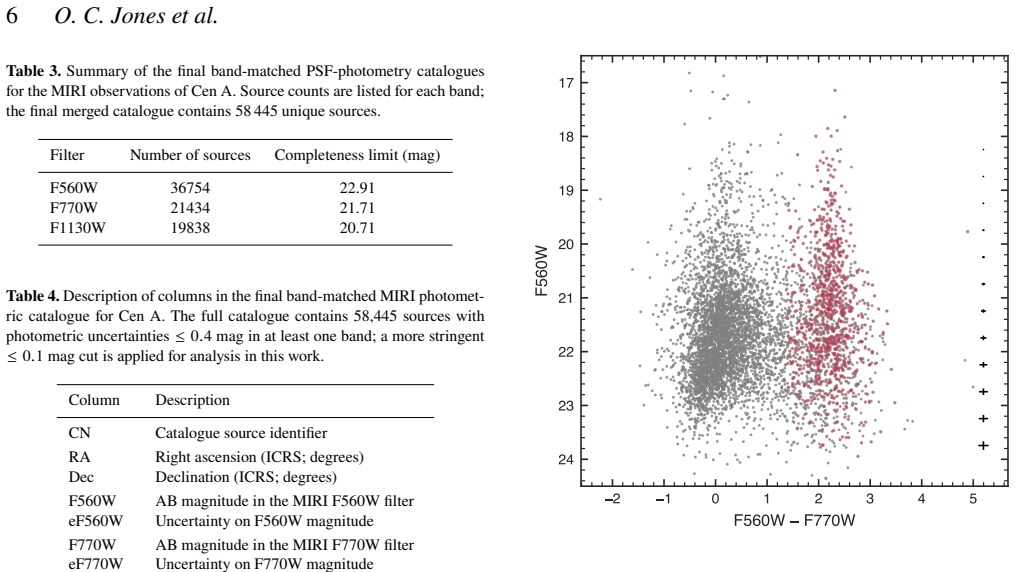
Mid-infrared colour cuts (F560W–F770W > 1.4 and F560W–F1130W > 1.8) applied to high-quality three-band photometry, combined with the sources’ measured spatial confinement to the warped disc and rising spectral slopes, that separate the red dust-enshrouded population from ordinary photospheric sources.
Load-bearing premise
That the mid-infrared colours plus spatial confinement to the disc are enough to show the red sources are mostly embedded young stars rather than extreme dust-producing evolved stars or other contaminants.
What would settle it
Near-infrared imaging or mid-infrared spectroscopy of a substantial fraction of the 928 red sources that reclassifies most of them as extreme AGB or other evolved stars, or that reveals a clear overdensity of the red sources along the radio-jet axis rather than the disc.
Editorial analysis
A structured set of objections, weighed in public.
Referee Report
Summary. The paper presents JWST/MIRI F560W, F770W and F1130W imaging of the central ~4 imes2 kpc of Centaurus A, producing a band-matched PSF catalogue of 58 445 sources (2 558 with σ≤0.1 mag in all three bands). Colour–magnitude and colour–colour diagrams show a clear bimodality; 928 sources selected by F560W–F770W>1.4 and F560W–F1130W>1.8 exhibit rising mid-IR slopes (median α=3.55) and are spatially confined to the warped dust disc (PCA first-component variance 94 %, perpendicular dispersion 0.38 kpc versus 0.63 kpc for the photospheric population). The authors interpret these sources as dominated by embedded Stage-I YSOs tracing recent (~10^5–10^6 yr) star formation regulated by merger-accreted gas, with no geometric correlation to the radio jet. The previously known Spitzer “oval dusty shell” is resolved into multiple F1130W-bright loops associated with the disc.
Significance. If the geometric result holds, the work cleanly separates merger-driven star formation in the central disc of the nearest radio galaxy from jet-triggered modes previously reported only in the outer halo. The public MIRI catalogue, the quantitative PCA/dispersion statistics, the multi-wavelength overlays with CO, radio and X-ray, and the resolution of the dusty shell into multiple loops are lasting observational contributions. The mid-IR colour selection and SED-slope analysis are carefully executed and provide a useful benchmark for future spectroscopic follow-up.
major comments (2)
- Section 4.1 (and colour cuts in §3.1.1): the claim that the 928 red sources are “dominated by embedded YSO candidates” rests on mid-IR colour analogy to Local Group regions, source counts exceeding the expected extreme-AGB fraction, and spatial confinement to the disc. The paper itself notes the colour overlap between Stage-I YSOs and extreme AGB stars and the absence of spectroscopic confirmation. While the geometric argument against a pure AGB population is persuasive, the language should be softened to “consistent with a population dominated by…” and residual AGB/RSG contamination should be quantified more explicitly (e.g., an upper limit scaled from LMC statistics or a simple luminosity-function comparison).
- Section 4.3: the conclusion of “no strong evidence for AGN jet–ISM interactions” on the scales probed is well supported by the lack of alignment with the radio/X-ray jet and by the thin-disc geometry. However, the paper also cites Espada et al. (2019) that star-formation efficiency is lower in the circumnuclear disc, possibly due to AGN-related shear/turbulence. A short quantitative statement of the surface-density contrast (or lack thereof) between jet-proximate and jet-distant regions of the disc would make the “no strong evidence” claim more falsifiable.
minor comments (5)
- Table 1 / §2.1: the two programmes have very different on-source times (1199 s vs 233 s). A brief note on how the depth variation is handled in the completeness limits (Fig. 4) and in the final high-quality sample would help the reader.
- Figure 9: the weak positive slope of the “main population” is attributed to residual diffuse/PAH background. A short test (e.g., aperture-size dependence or local-background residual map) would strengthen that interpretation.
- §3.3: the elevated 11.3/7.7 µm PAH ratio in the shells is cited from Quillen et al. (2008). Given that MIRI imaging alone cannot separate the two features, the statement should be clearly labelled as a literature result rather than a new measurement.
- Catalogue description (Table 4): magnitudes are stated to be uncorrected for extinction; a one-sentence reminder in the abstract or §3.1 would avoid misinterpretation by catalogue users.
- Typographical: “Observ ations” in the section heading; occasional missing spaces after commas in the abstract and introduction.
Circularity Check
No significant circularity: observational colour selection and geometric comparison to external disc/jet maps are independent of any fitted prediction or self-definitional loop.
full rationale
The paper is a straightforward JWST/MIRI imaging study. Source detection and PSF photometry (Section 2.3, starbugii parameters in Table 2) produce a catalogue; colour cuts F560W–F770W > 1.4 and F560W–F1130W > 1.8 are chosen at the observed density minimum separating bimodal populations in the CMD/CCD (Section 3.1.1, Figs 5–6), not derived from a model that already encodes the YSO claim. Spatial confinement is measured via PCA and perpendicular dispersions (Section 3.1.2) and compared to independently mapped CO, radio, and X-ray structures (Figs 10–11, citations to Espada et al. 2019, Hardcastle et al. 2003/2007). The interpretation that the 928 red sources are dominated by embedded YSOs rests on colour analogy to Local Group studies, source counts exceeding expected extreme-AGB fractions, and disc morphology; the paper itself flags the colour overlap and lack of spectroscopy (Section 4.1, 4.4). No parameter is fitted to a subset and then re-labelled a prediction, no uniqueness theorem is imported from the authors, and self-citations (Alonso Herrero et al. 2025, Pantoni et al. 2026, Evangelista et al. 2026) supply only ancillary MRS context for the nucleus, not the load-bearing disc-versus-jet geometry. The derivation chain is therefore self-contained against external multi-wavelength benchmarks.
Axiom & Free-Parameter Ledger
free parameters (3)
- F560W-F770W colour cut =
>1.4 mag
- F560W-F1130W colour cut =
>1.8 mag
- Photometric uncertainty threshold =
≤0.1 mag
axioms (4)
- domain assumption Distance to Cen A is 3.8 Mpc
- domain assumption Mid-IR extinction is relatively flat (A_5.6 ~0.05 A_V, A_11.3 ~0.02 A_V)
- domain assumption Extreme AGB stars are rare (~4 percent of evolved stars in the LMC) and follow the smooth stellar mass distribution
- ad hoc to paper Colour loci of Stage-I YSOs and extreme AGB stars can be distinguished statistically by spatial distribution even if they overlap in colour space
read the original abstract
Centaurus A (Cen A), the nearest active radio galaxy, hosts a warped dust disc formed in a gas-rich merger. We present JWST/MIRI imaging in three filters, F560W, F770W, and F1130W, of this central disc over a ~4 x 2 kpc region to characterise its resolved mid-infrared stellar populations. The images reveal a system of extended dusty structures, previously identified with Spitzer as an "oval dusty shell", now resolved into multiple loop-like features that are brightest in F1130W and closely associated with the warped disc. Colour-magnitude and colour-colour diagnostics reveal a distinct population of 928 red point sources with strong infrared excess, accounting for ~36 per cent of sources with high-quality photometry in all three bands, spatially confined to the disc. These sources exhibit rising mid-infrared spectral slopes indicative of emission from warm dust. Their colours and spatial distribution are consistent with a population dominated by embedded young stellar objects, tracing recent (~10^5-10^6 yr) star formation within the disc. The strong geometric alignment of these sources with the disc, together with the lack of correlation with the radio jet, suggests that star formation in the central regions of Cen A is primarily regulated by merger-accreted gas, with no strong evidence for AGN jet-ISM interactions.
Figures




Reference graph
Works this paper leans on
-
[1]
Aghdam S. T., et al., 2024, @doi [ ] 10.3847/1538-4357/ad57c0 , https://ui.adsabs.harvard.edu/abs/2024ApJ...972...47A 972, 47
-
[2]
Alonso Herrero A., et al., 2025, @doi [ ] 10.1051/0004-6361/202554823 , https://ui.adsabs.harvard.edu/abs/2025A&A...699A.334A 699, A334
-
[3]
Andr \'e P., Mattern M., Arzoumanian D., Shimajiri Y., Zavagno A., Abe D., Russeil D., 2025, @doi [ ] 10.3847/2041-8213/adc73d , https://ui.adsabs.harvard.edu/abs/2025ApJ...984L..59A 984, L59
-
[4]
Boyer M. L., et al., 2012, @doi [ ] 10.1088/0004-637X/748/1/40 , https://ui.adsabs.harvard.edu/abs/2012ApJ...748...40B 748, 40
-
[5]
Bradley L., et al., 2024, astropy/photutils: 2.0.2, @doi 10.5281/zenodo.13989456 , https://doi.org/10.5281/zenodo.13989456
-
[6]
Bushouse H., et al., 2025, JWST Calibration Pipeline , @doi 10.5281/zenodo.6984365
-
[7]
Clarke D. A., Burns J. O., Norman M. L., 1992, @doi [ ] 10.1086/171663 , https://ui.adsabs.harvard.edu/abs/1992ApJ...395..444C 395, 444
-
[8]
Cresci G., et al., 2015, @doi [ ] 10.1088/0004-637X/799/1/82 , https://ui.adsabs.harvard.edu/abs/2015ApJ...799...82C 799, 82
-
[9]
Crockett R. M., et al., 2012, @doi [ ] 10.1111/j.1365-2966.2012.20418.x , https://ui.adsabs.harvard.edu/abs/2012MNRAS.421.1603C 421, 1603
-
[10]
Cronin S. A., et al., 2026, @doi [ ] 10.3847/1538-4357/ae5f66 , https://ui.adsabs.harvard.edu/abs/2026ApJ..1002..217C 1002, 217
-
[11]
Croston J. H., et al., 2009, @doi [ ] 10.1111/j.1365-2966.2009.14715.x , https://ui.adsabs.harvard.edu/abs/2009MNRAS.395.1999C 395, 1999
-
[12]
Uniqueness in Harper's vertex-isoperimetric theorem
Crowther P. A., 2007, @doi [ ] 10.1146/annurev.astro.45.051806.110615 , https://ui.adsabs.harvard.edu/abs/2007ARA&A..45..177C 45, 177
work page internal anchor Pith review Pith/arXiv arXiv doi:10.1146/annurev.astro.45.051806.110615 2007
-
[13]
Dicken D., et al., 2024, @doi [ ] 10.1051/0004-6361/202449451 , https://ui.adsabs.harvard.edu/abs/2024A&A...689A...5D 689, A5
-
[14]
J., van den Bergh S., Harvel C
Dufour R. J., van den Bergh S., Harvel C. A., Martins D. H., Schiffer III F. H., Talbot Jr. R. J., Talent D. L., Wells D. C., 1979, @doi [ ] 10.1086/112421 , https://ui.adsabs.harvard.edu/abs/1979AJ.....84..284D 84, 284
-
[15]
Espada D., et al., 2009, @doi [ ] 10.1088/0004-637X/695/1/116 , https://ui.adsabs.harvard.edu/abs/2009ApJ...695..116E 695, 116
-
[16]
Espada D., et al., 2017, @doi [ ] 10.3847/1538-4357/aa78a9 , https://ui.adsabs.harvard.edu/abs/2017ApJ...843..136E 843, 136
-
[17]
Espada D., et al., 2019, @doi [ ] 10.3847/1538-4357/ab262d , https://ui.adsabs.harvard.edu/abs/2019ApJ...887...88E 887, 88
-
[18]
Evangelista L., et al., 2026, @doi [arXiv e-prints] 10.48550/arXiv.2605.22497 , https://ui.adsabs.harvard.edu/abs/2026arXiv260522497E p. arXiv:2605.22497
work page internal anchor Pith review Pith/arXiv arXiv doi:10.48550/arxiv.2605.22497 2026
-
[19]
Garc \' a-Bernete I., et al., 2024, @doi [ ] 10.1051/0004-6361/202450086 , https://ui.adsabs.harvard.edu/abs/2024A&A...691A.162G 691, A162
-
[20]
Gardner J. P., et al., 2023, @doi [ ] 10.1088/1538-3873/acd1b5 , https://ui.adsabs.harvard.edu/abs/2023PASP..135f8001G 135, 068001
-
[21]
A., 1979, @doi [ ] 10.1086/157265 , https://ui.adsabs.harvard.edu/abs/1979ApJ...232...60G 232, 60
Graham J. A., 1979, @doi [ ] 10.1086/157265 , https://ui.adsabs.harvard.edu/abs/1979ApJ...232...60G 232, 60
-
[22]
Habel N., et al., 2024, @doi [ ] 10.3847/1538-4357/ad5343 , https://ui.adsabs.harvard.edu/abs/2024ApJ...971..108H 971, 108
-
[23]
J., Olofsson H., eds, 2003, Asymptotic giant branch stars
Habing H. J., Olofsson H., eds, 2003, Asymptotic giant branch stars
2003
-
[24]
Hardcastle M. J., Worrall D. M., Kraft R. P., Forman W. R., Jones C., Murray S. S., 2003, @doi [ ] 10.1086/376519 , https://ui.adsabs.harvard.edu/abs/2003ApJ...593..169H 593, 169
doi:10.1086/376519 2003
-
[25]
Hardcastle M. J., et al., 2007, @doi [ ] 10.1086/524197 , https://ui.adsabs.harvard.edu/abs/2007ApJ...670L..81H 670, L81
doi:10.1086/524197 2007
-
[26]
Harris G. L. H., 2010, @doi [ ] 10.1071/AS09063 , https://ui.adsabs.harvard.edu/abs/2010PASA...27..475H 27, 475
-
[27]
Harris W. E., Harris G. L. H., 2002, @doi [ ] 10.1086/340466 , https://ui.adsabs.harvard.edu/abs/2002AJ....123.3108H 123, 3108
-
[28]
Hermosa Mu \ n oz L., et al., 2024, @doi [ ] 10.1051/0004-6361/202450262 , https://ui.adsabs.harvard.edu/abs/2024A&A...690A.350H 690, A350
-
[29]
Hodge P. W., Kennicutt Jr. R. C., 1983, @doi [ ] 10.1086/113318 , https://ui.adsabs.harvard.edu/abs/1983AJ.....88..296H 88, 296
-
[30]
Israel F. P., 1998, @doi [ ] 10.1007/s001590050011 , https://ui.adsabs.harvard.edu/abs/1998A&ARv...8..237I 8, 237
-
[31]
Jones O. C., Meixner M., Sargent B. A., Boyer M. L., Sewi o M., Hony S., Roman-Duval J., 2015, @doi [ ] 10.1088/0004-637X/811/2/145 , https://ui.adsabs.harvard.edu/abs/2015ApJ...811..145J 811, 145
-
[32]
Jones O. C., et al., 2017a, @doi [ ] 10.1093/mnras/stx1101 , https://ui.adsabs.harvard.edu/abs/2017MNRAS.470.3250J 470, 3250
-
[33]
Jones O. C., Meixner M., Justtanont K., Glasse A., 2017b, @doi [ ] 10.3847/1538-4357/aa6bf6 , https://ui.adsabs.harvard.edu/abs/2017ApJ...841...15J 841, 15
-
[34]
Jones O. C., et al., 2023, @doi [Nature Astronomy] 10.1038/s41550-023-01945-7 , https://ui.adsabs.harvard.edu/abs/2023NatAs...7..694J 7, 694
-
[35]
Joseph P., Sreekumar P., Stalin C. S., Paul K. T., Mondal C., George K., Mathew B., 2022, @doi [ ] 10.1093/mnras/stac2388 , https://ui.adsabs.harvard.edu/abs/2022MNRAS.516.2300J 516, 2300
-
[36]
Kainulainen J. T., et al., 2009, @doi [ ] 10.1051/0004-6361/200912624 , https://ui.adsabs.harvard.edu/abs/2009A&A...502L...5K 502, L5
-
[37]
Keel W. C., Banfield J. K., Medling A. M., Neff S. G., 2019, @doi [ ] 10.3847/1538-3881/aaf809 , https://ui.adsabs.harvard.edu/abs/2019AJ....157...66K 157, 66
-
[38]
Leeuw L. L., Hawarden T. G., Matthews H. E., Robson E. I., Eckart A., 2002, @doi [ ] 10.1086/324494 , https://ui.adsabs.harvard.edu/abs/2002ApJ...565..131L 565, 131
-
[39]
Lenki \'c L., et al., 2024, @doi [ ] 10.3847/1538-4357/ad3f90 , https://ui.adsabs.harvard.edu/abs/2024ApJ...967..110L 967, 110
-
[40]
Leroy A. K., et al., 2023, @doi [ ] 10.3847/2041-8213/acaf85 , https://ui.adsabs.harvard.edu/abs/2023ApJ...944L...9L 944, L9
-
[41]
Marconi A., Schreier E. J., Koekemoer A., Capetti A., Axon D., Macchetto D., Caon N., 2000, @doi [ ] 10.1086/308168 , https://ui.adsabs.harvard.edu/abs/2000ApJ...528..276M 528, 276
-
[42]
Minniti D., Rejkuba M., Funes J. G., Kennicutt Jr. R. C., 2004, @doi [ ] 10.1086/422546 , https://ui.adsabs.harvard.edu/abs/2004ApJ...612..215M 612, 215
-
[43]
A barred spiral at the centre of the giant elliptical radio galaxy Centaurus A
Mirabel I. F., et al., 1999, @doi [ ] 10.48550/arXiv.astro-ph/9810419 , https://ui.adsabs.harvard.edu/abs/1999A&A...341..667M 341, 667
work page internal anchor Pith review Pith/arXiv arXiv doi:10.48550/arxiv.astro-ph/9810419 1999
-
[44]
Mould J. R., et al., 2000, @doi [ ] 10.1086/308927 , https://ui.adsabs.harvard.edu/abs/2000ApJ...536..266M 536, 266
-
[45]
Mukherjee D., Bicknell G. V., Sutherland R., Wagner A., 2016, @doi [ ] 10.1093/mnras/stw1368 , https://ui.adsabs.harvard.edu/abs/2016MNRAS.461..967M 461, 967
-
[46]
Mukherjee D., Bicknell G. V., Wagner A. Y., Sutherland R. S., Silk J., 2018, @doi [ ] 10.1093/mnras/sty1776 , https://ui.adsabs.harvard.edu/abs/2018MNRAS.479.5544M 479, 5544
-
[47]
Nally C., 2023, StarbugII: JWST PSF photometry for crowded fields , Astrophysics Source Code Library, record ascl:2309.012 ( @eprint ascl 2309.012 )
2023
-
[48]
Nally C., et al., 2024, @doi [ ] 10.1093/mnras/stae1163 , https://ui.adsabs.harvard.edu/abs/2024MNRAS.531..183N 531, 183
-
[49]
Nayak O., et al., 2024, @doi [ ] 10.3847/1538-4357/ad7baf , https://ui.adsabs.harvard.edu/abs/2024ApJ...975..262N 975, 262
-
[50]
Neff S. G., Eilek J. A., Owen F. N., 2015, @doi [ ] 10.1088/0004-637X/802/2/87 , https://ui.adsabs.harvard.edu/abs/2015ApJ...802...87N 802, 87
-
[51]
Nesvadba N. P. H., et al., 2010, @doi [ ] 10.1051/0004-6361/200913333 , https://ui.adsabs.harvard.edu/abs/2010A&A...521A..65N 521, A65
-
[52]
Neumayer N., Cappellari M., Reunanen J., Rix H.-W., van der Werf P. P., de Zeeuw P. T., Davies R. I., 2007, @doi [ ] 10.1086/523039 , https://ui.adsabs.harvard.edu/abs/2007ApJ...671.1329N 671, 1329
doi:10.1086/523039 2007
-
[53]
Oosterloo T. A., Morganti R., 2005, @doi [ ] 10.1051/0004-6361:20041379 , https://ui.adsabs.harvard.edu/abs/2005A&A...429..469O 429, 469
-
[54]
Pantoni L., et al., 2026, @doi [ ] 10.1051/0004-6361/202558839 , https://ui.adsabs.harvard.edu/abs/2026A&A...709A.237P 709, A237
-
[55]
Peng E. W., Ford H. C., Freeman K. C., White R. L., 2002, @doi [ ] 10.1086/344308 , https://ui.adsabs.harvard.edu/abs/2002AJ....124.3144P 124, 3144
-
[56]
Peng E. W., Ford H. C., Freeman K. C., 2004, @doi [ ] 10.1086/381236 , https://ui.adsabs.harvard.edu/abs/2004ApJ...602..705P 602, 705
-
[57]
Perna M., et al., 2020, @doi [ ] 10.1051/0004-6361/202038328 , https://ui.adsabs.harvard.edu/abs/2020A&A...643A.139P 643, A139
-
[58]
Quillen A. C., de Zeeuw P. T., Phinney E. S., Phillips T. G., 1992, @doi [ ] 10.1086/171329 , https://ui.adsabs.harvard.edu/abs/1992ApJ...391..121Q 391, 121
-
[59]
Quillen A. C., Graham J. R., Frogel J. A., 1993, @doi [ ] 10.1086/172943 , https://ui.adsabs.harvard.edu/abs/1993ApJ...412..550Q 412, 550
-
[60]
Quillen A. C., Brookes M. H., Keene J., Stern D., Lawrence C. R., Werner M. W., 2006, @doi [ ] 10.1086/504418 , https://ui.adsabs.harvard.edu/abs/2006ApJ...645.1092Q 645, 1092
doi:10.1086/504418 2006
-
[61]
Quillen A. C., et al., 2008, @doi [ ] 10.1111/j.1365-2966.2007.12768.x , https://ui.adsabs.harvard.edu/abs/2008MNRAS.384.1469Q 384, 1469
-
[62]
Quillen A. C., Neumayer N., Oosterloo T., Espada D., 2010, @doi [ ] 10.1071/AS09069 , https://ui.adsabs.harvard.edu/abs/2010PASA...27..396Q 27, 396
doi:10.1071/as09069 2010
-
[63]
Reiter M., Morse J. A., Smith N., Haworth T. J., Kuhn M. A., Klaassen P. D., 2022, @doi [ ] 10.1093/mnras/stac2820 , https://ui.adsabs.harvard.edu/abs/2022MNRAS.517.5382R 517, 5382
-
[64]
Rejkuba M., Minniti D., Silva D. R., Bedding T. R., 2001, @doi [ ] 10.1051/0004-6361:20011315 , https://ui.adsabs.harvard.edu/abs/2001A&A...379..781R 379, 781
-
[65]
Rejkuba M., Minniti D., Silva D. R., Bedding T. R., 2003, @doi [ ] 10.1051/0004-6361:20034056 , https://ui.adsabs.harvard.edu/abs/2003A&A...411..351R 411, 351
-
[66]
Rejkuba M., Greggio L., Harris W. E., Harris G. L. H., Peng E. W., 2005, @doi [ ] 10.1086/432462 , https://ui.adsabs.harvard.edu/abs/2005ApJ...631..262R 631, 262
doi:10.1086/432462 2005
-
[67]
E., Greggio L., Crnojevi \'c D., Harris G
Rejkuba M., Harris W. E., Greggio L., Crnojevi \'c D., Harris G. L. H., 2022, @doi [ ] 10.1051/0004-6361/202141347 , https://ui.adsabs.harvard.edu/abs/2022A&A...657A..41R 657, A41
-
[68]
Riebel D., Srinivasan S., Sargent B., Meixner M., 2012, @doi [ ] 10.1088/0004-637X/753/1/71 , https://ui.adsabs.harvard.edu/abs/2012ApJ...753...71R 753, 71
-
[69]
Rieke G. H., et al., 2015, @doi [ ] 10.1086/682252 , https://ui.adsabs.harvard.edu/abs/2015PASP..127..584R 127, 584
doi:10.1086/682252 2015
-
[70]
Rigby J., et al., 2023, @doi [ ] 10.1088/1538-3873/acb293 , https://ui.adsabs.harvard.edu/abs/2023PASP..135d8001R 135, 048001
-
[71]
Rigopoulou D., et al., 2024, @doi [ ] 10.1093/mnras/stae1535 , https://ui.adsabs.harvard.edu/abs/2024MNRAS.532.1598R 532, 1598
-
[72]
Robitaille T. P., Whitney B. A., Indebetouw R., Wood K., Denzmore P., 2006, @doi [ ] 10.1086/508424 , https://ui.adsabs.harvard.edu/abs/2006ApJS..167..256R 167, 256
doi:10.1086/508424 2006
-
[73]
Salom \'e Q., Salom \'e P., Miville-Desch \^e nes M.-A., Combes F., Hamer S., 2017, @doi [ ] 10.1051/0004-6361/201731429 , https://ui.adsabs.harvard.edu/abs/2017A&A...608A..98S 608, A98
-
[74]
Santoro F., Oonk J. B. R., Morganti R., Oosterloo T., 2015, @doi [ ] 10.1051/0004-6361/201425103 , https://ui.adsabs.harvard.edu/abs/2015A&A...574A..89S 574, A89
-
[75]
Schiminovich D., van Gorkom J. H., van der Hulst J. M., Kasow S., 1994, @doi [ ] 10.1086/187246 , https://ui.adsabs.harvard.edu/abs/1994ApJ...423L.101S 423, L101
doi:10.1086/187246 1994
-
[76]
J., Capetti A., Macchetto F., Sparks W
Schreier E. J., Capetti A., Macchetto F., Sparks W. B., Ford H. J., 1996, @doi [ ] 10.1086/176917 , https://ui.adsabs.harvard.edu/abs/1996ApJ...459..535S 459, 535
-
[77]
Seale J. P., et al., 2014, @doi [ ] 10.1088/0004-6256/148/6/124 , https://ui.adsabs.harvard.edu/abs/2014AJ....148..124S 148, 124
-
[78]
Shin J., Woo J.-H., Chung A., Baek J., Cho K., Kang D., Bae H.-J., 2019, @doi [ ] 10.3847/1538-4357/ab2e72 , https://ui.adsabs.harvard.edu/abs/2019ApJ...881..147S 881, 147
-
[79]
Sloan G. C., et al., 2007, @doi [ ] 10.1086/519236 , https://ui.adsabs.harvard.edu/abs/2007ApJ...664.1144S 664, 1144
-
[80]
Soria R., et al., 1996, @doi [ ] 10.1086/177403 , https://ui.adsabs.harvard.edu/abs/1996ApJ...465...79S 465, 79
discussion (0)
Sign in with ORCID, Apple, or X to comment. Anyone can read and Pith papers without signing in.