REVIEW 2 major objections 2 minor 11 references
Rate Programmable Ionic-Redox Switching with Tunable Volatility in CuCrP2S6
T0 review · 2 major / 2 minor · reviewed 2026-06-25 · grok-4.3
Pith's one-line read Resistive switching in paraelectric CuCrP2S6 arises from ionic-redox activity with rate-tunable volatility.
desk verdict This paper isolates ion-redox resistive switching in paraelectric CuCrP2S6 and shows that sweep rate directly sets volatility through Cu+ diffusion. read the letter →
The pith
A machine-rendered reading of the paper's core claim, the machinery that carries it, and where it could break.
The reading
What carries the argument
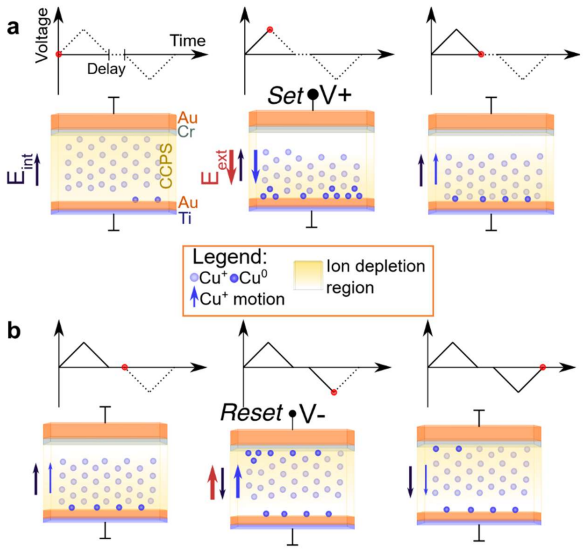
Rate-dependent ionic relaxation following Cu+ redox at the electrode interface, which controls both the formation of conductive paths and the subsequent decay of the resistance state.
What would settle it
Direct measurement of ferroelectric polarization loops or antiferroelectric behavior in the same CuCrP2S6 samples under the conditions used for switching would contradict the ion-only mechanism.
Extended reading notes
Core claim
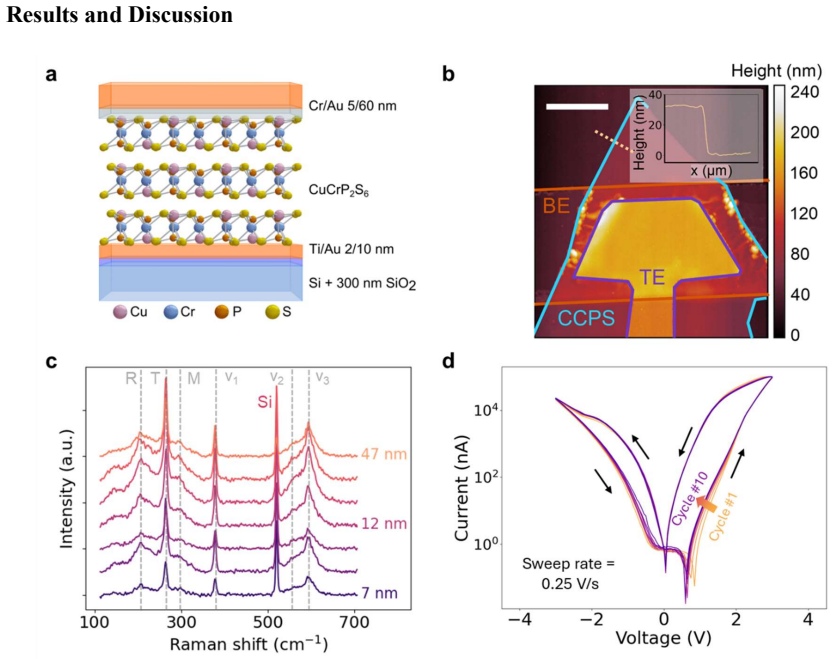
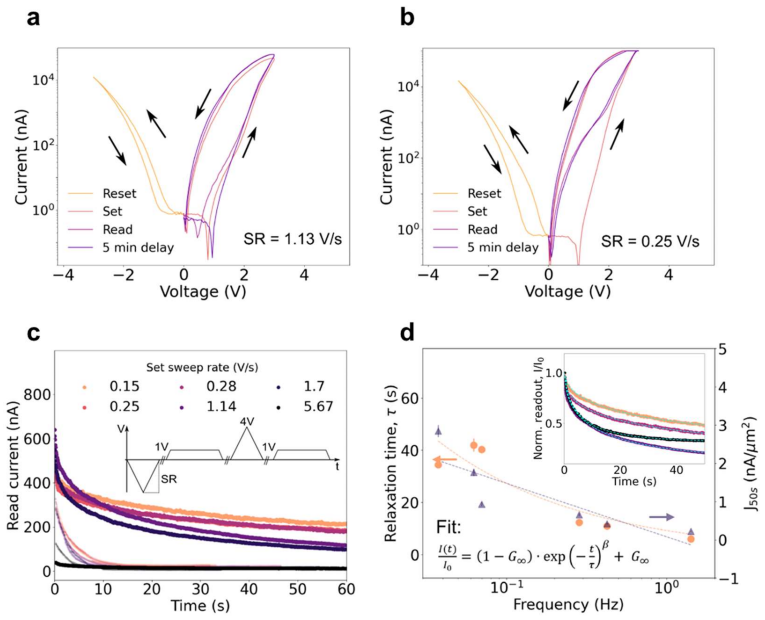
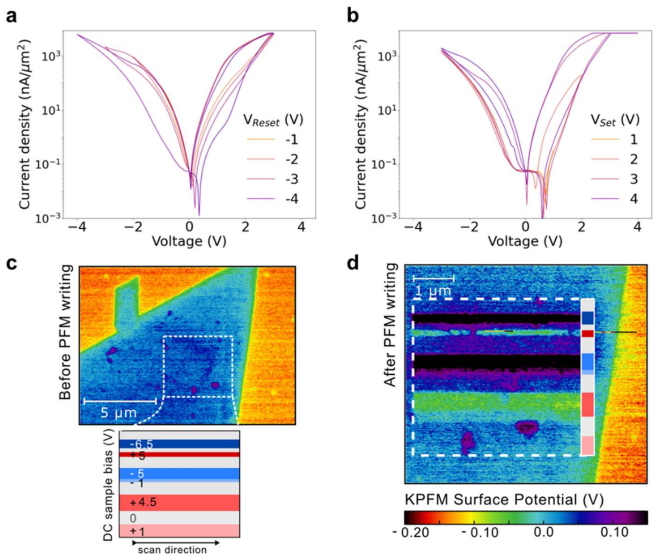
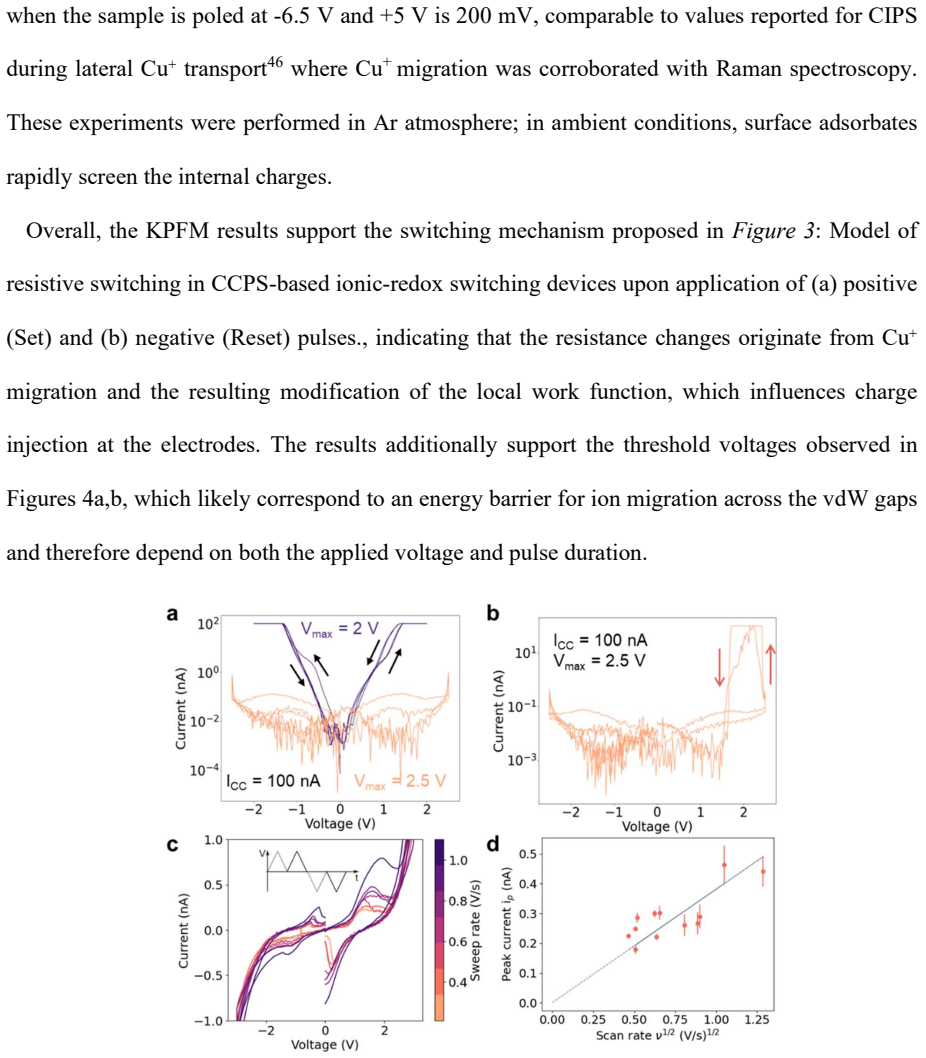
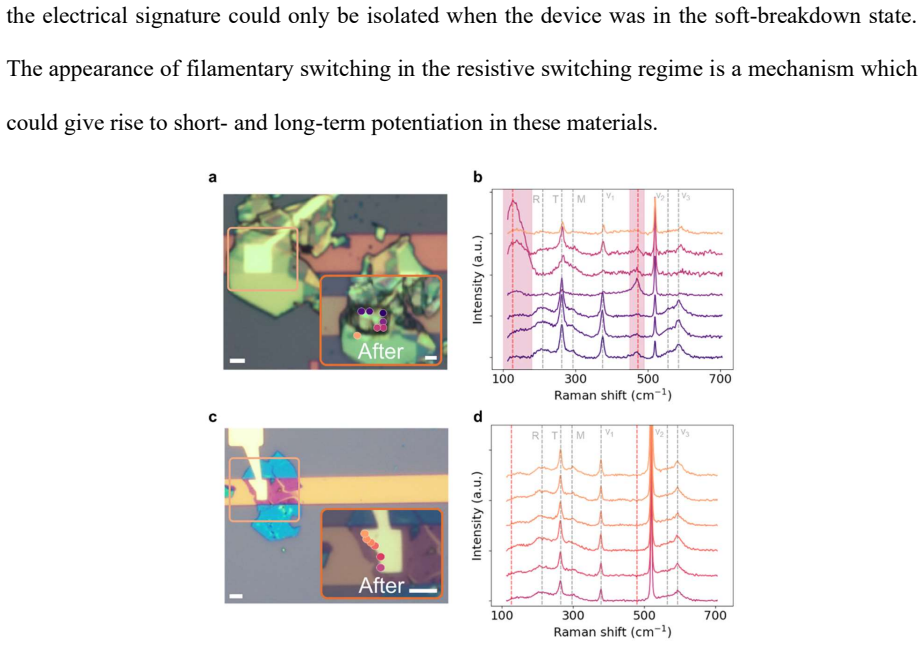
In the absence of measurable ferroelectricity, CuCrP2S6 exhibits resistive switching driven by solid-state redox associated with interfacial reduction of native Cu+ ions. This enables formation of filamentary conduction pathways whose states are programmable by voltage sweep rate. The resulting states display controllable volatility, with the decay time constant of the readout current determined by the prior switching rate through ionic relaxation. Analysis yields the Cu+ diffusion coefficient.
Load-bearing premise
The resistive switching and its dependence on sweep rate stem purely from ion dynamics and solid-state redox, with no contribution from undetected ferroelectric polarization or electrode-specific effects.
Editorial extensions
If this is right
- Resistance states can be set to different volatility levels solely by changing the voltage sweep rate during programming.
- The process is reproducible with both inert and reactive electrodes, indicating the redox is intrinsic to the material.
- Quantitative values for Cu+ diffusion provide a basis for predicting device timescales.
- The material platform supports multi-mode operation combining ion dynamics with resistive memory.
Reading between the lines
- Devices could use programming speed as a direct control for retention time, simplifying circuit design for neuromorphic systems.
- The same ion-redox mechanism may operate in other metal thiophosphates where ferroelectric explanations have been assumed.
- Extracted diffusion coefficients could be used to engineer layer thicknesses or compositions for target relaxation speeds.
Signed reviews
Editorial analysis
A structured set of objections, weighed in public.
Referee Report
Summary. The manuscript claims to isolate purely ion-driven resistive switching in the paraelectric phase of CuCrP2S6. Conductance is tuned via voltage amplitude and sweep rate, producing resistance states whose volatility (decay time constant) is set by the switching rate and attributed to ionic relaxation. Solid-state redox of native Cu+ ions is evidenced by inert/reactive electrode comparisons, enabling filamentary pathways, and the process yields an extracted Cu+ diffusion coefficient.
Significance. If the central experimental observations hold, the work supplies a concrete example of rate-programmable, volatility-tunable ionic-redox memristance decoupled from ferroelectric order. This strengthens the case for metal thiophosphates as a platform for dual-mode neuromorphic devices and supplies a quantitative transport parameter (D_Cu+) that can be compared across related compounds.
major comments (2)
- [Abstract / Results on ferroelectric characterization] The assertion that resistive switching occurs 'in the absence of measurable ferroelectricity' is load-bearing for the ion-only interpretation. The manuscript must specify the ferroelectric measurement protocol, applied field range, and detection limit (e.g., remnant polarization threshold) so that the null result can be evaluated quantitatively.
- [Analysis of redox kinetics] The extraction of the Cu+ diffusion coefficient from the redox process is presented as quantitative support. The fitting procedure, boundary conditions, and any assumptions about filament geometry or ion concentration must be shown explicitly; without them the reported D value cannot be reproduced or compared to literature.
minor comments (2)
- Figure captions should state the number of devices and cycles over which the rate-dependent I-V loops and retention curves were averaged, together with any exclusion criteria.
- The distinction between 'inert' and 'reactive' electrodes is central; the manuscript should tabulate the work functions or redox potentials used to classify each electrode material.
Simulated Author's Rebuttal
We thank the referee for the positive assessment and recommendation for minor revision. The two major comments identify areas where additional detail will strengthen the manuscript; we address each below and will incorporate the requested information in the revised version.
read point-by-point responses
-
Referee: [Abstract / Results on ferroelectric characterization] The assertion that resistive switching occurs 'in the absence of measurable ferroelectricity' is load-bearing for the ion-only interpretation. The manuscript must specify the ferroelectric measurement protocol, applied field range, and detection limit (e.g., remnant polarization threshold) so that the null result can be evaluated quantitatively.
Authors: We agree that quantitative specification of the ferroelectric measurements is required to support the claim. In the revised manuscript we will add a dedicated paragraph in the Methods (and a brief reference in Results) that states the P-E loop protocol, the maximum applied field, the frequency, the instrument sensitivity, and the resulting upper bound on detectable remnant polarization. This will allow readers to assess the null result directly. revision: yes
-
Referee: [Analysis of redox kinetics] The extraction of the Cu+ diffusion coefficient from the redox process is presented as quantitative support. The fitting procedure, boundary conditions, and any assumptions about filament geometry or ion concentration must be shown explicitly; without them the reported D value cannot be reproduced or compared to literature.
Authors: We accept that the diffusion-coefficient extraction must be fully documented for reproducibility. The revised manuscript will include an explicit description (in the main text or a new supplementary note) of the model equation, the boundary conditions employed, the assumed filament geometry, the estimated ion concentration, and the fitting routine used to obtain D_Cu+. These additions will enable direct comparison with literature values. revision: yes
Circularity Check
No significant circularity; experimental observations and analysis are self-contained
full rationale
The paper reports experimental resistive switching data in paraelectric CuCrP2S6, attributes rate-dependent conductance and volatility to ion dynamics based on electrode comparisons, and extracts a diffusion coefficient via direct analysis of observed transport kinetics. No derivation chain, fitted parameter renamed as prediction, or self-citation load-bearing premise is present. The central claims rest on measured I-V characteristics and time-dependent currents rather than any equation that reduces to its own inputs by construction.
Assumptions & free parameters
Cite this review
Pith. "Pith review of Rate Programmable Ionic-Redox Switching with Tunable Volatility in CuCrP2S6." pith.science (2026). https://pith.science/paper/JX3JLXVI
@misc{pith2026260625679,
  author       = {Pith},
  title        = {Pith review of: Rate Programmable Ionic-Redox Switching with Tunable Volatility in CuCrP2S6},
  year         = {2026},
  howpublished = {\url{https://pith.science/paper/JX3JLXVI}},
  note         = {Machine review of arXiv:2606.25679}
}
read the original abstract
Metal thiophosphates are emerging as a multifunctional material platform for neuromorphic electronics due to their accessible polar phases and ion dynamics on biologically relevant timescales. While resistive switching in these materials is frequently attributed to ferroelectric or antiferroelectric polarization, the intrinsic role of ion dynamics remains underexplored. Here, we isolate and demonstrate purely ion-driven resistive switching in paraelectric CuCrP2S6. Robust and reproducible resistive switching is observed in the absence of measurable ferroelectricity. The conductance can be tuned through both voltage amplitude and sweep rate, revealing a rate dependence characteristic of ion dynamics. The resulting resistance states exhibit controllable volatility, where switching rate determines the decay time constant of the readout current, attributed to ionic relaxation. Using either inert or reactive electrodes, we observe electrical evidence of solid-state redox activity associated with the interfacial reduction of native Cu+ ions, enabling controlled formation of filamentary conduction pathways. Analysis of this process allows extraction of the Cu+ diffusion coefficient, providing quantitative insight into the underlying transport kinetics. The understanding of ionic-redox based resistive switching in CuCrP2S6 is crucial for unleashing its full potential as a material platform for dual- or multi-mode operation.
Figures
Figures from the paper (3 more)
Reference graph
Works this paper leans on
-
[1]
(1) Indiveri, G.; Linares-Barranco, B.; Hamilton, T. J.; van Schaik, A.; Etienne-Cummings, R.; Delbruck, T.; Liu, S.-C.; Dudek, P.; Häfliger, P.; Renaud, S.; Schemmel, J.; Cauwenberghs, G.; Arthur, J.; Hynna, K.; Folowosele, F.; Saïghi, S.; Serrano-Gotarredona, T.; Wijekoon, J.; Wang, Y.; 24 Boahen, K. Neuromorphic Silicon Neuron Circuits. Front. Neurosci. 2011,
2011
-
[2]
Neuromorphic silicon neuron circuits.Frontiers in Neuroscience, 5:73, 2011
https://doi.org/10.3389/fnins.2011.00073. (2) Ielmini, D.; Ambrogio, S. Emerging Neuromorphic Devices. Nanotechnology 2019, 31 (9), 092001. https://doi.org/10.1088/1361-6528/ab554b. (3) Covi, E.; Lancaster, S.; Slesazeck, S.; Deshpande, V.; Mikolajick, T.; Dubourdieu, C. Challenges and Perspectives for Energy-Efficient Brain-Inspired Edge Computing Applic...
-
[3]
(6) Halter, M.; Bégon-Lours, L.; Sousa, M.; Popoff, Y.; Drechsler, U.; Bragaglia, V.; Offrein, B
https://doi.org/10.1038/s43246-024-00621-1. (6) Halter, M.; Bégon-Lours, L.; Sousa, M.; Popoff, Y.; Drechsler, U.; Bragaglia, V.; Offrein, B. J. A Multi-Timescale Synaptic Weight Based on Ferroelectric Hafnium Zirconium Oxide. Commun. Mater. 2023, 4 (1),
-
[4]
(7) Chen, Y.; Han, B.; Gobbi, M.; Hou, L.; Samorì, P
https://doi.org/10.1038/s43246-023-00342-x. (7) Chen, Y.; Han, B.; Gobbi, M.; Hou, L.; Samorì, P. Responsive Molecules for Organic Neuromorphic Devices: Harnessing Memory Diversification. Adv. Mater. 2025, 37 (19), 2418281. https://doi.org/10.1002/adma.202418281. (8) Martemucci, M.; Rummens, F.; Malot, Y.; Hirtzlin, T.; Guille, O.; Martin, S.; Carabasse, ...
-
[5]
https://doi.org/10.1038/s41467-023-43097-
-
[6]
Tunable Ferroelectricity in Van Der Waals Layered Antiferroelectric CuCrP2S6
(28) Cho, K.; Lee, S.; Kalaivanan, R.; Sankar, R.; Choi, K.-Y.; Park, S. Tunable Ferroelectricity in Van Der Waals Layered Antiferroelectric CuCrP2S6. Adv. Funct. Mater. 2022, 32 (36), 2204214. https://doi.org/10.1002/adfm.202204214. (29) Susner, M. A.; Rao, R.; Pelton, A. T.; McLeod, M. V.; Maruyama, B. Temperature-Dependent Raman Scattering and x-Ray Di...
-
[7]
https://doi.org/10.1038/s41467-023-43628-x. (36) Liu, P.; Li, Y.; Hou, D.; Zhu, H.; Luo, H.; Zhou, S.; Wei, L.; Niu, W.; Sheng, Z.; Mao, W.; Pu, Y. Switchable Diode Effect in 2D van Der Waals Ferroelectric CuCrP2S6. Appl. Phys. Lett. 2024, 124 (9). https://doi.org/10.1063/5.0191188. (37) Watson, A. J.; Lu, W.; Guimarães, M. H. D.; Stöhr, M. Transfer of La...
-
[8]
https://doi.org/10.1038/s41467-023-44132-y. (57) Jiang, X.; Wang, X.; Wang, X.; Zhang, X.; Niu, R.; Deng, J.; Xu, S.; Lun, Y.; Liu, Y.; Xia, T.; Lu, J.; Hong, J. Manipulation of Current Rectification in van Der Waals Ferroionic CuInP2S6. Nat. Commun. 2022, 13 (1),
Show all 11 references
-
[9]
(58) Ming, W.; Huang, B.; Zheng, S.; Bai, Y.; Wang, J.; Wang, J.; Li, J
https://doi.org/10.1038/s41467-022-28235-6. (58) Ming, W.; Huang, B.; Zheng, S.; Bai, Y.; Wang, J.; Wang, J.; Li, J. Flexoelectric Engineering of van Der Waals Ferroelectric CuInP2S6. Sci. Adv. 2022, 8 (33), eabq1232. https://doi.org/10.1126/sciadv.abq1232. (59) Crapanzano, L....
2022 doi
-
[10]
(60) Januel, T.; Billoint, O.; Grenouillet, L.; Martin, S.; Portal, J
https://theses.hal.science/tel-00204149 (accessed 2025-12-19). (60) Januel, T.; Billoint, O.; Grenouillet, L.; Martin, S.; Portal, J. M.; Vianello, E. Dual-Mode 16kb Memory: Transforming a Ferroelectric Capacitor Bitcell into Resistive Filamentary Memory. In 2025 IEEE Internat...
2025 doi
-
[11]
The devices were measured at a sweep rate of (a) 1.1.3 V/s and (b) 0.25 V/s. In the case of the faster sweep rate (a), the final reset shows a larger hysteresis due to the temporarily modified device state, but the ‘Reset’ successfully returns the device to the iniƟal state (as ...
1997 doi
Reviewed June 25, 2026 · model on record in the stance chip above.
Discussion (0). Continue with ORCID to comment.