REVIEW 3 major objections 5 minor 51 references
Diagrammatic Monte Carlo for positron-molecule many-body theory
T0 review · 3 major / 5 minor · reviewed 2026-08-02 · deepseek-v4-flash
Pith's one-line read Diagrammatic Monte Carlo reproduces exact positron binding energies in LiH by stochastically summing the infinite electron-positron ladder series.
desk verdict Useful proof-of-principle for diagMC in positron-molecule theory; the infinite-order resummation is the soft spot, but the LiH benchmark carries more weight than the stress-test allows. read the letter →
The pith
A machine-rendered reading of the paper's core claim, the machinery that carries it, and where it could break.
The reading
What carries the argument
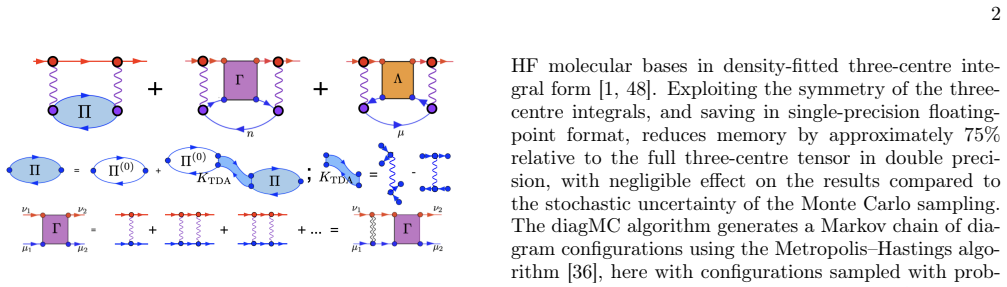
The central object is the irreducible self energy of the positron, expanded in Goldstone-type diagrams in powers of the Coulomb interaction; the ladder diagrams (electron-positron and positron-hole) are sampled order by order. The mechanism that makes it work is a Markov-chain update set that adds and removes interaction vertices and modifies internal lines, together with a normalising 'type-0' sector; the infinite-order limit is then extracted by Cesaro-Riesz weighted partial sums, where the nth-order contribution is multiplied by ((N-n+1)/N)^delta, and a fit of the binding energy versus 1/N to an exponential model to take N to infinity.
What would settle it
Perform the same stochastic resummation on a small molecule or model where the exact diagonalisation can be extended to orders N large enough that the extrapolation becomes essentially direct, or where the true infinite-order sum is known independently, and check whether the delta-averaged extrapolated value converges to that known number as N grows; a mismatch beyond the quoted uncertainty would indicate a bias in the resummation model.
Extended reading notes
Core claim
The central claim is that the divergent infinite-order electron-positron ladder (virtual positronium) series in the positron-molecule self energy can be summed stochastically rather than by exact diagonalisation. Each diagram order is sampled via Markov-chain Monte Carlo, with sign-accumulated estimates combined through Cesaro-Riesz weighted partial sums and an exponential 1/N extrapolation to reach the infinite-order limit. With this machinery, the method reproduces the exact diagonalisation binding energies for LiH at all tested levels, including the strongly divergent Gamma series, while storing only three-centre density-fitted integrals rather than the full two-particle Bethe-Salpeter ma
Load-bearing premise
The recovered infinite-order binding energy rests on the assumption that Cesaro-Riesz damping with delta between 1 and 3, together with the exponential 1/N fit, recovers the true sum of the divergent Gamma series; if that extrapolation is biased, the reported energies could be systematically wrong even though each sampled order is unbiased.
Editorial extensions
If this is right
- Positron binding energies can be computed in larger molecules than deterministic Bethe-Salpeter diagonalisation allows, because the dominant memory cost is the three-centre integrals (~N^3) rather than two-particle matrices (~N^4).
- The virtual-positronium ladder, the main non-perturbative correlation channel, is shown to be summable stochastically despite its order-by-order divergence.
- The same resummation pipeline applies to the RPA and TDHF GW series, which converge smoothly and extrapolate stably across the resummation parameter range.
- Combining the electron-positron and positron-hole ladders with the TDHF series reproduces the exact diagonalisation binding energy for LiH to within the stochastic uncertainty.
- The method removes the terabyte-scale memory bottleneck of deterministic two-particle diagonalisation, making positron-molecule studies feasible on modern distributed architectures.
Reading between the lines
- A testable consequence left implicit: the delta-scan procedure (delta from 1 to 3) plus exponential fit could be validated on a model where the exact infinite-order sum is known analytically, isolating any resummation bias from Monte Carlo sampling error.
- The method's success with bare Coulomb interactions suggests the next step is to combine it with self-consistent screening (beyond the Tamm-Dancoff approximation), which may extend quantitative accuracy to a wider class of molecules.
- The memory reduction opens the door to embarrassingly parallel implementations, but the scaling of the number of Monte Carlo steps required for the divergent Gamma series is not yet analysed; this will matter for larger basis sets.
- If the extrapolation model proves transferable, a practical protocol for other molecules would be to compute binding energies at several delta values and report the mean and spread, as done here.
Signed reviews
Editorial analysis
A structured set of objections, weighed in public.
Referee Report
Summary. The paper presents a diagrammatic Monte Carlo (diagMC) method for evaluating the positron-molecule self-energy in a Gaussian-orbital basis, including the GW@TDA, virtual-positronium (Γ) ladder, and positron-hole (Λ) ladder diagram classes. A Markov-chain Monte Carlo algorithm samples diagram orders and internal indices, with density fitting to store only three-centre integrals. The infinite-order limit of the Γ series, which grows without bound order-by-order, is handled by Cesàro–Riesz damping (Eq. 9) followed by an exponential fit in 1/N. The method is benchmarked on LiH against the authors' deterministic EXCITON+ Bethe–Salpeter exact-diagonalisation code. The reported binding energies agree with the benchmarks to within 5–30 meV at five levels of theory, and the largest memory arrays scale as O(N^3) instead of O(N^4).
Significance. If the extrapolation protocol is sound, this is a potentially important advance: it would be the first demonstration of stochastic, all-order summation of the virtual-positronium ladder in positron-molecule calculations, removing a major computational bottleneck and extending the reach of many-body positron theory to larger molecules. The memory reduction from N^4 to N^3 is concrete and practically valuable. The paper is also explicit about its proof-of-principle scope, benchmarks against a deterministic code, and uses physical diagram classes. The central risk is that the infinite-order Γ result depends on an unvalidated resummation whose uncertainty is understated; the reported agreement for LiH is encouraging but not conclusive. Overall, the significance is conditional on a validation of the resummation and on a more complete uncertainty propagation.
major comments (3)
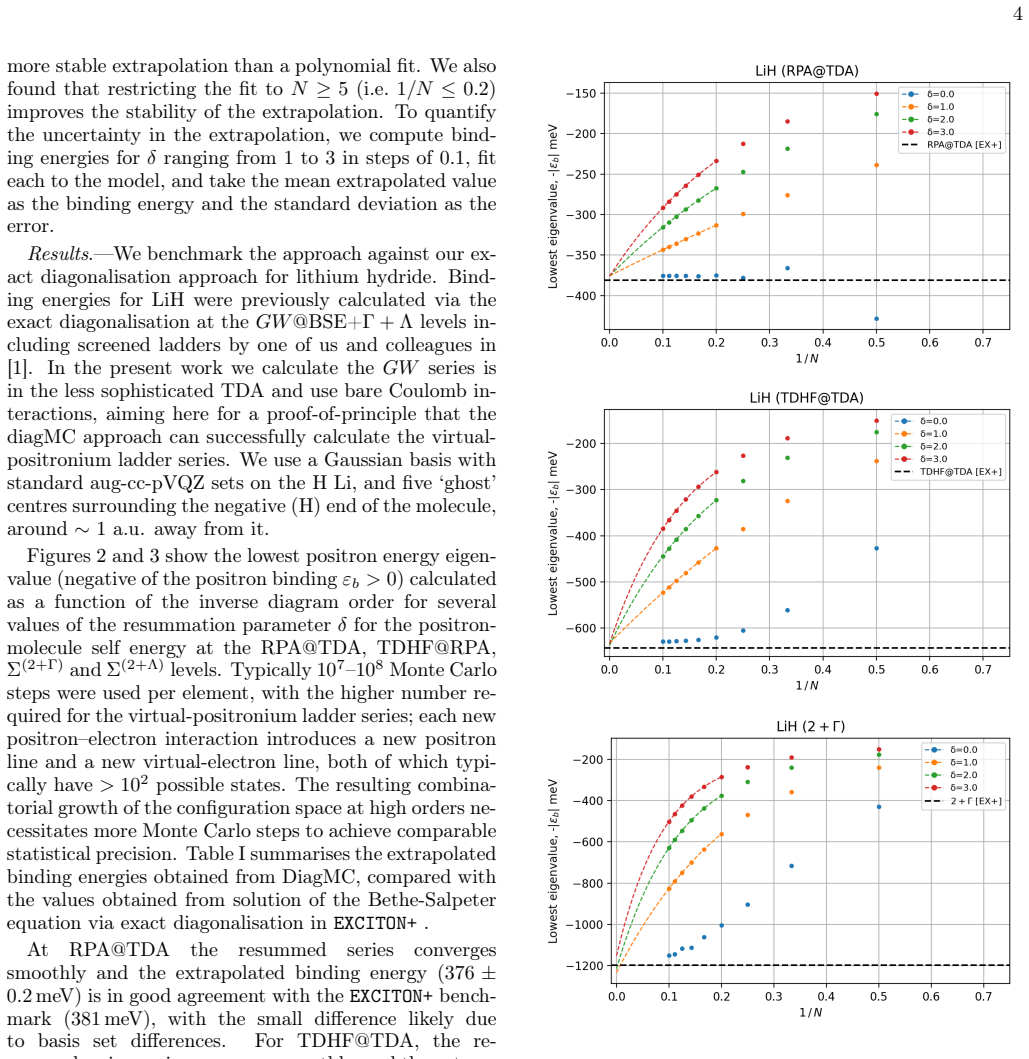
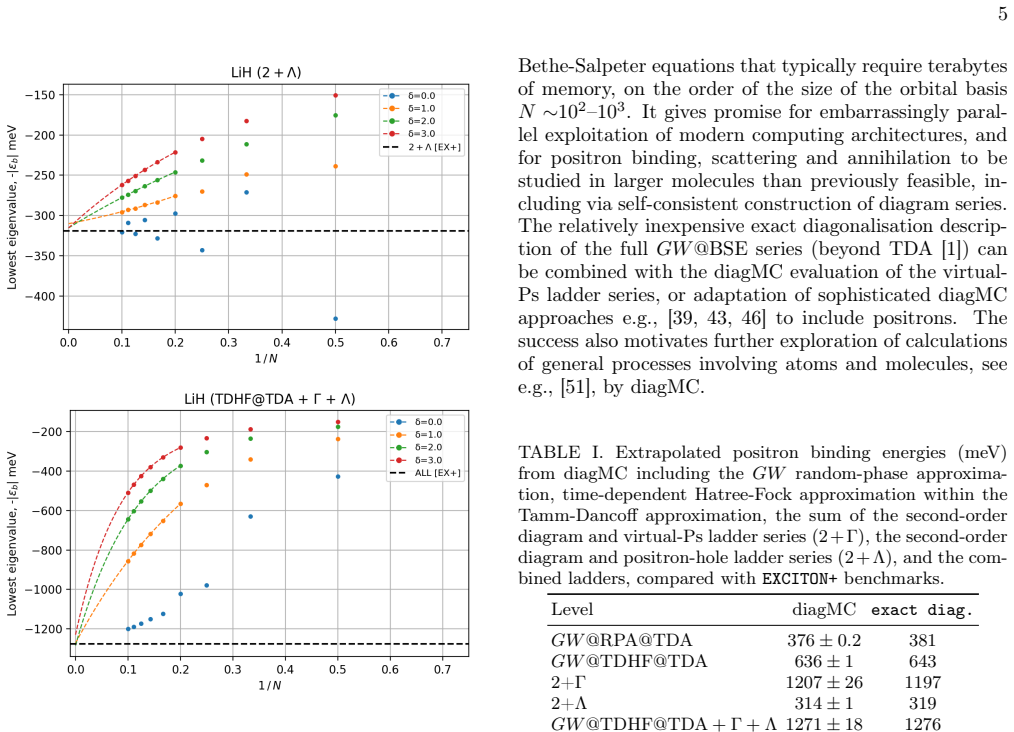
- [Eq. (9) and Results, Table I] The infinite-order extrapolation of the divergent Γ series is the load-bearing step. The reported 1207±26 meV at the 2+Γ level is only the standard deviation of the fitted C across δ∈[1,3]; it omits the MC statistical error of each Σ^(n), the uncertainty in the exponential model, the choice of the N≥5 fit window, and the possibility that the Cesàro–Riesz limit depends on δ. Since the bare series diverges, the statement after Eq. (9) that 'in the limit N→∞ the resummation reproduces the original series' is not meaningful; resummation defines a generalized sum that may differ from the physical BSE solution. The authors should validate the protocol on a deterministic order-by-order series, e.g., by computing finite-order Γ contributions with EXCITON+ in a small basis and applying the same resummation to those partial sums to see if they recover the BSE eigenvalue. They should also propagate
- [Results, Eq. (8) and Table I] Per-order Monte Carlo statistical uncertainties are not reported. The text states that 10^7–10^8 steps per element are used and that the Γ channel has larger stochastic uncertainty, but no error bars are assigned to Σ^(n) or to the resummed partial sums. Without these, the reader cannot determine whether the 10–30 meV differences between diagMC and EXCITON+ are statistically significant or simply reflect undiagnosed bias in the extrapolation. The reported 26 meV error bar for 2+Γ appears to be a purely systematic spread over δ, not a Monte Carlo error. This is a key omission for a stochastic method.
- [Results, extrapolation model] The exponential model ε_b(1/N)=A(e^{B/N}-1)+C fitted to N≥5 for δ∈[1,3] is not fully specified. The maximum order N_max is not stated, and no sensitivity analysis (e.g., varying N_min, using alternative fit forms, or showing the fitted curves for each δ) is provided. The argument that the leading correction is linear in 1/N applies to the resummed self-energy matrix elements, not directly to the binding energy after solving the Dyson equation, which is a nonlinear functional of Σ. The paper should state N_max, show the N-range and fitted curves, and discuss the stability of C with respect to the fitting window and model choice.
minor comments (5)
- [Footnote [27]] The citation placeholder '[23? ?]' appears in the sentence about annihilation-rate corrections; this must be fixed.
- [References [43] and [31]] Reference [43] lists two arXiv identifiers in a confusing format; check for a typo. Reference [31] also has an arXiv number that appears similar to another entry.
- [Eq. (1), type-0 sector] The choice D0=Σ^(2)_if is problematic if the second-order self-energy vanishes for some (i,f) pair. The authors should describe the fallback procedure or justify that this does not occur in the systems considered.
- [Algorithm details] The update set is described qualitatively. The proposal probabilities in Eq. (5)–(7) need to be stated explicitly to ensure reproducibility, especially for the 'add interaction' update where the ratio of proposal probabilities must cancel the combinatorial factors.
- [Figures 2 and 3] The figure captions and the text do not specify the number of MC steps per element per order, the total sampled orders, or whether the plotted points include any error bars. This information is essential for evaluating the reliability of the extrapolations.
Circularity Check
No significant circularity: the diagMC results are validated against an independent deterministic exact-diagonalisation benchmark, and the only fitted parameters are extrapolation constants that do not encode the target binding energies.
full rationale
The paper's derivation chain is self-contained. The Metropolis-Hastings estimator (Eq. 1), the diagram update weights (Eqs. 2-7), and the order-by-order accumulation (Eq. 8) define an unbiased Monte Carlo sampling of the finite-order self-energy. The infinite-order limit is treated by Cesaro-Riesz weighting (Eq. 9) plus an exponential extrapolation in 1/N, with the constant C reported as the binding energy. The reported values are compared to the authors' own EXCITON+ exact-diagonalisation code (Nature 2022), which is a deterministic, parameter-free solution of the Bethe-Salpeter equations for the same diagram classes; it is not used as an input to the Monte Carlo algorithm and does not set any constants in the fit. Thus the benchmark is independent support, not a circular input. The self-citation is present but not load-bearing in a circular sense. A caveat is warranted: the statement after Eq. (9) that the resummation 'reproduces the original series' in the N->infinity limit is not well-defined for the divergent Gamma series, and the extrapolation model and fit range (delta in [1,3], N>=5) are chosen pragmatically; the reported uncertainty (e.g., +/-26 meV) reflects only the spread of C over delta, not the Monte Carlo statistical error or model-selection error. This is a correctness/robustness risk, not a circularity, because the target EXCITON+ values are not fed into the fit. No other circular reduction is present.
Assumptions & free parameters
free parameters (2)
- Cesaro-Riesz exponent delta =
Scanned 1.0-3.0 in steps of 0.1
- Extrapolation model A, B, C =
Not reported
assumptions (5)
- domain assumption Tamm-Dancoff approximation is exact for the Gamma and Lambda ladder series
- ad hoc to paper Cesaro-Riesz resummation converges to the correct infinite-order sum for the divergent virtual-positronium series
- domain assumption Metropolis-Hastings update set is ergodic and satisfies detailed balance
- domain assumption Density fitting and single-precision storage of three-centre integrals give negligible error relative to MC sampling
- ad hoc to paper Exponential model captures the asymptotic 1/N dependence of the resummed binding energy
Cite this review
Pith. "Pith review of Diagrammatic Monte Carlo for positron-molecule many-body theory." pith.science (2026). https://pith.science/paper/JX4FVEFM
@misc{pith2026260602549,
  author       = {Pith},
  title        = {Pith review of: Diagrammatic Monte Carlo for positron-molecule many-body theory},
  year         = {2026},
  howpublished = {\url{https://pith.science/paper/JX4FVEFM}},
  note         = {Machine review of arXiv:2606.02549}
}
abstract
A diagrammatic Monte Carlo evaluation of the ladder series contributions to the correlation potential (self energy) of a positron in the field of a molecule is presented. The $GW$@TDHF, virtual-positronium ($T$-matrix), and positron-hole Goldstone ladder series contributions are stochastically sampled order-by-order within the Tamm-Dancoff approximation, which is exact for the latter two classes, with Ces{\'a}ro-Riesz resummation used to extrapolate to infinite order. Gaussian bases are employed and Coulomb matrix elements are represented via density fitting, with the three centre integrals the largest arrays required to be stored in memory. The stochastic approach thus realizes a reduction in memory of the largest arrays required on the order of the number of molecular orbitals in the basis $N\sim$10$^2$--10$^3$ compared to the exact deterministic solution of Bethe-Salpeter equations [J. Hofierka, B. Cunningham, C. M. Rawlins, C. H. Patterson and D. G. Green, Nature {\bf 606}, {688} (2022)]. Benchmark results for lithium hydride show quantitative agreement with exact diagonalisation, notably demonstrating the successful stochastic summation of the virtual-positronium infinite electron-positron ladder series.
Figures
Reference graph
Works this paper leans on
-
[1]
sider the positron-holeΛladder series
The black horizontal dashed line marks the reference EXCITON+Bethe-Salpeter equation solution via exact diago- nalisation. sider the positron-holeΛladder series. The convergence behaviour of this is qualitatively similar to that of the RPA@TDA and TDHF@TDA series. Cesàro–Riesz re- summation produces stable extrapolations to1/N→0 across the full rangeδ= 0–...
-
[2]
Hofierka, B
J. Hofierka, B. Cunningham, C. M. Rawlins, C. H. Pat- terson, and D. G. Green, Many-body theory of positron bindingtopolyatomicmolecules,Nature606,688(2022)
2022
-
[3]
Tuomisto and I
F. Tuomisto and I. Makkonen, Defect identification in semiconductors with positron annihilation: Experiment and theory, Rev. Mod. Phys.85, 1583 (2013)
2013
-
[4]
Hugenschmidt, Positrons in surface physics, Surf
C. Hugenschmidt, Positrons in surface physics, Surf. Sci. Rep.71, 547 (2016)
2016
-
[5]
J. R. Danielson, D. H. E. Dubin, R. G. Greaves, and C. M. Surko, Plasma and trap-based techniques for sci- ence with positrons, Rev. Mod. Phys.87, 247 (2015)
2015
-
[6]
G.B.Saha,Basics of PET imaging in physics, chemistry, and regulations(Springer, New York, 2005)
2005
-
[7]
R. L. Wahal,Principles and Practice of Positron Emis- sion Tomography(Lippincott, Williams and Wilkins, Philadelphia, 2008)
2008
-
[8]
Moskal, J
P. Moskal, J. Baran,et al., Positronium image of the human brain in vivo, Science Advances10, eadp2840 (2024)
2024
Show all 51 references
-
[9]
Moskal, A
P. Moskal, A. Bilewicz, M. Das, B. Huang, A. Khreptak, 6 S. Parzych, J. Qi, A. Rominger, R. Seifert, S. Sharma, K. Shi, W. M. Steinberger, R. Walczak, and E. Stępień, Positronium imaging: History, current status, and fu- ture perspectives, IEEE Transactions on Radiation and Pl...
2025
-
[10]
R. J. Drachman, Why positron physics is fun, AIP Con- ference Proceedings360, 369 (1996)
1996
-
[11]
Prantzos, C
N. Prantzos, C. Boehm, A. M. Bykov, R. Diehl, K. Fer- rière, N. Guessoum, P. Jean, J. Knoedlseder, A. Mar- cowith, I. V. Moskalenko, A. Strong, and G. Weidens- pointner, The 511 keV emission from positron annihila- tion in the Galaxy, Rev. Mod. Phys.83, 1001 (2011), publisher:...
2011
-
[12]
G. M. Fuller, A. Kusenko, D. Radice, and V. Takhistov, Positrons and 511 kev radiation as tracers of recent bi- nary neutron star mergers, Phys. Rev. Lett.122, 121101 (2019)
2019
-
[13]
V. V. Flambaum and I. B. Samsonov, Radiation from matter-antimatter annihilation in the quark nugget model of dark matter, Phys. Rev. D104, 063042 (2021)
2021
-
[14]
G. F. Gribakin, J. A. Young, and C. M. Surko, Positron- molecule interactions: Resonant attachment, annihila- tion, and bound states, Rev. Mod. Phys.82, 2557 (2010)
2010
-
[15]
G. F. Gribakin, J. F. Stanton, J. R. Danielson, M. R. Natisin, and C. M. Surko, Mode coupling and mul- tiquantum vibrational excitations in feshbach-resonant positron annihilation in molecules, Phys. Rev. A96, 062709 (2017)
2017
-
[16]
M. Y. Amusia, N. A. Cherepkov, L. V. Chernysheva, and S. G. Shapiro, Elastic scattering of slow positrons by he- lium, J. Phys. B: Atom. Mol. Phys.9, L531 (1976)
1976
-
[17]
V. A. Dzuba, V. V. Flambaum, W. A. King, B. N. Miller, and O. P. Sushkov, Interaction between slow positrons and atoms, Phys. Scr.T46, 248 (1993)
1993
-
[18]
V. A. Dzuba, V. V. Flambaum, G. F. Gribakin, and W.A.King,Boundstatesofpositronsandneutralatoms, Phys. Rev. A52, 4541 (1995)
1995
-
[19]
G. F. Gribakin and J. Ludlow, Many-body theory of positron-atom interactions, Phys. Rev. A70, 032720 (2004)
2004
-
[20]
Harabati, V
C. Harabati, V. Dzuba, and V. Flambaum, Identifica- tion of atoms that can bind positrons, Phys. Rev. A.89, 022517 (2014)
2014
-
[21]
Müller and L
M. Müller and L. S. Cederbaum, Many-body theory of composite electronic-positronic systems, Phys. Rev. A 42, 170 (1990)
1990
-
[22]
D. G. Green and G. F. Gribakin, Positron scattering and annihilation in hydrogenlike ions, Phys. Rev. A88, 032708 (2013)
2013
-
[23]
D. G. Green, J. A. Ludlow, and G. F. Gribakin, Positron scattering and annihilation on noble-gas atoms, Phys. Rev. A90, 032712 (2014)
2014
-
[24]
D. G. Green and G. F. Gribakin,γspectra and enhance- mentfactorsforpositronannihilationwithcoreelectrons, Phys. Rev. Lett.114, 093201 (2015)
2015
-
[25]
C. M. Rawlins, J. Hofierka, B. Cunningham, C. H. Pat- terson, and D. G. Green, Many-body theory calculations of positron scattering and annihilation inH 2,N 2, and CH4, Phys. Rev. Lett.130, 263001 (2023)
2023
-
[26]
A. L. Fetter and J. D. Walecka,Quantum Theory of Many-Particle Systems(McGraw-Hill, 1971)
1971
-
[27]
W. H. Dickhoff and D. Van Neck,Many-Body Theory Exposed!, 3rd ed. (World Scientific, 2025)
2025
-
[28]
For the positron-molecule problem theGWdiagram alone is wholly deficient. The importance of the virtual- positroniumΓladder series arises from the fact that suc- cessive terms in the series contribute with equal sign, in contrast to the all-electron case in which the signs al-...
-
[29]
J. P. Cassidy, J. Hofierka, B. Cunningham, C. M. Rawl- ins, C. H. Patterson, and D. G. Green, Many-body theory calculations of positron binding to halogenated hydrocar- bons, Phys. Rev. A109, L040801 (2024)
2024
-
[30]
Hofierka, B
J. Hofierka, B. Cunningham, and D. G. Green, Many- body theory calculations of positron binding to hydrogen cyanide, Eur. Phys. J. D78, 37 (2024)
2024
-
[31]
Arthur-Baidoo, J
E. Arthur-Baidoo, J. R. Danielson, C. M. Surko, J. P. Cassidy, S. K. Gregg, J. Hofierka, B. Cunningham, C. H. Patterson, and D. G. Green, Positron annihilation and binding in aromatic and other ring molecules, Phys. Rev. A109, 062801 (2024)
2024
-
[33]
J.Hofierka, C.M.Rawlins, B.Cunningham, D.T.Waide, and D. G. Green, Many-body theory calculations of positron scattering and annihilation in noble-gas atoms via the solution of Bethe–Salpeter equations using the gaussian-basis code EXCITON+, Front. in Physics11 (2023)
2023
-
[34]
S. K. Gregg, J. P. Cassidy, A. R. Swann, J. Hofierka, B. Cunningham, and D. G. Green, Many-body theory and gaussian-basis implementation of positron annihi- lationγ-ray spectra on polyatomic molecules (2025), arXiv:2502.12364
2025 arXiv
-
[35]
J. P. Cassidy, J. Hofierka, B. Cunningham, and D. G. Green, Many-body theory calculations of positronic- bonded molecular dianions, J. Chem. Phys.160, 084304 (2024)
2024
-
[36]
R. R. Riso, J. H. M. Trabski, F. Rossi, D. Green, and H. Koch, Coupled cluster theory for positron binding in anions and polyatomic molecules (2026), arXiv:2603.19948
2026 arXiv
-
[37]
N. V. Prokof’ev and B. V. Svistunov, Polaron problem by Diagrammatic Quantum Monte Carlo, Physical Review Letters81, 2514 (1998)
1998
-
[38]
Van Houcke, E
K. Van Houcke, E. Kozik, N. Prokof’ev, and B. Svis- tunov, Diagrammatic Monte Carlo, Physics Procedia6, 95 (2010)
2010
-
[39]
Van Houcke, F
K. Van Houcke, F. Werner, E. Kozik, N. Prokof’ev, B. Svistunov, M. J. H. Ku, A. T. Sommer, L. W. Cheuk, A. Schirotzek, and M. W. Zwierlein, Feynman diagrams versus Fermi-gas Feynman emulator, Nature Physics8, 366 (2012)
2012
-
[40]
Chen and K
K. Chen and K. Haule, A combined variational and dia- grammatic quantum Monte Carlo approach to the many- electron problem, Nature Comms.10, 3725 (2019)
2019
-
[41]
Šimkovic and R
F. Šimkovic and R. Rossi, Many-configuration markov- chain Monte Carlo (2021) arXiv:2102.05613
2021 arXiv
-
[42]
Azadi, A
S. Azadi, A. Davydov, and E. Kozik,GWspace-time method: Energy band gap of solid hydrogen, Phys. Rev. B105, 155136 (2022)
2022
-
[43]
Bighin, Q
G. Bighin, Q. P. Ho, M. Lemeshko, and T. V. Tscherbul, Diagrammatic Monte Carlo for electronic correlation in 7 molecules: High-order many-body perturbation theory with low scaling, Physical Review B108, 045115 (2023)
2023
-
[44]
Sturt and E
J. Sturt and E. Kozik, Exploiting parallelism for fast Feynman diagrammatics (2024) arXiv:2502.10327, 2501.00675
2024 arXiv
-
[45]
M.VanhoeckeandM.Schirò,DiagrammaticMonteCarlo for dissipative quantum impurity models, Phys. Rev. B 109, 125125 (2024)
2024
-
[46]
Brolli, C
S. Brolli, C. Barbieri, and E. Vigezzi, Diagrammatic Monte Carlo for finite systems at zero temperature, Phys. Rev. Lett.134, 182502 (2025)
2025
-
[47]
Y. Luo, J. Park, and M. Bernardi, First-principles dia- grammatic Monte Carlo for electron–phonon interactions and polaron, Nature Phys.21, 1275 (2025)
2025
-
[48]
Since the self-energy matrix is symmetric, only the upper triangle (i≤f) is sampled, with the calculation paral- lelised over unique(i, f)pairs
-
[49]
C. H. Patterson, Density fitting in periodic systems: Ap- plication to tdhf in diamond and oxides, J. Chem. Phys. 153, 064107 (2020)
2020
-
[50]
For ex- ample, selecting only the positron–electron interaction with all others set to zero yields theΓladder series
The proposal probabilities are user-configurable. For ex- ample, selecting only the positron–electron interaction with all others set to zero yields theΓladder series. When multiple interaction types are active, their proposal prob- abilities must be equal to satisfy detailed balance
-
[51]
Körle, On absolute summability by Riesz and gen- eralized Cesàro means
H.-H. Körle, On absolute summability by Riesz and gen- eralized Cesàro means. I, Canadian J. Math.22, 202 (1970)
1970
-
[52]
Boyle and M
J. Boyle and M. Pindzola,Many-body atomic physics (Cambridge University Press, 1998)
1998
Reviewed August 2, 2026 · model on record in the stance chip above.
Discussion (0). Continue with ORCID to comment.