REVIEW 3 minor 1 cited by
Randomly initialized EM algorithm for two-component Gaussian mixture achieves near optimality in $O(\sqrt{n})$ iterations
T0 review · 0 major / 3 minor · reviewed 2026-08-14 · deepseek-v4-flash
Pith's one-line read The paper proves that a single run of the EM algorithm from a random, carefully small initialization estimates the center of a symmetric two-component Gaussian mixture to within O((d log^3 n / n)^{1/4}) in O(sqrt n) iterations, even with…
desk verdict Important paper with a genuine gap in Lemma 19 that breaks the proof of the random-initialization theorem; deserves review but needs a fix. read the letter →
The pith
A machine-rendered reading of the paper's core claim, the machinery that carries it, and where it could break.
The reading
What carries the argument
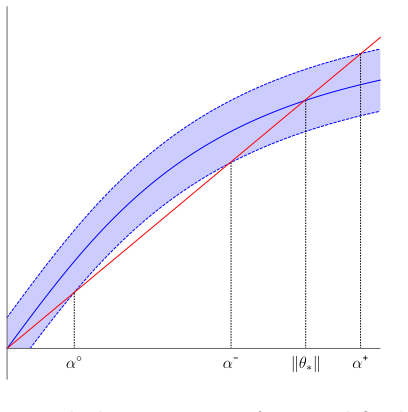
The load-bearing object is the EM update map $f_n(\theta)=\frac{1}{n}\sum_i Y_i\tanh\langle\theta,Y_i\rangle$ for the sample and its population limit $f(\theta)=E[Y\tanh\langle\theta,Y\rangle]$, which is also gradient ascent on the log-likelihood with step size one. The decisive ingredient is a relative concentration bound: on a ball of radius $\Theta(\sqrt{d})$, the difference $f_n-f$ is $O(\sqrt{d\log n/n})$-Lipschitz, so the finite-sample error shrinks proportionally when the iterates are near zero. To control the dependence between iterates and data, the paper introduces an auxiliary sequence in which the first coordinate of each sample has an independent random sign, following a leave-one-coordinate-out idea, and proves by induction that the original and auxiliary trajectories stay close while the signal component $\alpha_t=\langle\theta_t,\theta_*/\|\theta_*\|\rangle$ grows geometrically. The trajectory is then decomposed into phases: the orthogonal component $\beta_t$ contracts, the signal escapes a bad fixed point near zero, and a one-dimensional sandwich argument gives the final rate.
What would settle it
Run EM on $n\approx 10^6$ samples from a $d=5$ dimensional symmetric mixture with $\theta_*=0$, using the prescribed random initialization, and trace $\|\theta_t\|$. The theorem predicts that by $C\sqrt{n}\approx 1000C$ iterations the loss is at most $C(d\log^3 n/n)^{1/4}$ with high probability; a clear violation, with the loss stuck at order one or requiring far more iterations across repeated trials, would disprove the claimed finite-iteration guarantee. To probe the boundary, repeat with $\|\theta_0\|=1$: the paper's proof does not cover this, and failure there would confirm that the small-initialization condition is load-bearing rather than cosmetic.
Extended reading notes
Core claim
On its own terms, the paper proves Theorem 1: for the symmetric mixture $\frac12 N(-\theta_*,I_d)+\frac12 N(\theta_*,I_d)$ with $\|\theta_*\|\le r$, if $n\ge C d\log^3 d$ and EM is initialized at $\theta_0=C_0(d\log n/n)^{1/4}\eta_0$ with $\eta_0$ uniform on the unit sphere, then with probability $1-o_n(1)$ the loss $\min\{\|\theta_t-\theta_*\|,\|\theta_t+\theta_*\|\}$ is at most $C(d\log^3 n/n)^{1/4}$ for every $t\ge C\sqrt{n}$. The minimax lower bound for this model is of order $(d/n)^{1/4}$, so the EM trajectory is within logarithmic factors of statistically optimal accuracy and reaches that accuracy in sublinear time. When $\|\theta_*\|$ is above $(d\log^3 n/n)^{1/4}$, a refined pointwise theorem gives the faster rate $(1/\|\theta_*\|)\sqrt{d\log n/n}$, adapts to the Fisher information $\Theta(\|\theta_*\|^2)$, and shows the iterates converge to the unique global maximizer of the likelihood. In the worst case at $\theta_*=0$ the Fisher information vanishes and the population EM map behaves like $\theta\mapsto\theta-\theta^3$, which is why both the $n^{-1/4}$ statistical rate and the $1/\sqrt{t}$ convergence are fundamental rather than artifacts.
Load-bearing premise
The load-bearing premise is that the initialization has a precisely tuned tiny norm, $\|\theta_0\|=\Theta((d\log n/n)^{1/4})$, and the trajectory analysis that keeps the orthogonal component small collapses for standard constant-scale random starts, which the paper leaves as an open problem.
Editorial extensions
If this is right
- A single EM run, not multiple random restarts or sample splitting, is enough for near-optimal parameter estimation in this model when the initialization scale is chosen as in the paper.
- The number of iterations needed, $O(\sqrt{n})$, is much smaller than the sample size; the bottleneck is the flat likelihood at small separation, not the algorithm's implementation.
- No separation between the mixture components is required: $\theta_*=0$ is covered and the guarantee is continuous across the no-signal boundary.
- When the true parameter is separated from zero, EM automatically adapts to the parametric rate and lands on the MLE, so it inherits asymptotic efficiency.
- The minimax comparison pins down that the $n^{-1/4}$ rate is intrinsic to the problem, so the slow convergence observed in practice is not a fixable defect of EM.
Reading between the lines
- An extension the paper leaves open is whether a constant-norm random start also works; the authors conjecture yes, and a plausible route is allowing the orthogonal component to decay rather than requiring it to stay small throughout.
- The leave-one-coordinate-out technique should transfer to other rotationally invariant latent-variable models with a scalar signal, such as phase retrieval or single-index mixtures, wherever a relative Lipschitz bound replaces absolute concentration.
- A practical reading not drawn by the paper is that the EM stopping time can be scheduled from $n$ alone, making EM a one-pass statistical procedure rather than an optimization loop run to convergence.
Signed reviews
Editorial analysis
A structured set of objections, weighed in public.
Referee Report
Summary. This paper analyzes the EM algorithm for the symmetric two-component Gaussian mixture P_θ = (1/2)N(-θ,I_d)+(1/2)N(θ,I_d) under the bounded-norm assumption ‖θ*‖≤r. The main result (Theorem 1) states that if n≥C d log^3 d and EM is initialized at θ0=C0(d log n/n)^{1/4}η0 with η0 uniform on the unit sphere, then with probability 1-o(1) the loss min{‖θt-θ*‖,‖θt+θ*‖} is at most C(d log^3 n/n)^{1/4} for all t≥C√n, even when the components are not separated. This is within logarithmic factors of the minimax rate (d/n)^{1/4}. Under the additional condition ‖θ*‖≥(C d log^3 n/n)^{1/4}, Theorem 2 gives the faster adaptive rate (1/‖θ*‖)√(d log n/n) and proves convergence of the EM iterates to the MLE. The proof combines a one-dimensional sandwich argument based on Wasserstein concentration, a relative Lipschitz bound for the sample EM map, a d-dimensional population-EM analysis, an auxiliary randomized-sign sequence to track the initial growth of the signal from a random start, and a local contraction argument near the MLE. The paper also proves minimax lower bounds in Appendix B.
Significance. If the results are correct, this is a substantial advance over previous analyses: it removes the separation and initialization-quality conditions required by Balakrishnan et al. and avoids the sample-splitting/restarting device used by Daskalakis et al., for the canonical two-component Gaussian mixture. The zero-information regime is handled directly, and the O(√n) iteration count matches the slow convergence caused by vanishing curvature. The paper is honest about the main scope limitation: the guarantee requires the initialization norm to be precisely tuned to Θ((d log n/n)^{1/4}); constant-scale random initialization is left open in Section 7. The minimax benchmarks are derived independently via Le Cam, Fano, and spectral arguments, so the near-optimality claim is not circular. The proof structure is coherent and detailed, and the main theorems are not built on any fitted constants. I did, however, find a false bound inside Lemma 19 (see minor comments); it is locally fixable and does not affect the main claims. I also checked the stress-test concern about |∂_y Q|: it does not land, because the derivative contains a minus sign and is in fact bounded.
minor comments (3)
- [Section 11.2, Lemma 19] The bound |∂_y Q|≤1 is correct: direct differentiation gives ∂_yQ = (sech^2(y+x)-sech^2(y-x))/(2x), which is bounded by sup|(sech^2)'|≤1; the alleged unboundedness comes from a sign error. However, the stated bound |∂_x Q|≤1/3 is false. At (x,y)=(1,0), Q=tanh(x)/x and ∂_xQ = sech^2(1)-tanh(1) ≈ -0.3416, whose absolute value exceeds 1/3. The Taylor expansion used in the proof has an incorrect coefficient and sign; the correct identity is tanh(y+x)-tanh(y-x)=2x tanh'(y)+x^2∫_0^1(1-z)[tanh''(y+xz)-tanh''(y-xz)]dz. Using the integral representation Q=(1/2)∫_{-1}^1 tanh'(y+ux)du gives |∂_xQ|≤(1/2)sup|tanh''|≤1, so the bounded-derivative condition required in Lemma 16 holds with a slightly larger constant. Please correct Lemma 19 and the constants that depend on it.
- [Section 11.1, Lemma 9] In the bound for E_{2,⊥}, the random coefficients are (~b_i−b_i), which take values in {-2,0,2}, not Rademacher variables as assumed in Lemma 16. The same argument goes through with Hoeffding's inequality because the variables remain independent, zero-mean, and bounded, but this adaptation should be stated explicitly so that the proof is fully self-contained.
- [Section 1.2 and throughout] There are several places where the norm sign is dropped, e.g., 'For any θ∗≤r' after Eq. (15) should read 'For any ‖θ∗‖≤r'. Please normalize the notation.
Circularity Check
No circularity: EM rates are derived directly and compared against independently established minimax bounds.
full rationale
The paper's main claim is that the randomly initialized EM algorithm reaches near-minimax error in O(sqrt(n)) iterations. The EM-side of the derivation is self-contained: the sample EM map f_n(theta)=E_n[Y tanh<theta,Y>] is compared to its population limit via a relative Lipschitz/concentration bound (Theorem 4), the population EM map is analyzed through explicit properties of F and G (Lemma 5), the finite-sample trajectory is controlled by sandwich-type recursions (Theorems 5-7), and the random-initialization phase uses an auxiliary Rademacher-sequence argument to prove exponential growth of the signal component (Lemma 7, Theorem 8). None of these steps fits a parameter to the quantity being predicted; the only chosen scale, ||theta_0||=Theta((d log n/n)^{1/4}), is an explicit design assumption stated in Eq. (15), not a value estimated from data. The minimax benchmark (d/n)^{1/4} is established independently in Theorem 10 / Appendix B, via a spectral estimator upper bound and Le Cam/Fano lower bounds, with Lemma 27 proving the needed KL-local expansion. Thus the EM 'prediction' is not equivalent by construction to its inputs. Self-citations appear ([WZ18] as a prior conference version; [DWYZ19] as a 'cf.' for a crude MLE bound whose primary attribution is [HN16]), but they are not load-bearing for the central near-optimality claim, and they are used for refinements such as convergence to the MLE rather than to define the rate. The Section 7 open problem concerning constant-scale initialization is a disclosed limitation, not a circular step. Any alleged issue with Lemma 19's derivative bound concerns correctness, not circularity, and does not change this verdict.
Assumptions & free parameters
free parameters (1)
- Initialization norm scale =
C0(d log n/n)^{1/4}
assumptions (5)
- domain assumption Symmetric two-component Gaussian mixture with identity covariance and equal weights
- domain assumption Ground-truth norm bounded by constant r
- domain assumption Sample size n ≥ C d log^3 d
- ad hoc to paper Random initialization with uniform direction and small norm
- standard math Standard concentration inequalities, Wasserstein bounds, Davis-Kahan, and Fano/Le Cam arguments
Cite this review
Pith. "Pith review of Randomly initialized EM algorithm for two-component Gaussian mixture achieves near optimality in $O(\sqrt{n})$ iterations." pith.science (2026). https://pith.science/paper/JXFUPBHP
@misc{pith2026190810935,
  author       = {Pith},
  title        = {Pith review of: Randomly initialized EM algorithm for two-component Gaussian mixture achieves near optimality in $O(\sqrtn)$ iterations},
  year         = {2026},
  howpublished = {\url{https://pith.science/paper/JXFUPBHP}},
  note         = {Machine review of arXiv:1908.10935}
}
abstract
We analyze the classical EM algorithm for parameter estimation in the symmetric two-component Gaussian mixtures in $d$ dimensions. We show that, even in the absence of any separation between components, provided that the sample size satisfies $n=\Omega(d \log^3 d)$, the randomly initialized EM algorithm converges to an estimate in at most $O(\sqrt{n})$ iterations with high probability, which is at most $O((\frac{d \log^3 n}{n})^{1/4})$ in Euclidean distance from the true parameter and within logarithmic factors of the minimax rate of $(\frac{d}{n})^{1/4}$. Both the nonparametric statistical rate and the sublinear convergence rate are direct consequences of the zero Fisher information in the worst case. Refined pointwise guarantees beyond worst-case analysis and convergence to the MLE are also shown under mild conditions. This improves the previous result of Balakrishnan et al \cite{BWY17} which requires strong conditions on both the separation of the components and the quality of the initialization, and that of Daskalakis et al \cite{DTZ17} which requires sample splitting and restarting the EM iteration.
Figures


Figures from the paper (1 more)
Forward citations
Cited by 1 Pith paper
-
Transfer Learning in High-Dimensional Clustering: Minimax Thresholds and Applications in Single-Cell Data
In high-d two-community GMMs, consistent target clustering via transfer is possible iff either the target SNR clears the usual (d/n)^{1/4} barrier or the source is strong and aligned enough that µ∆_T, ∆_S, and µ∆_S∆_T...
Reference graph
Works this paper leans on
-
[1]
Christophe Biernacki, Gilles Celeux, and G \'e rard Govaert. Choosing starting values for the EM algorithm for getting the highest likelihood in multivariate gaussian mixture models. Computational Statistics & Data Analysis , 41(3-4):561--575, 2003
work page 2003
-
[2]
Statistical guarantees for the EM algorithm: From population to sample-based analysis
Sivaraman Balakrishnan, Martin J Wainwright, and Bin Yu. Statistical guarantees for the EM algorithm: From population to sample-based analysis. The Annals of Statistics , 45(1):77--120, 2017
2017
-
[3]
Gradient descent with random initialization: Fast global convergence for nonconvex phase retrieval
Yuxin Chen, Yuejie Chi, Jianqing Fan, and Cong Ma. Gradient descent with random initialization: Fast global convergence for nonconvex phase retrieval. Mathematical Programming , 2019
work page 2019
-
[4]
Trust region methods , volume 1
Andrew R Conn, Nicholas IM Gould, and Ph L Toint. Trust region methods , volume 1. Siam, 2000
work page 2000
-
[5]
Cai, Zongming Ma, and Yihong Wu
T.T. Cai, Zongming Ma, and Yihong Wu. Sparse PCA : Optimal rates and adaptive estimation. The Annals of Statistics , 41(6):3074--3110, 2013
work page 2013
-
[6]
Singularity, misspecification, and the convergence rate of em
Raaz Dwivedi, Nhat Ho, Koulik Khamaru, Michael I Jordan, Martin J Wainwright, and Bin Yu. Singularity, misspecification, and the convergence rate of em. arXiv preprint arXiv:1810.00828 , 2018
arXiv 2018
-
[7]
Sharp Analysis of Expectation-Maximization for Weakly Identifiable Models
Raaz Dwivedi, Nhat Ho, Koulik Khamaru, Martin J Wainwright, Michael I Jordan, and Bin Yu. Challenges with em in application to weakly identifiable mixture models. arXiv preprint arXiv:1902.00194 , 2019
work page Pith review arXiv 1902
-
[8]
Maximum likelihood from incomplete data via the EM algorithm
Arthur P Dempster, Nan M Laird, and Donald B Rubin. Maximum likelihood from incomplete data via the EM algorithm. Journal of the royal statistical society. Series B (methodological) , pages 1--38, 1977
work page 1977
Show all 36 references
-
[9]
Local operator theory, random matrices and B anach spaces
Kenneth R Davidson and Stanislaw J Szarek. Local operator theory, random matrices and B anach spaces. Handbook of the geometry of Banach spaces , 1(317-366):131, 2001
2001
-
[10]
Ten steps of EM suffice for mixtures of two G aussians
Constantinos Daskalakis, Christos Tzamos, and Manolis Zampetakis. Ten steps of EM suffice for mixtures of two G aussians. In Conference on Learning Theory , pages 704--710, 2017
2017
-
[11]
Natalie Doss, Yihong Wu, Pengkun Yang, and Harrison H. Zhou. Optimal estimation in the high-dimensional gaussian mixture model. Draft , Apr 2019
2019
-
[12]
On the rate of convergence in wasserstein distance of the empirical measure
Nicolas Fournier and Arnaud Guillin. On the rate of convergence in wasserstein distance of the empirical measure. Probability Theory and Related Fields , 162(3-4):707--738, 2015
2015
-
[13]
I. S. Gradshteyn and I. M. Ryzhik. Table of Integrals Series and Products . Academic, New York, NY, seventh edition, 2007
2007
-
[14]
Optimal rates for finite mixture estimation
Philippe Heinrich and Jonas Kahn. Optimal rates for finite mixture estimation. arXiv:1507.04313 , 2015
2015 arXiv
-
[15]
Convergence rates of parameter estimation for some weakly identifiable finite mixtures
Nhat Ho and XuanLong Nguyen. Convergence rates of parameter estimation for some weakly identifiable finite mixtures. The Annals of Statistics , 44(6):2726--2755, 2016
2016
-
[16]
Ingster and I.A
Y.I. Ingster and I.A. Suslina. Nonparametric goodness-of-fit testing under Gaussian models . Springer, New York, NY, 2003
2003
-
[17]
Local maxima in the likelihood of G aussian mixture models: Structural results and algorithmic consequences
Chi Jin, Yuchen Zhang, Sivaraman Balakrishnan, Martin J Wainwright, and Michael I Jordan. Local maxima in the likelihood of G aussian mixture models: Structural results and algorithmic consequences. In Advances in neural information processing systems , pages 4116--4124, 2016
2016
-
[18]
Global convergence of em algorithm for mixtures of two component linear regression
Jeongyeol Kwon, Wei Qian, Constantine Caramanis, Yudong Chen, and Damek Davis. Global convergence of em algorithm for mixtures of two component linear regression. arXiv preprint arXiv:1810.05752 , 2018
2018 arXiv
-
[19]
Choosing initial values for the EM algorithm for finite mixtures
Dimitris Karlis and Evdokia Xekalaki. Choosing initial values for the EM algorithm for finite mixtures. Computational Statistics & Data Analysis , 41(3):577--590, 2003
2003
-
[20]
Laurent and P
B. Laurent and P. Massart. Adaptive estimation of a quadratic functional by model selection. The Annals of Statistics , 28(5):1302--1338, 2000
2000
-
[21]
Statistical and computational guarantees of L loyd's algorithm and its variants
Yu Lu and Harrison H Zhou. Statistical and computational guarantees of L loyd's algorithm and its variants. arXiv preprint arXiv:1612.02099 , 2016
2016 arXiv
-
[22]
The landscape of empirical risk for nonconvex losses
Song Mei, Yu Bai, and Andrea Montanari. The landscape of empirical risk for nonconvex losses. The Annals of Statistics , 46(6A):2747--2774, 2018
2018
-
[23]
Sharp optimal recovery in the two G aussian mixture model
Mohamed Ndaoud. Sharp optimal recovery in the two G aussian mixture model. arXiv preprint arXiv:1812.08078 , 2018
2018 arXiv
-
[24]
Dissipation of information in channels with input constraints
Yury Polyanskiy and Yihong Wu. Dissipation of information in channels with input constraints. IEEE Transactions on Information Theory , 62(1):35--55, January 2016
2016
-
[25]
Mixture densities, maximum likelihood and the EM algorithm
Richard A Redner and Homer F Walker. Mixture densities, maximum likelihood and the EM algorithm. SIAM review , 26(2):195--239, 1984
1984
-
[26]
An introduction to maximum-likelihood methods in cryo- EM
Fred J Sigworth, Peter C Doerschuk, Jose-Maria Carazo, and Sjors HW Scheres. An introduction to maximum-likelihood methods in cryo- EM . In Methods in enzymology , volume 482, pages 263--294. Elsevier, 2010
2010
-
[27]
Empirical processes with applications to statistics
Galen R Shorack and Jon A Wellner. Empirical processes with applications to statistics . SIAM, 2009
2009
-
[28]
The transportation cost from the uniform measure to the empirical measure in dimension 3
M Talagrand. The transportation cost from the uniform measure to the empirical measure in dimension 3. The Annals of Probability , pages 919--959, 1994
1994
-
[29]
High-Dimensional Probability: An Introduction with Applications in Data Science
Roman Vershynin. High-Dimensional Probability: An Introduction with Applications in Data Science . Cambridge Series in Statistical and Probabilistic Mathematics. Cambridge University Press, 2018
2018
-
[30]
C. Villani. Topics in optimal transportation . American Mathematical Society, Providence, RI, 2003
2003
-
[31]
Functional properties of MMSE and mutual information
Yihong Wu and Sergio Verd\'u. Functional properties of MMSE and mutual information. IEEE Transactions on Information Theory , 58(3):1289 -- 1301, Mar. 2012
2012
-
[32]
Optimal estimation of G aussian mixtures with denoised method of moments
Yihong Wu and Pengkun Yang. Optimal estimation of G aussian mixtures with denoised method of moments. to appear in The Annals of Statistics , 2018. arxiv:1807.07237
2018 arXiv
-
[33]
Yihong Wu and Harrison H. Zhou. EM algorithm achieves the near-optimal rate for two-component symmetric G aussian mixtures in O ( n ) iterations. In Joint Statistical Meetings (JSM) , Vancouver BC, Canada, Jul 2018
2018
-
[34]
Global analysis of expectation maximization for mixtures of two G aussians
Ji Xu, Daniel J Hsu, and Arian Maleki. Global analysis of expectation maximization for mixtures of two G aussians. In Advances in Neural Information Processing Systems , pages 2676--2684, 2016
2016
-
[35]
On convergence properties of the EM algorithm for G aussian mixtures
Lei Xu and Michael I Jordan. On convergence properties of the EM algorithm for G aussian mixtures. Neural computation , 8(1):129--151, 1996
1996
-
[36]
Yang and A
Y. Yang and A. R. Barron. Information-theoretic determination of minimax rates of convergence. The Annals of Statistics , 27(5):1564--1599, 1999
1999
Reviewed August 14, 2026 · model on record in the stance chip above.
Discussion (0). Continue with ORCID to comment.