REVIEW 5 major objections 4 minor 55 references
Exploring a Hybrid Deep Learning Approach for Anomaly Detection in Mental Healthcare Provider Billing: Addressing Label Scarcity through Semi-Supervised Anomaly Detection
T0 review · 5 major / 4 minor · reviewed 2026-08-06 · deepseek-v4-flash
Pith's one-line read In mental-healthcare billing data, pseudo-labels generated by unsupervised anomaly detectors allow LSTM, Transformer, and hybrid models to catch anomalies, while models trained on the scarce real fraud labels detect nothing.
desk verdict A competent application paper whose evaluation rests on a single fraud case and in-sample pseudo-labels, so the central claim is not supported; the authors themselves admit the metrics are inapplicable before reporting them. read the letter →
The pith
A machine-rendered reading of the paper's core claim, the machinery that carries it, and where it could break.
The reading
What carries the argument
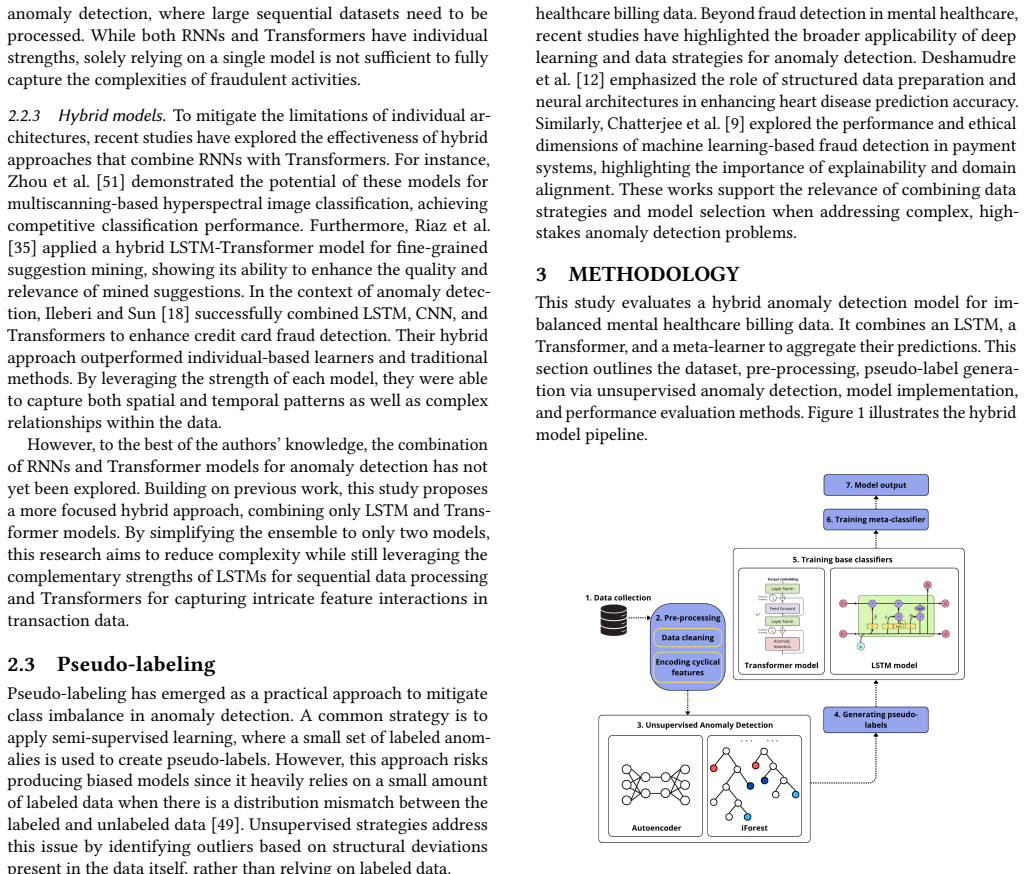
The carrying mechanism is an unsupervised pseudo-labeling pipeline. Isolation Forest scores each record by how quickly random isolation trees separate it, and an Autoencoder scores it by reconstruction error; both flag the most extreme 1.6% as anomalous, producing pseudo-labels without human fraud labels. Chronological sliding windows of length 100 (or 50 on operation-level data) then feed a two-layer LSTM and a Transformer encoder adapted from the Anomaly Transformer with a classification head replacing reconstruction, and a logistic-regression meta-learner stacks the two base models' label predictions. This machinery matters because it converts a label-scarce anomaly-detection problem into a supervised sequence-classification problem.
What would settle it
Hold out the 349 billing records tied to the single confirmed fraudulent client, train the iForest-LSTM on pseudo-labels from the remaining data, and measure recall on those confirmed records; if recall is near zero while pseudo-labeled test recall stays high, the model is mostly reproducing the unsupervised detector rather than finding real fraud.
Extended reading notes
Core claim
The central claim is that unsupervised pseudo-labels are a usable substitute for scarce fraud labels in this domain. On the declaration-level dataset, the Isolation-Forest-labeled LSTM achieves the best balance across all metrics (0.999 accuracy, 0.995 precision, 0.963 recall, 0.959 F1). On the more complex operation-level dataset, the same model keeps the best overall balance (0.996 accuracy, 0.918 precision, 0.699 recall), while the hybrid iForest-based model maximizes recall at 0.744 with lower precision (0.279). The paper also reports that autoencoder pseudo-labels separate better in t-SNE but produce worse classifiers, that original-label models fail completely, and that LSTM and Transformer errors differ significantly even when trained on identical pseudo-labels.
Load-bearing premise
The load-bearing premise is that the pseudo-labels produced by the Isolation Forest and Autoencoder are a valid learning signal, even though the unsupervised detectors were fit on the same records that later train the LSTM and Transformer.
Editorial extensions
If this is right
- On declaration-level billing data, the iForest-pseudo-labeled LSTM reaches 0.995 precision and 0.963 recall, so a single LSTM trained on unsupervised labels could serve as a high-sensitivity first-pass screener.
- On operation-level data, the hybrid iForest model reaches 0.744 recall but only 0.279 precision, meaning recall-oriented deployment would flood reviewers with false positives unless a precision filter is added.
- Models trained with the original fraud labels score zero on test metrics, so pseudo-labeling is not a small improvement but a precondition for these architectures to learn anything in this setting.
- Since McNemar's test shows LSTM and Transformer errors differ significantly under identical pseudo-labels, architecture choice changes which anomalies are found even when the training labels are the same.
- Autoencoder pseudo-labels look cleaner in t-SNE plots yet train worse classifiers, so visual label separation is not a reliable predictor of downstream anomaly-detection performance.
Reading between the lines
- Because the unsupervised detectors are fit on the same records used to train the downstream classifiers, the pseudo-labels on the training split are in-sample predictions; reported recall may partly measure how well the LSTM replicates the iForest detector rather than how well it generalizes to new fraud.
- The known fraudulent client's 349 declaration records and 84 operations are a natural held-out gold standard; the paper does not report recall on them, so the method's ability to catch confirmed fraud remains untested.
- The same pipeline could be tried in adjacent billing settings such as dentistry, outpatient surgery, or insurance claims, but the paper's own discussion implies it would need retraining because billing codes and policies differ.
- A direct test of the pseudo-labeling assumption would compare it against a modest number of expert-reviewed labels at equal annotation cost, to see whether unsupervised pseudo-labels genuinely beat a small amount of human supervision.
Editorial analysis
A structured set of objections, weighed in public.
Referee Report
Summary. The paper proposes a hybrid LSTM-Transformer anomaly detection framework for mental healthcare billing data, using pseudo-labels generated by Isolation Forest (iForest) and Autoencoder (AE) models to mitigate extreme label scarcity. The authors evaluate their approach on two proprietary datasets—declaration-level (71,196 records) and operation-level (1,589,951 records)—and report that the iForest-pseudo-labeled LSTM achieves the highest recall on declaration-level data (0.963) and that the hybrid iForest-based model achieves the highest recall on operation-level data (0.744), while all models trained on original labels fail to detect anomalies. The paper includes pseudo-code for the pseudo-labeling algorithms, detailed hyperparameter tables, SHAP interpretability analyses, and McNemar significance tests. The central claim is that pseudo-labeling with unsupervised detectors enables deep sequential models to detect billing anomalies under extreme label scarcity, with the iForest LSTM being the best overall performer.
Significance. The problem is practically relevant, and the use of two real-world proprietary billing datasets is a strength. The paper is transparent about its methodology: it provides algorithm pseudocode, hyperparameter grids, and extensive appendices, which support reproducibility within the constraints of private data. However, the evaluation is severely limited by three intertwined problems: ground-truth evaluation rests on a single confirmed fraud case, pseudo-labels for the training data are generated in-sample by the unsupervised detectors, and the original-label baselines score zero because the test splits lack positive labels. These issues mean the reported precision, recall, and F1 values do not support the general claim that the proposed approach provides effective anomaly detection in mental healthcare billing. The paper is best viewed as a case study or proof-of-concept; as it stands, it does not validate a general method, though it does illustrate a concrete pipeline and highlights challenges that future work should address.
major comments (5)
- [§3.1, §3.5.1, §4.2, Tables 1 and 2] The evaluation rests on a single confirmed fraud case: 349 billing records from one client out of 202. Section 3.5.1 explicitly states that with a single fraud case, traditional evaluation metrics were not applicable, yet Section 4.2 reports precision, recall, and F1 on the test set and uses these to conclude that iForest LSTM achieves the highest recall (0.963) on declaration-level data and the hybrid iForest model 0.744 on operation-level data. With only one positive client, these metrics measure retrieval of that one client's records, not generalizable fraud detection. This is the load-bearing weakness: even fully out-of-sample pseudo-labeling would not rescue the evaluation from the single-case ground truth. The authors should either reframe the paper as a case study with explicit caveats, or provide additional validation such as domain-expert review of flagged anomalies, precision-at-k analyses, or controlled experiments with synthetic anomalies.
- [§3.5.1 and §3.5.2] Pseudo-labels for the training data are generated in-sample by the unsupervised models. The unsupervised detectors are fit on an 80/20 split, while the LSTM and Transformer models use a separate 60/20/20 chronological split; the training portion of the downstream split is a subset of the unsupervised models' training data. Consequently, the pseudo-labels used to train the deep models are in-sample predictions from iForest and the AE, which can inflate the apparent quality of the pseudo-labels and cause the downstream model to partially replicate the unsupervised detector rather than learn generalizable patterns. The authors should generate pseudo-labels on a held-out split (or use a nested procedure) and report how performance changes when the pseudo-labels are out-of-sample.
- [§4.2.5, Tables 1 and 2] The original-label baselines score zero across all metrics, and the text states that in several test splits no labeled anomalies were present. This makes the comparison 'pseudo-labeling outperforms original-label training' unsupported by the reported numbers, because the baselines are evaluated against test sets that cannot contain any true positives. A meaningful comparison would require test splits that include the known fraud records, or evaluation metrics that do not depend on the presence of positives in the test set. As reported, the zero scores are an artifact of the evaluation split, not evidence about the value of pseudo-labeling.
- [§3.5.1, Table 3] The 1.6% contamination threshold is set by hand ('based on domain expertise'), and the AE anomaly threshold is the same 1.6% percentile. This is a free parameter that directly controls the pseudo-label positive rate, yet no sensitivity analysis is reported. The claimed performance differences between iForest-based and AE-based models, and between pseudo-labeling and original labels, could be driven by this arbitrary threshold. The authors should report results across a range of contamination rates or justify the chosen value with external information.
- [§4.2, Tables 1 and 2] The paper states that 'all models were run multiple times using the optimal threshold,' but no error bars, standard deviations, or confidence intervals are reported for the precision, recall, or F1 values. Without variance estimates, it is impossible to assess whether differences such as the iForest LSTM's recall of 0.963 versus the AE LSTM's 0.705 are statistically meaningful. The authors should report means and standard deviations across runs, and ideally bootstrap confidence intervals for the metrics.
minor comments (4)
- [§2.3] The sentence 'to the best of the authors’ knowledge, the combination of RNNs and Transformer models for anomaly detection has not yet been explored' is too strong given that the related work itself cites Ileberi and Sun [18], who combined LSTM, CNN, and Transformers for credit card fraud detection. Please soften the novelty claim to specify that the specific LSTM-Transformer hybrid on pseudo-labeled healthcare billing data has not been studied.
- [Appendix B, Tables 13 and 14] Several numerical entries in Tables 13 and 14 contain spacing errors such as '6 .35e-3' and '3 .93e8'; these should be corrected to standard decimal notation.
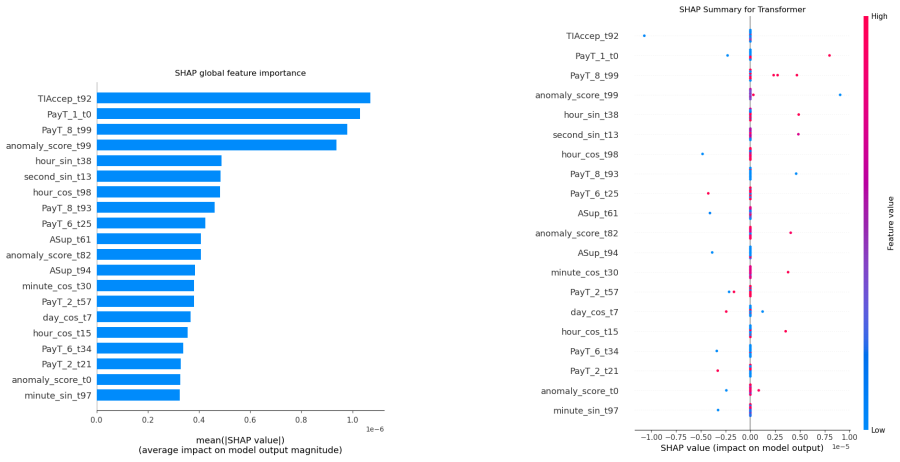
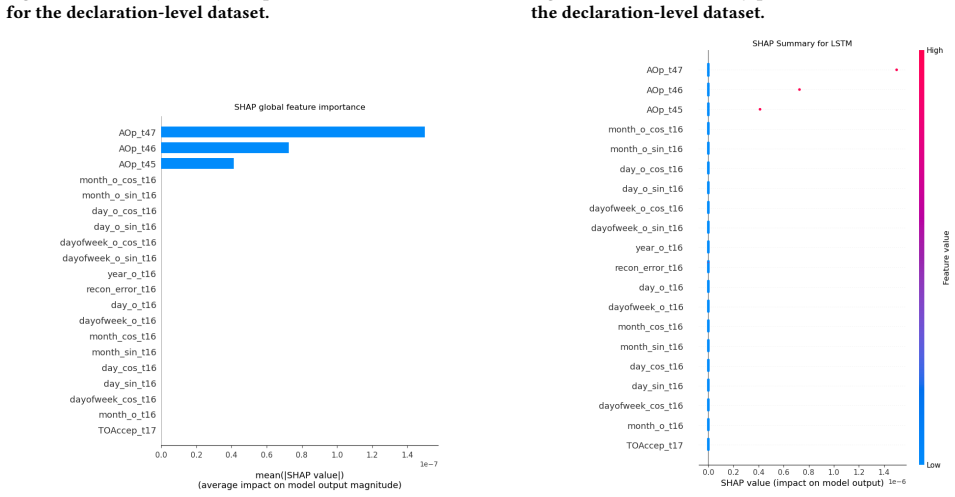
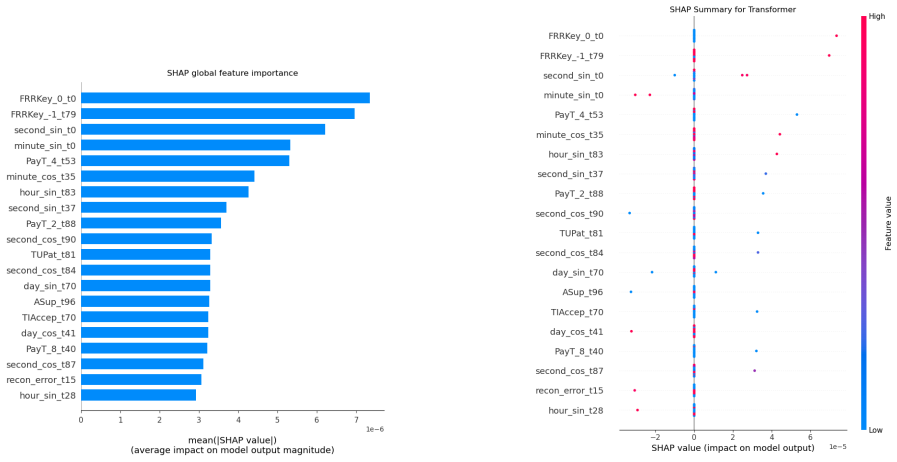
- [§4.3] The SHAP analysis is applied only to the iForest LSTM model; the text would benefit from a sentence explaining how the SHAP results connect to the anomaly detection claim, particularly because the top features (payment term, early payment) may reflect a client-specific billing profile rather than a general anomaly concept.
- [§3.2.3] The sliding window is applied without grouping by entity, which is a reasonable choice for learning global patterns, but the paper does not discuss the risk that consecutive windows from the same billing file create temporal leakage between the training, validation, and test splits. Please clarify whether windows from the same entity or declaration file can cross split boundaries.
Circularity Check
Pseudo-label quality is 'validated' by the same score threshold used to define the labels; the central fraud-detection result remains externally grounded.
-
self definitional
[Section 4.1.2, density plots (Figures 5-6); cf. Section 3.5.1 and Algorithm 1]
"For the declaration-level dataset, the iForest distribution (Figure 5) shows a clear separation, with normal instances peaking at 0.05 and anomalies at -0.025, with a threshold of -0.01."
The pseudo-labels are produced by thresholding the same iForest anomaly score at the 1.6% contamination quantile (Algorithm 1 steps 11-14; Section 3.5.1: 'the contamination threshold was set at 1.6% based on domain expertise'). Thus 'normal' and 'anomalous' are, by construction, the two sides of that score threshold, so the density-plot separation is tautological and cannot independently validate pseudo-label quality. The same applies to the AE reconstruction-error density plot, whose labels are defined by thresholding reconstruction error at 0.08. This circular step supports the claim that pseudo-labels are of good quality (Section 4.1), but it is auxiliary to the final ground-truth evaluation.
full rationale
The central anomaly-detection claim is not circular: pseudo-labels are generated by unsupervised iForest/AE models without using the ground-truth fraud labels, and the reported precision/recall/F1 values (Tables 1-2) are computed against the original confirmed-fraud labels in held-out test splits. That evaluation is weak—one confirmed fraud case (349 records from a single client, per Section 3.1), and the paper itself says 'traditional evaluation metrics were not applicable' (Section 3.5.1)—but it is externally grounded, so the main result does not reduce to its inputs. The one concrete circularity is the pseudo-label quality assessment in Section 4.1.2: separation in anomaly-score/reconstruction-error density plots is guaranteed by the thresholding rule that defines the labels, so the claimed 'clear separation' is an artifact of the definition rather than evidence of label quality. This is a non-central support step; the in-sample nature of the pseudo-labels and the single-case ground truth are validity/robustness concerns, not definitional circularity. Hence score 4: partial circularity in an auxiliary validation, with the central claim retaining independent content.
Assumptions & free parameters
free parameters (5)
- iForest contamination threshold theta =
0.016
- AE anomaly threshold percentile =
98.4%
- Optimal classification threshold per model =
varies, e.g., 0.936 for iForest LSTM
- Positive weight in loss function =
10 to 40 depending on model and dataset
- Sliding window size =
50 or 100
assumptions (4)
- domain assumption Sliding windows of billing records without grouping by entity preserve the temporal patterns relevant for anomaly detection.
- domain assumption The single confirmed fraud case is sufficient to evaluate anomaly detection performance.
- ad hoc to paper Pseudo-labels generated by unsupervised models trained on the same data are a valid training signal.
- ad hoc to paper The 1.6% contamination threshold reflects the true anomaly rate.
Cite this review
Pith. "Pith review of Exploring a Hybrid Deep Learning Approach for Anomaly Detection in Mental Healthcare Provider Billing: Addressing Label Scarcity through Semi-Supervised Anomaly Detection." pith.science (2026). https://pith.science/paper/JXJSDB2Y
@misc{pith2026250701924,
  author       = {Pith},
  title        = {Pith review of: Exploring a Hybrid Deep Learning Approach for Anomaly Detection in Mental Healthcare Provider Billing: Addressing Label Scarcity through Semi-Supervised Anomaly Detection},
  year         = {2026},
  howpublished = {\url{https://pith.science/paper/JXJSDB2Y}},
  note         = {Machine review of arXiv:2507.01924}
}
read the original abstract
The complexity of mental healthcare billing enables anomalies, including fraud. While machine learning methods have been applied to anomaly detection, they often struggle with class imbalance, label scarcity, and complex sequential patterns. This study explores a hybrid deep learning approach combining Long Short-Term Memory (LSTM) networks and Transformers, with pseudo-labeling via Isolation Forests (iForest) and Autoencoders (AE). Prior work has not evaluated such hybrid models trained on pseudo-labeled data in the context of healthcare billing. The approach is evaluated on two real-world billing datasets related to mental healthcare. The iForest LSTM baseline achieves the highest recall (0.963) on declaration-level data. On the operation-level data, the hybrid iForest-based model achieves the highest recall (0.744), though at the cost of lower precision. These findings highlight the potential of combining pseudo-labeling with hybrid deep learning in complex, imbalanced anomaly detection settings.
Figures


Figures from the paper (18 more)






Reference graph
Works this paper leans on
- [1]
-
[2]
Anas Al-Lahham, Nurbek Tastan, Zaigham Zaheer, and Karthik Nandakumar
-
[3]
Algemene Rekenkamer. 2022. Een zorgelijk gebrek aan daadkracht: Onderzoek naar de effectiviteit van zorgfraudebestrijding. https://www.rekenkamer.nl/ publicaties/rapporten/2022/04/14/een-zorg-gebrek-aan-daadkracht
work page 2022
-
[4]
Matin N. Ashtiani and Bijan Raahemi. 2022. Intelligent Fraud Detection in Financial Statements Using Machine Learning and Data Mining: A Systematic Literature Review. IEEE Access 10 (2022), 72504–72525. doi:10.1109/ACCESS.2021. 3096799
-
[5]
Ari Yair Barrera-Animas, Lukumon O. Oyedele, Muhammad Bilal, Taofeek Dolapo Akinosho, Juan Manuel Davila Delgado, and Lukman Adewale Akanbi. 2022. Rain- fall prediction: A comparative analysis of modern machine learning algorithms for time-series forecasting. Machine Learning with Applications 7 (2022), 100204. doi:10.1016/j.mlwa.2021.100204
arXiv 2022
-
[6]
Ibtissam Benchaji, Samira Douzi, and Bouabid El Ouahidi. 2021. Credit Card Fraud Detection Model Based on LSTM Recurrent Neural Networks.Journal of Advances in Information Technology 12, 2 (1 2021), 113–118. doi:10.12720/jait.12.2.113-118
-
[7]
Kaidi Cao, Colin Wei, Adrien Gaidon, Nikos Arechiga, and Tengyu Ma. 2019. Learning Imbalanced Datasets with Label-Distribution-Aware Margin Loss.arXiv (Cornell University) (1 2019)
work page 2019
-
[8]
Kangjie Cao, Ting Zhang, and Jueqiao Huang. 2024. Advanced hybrid LSTM- transformer architecture for real-time multi-task prediction in engineering sys- tems. Scientific Reports 14, 1 (2 2024). doi:10.1038/s41598-024-55483-x
Show all 55 references
-
[9]
Sahand Mohammadi Ziabari, and Amr Elsherbini
Agniv Chatterjee, S. Sahand Mohammadi Ziabari, and Amr Elsherbini. 2023. Payments Fraud Detection using ML methods: Exploring Performance, Ethical and Real-World Considerations in Machine Learning-based Fraud Detection for Secure Payments. Technical Report. University of Amste...
2023
-
[10]
Patricia Craja, Alisa Kim, and Stefan Lessmann. 2020. Deep learning for detecting financial statement fraud. Decision Support Systems 139 (10 2020), 113421. doi:10. 1016/j.dss.2020.113421
2020
-
[11]
Andrea Dal Pozzolo, Giacomo Boracchi, Olivier Caelen, Cesare Alippi, and Gi- anluca Bontempi. 2018. Credit Card Fraud Detection: A Realistic Modeling and a Novel Learning Strategy. IEEE Transactions on Neural Networks and Learning Systems 29, 8 (2018), 3784–3797. doi:10.1109/T...
2018
-
[12]
Sahand Mohammadi Ziabari, and Marc van Houten
Rohan Deshamudre, S. Sahand Mohammadi Ziabari, and Marc van Houten. 2023. Enhancing AI Adoption in Healthcare: A Data Strategy for Improved Heart Disease Prediction Accuracy through Deep Learning Techniques. In Proceedings of the ACM Symposium on Applied Computing . doi:10.100...
2023 doi
-
[13]
Bayan Bruss, and Leman Akoglu
Xueying Ding, Nikita Seleznev, Senthil Kumar, C. Bayan Bruss, and Leman Akoglu
-
[14]
Fabian Dubourvieux, Romaric Audigier, Angélique Loesch, Samia Ainouz, and Stéphane Canu. 2022. A formal approach to good practices in Pseudo-Labeling for Unsupervised Domain Adaptive Re-Identification. Computer Vision and Image Understanding 223 (8 2022), 103527. doi:10.1016/j...
2022
- [15]
-
[16]
Zain Hamid, Fatima Khalique, Saba Mahmood, Ali Daud, Amal Bukhari, and Bader Alshemaimri. 2024. Healthcare insurance fraud detection using data mining. BMC Medical Informatics and Decision Making 24, 1 (4 2024). doi:10.1186/s12911- 024-02512-4
2024 doi
-
[17]
Shawni Dutta and Samir Kuma Bandyopadhyay. 2020. Detection of Fraud Transactions Using Recurrent Neural Network during COVID-19. Journal of Advanced Research in Medical Science and Technology 07, 03 (10 2020), 16–21. doi:10.24321/2394.6539.202012
2020
-
[18]
Emmanuel Ileberi and Yanxia Sun. 2024. A Hybrid Deep Learning Ensemble Model for Credit Card Fraud Detection. IEEE Access 12 (2024), 175829–175838. doi:10.1109/ACCESS.2024.3502542
2024
- [19]
-
[20]
Yashvi Jain, Namrata Tiwari, Shripriya Dubey, and Sarika Jain. 2019. A compar- ative analysis of various credit card fraud detection techniques. International Journal of Recent Technology and Engineering 7, 5 (2019), 402–407
2019
- [21]
- [22]
-
[23]
Eunji Kim, Jehyuk Lee, Hunsik Shin, Hoseong Yang, Sungzoon Cho, Seung-Kwan Nam, Youngmi Song, Jeong-A Yoon, and Jong-Il Kim. 2019. Champion-challenger analysis for credit card fraud detection: Hybrid ensemble and deep learning. Expert Systems with Applications 128 (3 2019), 21...
2019 doi
-
[24]
Prateek Kumar Bansal, Divya Nimma, Nripendra Narayan Das, BVN Prasad Paruchuri, Harishchander Anandaram, and M. Karthik. 2024. Boosting Anomaly Detection in Financial Transactions: Leveraging Deep Learning with Isolation Forest for Enhanced Accuracy. (2024), 1–6. doi:10.1109/I...
2024
-
[25]
Deepak Kumar, Anshuman Singh, Pijush Samui, and Rishi Kumar Jha. 2019. Forecasting monthly precipitation using sequential modelling. Hydrological Sciences Journal 64, 6 (3 2019), 690–700. doi:10.1080/02626667.2019.1595624
2019
-
[26]
Dong Liang, Jun Wang, Xiaoyu Gao, Jiahui Wang, Xiaoyong Zhao, and Lei Wang
- [27]
-
[28]
Ahmed Marcouch and Marco van der Wel. 2023. Fenomeenanal- yse Criminele zzp’ers in de zorg Arnhem - iBabs Publieksportaal. https://arnhem.bestuurlijkeinformatie.nl/Reports/Item/4b3941ee-d0df-4160- bc1c-13ef09c160dd
2023
-
[29]
Quinn McNemar. 1947. Note on the sampling error of the difference between correlated proportions or percentages. Psychometrika 12, 2 (6 1947), 153–157. doi:10.1007/bf02295996
1947 doi
- [30]
-
[31]
Soroor Motie and Bijan Raahemi. 2024. Financial fraud detection using graph neural networks: A systematic review. Expert Systems with Applications 240 (4 2024), 122156. doi:10.1016/j.eswa.2023.122156
2024
-
[32]
Ali Vafaee Najar, Leili Alizamani, Marziye Zarqi, and Elaheh Hooshmand. 2025. A global scoping review on the patterns of medical fraud and abuse: integrating data-driven detection, prevention, and legal responses. Archives of Public Health 83, 1 (2 2025). doi:10.1186/s13690-02...
2025 doi
-
[33]
Ibomoiye Domor Mienye and Nobert Jere. 2024. Deep Learning for Credit Card Fraud Detection: A review of Algorithms, Challenges, and Solutions. IEEE Access 12 (1 2024), 96893–96910. doi:10.1109/access.2024.3426955
2024
-
[34]
Pradheepan Raghavan and Neamat El Gayar. 2019. Fraud Detection using Ma- chine Learning and Deep Learning. 2019 International Conference on Compu- tational Intelligence and Knowledge Economy (ICCIKE) , 334–339. doi:10.1109/ iccike47802.2019.9004231
2019
-
[35]
Jaleed Khan
Samad Riaz, Amna Saghir, Muhammad Junaid Khan, Hassan Khan, Hamid Saeed Khan, and M. Jaleed Khan. 2024. TransLSTM: A hybrid LSTM-Transformer model for fine-grained suggestion mining. Natural Language Processing Journal 8 (7 2024), 100089. doi:10.1016/j.nlp.2024.100089
2024
-
[36]
Jamal Abdul Nasir, Osama Subhani Khan, and Iraklis Varlamis. 2021. Fake news detection: A hybrid CNN-RNN based deep learning approach. International Journal of Information Management Data Insights 1 (1 2021), 100007. doi:10.1016/ j.jjimei.2020.100007
2021
-
[37]
Gnaneswar, R
Ruttala Sailusha, V. Gnaneswar, R. Ramesh, and G. Ramakoteswara Rao. 2020. Credit Card Fraud Detection Using Machine Learning. 2020 4th International Conference on Intelligent Computing and Control Systems (ICICCS) , 1264–1270. doi:10.1109/ICICCS48265.2020.9121114
2020
-
[38]
Thomas Schranz, Gerald Schweiger, Siegfried Pabst, and Franz Wotawa. 2020. Machine Learning for Water Supply Supervision. Springer International Publishing. 238–249 pages. doi:10.1007/978-3-030-55789-8_21
2020 doi
-
[39]
Samuthira Pandi, S Alamelu Alias Rajasree, and Dr
J Femila Roseline, GBSR Naidu, V. Samuthira Pandi, S Alamelu Alias Rajasree, and Dr. N. Mageswari. 2022. Autonomous credit card fraud detection using machine learning approach. Computers & Electrical Engineering 102 (6 2022), 108132. doi:10.1016/j.compeleceng.2022.108132
2022
-
[40]
Feng Shen, Xingchao Zhao, Gang Kou, and Fawaz E. Alsaadi. 2021. A new deep learning ensemble credit risk evaluation model with an improved synthetic minority oversampling technique. Applied Soft Computing 98 (1 2021), 106852. doi:10.1016/j.asoc.2020.106852
2021
-
[41]
Margot Smolenaars and Judith Spanjers. 2024. Klokkenluiders: grote jeugd-ggz- instelling fraudeert met zorggeld. (11 2024). https://www.ftm.nl/artikelen/ declaraties-jeugdzorg-karakter-zorgfraude
2024
-
[42]
Saeed Shafieian and Mohammad Zulkernine. 2022. Multi-layer stacking ensemble learners for low footprint network intrusion detection. Complex & Intelligent Systems 9, 4 (7 2022), 3787–3799. doi:10.1007/s40747-022-00809-3
2022 doi
-
[43]
Yuxuan Tang and Zhanjun Liu. 2024. A Credit Card Fraud Detection Algorithm Based on SDT and Federated Learning. IEEE Access 12 (2024), 182547–182560. doi:10.1109/ACCESS.2024.3491175 10
2024
-
[44]
Yuxuan Tang and Zhanjun Liu. 2024. A Distributed Knowledge Distillation Framework for Financial Fraud Detection Based on Transformer. IEEE Access 12 (2024), 62899–62911. doi:10.1109/ACCESS.2024.3387841
2024
-
[45]
Khushboo Taneja, Jyoti Vashishtha, and Saroj Ratnoo. 2025. Fraud-BERT: trans- former based context aware online recruitment fraud detection. Discover Com- puting 28 (2 2025). doi:10.1007/s10791-025-09502-8
2025 doi
-
[46]
Hongzuo Xu, Guansong Pang, Yijie Wang, and Yongjun Wang. 2023. Deep Isolation Forest for Anomaly Detection. IEEE Transactions on Knowledge and Data Engineering 35, 12 (4 2023), 12591–12604. doi:10.1109/tkde.2023.3270293
2023
- [47]
- [48]
-
[49]
Arik, and Tomas Pfister
Jinsung Yoon, Kihyuk Sohn, Chun-Liang Li, Sercan O. Arik, and Tomas Pfister
- [50]
-
[51]
Jun Yang, Jingbin Qu, Qiang Mi, and Qing Li. 2020. A CNN-LSTM model for tailings dam risk prediction. IEEE Access 8 (11 2020), 206491–206502. doi:10.1109/ access.2020.3037935
2020
- [53]
-
[55]
Weilian Zhou, Sei-Ichiro Kamata, Haipeng Wang, and Xi Xue. 2023. Multiscanning-Based RNN–Transformer for Hyperspectral Image Classifica- tion. IEEE Transactions on Geoscience and Remote Sensing 61 (2023), 1–19. doi:10.1109/TGRS.2023.3277014 11 Appendices A HYPERPARAMETERS For ...
2023
-
[2022]
2022 International Conference on Big Data, Information and Computer Network (BDICN), 306–310
Self-supervised Pretraining Isolated Forest for Outlier Detection. 2022 International Conference on Big Data, Information and Computer Network (BDICN), 306–310. doi:10.1109/BDICN55575.2022.00065
2022
- [2023]
Reviewed August 6, 2026 · model on record in the stance chip above.
Discussion (0). Sign in to comment.