REVIEW 3 major objections 5 minor 56 references
Apparent axion-photon conversion in PG 1015+014 disappears once the star's second harmonic is included in the background model.
Reviewed by Pith at T0; open to challenge. T0 means a machine referee read the full paper against a public rubric. the ladder, T0–T4 →
T0 review · deepseek-v4-flash
2026-08-01 14:44 UTC pith:JY524CA6
load-bearing objection Careful reanalysis of PG 1015+014 shows the claimed photometric axion signal is a background-model artifact; the paper's own limit is plausible, but magnetic-template uncertainties are not propagated. the 3 major comments →
Time-Domain Axion Searches with Magnetic White Dwarfs
The pith
A machine-rendered reading of the paper's core claim, the machinery that carries it, and where it could break.
Core claim
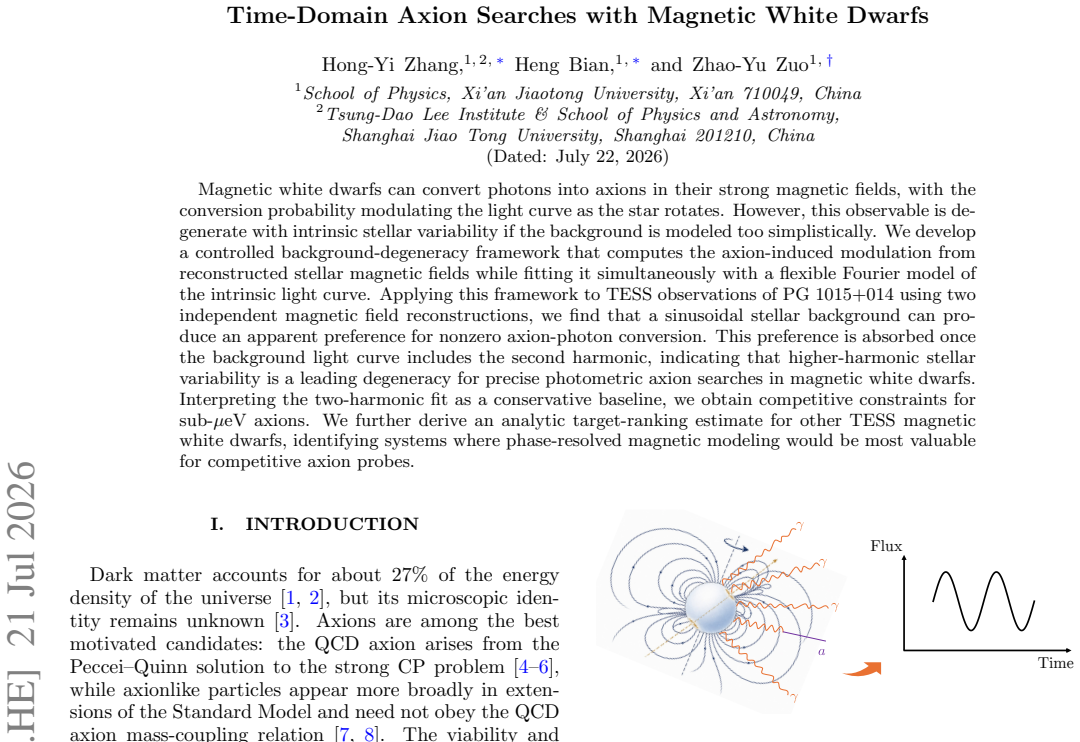
The central claim is that the apparent photometric preference for axion-photon conversion in PG 1015+014, which appears when the intrinsic light curve is assumed sinusoidal, is not evidence for axions. The same phase structure is absorbed by a stellar background containing the second rotational harmonic; AIC and BIC differences of 11.94 and 13.52 strongly favor the two-harmonic background-only model over the axion-plus-sinusoid model. With the two-harmonic baseline, the marginalized 95% upper limit on the axion-photon coupling is gaγ < 2×10^-11 GeV^-1 for ma ≲ 2×10^-7 eV. The limit is reproduced with two independent magnetic reconstructions (off-centered dipoles and a truncated multipole exp
What carries the argument
The machinery is a phase-resolved template for axion-induced flux attenuation: the surface-averaged photon survival probability is computed from the line-of-sight integral of the transverse magnetic field over the visible stellar disk, using a magnetic-field reconstruction from Zeeman-tomography data, and multiplied by a phenomenological Fourier background model with nuisance coefficients. The axion template's phase shape is fixed by the magnetic topology and limb darkening, while the background coefficients absorb ordinary stellar variability. A normalization rescaling for the associated Legendre functions is needed to convert published multipole coefficients into physical surface fields. T
Load-bearing premise
The published Zeeman-tomography magnetic-field reconstructions of PG 1015+014, including their phase convention and normalization, are taken as fixed inputs to the axion template, and uncertainties in these maps are not propagated into the final limit.
What would settle it
A reanalysis of the same TESS data with a background model that includes N_bkg=3 or a nonparametric stellar variability model, finding that the preference for nonzero gaγ persists with strong model-selection support, would contradict the paper's conclusion. Alternatively, new phase-resolved spectropolarimetry yielding a materially different magnetic topology for PG 1015+014 that removes the degeneracy would change the limit.
If this is right
- The earlier sinusoidal-background claim of a photometric axion preference in PG 1015+014 should be reinterpreted as a background-modeling artifact, not a signal.
- Future photometric axion searches using rotating magnetic white dwarfs must marginalize over at least the leading higher harmonics of the intrinsic light curve before claiming a detection.
- The conservative upper limit gaγ < 2×10^-11 GeV^-1 for sub-μeV axions is robust to the choice between two independent magnetic-field reconstructions.
- The analytic target-ranking estimate identifies nine additional TESS magnetic white dwarfs whose strong fields and precise photometry make them priorities for phase-resolved magnetic modeling.
- The framework can be adapted to other magnetized rotating objects, such as neutron stars, where a known magnetic geometry allows a template-based search.
Where Pith is reading between the lines
- The quoted limit inherits unquantified uncertainty from the published magnetic-field reconstructions, which are treated as fixed inputs; a different surface topology could shift both the degeneracy test and the constraint.
- If higher harmonics beyond the second are present at a level that mimics the axion template in other targets, the same absorption could weaken or strengthen limits depending on the object; the paper's N_bkg=2 baseline is a conservative choice, but not guaranteed sufficient for all stars.
- A testable extension: apply the same background-marginalized framework to the nine ranked targets once Zeeman-tomography reconstructions become available, predicting that any apparent axion preference from sinusoidal fits will be absorbed by higher harmonics.
- The approach implies a general caution for time-domain exotic-physics searches: parametric backgrounds with too few harmonics can convert ordinary stellar structure into spurious signals; flexible nonparametric background models or independent atmospheric modeling would provide a stronger cross-check.
Editorial analysis
A structured set of objections, weighed in public.
Referee Report
Summary. This paper develops a phase-resolved photometric framework for searching for axion-photon conversion in magnetic white dwarfs. For a given magnetic-field reconstruction, the axion-induced, phase-dependent attenuation is computed from Eq. (11) and fitted jointly with a Fourier model of the intrinsic stellar background (Eq. 18). Applying the framework to TESS observations of PG 1015+014 with two magnetic models, the authors show that a purely sinusoidal background yields apparent posterior support for nonzero g_aγ; this preference disappears when the second harmonic is added to the background (Secs. VI A-B), and AIC/BIC strongly favor the two-harmonic pure-background model (Sec. VI C). The baseline 95% upper limit is g_aγ < 2×10^-11 GeV^-1 for m_a ≲ 2×10^-7 eV (Eq. 21), and it is consistent between the triple-dipole and multipole reconstructions. A target-ranking estimate (Eq. 25) identifies other TESS magnetic white dwarfs for follow-up.
Significance. If the result holds, the paper makes two useful contributions. First, it demonstrates quantitatively that the previously reported photometric axion preference in PG 1015+014 (Ref. [34]) is a background-modeling artifact, not evidence for axions. Second, it establishes a controlled framework—combining a physically motivated axion template with a flexible Fourier background and explicit model selection—that can be applied to other rotating magnetized stars. The model-selection step (ΔAIC = 11.94, ΔBIC = 13.52) is a concrete, welcome test, and the consistency between the triple-dipole and multipole magnetic parametrizations is a strength. The main limitation is that the axion template is fixed by external magnetic reconstructions whose uncertainties are not propagated; moreover, the two reconstructions are not independent in the sense that they are fits to the same spectropolarimetric data. A sensitivity analysis would substantially strengthen the central claim.
major comments (3)
- [Sec. III B / Eq. (15)] The axion template is fixed entirely by the Euchner et al. (2006) reconstructions, but the Schmidt-normalization rescaling is asserted rather than validated. The text notes that directly using the tabulated coefficients with unnormalized Legendre functions gives unphysically large surface fields, yet no plot or quantitative check is shown that the rescaled coefficients reproduce the published surface-field maps. In addition, the triple-dipole and multipole models are both fits to the same spectropolarimetric data, so their agreement does not bound reconstruction uncertainties. I request an explicit sensitivity analysis: propagate the published parameter uncertainties, or perturb the multipole coefficients, the inclination, and the relative phase within plausible ranges, and recompute the template, the N_bkg=1 vs N_bkg=2 model comparison, and the limit in Eq. (21). Without this, the centr
- [Sec. VI B/D / Eq. (25)] The quoted 95% upper limit uses a flat prior log10(g_aγ/GeV^-1) ∈ [-11.2, -10.2] on a parameter that is not preferred by the data. For a one-sided limit, the posterior upper bound can depend on the prior lower edge; please report the cumulative posterior and test sensitivity to the prior boundary (e.g., extend the lower edge to -12). In addition, the surface-averaging factor x is said in Sec. II A to reduce the ray-level estimate, but its value is never computed from Eq. (11); Eq. (25) instead sets the normalization to match the PG 1015+014 limit. This makes the target-ranking projections partly calibrated rather than derived. I ask that x be computed from the template for PG 1015+014 and for each projected target, or that the projections be explicitly labeled as heuristics with an unspecified x.
- [Sec. VI C] The model-selection comparison is between Model A (N_bkg=1 + axion) and Model B (N_bkg=2 pure background). This demonstrates that a sinusoidal background plus axion is worse than a two-harmonic background without axions, but it does not directly test whether an axion component on top of a two-harmonic background is disfavored. The posterior in Figure 5 suggests no preference, but a quantitative comparison of N_bkg=2 + axion versus N_bkg=2 pure background would make the claim that the preference is 'absorbed by the second harmonic' more airtight. Please report the Δχ², ΔAIC, and ΔBIC for this additional pair, or explain why the posterior shape suffices.
minor comments (5)
- [Abstract and Sec. III B] The abstract states 'two independent magnetic field reconstructions'; both are parametrizations fit to the same Euchner et al. (2006) spectropolarimetric data. Suggest rewording to 'two independent parametrizations of the published reconstruction' to avoid overstating independence.
- [Figure 3] The three representative best-fit models are not labeled in the figure. Add a legend or explicit curve labels (N_bkg=1, N_bkg=2, and N_bkg=1+axion).
- [Sec. VI C] The best-fit χ² values are said to come from MCMC chains, but the precise estimator (maximum of log-likelihood over all samples, or a separate minimization) is not stated. Please specify how χ²_A and χ²_B were obtained, and report χ²_B explicitly.
- [Sec. IV] The check that the scatter error per bin is 'less than or comparable to the formal uncertainty' is vague. Give numerical values or a small table/figure comparing the two error estimates for the 32 bins.
- [Table I] The table footnote says coefficients are in MG after Schmidt normalization, but it is not clear whether the h_m^l entries for m=0 are zero or omitted. The caption should state the treatment of m=0 sine coefficients explicitly.
Circularity Check
No significant circularity: the central derivation is self-contained and the apparent axion preference is explicitly tested against a flexible background.
full rationale
The paper's central derivation is not circular. The phase-resolved axion template is computed from an external mixing formula (Raffelt–Stodolsky, Ref. [22]) and external Zeeman-tomography magnetic field reconstructions (Euchner et al., Ref. [33]); it is not defined in terms of the fitted background. The apparent nonzero axion preference under a sinusoidal background is explicitly diagnosed as an artifact by comparing to a two-harmonic background model: Model A vs Model B yields DeltaAIC = 11.94 and DeltaBIC = 13.52, and an N_bkg=3 test shows saturation (DeltaChi^2 = -0.10). This is a genuine statistical comparison, not a conclusion forced by construction. The two magnetic parametrizations from Ref. [33] are used as a cross-check; they are not independent external datasets, but this is a robustness limitation, not circularity. The Schmidt-normalization rescaling (Eq. 15) is a calibration to the published surface-field maps of Ref. [33], i.e., to an external benchmark, not to the paper's own result. Equation (25) is the only apparent calibration step: the text states 'The numerical normalization is chosen to match the coupling scale reached in the full PG 1015+014 analysis.' This is transparently an analytic sensitivity estimate for target ranking, not a derivation of the benchmark limit (21), and the relative ranking of targets is insensitive to the common normalization. No load-bearing self-citations are used; the author's prior works appear only in general dark-matter context. The main caveat—lack of propagated magnetic-reconstruction uncertainties—affects robustness but does not make the derivation equivalent to its inputs.
Axiom & Free-Parameter Ledger
free parameters (4)
- x (surface-averaging/geometric suppression factor) =
0.05 (fixed for all projected targets)
- Normalization of target-ranking formula (Eq. 25) =
2e-11 GeV^-1
- Fourier background coefficients theta_i =
fitted per light curve
- Relative phase phi_aγ =
sampled in [-0.5, 0.5]
axioms (6)
- standard math Axion-photon mixing formula (Eq. 2) from Raffelt and Stodolsky (1988)
- domain assumption Magnetic-field reconstructions of PG 1015+014 from Euchner et al. (2006) are valid inputs
- domain assumption Intrinsic stellar variability is representable by a low-order Fourier series, with N_bkg=2 sufficient
- domain assumption Cold white-dwarf mass-radius relation with mu_e=2 gives R_star=0.009 R_sun for M_star=0.91 M_sun
- domain assumption Monochromatic photon energy omega=1.5498 eV represents the TESS bandpass
- domain assumption Rotation period is constant over the four-year TESS baseline so phase folding is valid
read the original abstract
Magnetic white dwarfs can convert photons into axions in their strong magnetic fields, with the conversion probability modulating the light curve as the star rotates. However, this observable is degenerate with intrinsic stellar variability if the background is modeled too simplistically. We develop a controlled background-degeneracy framework that computes the axion-induced modulation from reconstructed stellar magnetic fields while fitting it simultaneously with a flexible Fourier model of the intrinsic light curve. Applying this framework to TESS observations of PG~1015+014 using two independent magnetic field reconstructions, we find that a sinusoidal stellar background can produce an apparent preference for nonzero axion-photon conversion. This preference is absorbed once the background light curve includes the second harmonic, indicating that higher-harmonic stellar variability is a leading degeneracy for precise photometric axion searches in magnetic white dwarfs. Interpreting the two-harmonic fit as a conservative baseline, we obtain competitive constraints for sub-$\mu\mathrm{eV}$ axions. We further derive an analytic target-ranking estimate for other TESS magnetic white dwarfs, identifying systems where phase-resolved magnetic modeling would be most valuable for competitive axion probes.
Figures


Reference graph
Works this paper leans on
-
[1]
Aghanimet al.(Planck), Planck 2018 results
N. Aghanimet al.(Planck), Planck 2018 results. VI. Cosmological parameters, Astron. Astrophys.641, A6 (2020), [Erratum: Astron.Astrophys. 652, C4 (2021)], arXiv:1807.06209 [astro-ph.CO]
Pith/arXiv arXiv 2018
-
[2]
Navaset al.(Particle Data Group), Review of particle physics, Phys
S. Navaset al.(Particle Data Group), Review of particle physics, Phys. Rev. D110, 030001 (2024)
2024
-
[3]
M. Cirelli, A. Strumia, and J. Zupan, Dark Matter, arXiv (2024), arXiv:2406.01705 [hep-ph]
Pith/arXiv arXiv 2024
-
[4]
R. D. Peccei and H. R. Quinn, CP Conservation in the Presence of Instantons, Phys. Rev. Lett.38, 1440 (1977)
1977
-
[5]
Weinberg, A New Light Boson?, Phys
S. Weinberg, A New Light Boson?, Phys. Rev. Lett.40, 223 (1978)
1978
-
[6]
Wilczek, Problem of StrongPandTInvariance in the Presence of Instantons, Phys
F. Wilczek, Problem of StrongPandTInvariance in the Presence of Instantons, Phys. Rev. Lett.40, 279 (1978)
1978
-
[7]
D. J. E. Marsh, Axion Cosmology, Phys. Rept.643, 1 (2016), arXiv:1510.07633 [astro-ph.CO]
Pith/arXiv arXiv 2016
-
[8]
L. Di Luzio, M. Giannotti, E. Nardi, and L. Visinelli, The landscape of QCD axion models, Phys. Rept.870, 1 (2020), arXiv:2003.01100 [hep-ph]
Pith/arXiv arXiv 2020
-
[9]
T. D. P. Edwards, B. J. Kavanagh, L. Visinelli, and C. Weniger, Transient Radio Signatures from Neutron Star Encounters with QCD Axion Miniclusters, Phys. Rev. Lett.127, 131103 (2021), arXiv:2011.05378 [hep- ph]
Pith/arXiv arXiv 2021
-
[10]
Zhang,Probing ultralight dark fields in cosmological and astrophysical systems, Ph.D
H.-Y. Zhang,Probing ultralight dark fields in cosmological and astrophysical systems, Ph.D. thesis, Rice U. (2023), arXiv:2401.00043 [hep-ph]
Pith/arXiv arXiv 2023
-
[11]
B. Salehian, H.-Y. Zhang, M. A. Amin, D. I. Kaiser, and M. H. Namjoo, Beyond Schr¨ odinger-Poisson: non- relativistic effective field theory for scalar dark matter, JHEP09, 050, arXiv:2104.10128 [astro-ph.CO]
-
[12]
M. A. Amin and Z.-G. Mou, Electromagnetic Bursts from Mergers of Oscillons in Axion-like Fields, JCAP02, 024, arXiv:2009.11337 [astro-ph.CO]
Pith/arXiv arXiv 2009
-
[13]
H.-Y. Zhang, R. Hagimoto, and A. J. Long, Neutron star cooling with lepton-flavor-violating axions, Phys. Rev. D 109, 103005 (2024), arXiv:2309.03889 [hep-ph]
Pith/arXiv arXiv 2024
-
[14]
L. Walters, J. E. Shroyer, M. Edenton, P. Agrawal, B. Johnson, B. J. Kavanagh, D. J. E. Marsh, and L. Visinelli, Axions in Andromeda: Searching for minicluster-neutron star encounters with the Green Bank Telescope, Phys. Rev. D110, 123002 (2024), arXiv:2407.13060 [astro-ph.CO]
Pith/arXiv arXiv 2024
-
[15]
Z. Yin, H. Cheng, E. Di Valentino, N. Gendler, D. J. E. Marsh, and L. Visinelli, Constraining the axiverse with reionization, arXiv 10.1103/wkm3-8qmh (2025), arXiv:2507.03535 [hep-ph]
Pith/arXiv arXiv 2025
- [16]
-
[17]
A. Cheek, L. Visinelli, and H.-Y. Zhang, Testing the Dark Origin of Neutrino Masses with Oscillation Experiments, Phys. Rev. Lett.135, 031801 (2025), arXiv:2503.08439 [hep-ph]
Pith/arXiv arXiv 2025
-
[18]
H.-Y. Zhang, Unified view of scalar and vector dark mat- ter solitons, JHEP04, 174, arXiv:2406.05031 [hep-ph]
-
[19]
M. A. Amin and P. Mocz, Formation, gravitational clus- tering, and interactions of nonrelativistic solitons in an expanding universe, Phys. Rev. D100, 063507 (2019), arXiv:1902.07261 [astro-ph.CO]
Pith/arXiv arXiv 2019
-
[20]
Z. Yin and L. Visinelli, Axion star condensation around primordial black holes and microlensing limits, JCAP10, 013, arXiv:2404.10340 [hep-ph]
-
[21]
U. Bhuraet al., Axion search with telescope for radio astronomy (ASTRA): forecast for observations between 0.5 and 4˜GHz, arXiv (2026), arXiv:2603.13194 [hep-ph]
arXiv 2026
-
[22]
Raffelt and L
G. Raffelt and L. Stodolsky, Mixing of the Photon with Low Mass Particles, Phys. Rev. D37, 1237 (1988)
1988
-
[23]
L. Ferrario, D. de Martino, and B. Gaensicke, Mag- netic White Dwarfs, Space Sci. Rev.191, 111 (2015), arXiv:1504.08072 [astro-ph.SR]
Pith/arXiv arXiv 2015
-
[24]
D. Lai and J. Heyl, Probing Axions with Radiation from Magnetic Stars, Phys. Rev. D74, 123003 (2006), arXiv:astro-ph/0609775
Pith/arXiv arXiv 2006
-
[25]
R. Gill and J. S. Heyl, Constraining the photon- axion coupling constant with magnetic white dwarfs, Phys. Rev. D84, 085001 (2011), arXiv:1105.2083 [astro- ph.HE]
Pith/arXiv arXiv 2011
-
[26]
C. Dessert, A. J. Long, and B. R. Safdi, X-ray Signatures of Axion Conversion in Magnetic White Dwarf Stars, Phys. Rev. Lett.123, 061104 (2019), arXiv:1903.05088 [hep-ph]
Pith/arXiv arXiv 2019
-
[27]
C. Dessert, A. J. Long, and B. R. Safdi, No Evidence for Axions from Chandra Observation of the Magnetic White Dwarf RE J0317-853, Phys. Rev. Lett.128, 071102 (2022), arXiv:2104.12772 [hep-ph]
Pith/arXiv arXiv 2022
-
[28]
O. Ning, C. Dessert, V. Hong, and B. R. Safdi, Search for axions from magnetic white dwarfs with Chandra x-ray observations, Phys. Rev. D111, 103002 (2025), arXiv:2411.05041 [astro-ph.HE]
Pith/arXiv arXiv 2025
-
[29]
C. Dessert, D. Dunsky, and B. R. Safdi, Upper limit on the axion-photon coupling from magnetic white dwarf polarization, Phys. Rev. D105, 103034 (2022), arXiv:2203.04319 [hep-ph]
Pith/arXiv arXiv 2022
-
[30]
J. N. Benabou, C. Dessert, K. C. Patra, T. G. Brink, W. Zheng, A. V. Filippenko, and B. R. Safdi, Search for Axions in Magnetic White Dwarf Polarization at Lick and Keck Observatories, arXiv (2025), arXiv:2504.12377 [hep-ph]
Pith/arXiv arXiv 2025
-
[31]
G. R. Ricker, J. N. Winn, R. Vanderspek, D. W. Latham, G. A. Bakos, J. L. Bean, Z. K. Berta-Thompson, T. M. Brown, L. Buchhave, N. R. Butler, R. P. Butler, W. J. Chaplin, D. Charbonneau, J. Christensen-Dalsgaard, M. Clampin, D. Deming, J. Doty, N. De Lee, C. Dressing, E. W. Dunham, M. Endl, F. Fressin, J. Ge, T. Henning, M. J. Holman, A. W. Howard, S. Ida...
2015
-
[32]
F. Euchner, S. Jordan, K. Beuermann, B. T. Gaensicke, and F. V. Hessmann, Zeeman tomography of magnetic white dwarfs, I. reconstruction of the field geometry from synthetic spectra, Astron. Astrophys.390, 633 (2002), arXiv:astro-ph/0205294
Pith/arXiv arXiv 2002
-
[33]
F. Euchner, S. Jordan, K. Beuermann, K. Reinsch, 13 and B. T. Gaensicke, Zeeman tomography of magnetic white dwarfs. 3. the 70-80 megagauss magnetic field of pg 1015+014, Astron. Astrophys.451, 671 (2006), arXiv:astro-ph/0602112
Pith/arXiv arXiv 2006
-
[34]
H.-C. Tian, Z.-Y. Wang, Y.-F. Liang, and Z.-W. Du, In- vestigating the light curve variation of magnetic white dwarfs induced by axion-photon conversion, Phys. Rev. D111, 123010 (2025), arXiv:2504.10965 [hep-ph]
Pith/arXiv arXiv 2025
-
[35]
C. S. Brinkworth, M. R. Burleigh, K. Lawrie, T. R. Marsh, and C. Knigge, Measuring the Rotational Peri- ods of Isolated Magnetic White Dwarfs, Astrophys. J. 773, 47 (2013)
2013
-
[36]
P. F. L. Maxted, L. Ferrario, T. R. Marsh, and D. T. Wickramasinghe, Wd1953-011 - a magnetic white dwarf with peculiar field structure, Mon. Not. Roy. Astron. Soc. 315, L41 (2000), arXiv:astro-ph/0005174
Pith/arXiv arXiv 2000
-
[37]
G. Valyavinet al., A study of the photometric variabil- ity of the peculiar magnetic white dwarf WD1953-011, Astrophys. J.734, 17 (2011), arXiv:1103.5778 [astro- ph.SR]
Pith/arXiv arXiv 2011
-
[38]
D. Maoz, T. Mazeh, and A. McQuillan, Kepler and the seven dwarfs: detection of low-level day-time-scale peri- odic photometric variations in white dwarfs, Mon. Not. Roy. Astron. Soc.447, 1749 (2015), arXiv:1409.5129 [astro-ph.SR]
Pith/arXiv arXiv 2015
-
[39]
M. S. Hernandez, M. R. Schreiber, J. D. Landstreet, S. Bagnulo, S. G. Parsons, M. Chavarria, O. Toloza, and K. J. Bell, Rotation plays a role in the genera- tion of magnetic fields in single white dwarfs, arXiv e-prints , arXiv:2401.15158 (2024), arXiv:2401.15158 [astro-ph.SR]
Pith/arXiv arXiv 2024
-
[40]
D. T. Wickramasinghe and M. Cropper, Spectropo- larimetry of the magnetic white dwarf PG 1015+014: ev- idence for a 100-MG field., Monthly Notices of the Royal Astronomical Society235, 1451 (1988)
1988
-
[41]
Seager,Exoplanet Atmospheres: Physical Processes (Princeton University Press, 2010)
S. Seager,Exoplanet Atmospheres: Physical Processes (Princeton University Press, 2010)
2010
-
[42]
F. Euchner, K. Reinsch, S. Jordan, K. Beuermann, and B. T. Gaensicke, Zeeman tomography of magnetic white dwarfs. 2. The Quadrupole-dominated magnetic field of HE 1045-0908, Astron. Astrophys.442, 651 (2005), arXiv:astro-ph/0507631
Pith/arXiv arXiv 2005
-
[43]
Nauenberg, Analytic Approximations to the Mass- Radius Relation and Energy of Zero-Temperature Stars, Astrophys
M. Nauenberg, Analytic Approximations to the Mass- Radius Relation and Energy of Zero-Temperature Stars, Astrophys. J.175, 417 (1972)
1972
-
[44]
MAST Team, TESS Photometry of PG 1015+014 (2026)
2026
-
[45]
M. C. Stumpeet al., Kepler Presearch Data Conditioning I - Architecture and Algorithms for Error Correction in Kepler Light Curves, Publ. Astron. Soc. Pac.124, 985 (2012), arXiv:1203.1382 [astro-ph.IM]
Pith/arXiv arXiv 2012
-
[46]
J. C. Smithet al., Kepler Presearch Data Condition- ing II - A Bayesian Approach to Systematic Error Correction, Publ. Astron. Soc. Pac.124, 1000 (2012), arXiv:1203.1383 [astro-ph.IM]
Pith/arXiv arXiv 2012
-
[47]
Lightkurve Collaboration, J. V. d. M. Cardoso, C. Hedges, M. Gully-Santiago, N. Saunders, A. M. Cody, T. Barclay, O. Hall, S. Sagear, E. Turtelboom, J. Zhang, A. Tzanidakis, K. Mighell, J. Coughlin, K. Bell, Z. Berta-Thompson, P. Williams, J. Dotson, and G. Bar- entsen, Lightkurve: Kepler and TESS time series analy- sis in Python, Astrophysics Source Code...
2018
-
[48]
P. Virtanenet al., SciPy 1.0–Fundamental Algorithms for Scientific Computing in Python, Nature Meth.17, 261 (2020), arXiv:1907.10121 [cs.MS]
Pith/arXiv arXiv 2020
-
[49]
Akaike, A new look at the statistical model identifi- cation, IEEE Trans
H. Akaike, A new look at the statistical model identifi- cation, IEEE Trans. Automatic Control19, 716 (1974)
1974
-
[50]
Schwarz, Estimating the Dimension of a Model, An- nals Statist.6, 461 (1978)
G. Schwarz, Estimating the Dimension of a Model, An- nals Statist.6, 461 (1978)
1978
-
[51]
R. E. Kass and A. E. Raftery, Bayes Factors, J. Am. Statist. Assoc.90, 773 (1995)
1995
-
[52]
S. Bagnulo and J. D. Landstreet, Strong magnetic fields of old white dwarfs are symmetric about the stellar rota- tion axes, Astronomy & Astrophysics692, A174 (2024), arXiv:2411.10270 [astro-ph.SR]
Pith/arXiv arXiv 2024
-
[53]
ˇZ. Ivezi´ cet al.(LSST), LSST: from Science Drivers to Reference Design and Anticipated Data Products, As- trophys. J.873, 111 (2019), arXiv:0805.2366 [astro-ph]
Pith/arXiv arXiv 2019
-
[54]
R. Akesonet al., The Wide Field Infrared Survey Telescope: 100 Hubbles for the 2020s, arXiv (2019), arXiv:1902.05569 [astro-ph.IM]
Pith/arXiv arXiv 2019
-
[55]
Gonget al.(CSST), Introduction to the Chinese Space Station Survey Telescope (CSST), Sci
Y. Gonget al.(CSST), Introduction to the Chinese Space Station Survey Telescope (CSST), Sci. China Phys. Mech. Astron.69, 239501 (2026), arXiv:2507.04618 [astro-ph.IM]
arXiv 2026
-
[56]
Shvartzvaldet al., ULTRASAT: A Wide-field Time- domain UV Space Telescope, Astrophys
Y. Shvartzvaldet al., ULTRASAT: A Wide-field Time- domain UV Space Telescope, Astrophys. J.964, 74 (2024), arXiv:2304.14482 [astro-ph.IM]
Pith/arXiv arXiv 2024
discussion (0)
Sign in with ORCID, Apple, or X to comment. Anyone can read and Pith papers without signing in.