REVIEW 3 major objections 3 minor 70 references
Spin-orbit torques in a Rashba honeycomb antiferromagnet
T0 review · 3 major / 3 minor · reviewed 2026-08-14 · deepseek-v4-flash
Pith's one-line read A sublattice-symmetric Rashba honeycomb antiferromagnet exhibits no Néel and no anti-damping spin-orbit torques; only an isotropic Edelstein field-like torque remains, and broken sublattice symmetry restores finite anisotropic…
desk verdict A clean numerical result — zero anti-damping torques in the symmetric Rashba honeycomb antiferromagnet — that would be more convincing if the 'identically vanishing' claims were derived or backed with error bars. read the letter →
The pith
A machine-rendered reading of the paper's core claim, the machinery that carries it, and where it could break.
The reading
What carries the argument
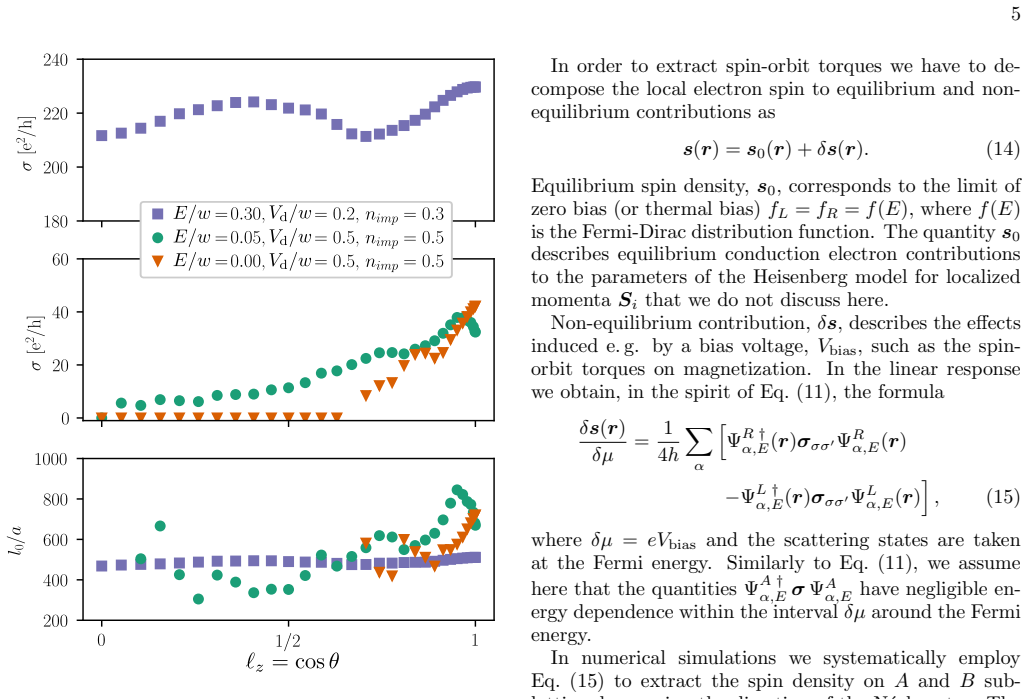
The load-bearing object is the non-equilibrium spin-density response $\delta s/\delta\mu$ computed from scattering states in a two-terminal geometry and decomposed onto the vector basis allowed by the low-energy $C_{\infty v}$ symmetry. The argument is carried by the exact sublattice symmetry of the symmetric model: conjugation by $\Lambda_x$ (exchange of sublattices) combined with $\boldsymbol{\ell}\to -\boldsymbol{\ell}$ leaves the Hamiltonian invariant, which makes the staggered polarization $\delta s_-$ vanish and forces the two anti-damping coefficients $B_\perp$ and $B_\parallel$ to zero. The remaining coefficients $a_I$, $a'_I$, $c$ are extracted numerically by fitting over many Néel-vector orientations; their dependence on disorder and on the polar angle $\theta$ encodes the field-like torques. The same ansatz, applied to the asymmetric one-sublattice model with vector $n_A$, yields the four torque coefficients $a_I$, $b_\perp$, $b_\parallel$, $c$ that are the paper's main output.
What would settle it
Compute the non-equilibrium spin density in the symmetric honeycomb model at a Fermi energy well above the Dirac point, where Fermi surfaces are strongly warped by the $C_{3v}$ lattice symmetry, and fit the response with basis functions that include threefold and sixfold angular harmonics. If any such harmonic, or any component of the torque along the anti-damping directions, is nonzero, then the identically vanishing anti-damping torque is an artifact of the symmetric $C_{\infty v}$ ansatz rather than a property of the lattice model.
Extended reading notes
Core claim
The central discovery is an exact symmetry-enforced vanishing of two of the three classes of spin-orbit torque in the symmetric model. With identical s-d exchange on A and B sublattices, the Hamiltonian obeys a sublattice symmetry $\Lambda_x H[-\boldsymbol{\ell}]\Lambda_x = H[\boldsymbol{\ell}]$; the paper argues and numerically confirms that this forces the non-equilibrium staggered spin density $\delta s_-$ to zero and the anti-damping torque coefficients $B_\perp = B_\parallel = 0$ in all transport regimes. What remains in the metal regime is the single isotropic Edelstein term $\delta s_+ \propto \hat{z}\times j$, i.e. a purely field-like torque of the inverse spin-galvanic type. In the half-metal regime two additional field-like high-harmonic torques with coefficients $a'_I$ and $c$ appear, but still no anti-damping torque. If the sublattice symmetry is broken by coupling s-d exchange to only one sublattice, the torque acquires four angular coefficients; the anti-damping coefficients $b_\perp$ and $b_\parallel$ become finite and strongly depend on impurity concentration, while field-like coefficients remain largely disorder-insensitive.
Load-bearing premise
The paper's conclusions rely on the assumption that the non-equilibrium spin density contains only the vector harmonics allowed by the low-energy $C_{\infty v}$ symmetry; if additional angular harmonics allowed by the full $C_{3v}$ lattice symmetry are present, the fitted zero anti-damping coefficients would be incomplete and could be nonzero.
Editorial extensions
If this is right
- In a sublattice-symmetric Rashba honeycomb antiferromagnet, current-driven switching of the Néel vector cannot proceed through the two torques previously thought responsible; only the field-like Edelstein torque acts, which is generally too weak to switch.
- The metal-regime spin-orbit torque in such a symmetric antiferromagnet is fully described by one angle-independent coefficient $a_I$, independent of impurity concentration, making it a direct analogue of the Edelstein effect.
- Breaking sublattice symmetry creates anti-damping torques whose anisotropy is controlled by the Néel-vector orientation: in-plane orientations maximize them in the metal regime.
- Anti-damping torques scale oppositely with disorder in the two regimes — suppressed in the metal regime, enhanced in the half-metal regime — so impurity engineering can tune them.
- In the asymmetric model, the staggered or Néel torque is no longer a useful notion; dynamics is governed by the single-lattice torque $T^A$, and the model applies to ferrimagnets like GdFeCo.
Reading between the lines
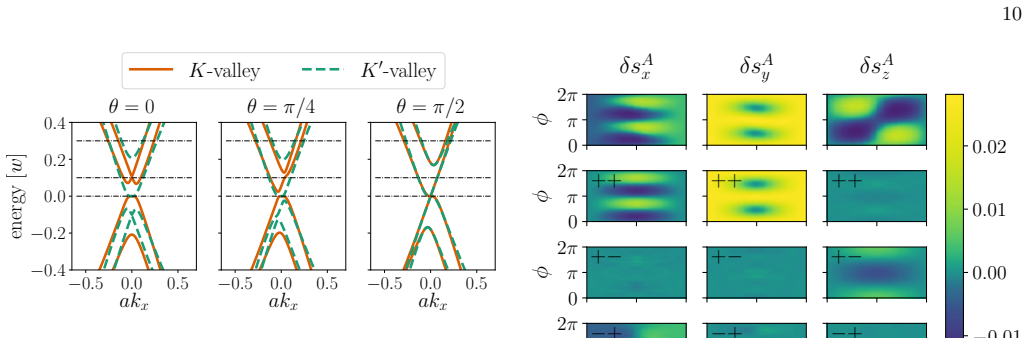
- If the $C_{\infty v}$ ansatz is not complete, the reported zeros could fail at higher Fermi energies where Fermi-surface warping from the lattice $C_{3v}$ symmetry becomes significant; a direct check would be to fit scattering data including threefold and sixfold harmonics.
- The symmetric-model result suggests a general design rule: any bipartite antiferromagnet with equal coupling on both sublattices and Rashba-type spin-orbit coupling should exhibit only field-like torques, so a measured anti-damping torque in such a system is a fingerprint of sublattice-symmetry breaking.
- The disorder-dependence pattern (metal versus half-metal) could be tested in half-metallic antiferromagnets by comparing torque efficiencies in samples with different resistivities.
- The switching mechanism via a transient fully magnetized state during an anti-damping-dominated pulse, which the paper notes resembles all-optical switching in GdFeCo, could be probed by time-resolved magneto-optical measurements on current pulses.
Signed reviews
Editorial analysis
A structured set of objections, weighed in public.
Referee Report
Summary. This manuscript studies current-induced spin-orbit torques (SOTs) in a two-dimensional honeycomb antiferromagnet with Rashba spin-orbit coupling and on-site disorder, using the kwant transport solver. The authors compute non-equilibrium spin densities on the two sublattices for many Néel-vector orientations and fit them to symmetry-motivated angular decompositions. In the symmetric model they conclude that the staggered polarization and all anti-damping torques vanish identically, leaving an isotropic Edelstein field-like torque in the metal regime and additional field-like harmonics in the half-metal regime. In an asymmetric model with s-d coupling on one sublattice only, they find finite anisotropic, disorder-dependent anti-damping torques. The final section uses these torques in Landau-Lifshitz-Gilbert simulations to illustrate pulsed-current Néel-vector switching.
Significance. If the central identity claims hold, the paper provides a useful microscopic benchmark for symmetry classifications of SOTs in antiferromagnets and identifies 2D confinement as a source of torque anisotropy. Its strengths are the transparent scattering-based methodology, the systematic angular sampling over 200 Néel orientations, the clear separation of metal and half-metal regimes, and the connection to experimentally relevant ferrimagnetic systems. The main limitation is that the zero-torque result is verified only within a five-vector ansatz whose completeness is asserted from an effective C∞v model while the actual tight-binding model has C3v symmetry; without either a symmetry proof or a completeness check, the word "identically" is stronger than the numerical and symmetry evidence presented.
major comments (3)
- [§VI–§VII, Eqs. (23)–(25)] The central claim that the symmetric model has B∥ = B⊥ = 0 identically is not derived. The stated sublattice symmetry Λx Heff[−l]Λx = Heff[l] is used to argue δs− = 0, but the anti-damping coefficients in Eq. (25) multiply vector forms built from δs+, and no operation is exhibited that forces those coefficients to zero. In addition, the completeness of the C∞v decomposition (25) is asserted rather than proved for the actual C3v lattice; the zigzag two-terminal ribbon has even lower symmetry. If C3v-allowed harmonics are present, a least-squares fit to the five-vector ansatz can absorb them, biasing the coefficients and concealing a finite anti-damping torque. Please provide an explicit symmetry derivation for B∥ = B⊥ = 0, or test the fit with an extended basis containing C3v-allowed terms and report the resulting coefficients.
- [§VII.A, Fig. 7 and §VIII, Fig. 11] The "identically vanishing" statements are supported only by fits of disorder-averaged data, with 30–80 realizations and no reported error bars. Since the quantitative content of the paper is a set of fitted coefficients (aI, a′I, c, b⊥, b∥), the absence of confidence intervals makes it impossible to judge whether the zero values are exact to numerical precision or merely small. Please report standard errors or confidence intervals for the extracted coefficients, and state the residuals of the fits; for the asymmetric model, apply the same completeness check to Eq. (38), since the Fermi surfaces in Fig. 9 are warped by C3v effects and may require additional angular harmonics.
- [Eq. (15)] The prefactor in the linear-response formula for δs/δµ appears to be off by a factor of two relative to Eq. (13): from the zero-temperature limit of (13), δs/δµ = (1/4πℏ) Σα [...] = (1/(2h)) Σα [...], whereas Eq. (15) states 1/(4h). Since the normalized coefficients in Figs. 7 and 11 and the prefactor η in Eqs. (27) and (39) inherit this normalization, please clarify the definition of h and the summation convention, and correct the prefactor if needed.
minor comments (3)
- [Fig. 12 and §IX] The caption of Fig. 12 states that the top and bottom panels show dynamics for the symmetric and asymmetric models, but the text does not state the initial Néel orientation or the duration of the current pulses; please add these parameters for reproducibility.
- [Eq. (12)] The notation σ in Eq. (12) is called a dimensionless 2D conductivity, but it is extracted from L⟨G⟩/W with a factor 2e²/h; please state the units explicitly (for example, in units of e²/h per square) to avoid confusion.
- [§V, Eq. (20)] In Eq. (20), the torque terms contain (JA/ℏ)(l×s+ + m×s−) and (JA/ℏ)(m×s+ + l×s−); after substituting δs± in Eq. (21), the relation to the four torques T_l± and T_m± is clear, but the sign convention for δs− should be stated explicitly in the text.
Circularity Check
No significant circularity: the torque results are numerical fits and symmetry statements, not predictions derived from the fitted parameters.
full rationale
The paper's central claims are that the symmetric s-d coupling model has vanishing staggered polarization and vanishing anti-damping torques, while the asymmetric model has finite anisotropic anti-damping torques. These claims come from three independent inputs: (1) the exact sublattice symmetry relation Λx H_eff[-l] Λx = H_eff[l] for δs-=0; (2) direct numerical evaluation of the non-equilibrium spin density from the scattering formula (15) using kwant; and (3) least-squares fitting of that data to the general symmetry-compatible basis of Eq. (25)/(38), a basis that explicitly contains the anti-damping vector forms proportional to B⊥ and B‖. The fit is not a prediction in the circular sense: the same ansatz includes the B-terms, and the fit returns zero coefficients in the symmetric model and nonzero ones in the asymmetric model, so the vanishing result is not forced by the ansatz. The C∞v versus C3v completeness question is a genuine modeling risk—additional lattice-allowed harmonics could in principle bias the extracted coefficients—but an incomplete basis is a correctness issue, not a reduction of the result to its inputs. The self-citations to Refs. 55 and 56 are used for comparison with known analytical results for the Rashba ferromagnet and for methodological context, but the torque-from-spin-density relation is re-derived in Sec. V, so the citations are not load-bearing. The LLG dynamics of Sec. IX use the fitted coefficients as inputs, which is a standard application rather than a circular prediction. No step in the paper equates a claimed prediction with a fitted parameter by construction.
Assumptions & free parameters
free parameters (4)
- aI (symmetric model) =
approximately 0.75 in the normalized units of Fig. 7
- a'I(lz^2) (symmetric half-metal regime) =
function shown in Fig. 7 (middle panel)
- c(lz^2) (symmetric half-metal regime) =
function shown in Fig. 7 (right panel)
- aI, b_perp, b_parallel, c (asymmetric model) =
functions of n_z^2 shown in Fig. 11
assumptions (5)
- domain assumption Localized magnetic moments are treated as classical vectors with S >> 1 and a single-domain antiferromagnetic order.
- standard math The non-equilibrium spin density is obtained from a linear-response scattering formula, Eq. (15), assuming negligible energy dependence over the bias window.
- domain assumption On-site disorder with Vi = +/- Vd on random sites provides the dominant momentum and angular momentum relaxation mechanism.
- domain assumption The symmetry decomposition of Eq. (25) under C∞v is complete for the non-equilibrium spin density.
- domain assumption The exact sublattice symmetry of the symmetric model ensures δs- = 0 and vanishing anti-damping torques in all regimes.
Cite this review
Pith. "Pith review of Spin-orbit torques in a Rashba honeycomb antiferromagnet." pith.science (2026). https://pith.science/paper/JYUBJILK
@misc{pith2026190811354,
  author       = {Pith},
  title        = {Pith review of: Spin-orbit torques in a Rashba honeycomb antiferromagnet},
  year         = {2026},
  howpublished = {\url{https://pith.science/paper/JYUBJILK}},
  note         = {Machine review of arXiv:1908.11354}
}
read the original abstract
Recent experiments on switching antiferromagnetic domains by electric current pulses have attracted a lot of attention to spin-orbit torques in antiferromagnets. In this work, we employ the tight-binding model solver, kwant, to compute spin-orbit torques in a two-dimensional antiferromagnet on a honeycomb lattice with strong spin-orbit interaction of Rashba type. Our model combines spin-orbit interaction, local s-d-like exchange, and scattering of conduction electrons on on-site disorder potential to provide a microscopic mechanism for angular momentum relaxation. We consider two versions of the model: one with preserved and one with broken sublattice symmetry. A non-equilibrium staggered polarization, that is responsible for the so-called Neel spin-orbit torque, is shown to vanish identically in the symmetric model but may become finite if sublattice symmetry is broken. Similarly, anti-damping spin-orbit torques vanish in the symmetric model but become finite and anisotropic in a model with broken sublattice symmetry. As expected, anti-damping torques also reveal a sizable dependence on impurity concentration. Our numerical analysis also confirms symmetry classification of spin-orbit torques and strong torque anisotropy due to in-plane confinement of electron momenta.
Figures


Figures from the paper (7 more)




Reference graph
Works this paper leans on
-
[1]
author author S. D. \ Bader \ and\ author S. S. P. \ Parkin ,\ 10.1146/annurev-conmatphys-070909-104123 journal journal Annu. Rev. Condens. Matter Phys. \ volume 1 ,\ pages 71 ( year 2010 ) ,\ http://arxiv.org/abs/https://doi.org/10.1146/annurev-conmatphys-070909-104123 https://doi.org/10.1146/annurev-conmatphys-070909-104123 NoStop
-
[2]
author author J. Sinova \ and\ author I. Z uti\'c ,\ 10.1038/nmat3304 journal journal Nat. Mater. \ volume 11 ,\ pages 368 ( year 2012 ) NoStop
-
[3]
author author S. Bhatti , author R. Sbiaa , author A. Hirohata , author H. Ohno , author S. Fukami , \ and\ author S. N. \ Piramanayagam ,\ https://doi.org/10.1016/j.mattod.2017.07.007 journal journal Mater. Today \ volume 20 ,\ pages 530 ( year 2017 ) NoStop
-
[4]
author author A. D. \ Kent \ and\ author D. C. \ Worledge ,\ 10.1038/nnano.2015.24 journal journal Nat. Nanotechnol. \ volume 10 ,\ pages 187 ( year 2015 ) NoStop
-
[5]
author author N. Sato , author F. Xue , author R. M. \ White , author C. Bi , \ and\ author S. X. \ Wang ,\ 10.1038/s41928-018-0131-z journal journal Nat. Electron. \ volume 1 ,\ pages 508 ( year 2018 ) NoStop
-
[6]
author author A. H. \ MacDonald \ and\ author M. Tsoi ,\ 10.1098/rsta.2011.0014 journal journal Phil. Trans. R. Soc. A \ volume 369 ,\ pages 3098 ( year 2011 ) ,\ http://arxiv.org/abs/https://royalsocietypublishing.org/doi/pdf/10.1098/rsta.2011.0014 https://royalsocietypublishing.org/doi/pdf/10.1098/rsta.2011.0014 NoStop
arXiv 2011
-
[7]
author author E. V. \ Gomonay \ and\ author V. M. \ Loktev ,\ 10.1063/1.4862467 journal journal Low Temp. Phys. \ volume 40 ,\ pages 17 ( year 2014 ) ,\ http://arxiv.org/abs/https://doi.org/10.1063/1.4862467 https://doi.org/10.1063/1.4862467 NoStop
-
[8]
Wadley , author B
author author P. Wadley , author B. Howells , author J. Z elezn \'y , author C. Andrews , author V. Hills , author R. P. \ Campion , author V. Nov \'a k , author K. Olejn \' k , author F. Maccherozzi , author S. S. \ Dhesi , author S. Y. \ Martin , author T. Wagner , author J. Wunderlich , author F. Freimuth , author Y. Mokrousov , author J. Kune s , auth...
Show all 70 references
-
[9]
Jungwirth , author X
author author T. Jungwirth , author X. Marti , author P. Wadley , \ and\ author J. Wunderlich ,\ https://www.nature.com/articles/nnano.2016.18 journal journal Nat. Nanotech. \ volume 11 ,\ pages 231 ( year 2016 ) NoStop
2016
-
[10]
Baltz , author A
author author V. Baltz , author A. Manchon , author M. Tsoi , author T. Moriyama , author T. Ono , \ and\ author Y. Tserkovnyak ,\ 10.1103/RevModPhys.90.015005 journal journal Rev. Mod. Phys. \ volume 90 ,\ pages 015005 ( year 2018 ) NoStop
-
[11]
Jungwirth , author J
author author T. Jungwirth , author J. Sinova , author A. Manchon , author X. Marti , author J. Wunderlich , \ and\ author C. Felser ,\ 10.1038/s41567-018-0063-6 journal journal Nat. Phys. \ volume 14 ,\ pages 200 ( year 2018 ) NoStop
-
[12]
author author M. B. \ Jungfleisch , author W. Zhang , \ and\ author A. Hoffmann ,\ https://doi.org/10.1016/j.physleta.2018.01.008 journal journal Physics Letters A \ volume 382 ,\ pages 865 ( year 2018 ) NoStop
2018 doi
-
[13]
Gomonay , author T
author author O. Gomonay , author T. Jungwirth , \ and\ author J. Sinova ,\ 10.1103/PhysRevLett.117.017202 journal journal Phys. Rev. Lett. \ volume 117 ,\ pages 017202 ( year 2016 ) NoStop
2016 doi
-
[14]
Olejn \' k et al
author author K. Olejn \' k et al. ,\ 10.1126/sciadv.aar3566 journal journal Sci. Adv. \ volume 4 ( year 2018 ),\ 10.1126/sciadv.aar3566 NoStop
2018 doi
-
[15]
Fina \ and\ author X
author author I. Fina \ and\ author X. Marti ,\ 10.1109/TMAG.2016.2606561 journal journal IEEE Trans. Magn. \ volume 53 ,\ pages 1 ( year 2017 ) NoStop
2016
-
[16]
Brataas , author A
author author A. Brataas , author A. D. \ Kent , \ and\ author H. Ohno ,\ 10.1038/nmat3311 journal journal Nat. Mater. \ volume 11 ,\ pages 372 ( year 2012 ) NoStop
2012 doi
-
[17]
author author K. M. D. \ Hals \ and\ author A. Brataas ,\ 10.1103/PhysRevB.88.085423 journal journal Phys. Rev. B \ volume 88 ,\ pages 085423 ( year 2013 ) NoStop
2013 doi
-
[18]
Z Z elezn\'y et al
author author J. Z Z elezn\'y et al. ,\ 10.1103/PhysRevLett.113.157201 journal journal Phys. Rev. Lett. \ volume 113 ,\ pages 157201 ( year 2014 ) NoStop
2014 doi
-
[19]
Freimuth , author S
author author F. Freimuth , author S. Bl\"ugel , \ and\ author Y. Mokrousov ,\ 10.1103/PhysRevB.90.174423 journal journal Phys. Rev. B \ volume 90 ,\ pages 174423 ( year 2014 ) NoStop
2014 doi
-
[20]
Ghosh \ and\ author A
author author S. Ghosh \ and\ author A. Manchon ,\ 10.1103/PhysRevB.95.035422 journal journal Phys. Rev. B \ volume 95 ,\ pages 035422 ( year 2017 ) NoStop
2017 doi
-
[21]
S S mejkal , author J
author author L. S S mejkal , author J. Z Z elezn\'y , author J. Sinova , \ and\ author T. Jungwirth ,\ 10.1103/PhysRevLett.118.106402 journal journal Phys. Rev. Lett. \ volume 118 ,\ pages 106402 ( year 2017 ) NoStop
2017 doi
-
[22]
Z elezn\'y , author P
author author J. Z elezn\'y , author P. Wadley , author K. Olejn\'ik , author A. Hoffmann , \ and\ author H. Ohno ,\ 10.1038/s41567-018-0062-7 journal journal Nat. Phys. \ volume 14 ,\ pages 220 ( year 2018 ) NoStop
2018 doi
-
[23]
author author X. F. \ Zhou et al. ,\ 10.1103/PhysRevApplied.9.054028 journal journal Phys. Rev. Applied \ volume 9 ,\ pages 054028 ( year 2018 ) NoStop
2018 doi
-
[24]
Manchon et al
author author A. Manchon et al. ,\ https://arxiv.org/pdf/1801.09636.pdf journal journal arXiv preprint arXiv:1801.09636 \ ( year 2018 ) NoStop
2018 arXiv
-
[25]
Moriyama , author W
author author T. Moriyama , author W. Zhou , author T. Seki , author K. Takanashi , \ and\ author T. Ono ,\ 10.1103/PhysRevLett.121.167202 journal journal Phys. Rev. Lett. \ volume 121 ,\ pages 167202 ( year 2018 ) NoStop
2018 doi
-
[26]
Li , author K
author author Y. Li , author K. W. \ Edmonds , author X. Liu , author H. Zheng , \ and\ author K. Wang ,\ 10.1002/qute.201800052 journal journal Adv. Quantum Technol. \ volume 2 ,\ pages 1800052 ( year 2019 ) NoStop
2019 doi
-
[27]
Chen et al
author author X. Chen et al. ,\ 10.1038/s41563-019-0424-2 journal journal Nat. Mater. \ volume 18 ,\ pages 931 ( year 2019 ) NoStop
2019 doi
-
[28]
author author X. F. \ Zhou et al. ,\ 10.1103/PhysRevApplied.11.054030 journal journal Phys. Rev. Applied \ volume 11 ,\ pages 054030 ( year 2019 a ) NoStop
2019 doi
-
[29]
Zhou et al
author author J. Zhou et al. ,\ 10.1126/sciadv.aau6696 journal journal Sci. Adv. \ volume 5 ( year 2019 b ),\ 10.1126/sciadv.aau6696 NoStop
2019 doi
-
[30]
author author S. Y. \ Bodnar et al. ,\ 10.1038/s41467-017-02780-x journal journal Nat. Commun. \ volume 9 ,\ pages 348 ( year 2018 ) NoStop
2018 doi
-
[31]
Saidl et al
author author V. Saidl et al. ,\ 10.1038/nphoton.2016.255 journal journal Nat. Photonics \ volume 11 ,\ pages 91 ( year 2017 ) NoStop
2016 doi
-
[32]
author author V. M. T. S. \ Barthem , author C. V. \ Colin , author H. Mayaffre , author M.-H. \ Julien , \ and\ author D. Givord ,\ 10.1038/ncomms3892 journal journal Nat. Commun. \ volume 4 ,\ pages 2892 ( year 2013 ) NoStop
2013 doi
-
[33]
auning , author A. Sapozhnik , author H.-J. \ Elmers , author H. Zabel , \ and\ author M. Kl\
author author M. Jourdan , author H. Br\"auning , author A. Sapozhnik , author H.-J. \ Elmers , author H. Zabel , \ and\ author M. Kl\"aui ,\ 10.1088/0022-3727/48/38/385001 journal journal J. Phys. D \ volume 48 ,\ pages 385001 ( year 2015 ) NoStop
-
[34]
Bhattacharjee et al
author author N. Bhattacharjee et al. ,\ 10.1103/PhysRevLett.120.237201 journal journal Phys. Rev. Lett. \ volume 120 ,\ pages 237201 ( year 2018 ) NoStop
2018 doi
-
[35]
author author S. K. \ Pandey , author P. Mahadevan , \ and\ author D. D. \ Sarma ,\ 10.1209/0295-5075/117/57003 journal journal EPL \ volume 117 ,\ pages 57003 ( year 2017 ) NoStop
2017 doi
-
[36]
Tshitoyan et al
author author V. Tshitoyan et al. ,\ 10.1103/PhysRevB.92.214406 journal journal Phys. Rev. B \ volume 92 ,\ pages 214406 ( year 2015 ) NoStop
2015 doi
-
[37]
Z Z elezn\'y , author H
author author J. Z Z elezn\'y , author H. Gao , author A. Manchon , author F. Freimuth , author Y. Mokrousov , author J. Zemen , author J. Ma s s ek , author J. Sinova , \ and\ author T. Jungwirth ,\ 10.1103/PhysRevB.95.014403 journal journal Phys. Rev. B \ volume 95 ,\ pages ...
-
[38]
author author E. L. \ Fj rbu , author N. Rohling , \ and\ author A. Brataas ,\ 10.1103/PhysRevB.95.144408 journal journal Phys. Rev. B \ volume 95 ,\ pages 144408 ( year 2017 ) NoStop
2017 doi
-
[39]
Cheng , author D
author author R. Cheng , author D. Xiao , \ and\ author A. Brataas ,\ 10.1103/PhysRevLett.116.207603 journal journal Phys. Rev. Lett. \ volume 116 ,\ pages 207603 ( year 2016 ) NoStop
2016 doi
-
[40]
Khymyn , author I
author author R. Khymyn , author I. Lisenkov , author V. Tiberkevich , author B. A. \ Ivanov , \ and\ author A. Slavin ,\ https://doi.org/10.1038/srep43705 journal journal Scientific Reports \ volume 7 ,\ pages 43705 EP ( year 2017 ) NoStop
-
[41]
Manchon ,\ 10.1088/1361-648x/aa521d journal journal Journal of Physics: Condensed Matter \ volume 29 ,\ pages 104002 ( year 2017 ) NoStop
author author A. Manchon ,\ 10.1088/1361-648x/aa521d journal journal Journal of Physics: Condensed Matter \ volume 29 ,\ pages 104002 ( year 2017 ) NoStop
2017 doi
-
[42]
Ghosh \ and\ author A
author author S. Ghosh \ and\ author A. Manchon ,\ 10.1103/PhysRevB.100.014412 journal journal Phys. Rev. B \ volume 100 ,\ pages 014412 ( year 2019 ) NoStop
2019 doi
-
[43]
Watanabe \ and\ author Y
author author H. Watanabe \ and\ author Y. Yanase ,\ 10.1103/PhysRevB.98.220412 journal journal Phys. Rev. B \ volume 98 ,\ pages 220412 ( year 2018 ) NoStop
2018 doi
-
[44]
author author K. M. D. \ Hals , author Y. Tserkovnyak , \ and\ author A. Brataas ,\ 10.1103/PhysRevLett.106.107206 journal journal Phys. Rev. Lett. \ volume 106 ,\ pages 107206 ( year 2011 ) NoStop
2011 doi
-
[45]
Barker \ and\ author O
author author J. Barker \ and\ author O. A. \ Tretiakov ,\ 10.1103/PhysRevLett.116.147203 journal journal Phys. Rev. Lett. \ volume 116 ,\ pages 147203 ( year 2016 ) NoStop
2016 doi
-
[46]
Zhang , author Y
author author X. Zhang , author Y. Zhou , \ and\ author M. Ezawa ,\ https://doi.org/10.1038/srep24795 journal journal Scientific Reports \ volume 6 ,\ pages 24795 EP ( year 2016 ) NoStop
2016 doi
-
[47]
Slonczewski ,\ https://doi.org/10.1016/0304-8853(96)00062-5 journal journal Journal of Magnetism and Magnetic Materials \ volume 159 ,\ pages L1 ( year 1996 ) NoStop
author author J. Slonczewski ,\ https://doi.org/10.1016/0304-8853(96)00062-5 journal journal Journal of Magnetism and Magnetic Materials \ volume 159 ,\ pages L1 ( year 1996 ) NoStop
1996 doi
-
[48]
Shiino , author S.-H
author author T. Shiino , author S.-H. \ Oh , author P. M. \ Haney , author S.-W. \ Lee , author G. Go , author B.-G. \ Park , \ and\ author K.-J. \ Lee ,\ 10.1103/PhysRevLett.117.087203 journal journal Phys. Rev. Lett. \ volume 117 ,\ pages 087203 ( year 2016 ) NoStop
-
[49]
author author C. A. \ Akosa , author O. A. \ Tretiakov , author G. Tatara , \ and\ author A. Manchon ,\ 10.1103/PhysRevLett.121.097204 journal journal Phys. Rev. Lett. \ volume 121 ,\ pages 097204 ( year 2018 ) NoStop
2018 doi
-
[50]
Tomasello , author V
author author R. Tomasello , author V. Puliafito , author E. Martinez , author A. Manchon , author M. Ricci , author M. Carpentieri , \ and\ author G. Finocchio ,\ 10.1088/1361-6463/aa7a98 journal journal Journal of Physics D: Applied Physics \ volume 50 ,\ pages 325302 ( year...
-
[51]
author author C. W. \ Groth , author M. Wimmer , author A. R. \ Akhmerov , \ and\ author X. Waintal ,\ 10.1088/1367-2630/16/6/063065 journal journal New J. Phys. \ volume 16 ,\ pages 063065 ( year 2014 ) NoStop
2014 doi
-
[52]
author author C. L. \ Kane \ and\ author E. J. \ Mele ,\ 10.1103/PhysRevLett.95.146802 journal journal Phys. Rev. Lett. \ volume 95 ,\ pages 146802 ( year 2005 ) NoStop
2005 doi
-
[53]
Qiao , author H
author author Z. Qiao , author H. Jiang , author X. Li , author Y. Yao , \ and\ author Q. Niu ,\ 10.1103/PhysRevB.85.115439 journal journal Phys. Rev. B \ volume 85 ,\ pages 115439 ( year 2012 ) NoStop
2012 doi
-
[54]
Ezawa ,\ 10.1103/PhysRevLett.110.026603 journal journal Physical Review Letters \ volume 110 ( year 2013 ),\ 10.1103/PhysRevLett.110.026603 NoStop
author author M. Ezawa ,\ 10.1103/PhysRevLett.110.026603 journal journal Physical Review Letters \ volume 110 ( year 2013 ),\ 10.1103/PhysRevLett.110.026603 NoStop
2013 doi
-
[55]
author author I. A. \ Ado , author O. A. \ Tretiakov , \ and\ author M. Titov ,\ 10.1103/PhysRevB.95.094401 journal journal Phys. Rev. B \ volume 95 ,\ pages 094401 ( year 2017 ) NoStop
2017 doi
-
[56]
author author I. A. \ Ado , author P. M. \ Ostrovsky , \ and\ author M. Titov ,\ https://arxiv.org/abs/1907.02041 journal journal arXiv:1907.02041 \ ( year 2019 ) NoStop
1907 arXiv
-
[57]
author author S. Datta ,\ 10.1017/CBO9780511805776 title Electronic Transport in Mesoscopic Systems ,\ Cambridge Studies in Semiconductor Physics and Microelectronic Engineering\ ( publisher Cambridge University Press ,\ year 1995 ) NoStop
-
[58]
van der Bijl \ and\ author R
author author E. van der Bijl \ and\ author R. A. \ Duine ,\ 10.1103/PhysRevB.86.094406 journal journal Phys. Rev. B \ volume 86 ,\ pages 094406 ( year 2012 ) NoStop
2012 doi
-
[59]
Garello , author I
author author K. Garello , author I. M. \ Miron , author C. O. \ Avci , author F. Freimuth , author Y. Mokrousov , author S. Bl \"u gel , author S. Auffret , author O. Boulle , author G. Gaudin , \ and\ author P. Gambardella ,\ https://doi.org/10.1038/nnano.2013.145 journal jo...
-
[60]
author author V. M. \ Edelstein ,\ http://www.sciencedirect.com/science/article/pii/003810989090963C journal journal Solid State Commun. \ volume 73 ,\ pages 233 ( year 1990 ) NoStop
1990
-
[61]
Manchon \ and\ author S
author author A. Manchon \ and\ author S. Zhang ,\ 10.1103/PhysRevB.78.212405 journal journal Phys. Rev. B \ volume 78 ,\ pages 212405 ( year 2008 ) NoStop
2008 doi
-
[62]
Garate \ and\ author A
author author I. Garate \ and\ author A. H. \ MacDonald ,\ 10.1103/PhysRevB.80.134403 journal journal Phys. Rev. B \ volume 80 ,\ pages 134403 ( year 2009 ) NoStop
2009 doi
-
[63]
van Leuken \ and\ author R
author author H. van Leuken \ and\ author R. A. \ de Groot ,\ 10.1103/PhysRevLett.74.1171 journal journal Phys. Rev. Lett. \ volume 74 ,\ pages 1171 ( year 1995 ) NoStop
1995 doi
-
[64]
\ Gong , author C
author author S.-J. \ Gong , author C. Gong , author Y.-Y. \ Sun , author W.-Y. \ Tong , author C.-G. \ Duan , author J.-H. \ Chu , \ and\ author X. Zhang ,\ 10.1073/pnas.1715465115 journal journal Proceedings of the National Academy of Sciences \ volume 115 ,\ pages 8511 ( ye...
-
[65]
Kurt , author K
author author H. Kurt , author K. Rode , author P. Stamenov , author M. Venkatesan , author Y.-C. \ Lau , author E. Fonda , \ and\ author J. M. D. \ Coey ,\ 10.1103/PhysRevLett.112.027201 journal journal Phys. Rev. Lett. \ volume 112 ,\ pages 027201 ( year 2014 ) NoStop
-
[66]
Betto , author K
author author D. Betto , author K. Rode , author N. Thiyagarajah , author Y.-C. \ Lau , author K. Borisov , author G. Atcheson , author M. Žic , author T. Archer , author P. Stamenov , \ and\ author J. M. D. \ Coey ,\ 10.1063/1.4943756 journal journal AIP Advances \ volume 6 ,...
-
[67]
Kim , author D
author author J. Kim , author D. Lee , author K.-J. \ Lee , author B.-K. \ Ju , author H. C. \ Koo , author B.-C. \ Min , \ and\ author O. Lee ,\ 10.1038/s41598-018-24480-2 journal journal Scientific Reports \ volume 8 ,\ pages 6017 ( year 2018 ) NoStop
-
[68]
Roschewsky , author T
author author N. Roschewsky , author T. Matsumura , author S. Cheema , author F. Hellman , author T. Kato , author S. Iwata , \ and\ author S. Salahuddin ,\ 10.1063/1.4962812 journal journal Applied Physics Letters \ volume 109 ,\ pages 112403 ( year 2016 ) ,\ http://arxiv.org...
-
[69]
Roschewsky , author C.-H
author author N. Roschewsky , author C.-H. \ Lambert , \ and\ author S. Salahuddin ,\ 10.1103/PhysRevB.96.064406 journal journal Phys. Rev. B \ volume 96 ,\ pages 064406 ( year 2017 ) NoStop
2017 doi
-
[70]
Kirilyuk , author A
author author A. Kirilyuk , author A. V. \ Kimel , \ and\ author T. Rasing ,\ 10.1103/RevModPhys.82.2731 journal journal Rev. Mod. Phys. \ volume 82 ,\ pages 2731 ( year 2010 ) NoStop
2010 doi
Reviewed August 14, 2026 · model on record in the stance chip above.
Discussion (0). Continue with ORCID to comment.