REVIEW 2 major objections 6 minor 1 cited by
Geometrical properties of strained and twisted moir\'e heterostructures
T0 review · 2 major / 6 minor · reviewed 2026-08-03 · deepseek-v4-flash
Pith's one-line read This review establishes that strain, combined with twist, can continuously control the angle between moiré lattice vectors, making square, hexagonal, and quasi-1D moiré superlattices patternable.
desk verdict A useful, honest review of moiré geometry under strain; the math holds up, but the central design claim is only proven in the rigid limit, and the paper says so. read the letter →
The pith
A machine-rendered reading of the paper's core claim, the machinery that carries it, and where it could break.
The reading
What carries the argument
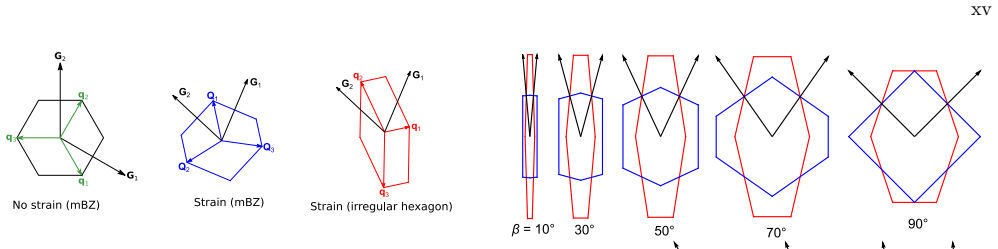
The central object is the moiré construction T = (I + E/2)R(−θ/2) − (I − E/2)R(θ/2), a 2×2 matrix mapping undeformed reciprocal vectors bᵢ to moiré vectors Gᵢ = T bᵢ. Its geometry is carried by the symmetric tensor F = TᵀT: the angle between moiré vectors is cosβ = (F b₁·b₂)/√[(F b₁·b₁)(F b₂·b₂)], and the moiré lengths are |Gᵢ| = √(F bᵢ·bᵢ). The strain-dependent part F_ε is non-spherical only for strain that deforms the unit cell, and this is what changes β. A critical condition det T = 0 gives collinear moiré vectors, producing quasi-1D channels; equal-length and perpendicular conditions give square patterns. The formalism assumes small deformations with rigid, homogeneous twist and strain
What would settle it
Measure the moiré angle β in a twisted bilayer with controlled uniaxial heterostrain at a small twist angle (e.g., θ ≈ 1°–2°) and compare with Eq. (38): the prediction is cosβ ≈ −1/2 + (3√3/8)(ν+1) ε_u/θ, and a square pattern should appear near ε_sq ≈ 0.94 tan(θ/2). If no strain value between 0% and 10% produces β = 90°, or if β does not vary continuously with ε/θ, the central claim fails.
Extended reading notes
Core claim
The paper argues that the geometry of strained and twisted moiré patterns is fully encoded in the symmetric tensor F = TᵀT, where T = (I + E/2)R(−θ/2) − (I − E/2)R(θ/2). The moiré angle β satisfies cosβ = (F b₁·b₂) / √[(F b₁·b₁)(F b₂·b₂)], and the moiré lengths are |Gᵢ| = √(F bᵢ·bᵢ). Because F contains a non-spherical strain-dependent contribution F_ε that mixes twist and strain, β can deviate from the hexagonal 120° value. At low twist angles, the ratio ε/θ controls β, allowing continuous design between 0° and 180° with modest strains. The review catalogs explicit strain parameters for uniaxial, shear, and biaxial strain that yield quasi-1D channels (det T = 0, critical strain ε_c = ±2√ν ta
Load-bearing premise
The load-bearing premise is that both layers deform as rigid lattices under homogeneous in-plane strain with no lattice relaxation; if relaxation is significant, the actual moiré geometry will deviate from these predictions.
Editorial extensions
If this is right
- With low twist angles and strains ε ≲ 10%, any moiré angle β between 0° and 180° is reachable, so square, hexagonal, and quasi-1D moiré patterns can be designed on demand.
- Biaxial strain can reproduce the same moiré periodicity as a twist, but the flat-band physics around the magic angle only occurs in the no-strain twist configuration.
- The critical strain for quasi-1D channels is small at low angles (ε_c ≈ ±θ/√ν; for graphene ≈ ±5θ/2), explaining the ubiquity of strain-induced 1D patterns in experiments.
- For hexagonal heterobilayers, the lattice mismatch introduces a threshold in twist/strain below which particular geometries (square, hexagonal) do not form.
- The real-space moiré-vector formula for monoclinic lattices generalizes the hexagonal results, covering rectangular and oblique lattices as well.
Reading between the lines
- In the editor's reading: since the formalism assumes rigid layers with no lattice relaxation, realistic relaxed samples—where AA regions shrink and domain walls form—will likely show the same qualitative design trends but with shifted critical strain values and possibly altered β; relaxation must be added to make quantitative predictions.
- A practical extension would be to use the closed-form strain parameters from Eqs. (43)–(44) as starting points for atomistic relaxation calculations, which could reveal how much the square and quasi-1D patterns survive when the layer is allowed to deform energetically.
- The equivalence between uniaxial strain and a combination of shear and biaxial strain (with an effective Poisson ratio) implies that materials with different elastic properties can still reach the same moiré geometry by tuning the strain ratio, potentially extending the design platform to a wide family of 2D materials
- The mBZ construction for equal-length moiré vectors with arbitrary β could be used to reinterpret transport experiments in strained twisted bilayer graphene, since the Dirac points no longer sit at the mBZ vertices.
Signed reviews
Editorial analysis
A structured set of objections, weighed in public.
Referee Report
Summary. This manuscript is a review of the geometry of strained and twisted moiré heterostructures. It opens with the linear elasticity formalism for 2D in-plane strain, catalogs uniaxial, shear, and biaxial deformations, and then develops the moiré-vector formalism for hexagonal homobilayers, hexagonal heterobilayers, and monoclinic lattices. The central mathematical object is the transformation T of Eq. (34) and the symmetric tensor F=T^T T of Eq. (35), from which the moiré angle β and vector lengths are derived. The review provides closed-form recipes for quasi-1D, square, and hexagonal moiré patterns, discusses the moiré Brillouin zone reconstruction, acknowledges lattice relaxation as a limitation, and surveys experimental strain-engineering techniques and observed strained moiré patterns. The paper claims that strain plus twist can, in principle, tune β continuously from 0° to 180° in the low-twist, moderate-strain regime.
Significance. If read within its explicitly stated rigid-limit scope, this review is a valuable pedagogical synthesis. Its strengths are the explicit closed-form conditions for special geometries—critical strain for 1D collapse in Eq. (69), the square-pattern recipe in Eq. (78), the hexagonal-pattern recipe in Eq. (79), and the generalized mBZ construction in Eq. (82)—and the direct comparison with experiments such as the TBG square pattern at θ≈0.38° in Ref. [87]. The formalism is standard linear elasticity, no parameters are fitted, and the predictive statements are falsifiable in the rigid-limit model. The main weakness is that the practical reach of the central claim is not quantitatively qualified against lattice relaxation, which the review itself states is outside its scope.
major comments (2)
- [III A (paragraph before Eq. (38)) and III F] The statement that for low twist angles and ε≲10% one can vary β to any value between 0° and 180° is presented as a practical design capability, but it is a result of the rigid homogeneous-strain model of Eq. (26). Section IIIF explicitly acknowledges that relaxed configurations “cannot be accounted by homogeneous twist and strain profiles,” and cites many works showing that relaxation is strongest at small twist angles—precisely the regime where ε/θ is large. The manuscript should (i) state that this claim is strictly rigid-limit, (ii) provide a quantitative criterion or a discussion of when relaxation corrections can be neglected (e.g., domain-wall width relative to moiré period), and (iii) temper the “accessible experimental platform” language accordingly. As it stands, the abstract and introduction overstate the experimental relevance of a result whose domain of validity is not estab
- [III E, Eq. (82)] Eq. (82) defines Q1 and then labels the next two expressions both as Q2; the third expression should define Q3 = Q1 + G1 − λG2, as implied by the reduction to Eq. (81) for β=120°. As printed, the mBZ construction for general β is incomplete. The sentence “In the special case of β=90°, the four points reduce to four because Q1 = −Q3” is also unclear: the six candidate points should reduce to four for a square lattice, but the stated equality does not hold with the definitions given (for β=90°, λ=1, Q1=-(G1+G2)/2 while −Q3=(-G1+3G2)/2). Please correct the definitions and the degeneracy statement.
minor comments (6)
- [III D3, Eq. (79) and following text] Typos in the hexagonal-pattern recipe: β=600 should read β=60°, and “ϕsq ≈ −4.38°” should read “ϕhex ≈ −4.38°.” The same paragraph should be checked for other notation slips.
- [III A1, text after Eq. (46)] “Possion’s ratio” should be “Poisson’s ratio.”
- [Fig. 3 caption] “Wiger-Seitz cell” should be “Wigner-Seitz cell,” and the same typo appears elsewhere.
- [IV B3] “unintensional strains” should be “unintentional strains.”
- [III E, first paragraph] “In the the case of only a twist” has a duplicated article; also “In the the case” appears earlier in the same section.
- [III F] “cannot be accounted by homogeneous twist and strain profiles” should be “cannot be accounted for by ...”; similar grammatical fix in the next sentence.
Circularity Check
No significant circularity: the formal results follow algebraically from the stated rigid-deformation ansatz; self-citations serve as review references, and the relaxation caveat is a scope limitation, not a circular substitution.
full rationale
The paper's derivation chain is self-contained in the sense relevant to circularity. The deformation of each layer is specified by Eq. (26), a_{i,±}=(I+E_±)R(θ_±)a_i, a stated homogeneous-strain assumption; moiré vectors are then defined by the reciprocal-space difference Eq. (33) and the map T in Eq. (34). From T the symmetric tensor F=T^T T is computed and cosβ is obtained in Eq. (35) as an algebraic consequence, not as an imposed value. The 'any angle β between 0 and 180°' claim follows from the leading-order expansion Eq. (38), which is a Taylor limit of Eq. (35) for small θ and ε; it is not a fit to the target β. The special geometries (square, hexagonal, quasi-1D) are likewise derived by imposing defining conditions—equal length and perpendicularity in Eq. (77), or det T=0 in Eq. (68)—and solving the same F equations; they are not inserted as inputs. The review relies on Refs. [27], [28], and [66] for several closed-form expressions, and two of these are authored by members of this review's author team; however, the present text states the underlying model (homogeneous strain, no relaxation), and the cited results are parameter-free algebraic solutions under that stated model, with external experimental comparison, e.g., the square-pattern prediction ε_sq(θ=0.38°)≈0.3% against the measured (0.21±0.12)% from Ref. [87]. No uniqueness theorem or ansatz is imported solely from a self-citation to force the conclusion. The manuscript explicitly flags the limitation that relaxed configurations 'cannot be accounted by homogeneous twist and strain profiles' (Section IIIF) and are beyond scope; this is a stated validity limitation of the rigid model, not a circular step that substitutes the prediction with the input. Accordingly, the correct circularity finding is a non-finding.
Assumptions & free parameters
free parameters (1)
- µ (interlayer strain partitioning)
assumptions (5)
- domain assumption Small-strain linear elasticity with homogeneous, time-independent, in-plane deformation.
- domain assumption Moiré geometry is well defined for incommensurate stacks via G_i = b_{i,-} - b_{i,+}.
- domain assumption Symmetric configuration θ_±=±θ/2 and E_±=±E/2 captures the relevant physics.
- domain assumption Lattice relaxation is neglected; layers follow externally imposed homogeneous deformations.
- domain assumption Lattice mismatch in hexagonal heterobilayers is representable as biaxial strain ±E_b/2.
Cite this review
Pith. "Pith review of Geometrical properties of strained and twisted moir\'e heterostructures." pith.science (2026). https://pith.science/paper/JZAVJN6Z
@misc{pith2026251116219,
  author       = {Pith},
  title        = {Pith review of: Geometrical properties of strained and twisted moir\'e heterostructures},
  year         = {2026},
  howpublished = {\url{https://pith.science/paper/JZAVJN6Z}},
  note         = {Machine review of arXiv:2511.16219}
}
read the original abstract
The experimental observations of many interaction-driven electronic phases in moir\'e superlattices have stimulated intense theoretical and experimental efforts to understand and engineer these correlated physics. Strain is a powerful tool for manipulating and controlling the geometrical and electronic structures of moir\'e superlattices. This review provides a comprehensive introduction to the geometry of strained moir\'e superlattices. First, starting from the linear elasticity theory, we briefly introduce the general formalism of small deformations in two-dimensional materials, and discuss the particular cases of uniaxial, shear and biaxial strain. Then, we apply the theory to twisted and strained moir\'e materials, mainly focusing on the hexagonal homobilayers, hexagonal heterobilayers and monoclinic lattices. Special moir\'e geometries, like the quasi-unidimensional patterns, square patterns and hexagonal, are theoretically predicted by manipulating the strain and twist. Finally, we review recently developed strain techniques and the special moir\'e geometries realized via these approaches. This review aims at equipping the reader with a robust understanding on the description and implementation of strain in moir\'e materials, as well as highlight some major breakthroughs in this active field.
Figures


Figures from the paper (11 more)





Forward citations
Cited by 1 Pith paper
-
Intertwined chirality and symmetry breaking in moir\'e domain-wall networks
Domain-wall networks in strained graphene bilayers spontaneously form chiral geometries during relaxation, and this chirality shifts low-energy electrons from junctions to asymmetric wall channels.
Reference graph
Works this paper leans on
-
[1]
This re- sult in the formation of quasi-unidimensional moiré chan- nels that have been seen in numerous experiments (see Section IV)
Quasi-unidimensional patterns The significant deformation of the moiré geometry un- der strain can lead to a critical situation in which the moiré vectors become collinear [23, 27, 28, 66]. This re- sult in the formation of quasi-unidimensional moiré chan- nels that have been seen in numerous experiments (see Section IV). In reciprocal space, as the criti...
2023
-
[87]
Cantele, D
G. Cantele, D. Alfè, F. Conte, V. Cataudella, D. Ninno, and P. Lucignano, Structural relaxation and low-energy properties of twisted bilayer graphene, Physical Review Research2, 043127 (2020)
2020
-
[2]
In other words, the moiré patterns with both twist and shear strain are not hexagonal [27, 28]
Shear strain For shear strain the transformationFreads F= 4 sin2 θ 2 +ϵ 2 s cos2 θ 2 I−2ϵ s sin (θ) R (2φ)σz.(47) The last term, which depends on the interplay between twistandstrain, isnotasphericaltensorsoitchangesthe moiré geometry. In other words, the moiré patterns with both twist and shear strain are not hexagonal [27, 28]. The possible strained con...
-
[3]
Its effect is to only modify the orientation and length of the moiré vectors
Biaxial strain For biaxial strain the transformationFreads F= 4 sin2 θ 2 +ϵ 2 b cos2 θ 2 I.(48) As this is, as expected, a spherical tensor, a biaxial strain does not change the moiré geometry. Its effect is to only modify the orientation and length of the moiré vectors. However, both changes are important and can actually significantly influence the geom...
-
[4]
Shear and biaxial strain In the presence of both shear and biaxial strains, the lattices change both their shape and size. The corre- sponding strain tensor is given by E= ϵb −ϵ s sin 2φ ϵ s cos 2φ ϵs cos 2φ ϵ b +ϵ s sin 2φ .(53) As noted above, any strain tensor can be generally de- composed as a mixture of biaxial and shear strains, cf. Eq. (27). The co...
2023
-
[5]
These have been predicted theoretically [27, 28] (see Figures 3 and 5), and observed experimentally [85– 87] (see Section IV)
Square patterns Another interesting case is the formation of square pat- terns. These have been predicted theoretically [27, 28] (see Figures 3 and 5), and observed experimentally [85– 87] (see Section IV). In general there is a family of twist and strain configurations that lead to square moiré pat- terns (see, e.g., label II in Figure 5). Geometrically,...
2024
-
[6]
But one can also have hexagonal moiré patterns with twist and strain [28]
Hexagonal patterns Hexagonal moiré patterns emerge naturally in the case of only twist without strain (e.g., in twisted bilayer graphene) [2, 3]. But one can also have hexagonal moiré patterns with twist and strain [28]. The simplest case is, ofcourse, withtwistandbiaxialstrain, asthisalwayspre- serves the hexagonal shape or the layers (Section IIIA3). Fo...
2024
-
[7]
In this technique, the active 2D layer can be suspended or directly stacked on the substrate
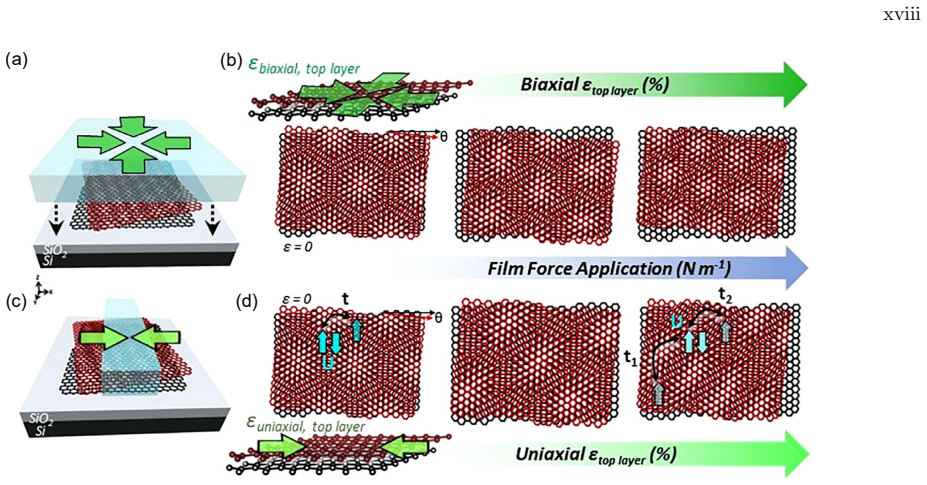
Substrate out-of-plane bending One strain technique for moiré materials is based on in-plane or out-of-plane stretching or bending the under- lying substrate or active 2D materials [30, 32, 102, 122]. In this technique, the active 2D layer can be suspended or directly stacked on the substrate. We refer to this method as substrate bending technique. A simi...
Show all 147 references
-
[8]
Process-induced strain Another common approach is a process-induced strain technique, which is based on the deposition of stressed thin films onto the active 2D materials [31, 124–127]. In Ref. [31], Peñaet al.utilized this method to gener- ate designable layer-by-layer strain...
-
[9]
Sliding-based strain In Ref. [123], Sequeiraet al.presented a sliding- based technique to manipulate the uniaxial heterostrain in graphene-hexagonal boron nitride (hBN) and study the strain effect on moiré geometry. To this end, they fabricated an open-faced graphene device on...
2024
-
[10]
For exam- ple, the superconductivity in TBG is observed around a twist angle 1.1◦, but has a tolerance of only 0.1◦ [129]
Continuous tuning moiré patterns In the moiré systems, the geometric and electronic properties are often highly dependent on the moiré pe- riodicity and the interlayer atomic registry. For exam- ple, the superconductivity in TBG is observed around a twist angle 1.1◦, but has a...
2025
-
[11]
In this setup, a continuous and homogeneous uniaxial heterostrain is generated by bending a flexible substrate with different radiusR(see Sec
Rectangular moiré patterns Figure 14 shows a strain-induced moiré pattern ma- nipulation in twisted bilayer WSe2 [32]. In this setup, a continuous and homogeneous uniaxial heterostrain is generated by bending a flexible substrate with different radiusR(see Sec. IVA1). The defo...
-
[12]
The critical condition can be, in principle, engineered by extenally induced-strain (Section IVA)
Quasi-1D pattern As discussed in Section IIID1, in strained moiré mate- rials there can be a critical strain configuration at which the moiré collapse into a quasi-1D pattern. The critical condition can be, in principle, engineered by extenally induced-strain (Section IVA). Bu...
2021
-
[13]
Severo Ochoa
Giant atomic swirl As noted in Section IIIF, relaxation-induced giant atomic swirls can emerge in the domain wall networks of moiré materials [98, 134]. Figure 16 shows a moiré pattern formed in bilayer graphene with only biaxial het- erostrain, which was produced by hydrogen ...
2023
-
[14]
F. He, Y. Zhou, Z. Ye, S.-H. Cho, J. Jeong, X. Meng, and Y. Wang, Moiré patterns in 2d materials: a review, ACS Nano15, 5944 (2021)
2021
-
[15]
E. Y. Andrei, D. K. Efetov, P. Jarillo-Herrero, A. H. MacDonald, K. F. Mak, T. Senthil, E. Tutuc, A. Yaz- dani, and A. F. Young, The marvels of moiré materials, Nature Reviews Materials6, 201 (2021)
2021
-
[16]
E. Y. Andrei and A. H. MacDonald, Graphene bilayers with a twist, Nature Materials19, 1265 (2020)
2020
-
[17]
Lopes dos Santos, N
J. Lopes dos Santos, N. Peres, and A. Castro Neto, Graphene bilayer with a twist: Electronic structure, Physical Review Letters99, 256802 (2007)
2007
-
[18]
Bistritzer and A
R. Bistritzer and A. H. MacDonald, Moiré bands in twisted double-layer graphene, Proceedings of the Na- tional Academy of Sciences108, 12233 (2011)
2011
-
[19]
Y. Cao, V. Fatemi, A. Demir, S. Fang, S. L. Tomarken, J. Y. Luo, J. D. Sanchez-Yamagishi, K. Watanabe, T. Taniguchi, E. Kaxiras,et al., Correlated insulator behaviour at half-filling in magic-angle graphene super- lattices, Nature556, 80 (2018)
2018
-
[20]
Y. Xu, S. Liu, D. A. Rhodes, K. Watanabe, T. Taniguchi, J. Hone, V. Elser, K. F. Mak, and J. Shan, Correlatedinsulatingstatesatfractionalfillingsofmoiré superlattices, Nature587, 214 (2020)
2020
-
[21]
Y. Cao, V. Fatemi, S. Fang, K. Watanabe, T. Taniguchi, E. Kaxiras, and P. Jarillo-Herrero, Unconventional su- perconductivity in magic-angle graphene superlattices, Nature556, 43 (2018)
2018
-
[22]
Y. Xia, Z. Han, K. Watanabe, T. Taniguchi, J. Shan, and K. F. Mak, Superconductivity in twisted bilayer wse2, Nature637, 833 (2025)
2025
-
[23]
Y. Guo, J. Pack, J. Swann, L. Holtzman, M. Cothrine, K. Watanabe, T. Taniguchi, D. G. Mandrus, K. Bar- mak, J. Hone,et al., Superconductivity in 5.0 twisted bilayer wse2, Nature637, 839 (2025)
2025
-
[24]
Zheng, Q
Z. Zheng, Q. Ma, Z. Bi, S. de La Barrera, M.-H. Liu, N. Mao, Y. Zhang, N. Kiper, K. Watanabe, T. Taniguchi,et al., Unconventional ferroelectricity in moiré heterostructures, Nature588, 71 (2020)
2020
-
[25]
A. L. Sharpe, E. J. Fox, A. W. Barnard, J. Finney, K. Watanabe, T. Taniguchi, M. Kastner, and D. Goldhaber-Gordon, Emergent ferromagnetism near three-quarters filling in twisted bilayer graphene, Sci- ence365, 605 (2019)
2019
-
[26]
Serlin, C
M. Serlin, C. Tschirhart, H. Polshyn, Y. Zhang, J. Zhu, K. Watanabe, T. Taniguchi, L. Balents, and A. Young, Intrinsic quantized anomalous hall effect in a moiré het- erostructure, Science367, 900 (2020)
2020
-
[27]
F. Xu, Z. Sun, T. Jia, C. Liu, C. Xu, C. Li, Y. Gu, K.Watanabe, T.Taniguchi, B.Tong,et al.,Observation of integer and fractional quantum anomalous hall effects in twisted bilayer mote2, Physical Review X13, 031037 (2023)
2023
-
[28]
J. Cai, E. Anderson, C. Wang, X. Zhang, X. Liu, W. Holtzmann, Y. Zhang, F. Fan, T. Taniguchi, K. Watanabe,et al., Signatures of fractional quantum anomalous hall states in twisted mote2, Nature622, 63 (2023)
2023
-
[29]
Y. Zeng, Z. Xia, K. Kang, J. Zhu, P. Knüppel, C.Vaswani, K.Watanabe, T.Taniguchi, K.F.Mak,and J. Shan, Thermodynamic evidence of fractional chern insulator in moiré mote2, Nature622, 69 (2023)
2023
-
[30]
H. Park, J. Cai, E. Anderson, Y. Zhang, J. Zhu, X. Liu, C. Wang, W. Holtzmann, C. Hu, Z. Liu,et al., Obser- vation of fractionally quantized anomalous hall effect, Nature622, 74 (2023)
2023
-
[31]
T. Li, S. Jiang, L. Li, Y. Zhang, K. Kang, J. Zhu, K. Watanabe, T. Taniguchi, D. Chowdhury, L. Fu, et al., Continuous mott transition in semiconductor moiré superlattices, Nature597, 350 (2021)
2021
-
[32]
J. M. Park, Y. Cao, K. Watanabe, T. Taniguchi, and P. Jarillo-Herrero, Tunable strongly coupled supercon- ductivity in magic-angle twisted trilayer graphene, Na- ture590, 249 (2021)
2021
-
[33]
H. Kim, Y. Choi, C. Lewandowski, A. Thomson, Y. Zhang, R. Polski, K. Watanabe, T. Taniguchi, J. Al- icea, and S. Nadj-Perge, Evidence for unconventional superconductivity in twisted trilayer graphene, Nature 606, 494 (2022)
2022
-
[34]
Zhang, R
Y. Zhang, R. Polski, C. Lewandowski, A. Thomson, Y. Peng, Y. Choi, H. Kim, K. Watanabe, T. Taniguchi, J. Alicea,et al., Promotion of superconductivity in magic-angle graphene multilayers, Science377, 1538 (2022)
2022
-
[35]
Wang, E.-M
L. Wang, E.-M. Shih, A. Ghiotto, L. Xian, D. A. Rhodes, C. Tan, M. Claassen, D. M. Kennes, Y. Bai, B. Kim,et al., Correlated electronic phases in twisted bilayer transition metal dichalcogenides, Nature Mate- xxiii rials19, 861 (2020)
2020
-
[36]
D. A. Cosma, J. R. Wallbank, V. Cheianov, and V. I. Fal’Ko, Moiré pattern as a magnifying glass for strain anddislocationsinvanderwaalsheterostructures,Fara- day Discussions173, 137 (2014)
2014
-
[37]
G. G. Naumis, S. Barraza-Lopez, M. Oliva-Leyva, and H. Terrones, Electronic and optical properties of strained graphene and other strained 2d materials: a re- view, Reports on Progress in Physics80, 096501 (2017)
2017
-
[38]
G. G. Naumis, S. A. Herrera, S. P. Poudel, H. Naka- mura, and S. Barraza-Lopez, Mechanical, electronic, optical, piezoelectric and ferroic properties of strained graphene and other strained monolayers and multilay- ers: an update, Reports on Progress in Physics87, 016502 (2023)
2023
-
[39]
Z. Dai, L. Liu, and Z. Zhang, Strain engineering of 2d materials: issues and opportunities at the interface, Ad- vanced Materials31, 1805417 (2019)
2019
-
[40]
M. Kögl, P. Soubelet, M. Brotons-Gisbert, A. Stier, B. Gerardot, and J. Finley, Moiré straintronics: a uni- versal platform for reconfigurable quantum materials, npj 2D Materials and Applications7, 32 (2023)
2023
-
[41]
Escudero, A
F. Escudero, A. Sinner, Z. Zhan, P. A. Pantaleón, and F. Guinea, Designing moiré patterns by strain, Physical Review Research6, 023203 (2024)
2024
-
[42]
N. P. Kazmierczak, M. Van Winkle, C. Ophus, K. C. Bustillo, S. Carr, H. G. Brown, J. Ciston, T. Taniguchi, K.Watanabe,andD.K.Bediako,Strainfieldsintwisted bilayer graphene, Nature Materials20, 956 (2021)
2021
-
[43]
Kapfer, B
M. Kapfer, B. S. Jessen, M. E. Eisele, M. Fu, D. R. Danielsen, T. P. Darlington, S. L. Moore, N. R. Finney, A. Marchese, V. Hsieh,et al., Programming twist an- gle and strain profiles in 2d materials, Science381, 677 (2023)
2023
-
[44]
T. Peña, A. Dey, S. A. Chowdhury, A. Azizimanesh, W. Hou, A. Sewaket, C. Watson, H. Askari, and S. M. Wu, Moiré engineering in 2d heterostructures with process-induced strain, Applied Physics Letters122 (2023)
2023
-
[45]
H. Ou, K. Oi, R. Usami, T. Endo, K. Shinokita, R. Ki- taura, K. Matsuda, Y. Miyata, J. Pu, and T. Takenobu, Continuous strain modulation of moiré superlattice symmetry from triangle to rectangle, Small , 2407316 (2025)
2025
-
[46]
Huder, A
L. Huder, A. Artaud, T. Le Quang, G. T. De Lais- sardière, A. G. Jansen, G. Lapertot, C. Chapelier, and V. T. Renard, Electronic spectrum of twisted graphene layers under heterostrain, Physical Review Letters120, 156405 (2018)
2018
-
[47]
Kerelsky, L
A. Kerelsky, L. J. McGilly, D. M. Kennes, L. Xian, M. Yankowitz, S. Chen, K. Watanabe, T. Taniguchi, J. Hone, C. Dean,et al., Maximized electron interac- tions at the magic angle in twisted bilayer graphene, Nature572, 95 (2019)
2019
-
[48]
Y. Xie, B. Lian, B. Jäck, X. Liu, C.-L. Chiu, K. Watan- abe, T. Taniguchi, B. A. Bernevig, and A. Yazdani, Spectroscopic signatures of many-body correlations in magic-angle twisted bilayer graphene, Nature572, 101 (2019)
2019
-
[49]
Mesple, A
F. Mesple, A. Missaoui, T. Cea, L. Huder, F. Guinea, G. Trambly de Laissardière, C. Chapelier, and V. T. Renard, Heterostrain determines flat bands in magic- angle twisted graphene layers, Physical Review Letters 127, 126405 (2021)
2021
-
[50]
X. Wang, J. Finney, A. L. Sharpe, L. K. Rodenbach, C. L. Hsueh, K. Watanabe, T. Taniguchi, M. Kast- ner, O. Vafek, and D. Goldhaber-Gordon, Unusual mag- netotransport in twisted bilayer graphene from strain- induced open fermi surfaces, Proceedings of the Na- tional Academy of...
2023
-
[51]
J. Yu, G. Jia, Q. Li, Y. Wang, K. Xiao, Y. Ju, H. Zhang, Z. Hu, Y. Guo, B. Lian,et al., Twist angle driven elec- tronic structure evolution of twisted bilayer graphene, arXiv preprint arXiv:2406.20040 (2024)
2024 arXiv
-
[52]
Carrasco, F
R. Carrasco, F. Escudero, Z. Zhan, E. Cortés, B. Viña- Bausá, Y. Maximenko, P. A. Pantaleón, F. Guinea, and I. Brihuega, Twistraintronics in square moiré superlat- ticesofstackedgraphenelayers,Tobepublished (2025)
2025
-
[53]
Y. Hou, J. Zhou, M. Xue, M. Yu, Y. Han, Z. Zhang, and Y. Lu, Strain engineering of twisted bilayer graphene: The rise of strain-twistronics, Small21, 2311185 (2025)
2025
-
[54]
D. Zhai, H. Yu, and W. Yao, Twistronics and moiré superlattice physics in 2d transition metal dichalco- genides, Reports on Progress in Physics88, 084501 (2025)
2025
-
[55]
Trambly de Laissardière, S
G. Trambly de Laissardière, S. Venkateswarlu, A. Miss- saoui, G. Jemaï, K. Chika, J. Vahedi, O. Faizy Na- marvar, J.-P. Julien, A. Honecker, L. Magaud,et al., Electronic structure and transport in materials with flat bands: 2d materials and quasicrystals, Physica E Low- Dimens...
2026
-
[56]
V. M. Pereira, A. Castro Neto, and N. Peres, Tight- binding approach to uniaxial strain in graphene, Phys- ical Review B80, 045401 (2009)
2009
-
[57]
J. C. Meyer, A. K. Geim, M. I. Katsnelson, K. S. Novoselov, T. J. Booth, and S. Roth, The structure of suspended graphene sheets, Nature446, 60 (2007)
2007
-
[58]
Fasolino, J
A. Fasolino, J. Los, and M. I. Katsnelson, Intrinsic rip- ples in graphene, Nature Materials6, 858 (2007)
2007
-
[59]
Uchida, S
K. Uchida, S. Furuya, J.-I. Iwata, and A. Oshiyama, Atomic corrugation and electron localization due to moiré patterns in twisted bilayer graphenes, Physical Review B90, 155451 (2014)
2014
-
[60]
N. N. Nam and M. Koshino, Lattice relaxation and energy band modulation in twisted bilayer graphene, Physical Review B96, 075311 (2017)
2017
-
[61]
Koshino, N
M. Koshino, N. F. Yuan, T. Koretsune, M. Ochi, K. Kuroki, and L. Fu, Maximally localized wannier or- bitals and the extended hubbard model for twisted bi- layer graphene, Physical Review X8, 031087 (2018)
2018
-
[62]
Cazeaux, D
P. Cazeaux, D. Clark, R. Engelke, P. Kim, and M. Luskin, Relaxation and domain wall structure of bilayer moiré systems, Journal of Elasticity154, 443 (2023)
2023
-
[63]
L. D. Landau, L. Pitaevskii, A. M. Kosevich, and E. M. Lifshitz,Theory of elasticity: volume 7, Vol. 7 (Elsevier, Amsterdam Heidelberg, 2012)
2012
-
[64]
M. E. Gurtin,An introduction to continuum mechanics, Vol. 158 (Academic press, San Diego, Calif., 1982)
1982
-
[65]
M. E. Gurtin, E. Fried, and L. Anand,The mechanics and thermodynamics of continua(Cambridge university press, Cambridge, 2010)
2010
-
[66]
M. A. Vozmediano, M. Katsnelson, and F. Guinea, Gauge fields in graphene, Physics Reports496, 109 (2010)
2010
-
[67]
Guinea, Strain engineering in graphene, Solid State Communications152, 1437 (2012)
F. Guinea, Strain engineering in graphene, Solid State Communications152, 1437 (2012). xxiv
2012
-
[68]
Amorim, A
B. Amorim, A. Cortijo, F. De Juan, A. G. Grushin, F. Guinea, A. Gutiérrez-Rubio, H. Ochoa, V. Parente, R. Roldán, P. San-Jose,et al., Novel effects of strains in graphene and other two dimensional materials, Physics Reports617, 1 (2016)
2016
-
[69]
C. Si, Z. Sun, and F. Liu, Strain engineering of graphene: a review, Nanoscale8, 3207 (2016)
2016
-
[70]
C. Lee, X. Wei, J. W. Kysar, and J. Hone, Measure- ment of the elastic properties and intrinsic strength of monolayer graphene, Science321, 385 (2008)
2008
-
[71]
D. G. Papageorgiou, I. A. Kinloch, and R. J. Young, Mechanical properties of graphene and graphene-based nanocomposites, Progress in Materials Science90, 75 (2017)
2017
-
[72]
Frisenda, M
R. Frisenda, M. Drüppel, R. Schmidt, S. Michaelis de Vasconcellos, D. Perez de Lara, R. Bratschitsch, M. Rohlfing, and A. Castellanos-Gomez, Biaxial strain tuning of the optical properties of single-layer transition metal dichalcogenides, npj 2D Materials and Applica- tions1, ...
2017
-
[73]
Qiao, L.-J
J.-B. Qiao, L.-J. Yin, and L. He, Twisted graphene bi- layer around the first magic angle engineered by het- erostrain, Physical Review B98, 235402 (2018)
2018
-
[74]
Blakslee, D
O. Blakslee, D. Proctor, E. Seldin, G. Spence, and T. Weng, Elastic constants of compression-annealed py- rolytic graphite, Journal of Applied Physics41, 3373 (1970)
1970
-
[75]
Z. Bi, N. F. Yuan, and L. Fu, Designing flat bands by strain, Physical Review B100, 035448 (2019)
2019
-
[76]
Moon and M
P. Moon and M. Koshino, Optical absorption in twisted bilayer graphene, Physical Review B87, 205404 (2013)
2013
-
[77]
D. M. Kennes, M. Claassen, L. Xian, A. Georges, A. J. Millis, J. Hone, C. R. Dean, D. Basov, A. N. Pa- supathy, and A. Rubio, Moiré heterostructures as a condensed-matter quantum simulator, Nature Physics 17, 155 (2021)
2021
-
[78]
A. H. Castro Neto, F. Guinea, N. M. Peres, K. S. Novoselov, and A. K. Geim, The electronic properties of graphene, Reviews of Modern Physics81, 109 (2009)
2009
-
[79]
Sinner, P
A. Sinner, P. A. Pantaleon, and F. Guinea, Strain- induced quasi-1d channels in twisted moiré lattices, Physical Review Letters131, 166402 (2023)
2023
-
[80]
Halbertal, N
D. Halbertal, N. R. Finney, S. S. Sunku, A. Kerelsky, C. Rubio-Verdú, S. Shabani, L. Xian, S. Carr, S. Chen, C. Zhang,et al., Moiré metrology of energy landscapes in van der waals heterostructures, Nature Communica- tions12, 242 (2021)
2021
-
[81]
Shallcross, S
S. Shallcross, S. Sharma, E. Kandelaki, and O. Pankra- tov,Electronicstructureofturbostraticgraphene,Phys- ical Review B81, 165105 (2010)
2010
-
[82]
H. Shi, Z. Zhan, Z. Qi, K. Huang, E. v. Veen, J. Á. Silva- Guillén, R.Zhang, P.Li, K.Xie, H.Ji,et al.,Large-area, periodic, and tunable intrinsic pseudo-magnetic fields in low-angletwistedbilayergraphene,NatureCommunica- tions11, 371 (2020)
2020
-
[83]
D. Wang, F. Escudero, P. A. Pantaleón, S. Yuan, F. Guinea, and Z. Zhan, Straintronics and twistronics in bilayer graphene, To be published (2025)
2025
-
[84]
Koshino, Interlayer interaction in general incommen- surate atomic layers, New Journal of Physics17, 015014 (2015)
M. Koshino, Interlayer interaction in general incommen- surate atomic layers, New Journal of Physics17, 015014 (2015)
2015
-
[85]
Suárez Morell, J
E. Suárez Morell, J. Correa, P. Vargas, M. Pacheco, and Z. Barticevic, Flat bands in slightly twisted bilayer graphene: Tight-binding calculations, Physical Review B82, 121407 (2010)
2010
-
[86]
M. Long, P. A. Pantaleón, Z. Zhan, F. Guinea, J. Á. Silva-Guillén, and S. Yuan, An atomistic approach for the structural and electronic properties of twisted bi- layergraphene-boronnitrideheterostructures,npjCom- putational Materials8, 73 (2022)
2022
-
[88]
Leconte, S
N. Leconte, S. Javvaji, J. An, A. Samudrala, and J. Jung, Relaxation effects in twisted bilayer graphene: A multiscale approach, Physical Review B106, 115410 (2022)
2022
-
[89]
San-Jose, J
P. San-Jose, J. González, and F. Guinea, Non-abelian gauge potentials in graphene bilayers, Physical Review Letters108, 216802 (2012)
2012
-
[90]
J. S. Alden, A. W. Tsen, P. Y. Huang, R. Hov- den, L. Brown, J. Park, D. A. Muller, and P. L. McEuen, Strain solitons and topological defects in bi- layer graphene, Proceedings of the National Academy of Sciences110, 11256 (2013)
2013
-
[91]
Y. Bai, L. Zhou, J. Wang, W. Wu, L. J. McGilly, D. Hal- bertal, C. F. B. Lo, F. Liu, J. Ardelean, P. Rivera,et al., Excitons in strain-induced one-dimensional moiré po- tentials at transition metal dichalcogenide heterojunc- tions, Nature Materials19, 1068 (2020)
2020
-
[92]
N. C. Hesp, S. Batlle-Porro, R. Krishna Kumar, H. Agarwal, D. Barcons Ruiz, H. Herzig Shein- fux, K. Watanabe, T. Taniguchi, P. Stepanov, and F. H. Koppens, Cryogenic nano-imaging of second-order moiré superlattices, Nature Materials23, 1664 (2024)
2024
-
[93]
Yankowitz, J
M. Yankowitz, J. Xue, D. Cormode, J. D. Sanchez- Yamagishi, K. Watanabe, T. Taniguchi, P. Jarillo- Herrero, P. Jacquod, and B. J. LeRoy, Emergence of su- perlattice dirac points in graphene on hexagonal boron nitride, Nature Physics8, 382 (2012)
2012
-
[94]
J. Xue, J. Sanchez-Yamagishi, D. Bulmash, P. Jacquod, A. Deshpande, K. Watanabe, T. Taniguchi, P. Jarillo- Herrero, and B. J. LeRoy, Scanning tunnelling mi- croscopy and spectroscopy of ultra-flat graphene on hexagonal boron nitride, Nature Materials10, 282 (2011)
2011
-
[95]
Decker, Y
R. Decker, Y. Wang, V. W. Brar, W. Regan, H.-Z. Tsai, Q.Wu, W.Gannett, A.Zettl,andM.F.Crommie,Local electronic properties of graphene on a bn substrate via scanning tunneling microscopy, Nano Letters11, 2291 (2011)
2011
-
[96]
T. Cea, P. A. Pantaleón, and F. Guinea, Band structure of twisted bilayer graphene on hexagonal boron nitride, Physical Review B102, 155136 (2020)
2020
-
[97]
M. Long, Z. Zhan, P. A. Pantaleón, J. Á. Silva- Guillén, F. Guinea, and S. Yuan, Electronic properties of twisted bilayer graphene suspended and encapsulated with hexagonal boron nitride, Physical Review B107, 115140 (2023)
2023
-
[98]
C. D. Mendoza, I. J. Califrer, and F. L. Freire Jr, Strain in twisted bilayer graphene grown by chemical vapour deposition on ni surfaces, Applied Surface Science544, 148884 (2021)
2021
-
[99]
Tilak, G
N. Tilak, G. Li, T. Taniguchi, K. Watanabe, and E. Y. Andrei, Moiré potential, lattice relaxation, and layer polarization in marginally twisted mos2 bilayers, Nano Letters23, 73 (2022). xxv
2022
-
[100]
Y. Yu, K. Zhang, H. Parks, M. Babar, S. Carr, I. M. Craig, M. Van Winkle, A. Lyssenko, T. Taniguchi, K. Watanabe,et al., Tunable angle-dependent electro- chemistry at twisted bilayer graphene with moiré flat bands, Nature Chemistry14, 267 (2022)
2022
-
[101]
Van Wijk, A
M. Van Wijk, A. Schuring, M. Katsnelson, and A. Fa- solino, Relaxation of moiré patterns for slightly mis- aligned identical lattices: graphene on graphite, 2D Ma- terials2, 034010 (2015)
2015
-
[102]
Zhang and E
K. Zhang and E. B. Tadmor, Structural and electron diffraction scaling of twisted graphene bilayers, Journal of the Mechanics and Physics of Solids112, 225 (2018)
2018
-
[103]
S. Carr, D. Massatt, S. B. Torrisi, P. Cazeaux, M. Luskin, and E. Kaxiras, Relaxation and domain formation in incommensurate two-dimensional het- erostructures, Physical Review B98, 224102 (2018)
2018
-
[104]
Guinea and N
F. Guinea and N. R. Walet, Continuum models for twisted bilayer graphene: Effect of lattice deformation and hopping parameters, Physical Review B99, 205134 (2019)
2019
-
[105]
Lucignano, D
P. Lucignano, D. Alfè, V. Cataudella, D. Ninno, and G.Cantele,Crucialroleofatomiccorrugationontheflat bands and energy gaps of twisted bilayer graphene at the magic angleθ1. 08, Physical Review B99, 195419 (2019)
2019
-
[106]
M. M. A. Ezzi, G. N. Pallewela, C. De Beule, E. Mele, and S. Adam, Analytical model for atomic relaxation in twisted moiré materials, Physical Review Letters133, 266201 (2024)
2024
-
[107]
Kang and O
J. Kang and O. Vafek, Analytical solution for the re- laxed atomic configuration of twisted bilayer graphene including heterostrain, Physical Review B112, 125138 (2025)
2025
-
[108]
Kang and O
J. Kang and O. Vafek, Pseudomagnetic fields, particle- hole asymmetry, and microscopic effective continuum hamiltonians of twisted bilayer graphene, Physical Re- view B107, 075408 (2023)
2023
-
[109]
Ceferino and F
A. Ceferino and F. Guinea, Pseudomagnetic fields in fully relaxed twisted bilayer and trilayer graphene, 2D Materials11, 035015 (2024)
2024
-
[110]
Kundu, I
S. Kundu, I. Maity, R. Bajaj, H. Krishnamurthy, and M. Jain, Atomic relaxation and flat bands in strain- engineeredtransitionmetaldichalcogenidebilayermoiré systems, Physical Review B112, 155412 (2025)
2025
-
[111]
Mesple, N
F. Mesple, N. R. Walet, G. Trambly de Laissardière, F. Guinea, D. Došenović, H. Okuno, C. Paillet, A. Mi- chon, C. Chapelier, and V. T. Renard, Giant atomic swirl in graphene bilayers with biaxial heterostrain, Ad- vanced Materials35, 2306312 (2023)
2023
-
[112]
Lalmi, J
B. Lalmi, J. Girard, E. Pallecchi, M. Silly, C. David, S. Latil, F. Sirotti, and A. Ouerghi, Flower-shaped do- mains and wrinkles in trilayer epitaxial graphene on sil- icon carbide, Scientific Reports4, 4066 (2014)
2014
-
[113]
Cazeaux, M
P. Cazeaux, M. Luskin, and D. Massatt, Energy min- imization of two dimensional incommensurate het- erostructures,ArchiveforRationalMechanicsandAnal- ysis235, 1289 (2020)
2020
-
[114]
Vafek and J
O. Vafek and J. Kang, Continuum effective hamiltonian for graphene bilayers for an arbitrary smooth lattice de- formation from microscopic theories, Physical Review B 107, 075123 (2023)
2023
-
[115]
X. Gao, H. Sun, D.-H. Kang, C. Wang, Q. J. Wang, and D. Nam, Heterostrain-enabled dynamically tunable moiré superlattice in twisted bilayer graphene, Scientific Reports11, 21402 (2021)
2021
-
[116]
G.-H. Lee, R. C. Cooper, S. J. An, S. Lee, A. Van Der Zande, N. Petrone, A. G. Hammerberg, C. Lee, B. Crawford, W. Oliver,et al., High-strength chemical- vapor–deposited graphene and grain boundaries, Sci- ence340, 1073 (2013)
2013
-
[117]
H. Li, A. W. Contryman, X. Qian, S. M. Ardakani, Y. Gong, X. Wang, J. M. Weisse, C. H. Lee, J. Zhao, P. M. Ajayan,et al., Optoelectronic crystal of artificial atoms in strain-textured molybdenum disulphide, Na- ture Communications6, 7381 (2015)
2015
-
[118]
Y.Zhang, M.Heiranian, B.Janicek, Z.Budrikis, S.Zap- peri, P. Y. Huang, H. T. Johnson, N. R. Aluru, J. W. Lyding, and N. Mason, Strain modulation of graphene by nanoscale substrate curvatures: a molecular view, Nano Letters18, 2098 (2018)
-
[119]
So, K.-Y
J.-P. So, K.-Y. Jeong, J. M. Lee, K.-H. Kim, S.-J. Lee, W. Huh, H.-R. Kim, J.-H. Choi, J. M. Kim, Y. S. Kim,et al., Polarization control of deterministic single- photon emitters in monolayer wse2, Nano Letters21, 1546 (2021)
2021
-
[120]
T. P. Darlington, C. Carmesin, M. Florian, E. Yanev, O. Ajayi, J. Ardelean, D. A. Rhodes, A. Ghiotto, A.Krayev, K.Watanabe,et al.,Imagingstrain-localized excitonsinnanoscalebubblesofmonolayerwse 2 atroom temperature, Nature Nanotechnology15, 854 (2020)
2020
-
[121]
N. Levy, S. Burke, K. Meaker, M. Panlasigui, A. Zettl, F. Guinea, A. C. Neto, and M. F. Crommie, Strain- induced pseudo–magnetic fields greater than 300 tesla in graphene nanobubbles, Science329, 544 (2010)
2010
-
[122]
J. S. Bunch, S. S. Verbridge, J. S. Alden, A. M. Van Der Zande, J. M. Parpia, H. G. Craighead, and P. L. McEuen, Impermeable atomic membranes from graphene sheets, Nano Letters8, 2458 (2008)
2008
-
[123]
Lloyd, X
D. Lloyd, X. Liu, J. W. Christopher, L. Cantley, A. Wadehra, B. L. Kim, B. B. Goldberg, A. K. Swan, and J. S. Bunch, Band gap engineering with ultralarge biaxial strains in suspended monolayer mos2, Nano Let- ters16, 5836 (2016)
2016
-
[124]
K. Y. Thai, I. Park, B. J. Kim, A. T. Hoang, Y. Na, C. U. Park, Y. Chae, and J.-H. Ahn, Mos2/graphene photodetector array with strain-modulated photore- sponse up to the near-infrared regime, ACS Nano15, 12836 (2021)
2021
-
[125]
H. J. Conley, B. Wang, J. I. Ziegler, R. F. Haglund Jr, S. T. Pantelides, and K. I. Bolotin, Bandgap engineering of strained monolayer and bilayer mos2, Nano Letters 13, 3626 (2013)
2013
-
[126]
I. M. Datye, A. Daus, R. W. Grady, K. Brenner, S. Vaziri, and E. Pop, Strain-enhanced mobility of monolayer mos2, Nano Letters22, 8052 (2022)
2022
-
[127]
Castellanos-Gomez, R
A. Castellanos-Gomez, R. Roldán, E. Cappelluti, M. Buscema, F. Guinea, H. S. Van Der Zant, and G. A. Steele, Local strain engineering in atomically thin mos2, Nano Letters13, 5361 (2013)
2013
-
[128]
Deng and V
S. Deng and V. Berry, Wrinkled, rippled and crumpled graphene: an overview of formation mechanism, elec- tronic properties, and applications, Materials Today19, 197 (2016)
2016
-
[129]
J. Lee, S. J. Yun, C. Seo, K. Cho, T. S. Kim, G. H. An, K. Kang, H. S. Lee, and J. Kim, Switchable, tunable, anddirectableexcitonfunnelinginperiodicallywrinkled ws2, Nano Letters21, 43 (2020). xxvi
2020
-
[130]
H. H. Pérez Garza, E. W. Kievit, G. F. Schneider, and U. Staufer, Controlled, reversible, and nondestruc- tive generation of uniaxial extreme strains (> 10%) in graphene, Nano Letters14, 4107 (2014)
2014
-
[131]
D. Ziss, J. Martín-Sánchez, T. Lettner, A. Halilovic, G. Trevisi, R. Trotta, A. Rastelli, and J. Stangl, Com- parison of different bonding techniques for efficient strain transfer using piezoelectric actuators, Journal of Applied Physics121(2017)
2017
-
[132]
Antoniazzi, T
I. Antoniazzi, T. Woźniak, A. Pawbake, N. Zawadzka, M. Grzeszczyk, Z. Muhammad, W. Zhao, J. Ibáñez, C. Faugeras, M. R. Molas,et al., Pressure-induced op- tical anisotropy of hfs2, Journal of Applied Physics136 (2024)
2024
-
[133]
Jiang, J
Y. Jiang, J. Mao, J. Duan, X. Lai, K. Watanabe, T. Taniguchi, and E. Y. Andrei, Visualizing strain- induced pseudomagnetic fields in graphene through an hbn magnifying glass, Nano Letters17, 2839 (2017)
2017
-
[134]
Z. Liu, X. Ma, J. Cenker, J. Cai, Z. Fei, P. Malinowski, J. Mutch, Y. Zhao, K. Hwangbo, Z. Lin,et al., Contin- uously tunable uniaxial strain control of van der waals heterostructure devices, Journal of Applied Physics135 (2024)
2024
-
[135]
L. Wang, S. Zihlmann, A. Baumgartner, J. Overbeck, K. Watanabe, T. Taniguchi, P. Makk, and C. Scho- nenberger, In situ strain tuning in hbn-encapsulated graphene electronic devices, Nano Letters19, 4097 (2019)
2019
-
[136]
Sequeira, A
I. Sequeira, A. Z. Barabas, A. H. Barajas-Aguilar, M. G. Bacani, N. Nakatsuji, M. Koshino, T. Taniguichi, K. Watanabe, and J. D. Sanchez-Yamagishi, Manipulat- ing moires by controlling heterostrain in van der waals devices, Nano Letters24, 15662 (2024)
2024
-
[137]
T. Peña, S. A. Chowdhury, A. Azizimanesh, A. Sewaket, H. Askari, and S. M. Wu, Strain engineering 2d mos2 with thin film stress capping layers, 2D Materials8, 045001 (2021)
2021
-
[138]
Zhang, H
Y. Zhang, H. L. Zhao, S. Huang, M. A. Hossain, and A. M. van der Zande, Enhancing carrier mobility in monolayer mos2 transistors with process-induced strain, ACS Nano18, 12377 (2024)
2024
-
[139]
Zhang, M
Y. Zhang, M. A. Hossain, K. J. Hwang, P. F. Ferrari, J. Maduzia, T. Peña, S. M. Wu, E. Ertekin, and A. M. van der Zande, Patternable process-induced strain in 2d monolayers and heterobilayers, ACS Nano18, 4205 (2024)
2024
-
[140]
Q. Liu, Y. Zhang, H. Dong, N. Mason, A. M. van der Zande, and H. T. Johnson, Programmable strainscapes in a two-dimensional (2d) material monolayer, ACS Nano (2025)
2025
-
[141]
Shabani, D
S. Shabani, D. Halbertal, W. Wu, M. Chen, S. Liu, J. Hone, W. Yao, D. N. Basov, X. Zhu, and A. N. Pasu- pathy, Deep moiré potentials in twisted transition metal dichalcogenide bilayers, Nature Physics17, 720 (2021)
2021
-
[142]
Y. Cao, D. Rodan-Legrain, J. M. Park, N. F. Yuan, K. Watanabe, T. Taniguchi, R. M. Fernandes, L. Fu, andP.Jarillo-Herrero,Nematicityandcompetingorders in superconducting magic-angle graphene, Science372, 264 (2021)
2021
-
[143]
P. A. Pantaleón, H. Sainz-Cruz, and F. Guinea, Design- ing moiré patterns by shearing, ACS Nano18, 28575 (2024)
2024
-
[144]
Halbertal, S
D. Halbertal, S. Turkel, C. J. Ciccarino, J. B. Profe, N. Finney, V. Hsieh, K. Watanabe, T. Taniguchi, J. Hone, C. Dean,et al., Unconventional non-local re- laxation dynamics in a twisted trilayer graphene moiré superlattice, Nature Communications13, 7587 (2022)
2022
-
[145]
X. Yang, Y. Zhang, L. Chen, K. Aso, W. Yamamori, R. Moriya, K. Watanabe, T. Taniguchi, T. Sasagawa, N. Nakatsuji,et al., Intrinsic one-dimensional moire su- perlattice in large-angle twisted bilayer wte2, ACS Nano 19, 13007 (2025)
2025
-
[146]
F. S. Boi, O. Odunmbaku, A. Taallah, and S. Wang, Quasi-1d, rectangular-like and hexagonal moiré super- lattices in exfoliated highly oriented pyrolytic graphite, Diamond and Related Materials151, 111843 (2025)
2025
-
[147]
J. Shi, G. Chaudhary, A. H. MacDonald, and I. Martin, Spontaneous twirls and structural frustration in moir\’e materials, arXiv preprint arXiv:2509.10907 (2025)
2025
Reviewed August 3, 2026 · model on record in the stance chip above.
Discussion (0). Continue with ORCID to comment.