REVIEW 2 major objections 4 minor 35 references
Cross-Attention Message-Passing Transformers for Code-Agnostic Decoding in 6G Networks
T0 review · 2 major / 4 minor · reviewed 2026-08-06 · deepseek-v4-flash
Pith's one-line read The paper reports that a masked cross-attention transformer can decode several error-correcting code classes with a single trained model, outperforming belief propagation on the tested codes.
desk verdict The CrossMPT architecture is a genuine improvement over ECCT, but the code-agnostic foundation-model claim is untested: every FCrossMPT/FCrossED evaluation code is in the training set. read the letter →
The pith
A machine-rendered reading of the paper's core claim, the machinery that carries it, and where it could break.
The reading
What carries the argument
The central object is the masked cross-attention block pair indexed by the code's parity-check matrix $H$, the matrix whose rows define the parity-check equations. In each CrossMPT layer, the first block uses the magnitude embedding as query and the syndrome embedding as key and value with mask $H^\top$; the second uses the syndrome embedding as query and the updated magnitude embedding as key and value with mask $H$. Because the masks restrict attention to entries where $H$ or $H^\top$ has a one, the network only exchanges messages along legitimate variable–check connections, reproducing the information flow of belief propagation. FCrossMPT and FCrossED make this code-agnostic by using one shared embedding vector for all magnitude positions and one for all syndrome positions, and by resizing the syndrome embedding with $H^\top$ before the output layer; CrossED additionally runs $p$ parallel blocks with complementary parity-check masks generated by cyclically shifting the systematic parity-check matrix.
What would settle it
Train FCrossMPT on one set of codes, for example BCH and LDPC codes of lengths 49, 63, and 121, then test it on a held-out polar code or a BCH code of a length not in training; if the held-out BER at a fixed $E_b/N_0$ is close to random guessing or clearly worse than a code-specific decoder trained for that code, the claim of code-agnostic foundation decoding is refuted.
Extended reading notes
Core claim
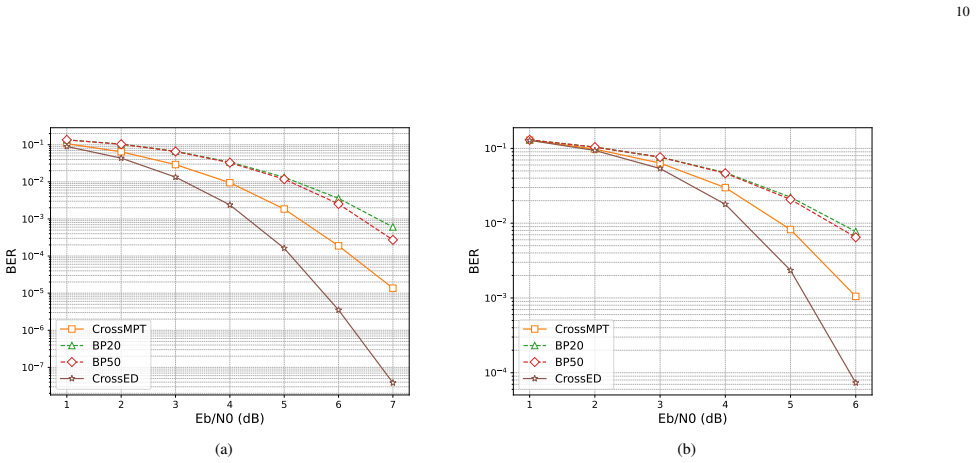
CrossMPT's discovery is that decoding can be learned by iteratively alternating two sparse cross-attention operations: magnitude embeddings attend to syndrome embeddings through the mask $H^\top$, and syndrome embeddings attend to magnitude embeddings through $H$. This mirrors sum-product message passing on the Tanner graph, and the paper shows it is enough to outperform the denser ECCT self-attention and belief propagation on the codes tested, with sparser masks yielding lower FLOPs, faster inference, and much lower memory for long codes. The foundation variants carry the claim further: with position-invariant embeddings, a single model trained jointly on several codes achieves BER comparable to separately trained code-specific CrossMPT and to ECCT on all evaluated codes. The ensemble variant CrossED uses several cyclically shifted parity-check matrices in parallel to fix the weak bit positions left by a single systematic parity-check matrix, giving large BER gains on short blocklength codes without extra parameters or latency.
Load-bearing premise
The foundation-model claim rests on the assumption that training on a small fixed set of codes produces a decoder that works for codes, lengths, and rates outside that set; the experiments only evaluate codes that were included in the training data.
Editorial extensions
If this is right
- If the reported results hold, a single CrossMPT-trained model can replace code-specific decoders across the BCH, polar, and LDPC families tested, cutting the number of decoder implementations in a 6G modem.
- CrossMPT's sparser attention means ECCT-sized transformers can scale to longer blocklengths, such as the (648,540) LDPC code, where the original ECCT could not fit in the authors' memory budget.
- CrossED's complementary parity-check masks improve short-blocklength BER by over an order of magnitude at the tested SNR points, with no extra inference latency because the parallel blocks run simultaneously.
- The foundation variants FCrossMPT and FCrossED imply that one set of weights can be trained jointly on codes of different class, length, and rate, a necessary step toward an AI-native physical layer for 6G.
Reading between the lines
- The paper's foundation-model evidence is weaker than the 'code-agnostic' wording suggests: every evaluated code appears in the training set, so the current experiments demonstrate multi-code fitting rather than transfer to unseen parameters; a leave-one-code-out test is the missing experiment.
- If genuine transfer holds, one could pre-train a decoder on a small family of codes and then apply it to new 6G code designs without any retraining or weight adaptation, which would change how new physical-layer codes are deployed; the paper does not yet establish this.
- The complementary-mask idea is stated for cyclic codes via column shifts; for non-cyclic codes the paper only says partial diagonalization 'as much as possible', leaving a concrete construction and bound on bit coverage as an open extension.
- Because attention is restricted to edges of the Tanner graph, scaling to very long codes may need low-rank or sparse attention kernels beyond simple masking; that is an implementation question the paper leaves implicit.
Editorial analysis
A structured set of objections, weighed in public.
Referee Report
Summary. The paper proposes CrossMPT, a transformer-based channel decoder that iteratively updates magnitude and syndrome embeddings through two masked cross-attention blocks, using the parity-check matrix and its transpose as attention masks. It then introduces FCrossMPT, a length/rate/class-invariant variant built from shared embeddings, and CrossED, an ensemble of CrossMPT blocks using complementary parity-check matrices, together with a foundation version FCrossED. Experiments compare BER against ECCT and BP-based neural decoders on BCH, polar, and LDPC codes, and report complexity and memory reductions for CrossMPT over ECCT.
Significance. If validated, the code-agnostic foundation-model claim would be a useful step toward flexible decoders for 6G, and CrossMPT's sparse cross-attention is a principled simplification of ECCT. The ablation in Table I gives evidence that magnitude-syndrome interactions alone are sufficient for the tested codes, and the complexity analysis in Section V-D quantifies a concrete advantage in FLOPs, memory, and training time. However, the paper's headline claim of generalization without retraining is not tested: all foundation-model evaluations use codes from the training set, and the performance comparisons lack error bars. The architectural and complexity contributions are credible, but the foundation-model conclusion currently exceeds the evidence.
major comments (2)
- [IV-B, IV-D] The abstract and conclusion claim 'code-agnostic' decoding 'without retraining,' but no experiment evaluates a code, length, or rate outside the training set. In Section IV-B, the (121,70) and (121,80) evaluation codes are explicitly stated to be 'included in the training data set'; the mixed-code experiment trains on all four codes shown in Fig. 9; and Section IV-D trains FCrossED on (15,7), (31,16), and (63,30), then reports results only for (31,16) and (63,30), both in the training set. Every reported foundation-model result is therefore in-distribution multi-task fitting, which cannot distinguish memorization of the small set of parity-check matrices from zero-shot generalization. To support the central claim, the authors should add held-out evaluations on codes, lengths, and rates not seen during training, and should separate a weaker 'multi-task decoding' claim from the stronger 'code-agnostic foundation model' claim.
- [IV and Table I] No Monte-Carlo trial counts, error bars, confidence intervals, or multiple-seed results are reported for any BER curve or table entry. For example, in Table I the difference between ECCT+Masking and ECCT at parameter 4 for the (63,45) code is 5.53 vs 5.60; without variance information, the claim of 'no significant performance degradation' and the broader state-of-the-art claim are not statistically grounded. The authors should report the number of Monte-Carlo trials and standard errors or confidence intervals for the main BER comparisons and ablations, or otherwise justify that the differences are beyond training noise.
minor comments (4)
- [VI] The conclusion contains a duplicated sentence: 'To move toward a code-agnostic foundation model, we developed FCrossMPT by replacing code-dependent parameters with code-invariant embeddings' appears twice in succession.
- [II-C] The text refers to a theoretical proof in [25] that preprocessing makes performance invariant to the training codeword, but the theorem is not stated; adding a precise statement would help the reader verify the claim.
- [IV-A] The phrase 'CrossMPT and ECCT are obtained with N=6 and d=128' should be 'configured with' or 'set to'; as written it is slightly misleading.
- [Abstract and IV-A] The 'state-of-the-art among single neural decoders' claim is based on comparisons with ECCT and two BP-based neural decoders on a limited set of codes; the comparison set should be stated explicitly or the claim should be softened.
Circularity Check
No circular derivation; the foundation-model generalization claim is empirically under-tested but not circular.
full rationale
The paper's contributions are empirical neural-decoder results; there is no first-principles derivation that reduces to its own inputs. CrossMPT's mask design (H and H^T in the cross-attention blocks) is an architectural definition, not a derived prediction. FCrossMPT's shared embeddings are explicitly adopted from FECCT [29], an external prior work, and the output-layer linear-combination motivation is likewise attributed to [29]. The only same-author design ingredient is the complementary-PCM masking from MM-ECCT [28], but CrossED's benefit is independently evaluated in this paper (Sec. V-C, Fig. 13), so the citation is not load-bearing in the sense of substituting for evidence. The main weakness is the 'foundation' claim: Sec. IV-B states the evaluated codes 'are included in the training data set,' and Sec. IV-D trains on all codes it later evaluates, so zero-shot transfer to unseen codes is never tested. That is a gap between claim and evidence, not a circular reduction: the reported BER curves are measured outcomes, not quantities forced by construction from fitted parameters. Accordingly no circular step meets the evidentiary bar of quoting a specific equation or construction that equals its own input.
Assumptions & free parameters
free parameters (6)
- Number of decoder layers N =
6 or 10 depending on code
- Embedding dimension d =
128, with 32 for BCH(255,223) and WRAN(384,320)
- Ensemble size p =
2 for (63,30) and (127,64) BCH; 3 for (31,21) BCH
- Training SNR range =
3 to 7 dB Eb/N0
- Epoch count =
1000, 3000, 4000, or 5000 depending on experiment
- Batch size =
128 or 256
assumptions (6)
- standard math For any linear code, multiple valid parity-check matrices represent the same code, and the syndrome s(y)=H y_b is a sufficient statistic under the all-zero codeword preprocessing of [25].
- domain assumption Training on all-zero codewords over an AWGN channel in the 3 to 7 dB Eb/N0 range transfers to all codewords and to the full SNR operating range.
- domain assumption A single shared magnitude embedding and a single shared syndrome embedding are sufficient to make decoding invariant to code length, rate, and class.
- domain assumption The syndrome embedding can be resized to magnitude shape by multiplying with H^T and then added to the magnitude embedding in the output layer.
- standard math Cyclic shifts of a systematic PCM produce valid PCMs for cyclic codes, so the shifted matrices can be used as ensemble masks.
- domain assumption Complementary PCM masks whose identity positions cover different bit ranges improve ensemble BER because identity-matrix positions have lower BER.
Cite this review
Pith. "Pith review of Cross-Attention Message-Passing Transformers for Code-Agnostic Decoding in 6G Networks." pith.science (2026). https://pith.science/paper/JZG6OMXT
@misc{pith2026250701038,
  author       = {Pith},
  title        = {Pith review of: Cross-Attention Message-Passing Transformers for Code-Agnostic Decoding in 6G Networks},
  year         = {2026},
  howpublished = {\url{https://pith.science/paper/JZG6OMXT}},
  note         = {Machine review of arXiv:2507.01038}
}
read the original abstract
Channel coding for 6G networks is expected to support a wide range of requirements arising from heterogeneous communication scenarios. These demands challenge traditional code-specific decoders, which lack the flexibility and scalability required for next-generation systems. To tackle this problem, we propose an AI-native foundation model for unified and code-agnostic decoding based on the transformer architecture. We first introduce a cross-attention message-passing transformer (CrossMPT). CrossMPT employs two masked cross-attention blocks that iteratively update two distinct input representations-magnitude and syndrome vectors-allowing the model to effectively learn the decoding problem. Notably, our CrossMPT has achieved state-of-the-art decoding performance among single neural decoders. Building on this, we develop foundation CrossMPT (FCrossMPT) by making the architecture invariant to code length, rate, and class, allowing a single trained model to decode a broad range of codes without retraining. To further enhance decoding performance, particularly for short blocklength codes, we propose CrossMPT ensemble decoder (CrossED), an ensemble decoder composed of multiple parallel CrossMPT blocks employing different parity-check matrices. This architecture can also serve as a foundation model, showing strong generalization across diverse code types. Overall, the proposed AI-native code-agnostic decoder offers flexibility, scalability, and high performance, presenting a promising direction to channel coding for 6G networks.
Figures


Figures from the paper (11 more)




Reference graph
Works this paper leans on
-
[1]
CrossMPT: Cross-attention message-passing transformer for error correcting codes,
S.-J. Park, H.-Y . Kwak, S.-H. Kim, Y . Kim, and J.-S. No, “CrossMPT: Cross-attention message-passing transformer for error correcting codes,” inProc. Int. Conf. Learn. Representations (ICLR), Apr. 2025. [Online]. Available: https://openreview.net/forum?id=gFvRRCnQvX
work page 2025
-
[2]
A vision of 6G wireless systems: Applications, trends, technologies, and open research problems,
W. Saad, M. Bennis, and M. Chen, “A vision of 6G wireless systems: Applications, trends, technologies, and open research problems,”IEEE Netw., vol. 21, no. 3, pp. 134–142, 2020
work page 2020
-
[3]
The road towards 6G: A comprehensive survey,
W. Jiang, B. Han, M. A. Habibi, and H. D. Schotten, “The road towards 6G: A comprehensive survey,”IEEE Open J. Commun. Soc., vol. 2, pp. 334–366, 2021
2021
-
[4]
Trends in channel coding for 6G,
S. Miao, C. Kestel, L. Johannsen, M. Geiselhart, L. Schmalen, A. Balatsoukas-Stimming, G. Liva, N. Wehn, and S. ten Brink, “Trends in channel coding for 6G,”Proc. IEEE, vol. 112, no. 7, pp. 653–675, 2024
work page 2024
-
[5]
6G: A welcome chance to unify channel coding?
M. Geiselhart, F. Krieg, J. Clausius, D. Tandler, and S. ten Brink, “6G: A welcome chance to unify channel coding?”IEEE BITS Inf. Theory Mag., vol. 3, no. 1, pp. 67–80, 2023
work page 2023
-
[6]
Channel coding for 6g extreme connectivity- requirements, capabilities and fundamental tradeoffs,
H. Zhang and W. Tong, “Channel coding for 6g extreme connectivity- requirements, capabilities and fundamental tradeoffs,”IEEE BITS Inf. Theory Mag., vol. 3, no. 1, pp. 54–66, 2023
work page 2023
-
[7]
BERT: Pre-training of deep bidirectional transformers for language understanding,
J. Devlin, M.-W. Chang, K. Lee, and K. Toutanova, “BERT: Pre-training of deep bidirectional transformers for language understanding,” inProc. Conf. North Amer. Chapter Assoc. Comput. Linguistics-Hum. Lang. Technol., (NAACL), 2019
work page 2019
-
[8]
Deep residual learning for image recognition,
K. He, X. Zhang, S. Ren, and J. Sun, “Deep residual learning for image recognition,” inProc. IEEE Conf. Comput. Vis. Pattern Recog- nit. (CVPR), 2016
work page 2016
Show all 35 references
-
[9]
Rich feature hierarchies for accurate object detection and semantic segmentation,
R. Girshick, J. Donahue, T. Darrell, and J. Malik, “Rich feature hierarchies for accurate object detection and semantic segmentation,” inProc. IEEE Conf. Comput. Vis. Pattern Recognit. (CVPR), 2014
2014
-
[10]
End-to-end object detection with transformers,
N. Carion, F. Massa, G. Synnaeve, N. Usunier, A. Kirillov, and S. Zagoruyko, “End-to-end object detection with transformers,” inProc. Eur. Conf. Comput. Vis. (ECCV), 2020
2020
-
[11]
The capacity of low-density parity check codes under message-passing decoding,
T. Richardson and R. Urbanke, “The capacity of low-density parity check codes under message-passing decoding,”IEEE Trans. Inf. Theory, vol. 47, no. 2, pp. 599–618, 2001
2001
-
[12]
Reduced complexity iterative decoding of low-density parity check codes based on belief propagation,
M. P. C. Fossorier, M. Mihaljevic, and H. Imai, “Reduced complexity iterative decoding of low-density parity check codes based on belief propagation,”IEEE Trans. on Commun., vol. 47, no. 5, pp. 673–680, 1999
1999
-
[13]
Soft-decision decoding of linear block codes based on ordered statistics,
M. P. C. Fossorier and S. Lin, “Soft-decision decoding of linear block codes based on ordered statistics,”IEEE Trans. Inf. Theory, vol. 41, no. 5, pp. 1379–1396, 1995
1995
-
[14]
Capacity-achieving guessing random additive noise decoding,
K. R. Duffy, J. Li, and M. M ´edard, “Capacity-achieving guessing random additive noise decoding,”IEEE Trans. Inf. Theory, vol. 65, no. 7, pp. 4023–4040, 2019
2019
-
[15]
Deep learning methods for improved decoding of linear codes,
E. Nachmani, E. Marciano, L. Lugosch, W. J. Gross, D. Burshtein, and Y . Beery, “Deep learning methods for improved decoding of linear codes,”IEEE J. Sel. Topics Signal Process., vol. 12, no. 1, pp. 119–131, 2018
2018
-
[16]
Learning to decode protograph LDPC codes,
J. Dai, K. Tan, Z. Si, K. Niu, M. Chen, H. V . Poor, and S. Cui, “Learning to decode protograph LDPC codes,”IEEE J. Sel. Areas Commun., vol. 39, no. 7, pp. 1983–1999, 2021
1983
-
[17]
Hyper-graph-network decoders for block codes,
E. Nachmani and L. Wolf, “Hyper-graph-network decoders for block codes,” inProc. Adv. Neural Inf. Process. Syst. (NeurIPS), 2019, pp. 2326–2336
2019
-
[18]
Autoregressive belief propagation for decoding block codes,
E. Nachmani and L. Wolf, “Autoregressive belief propagation for decoding block codes,” inarxiv preprint arXiv:2103.11780, 2021
2021 arXiv
-
[19]
Boosting learning for LDPC codes to improve the error-floor performance,
H.-Y . Kwak, D.-Y . Yun, Y . Kim, S.-H. Kim, and J.-S. No, “Boosting learning for LDPC codes to improve the error-floor performance,” in Proc. Adv. Neural Inf. Process. Syst. (NeurIPS), Dec. 2023
2023
-
[20]
Neural min-sum decoding for generalized LDPC codes,
H.-Y . Kwak, J.-W. Kim, Y . Kim, S.-H. Kim, and J.-S. No, “Neural min-sum decoding for generalized LDPC codes,”IEEE Commun. Lett., vol. 26, no. 12, pp. 2841–2845, 2022
2022
-
[21]
Boosted neural decoders: Achieving extreme reliability of ldpc codes for 6G networks,
H.-Y . Kwak, D.-Y . Yun, Y . Kim, S.-H. Kim, and J.-S. No, “Boosted neural decoders: Achieving extreme reliability of ldpc codes for 6G networks,”IEEE J. Sel. Areas Commun., vol. 43, no. 4, pp. 1089–1102, 2025
2025
-
[22]
Pruning and quantizing neural belief propagation decoders,
A. Buchberger, C. Hager, H. D. Pfister, L. Schmalen, and A. G. I. Amat, “Pruning and quantizing neural belief propagation decoders,”IEEE J. Sel. Areas in Commun., vol. 39, no. 7, pp. 1957–1966, 2021
1957
-
[23]
On deep learning- based channel decoding,
T. Gruber, S. Cammerer, J. Hoydis, and T. Brink, “On deep learning- based channel decoding,” inProc. Annu. Conf. Inf. Sci. Syst. (CISS), 2017, pp. 1–6
2017
-
[24]
Scaling deep learning-based decoding of polar codes via partitioning,
S. Cammerer, T. Gruber, J. Hoydis, and S. ten Brink, “Scaling deep learning-based decoding of polar codes via partitioning,” inProc. IEEE Global Commun. Conf. (GLOBECOM), 2017
2017
-
[25]
Deep learning for decoding of linear codes - A syndrome-based approach,
A. Bennatan, Y . Choukroun, and P. Kisilev, “Deep learning for decoding of linear codes - A syndrome-based approach,” inProc. IEEE Int. Symp. Inf. Theory (ISIT), 2018, pp. 1595–1599
2018
-
[26]
Error correction code transformer,
Y . Choukroun and L. Wolf, “Error correction code transformer,” inProc. Adv. Neural Inf. Process. Syst. (NeurIPS), 2022
2022
-
[27]
Denoising diffusion error correction codes,
Y . Choukroun and L. Wolf, “Denoising diffusion error correction codes,” inProc. Int. Conf. Learn. Representations (ICLR), 2023
2023
-
[28]
Multiple- masks error correction code transformer for short block codes,
S.-J. Park, H.-Y . Kwak, S. Kim, S. Kim, Y . Kim, and J.-S. No, “Multiple- masks error correction code transformer for short block codes,”IEEE J. Sel. Areas Commun., 2025, accepted
2025
-
[29]
A foundation model for error correction codes,
Y . Choukroun and L. Wolf, “A foundation model for error correction codes,” inProc. Int. Conf. Learn. Representations (ICLR), 2024
2024
-
[30]
Attention is all you need,
A. Vaswani, N. Shazeer, N. Parmar, J. Uszkoreit, L. Jones, A. N. Gomez, Ł. Kaiser, and I. Polosukhin, “Attention is all you need,” inProc. Adv. Neural Inf. Process. Syst. (NeurIPS), 2017
2017
-
[31]
An image is worth16×16words: Transformers for image recognition at scale,
A. Dosovitskiyet al., “An image is worth16×16words: Transformers for image recognition at scale,” inProc. Int. Conf. Learn. Representa- tions (ICLR), 2021
2021
-
[32]
Speech-transformer: A no-recurrence sequence-to-sequence model for speech recognition,
L. Dong, S. Xu, and B. Xu, “Speech-transformer: A no-recurrence sequence-to-sequence model for speech recognition,” inProc. IEEE Int. Conf. Acoust., Speech, Signal Process. (ICASSP), 2018, pp. 5884–5888
2018
-
[33]
Highly accurate protein structure prediction with AlphaFold,
J. Jumperet al., “Highly accurate protein structure prediction with AlphaFold,”Nature, vol. 596, no. 7873, pp. 583–589, 2021
2021
-
[34]
Adam: A method for stochastic optimization,
D. P. Kingma and J. Ba, “Adam: A method for stochastic optimization,” inarXiv preprint arXiv:1412.6980, 2014
2014 arXiv
-
[35]
Database of channel codes and ML simulation results,
M. Helmling, S. Scholl, F. Gensheimer, T. Dietz, D. Kraft, S. Ruzika, and N. Wehn, “Database of channel codes and ML simulation results,” https://rptu.de/en/channel-codes, 2019, accessed: 2024-05-01
2019
Reviewed August 6, 2026 · model on record in the stance chip above.
Discussion (0). Continue with ORCID to comment.