Linearized stability of T-duality quantum-inspired thin-shell wormholes
Pith reviewed 2026-06-27 12:06 UTC · model grok-4.3
The pith
T-duality regularization yields a window of unconditional stability for thin-shell wormholes at intermediate radii
A machine-rendered reading of the paper's core claim, the machinery that carries it, and where it could break.
Core claim
In the T-duality quantum-corrected spacetime the thin-shell wormhole admits a region of unconditional stability for intermediate throat radii a approximately equal to the fundamental length l0, where the geometric stability threshold becomes negative so that any convex surface mass function yields stability, in contrast to the classical Schwarzschild thin-shell wormhole which requires a specific equation of state.
What carries the argument
The effective potential for small radial perturbations obtained from the second variation of the junction-condition energy equation, whose second derivative at equilibrium depends on the T-duality metric functions and surface stresses.
Load-bearing premise
The T-duality regularized metric with length scale l0 is taken as the exact background geometry and the thin-shell junction conditions are assumed to produce the stated surface stresses and stability equation.
What would settle it
A direct evaluation of the second derivative of the effective potential for the T-duality metric that shows the stability threshold remains positive for all radii near l0 would falsify the unconditional-stability window.
Figures
read the original abstract
Wormholes that are traversable in principle offer fascinating insights into general relativity, yet they typically require exotic matter and suffer from stability issues. We construct a thin-shell wormhole by gluing two copies of a quantum-corrected, regular spacetime obtained from string T-duality. This regularisation replaces the classical curvature singularity with a smooth core and introduces a fundamental length scale $l_0$. For the static configuration, we derive the surface stresses and show that, unlike the Schwarzschild case, the null and strong energy conditions can be satisfied for sufficiently large throat radii. A linearised stability analysis reveals a rich landscape: close to the minimum allowed throat radius the configuration is unstable; at intermediate radii ($a \sim l_0$) the geometric stability threshold becomes negative, yielding a window of \emph{unconditional stability} where any convex surface mass function suffices; at large radii the wormhole recovers Schwarzschild-like behaviour and stability requires a stiff equation of state. The T-duality scale $l_0$ is thus not merely a regulariser but a key physical parameter that opens a novel region of unconditional stability absent in classical thin-shell wormholes. Our results suggest that quantum-gravity-motivated modifications can simultaneously cure singularities and make traversable wormholes dynamically viable, providing new targets for gravitational-wave astronomy and theoretical studies of exotic compact objects.
Editorial analysis
A structured set of objections, weighed in public.
Referee Report
Summary. The paper constructs thin-shell wormholes by gluing two copies of a T-duality-regularized spacetime (with fundamental length l0 replacing the classical singularity). It derives the surface energy density and pressure via Israel junction conditions, shows that the null and strong energy conditions can be satisfied for sufficiently large throat radii (unlike the Schwarzschild case), and performs a linearized stability analysis around the static configuration. The analysis identifies three regimes: instability near the minimum allowed throat radius, a window of unconditional stability at intermediate radii a ∼ l0 (where the geometric stability threshold is negative, so any convex surface mass function suffices), and Schwarzschild-like behavior at large radii requiring a stiff equation of state. The T-duality scale l0 is presented as both a regularizer and the parameter enabling the novel stability window.
Significance. If the derivations hold, the result is significant: it shows that a quantum-gravity-motivated regularization can simultaneously eliminate the curvature singularity and open a regime of unconditional dynamical stability for thin-shell wormholes that is absent in the classical case. This provides concrete new targets for gravitational-wave astronomy and studies of exotic compact objects, with the stability threshold arising as a geometric quantity rather than a fitted parameter.
major comments (1)
- [Linearized stability analysis] Linearized stability analysis (the section deriving the effective potential and its second derivative): the central claim of an unconditional-stability window rests on the geometric stability threshold becoming negative for a ∼ l0. The explicit metric functions f(r) of the T-duality spacetime, the resulting extrinsic curvatures from the junction conditions, and the differentiated conservation/dynamical equation must be displayed (including all terms involving l0) so that the sign change can be verified independently; an algebraic sign error, omitted l0-derivative term, or incorrect identification of the background radius a0 would eliminate the negativity and collapse the window to the classical case.
minor comments (2)
- The abstract summarizes the outcome but the manuscript should include all intermediate expressions for the surface stresses σ(a), p(a) and the stability threshold to ensure reproducibility.
- Notation for the T-duality scale l0 and the throat radius a should be introduced with a clear statement of their relative scale in the static background.
Simulated Author's Rebuttal
We thank the referee for the careful reading of our manuscript and for highlighting the importance of explicit verification of the stability threshold. We address the single major comment below and will incorporate the requested details in a revised version.
read point-by-point responses
-
Referee: Linearized stability analysis (the section deriving the effective potential and its second derivative): the central claim of an unconditional-stability window rests on the geometric stability threshold becoming negative for a ∼ l0. The explicit metric functions f(r) of the T-duality spacetime, the resulting extrinsic curvatures from the junction conditions, and the differentiated conservation/dynamical equation must be displayed (including all terms involving l0) so that the sign change can be verified independently; an algebraic sign error, omitted l0-derivative term, or incorrect identification of the background radius a0 would eliminate the negativity and collapse the window to the classical case.
Authors: We agree that the explicit expressions are required for independent verification. In the revised manuscript we will add: (i) the complete T-duality metric function f(r) with all l0 terms, (ii) the full Israel-junction expressions for the extrinsic curvature components K^θ_θ and K^τ_τ evaluated at the throat (including every derivative with respect to l0), and (iii) the differentiated conservation equation that yields the effective potential V(a) together with its second derivative at the static radius a0. These additions will make the sign change of the geometric stability threshold at a ∼ l0 directly verifiable and will confirm that the negativity arises from the quantum-correction terms rather than from an algebraic error or omitted derivative. The background radius a0 is identified unambiguously as the static solution of the junction conditions. revision: yes
Circularity Check
No circularity: stability threshold derived from junction conditions on given metric
full rationale
The derivation proceeds from the T-duality-regularized metric (taken as input) through explicit Israel junction conditions to surface stresses σ(a), p(a), then to the linearized equation of motion whose coefficient (the geometric stability threshold) is computed by differentiation. No step equates a fitted parameter to a prediction, renames a known result, or reduces the central claim to a self-citation chain. The sign change at a ∼ l0 is an algebraic outcome of the explicit functions, not imposed by definition. This is the normal case of a self-contained calculation against external benchmarks.
Axiom & Free-Parameter Ledger
axioms (2)
- domain assumption The T-duality-regularized spacetime is a valid solution of the effective string equations and can be glued across a thin shell using the standard Israel junction conditions.
- domain assumption Linearized perturbations around the static throat capture the dynamical stability of the configuration.
Forward citations
Cited by 1 Pith paper
-
Thermodynamics of thin-shell wormholes
The paper derives a generalized first law for thin-shell wormholes showing entropy conservation for isolated transparent shells and flux-dependent entropy change when bulk matter crosses the throat.
Reference graph
Works this paper leans on
-
[1]
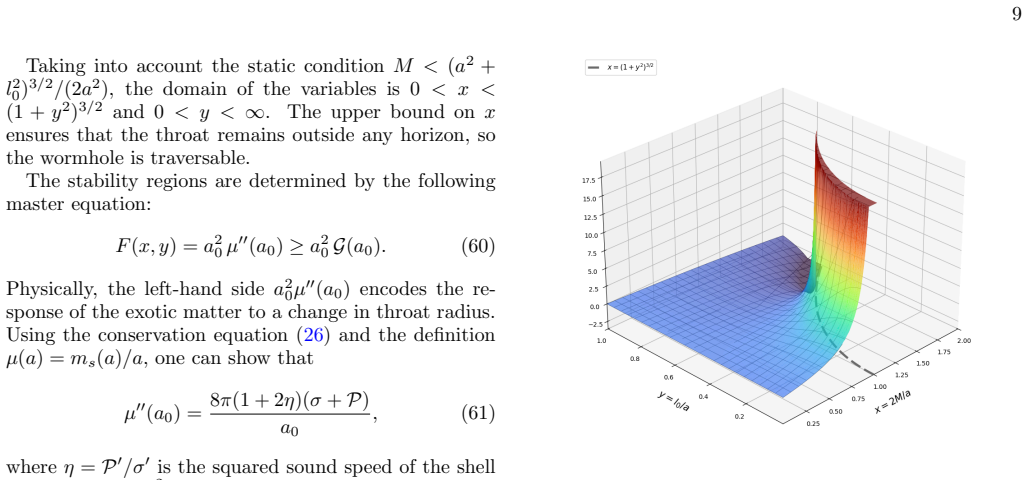
Using Eqs. (31)–(32), a straightforward calculation yields σ(a)+P(a) = 1 4πa 3M a4 −(a 2 +l 2 0)5/2 (a2 +l 2 0)5/2 s 1− 2M a2 (a2 +l 2 0)3/2 .(37) The sign ofσ+Pis determined by the numerator 3M a 4− (a2 +l 2 0)5/2. Hence the NEC is satisfied iff 3M a4 ≥(a 2 +l 2 0)5/2.(38) 6 For a fixed wormhole massM, this inequality defines a range of throat radiia(pos...
-
[2]
The first condition gives the surface mass at equilib- rium: ms(a0) =−2a 0 s 1− b(a0) a0 ,(44) where the negative sign is selected by consistency with Eq. (20). The second condition,V ′(a0) = 0, yields the equilibrium relation m′ s(a0) = ms(a0) 2a0 − 1−b ′(a0)r 1− b(a0) a0 .(45) 7 Equation (45) is a purely geometric consistency con- dition, independent of...
-
[3]
Taylor expansion and the stability criterion The dynamics of the throat are governed by the ef- fective potential (43), which we rewrite in terms of the normalised surface massµ(a) =m s(a)/aas V(a) = 1− b(a) a − µ(a) 2 2 .(47) For a static solution ata=a 0, the conditionsV(a 0) = 0 andV ′(a0) = 0 hold. ExpandingV(a) abouta 0 and using the static condition...
-
[4]
Static conditions in theµ-formulation From Eq. (47), the static conditionsV(a 0) = 0 and V ′(a0) = 0 yield the equilibrium values of the normalised surface mass and its first derivative: µ(a0) =−2 s 1− b(a0) a0 ,(50) µ′(a0) = b(a) a ′ a=a0r 1− b(a0) a0 .(51) Equation (50) determines the surface mass at the throat; the negative sign reflects the fact that ...
-
[5]
b(a) a ′ a=a0 #2 1− b(a0) a0 3/2 + b(a) a ′′ a=a0r 1− b(a0) a0 . (53) The right-hand side is thegeometric stability threshold, G(a)≡ 1 2
Second derivative and the GLMV master stability condition The stability of the static configuration is determined by the sign ofV ′′(a0). Differentiating Eq. (47) twice and evaluating ata 0 using the static conditions (50)–(51), we obtain the central result of the linearized analysis: V ′′(a0) = s 1− b(a0) a0 µ′′(a0)− 1 2 " b(a) a ′ a=a0 #2 1− b(a0) a0 − ...
2018
-
[6]
Wormholes in space- time and their use for interstellar travel: A tool for teach- ing general relativity,
M. S. Morris and K. S. Thorne, “Wormholes in space- time and their use for interstellar travel: A tool for teach- ing general relativity,” Am. J. Phys.56(1988), 395-412
1988
-
[7]
Worm- holes, Time Machines, and the Weak Energy Condition,
M. S. Morris, K. S. Thorne and U. Yurtsever, “Worm- holes, Time Machines, and the Weak Energy Condition,” Phys. Rev. Lett.61(1988), 1446-1449
1988
-
[8]
Lorentzian wormholes: From Einstein to Hawking,
M. Visser, “Lorentzian wormholes: From Einstein to Hawking,” (American Institute of Physics, New York)
-
[9]
Exotic solutions in General Relativ- ity: Traversable wormholes and ’warp drive’ spacetimes,
F. S. N. Lobo, “Exotic solutions in General Relativ- ity: Traversable wormholes and ’warp drive’ spacetimes,” [arXiv:0710.4474 [gr-qc]]
-
[10]
InProceedings of the 15th ACM SIGPLAN-SIGACT symposium on Principles of programming languages
F. S. N. Lobo, “Wormholes, Warp Drives and En- ergy Conditions,” Fundam. Theor. Phys.189(2017), pp.-279 Springer, 2017, ISBN 978-3-319-55181-4, 978- 3-319-85588-2, 978-3-319-55182-1 doi:10.1007/978-3-319- 55182-1
-
[11]
Traversable wormholes: Some simple examples,
M. Visser, “Traversable wormholes: Some simple examples,” Phys. Rev. D39(1989), 3182-3184 [arXiv:0809.0907 [gr-qc]]
Pith/arXiv arXiv 1989
-
[12]
Traversable wormholes from surgically mod- ified Schwarzschild space-times,
M. Visser, “Traversable wormholes from surgically mod- ified Schwarzschild space-times,” Nucl. Phys. B328 (1989), 203-212 [arXiv:0809.0927 [gr-qc]]. 12
Pith/arXiv arXiv 1989
-
[13]
Thin shell wormholes: Lin- earization stability,
E. Poisson and M. Visser, “Thin shell wormholes: Lin- earization stability,” Phys. Rev. D52(1995), 7318-7321 [arXiv:gr-qc/9506083 [gr-qc]]
Pith/arXiv arXiv 1995
-
[14]
¨Uber die grenzbedingungen des schwerefeldes an unsteig keitsfl¨ achen
N. Sen, “ ¨Uber die grenzbedingungen des schwerefeldes an unsteig keitsfl¨ achen”, Ann. Phys. (Leipzig)73, 365 (1924)
1924
-
[15]
Fl¨ achenhafte verteiliung der materie in der Einsteinschen gravitationstheorie
K. Lanczos, “Fl¨ achenhafte verteiliung der materie in der Einsteinschen gravitationstheorie”, Ann. Phys. (Leipzig) 74, 518 (1924)
1924
-
[16]
M´ emorial des sciences math´ ematiques XXV
G. Darmois, “M´ emorial des sciences math´ ematiques XXV”, Fascicule XXV ch V (Gauthier-Villars, Paris, France, 1927)
1927
-
[17]
O’Brien and J
S. O’Brien and J. L. Synge, Commun. Dublin Inst. Adv. Stud. A., no. 9 (1952)
1952
-
[18]
Th´ eories Relativistes de la Gravitation et de l’Electromagnetisme
A. Lichnerowicz, “Th´ eories Relativistes de la Gravitation et de l’Electromagnetisme”, Masson, Paris (1955)
1955
-
[19]
Singular hypersurfaces and thin shells in gen- eral relativity,
W. Israel, “Singular hypersurfaces and thin shells in gen- eral relativity,” Nuovo Cim. B44S10(1966), 1 [erratum: Nuovo Cim. B48(1967), 463]
1966
-
[20]
Linearized stability of charged thin shell wormholes,
E. F. Eiroa and G. E. Romero, “Linearized stability of charged thin shell wormholes,” Gen. Rel. Grav.36 (2004), 651-659 [arXiv:gr-qc/0303093 [gr-qc]]
Pith/arXiv arXiv 2004
-
[21]
Linearized stability analysis of thin shell wormholes with a cosmological con- stant,
F. S. N. Lobo and P. Crawford, “Linearized stability analysis of thin shell wormholes with a cosmological con- stant,” Class. Quant. Grav.21(2004), 391-404 [arXiv:gr- qc/0311002 [gr-qc]]
arXiv 2004
-
[22]
Surface stresses on a thin shell sur- rounding a traversable wormhole,
F. S. N. Lobo, “Surface stresses on a thin shell sur- rounding a traversable wormhole,” Class. Quant. Grav. 21(2004), 4811-4832 [arXiv:gr-qc/0409018 [gr-qc]]
Pith/arXiv arXiv 2004
-
[23]
Energy conditions, traversable wormholes and dust shells,
F. S. N. Lobo, “Energy conditions, traversable wormholes and dust shells,” Gen. Rel. Grav.37(2005), 2023-2038 [arXiv:gr-qc/0410087 [gr-qc]]
Pith/arXiv arXiv 2005
-
[24]
Stability of transparent spheri- cally symmetric thin shells and wormholes,
M. Ishak and K. Lake, “Stability of transparent spheri- cally symmetric thin shells and wormholes,” Phys. Rev. D65(2002), 044011 [arXiv:gr-qc/0108058 [gr-qc]]
Pith/arXiv arXiv 2002
-
[25]
N. M. Garcia, F. S. N. Lobo and M. Visser, “Generic spherically symmetric dynamic thin-shell traversable wormholes in standard general relativity,” Phys. Rev. D 86(2012), 044026 [arXiv:1112.2057 [gr-qc]]
Pith/arXiv arXiv 2012
-
[26]
Generic thin-shell gravastars,
P. Martin Moruno, N. Montelongo Garcia, F. S. N. Lobo and M. Visser, “Generic thin-shell gravastars,” JCAP03 (2012), 034 [arXiv:1112.5253 [gr-qc]]
Pith/arXiv arXiv 2012
-
[27]
Wormholes minimally violating the null en- ergy condition,
M. Bouhmadi-L´ opez, F. S. N. Lobo and P. Mart´ ın- Moruno, “Wormholes minimally violating the null en- ergy condition,” JCAP11(2014), 007 [arXiv:1407.7758 [gr-qc]]
Pith/arXiv arXiv 2014
-
[28]
Sculpting Spacetime: Thin Shells in Wormhole Physics,
F. S. N. Lobo, “Sculpting Spacetime: Thin Shells in Wormhole Physics,” Universe11(2025) no.8, 270 [arXiv:2508.17823 [gr-qc]]
arXiv 2025
-
[29]
Higher-dimensional thin-shell wormholes in third-order Lovelock gravity,
M. R. Mehdizadeh, M. Kord Zangeneh and F. S. N. Lobo, “Higher-dimensional thin-shell wormholes in third-order Lovelock gravity,” Phys. Rev. D92(2015) no.4, 044022 [arXiv:1506.03427 [gr-qc]]
Pith/arXiv arXiv 2015
-
[30]
Higher dimensional thin-shell wormholes in Einstein- Yang-Mills-Gauss-Bonnet gravity,
S. H. Mazharimousavi, M. Halilsoy and Z. Amirabi, “Higher dimensional thin-shell wormholes in Einstein- Yang-Mills-Gauss-Bonnet gravity,” Class. Quant. Grav. 28(2011), 025004 [arXiv:1007.4627 [gr-qc]]
Pith/arXiv arXiv 2011
-
[31]
Stability of thin-shell wormhole in 4D Einstein-Gauss-Bonnet grav- ity,
N. Godani, D. V. Singh and G. C. Samanta, “Stability of thin-shell wormhole in 4D Einstein-Gauss-Bonnet grav- ity,” Phys. Dark Univ.35(2022), 100952
2022
-
[32]
Stability of Brans-Dicke thin shell wormholes,
X. Yue and S. Gao, “Stability of Brans-Dicke thin shell wormholes,” Phys. Lett. A375(2011), 2193-2200 [arXiv:1105.4310 [gr-qc]]
Pith/arXiv arXiv 2011
-
[33]
Effect of the Gauss-Bonnet parameter in the stability of thin-shell wormholes,
Z. Amirabi, M. Halilsoy and S. Habib Mazharimousavi, “Effect of the Gauss-Bonnet parameter in the stability of thin-shell wormholes,” Phys. Rev. D88(2013) no.12, 124023 [arXiv:1103.3019 [gr-qc]]
Pith/arXiv arXiv 2013
-
[34]
Linear stability analy- sis of a rotating thin-shell wormhole,
N. Tsukamoto and T. Kokubu, “Linear stability analy- sis of a rotating thin-shell wormhole,” Phys. Rev. D98 (2018) no.4, 044026 [arXiv:1807.01528 [gr-qc]]
Pith/arXiv arXiv 2018
-
[35]
Stabil- ity of ad-dimensional thin-shell wormhole surrounded by quintessence,
A. Banerjee, K. Jusufi and S. Bahamonde, “Stabil- ity of ad-dimensional thin-shell wormhole surrounded by quintessence,” Grav. Cosmol.24(2018) no.1, 71-79 [arXiv:1612.06892 [gr-qc]]
Pith/arXiv arXiv 2018
-
[36]
Quantum-inspired wormholes from string T-duality,
F. S. N. Lobo and M. E. Rodrigues, “Quantum-inspired wormholes from string T-duality,” Phys. Rev. D112 (2025) no.6, 064082 [arXiv:2506.17950 [gr-qc]]
arXiv 2025
-
[37]
Quan- tum Corrected Black Holes from String T-Duality,
P. Nicolini, E. Spallucci and M. F. Wondrak, “Quan- tum Corrected Black Holes from String T-Duality,” Phys. Lett. B797(2019), 134888 [arXiv:1902.11242 [gr-qc]]
arXiv 2019
-
[38]
P. Musgrave and K. Lake, “Junctions and thin shells in general relativity using computer algebra. 1: The Darmois-Israel formalism,” Class. Quant. Grav.13 (1996), 1885-1900 [arXiv:gr-qc/9510052 [gr-qc]]
Pith/arXiv arXiv 1996
discussion (0)
Sign in with ORCID, Apple, or X to comment. Anyone can read and Pith papers without signing in.