REVIEW 2 major objections 5 minor 90 references
Emergent fractons and algebraic quantum liquid from plaquette melting transitions
T0 review · 2 major / 5 minor · reviewed 2026-08-14 · deepseek-v4-flash
Pith's one-line read Valence plaquette solid defects are fractons, so plaquette melting runs through an algebraic bond liquid.
desk verdict VPS vortices as fractons is a novel and defensible claim, but the two-stage melting scenario rests on a plaquette constraint that may break down right at the transition. read the letter →
The pith
A machine-rendered reading of the paper's core claim, the machinery that carries it, and where it could break.
The reading
What carries the argument
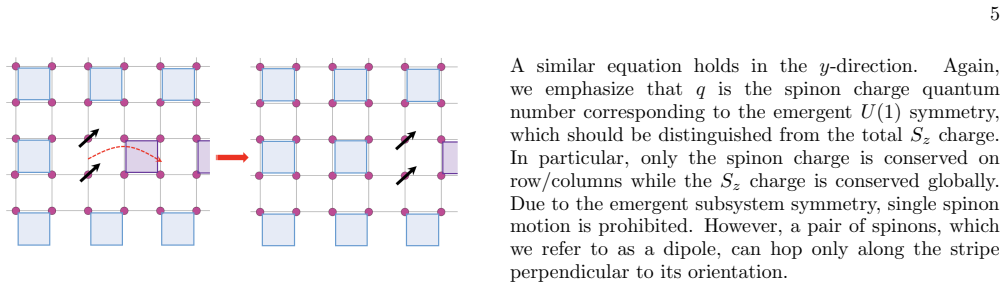
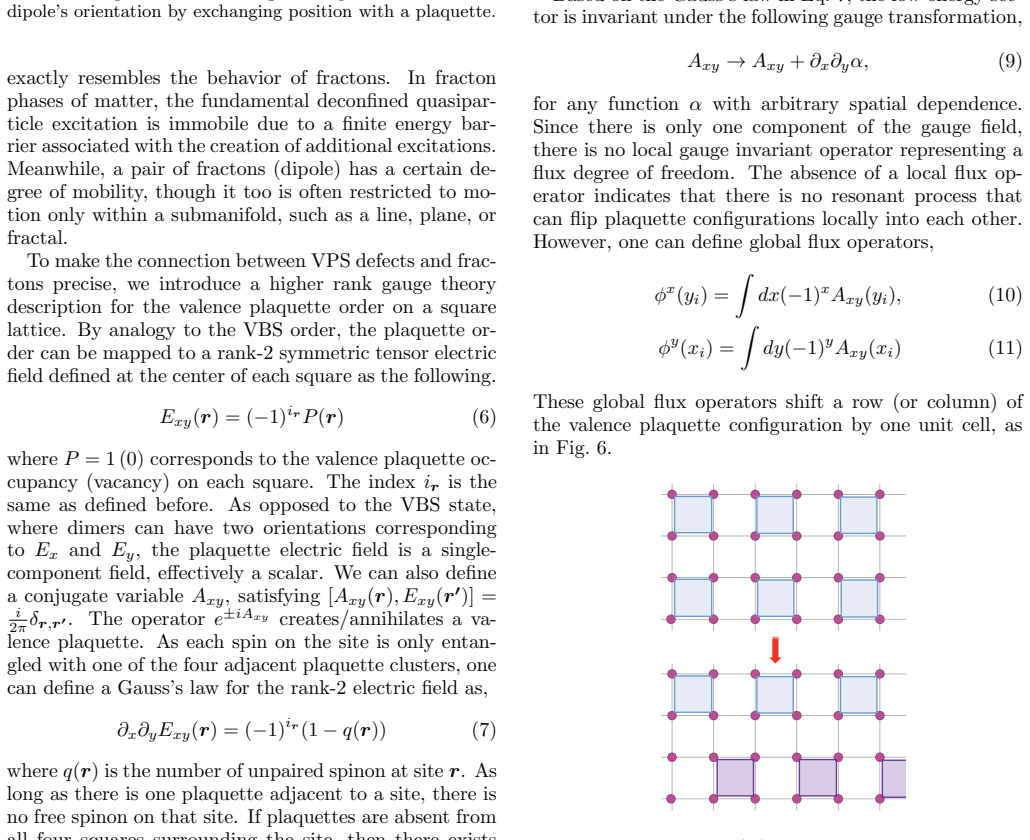
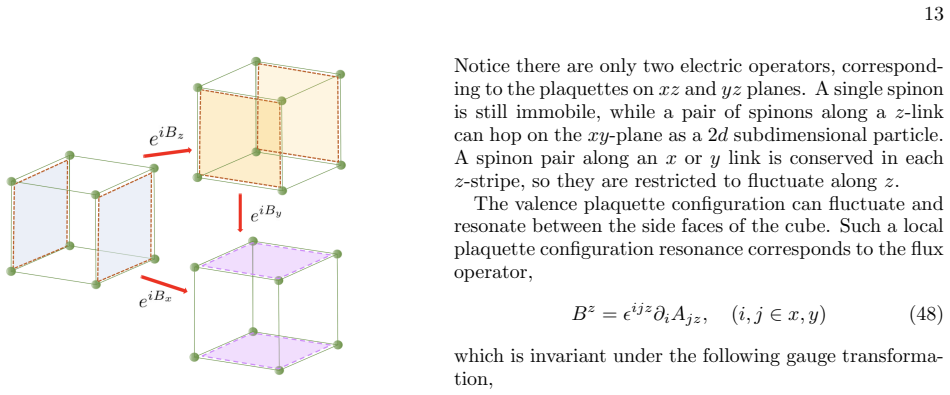
The load-bearing object is the hollow rank-2 symmetric tensor gauge theory: a single-component electric field $E_{xy}(r)=(-1)^{i_r}P(r)$ defined on plaquette centers, with conjugate variable $A_{xy}$ that creates or annihilates a valence plaquette. Its Gauss law $\partial_x\partial_y E_{xy}=(-1)^{i_r}(1-q)$ encodes the constraint that each site touches exactly one plaquette, and it generates subsystem conservation of spinon charge on every row and column. This is what turns the vortex-core spinon into a fracton and restricts dipole motion to transverse stripes; all later results, the absence of direct VPS–Néel condensation, the intermediate bond-ordered or algebraic bond-liquid phases, and the 3D generalizations, follow from this constraint and the higher-rank analogue $\partial_x\partial_y\partial_z E_{xyz}$ in three dimensions.
What would settle it
Compute the single-spinon spectral function in a deep VPS regime of a two-dimensional spin model: a dispersing peak at finite momentum would mean a single vortex core can move without breaking additional plaquettes, contradicting the claimed immobility. Alternatively, an observed direct continuous VPS-to-Néel transition with no intervening bond-ordered or algebraic bond-liquid phase, in a regime where the plaquette description is known to hold, would falsify the predicted melting scenario.
Extended reading notes
Core claim
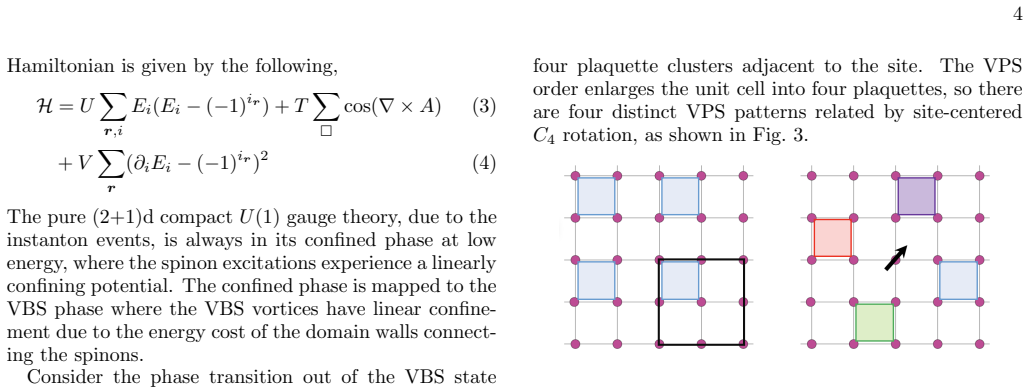
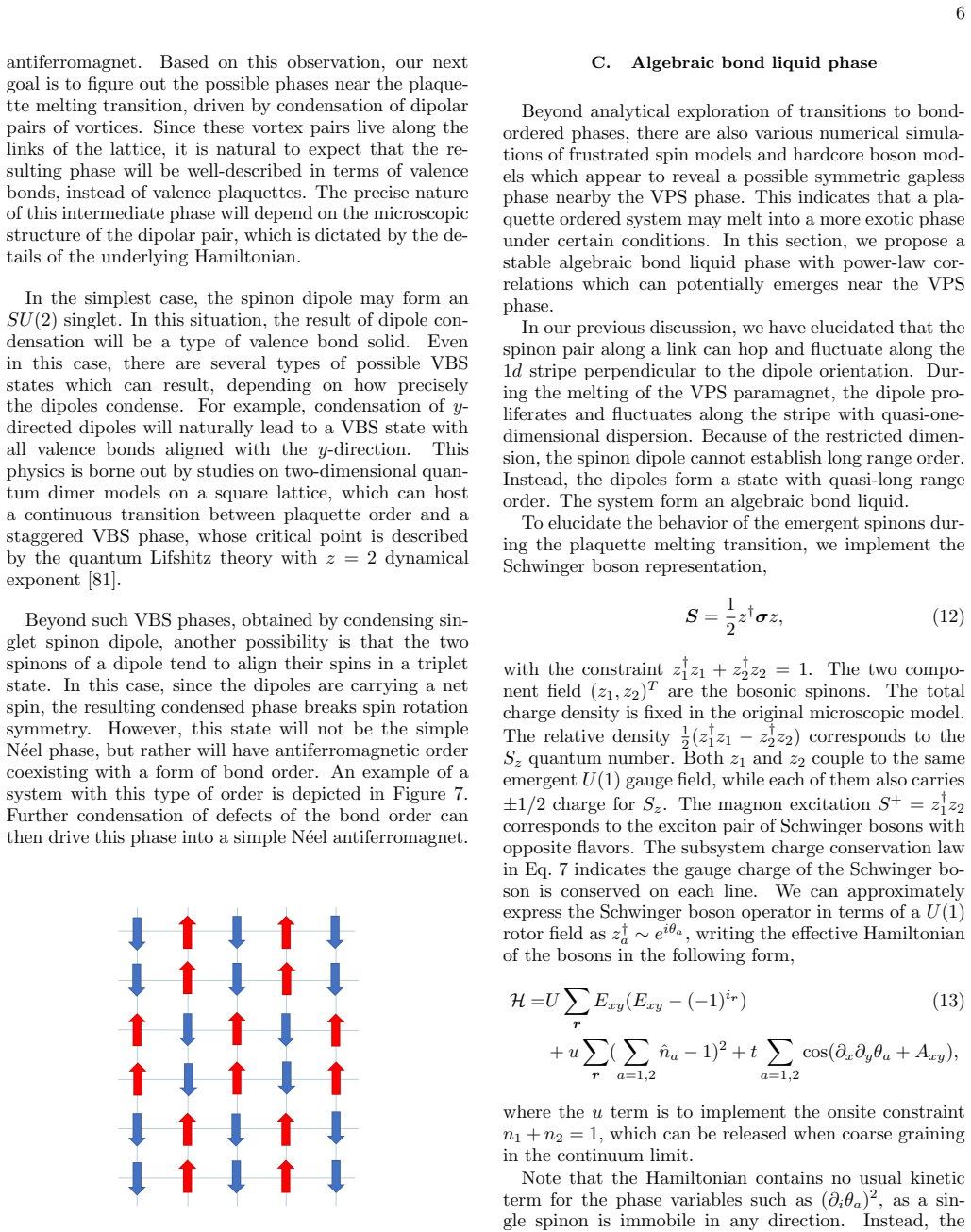
The paper's central discovery is that VPS vortices are emergent fractons, and that this changes the phase diagram out of plaquette order. In a deep VPS state each site participates in exactly one of the four surrounding plaquettes; encoding this by $E_{xy}(r)=(-1)^{i_r}P(r)$ leads to the Gauss law $\partial_x\partial_y E_{xy}=(-1)^{i_r}(1-q)$, the two-dimensional hollow rank-2 tensor gauge theory. The double derivative conserves spinon charge on each row and column, leaving a single spinon immobile and letting a dipole hop only perpendicular to its own axis. Because direct vortex condensation is blocked while this constraint holds, the VPS cannot melt continuously into a simple Néel antiferromagnet; the natural melting channel is proliferation of spinon dipoles. The paper argues that dipole condensation can produce bond-ordered phases, and, when the dipoles keep fluctuating, a stable algebraic bond liquid with power-law bond correlations, specific heat $T\ln(1/T)$, entanglement entropy $L\ln L$, and a Bose surface with dispersion $|\sin k_x \sin k_y|$. The same reasoning extends to three-dimensional valence cube solids, whose defects include immobile spinons, immobile spinon dipoles, and planar spinon quadrupoles that move as lineons.
Load-bearing premise
The deep-plaquette picture, in which every spin belongs to exactly one four-spin plaquette and cannot leave it without breaking a plaquette, must survive all the way to the melting transition; the authors note explicitly that if plaquettes can easily break into pairs of dimers, the fracton mobility restrictions can break down.
Editorial extensions
If this is right
- The VPS-to-Néel transition is not a simple deconfined quantum critical point of the familiar VBS type while plaquette order remains well-defined, because single vortex condensation is kinematically blocked.
- Melting of a 2D VPS generically proceeds in two stages: first spinon dipoles proliferate, and only later, if at all, do single spinons condense, making an intermediate phase between VPS and Néel the generic outcome.
- When that intermediate phase stays gapless, it is an algebraic bond liquid whose observable signatures are $T\ln(1/T)$ specific heat, $L\ln L$ entanglement entropy, a spin-structure factor proportional to $|\sin k_x\sin k_y|$, and a two-dipole continuum in the bond spectral function.
- In three dimensions, valence cube and valence plaquette orders have a mobility hierarchy (single spinon immobile, spinon dipole immobile, planar quadrupole moving as a lineon), so their melting transitions avoid single-defect condensation and proceed by proliferating the most mobile bound objects.
- In the strongly anisotropic limit, the 3D VPS-to-VBS transition maps to coupled 2D VBS melting problems and, once monopole tunneling locks the layers, belongs to the 3D XY universality class with a reduced effective dimension.
Reading between the lines
- If the fracton constraint survives to the transition, the algebraic bond liquid is a natural candidate for the intermediate phase seen in numerics on 2D Heisenberg models near VPS order; a direct test is to compute the bond-correlation exponent and entanglement scaling in those models.
- The row-and-column conservation argument generalizes to other bipartite lattices and to SU(N) plaquette orders, so plaquette melting in SU(4) or triangular-lattice SU(3) systems should show similarly suppressed single-vortex condensation and possibly fractal mobility.
- Any microscopic term that lets a dipole hop along its own orientation, such as tunneling between dimer pairs, should destabilize the algebraic bond liquid; tuning such a term would provide a clean numerical knob to test the mechanism.
- Because the Bose surface has anisotropic power-law correlations, direction-dependent structure-factor measurements on candidate frustrated magnets could distinguish an algebraic bond liquid from a conventional gapped paramagnet.
Signed reviews
Editorial analysis
A structured set of objections, weighed in public.
Referee Report
Summary. The manuscript studies topological defects of valence plaquette solid (VPS) order in two and three spatial dimensions. Using a mapping to hollow rank-2 tensor gauge theory, it argues that a single VPS vortex carrying a spinon is immobile (a fracton), while a spinon dipole can move only transversely to its orientation. On this basis, the authors argue that a continuous VPS-to-Néel transition via single-vortex condensation is kinematically impeded, and that melting instead proceeds through spinon-dipole proliferation, potentially producing a stable gapless algebraic bond liquid in 2D. The paper also extends the analysis to 3D valence cube and valence plaquette orders, and discusses an anisotropic limit that maps to a 2D VBS melting transition.
Significance. If the central claim holds, the paper provides a new route to emergent fractons in spin systems with spontaneously broken spatial symmetry, and it gives a concrete field-theoretic mechanism for a 2D bosonic 'Bose metal' with symmetry fractionalization. The manuscript contains several explicit, falsifiable predictions: a nodal-line dispersion |sin kx sin ky|, a static structure factor Szz(k) ~ |sin kx sin ky|, specific heat Cv ~ T ln(1/T), and entanglement entropy scaling L ln L. The presentation is clear, and the authors honestly flag the main caveat to their fracton scenario, namely that the mobility restrictions could fail if plaquettes break into dimer pairs. The main weaknesses are that the persistence of the fracton constraint through the melting transition is assumed rather than established, and the stability of the algebraic bond liquid is imported from prior work on exciton Bose liquids rather than recomputed for the present theory.
major comments (2)
- [Section III.A and Introduction, Eq. (7)] The central claim that VPS defects are fractons rests on the hollow rank-2 Gauss law ∂x∂y Exy = (-1)^ir(1-q), which is a modeling choice encoding binary plaquette occupancy. The manuscript itself states in the Introduction that 'the mobility restrictions could break down in a regime where a plaquette can easily break down into a pair of dimers.' Such dimer breakdown is precisely what is expected at the VPS melting transition, where plaquette vacancies proliferate. Therefore the conclusion in Section III.A that 'even if the fractons become deconfined at a quantum critical point, their mobility restriction serves as an impediment to direct condensation' is not supported by the presented derivation. The authors should either provide a microscopic lattice model in which the plaquette constraint is exact up to the transition (e.g., a quantum dimer model with no dimer coverings), or give a quantitative estimate showing that the dimer-breakdown amplitude is small compared with the vortex-tunneling amplitude near the transition.
- [Section III.C, Eq. (14)-(18)] The stability of the proposed algebraic bond liquid is not derived in this paper. The Gaussian action in Eq. (14) contains a single dimensionless parameter K = sqrt(t/u), but the scaling dimensions of the vertex operators V = cos(4π∂iφ-) and V' = cos(2π∂i^2φ-) are not computed for this action. Instead, the paper states that 'In Ref. [21, 72], it was shown that there is a finite region for K > Kc where all vertex operators are irrelevant, so the algebraic bond liquid is stable.' This imports the stability criterion from prior studies of exciton Bose liquids without demonstrating that the VPS melting transition can access K > Kc. As a result, the intermediate gapless phase remains a plausible scenario rather than a consequence of the plaquette-melting framework. Please compute the vertex-operator scaling dimensions for Eq. (18) or explicitly state the microscopic conditions under which K > Kc is realized.
minor comments (5)
- [Section III.D, Eq. (30)] The upper spectral bound is given as Ω_upper(Qx) ~ sin(Qx/2), but maximizing |sin(kx)| + |sin(Qx - kx)| over kx for Qx in [0,π] yields 2 sin(Qx/2), not sin(Qx/2). Please correct this expression and check whether Fig. 8 is affected.
- [Section III.D, Eq. (25)] The static structure factor Szz(k) is said to be measurable by 'inelastic neutron scattering and electron spin resonance.' Electron spin resonance typically probes dynamic susceptibilities at fixed frequency, not the static structure factor; consider also mentioning nuclear magnetic resonance or inelastic neutron scattering as more direct probes of Szz(k).
- [Section I, paragraph 4] There is a misspelling: 'oberserved' should be 'observed'.
- [Section III.A, Eq. (6)-(7)] The index r is used both for the site in the Gauss law Eq. (7) and for the plaquette center in the definition of Exy in Eq. (6); please clarify the lattice-position conventions (e.g., by explicitly writing r as a site index and r+1/2 as a plaquette center) to avoid ambiguity.
- [Section III.E, Eq. (31)] The vectors e1, e2, e3 pointing from a site to the left-oriented triangles are not defined in the text or figure; please define them explicitly or refer to the figure with a coordinate description.
Circularity Check
No significant circularity: the Gauss-law mapping is a stated modeling assumption, and the algebraic bond liquid stability and tensor-gauge results are imported from independent prior work.
full rationale
The derivation chain is self-contained in the sense required by the circularity test. The paper introduces the rank-2 tensor gauge theory by positing Exy = (-1)^ir P(r) and then defining the Gauss law ∂x∂yExy = (-1)^ir(1-q), where q is the number of unpaired spinons; this is an explicit modeling assumption that encodes the plaquette-occupancy constraint, not a fit to the target result. The fracton mobility restrictions follow mathematically from the double-derivative structure and the resulting subsystem conservation laws, so they are consequences of the postulated constraint rather than inputs used to define it. The algebraic bond liquid analysis takes its stability criterion from prior independent works (Refs. 71-74), with exponents expressed in terms of an undetermined parameter K rather than fitted to reproduce the claimed phase. The paper's self-citations to Pretko, You, and collaborators concern established tensor-gauge and fracton-melting results that are independently published and not the sole support for the central claim. Finally, the paper explicitly flags the limitation that plaquette mobility restrictions could break down if a plaquette easily breaks into a pair of dimers (Introduction and Section III.A), making the central claim conditional rather than circular. No quoted equation reduces to its own input by construction, and no fitted parameter is renamed as a prediction.
Assumptions & free parameters
free parameters (2)
- K (Gaussian stiffness) =
not determined
- Kc (critical stiffness) =
not computed here; cited from Refs. [21,72]
assumptions (7)
- standard math Lieb-Schultz-Mattis theorem forbids a featureless gapped paramagnet in spin-1/2 square lattice models.
- standard math The compact (2+1)d U(1) gauge theory is always confined at low energy due to instanton proliferation.
- domain assumption VPS order is represented by a binary plaquette occupancy P and obeys the rank-2 Gauss law ∂x∂y Exy = (-1)^ir(1-q).
- domain assumption The vortex-core spinon in the VPS phase carries the same gauge charge and Gauss-law constraint as the background plaquettes.
- domain assumption The Gaussian/bosonized action in Eq. 16 and its dual Eq. 18 capture the low-energy physics, and the vertex-operator irrelevance criterion K>Kc from Refs. [21,72] transfers to this model.
- standard math Mermin-Wagner-type suppression of long-range order applies to the 1d dipole motion in each stripe.
- domain assumption Rank-3 and rank-2 hollow tensor gauge theories with Gauss laws Eqs. 32 and 42 describe 3D cube and plaquette orders.
Cite this review
Pith. "Pith review of Emergent fractons and algebraic quantum liquid from plaquette melting transitions." pith.science (2026). https://pith.science/paper/JZV75PCV
@misc{pith2026190808540,
  author       = {Pith},
  title        = {Pith review of: Emergent fractons and algebraic quantum liquid from plaquette melting transitions},
  year         = {2026},
  howpublished = {\url{https://pith.science/paper/JZV75PCV}},
  note         = {Machine review of arXiv:1908.08540}
}
abstract
Paramagnetic spin systems with spontaneously broken spatial symmetries, such as valence bond solid (VBS) phases, can host topological defects carrying non-trivial quantum numbers, which enables the paradigm of deconfined quantum criticality. In this work, we study the properties of topological defects in valence plaquette solid (VPS) phases on square and cubic lattices. We show that the defects of the VPS order parameter, in addition to possessing non-trivial quantum numbers, have fracton mobility constraints deep in the VPS phase, which has been overlooked previously. The spinon inside a single vortex cannot move freely in any direction, while a dipolar pair of vortices with spinon pairs can only move perpendicular to its dipole moment. These mobility constraints, while they persist, can potentially inhibit the condensation of vortices and preclude a continuous transition from the VPS to the N\'eel antiferromagnet. Instead, the VPS melting transition can be driven by proliferation of spinon dipoles. For example, we argue that a $2d$ VPS can melt into a stable gapless phase in the form of an algebraic bond liquid with algebraic correlations and long range entanglement. Such a bond liquid phase yields a concrete example of the elusive $2d$ Bose metal with symmetry fractionalization. We also study $3d$ valence plaquette and valence cube ordered phase, and demonstrate that the topological defects therein also have fractonic dynamics. Possible nearby phases after melting the valence plaquettes or cubes are also discussed.
Figures


Figures from the paper (8 more)




Reference graph
Works this paper leans on
-
[1]
Senthil, A
T. Senthil, A. Vishwanath, L. Balents, S. Sachdev, and M. P. A. Fisher, Science 303, 1490 (2004), https://science.sciencemag.org/content/303/5663/1490.full.pdf
2004
-
[2]
In a spin-wave approximation, we can expand the cosine term and take the gaussian theory
With a large t, the system tends to fall into an ordered state of θ1 and θ2. In a spin-wave approximation, we can expand the cosine term and take the gaussian theory. In the resultant theory, the gauge fields and the∂x∂y∂z(θ1 +θ2) mode gap out each other through an analog of the Higgs mechanism. The only physical mode left is ∂x∂y∂z(θ1− θ2). Let us label θ...
-
[3]
T. Senthil, L. Balents, S. Sachdev, A. Vishwanath, and M. P. A. Fisher, Journal of the Physical Society of Japan 74, 1 (2005), https://doi.org/10.1143/JPSJS.74S.1
-
[4]
spin- wave
Right: The vortex connecting four distinct VPS patterns carries a spinon. A. Defect structure To restore the spatial symmetry, it is essential to pro- liferate the C4 symmetry defect. For the plaquette crys- talline phase, one can define the four distinct plaquette patterns as a Z4 boson. The C4 symmetry defect formed by the vortex configuration of the orde...
-
[5]
Senthil, L
T. Senthil, L. Balents, S. Sachdev, A. Vishwanath, and M. P. A. Fisher, Phys. Rev. B 70, 144407 (2004)
2004
-
[6]
Levin and T
M. Levin and T. Senthil, Phys. Rev. B70, 220403 (2004)
2004
-
[7]
O. I. Motrunich and A. Vishwanath, Phys. Rev. B 70, 075104 (2004)
2004
-
[8]
A. W. Sandvik, Phys. Rev. Lett. 98, 227202 (2007)
2007
Show all 90 references
-
[9]
R. G. Melko and R. K. Kaul, Phys. Rev. Lett. 100, 017203 (2008)
2008
-
[10]
J. Lou, A. W. Sandvik, and N. Kawashima, Phys. Rev. B 80, 180414 (2009)
2009
-
[11]
Banerjee, K
A. Banerjee, K. Damle, and F. Alet, Phys. Rev. B 82, 155139 (2010)
2010
-
[12]
A. W. Sandvik, Phys. Rev. Lett. 104, 177201 (2010)
2010
-
[13]
Harada, T
K. Harada, T. Suzuki, T. Okubo, H. Matsuo, J. Lou, H. Watanabe, S. Todo, and N. Kawashima, Phys. Rev. B 88, 220408 (2013)
2013
-
[14]
Pujari, K
S. Pujari, K. Damle, and F. Alet, Phys. Rev. Lett. 111, 087203 (2013)
2013
-
[15]
R. K. Kaul and A. W. Sandvik, Phys. Rev. Lett. 108, 137201 (2012)
2012
-
[16]
Bartosch, Phys
L. Bartosch, Phys. Rev. B 88, 195140 (2013)
2013
-
[17]
Banerjee, K
A. Banerjee, K. Damle, and F. Alet, Phys. Rev. B 83, 235111 (2011)
2011
-
[18]
Nahum, J
A. Nahum, J. T. Chalker, P. Serna, M. Ortu˜ no, and A. M. Somoza, Phys. Rev. X 5, 041048 (2015)
2015
-
[19]
C. Wang, A. Nahum, M. A. Metlitski, C. Xu, and T. Senthil, Phys. Rev. X 7, 031051 (2017)
2017
-
[20]
Vishwanath, L
A. Vishwanath, L. Balents, and T. Senthil, Phys. Rev. B 69, 224416 (2004)
2004
-
[21]
Pankov, R
S. Pankov, R. Moessner, and S. L. Sondhi, Phys. Rev. B 76, 104436 (2007)
2007
-
[22]
S.-S. Gong, W. Zhu, D. N. Sheng, O. I. Motrunich, and M. P. A. Fisher, Phys. Rev. Lett. 113, 027201 (2014)
2014
-
[23]
Xu and C
C. Xu and C. Wu, Physical Review B 77, 134449 (2008)
2008
-
[24]
Z. Zhu, D. A. Huse, and S. R. White, Phys. Rev. Lett. 110, 127205 (2013)
2013
-
[25]
Moessner, S
R. Moessner, S. L. Sondhi, and P. Chandra, Phys. Rev. B 64, 144416 (2001)
2001
-
[26]
H. H. Zhao, C. Xu, Q. N. Chen, Z. C. Wei, M. P. Qin, G. M. Zhang, and T. Xiang, Phys. Rev. B 85, 134416 (2012)
2012
-
[27]
A. F. Albuquerque, D. Schwandt, B. Het´ enyi, S. Cap- poni, M. Mambrini, and A. M. L¨ auchli, Phys. Rev. B 84, 024406 (2011)
2011
-
[28]
Zayed, C
M. Zayed, C. R¨ uegg, A. L¨ auchli, C. Panagopoulos, S. Saxena, M. Ellerby, D. McMorrow, T. Str¨ assle, S. Klotz, G. Hamel, et al., Nature Physics 13, 962 (2017)
2017
-
[29]
B. Zhao, P. Weinberg, and A. W. Sandvik, arXiv preprint arXiv:1804.07115 (2018)
2018 arXiv
-
[30]
R. M. Nandkishore and M. Hermele, Annual Re- view of Condensed Matter Physics 10, 295 (2019), https://doi.org/10.1146/annurev-conmatphys-031218- 013604
2019 doi
-
[31]
Vijay, J
S. Vijay, J. Haah, and L. Fu, Phys. Rev. B 92, 235136 (2015)
2015
-
[32]
Vijay, J
S. Vijay, J. Haah, and L. Fu, Phys. Rev. B 94, 235157 (2016)
2016
-
[33]
Chamon, Phys
C. Chamon, Phys. Rev. Lett. 94, 040402 (2005)
2005
-
[34]
Haah, Phys
J. Haah, Phys. Rev. A 83, 042330 (2011)
2011
-
[35]
Yoshida, Phys
B. Yoshida, Phys. Rev. B 88, 125122 (2013)
2013
-
[36]
Pretko and L
M. Pretko and L. Radzihovsky, Phys. Rev. Lett. 120, 195301 (2018)
2018
-
[37]
Pai and M
S. Pai and M. Pretko, Phys. Rev. B 97, 235102 (2018)
2018
-
[38]
Gromov, Phys
A. Gromov, Phys. Rev. Lett. 122, 076403 (2019)
2019
-
[39]
Pretko and L
M. Pretko and L. Radzihovsky, Phys. Rev. Lett. 121, 235301 (2018)
2018
-
[40]
Kumar and A
A. Kumar and A. C. Potter, arXiv e-prints , arXiv:1808.05621 (2018), arXiv:1808.05621 [cond- 16 mat.str-el]
2018 arXiv
-
[41]
Sous and M
J. Sous and M. Pretko, arXiv e-prints , arXiv:1904.08424 (2019), arXiv:1904.08424 [cond-mat.str-el]
2019 arXiv
-
[42]
Shirley, K
W. Shirley, K. Slagle, Z. Wang, and X. Chen, Phys. Rev. X 8, 031051 (2018)
2018
-
[43]
Pai and M
S. Pai and M. Hermele, arXiv e-prints , arXiv:1903.11625 (2019), arXiv:1903.11625 [cond-mat.str-el]
2019 arXiv
- [44]
-
[45]
Shirley, K
W. Shirley, K. Slagle, and X. Chen, SciPost Phys. 6, 41 (2019)
2019
-
[46]
Y. You, T. Devakul, F. Burnell, and S. Sondhi, arXiv preprint arXiv:1805.09800 (2018)
2018 arXiv
-
[47]
H. Song, A. Prem, S.-J. Huang, and M. A. Martin- Delgado, Phys. Rev. B 99, 155118 (2019)
2019
-
[48]
Slagle and Y
K. Slagle and Y. B. Kim, Phys. Rev. B Condens. Matter 96, 195139 (2017)
2017
-
[49]
H. Ma, E. Lake, X. Chen, and M. Hermele, Phys. Rev. B 95, 245126 (2017)
2017
-
[50]
H. Ma, A. T. Schmitz, S. A. Parameswaran, M. Hermele, and R. M. Nandkishore, Phys. Rev. B 97, 125101 (2018)
2018
-
[51]
Vijay, (2017), arXiv:1701.00762 [cond-mat.str-el]
S. Vijay, (2017), arXiv:1701.00762 [cond-mat.str-el]
2017 arXiv
-
[52]
Petrova and N
O. Petrova and N. Regnault, Phys. Rev. B 96, 224429 (2017)
2017
-
[53]
A. T. Schmitz, H. Ma, R. M. Nandkishore, and S. A. Parameswaran, Phys. Rev. B 97, 134426 (2018)
2018
-
[54]
A. T. Schmitz, arXiv preprint arXiv:1809.10151 (2018)
2018 arXiv
-
[55]
Prem, S.-J
A. Prem, S.-J. Huang, H. Song, and M. Hermele, Phys. Rev. X 9, 021010 (2019)
2019
-
[56]
H. Yan, O. Benton, L. D. C. Jaubert, and N. Shannon, arXiv e-prints , arXiv:1902.10934 (2019), arXiv:1902.10934 [cond-mat.str-el]
2019 arXiv
-
[57]
A. Dua, D. J. Williamson, J. Haah, and M. Cheng, arXiv e-prints , arXiv:1903.12246 (2019), arXiv:1903.12246 [cond-mat.str-el]
2019 arXiv
-
[58]
Bravyi and J
S. Bravyi and J. Haah, Phys. Rev. Lett. 111, 200501 (2013)
2013
-
[59]
B. M. Terhal, Rev. Mod. Phys. 87, 307 (2015)
2015
-
[60]
Pretko, Phys
M. Pretko, Phys. Rev. D 96, 024051 (2017)
2017
-
[61]
Yan, Phys
H. Yan, Phys. Rev. B 99, 155126 (2019)
2019
-
[62]
A. Prem, J. Haah, and R. Nandkishore, Phys. Rev. B Condens. Matter 95, 155133 (2017)
2017
-
[63]
S. Pai, M. Pretko, and R. M. Nandkishore, Phys. Rev. X 9, 021003 (2019)
2019
-
[64]
Ma and M
H. Ma and M. Pretko, Phys. Rev. B 98, 125105 (2018)
2018
-
[65]
Pretko, Physical Review B 95, 115139 (2017)
M. Pretko, Physical Review B 95, 115139 (2017)
2017
-
[66]
Pretko, Physical Review B 96, 035119 (2017)
M. Pretko, Physical Review B 96, 035119 (2017)
2017
-
[67]
H. Ma, M. Hermele, and X. Chen, Phys. Rev. B 98, 035111 (2018)
2018
-
[68]
Bulmash and M
D. Bulmash and M. Barkeshli, Phys. Rev. B 97, 235112 (2018)
2018
- [69]
-
[70]
Pretko, Phys
M. Pretko, Phys. Rev. B Condens. Matter 96, 125151 (2017)
2017
-
[71]
Y. You, T. Devakul, S. L. Sondhi, and F. J. Burnell, arXiv e-prints , arXiv:1904.11530 (2019), arXiv:1904.11530 [cond-mat.str-el]
2019 arXiv
-
[72]
Gromov, arXiv preprint arXiv:1812.05104 (2018)
A. Gromov, arXiv preprint arXiv:1812.05104 (2018)
2018 arXiv
-
[73]
Xu and M
C. Xu and M. P. Fisher, Physical Review B 75, 104428 (2007)
2007
-
[74]
Paramekanti, L
A. Paramekanti, L. Balents, and M. P. Fisher, Physical Review B 66, 054526 (2002)
2002
-
[75]
Tay and O
T. Tay and O. I. Motrunich, Physical review letters 105, 187202 (2010)
2010
-
[76]
T. Tay, O. I. Motrunich, et al., Physical Review B 83, 205107 (2011)
2011
-
[77]
R. V. Mishmash, M. S. Block, R. K. Kaul, D. Sheng, O. I. Motrunich, and M. P. Fisher, Physical Review B 84, 245127 (2011)
2011
-
[78]
H.-H. Lai, K. Yang, and N. Bonesteel, Physical review letters 111, 210402 (2013)
2013
-
[79]
E. Lieb, T. Schultz, and D. Mattis, Annals of Physics 16, 407 (1961)
1961
-
[80]
M. B. Hastings, Phys. Rev. B 69, 104431 (2004)
2004
-
[81]
Oshikawa, Phys
M. Oshikawa, Phys. Rev. Lett. 84, 1535 (2000)
2000
-
[82]
Pankov, R
S. Pankov, R. Moessner, and S. L. Sondhi, Physical Re- view B 76, 104436 (2007)
2007
-
[83]
Fradkin, D
E. Fradkin, D. A. Huse, R. Moessner, V. Oganesyan, and S. L. Sondhi, Phys. Rev. B 69, 224415 (2004)
2004
-
[84]
ˆn− =sz + 1/2 is the conjugate variable of θ−
-
[85]
Kohno, O
M. Kohno, O. A. Starykh, and L. Balents, Nature Physics 3, 790 (2007)
2007
-
[86]
H.-H. Lai, K. Yang, and N. E. Bonesteel, Phys. Rev. Lett. 111, 210402 (2013)
2013
-
[87]
M. M. Wolf, Phys. Rev. Lett. 96, 010404 (2006)
2006
-
[88]
Gioev and I
D. Gioev and I. Klich, Phys. Rev. Lett. 96, 100503 (2006)
2006
-
[89]
Swingle, Phys
B. Swingle, Phys. Rev. Lett. 105, 050502 (2010)
2010
-
[90]
The cube r is the adjacent cube of site r along the (111) direction
Reviewed August 14, 2026 · model on record in the stance chip above.
Discussion (0). Continue with ORCID to comment.