REVIEW 3 major objections 4 minor 45 references
Spin State Dynamics in a Bichromatic Microwave Field: Role of Bright and Dark States in coupling with Reservoir
T0 review · 3 major / 4 minor · reviewed 2026-08-14 · deepseek-v4-flash
Pith's one-line read Bichromatic microwave driving makes one component of a composite magnetic resonance immune to power broadening, because a dark combination of spin populations decouples from the field.
desk verdict Bichromatic driving of an open two-level system yields a dark population mode whose width stabilizes at gamma; the qualitative claim holds, the quantitative fit is partly circular, and the vanishing amplitude of the stabilizing line needs addressing. read the letter →
The pith
A machine-rendered reading of the paper's core claim, the machinery that carries it, and where it could break.
The reading
What carries the argument
The load-bearing object is the Liouvillian $L_0$ of the reduced population equations, together with its real eigenvectors $\eta_1,\eta_0$ (population combinations) and eigenvalues $\lambda_k=1+S-(-1)^k\sqrt{S^2+\epsilon^2}$, interpreted as dimensionless relaxation rates. Diagonalizing $L_0$ defines a mixing angle $\theta$ and shows that for strong microwaves $\eta_1$ becomes the population difference while $\eta_0$ becomes the population sum, so their rates approach $1+2S$ and $1$. A first-harmonic Fourier solution of the full time-dependent equation converts those rates into observable Lorentzian widths, predicting $w_0\simeq\gamma\lambda_0\to\gamma$, $w_1\simeq\gamma\sqrt{\lambda_1^2-2S^2}$, and an amplitude $A_0$ that falls to zero at high power. This machinery is what links the asymptotic eigenvalue structure directly to the measured composite resonance shape.
What would settle it
A numerical solution of the full master equation without adiabatic elimination and without truncating the Fourier series, using the experimental parameters ($\Gamma\simeq 10\gamma$, $\epsilon\simeq 0.85$), should show whether the component $w_0$ stays flat as $S$ grows past the measured range; if it rises with microwave power, the stabilization is an artifact of the first-harmonic/adiabatic approximation. A high-power experiment that resolves a growing $w_0$ would likewise refute the claim.
Extended reading notes
Core claim
When two strong, nearly degenerate microwaves drive a transition of an open spin system (here the $|m_S=0\rangle\leftrightarrow|m_S=+1\rangle$ transition of NV centers), the fluorescence signal contains a composite resonance made of several Lorentzian pieces. The central finding is that the width $w_0$ of one piece saturates at $\gamma$ as the saturation parameter $S$ grows, while the width $w_1$ of the other grows roughly as $\sqrt{2\gamma S}$. This asymmetry is traced to a decomposition of the population evolution generator: for $S\to\infty$, one real combination of populations $\eta_1$ tends to the population difference and relaxes at rate $\gamma(1+2S)$ (bright, power-broadened), while the other combination $\eta_0$ tends to the population sum and relaxes at rate $\gamma$ (dark, power-stabilized). The existence of the dark combination requires asymmetry of the two population relaxation rates ($\epsilon\neq 0$), i.e. an open system; in a closed system the resonance collapses to a single power-broadened hole. The authors also report light-induced narrowing of the broader component and interpret the whole effect as a classical, nonunitary analogue of coherent population trapping.
Load-bearing premise
The whole argument rests on treating the spins' internal quantum phase as instantly slaved to the populations and ignoring fast oscillations of the populations; the experiment runs close to the edge of that treatment, so the predicted width stabilization could be an artifact of the approximations.
Editorial extensions
If this is right
- Bichromatic microwave spectroscopy can separate the two population relaxation rates that are jointly hidden in a standard single-field ODMR resonance.
- A multicomponent, nested resonance obtained with two nearly degenerate fields becomes a diagnostic of system openness: in a closed system the structure collapses to one power-broadened hole.
- The power-stabilized narrow component offers a route to precision spectroscopy and relaxation metrology without power-broadening limitations, provided $\gamma_0<\gamma_1\ll\Gamma$.
- At high microwave power the open system effectively closes: the dark combination's amplitude $A_0$ vanishes and the population sum becomes power-independent.
- The same two-rate structure offers a mechanism for the multiexponential population decays observed in dense NV ensembles, because different coupling constants give different effective decay channels.
Reading between the lines
- Editorial inference: the population-mode dark/bright picture should transfer to any driven open two-level system with asymmetric relaxation, such as donor spins, rare-earth ions, or trapped-ion hyperfine levels, so the stabilization effect could be sought outside diamond.
- Editorial inference: solving the full master equation numerically without the first-harmonic truncation would sharpen the prediction; if $w_0$ remains flat past the current power range the stabilization is robust, and if not it is an artifact of the truncation.
- Editorial inference: the observed light narrowing of $w_1$ suggests the broad component could serve as a sensitive probe of reservoir coupling, potentially giving an optical handle to tune spin relaxation in sensing applications, which the paper does not explicitly pursue.
- Editorial inference: since the analogy with CPT is classical (population combinations rather than coherences), a purely classical two-mode damped oscillator driven by a bichromatic force should reproduce the same width stabilization, clarifying how much of the effect is quantum.
Signed reviews
Editorial analysis
A structured set of objections, weighed in public.
Referee Report
Summary. The paper studies an open two-level spin system (NV centers in diamond) driven by two nearly degenerate microwave fields. The authors derive a reduced population-only master equation via adiabatic elimination of coherences, diagonalize the time-independent part to identify 'bright' and 'dark' population superpositions, and use a first-harmonic approximation to obtain a composite resonance composed of two narrow Lorentzians with widths w1 and w0. They report experimental ODMR data showing power broadening of w1 and stabilization (power independence) of w0, as well as light narrowing of w1. The main claim is that the saturation of w0 at the mean population relaxation rate γ is a direct consequence of the dark state η0.
Significance. If correct, the work is valuable: it extends the bright/dark-state concept from coherent superpositions to combinations of populations in an open system, predicts a measurable stabilization against power broadening, and demonstrates the effect in an NV ensemble. The analytical formulas for amplitudes and widths (Eq. S13) are explicit, and the identification of the slow-decay exponent with the stabilized width is insightful. The paper also delivers a falsifiable prediction (power-independence of w0 for strong driving) and provides experimental data supporting a qualitative effect. However, the quantitative support is weakened by the issues raised below.
major comments (3)
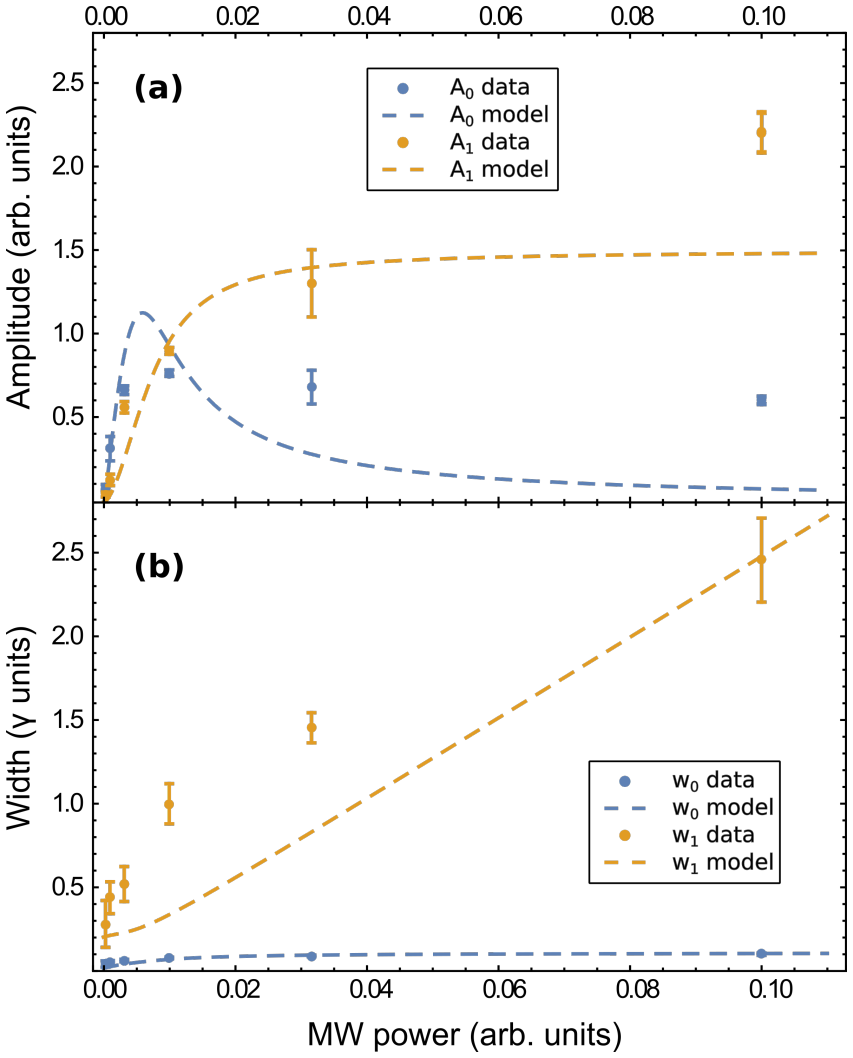
- [Supplemental §V, Eq. (S13)] The predicted stabilization occurs in the same strong-driving limit in which the amplitude A0 of the component whose width is w0 vanishes. Expanding Eq. (S13) for S≫1 with w0≃γλ0 gives A0 ≃ ε²/(2S) → 0, and Fig. 2(a) shows A0 decreasing to zero for S≳2. The experimental Fig. 4 reports fits of a triple-Lorentzian, but the paper does not state the S range covered or the noise floor of A0. If the data lie in the regime where A0 is below the noise floor, the flat w0 curve may reflect the fitting model rather than a physical pole of the response. To support the central claim, the authors should report the S values of Fig. 4, the fitted A0 with error bars versus S, and a quantitative criterion for when w0 is constrained by the data.
- [Main paper Eqs. (1)–(5) and Supplemental §III] The derivation assumes δ≪Γ and, for the first-harmonic approximation, Ω≪Γ. The experiment operates at Γ≈10γ, and the fitted values γ=0.11, ε=0.85 imply that for S≈1 one has Ω/Γ≈0.32, which is not deep in the Ω≪Γ regime, and for S≳1 higher harmonics become relevant. The authors explicitly concede that 'modelling of wk and Ak is not very accurate' in this regime. Since the central prediction w0≈γλ0 is derived from this first-harmonic, asymptotic analysis, the paper should either compute the next-order corrections (including higher harmonics and retained coherences) or provide a numerical solution of the full master equation showing that w0 saturation is not an artifact of the truncation. The statement in Sec. IV.C of the Supplemental that a more accurate analysis 'confirms' stabilization is not sufficient without presenting it.
- [Main paper Fig. 4] The theoretical curves in Fig. 4 are computed with γ=0.11 and ε=0.85, but the manuscript does not state whether these values are independently measured or obtained by fitting the same w0 and A0 data shown in the figure. If they are fitted, the agreement of w0(S) with the predicted plateau is partly guaranteed by construction, because the asymptotic w0 equals γ. To make the stabilization claim quantitative and testable, the authors should determine γ and ε from independent measurements (e.g., from single-MW power broadening or from the closed-system limit) and then compare the predicted w0, w1, A0, A1 with the data without re-fitting.
minor comments (4)
- [Main paper after Eq. (6)] The displayed formula for w1 reads 'w1≃√(2γS+γ(4−ϵ²)/2√2 have been neglected)', which is grammatically incomplete and likely missing parentheses; it should read w1≃√(2γS+γ(4−ϵ²))/2 plus terms neglected.
- [Supplemental Sec. IV.C (last paragraph)] The sentence 'This also justifies our interpretation of the uncoupled state as the bright one and the coupled state as the dark one' is inconsistent with the earlier identification of η1 as bright/coupled (power-broadened) and η0 as dark/uncoupled (stabilized); please correct the labels.
- [Fig. 4 caption] Please specify the meaning of the error bars, the number of experimental points, and the range of S (or MW power) covered, as well as whether γ and ε are fitted or fixed.
- [Abstract] The abstract mentions 'light-induced narrowing of such composite resonances' while the main text describes both power stabilization and a separate light-narrowing effect; clarify in the abstract that the two effects are distinct.
Circularity Check
No significant circularity: the w0 stabilization result is an analytic consequence of the model's Liouvillian eigenstructure and is validated against experiment rather than assumed by construction.
full rationale
The derivation is self-contained: the population equations (S5) follow from the master equation by adiabatic elimination; diagonalizing L0 gives eigenvalues lambda_k = 1 + S - (-1)^k sqrt(S^2 + eps^2), so lambda_0 -> 1 for strong drive; the first-harmonic Floquet solution yields Eq. (S13), and its strong-field simplification gives w0 = gamma*lambda_0 -> gamma (Eq. S14). The 'dark state' eta0 is an identification applied after these eigenmodes are derived, not an input that fixes the width. The experimental comparison in Fig. 4 uses gamma = 0.11 and epsilon = 0.85 as physical model parameters; even if those values were matched to the resonance data, the predicted S-independence of w0 and its contrast with the growing w1 is a functional-form prediction that a single fitted plateau value cannot manufacture. The paper explicitly concedes that the experiment operates near Gamma ~ 10 gamma and that 'modelling of wk and Ak is not very accurate' there, and this is a stated accuracy limitation rather than circular reasoning. Similarly, the vanishing of A0 at very large S is a possible identifiability concern for the strongest-drive regime, but w0 is obtained from the full S13 expressions at finite S before the asymptotic limit, so it is a robustness/correctness issue outside the circularity definition. No load-bearing self-citation is present: the cited prior work [26,29,35] supports the experimental platform and context, not the central analytical claim, which is derived and then experimentally tested in the present paper.
Assumptions & free parameters
free parameters (2)
- gamma (average population relaxation rate) =
0.11
- epsilon (asymmetry parameter) =
0.85
assumptions (6)
- domain assumption Population relaxation and coherence dephasing follow the phenomenological master equation with rates gamma0, gamma1, and Gamma.
- domain assumption Adiabatic elimination of coherences (delta much less than Gamma) reduces the dynamics to populations (Eq. 1).
- domain assumption First-harmonic approximation (Omega much less than Gamma) with neglect of higher harmonics of delta.
- domain assumption The NV center is reduced to an effective two-level system, with the |mS = -1> state and other levels treated as a probability reservoir.
- domain assumption Optical pumping is assumed only to set initial spin polarization and equilibrium populations.
- domain assumption Both microwave fields are equally strong (Omega1 = Omega2).
Cite this review
Pith. "Pith review of Spin State Dynamics in a Bichromatic Microwave Field: Role of Bright and Dark States in coupling with Reservoir." pith.science (2026). https://pith.science/paper/K2XJWUET
@misc{pith2026190805205,
  author       = {Pith},
  title        = {Pith review of: Spin State Dynamics in a Bichromatic Microwave Field: Role of Bright and Dark States in coupling with Reservoir},
  year         = {2026},
  howpublished = {\url{https://pith.science/paper/K2XJWUET}},
  note         = {Machine review of arXiv:1908.05205}
}
read the original abstract
Driving an open spin system by two strong, nearly degenerate fields enables addressing populations of individual spin states, characterisation of their interaction with thermal bath, and measurements of their relaxation/decoherence rates. With such addressing we observe nested magnetic resonances having nontrivial dependence on microwave field intensity: while the width of one of the resonances undergoes a strong power broadening, the other one exhibits a peculiar field-induced stabilization. We also observe light-induced narrowing of such composite resonances. The observations are explained by the dynamics of bright and dark superposition states and their interaction with reservoir.
Figures


Figures from the paper (2 more)

Reference graph
Works this paper leans on
-
[1]
+S ( 1 + cosδt ) (n1−n0), (1) where we takeδ≪ Γ, assume both MWs equally strong and characterized by Rabi frequency Ω, define S = Ω2 γΓ· (LΓ(ω1−ω0) +LΓ(ω2−ω0)) as the saturation parameter, and use a normalized Lorentz function La(x) = a2 x2+a2 . Details can be found in [34]. We represent the fluorescence signal as a time averaged linear combination of popul...
-
[2]
and η0 = sinθ(n1− ¯n0
-
[3]
with θ being the mixing angle. Eqs. 3 and 4 suggest interpretation of combinations η1 and η0 as two states with co- efficients γ·λk = γ· (1 +S− (−1)k√ S2 +ϵ2) being their relaxation rates. We discover here an analogy with CPT and the familiar interpretation of the bright (coupled) and dark (uncoupled) states [1, 2]. Note, that ηk are combinations of populat...
work page 2016
-
[4]
H. R. Gray, R. M. Whitley, and C. R. Stroud, Optics letters 3, 218 (1978)
work page 1978
-
[5]
Arimondo, in Progress in Optics , Vol
E. Arimondo, in Progress in Optics , Vol. 35, edited by E. Wolf (Elsevier, 1996) pp. 257–354
work page 1996
-
[6]
C. Santori, P. Tamarat, P. Neumann, J. Wrachtrup, D. Fattal, R. G. Beausoleil, J. Rabeau, P. Olivero, A. D. Greentree, S. Prawer, et al. , Physical review letters 97, 247401 (2006)
work page 2006
-
[7]
X. Xu, B. Sun, P. R. Berman, D. G. Steel, A. S. Bracker, D. Gammon, and L. Sham, Nature Physics 4, 692 (2008)
work page 2008
- [8]
Show all 45 references
-
[9]
Hansom, C
J. Hansom, C. H. Schulte, C. Le Gall, C. Matthiesen, E. Clarke, M. Hugues, J. M. Taylor, and M. Atat¨ ure, Nature Physics10, 725 (2014)
2014
-
[10]
C. G. Yale, B. B. Buckley, D. J. Christle, G. Burkard, F. J. Heremans, L. C. Bassett, and D. D. Awschalom, Proceedings of the National Academy of Sciences 110, 7595 (2013)
2013
-
[11]
L. J. Rogers, K. D. Jahnke, M. H. Metsch, A. Sipahigil, J. M. Binder, T. Teraji, H. Sumiya, J. Isoya, M. D. Lukin, P. Hemmer, et al. , Physical review letters 113, 263602 (2014)
2014
-
[12]
Pingault, J
B. Pingault, J. N. Becker, C. H. Schulte, C. Arend, C. Hepp, T. Godde, A. I. Tartakovskii, M. Markham, C. Becher, and M. Atat¨ ure, Physical review letters 113, 263601 (2014)
2014
-
[13]
Jamonneau, G
P. Jamonneau, G. H´ etet, A. Dr´ eau, J.-F. Roch, and V. Jacques, Physical review letters116, 043603 (2016)
2016
-
[14]
Smeltzer, J
B. Smeltzer, J. McIntyre, and L. Childress, Physical Review A 80, 050302 (2009)
2009
-
[15]
Englund, B
D. Englund, B. Shields, K. Rivoire, F. Hatami, J. Vuckovic, H. Park, and M. D. Lukin, Nano letters 10, 3922 (2010)
2010
-
[16]
De Lange, T
G. De Lange, T. Van Der Sar, M. Blok, Z.-H. Wang, V. Dobrovitski, and R. Hanson, Scientific reports 2, 1 (2012)
2012
-
[17]
Belthangady, N
C. Belthangady, N. Bar-Gill, L. M. Pham, K. Arai, D. Le Sage, P. Cappellaro, and R. L. 12 Walsworth, Physical review letters 110, 157601 (2013)
2013
-
[18]
Childress and R
L. Childress and R. Hanson, MRS bulletin 38, 134 (2013)
2013
-
[19]
T. E. Northup and R. Blatt, Nature photonics 8, 356 (2014)
2014
-
[20]
S. Rohr, E. Dupont-Ferrier, B. Pigeau, P. Verlot, V. Jacques, and O. Arcizet, Physical review letters 112, 010502 (2014)
2014
-
[21]
D. A. Golter, T. K. Baldwin, and H. Wang, Physical review letters 113, 237601 (2014)
2014
-
[22]
D. Lee, K. W. Lee, J. V. Cady, P. Ovartchaiyapong, and A. Bleszynski Jayich, Journal of Optics 19, 033001 (2017)
2017
-
[23]
X. Gu, A. F. Kockum, A. Miranowicz, Y.-x. Liu, and F. Nori, Physics Reports 718, 1 (2017)
2017
-
[24]
J. Choi, S. Choi, G. Kucsko, P. C. Maurer, B. J. Shields, H. Sumiya, S. Onoda, J. Isoya, E. Demler, F. Jelezko, et al. , Physical review letters 118, 093601 (2017)
2017
-
[25]
Kucsko, S
G. Kucsko, S. Choi, J. Choi, P. C. Maurer, H. Zhou, R. Landig, H. Sumiya, S. Onoda, J. Isoya, F. Jelezko, et al. , Physical Review Letters 121, 023601 (2018)
2018
-
[26]
Astner, J
T. Astner, J. Gugler, A. Angerer, S. Wald, S. Putz, N. J. Mauser, M. Trupke, H. Sumiya, S. Onoda, J. Isoya, et al. , Nature materials 17, 313 (2018)
2018
-
[27]
Bauch, C
E. Bauch, C. A. Hart, J. M. Schloss, M. J. Turner, J. F. Barry, P. Kehayias, S. Singh, and R. L. Walsworth, Physical Review X 8, 031025 (2018)
2018
-
[28]
J. F. Barry, J. M. Schloss, E. Bauch, M. J. Turner, C. A. Hart, L. M. Pham, and R. L. Walsworth, Reviews of Modern Physics 92, 015004 (2020)
2020
-
[29]
Kehayias, M
P. Kehayias, M. Mr´ ozek, V. M. Acosta, A. Jarmola, D. Rudnicki, R. Folman, W. Gawlik, and D. Budker, Physical Review B 89, 245202 (2014)
2014
-
[30]
S. Putz, A. Angerer, D. O. Krimer, R. Glattauer, W. J. Munro, S. Rotter, J. Schmiedmayer, and J. Majer, Nature Photonics 11, 36 (2017)
2017
-
[31]
V. A. Soltamov, C. Kasper, A. V. Poshakinskiy, A. N. Anisimov, E. N. Mokhov, A. Sperlich, S. A. Tarasenko, P. G. Baranov, G. V. Astakhov, and V. Dyakonov, Nature communications 10, 1 (2019)
2019
-
[32]
Mr´ ozek, A
M. Mr´ ozek, A. M. Wojciechowski, D. Rudnicki, J. Zachorowski, P. Kehayias, D. Budker, and W. Gawlik, Physical Review B 94, 035204 (2016)
2016
-
[33]
E. V. Baklanov and V. P. Chebotaev, Sov. Phys. JETP 34, 287 (1972)
1972
-
[34]
Sargent III, Physics Reports 43, 223 (1978)
M. Sargent III, Physics Reports 43, 223 (1978)
1978
-
[35]
Lauprˆ etre, S
T. Lauprˆ etre, S. Kumar, P. Berger, R. Faoro, R. Ghosh, F. Bretenaker, and F. Goldfarb, 13 Physical Review A 85, 051805 (2012)
2012
-
[36]
H. A. R. El-Ella, A. Huck, and U. L. Andersen, Physical Review B 100, 214407 (2019)
2019
-
[37]
See Supplemental Information to this Letter
-
[38]
Mr´ ozek, D
M. Mr´ ozek, D. Rudnicki, P. Kehayias, A. Jarmola, D. Budker, and W. Gawlik, EPJ Quantum Technology 2, 1 (2015)
2015
-
[39]
Dr´ eau, M
A. Dr´ eau, M. Lesik, L. Rondin, P. Spinicelli, O. Arcizet, J.-F. Roch, and V. Jacques, Physical Review B 84, 195204 (2011), the observed independence of w0 on light power should not be confused with the effect reported in: A. Dr´ eau, M. Lesik, L. Rondin, P. Spinicelli, O. Arc...
2011
-
[40]
Jensen, V
K. Jensen, V. M. Acosta, A. Jarmola, and D. Budker, Physical Review B 87, 014115 (2013). 14 Spin State Dynamics in a Bichromatic Microwave Field: Role of Bright and Dark States in coupling with Reservoir – Supplemental Materials Wojciech Gawlik, Piotr Olczykowski, Mariusz Mr´ ...
2013
-
[41]
Moreover, we assume that both Γ and γ are nonzero
Γ ρ10 Γρ01 γ0(ρ00−ρ0 00) ) , where ρ0 kk are equilibrium populations, γk = γ(1− (−1)kϵ) denote the rates with which populations ρkk relax to equilibrium, and Γ is the relaxation rate of coherences ρjk (here and throughout the paper indices j, k = 0, 1). Moreover, we assume tha...
-
[42]
+ i 2(Ω1 + Ω2e−iδt)ρ10− i 2(Ω1 + Ω2eiδt)ρ01, ˙ρ00 =−γ(1−ϵ)(ρ00−ρ0 00)− i 2(Ω1 + Ω2e−iδt)ρ10 + i 2(Ω1 + Ω2eiδt)ρ01, ˙ρ10 =−(Γ−iω)ρ10 + i 2(Ω1 + Ω2eiδt)(ρ11−ρ00), ˙ρ01 =−(Γ +iω)ρ01− i 2(Ω1 + Ω2e−iδt)(ρ11−ρ00). (S2) II. CLOSED VS. OPEN SYSTEMS The trace of the density matrix repr...
-
[43]
arXiv:1908.05205v2 [quant-ph] 24 Sep 2020 2 Conservation of the total probability requires that the left-hand side of the above equation nullifies, i.e
+ (1−ϵ)(ρ00−ρ0 00) ) . arXiv:1908.05205v2 [quant-ph] 24 Sep 2020 2 Conservation of the total probability requires that the left-hand side of the above equation nullifies, i.e. ˙ρ00 + ˙ρ11 = 0, which results in: ρ11 +ρ00 +ϵ(ρ11−ρ00) =ρ0 11 +ρ0 00 +ϵ(ρ0 11−ρ0 00). Without loss of...
1908 arXiv
-
[44]
+S ( 1 + cosδt ) (n1−n0), (S5) where: S = Ω2 γΓ ( LΓ(ω1−ω0) +LΓ(ω2−ω0) ) and we use a normalized Lorentz function La(x) = a2 x2+a2 . IV. LIOUVILLE EQUA TION, EIGENV ALUES, DARK AND BRIGHT ST A TES A. Liouvillian expansion We decompose the Liouvillian into a sum of a time indep...
-
[45]
(S10) We apply this result to the initial differential equations (Eqs
+ϵ(n0 1−n0 0)√ 2 . (S10) We apply this result to the initial differential equations (Eqs. S5) which yields: ˙η1 =−(1 + 2S)η1−ϵη 0− 2S cos(δt)η1 + 1−ϵ2 √ 2 (n0 1−n0 0), ˙η0 =−η0−ϵη 1. (S11) The above equations induce following observations: • Firstly, they show that strong bichr...
1978
Reviewed August 14, 2026 · model on record in the stance chip above.
Discussion (0). Continue with ORCID to comment.