REVIEW 2 major objections 5 minor 46 references
Reinforcement Learning Closures for Underresolved Partial Differential Equations using Synthetic Data
T0 review · 2 major / 5 minor · reviewed 2026-08-15 · deepseek-v4-flash
Pith's one-line read A reinforcement-learning policy can learn a closure model for a coarse-grid PDE from synthetic manufactured solutions alone, and the same policy cuts errors on the unforced PDE it never saw.
desk verdict Real idea with solid in-distribution gains, but the headline out-of-distribution claim is weakened because the model checkpoint was selected on homogeneous validation data. read the letter →
The pith
A machine-rendered reading of the paper's core claim, the machinery that carries it, and where it could break.
The reading
What carries the argument
The central objects are the method of manufactured solutions and the Closure-RL policy. The method of manufactured solutions turns a chosen smooth analytic function into an exact PDE solution by adding a computed forcing term to the equation. The Closure-RL policy is a convolutional neural network trained with proximal policy optimization that observes the normalized forcing term, the last two coarse states, and the PDE parameters, and outputs a corrective action added to the coarse-grid update. The reward at each step is the reduction in squared error between the coarse state and the subsampled manufactured solution, and the forcing term in the observation is what lets the policy transfer from inhomogeneous training cases to homogeneous evolutions where the forcing is zero.
What would settle it
Run the trained one-dimensional Burgers closure on homogeneous initial data containing a sharp front or high-wavenumber content not present in the training family, and compare its cumulative squared error against the unclosed coarse solver; if the closure does not beat the coarse solver across the simulation, the transfer claim fails.
Extended reading notes
Core claim
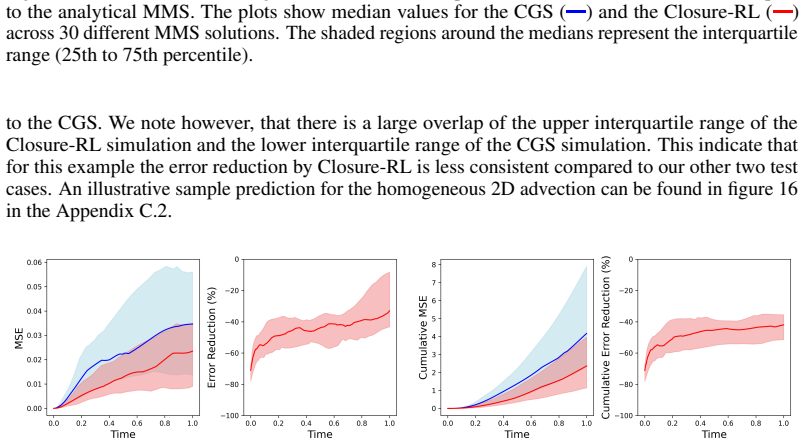
The central claim is that the missing subgrid-scale information in a coarse-grid PDE solve can be learned as a per-point forcing correction by a reinforcement-learning policy, with all training data obtained by manufacturing smooth analytic solutions and back-computing their forcing terms. Because the manufactured solutions are known analytically, the fine-grid reference used for rewards is available without any expensive simulation. The paper shows on the one- and two-dimensional Burgers equations and the two-dimensional advection equation that the learned closure reduces median squared error by more than 80 percent, 60 percent, and 40 to 80 percent, respectively, on unseen inhomogeneous cases, and reduces it by roughly 80 percent, 40 to 60 percent, and 40 percent on homogeneous evolutions. In a direct comparison, the reinforcement-learning closure also generalizes to these out-of-distribution homogeneous cases better than a Fourier neural operator trained on the same synthetic data.
Load-bearing premise
The load-bearing premise is that the parameterized, smooth, low-wavenumber manufactured solutions used for training represent the true solutions of these PDEs closely enough that a closure learned on them will also correct coarse-grid errors for unforced evolutions.
Editorial extensions
If this is right
- Closure models can be trained without computing any fine-grid reference simulations, because the manufactured solution provides the reference analytically.
- A closure trained on forced, inhomogeneous PDEs transfers to unforced homogeneous evolutions, so the training distribution does not have to contain the target PDE regime.
- Across the three test PDEs, the learned closures reduce the median squared error of the coarse solver by roughly 40 to 80 percent on unseen cases.
- The same synthetic-data pipeline can train other models such as neural operators, but the reinforcement-learning closure generalizes better to out-of-distribution unforced cases.
- Systems whose governing equations are known but whose high-resolution data are scarce become viable targets for data-driven closure modeling.
Reading between the lines
- This suggests the generalization hinges on the forcing term in the observation: at test time the policy sees a zero forcing signal and must rely on the coarse state alone, which may explain why out-of-distribution gains are smaller than in-distribution gains.
- A natural stress test is to train on smooth low-wavenumber families and evaluate on shock-forming or turbulent initial data; the paper's claim would fail precisely where the manufactured family stops being representative.
- Because the method of manufactured solutions supplies exact pointwise targets, the same synthetic data could train non-reinforcement-learning closure models through differentiable solvers, widening the approach beyond policy-gradient training.
- The low-wavenumber exponential-decay structure of all three manufactured families suggests the method is most credible for regimes where the unresolved scales are smooth; evidence for broadband or chaotic subgrid dynamics is still open.
Signed reviews
Editorial analysis
A structured set of objections, weighed in public.
Referee Report
Summary. The paper proposes a framework for learning closure models for coarse-grained PDE solvers using reinforcement learning trained exclusively on synthetic data generated by the method of manufactured solutions (MMS). Instead of running expensive fine-grid simulations, the authors manufacture parameterized analytical solutions, compute the corresponding forcing terms, and train an RL policy (Closure-RL) to correct the coarse-grid update. The method is demonstrated on 1D Burgers, 2D Burgers, and 2D advection equations, with in-distribution tests on unseen MMS-forced cases and out-of-distribution tests on homogeneous (unforced) PDEs. The central claim is that closures trained on inhomogeneous MMS data generalize to homogeneous PDEs, achieving median error reductions of roughly 80%, 60%, and 40% for the three test families relative to the unclosed coarse-grid solver. The paper also compares against a Fourier Neural Operator baseline and reports training details in the appendix.
Significance. If the central claim holds, the work is significant: it offers a way to train data-driven closure models without any fine-grid simulation data, which is a major bottleneck for many PDE applications. The strengths of the paper are that the synthetic-data pipeline is simple and clearly described, the empirical results are reported consistently across three PDE families with interquartile ranges, the training configuration is documented in detail, and the RL closures are compared with an FNO baseline. However, the significance is conditional: the homogeneous generalization claim is currently weakened by the checkpoint-selection procedure described in Appendix A, and the MMS solution families are smooth and low-wavenumber, so the scope of the demonstrated extrapolation needs to be stated more carefully. With the selection confound resolved, the paper would constitute a meaningful contribution to closure modeling and data-efficient learning for PDEs.
major comments (2)
- [Appendix A; §3.1.2, §3.2.2, §3.3.2] The homogeneous out-of-distribution claim is confounded by checkpoint selection. Appendix A states that at the end of each epoch the model is evaluated on a validation set consisting of 32 homogeneous-PDE initial conditions, and that this validation set is used to choose the checkpoint that performs best on both homogeneous and inhomogeneous PDEs. Since the homogeneous task is exactly the extrapolation target, the reported median error reductions (roughly 80%, 60%, and 40% in Figures 4, 7, and 9) may reflect selecting the best of 1000 PPO checkpoints on the target distribution rather than transfer from the MMS training procedure. The manuscript does not report the selected epoch, the validation scores, or the performance of the final checkpoint or of a checkpoint selected using only inhomogeneous validation data. Please provide these results; without them, the central claim that MMS-trained closures generalize to homogeneous PDEs is not tested as stated.
- [§2.1, Eqs. (9), (11), (14); §3.1.2] The representativeness of the MMS solution families for the homogeneous extrapolation is not established. The manufactured solutions are smooth trigonometric and exponential functions with wavenumbers 2π or 4π and decaying amplitudes, and the homogeneous test cases appear to be initialized from the same MMS family (the text in §3.1.2 refers to "30 different MMS solutions" for a homogeneous problem, which has no MMS forcing). The paper therefore demonstrates transfer from forced to unforced dynamics within one smooth, low-wavenumber solution family, not transfer to homogeneous evolutions with qualitatively different features such as shocks or sharp gradients. A concrete test would be to evaluate the trained closure on homogeneous initial conditions that are not drawn from Eqs. (9), (11), or (14), for instance a localized pulse or a developing shock; if the closure degrades there, the abstract and conclusions should be narrowed accordingly.
minor comments (5)
- [§3.1.2 and Figure 4] The homogeneous test is described as being evaluated "across 30 different MMS solutions," but a homogeneous problem has no MMS forcing term; please state explicitly that the 30 test initial conditions are drawn from Eq. (9) at t=0 (or otherwise specify the initialization procedure).
- [Figure 18 caption] The caption of Figure 18 says "Results for the inhomogeneous 1D Burgers' equation," but the surrounding text in Appendix D describes this figure as the homogeneous, out-of-distribution test case; please correct the caption.
- [Page 2, Section 1] The word "tubulence" in the first paragraph of the Introduction should be "turbulence."
- [Section 2.2] The notation fΔx = dΔx is confusing because it reads as multiplication by f; please clarify that the fine-grid spacing is related to the coarse-grid spacing by a scaling factor d (for example, Δx_f = d Δx).
- [Section 2.3, Eq. (7)] Please state explicitly in the main text that during training the target S(ψ^n) in the reward is the analytical MMS solution, not a numerically simulated fine-grid solution, since the relevant remark currently appears only in Section 2.2.
Circularity Check
Homogeneous generalization results are partly constructed by selecting the final checkpoint on homogeneous validation data; the rest of the derivation is self-contained.
-
fitted input called prediction
[Appendix A, 'Training Details and Hyperparameters'; used for OOD results in Sections 3.1.2, 3.2.2, and 3.3.2]
"At the end of each epoch, the RL model is evaluated on a validation set consisting of 32 different initial conditions of the homogeneous PDE. This validation set is employed to additionally track the accuracy of the learned closure model for the homogeneous test case and allows us to choose a closure model that is the best choice with regards to performance on both homogeneous and inhomogeneous PDEs."
The paper's central out-of-distribution claim (Sections 3.1.2, 3.2.2, 3.3.2) is that closures trained on forced MMS data generalize to homogeneous PDEs, with Section 3.1.2 adding that Closure-RL 'had not seen an homogeneous PDE during training.' Appendix A, however, shows that a homogeneous-PDE validation set is evaluated every epoch and is used to select the final checkpoint. The selected epoch is therefore a tuning parameter fitted to the target distribution, and the reported homogeneous test errors are produced by the checkpoint that already performed well on homogeneous validation trajectories. The 80%, 60%, and 40% median reductions cannot be cleanly attributed to MMS training; they are partly constructed by target-distribution model selection.
full rationale
No self-definitional circularity was found in the MMS derivation: the forcing term is computed from the chosen manufactured solution by direct substitution (Eqs. 1-4), and the RL reward compares CGS states to analytic MMS states, so the in-distribution training signal is not secretly identical to the reported metric. The in-distribution evaluations on unseen samples of the same MMS family are standard interpolation, not circularity. The reliance on the same-group Closure-RL framework (von Bassewitz et al., 2025) is self-citation, but it is used as an implementation recipe rather than as a uniqueness theorem or as evidence for the MMS-transfer conclusion, so it is not load-bearing circularity. The weak assumption that low-wavenumber trigonometric and exponential MMS families are representative of homogeneous solutions is a correctness and generalization risk, not a circularity. The one substantive circular element is the checkpoint-selection leakage: Appendix A shows the homogeneous validation set is used to choose the deployed policy, while Sections 3.1.2 through 3.3.2 present homogeneous test error reductions as evidence that MMS-trained closures generalize to homogeneous PDEs. That selection step means the headline out-of-distribution numbers are partly determined by target-distribution data. For this reason the score is 6 rather than 0-2; the rest of the pipeline is self-contained and externally checkable.
Assumptions & free parameters
assumptions (3)
- ad hoc to paper The parameterized MMS solution families (Eqs 9, 11, 14) are representative of the solution space of the corresponding PDEs, so a closure trained on them generalizes to unforced evolutions.
- domain assumption The coarse-grid solver (upwind, central differences, explicit Euler) and the Closure-RL framework (PPO, CNN architecture) provide a stable training environment and a policy that is a function of the observations.
- domain assumption The reward function (Eq 7) based on pointwise squared error against the analytical MMS solution is an appropriate objective for learning the unresolved-scale closure.
Cite this review
Pith. "Pith review of Reinforcement Learning Closures for Underresolved Partial Differential Equations using Synthetic Data." pith.science (2026). https://pith.science/paper/K3SLPGCI
@misc{pith2026250511308,
  author       = {Pith},
  title        = {Pith review of: Reinforcement Learning Closures for Underresolved Partial Differential Equations using Synthetic Data},
  year         = {2026},
  howpublished = {\url{https://pith.science/paper/K3SLPGCI}},
  note         = {Machine review of arXiv:2505.11308}
}
read the original abstract
Partial Differential Equations (PDEs) describe phenomena ranging from turbulence and epidemics to quantum mechanics and financial markets. Despite recent advances in computational science, solving such PDEs for real-world applications remains prohibitively expensive because of the necessity of resolving a broad range of spatiotemporal scales. In turn, practitioners often rely on coarse-grained approximations of the original PDEs, trading off accuracy for reduced computational resources. To mitigate the loss of detail inherent in such approximations, closure models are employed to represent unresolved spatiotemporal interactions. We present a framework for developing closure models for PDEs using synthetic data acquired through the method of manufactured solutions. These data are used in conjunction with reinforcement learning to provide closures for coarse-grained PDEs. We illustrate the efficacy of our method using the one-dimensional and two-dimensional Burgers' equations and the two-dimensional advection equation. Moreover, we demonstrate that closure models trained for inhomogeneous PDEs can be effectively generalized to homogeneous PDEs. The results demonstrate the potential for developing accurate and computationally efficient closure models for systems with scarce data.
Figures


Figures from the paper (15 more)






Reference graph
Works this paper leans on
-
[1]
Scientific multi-agent reinforcement learning for wall-models of turbulent flows
H Jane Bae and Petros Koumoutsakos. Scientific multi-agent reinforcement learning for wall-models of turbulent flows. Nature Communications, 13 0 (1): 0 1443, 2022
work page 2022
-
[2]
Machine learning for fluid mechanics
Steven L Brunton, Bernd R Noack, and Petros Koumoutsakos. Machine learning for fluid mechanics. Annual review of fluid mechanics, 52 0 (1): 0 477--508, 2020
2020
-
[3]
Physics-informed neural networks (pinns) for fluid mechanics: A review
Shengze Cai, Zhiping Mao, Zhicheng Wang, Minglang Yin, and George Em Karniadakis. Physics-informed neural networks (pinns) for fluid mechanics: A review. Acta Mechanica Sinica, 37 0 (12): 0 1727--1738, 2021
2021
-
[4]
Data-driven discovery of coordinates and governing equations
Kathleen Champion, Bethany Lusch, J Nathan Kutz, and Steven L Brunton. Data-driven discovery of coordinates and governing equations. Proceedings of the National Academy of Sciences, 116 0 (45): 0 22445--22451, 2019
2019
-
[5]
Neural ordinary differential equations
Ricky TQ Chen, Yulia Rubanova, Jesse Bettencourt, and David K Duvenaud. Neural ordinary differential equations. Advances in neural information processing systems, 31, 2018
2018
-
[6]
Miles Cranmer, Sam Greydanus, Stephan Hoyer, Peter Battaglia, David Spergel, and Shirley Ho. Lagrangian neural networks. arXiv preprint arXiv:2003.04630, 2020
arXiv 2003
-
[7]
A numerical study of three-dimensional turbulent channel flow at large reynolds numbers
James W Deardorff. A numerical study of three-dimensional turbulent channel flow at large reynolds numbers. Journal of Fluid Mechanics, 41 0 (2): 0 453--480, 1970
work page 1970
-
[8]
A national strategy for advancing climate modeling
Edward Dunlea and Chris Elfring. A national strategy for advancing climate modeling. Technical report, National Research Council, 2012
work page 2012
Show all 46 references
-
[9]
Predicting the uncertainty of numerical weather forecasts: A review
Martin Ehrendorfer. Predicting the uncertainty of numerical weather forecasts: A review. METEOROLOGISCHE ZEITSCHRIFT-BERLIN-, 6: 0 147--183, 1997
1997
-
[10]
Generative learning for forecasting the dynamics of high-dimensional complex systems
Han Gao, Sebastian Kaltenbach, and Petros Koumoutsakos. Generative learning for forecasting the dynamics of high-dimensional complex systems. Nature Communications, 15 0 (1): 0 8904, 2024
2024
-
[11]
Hamiltonian neural networks
Samuel Greydanus, Misko Dzamba, and Jason Yosinski. Hamiltonian neural networks. Advances in neural information processing systems, 32, 2019
2019
-
[12]
Erisa Hasani and Rachel A. Ward. Generating synthetic data for neural operators, 2024. URL https://arxiv.org/abs/2401.02398
2024 arXiv
-
[13]
Incorporating physical constraints in a deep probabilistic machine learning framework for coarse-graining dynamical systems
Sebastian Kaltenbach and Phaedon-Stelios Koutsourelakis. Incorporating physical constraints in a deep probabilistic machine learning framework for coarse-graining dynamical systems. Journal of Computational Physics, 419: 0 109673, 2020
2020
-
[14]
Physics-aware, probabilistic model order reduction with guaranteed stability
Sebastian Kaltenbach and Phaedon-Stelios Koutsourelakis. Physics-aware, probabilistic model order reduction with guaranteed stability. ICLR, 2021
2021
-
[15]
Semi-supervised invertible neural operators for bayesian inverse problems
Sebastian Kaltenbach, Paris Perdikaris, and Phaedon-Stelios Koutsourelakis. Semi-supervised invertible neural operators for bayesian inverse problems. Computational Mechanics, pages 1--20, 2023
2023
-
[16]
Solving inverse problems in physics by optimizing a discrete loss: Fast and accurate learning without neural networks
Petr Karnakov, Sergey Litvinov, and Petros Koumoutsakos. Solving inverse problems in physics by optimizing a discrete loss: Fast and accurate learning without neural networks. PNAS nexus, 3 0 (1): 0 pgae005, 2024
2024
-
[17]
Physics-informed machine learning
George Em Karniadakis, Ioannis G Kevrekidis, Lu Lu, Paris Perdikaris, Sifan Wang, and Liu Yang. Physics-informed machine learning. Nature Reviews Physics, 3 0 (6): 0 422--440, 2021
2021
-
[18]
Adaptive learning of effective dynamics for online modeling of complex systems
Ivica Ki c i \'c , Pantelis R Vlachas, Georgios Arampatzis, Michail Chatzimanolakis, Leonidas Guibas, and Petros Koumoutsakos. Adaptive learning of effective dynamics for online modeling of complex systems. Computer Methods in Applied Mechanics and Engineering, 415: 0 116204, 2023
2023
-
[19]
Auto-encoding variational bayes, 2013
Diederik P Kingma and Max Welling. Auto-encoding variational bayes, 2013
2013
-
[20]
A library for learning neural operators, 2024
Jean Kossaifi, Nikola Kovachki, Zongyi Li, Davit Pitt, Miguel Liu-Schiaffini, Robert Joseph George, Boris Bonev, Kamyar Azizzadenesheli, Julius Berner, and Anima Anandkumar. A library for learning neural operators, 2024
2024
-
[21]
Neural operator: Learning maps between function spaces with applications to pdes
Nikola Kovachki, Zongyi Li, Burigede Liu, Kamyar Azizzadenesheli, Kaushik Bhattacharya, Andrew Stuart, and Anima Anandkumar. Neural operator: Learning maps between function spaces with applications to pdes. Journal of Machine Learning Research, 24 0 (89): 0 1--97, 2023
2023
-
[22]
Fourier neural operator for parametric partial differential equations
Zongyi Li, Nikola Kovachki, Kamyar Azizzadenesheli, Burigede Liu, Kaushik Bhattacharya, Andrew Stuart, and Anima Anandkumar. Fourier neural operator for parametric partial differential equations. arXiv preprint arXiv:2010.08895, 2020
2010 arXiv
-
[23]
On kinematic waves ii
Michael James Lighthill and Gerald Beresford Whitham. On kinematic waves ii. a theory of traffic flow on long crowded roads. Proceedings of the royal society of london. series a. mathematical and physical sciences, 229 0 (1178): 0 317--345, 1955
1955
-
[24]
Learning nonlinear operators via deeponet based on the universal approximation theorem of operators
Lu Lu, Pengzhan Jin, Guofei Pang, Zhongqiang Zhang, and George Em Karniadakis. Learning nonlinear operators via deeponet based on the universal approximation theorem of operators. Nature machine intelligence, 3 0 (3): 0 218--229, 2021
2021
-
[25]
Deep lagrangian networks: Using physics as model prior for deep learning
Michael Lutter, Christian Ritter, and Jan Peters. Deep lagrangian networks: Using physics as model prior for deep learning. arXiv preprint arXiv:1907.04490, 2019
1907 arXiv
-
[26]
Explicit and implicit les closures for burgers turbulence
Romit Maulik and Omer San. Explicit and implicit les closures for burgers turbulence. Journal of Computational and Applied Mathematics, 327: 0 12--40, 2018
2018
-
[27]
Automating turbulence modelling by multi-agent reinforcement learning
Guido Novati, Hugues Lascombes de Laroussilhe, and Petros Koumoutsakos. Automating turbulence modelling by multi-agent reinforcement learning. Nature Machine Intelligence, 3 0 (1): 0 87--96, 2021. doi:10.1038/s42256-020-00272-0. URL https://doi.org/10.1038/s42256-020-00272-0
2021 doi
-
[28]
Modelling: Build imprecise supercomputers
Tim Palmer. Modelling: Build imprecise supercomputers. Nature, 526 0 (7571): 0 32--33, 2015
2015
-
[29]
Numerical approximation of partial differential equations, volume 23
Alfio Quarteroni and Alberto Valli. Numerical approximation of partial differential equations, volume 23. Springer Science & Business Media, 2008
2008
-
[30]
Physics-informed neural networks: A deep learning framework for solving forward and inverse problems involving nonlinear partial differential equations
Maziar Raissi, Paris Perdikaris, and George E Karniadakis. Physics-informed neural networks: A deep learning framework for solving forward and inverse problems involving nonlinear partial differential equations. Journal of Computational physics, 378: 0 686--707, 2019
2019
-
[31]
A probabilistic generative model for semi-supervised training of coarse-grained surrogates and enforcing physical constraints through virtual observables
Maximilian Rixner and Phaedon-Stelios Koutsourelakis. A probabilistic generative model for semi-supervised training of coarse-grained surrogates and enforcing physical constraints through virtual observables. Journal of Computational Physics, 434: 0 110218, 2021
2021
-
[32]
Code verification by the method of manufactured solutions
Patrick J Roache. Code verification by the method of manufactured solutions. J. Fluids Eng., 124 0 (1): 0 4--10, 2002
2002
-
[33]
11 pflop/s simulations of cloud cavitation collapse
Diego Rossinelli, Babak Hejazialhosseini, Panagiotis Hadjidoukas, Costas Bekas, Alessandro Curioni, Adam Bertsch, Scott Futral, Steffen J Schmidt, Nikolaus A Adams, and Petros Koumoutsakos. 11 pflop/s simulations of cloud cavitation collapse. In Proceedings of the Internationa...
2013
-
[34]
Weak neural variational inference for solving bayesian inverse problems without forward models: applications in elastography
Vincent C Scholz, Yaohua Zang, and Phaedon-Stelios Koutsourelakis. Weak neural variational inference for solving bayesian inverse problems without forward models: applications in elastography. Computer Methods in Applied Mechanics and Engineering, 433: 0 117493, 2025
2025
-
[35]
Proximal policy optimization algorithms
John Schulman, Filip Wolski, Prafulla Dhariwal, Alec Radford, and Oleg Klimov. Proximal policy optimization algorithms. arXiv preprint arXiv:1707.06347, 2017
2017 arXiv
-
[36]
General circulation experiments with the primitive equations: I
Joseph Smagorinsky. General circulation experiments with the primitive equations: I. the basic experiment. Monthly weather review, 91 0 (3): 0 99--164, 1963
1963
-
[37]
Strategies for turbulence modelling and simulations
Philippe R Spalart. Strategies for turbulence modelling and simulations. International journal of heat and fluid flow, 21 0 (3): 0 252--263, 2000
2000
-
[38]
Hamiltonian generative networks
Peter Toth, Danilo Jimenez Rezende, Andrew Jaegle, S \'e bastien Racani \`e re, Aleksandar Botev, and Irina Higgins. Hamiltonian generative networks. arXiv preprint arXiv:1909.13789, 2019
1909 arXiv
-
[39]
Multiscale simulations of complex systems by learning their effective dynamics
Pantelis R Vlachas, Georgios Arampatzis, Caroline Uhler, and Petros Koumoutsakos. Multiscale simulations of complex systems by learning their effective dynamics. Nature Machine Intelligence, 4 0 (4): 0 359--366, 2022
2022
-
[40]
Closure discovery for coarse-grained partial differential equations using grid-based reinforcement learning
Jan-Philipp von Bassewitz, Sebastian Kaltenbach, and Petros Koumoutsakos. Closure discovery for coarse-grained partial differential equations using grid-based reinforcement learning. Conference on Parsimony and Learning (CPAL), 2025
2025
-
[41]
Learning the solution operator of parametric partial differential equations with physics-informed deeponets
Sifan Wang, Hanwen Wang, and Paris Perdikaris. Learning the solution operator of parametric partial differential equations with physics-informed deeponets. Science advances, 7 0 (40): 0 eabi8605, 2021
2021
-
[42]
Tianshou: A highly modularized deep reinforcement learning library
Jiayi Weng, Huayu Chen, Dong Yan, Kaichao You, Alexis Duburcq, Minghao Zhang, Yi Su, Hang Su, and Jun Zhu. Tianshou: A highly modularized deep reinforcement learning library. Journal of Machine Learning Research, 23 0 (267): 0 1--6, 2022
2022
-
[43]
Multiscale model for turbulent flows
David C Wilcox. Multiscale model for turbulent flows. AIAA journal, 26 0 (11): 0 1311--1320, 1988
1988
-
[44]
Ode2vae: Deep generative second order odes with bayesian neural networks
Cagatay Yildiz, Markus Heinonen, and Harri Lahdesmaki. Ode2vae: Deep generative second order odes with bayesian neural networks. Advances in Neural Information Processing Systems, 32, 2019
2019
-
[45]
Dgno: A novel physics-aware neural operator for solving forward and inverse pde problems based on deep, generative probabilistic modeling
Yaohua Zang and Phaedon-Stelios Koutsourelakis. Dgno: A novel physics-aware neural operator for solving forward and inverse pde problems based on deep, generative probabilistic modeling. arXiv preprint arXiv:2502.06250, 2025
2025 arXiv
-
[46]
Learning deep cnn denoiser prior for image restoration, 2017
Kai Zhang, Wangmeng Zuo, Shuhang Gu, and Lei Zhang. Learning deep cnn denoiser prior for image restoration, 2017. URL https://arxiv.org/abs/1704.03264
2017 arXiv
Reviewed August 15, 2026 · model on record in the stance chip above.
Discussion (0). Continue with ORCID to comment.