REVIEW 4 major objections 4 minor 22 references
State-conditioning an offline goal-conditioned agent's goal embedding via a near-identity gated residual improves navigation (Dual 28 to 82% on AntMaze-large), and the gain is carried by the gate, not the difference-aware attention bias.
Reviewed by Pith at T0; open to challenge. T0 means a machine referee read the full paper against a public rubric. the ladder, T0–T4 →
T0 review · deepseek-v4-flash
2026-08-02 03:56 UTC pith:K3YKJEQB
load-bearing objection A clean, honestly-reported module with a real ablative finding, but the headline navigation gains rest on baselines copied from another paper and the theory overclaims what is actually proven. the 4 major comments →
DAGR: State-Conditioned Goal Representations via Difference-Aware Goal Cross-Attention
The pith
A machine-rendered reading of the paper's core claim, the machinery that carries it, and where it could break.
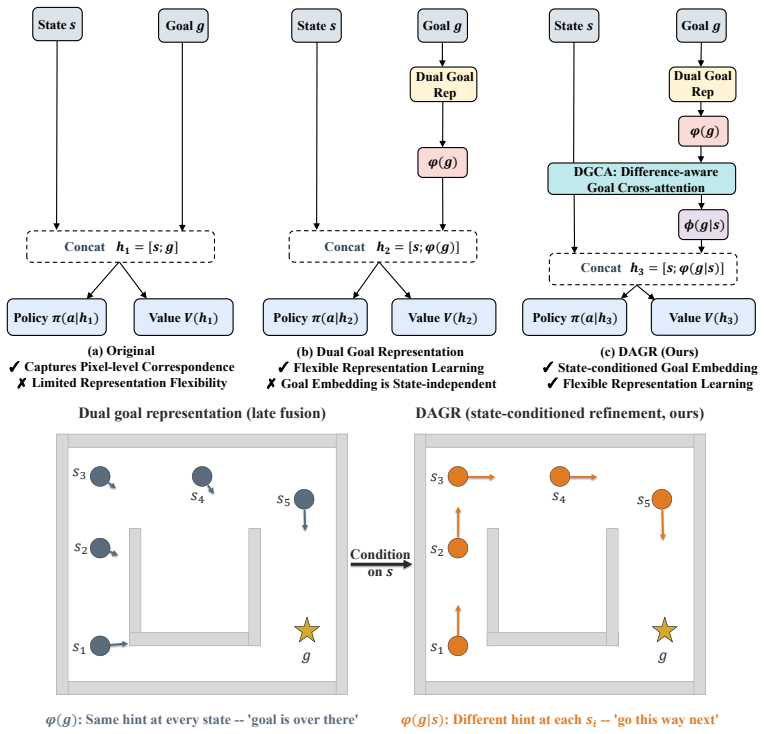
The module works in three steps. State and goal encodings are split into tokens at three scales (16, 8, and 4 tokens) so fine and coarse structure can be compared. Cross-attention lets the goal vector read the state tokens, with its attention scores boosted by a learnable per-token difference map, so tokens where state and goal disagree get more weight. The refined vector is then added to the original goal vector through a gate that starts almost closed, so at initialization DAGR is exactly the base method; training opens the gate only where it pays.
On OGBench navigation the gains are large: AntMaze-large goes from 28% to 82% success and HumanoidMaze-large from 3% to 62%. The paper's own ablations show the difference-bias attention is not what drives the gains: removing it leaves performance unchanged, while removing the gated shortcut costs about 23 points. On manipulation and puzzle tasks DAGR matches or falls below the base, including a 25-point regression on Cube-Double that the paper's theory did not predict. The authors state these negative results in the abstract.
Core claim
Quote: 'DAGR defines the goal representation φ∨_{DAGR}(g|s)(s′) = d∗(s′, g) · ∆_{s,g}(s′) ... which augments the Dual functional φ∨(g)(s′) = d∗(s′, g) with a state-dependent term' (Fig. 1 caption, Eq. 2), plus the abstract: 'On OGBench, DAGR improves navigation... Our ablations trace the gain to the gated residual, not to the difference bias that names the method.' If the paper is correct, state-conditioning a representation-learned goal encoder through a near-identity gated residual is a composable fix that lifts offline GCRL navigation (Dual 28→82% on AntMaze-large, 29→83% on HumanoidMaze-medium, 3→62% on HumanoidMaze-large), while the named attention bias is an initialization prior that does not carry the improvement.
Load-bearing premise
Every headline 'improvement' is a difference against baseline columns copied from a different paper rather than re-run under DAGR's setup: 'The Orig, VIB, VIP, TRA, BYOL-γ, and Dual columns are reproduced from Park et al. [2026], Table 1' (Section 5, Table 1 caption), with DAGR using one fixed configuration while the baselines use 'their own tuned settings.' If those external numbers (or the underlying environment versions, goal sampling, checkpoint selection, or evaluation protocol) are not directly comparable, the claimed navigation gains — including 28→82 on AntMaze-large and 3→62 on HumanoidMaze-large — could be partly artifacts of evaluation setup rather than of the module. The paper's own learning curves (Fig. 8) do plot an in-house Dual, but with 4 seeds and numbers that differ from the table it is compared against, so this comparability premise is structural, not cosmetic.
Editorial analysis
A structured set of objections, weighed in public.
Referee Report
Summary. The paper identifies state-independence of the goal encoder as a shared limitation of late-fusion goal-representation methods in offline GCRL, and proposes DAGR, a module that refines a frozen/trained static goal embedding phi(g) into a state-conditioned phi(g|s) via multi-scale gated cross-attention. The attention rule is biased by a per-token difference map between projected state and goal tokens, while a near-identity gated residual is intended to preserve the base representation. The authors prove safety properties (sufficiency and noise-invariance preservation, a gate-controlled approximation bound), state a structural condition (discrepancy structure) under which state-conditioning helps, and evaluate on OGBench by layering DAGR on Dual with GCIVL. They report large navigation gains (e.g., AntMaze-large 28->82, HumanoidMaze-large 3->62), mixed or negative results on manipulation and puzzles, and an ablation tracing the navigation gain to the gated residual rather than to the difference bias. The paper is unusually explicit about the limits of its own theory and about the failure on Cube-Double/Scene.
Significance. If the headline navigation numbers survive a controlled comparison, the contribution is significant: it isolates state-conditioning as a composable, method-agnostic design axis, provides a module that can be layered on any late-fusion encoder, and supports the empirical attribution claim with a component ablation. The paper's strengths include a fixed configuration across tasks, 8-seed state / 4-seed visual evaluations, in-house learning curves, full component ablations, a code release, and a candid separation of what is proved from what is assumed. The honest reporting of the manipulation regression and of the fact that the named difference bias is not the active ingredient is a genuine strength. However, the theoretical advances are conditional on assumptions the paper itself does not verify, and the headline empirical claims rely on cross-paper baseline numbers rather than a controlled re-run; these issues determine the recommendation.
major comments (4)
- [Section 5, Tables 1-2 and Figure 8] The headline improvements over Dual are comparisons against numbers reproduced from Park et al. [2026] under 'their own tuned settings,' while DAGR uses a single fixed configuration. This is a cross-paper comparison, not a controlled one. The large claimed gains (AntMaze-large 28->82, HumanoidMaze-large 3->62) would be attributable to the module only if environment versions, goal-sampling distributions, checkpoint selection, and evaluation protocols are identical. The in-house Dual learning curves in Figure 8 use four seeds and are not reported as final means in the same table, so they do not close this gap. Please re-run at least Dual, and ideally the other baselines, under the exact DAGR evaluation protocol; otherwise, state clearly that the gains are relative to published numbers and temper the corresponding claims.
- [Section 4.4, Theorem 4.3 and Eqs. (7)-(8)] Theorem 4.3 requires that the in-block normalization be injective on the range of phi, and the text immediately concedes: 'The injectivity condition does not.' Since Equations (7) and (8) insert LayerNorm after each gated residual block, the sufficiency-preservation theorem as stated does not apply to the evaluated architecture. This is not merely a presentational caveat: Section 6 later attributes the manipulation regression to this same normalization. The theorem should be restated for the architecture without the problematic normalization (or with pre-normalization), or the authors should prove injectivity for the actual LayerNorm used. As written, the sufficiency-preservation claim for DAGR is conditional on an unverified hypothesis.
- [Section 4.4, Proposition 4.6 and Appendix C] The claimed sample-complexity advantage of Proposition 4.6 rests on a realizability gap: there exists an Lh-Lipschitz realization on (psi(s), phi_DAGR(g|s)) but no Lh-Lipschitz realization on (psi(s), phi(g)). This is precisely the representation-level advantage the proposition purports to establish, and Appendix C admits that it is not verified and that the experiments are equally consistent with added capacity or a better-conditioned optimization path. The result should be presented as a conditional statement, not as a demonstrated tighter bound; the abstract and contributions should not cite it as an established theoretical advantage without the probe results that Appendix C itself identifies as necessary.
- [Section 1, Contributions (iii) vs Section 5.1 and Remark 4.8] The contribution list states that 'both predictions hold on OGBench,' but the paper's own results on Cube-Double and Scene contradict this. Proposition 4.7 predicts that the best DAGR can do on non-discrepancy tasks is to match Dual by closing its gates; on Cube-Double the gates stay below 0.01, yet success drops by 25 points, and Remark 4.8 explicitly calls this a failure of the prediction. The contribution statement should be revised to scope the structural prediction to the navigation tasks and to present the manipulation regression as an unexplained failure, as the body of the paper does.
minor comments (4)
- [Table 2] The row 'Avg. (all 7 tasks)' reads '387 12 16 13 30 32'; this is presumably '38 7 12 16 13 30 32.' Please fix the missing spacing and verify that all columns align.
- [Figure 1 caption and throughout] Several instances of missing spacing around the method name appear, e.g., 'DAGRdefines', 'DAGRis', 'DAGRimproves'. A global typographic pass is needed.
- [Figure 8 caption] The caption states that learning curves use four seeds for state-based tasks, while main state-based results in Table 1 use eight seeds. Please clarify why the learning curves use fewer seeds and state whether the final points correspond to the table means.
- [References] Several references are cited as arXiv preprints dated 2026, including works by the same authors. If any of these are still unpublished or not publicly available, please mark them accordingly or cite the published versions.
Circularity Check
Prop. 4.6's sample-complexity 'prediction' assumes the very realizability gap it claims to establish; the empirical attribution is otherwise self-contained.
specific steps
-
other
[Section 4.4, Proposition 4.6; Appendix C; Section 5.1]
"The bound rests on a realizability assumption that we do not verify directly... Proposition 4.6 assumes a realizability gap. There exists an Lh-Lipschitz h~ with h~(ψ(s), φ_DAGR(g|s)) = h(s,g), and no Lh-Lipschitz function on (ψ(s), φ(g)) realizes h. We do not verify this... Proposition 4.6 therefore gives a tighter sample-complexity upper bound on these tasks."
The theorem's advertised tighter bound U_DAGR ≤ Lh Lρ Rn(Hρ) versus U_late ≤ Lψ−1 Lφ−1 Lh Lρ Rn(Hρ) is obtained by assuming that late-fusion inputs admit no Lh-Lipschitz realization of the discrepancy map while φ_DAGR does. That is exactly the representational advantage the paper invokes Proposition 4.6 to predict on navigation tasks. Appendix C concedes the assumption is unverified and names alternative explanations (added capacity, better-conditioned optimization). The result is therefore a conditional restatement of its own key premise, not an independent first-principles derivation.
full rationale
The empirical core is largely self-contained: Table 6 ablations and Figure 8 in-house learning curves independently support the claim that the gated residual, not the difference bias, carries the navigation gain, and Remark 4.8 openly reports a failed theoretical prediction. The main circular content is Proposition 4.6, whose advertised sample-complexity advantage is conditional on an unverified realizability gap that essentially asserts the late-fusion weakness the proposition is invoked to establish; the paper itself downgrades it to motivation. Separately, the headline navigation improvements (e.g., 28→82, 3→62) compare DAGR against baseline columns reproduced from Park et al. [2026] under their own tuned settings rather than re-run under DAGR's protocol; this is a comparability/validity limitation, not circularity, but it means the absolute gains are not fully self-contained. No load-bearing self-citation chain is present: the repeated Park et al. citations are external prior work. Score 4 reflects partial circularity in the theoretical prediction, while the empirical attribution remains independently grounded.
Axiom & Free-Parameter Ledger
free parameters (4)
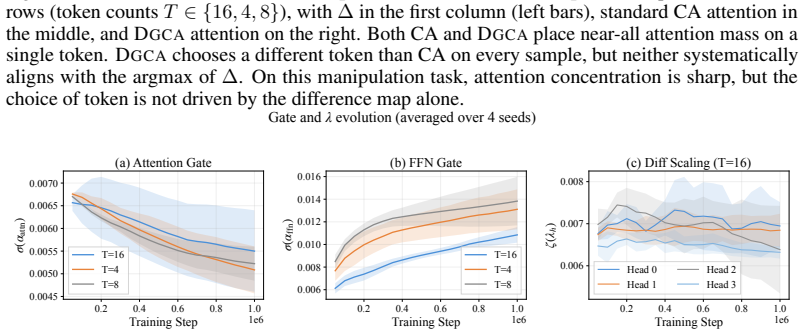
- Gate initialization α0 = −5 (attention and FFN, componentwise) =
−5 → σ(α0) ≈ 0.0067
- Difference-bias initialization λ0 = −5 per head and scale =
−5 → ζ(λ0) ≈ 0.0067
- Fusion logit init w = 0 (uniform scale weights) =
0 → uniform 1/3
- Architecture constants: L=3, T=(16,8,4), H=4, dk=64, dm=256, FFN 256 =
fixed configuration
axioms (5)
- ad hoc to paper Realizability gap of Prop 4.6: there exists an Lh-Lipschitz ĥ with ĥ(ψ(s), φ_DAGR(g|s)) = h(s,g), and no Lh-Lipschitz function on (ψ(s), φ(g)) realizes h at equal budget
- ad hoc to paper In-block LayerNorm is injective on the range of ϕ (Theorem 4.3)
- domain assumption Task classification into discrepancy-structure vs goal-only (Definition 3): maze navigation has h(s,g)=πxy(s)−πxy(g); Cube-Double and Scene violate the condition
- domain assumption Inverse-selection Lipschitz constants Lψ−1, Lϕ−1 ≥ 1 because encoders are 'non-expansive reductions of dimension' (Prop 4.2 and Prop 4.6 proofs)
- domain assumption Sufficiency and noise invariance of the base Dual representation from Park et al. [2026] (Theorem 4.4 relies on ϕ(og)=ϕ(xg) and ψg(og)=ψg(xg))
read the original abstract
Goal-conditioned reinforcement learning hinges on how the goal is encoded. Contrastive, metric, temporal-distance, and information-theoretic encoders differ in objective. They still share one trait. None of them sees the current state. Such a state-independent embedding cannot mark which part of the goal still needs action. The policy must then recover that cue by inverting both encoders. We propose DAGR. It refines the static embedding of any late-fusion encoder into a state-conditioned one through multi-scale gated cross-attention. A near-identity gated residual preserves the base representation. Difference-aware Goal Cross-Attention then biases the attention scores using a per-token state-goal discrepancy map. On OGBench, DAGR improves navigation. Our ablations trace the gain to the gated residual, not to the difference bias that names the method. On manipulation and puzzle tasks it matches or falls below the base. DAGR is a structured refinement, not a universal improvement.
Figures




Reference graph
Works this paper leans on
-
[1]
Hongjoon Ahn, Heewoong Choi, Jisu Han, and Taesup Moon. Option-aware temporally abstracted value for offline goal-conditioned reinforcement learning.arXiv preprint arXiv:2505.12737,
-
[3]
Both CA and DGCAplace near-all attention mass on a single token
(d) Sample 3 Figure 4:Attention versus difference map on four Cube-Double samples.Each panel shows three rows (token counts T∈ {16,4,8}), with ∆ in the first column (left bars), standard CA attention in the middle, and DGCAattention on the right. Both CA and DGCAplace near-all attention mass on a single token. DGCAchooses a different token than CA on ever...
2026
-
[4]
D.1 Proof of Proposition 4.1 Proposition D.1(Restated).For any state-independentϕ, I(A ∗;ϕ(G)|S)≤I(A ∗;G|S), with equality if and only ifϕ(G)retains all goal information relevant toA ∗ givenS. Proof. Because ϕ does not depend on S, conditioned on S=s the optimal action A∗ is determined by π∗(· |s, g), which under the late-fusion architecture depends on g ...
1999
-
[8]
Sergey Levine, Aviral Kumar, George Tucker, and Justin Fu. Offline reinforcement learning: Tutorial, review, and perspectives on open problems.arXiv preprint arXiv:2005.01643,
Pith/arXiv arXiv 2005
-
[10]
Yecheng Jason Ma, Jason Yan, Dinesh Jayaraman, and Osbert Bastani. How far i’ll go: Offline goal- conditioned reinforcement learning via f-advantage regression.arXiv preprint arXiv:2206.03023, 2022a. Yecheng Jason Ma, Jason Yan, Dinesh Jayaraman, and Osbert Bastani. Offline goal-conditioned reinforcement learning via f-advantage regression. InNeural Infor...
-
[11]
Octo: An open-source generalist robot policy
Octo Model Team, Dibya Ghosh, Homer Walke, Karl Pertsch, Kevin Black, Oier Mees, Sudeep Dasari, Joey Hejna, Tobias Xu, Jianlan Luo, et al. Octo: An open-source generalist robot policy. arXiv preprint arXiv:2405.12213,
-
[12]
The information bottleneck method.arXiv preprint physics/0004057,
Naftali Tishby, Fernando C Pereira, and William Bialek. The information bottleneck method.arXiv preprint physics/0004057,
-
[13]
Scaling proprioceptive- visual learning with heterogeneous pre-trained transformers
Lirui Wang, Xinlei Zhao, Jialiang Liu, Herke van Hoof, and Pieter Abbeel. Scaling proprioceptive- visual learning with heterogeneous pre-trained transformers. InNeural Information Processing Systems (NeurIPS), 2024a. Mianchu Wang, Keiran Paster, Jimmy Ba, and Sheila Agrawal. Go-plan: Goal-conditioned offline reinforcement learning by planning with learned...
2022
-
[14]
Stabilizing contrastive RL: Techniques for robotic goal reaching from offline data
Chongyi Zheng, Benjamin Eysenbach, Homer Rich Walke, Patrick Yin, Kuan Fang, Ruslan Salakhut- dinov, and Sergey Levine. Stabilizing contrastive RL: Techniques for robotic goal reaching from offline data. InThe Twelfth International Conference on Learning Representations, 2024a. Chongyi Zheng, Benjamin Eysenbach, Homer Walters, Ruslan Salakhutdinov, and Se...
-
[15]
Flattening hierarchies with policy bootstrapping.arXiv preprint arXiv:2505.14975,
John L Zhou and Jonathan C Kao. Flattening hierarchies with policy bootstrapping.arXiv preprint arXiv:2505.14975,
-
[16]
19 D.2 Proof of Proposition 4.2
15 Contents of Appendix A Training Procedure 17 B Notation 18 C On the Realizability Assumption of Proposition 4.6 19 D Theoretical Proofs 19 D.1 Proof of Proposition 4.1 . . . . . . . . . . . . . . . . . . . . . . . . . . . . . . . . 19 D.2 Proof of Proposition 4.2 . . . . . . . . . . . . . . . . . . . . . . . . . . . . . . . . 19 D.3 Proof of Theorem 4....
2026
-
[18]
=ϕ(g 2). Given(s, ϕDAGR (g|s)),ϕ(g)can be recovered by the contraction-mapping iteration ϕ(k+1) =ϕ DAGR (g|s)− X ℓ softmax(w)ℓ ·δ ℓ(ϕ(k), s), which converges by the Banach fixed-point theorem sincemax ℓ cℓ <1. Theorem D.4(Restated).Under the assumptions of Theorem 4.3, ϕDAGR (· |s)is sufficient: there exists˜πsuch thatV ˜π(·|s,ϕDAGR (g|s))(s, g) =V∗(s, g)...
2026
-
[19]
The locomotion suite uses PointMaze, AntMaze, and HumanoidMaze with medium, large, and giant variants of increasing layout complexity and path length
on OGBench [Park et al., 2025]. The locomotion suite uses PointMaze, AntMaze, and HumanoidMaze with medium, large, and giant variants of increasing layout complexity and path length. The manipulation suite uses a 6-DoF UR5e robot arm on Cube (Single requires placing one cube at a target, Double requires coordinating two), Scene (multi-object interaction w...
2025
-
[20]
TSucc. HSucc. α0 Succ. 1 38.5±3.1 143.5±5.0 −536.8±7.9 4 37.4±3.6 2 39.8 ±5.1 −233.2 ±3.9 8 36.4±3.6 4 32.5±8.2 028.4±2.8 1638.1±4.1 8 33.1±3.0 32 37.2±5.9 E.4 Computational Resources and Overhead Measurements All experiments were conducted on NVIDIA A100 GPUs. State-based experiments require approxi- mately three hours per seed and visual experiments app...
2025
-
[22]
Hierarchical planning (HIQL) is also far above zero
already achieves substantial success. Hierarchical planning (HIQL) is also far above zero. Method Puzzle-3×3 Puzzle-4×4 Late Fusion (Dual) 0 0 Dual + CA 0 0 Dual + DAGR0 0 Early Fusion (Orig) 2265 HIQL [Park et al., 2023]7360 Table 9: Per-task average ζ(λ) (mean across H= 4 heads and L= 3 scales at the end of training, one seed per task). Initial valueζ(λ
2023
-
[2002]
π0: A vision-language-action flow model for general robot control.arXiv preprint arXiv:2410.24164,
Kevin Black, Noah Brown, Danny Driess, Adnan Esmail, Michael Equi, Chelsea Finn, Niccolo Fusai, Lachy Groom, Karol Hausman, Brian Ichter, et al. π0: A vision-language-action flow model for general robot control.arXiv preprint arXiv:2410.24164,
-
[2017]
Erdemt Bao, Xing Lei, and Jun Chen. Nftr: From provable mode-averaging to geodesic subgoal selection in offline goal-conditioned rl.arXiv preprint arXiv:2607.07855,
-
[2018]
Junseok Kim, Dohyeong Kim, Mineui Hong, and Songhwai Oh. Compositional transduc- tion with latent analogies for offline goal-conditioned reinforcement learning.arXiv preprint arXiv:2605.20609,
-
[2020]
Goal-conditioned reinforcement learning: Problems and solutions.arXiv preprint arXiv:2201.08299,
Minghuan Liu, Menghui Zhu, and Weinan Zhang. Goal-conditioned reinforcement learning: Problems and solutions.arXiv preprint arXiv:2201.08299,
-
[2024]
Anthony Brohan, Noah Brown, Justice Carbajal, Yevgen Chebotar, Xi Chen, Krzysztof Choromanski, Tianli Ding, Danny Driess, Avinava Dubey, Chelsea Finn, et al. Rt-2: Vision-language-action models transfer web knowledge to robotic control.arXiv preprint arXiv:2307.15818, 2023a. Anthony Brohan, Noah Brown, Justice Carbajal, Yevgen Chebotar, Joseph Dabis, Chel...
-
[2025]
Gchr: Goal-conditioned hindsight regularization for sample-efficient reinforcement learning
Xing Lei, Wenyan Yang, Kaiqiang Ke, Shentao Yang, Xuetao Zhang, Joni Pajarinen, and Donglin Wang. Gchr: Goal-conditioned hindsight regularization for sample-efficient reinforcement learning. arXiv preprint arXiv:2508.06108,
-
[2026]
Openvla: An open-source vision-language-action model.arXiv preprint arXiv:2406.09246,
Moo Jin Kim, Karl Pertsch, Siddharth Karamcheti, Ted Xiao, Ashwin Balakrishna, Suraj Nair, Rafael Rafailov, Ethan Foster, Grace Lam, Pannag Sanketi, et al. Openvla: An open-source vision-language-action model.arXiv preprint arXiv:2406.09246,
discussion (0)
Sign in with ORCID, Apple, or X to comment. Anyone can read and Pith papers without signing in.