Tailoring pure valley-Zeeman spin-orbit coupling in WSe₂-encapsulated monolayer graphene
Pith reviewed 2026-06-28 09:03 UTC · model grok-4.3
The pith
Encapsulating graphene between twisted WSe2 layers produces pure valley-Zeeman spin-orbit coupling that reorders Landau levels.
A machine-rendered reading of the paper's core claim, the machinery that carries it, and where it could break.
Core claim
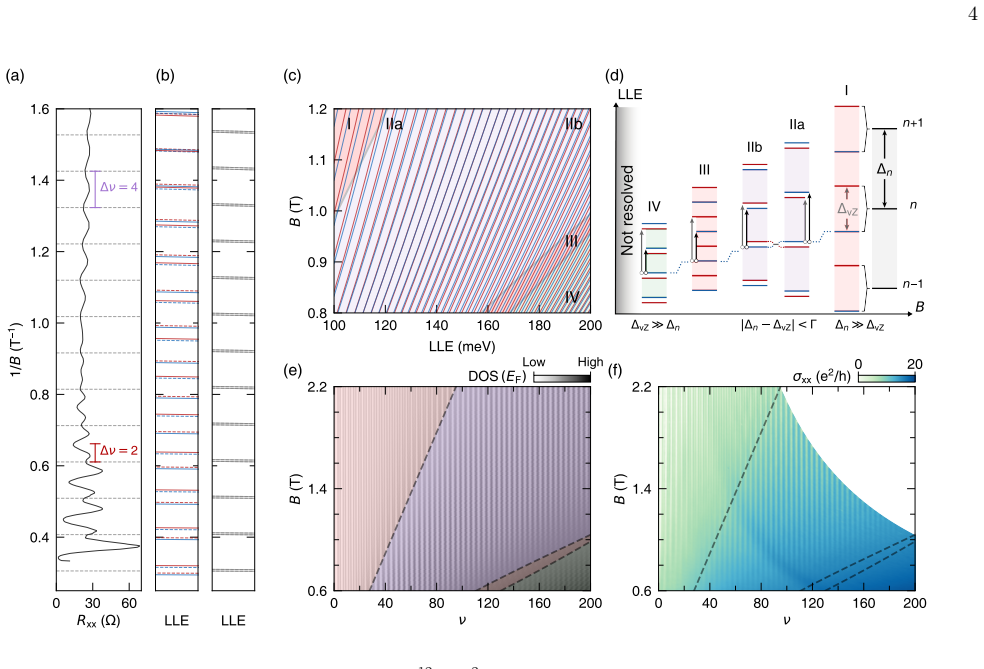
Pure valley-Zeeman spin-orbit coupling is realized in monolayer graphene by encapsulation between two parallel twisted WSe2 monolayers. This produces a symmetry-enforced reordering of Landau levels driven by the competition between the fixed valley-Zeeman energy and the magnetic-field-dependent cyclotron energy, characterized by a transition from symmetry-broken states to restored fourfold degeneracy with integer or half-integer quantum Hall sequences.
What carries the argument
Competition between fixed valley-Zeeman energy and magnetic-field-dependent cyclotron energy that enforces Landau level reordering and degeneracy restoration.
If this is right
- Landau levels reorder at magnetic fields where the valley-Zeeman energy equals the cyclotron energy.
- Quantum Hall sequences switch between integer and half-integer fillings as degeneracy is restored.
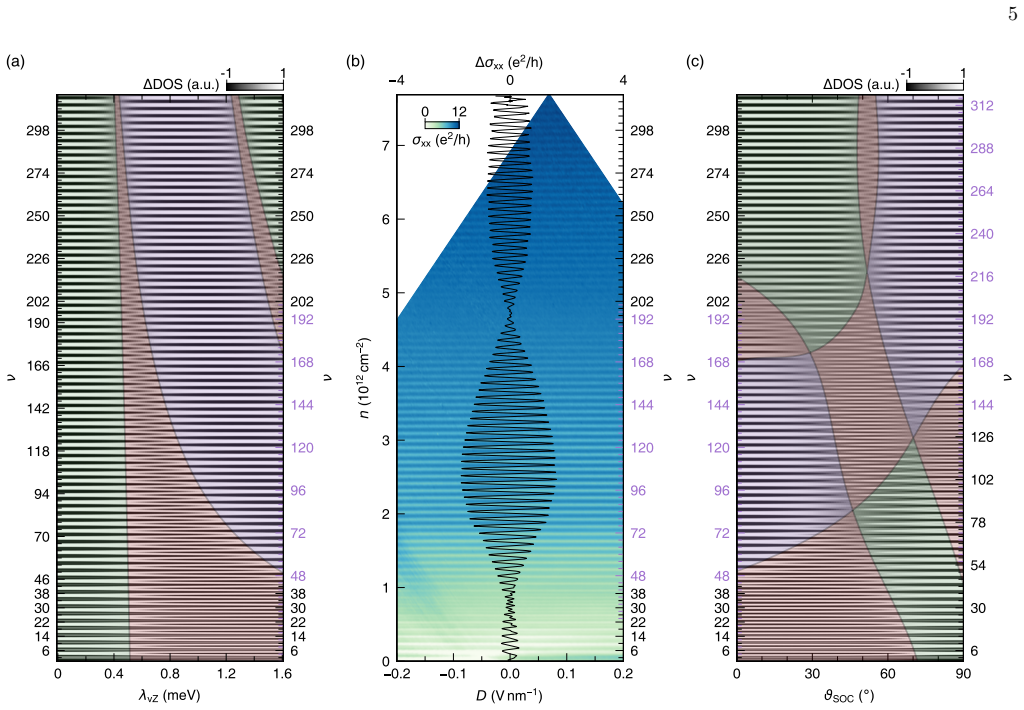
- The proximity spin-orbit coupling can be completely quenched by adjusting the encapsulated geometry.
Where Pith is reading between the lines
- This geometry-based selection of SOC type could enable devices that control valley degrees of freedom while avoiding unwanted Rashba terms.
- Similar twisted parallel encapsulation might isolate other SOC components when applied to different 2D material pairs.
Load-bearing premise
The observed Landau level reordering and degeneracy restoration arise solely from pure valley-Zeeman SOC induced by the twisted parallel encapsulation geometry, with no significant contribution from other proximity effects or disorder.
What would settle it
Observation of no Landau level reordering in graphene encapsulated by parallel but non-twisted WSe2 layers would indicate that the twisted geometry is required for the pure valley-Zeeman effect.
Figures
read the original abstract
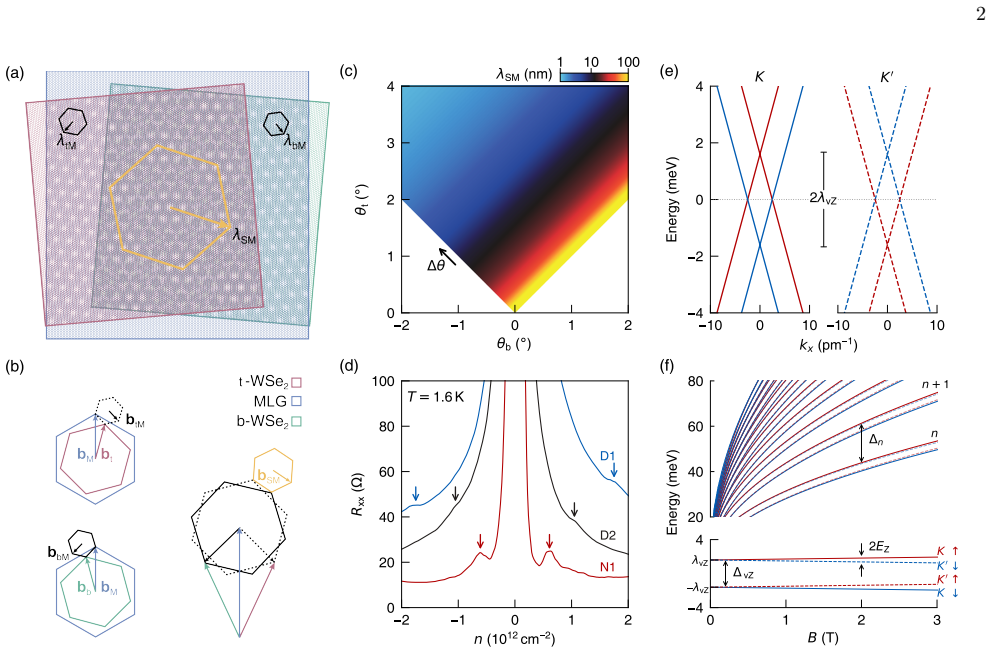
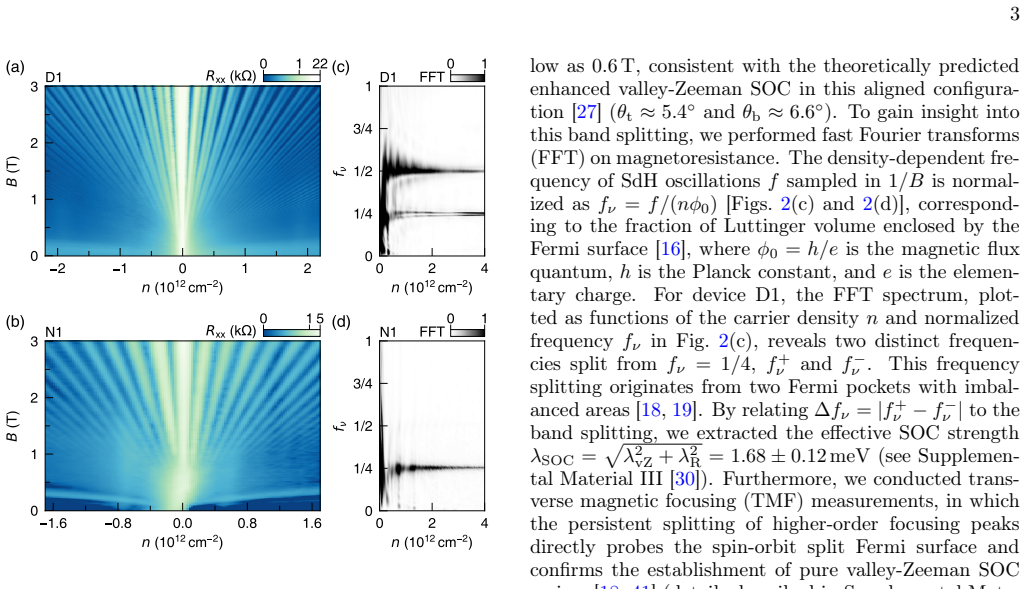
Engineering proximity effects in twisted van der Waals heterostructures offers a powerful platform for designing electronic properties. While theoretical predictions of quantum interference in transition metal dichalcogenide-encapsulated graphene can selectively control the spin-orbit coupling component, experimental realizations have remained elusive. Here, we report pure valley-Zeeman spin-orbit coupling in monolayer graphene, achieved by encapsulation between two parallel twisted WSe$_2$ monolayers. We observed a symmetry-enforced reordering of Landau levels, which is driven by the competition between the fixed valley-Zeeman energy and the magnetic-field-dependent cyclotron energy. This reordering is characterized by a transition from symmetry-broken states in the quantum Hall effect to a restored fourfold degeneracy with integer or half-integer quantum Hall sequences. We also demonstrate the ability to completely quench the proximity spin-orbit coupling by tuning the encapsulated geometry.
Editorial analysis
A structured set of objections, weighed in public.
Referee Report
Summary. The manuscript claims to realize pure valley-Zeeman spin-orbit coupling in monolayer graphene by encapsulation between two parallel twisted WSe₂ monolayers. This produces a symmetry-enforced reordering of Landau levels arising from competition between a fixed valley-Zeeman energy and the magnetic-field-dependent cyclotron energy, manifesting as a transition from symmetry-broken quantum Hall states to restored fourfold degeneracy with integer or half-integer filling-factor sequences. The work also reports complete quenching of the proximity-induced SOC by tuning the encapsulation geometry.
Significance. If the central interpretation holds, the result supplies an experimental route to selectively engineer the valley-Zeeman component of proximity SOC while suppressing other terms, which is of direct relevance to valleytronics and spin-orbit engineering in graphene heterostructures. The geometry-tunable quenching further offers a control knob not previously demonstrated in this class of devices.
major comments (1)
- [Abstract] Abstract (and the paragraph describing the transition from symmetry-broken states to restored fourfold degeneracy): the claim that the observed Landau-level reordering arises solely from pure valley-Zeeman SOC with negligible Rashba, intervalley scattering, or disorder contributions is load-bearing for the central interpretation. The provided text supplies no quantitative controls, fitting details, or exclusion arguments that would rule out alternative mechanisms capable of producing similar degeneracy restoration.
minor comments (1)
- The abstract states the geometry enables the effect but does not specify the twist angle, layer alignment details, or sample fabrication parameters needed to assess reproducibility.
Simulated Author's Rebuttal
We thank the referee for their careful reading of the manuscript. We address the single major comment below, focusing on the evidence supporting the interpretation of pure valley-Zeeman SOC.
read point-by-point responses
-
Referee: [Abstract] Abstract (and the paragraph describing the transition from symmetry-broken states to restored fourfold degeneracy): the claim that the observed Landau-level reordering arises solely from pure valley-Zeeman SOC with negligible Rashba, intervalley scattering, or disorder contributions is load-bearing for the central interpretation. The provided text supplies no quantitative controls, fitting details, or exclusion arguments that would rule out alternative mechanisms capable of producing similar degeneracy restoration.
Authors: The reordering is presented as symmetry-enforced by the valley-Zeeman term, whose fixed energy scale competes with the B-dependent cyclotron energy to restore fourfold degeneracy above a characteristic field. This specific field dependence and the resulting integer/half-integer filling sequences are incompatible with Rashba SOC (which mixes spin and valley differently) or with generic disorder/intervalley scattering (which would not produce a sharp, tunable restoration tied to the cyclotron scale). The main text contains the symmetry analysis underlying this distinction. We acknowledge that the abstract and transition paragraph are concise and do not include explicit quantitative bounds or fitting; we will expand the relevant section with energy-scale estimates and a short discussion of why alternatives are disfavored. revision: partial
Circularity Check
No circularity: experimental observations of Landau level reordering supported by transport data and geometry control
full rationale
The paper is an experimental study reporting measured quantum Hall signatures in a van der Waals heterostructure. Its central claims rest on observed transitions in degeneracy and filling factors under varying magnetic field and encapsulation geometry, interpreted via symmetry considerations. No derivation chain, equation, or parameter fit is shown to reduce by construction to the paper's own inputs or prior self-citations; the results are externally falsifiable via independent transport measurements and do not rely on self-referential definitions or ansatzes smuggled through citations. This is the expected outcome for a data-driven experimental report.
Axiom & Free-Parameter Ledger
axioms (1)
- domain assumption Quantum interference in TMD-encapsulated graphene can selectively control the spin-orbit coupling component
Reference graph
Works this paper leans on
-
[1]
A. K. Geim and I. V. Grigorieva, Van der Waals het- erostructures, Nature499, 419 (2013)
2013
-
[2]
E. Y. Andrei and A. H. MacDonald, Graphene bilayers with a twist, Nat. Mater.19, 1265 (2020)
2020
-
[3]
D. M. Kennes, M. Claassen, L. Xian, A. Georges, A. J. Millis, J. Hone, C. R. Dean, D. N. Basov, A. N. Pa- supathy, and A. Rubio, Moiré heterostructures as a condensed-matterquantumsimulator,Nat.Phys.17,155 (2021)
2021
-
[4]
Li, Y.-F
C. Li, Y.-F. Zhao, A. Vera, O. Lesser, H. Yi, S. Ku- mari, Z. Yan, C. Dong, T. Bowen, K. Wang, H. Wang, J. L. Thompson, K. Watanabe, T. Taniguchi, D. Reifs- nyder Hickey, Y. Oreg, J. A. Robinson, C.-Z. Chang, and J. Zhu, Proximity-induced superconductivity in epitaxial topological insulator/graphene/gallium heterostructures, Nat. Mater.22, 570 (2023)
2023
-
[5]
Pandey, T
S. Pandey, T. Pin, S. Hettler, R. Arenal, C. Bouil- let, T. Maroutian, J. Robert, B. Gobaut, B. Kundys, J.-F. Dayen, and D. Halley, Proximity-Mediated Multi- Ferroelectric Coupling in Highly Strained EuO-Graphene Heterostructures, Adv. Mater.37, 2417669 (2025)
2025
-
[6]
Zollner, M
K. Zollner, M. Kurpas, M. Gmitra, and J. Fabian, First- principles determination of spin–orbit coupling parame- ters in two-dimensional materials, Nat. Rev. Phys.7, 255 (2025)
2025
-
[7]
A. S. Mayorov, P. Wang, X. Yue, B. Wu, J. He, D. Zhang, F. Lian, S. Jiang, J. Huang, Z. Wang, Q. Guo, K. Watan- abe, T. Taniguchi, R. Du, R. Wang, B. Wang, L. Wang, K. S. Novoselov, and G. Yu, Quantum Hall effect at 0.002 T in graphene, Nat. Commun.17, 2003 (2026)
2003
-
[8]
Avsar, J
A. Avsar, J. Y. Tan, T. Taychatanapat, J. Balakrishnan, G. Koon, Y. Yeo, J. Lahiri, A. Carvalho, A. S. Rodin, E. O’Farrell, G. Eda, A. H. Castro Neto, and B. Özyil- maz, Spin–orbit proximity effect in graphene, Nat. Com- mun.5, 4875 (2014)
2014
-
[9]
W. Han, R. K. Kawakami, M. Gmitra, and J. Fabian, Graphene spintronics, Nat. Nanotechnol.9, 794 (2014)
2014
-
[10]
Wang, D.-K
Z. Wang, D.-K. Ki, H. Chen, H. Berger, A. H. MacDon- ald, and A. F. Morpurgo, Strong interface-induced spin– orbit interaction in graphene onWS2, Nat. Commun.6, 8339 (2015)
2015
-
[11]
K. Kim, S. Larentis, B. Fallahazad, K. Lee, J. Xue, D. C. Dillen, C. M. Corbet, and E. Tutuc, Band Alignment inWSe 2–Graphene Heterostructures, ACS Nano9, 4527 (2015)
2015
-
[12]
Wang, D.-K
Z. Wang, D.-K. Ki, J. Y. Khoo, D. Mauro, H. Berger, L. S. Levitov, and A. F. Morpurgo, Origin and Magni- tude of ‘Designer’ Spin-Orbit Interaction in Graphene on Semiconducting Transition Metal Dichalcogenides, Phys. Rev. X6, 041020 (2016)
2016
-
[13]
L. A. Benítez, J. F. Sierra, W. Savero Torres, A. Arrighi, F.Bonell, M.V.Costache,andS.O.Valenzuela,Strongly anisotropic spin relaxation in graphene–transition metal dichalcogenide heterostructures at room temperature, Nat. Phys.14, 303 (2018)
2018
-
[14]
J. Hu, Y. Han, X. Chi, G. J. Omar, M. M. E. Al Ezzi, J. Gou, X. Yu, R. Andrivo, K. Watanabe, T. Taniguchi, A. T. S. Wee, Z. Qiao, and A. Ariando, Tunable Spin- Polarized States in Graphene on a Ferrimagnetic Oxide Insulator, Adv. Mater.36, 2305763 (2024)
2024
-
[15]
T. Han, Z. Lu, Y. Yao, J. Yang, J. Seo, C. Yoon, K. Watanabe, T. Taniguchi, L. Fu, F. Zhang, and L. Ju, Large quantum anomalous Hall effect in spin-orbit proximitized rhombohedral graphene, Science384, 647 (2024)
2024
-
[16]
Zhang, G
Y. Zhang, G. Shavit, H. Ma, Y. Han, C. W. Siu, A. Mukherjee, K. Watanabe, T. Taniguchi, D. Hsieh, C. Lewandowski, F. Von Oppen, Y. Oreg, and S. Nadj- Perge, Twist-programmable superconductivity in spin– orbit-coupled bilayer graphene, Nature641, 625 (2025). 7
2025
-
[17]
Tiwari, M
P. Tiwari, M. K. Jat, A. Udupa, D. S. Narang, K. Watan- abe, T. Taniguchi, D. Sen, and A. Bid, Experimen- tal observation of spin-split energy dispersion in high- mobility single-layer graphene/WSe 2 heterostructures, npj 2D Mater Appl6, 68 (2022)
2022
-
[18]
Rao, W.-H
Q. Rao, W.-H. Kang, H. Xue, Z. Ye, X. Feng, K. Watan- abe, T. Taniguchi, N. Wang, M.-H. Liu, and D.-K. Ki, Ballistic transport spectroscopy of spin-orbit-coupled bands in monolayer graphene onWSe2, Nat. Commun. 14, 6124 (2023)
2023
-
[19]
Masseroni, M
M. Masseroni, M. Gull, A. Panigrahi, N. Jacob- sen, F. Fischer, C. Tong, J. D. Gerber, M. Niese, T. Taniguchi, K. Watanabe, L. Levitov, T. Ihn, K. Ensslin, and H. Duprez, Spin-orbit proximity in MoS2/bilayer graphene heterostructures, Nat. Commun. 15, 9251 (2024)
2024
-
[20]
H. Yang, B. Martín-García, J. Kimák, E. Schmoranze- rová, E. Dolan, Z. Chi, M. Gobbi, P. Němec, L. E. Hueso, and F. Casanova, Twist-angle-tunable spin tex- ture inWSe 2/graphene van der Waals heterostructures, Nat. Mater.23, 1502 (2024)
2024
-
[21]
David, P
A. David, P. Rakyta, A. Kormányos, and G. Burkard, In- duced spin-orbit coupling in twisted graphene–transition metal dichalcogenide heterobilayers: Twistronics meets spintronics, Phys. Rev. B100, 085412 (2019)
2019
-
[22]
Li and M
Y. Li and M. Koshino, Twist-angle dependence of the proximity spin-orbit coupling in graphene on transition- metal dichalcogenides, Phys. Rev. B99, 075438 (2019)
2019
-
[23]
S. Lee, D. J. P. De Sousa, Y.-K. Kwon, F. De Juan, Z. Chi, F. Casanova, and T. Low, Charge-to-spin conver- sion in twisted graphene/WSe2 heterostructures, Phys. Rev. B106, 165420 (2022)
2022
-
[24]
Naimer and J
T. Naimer and J. Fabian, Twist-angle dependent proxim- ity induced spin-orbit coupling in graphene/topological insulator heterostructures, Phys. Rev. B107, 195144 (2023)
2023
-
[25]
Naimer, M
T. Naimer, M. Gmitra, and J. Fabian, Tuning proximity spin-orbit coupling in graphene/NbSe2 heterostructures via twist angle, Phys. Rev. B109, 205109 (2024)
2024
-
[26]
J. O. Island, X. Cui, C. Lewandowski, J. Y. Khoo, E. M. Spanton, H. Zhou, D. Rhodes, J. C. Hone, T. Taniguchi, K. Watanabe, L. S. Levitov, M. P. Zale- tel, and A. F. Young, Spin–orbit-driven band inversion in bilayer graphene by the van der Waals proximity effect, Nature571, 85 (2019)
2019
-
[27]
C. G. Péterfalvi, A. David, P. Rakyta, G. Burkard, and A.Kormányos,Quantuminterferencetuningofspin-orbit coupling in twisted van der Waals trilayers, Phys. Rev. Research4, L022049 (2022)
2022
-
[28]
Zollner, S
K. Zollner, S. M. João, B. K. Nikolić, and J. Fabian, Twist- and gate-tunable proximity spin-orbit coupling, spin relaxation anisotropy, and charge-to-spin conver- sion in heterostructures of graphene and transition metal dichalcogenides, Phys. Rev. B108, 235166 (2023)
2023
-
[29]
K. Kim, M. Yankowitz, B. Fallahazad, S. Kang, H. C. P. Movva, S. Huang, S. Larentis, C. M. Corbet, T. Taniguchi, K. Watanabe, S. K. Banerjee, B. J. LeRoy, and E. Tutuc, Van der Waals Heterostructures with High Accuracy Rotational Alignment, Nano Letters16, 1989 (2016)
1989
-
[30]
See Supplemental Material [url] for Landau level calcula- tions, super-moiré lattice modeling, device information, transverse magnetic focusing results, data analysis and reproducibility, which includes Refs. [31–37]
-
[31]
Zubair, P
M. Zubair, P. Vasilopoulos, and M. Tahir, Influence of interface induced valley-Zeeman and spin-orbit couplings on transport in heterostructures of graphene onWSe2, Phys. Rev. B101, 165436 (2020)
2020
-
[32]
Kumar, S
A. Kumar, S. Maiti, and D. L. Maslov, Zero-field spin resonance in graphene with proximity-induced spin-orbit coupling, Phys. Rev. B104, 155138 (2021)
2021
-
[33]
Sichau, M
J. Sichau, M. Prada, T. Anlauf, T. J. Lyon, B. Bosn- jak, L. Tiemann, and R. H. Blick, Resonance Microwave MeasurementsofanIntrinsicSpin-OrbitCouplingGapin Graphene: A Possible Indication of a Topological State, Phys. Rev. Lett.122, 046403 (2019)
2019
-
[34]
Yankowitz, J
M. Yankowitz, J. Xue, D. Cormode, J. D. Sanchez- Yamagishi, K. Watanabe, T. Taniguchi, P. Jarillo- Herrero, P. Jacquod, and B. J. LeRoy, Emergence of su- perlattice Dirac points in graphene on hexagonal boron nitride, Nat. Phys.8, 382 (2012)
2012
-
[35]
Y. Li, Y. Rao, K. F. Mak, Y. You, S. Wang, C. R. Dean, and T. F. Heinz, Probing Symmetry Properties of few- layerMoS 2 and h-BN by Optical Second-Harmonic Gen- eration, Nano Lett.13, 3329 (2013)
2013
-
[36]
Rickhaus, G
P. Rickhaus, G. Zheng, J. L. Lado, Y. Lee, A. Kurz- mann, M. Eich, R. Pisoni, C. Tong, R. Garreis, C. Gold, M. Masseroni, T. Taniguchi, K. Wantanabe, T. Ihn, and K. Ensslin, Gap Opening in Twisted Double Bilayer Graphene by Crystal Fields, Nano Lett.19, 8821 (2019)
2019
-
[37]
Taychatanapat, K
T. Taychatanapat, K. Watanabe, T. Taniguchi, and P. Jarillo-Herrero, Electrically Tunable Transverse Mag- netic Focusing in Graphene, Nat. Phys.9, 225 (2013)
2013
-
[38]
Hermann, Periodic Overlayers and Moiré Patterns: Theoretical Studies of Geometric Properties, J
K. Hermann, Periodic Overlayers and Moiré Patterns: Theoretical Studies of Geometric Properties, J. Phys.: Condens. Matter24, 314210 (2012)
2012
-
[39]
L. Wang, S. Zihlmann, M.-H. Liu, P. Makk, K. Watan- abe, T. Taniguchi, A. Baumgartner, and C. Schönen- berger, New Generation of Moiré Superlattices in Doubly Aligned hBN/Graphene/hBN Heterostructures, Nano Lett.19, 2371 (2019)
2019
-
[40]
Jiang, R
S. Jiang, R. Du, J. Jiang, G. Liu, J. Huang, Y. Du, Y. Han, J. Xiao, D. Zhang, F. Lian, W. Xu, S. Wang, L. Qiao, K. Watanabe, T. Taniguchi, X. Xi, W. Ren, B. Wang, A. S. Mayorov, K. Chang, H. Yang, L. Wang, and G. Yu, The interplay of ferroelectricity and magneto- transport in non-magnetic moiré superlattices, Nat. Commun.16, 5640 (2025)
2025
-
[41]
W.-H. Kang, M. Barth, A. Costa, A. Garcia-Ruiz, A. Mreńca-Kolasińska, M.-H. Liu, and D. Kochan, Mag- netotransport and Spin-Relaxation Signatures of the Ra- dial Rashba and Dresselhaus Spin-Orbit Coupling in Proximitized Graphene, Phys. Rev. Lett.133, 216201 (2024)
2024
-
[42]
A. H. Castro Neto, F. Guinea, N. M. R. Peres, K. S. Novoselov, and A. K. Geim, The Electronic Properties of Graphene, Rev. Mod. Phys.81, 109 (2009)
2009
-
[43]
Frank and J
T. Frank and J. Fabian, Landau levels in spin-orbit cou- pling proximitized graphene: Bulk states, Phys. Rev. B 102, 165416 (2020)
2020
-
[44]
C. Wang, W. Duan, L. Glazman, and A. Alexandrad- inata, Landau quantization of nearly degenerate bands and full symmetry classification of Landau level cross- ings, Phys. Rev. B100, 014442 (2019)
2019
-
[45]
Hu, Z.-Z
J. Hu, Z.-Z. Fang, F. Sheng, C. Hua, C. Xi, G. Kuang, L. Pi, K. Watanabe, T. Taniguchi, Q.-L. Xia, and Y.Zheng,TopologicalFermiologyofgate-tunableRashba electron gases, Sci. Adv.10, eadp8208 (2024). 8
2024
-
[46]
Gmitra, D
M. Gmitra, D. Kochan, P. Högl, and J. Fabian, Trivial and inverted Dirac bands and the emergence of quantum spin Hall states in graphene on transition-metal dichalco- genides, Phys. Rev. B93, 155104 (2016)
2016
discussion (0)
Sign in with ORCID, Apple, or X to comment. Anyone can read and Pith papers without signing in.