REVIEW 3 major objections 5 minor 1 cited by
Bursty star formation prevents large dust reservoirs from lasting long in early galaxies.
Reviewed by Pith at T0; open to challenge. T0 means a machine referee read the full paper against a public rubric. the ladder, T0–T4 →
T0 review · grok-4.5
2026-07-13 06:25 UTC pith:K64V5BKH
load-bearing objection Solid dust analysis of Thesan-Zoom that cleanly shows, inside this model, bursty SF cannot keep large dust reservoirs; the UVLF implication is real but rests on missing dense-clump shielding. the 3 major comments →
The Thesan-Zoom project: bursty star formation is incompatible with prolonged dust survival
The pith
A machine-rendered reading of the paper's core claim, the machinery that carries it, and where it could break.
Core claim
In the thesan-zoom model, bursty star formation prevents large dust reservoirs (M_dust/M_star greater than or equal to 10^{-3}) from surviving over a significant fraction of cosmic time; short-lived IR-bright phases (median duration roughly 20 Myr) alternate with longer dust-poor phases, so that observed dust properties and the high-redshift UV luminosity function can be reconciled only if burstiness declines rapidly by z approximately 8 or if additional shielding physics is present.
What carries the argument
The coupled on-the-fly dust model (formation via stellar yields, metallicity-dependent accretion, thermal and supernova sputtering) fully linked to multi-phase ISM and SMUGGLE stellar feedback; the machinery shows that feedback co-spatial with newly formed dust preferentially destroys and ejects it after each burst.
Load-bearing premise
The assumption that the adopted sub-grid dust physics and feedback scheme correctly capture how dust survives, even though unresolved dense clumps that could shield dust are missing.
What would settle it
Deep continuum or absorption measurements showing large dust reservoirs (M_dust/M_star greater than or equal to 10^{-3}) coexisting with high specific star-formation rates in a statistical sample of z greater than or equal to 10 UV-bright galaxies would falsify the claimed incompatibility.
If this is right
- Bursty star formation can explain the z greater than or equal to 10 UV-bright excess only if it rapidly settles by z approximately 8, where large dust reservoirs are already detected.
- Observed IR-bright high-redshift galaxies are short-lived post-burst phases lasting only tens of Myr and are therefore biased relative to the bulk population.
- Dust-poor post-starburst phases should preferentially allow high escape fractions of ionizing photons.
- A mechanism that shields dust from strong feedback is required if the same galaxy-formation model is to match the higher observed UV attenuation at lower redshifts.
Where Pith is reading between the lines
- If unresolved cold clumps systematically protect dust, models that currently under-produce attenuation may still be viable once resolution or sub-grid shielding improves.
- A statistical sample of dust masses in UV-selected z greater than 10 galaxies would cleanly discriminate between pure burstiness and models that retain dust while still producing UV variability.
- The same cycle that erases dust after each burst may also explain why some high-redshift samples appear split into dust-rich and dust-poor populations without requiring two distinct formation channels.
Editorial analysis
A structured set of objections, weighed in public.
Referee Report
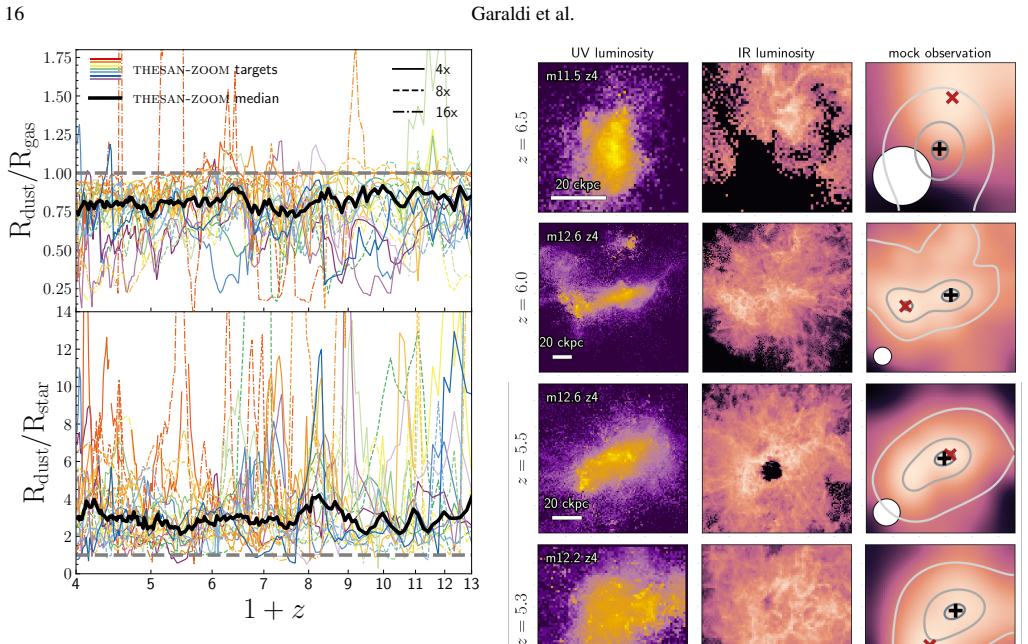
Summary. The paper analyses cosmic dust in the Thesan-Zoom radiation-hydrodynamical zoom-in suite, which couples an on-the-fly dust model (adapted from McKinnon et al. 2016, 2017) to multi-phase ISM physics, SMUGGLE feedback and radiative transfer at z ≥ 3. Simulated galaxies reproduce observed DGR and DMR trends with metallicity and broadly match dust temperatures and UV–IR offsets, but show a dust deficit at high sSFR and systematically low A1500 even after TODDLERS post-processing of unresolved birth-cloud dust. The central claim is that the emergent bursty star-formation cycle (illustrated in Sec. 5.1 and Fig. 15) produces short-lived IR-bright phases (median ~20 Myr) and longer dust-poor phases, so that large reservoirs (M_dust/M_star ≳ 10^{-3}) cannot survive for a significant fraction of cosmic time; therefore bursty SF can explain the z ≳ 10 UVLF excess only if it settles by z ~ 8, or the model is missing shielding physics.
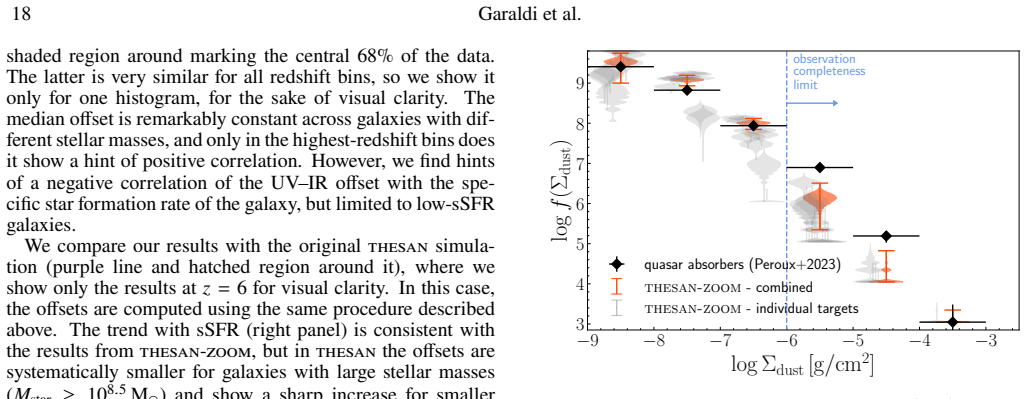
Significance. If the result holds, it supplies a concrete, falsifiable constraint linking two major high-z puzzles: the JWST UVLF excess and the presence of substantial dust reservoirs by z ~ 8. The work is valuable because it is one of the few suites that self-consistently couples live dust, multi-phase ISM and radiation, produces quantitative predictions (IR-phase duty cycle, T_dust–ΔMS correlation, UV–IR offsets) that can be tested with ALMA/NOEMA and JWST, and explicitly flags the model limitations that would reverse the conclusion. The forward-modelling of UV–IR offsets and dust surface-density distributions, and the transparent comparison to multiple observational samples and other simulations, are clear strengths.
major comments (3)
- Sec. 5.1 and Fig. 15 establish the co-spatial growth–destruction cycle that underpins the incompatibility claim, yet Sec. 2.2, Sec. 5.4 and Appendix B acknowledge that unresolved cold dense clumps (n ≳ 10 cm^{-3}, T ≲ 100 K) capable of shielding dust from the SMUGGLE injection kernel are missing. Because the paper itself identifies this as the softest link, the central statement that bursty SF is incompatible with prolonged survival of M_dust/M_star ≳ 10^{-3} should be explicitly conditioned on the absence of such shielding, and a quantitative estimate (or at least a clear statement of the required change in destruction efficiency or recovery timescale) should be added so that the UVLF implication remains falsifiable rather than model-contingent.
- Sec. 4.3 and Fig. 14 show that A1500 remains low compared with observations even after TODDLERS birth-cloud dust is included. The abstract and Sec. 5 correctly note that a shielding mechanism is therefore required, but the paper does not quantify how much additional shielded dust (or what change in feedback topology) would be needed to reach the observed A1500 while preserving the bursty UVLF success at z ≳ 10. Without that estimate the claim that the model is already close enough for the duty-cycle argument to be robust is under-supported.
- The single effective grain size a_eff = 0.1 μm and the restriction of accretion to star-forming gas (Eq. 1 and Sec. 2.2) lock dust production to the same dense gas that later hosts feedback. Sec. 5.4 mentions grain-size evolution only in passing. A short test or literature-based estimate of how a multi-bin size distribution (or accretion outside star-forming gas) would alter the post-burst recovery timescale would strengthen the claim that the incompatibility is robust to dust-physics uncertainties.
minor comments (5)
- Fig. 2 caption and text: the vertical stripes of constant M_star are attributed to rapid dust growth; a brief note that they could also reflect temporary dust ejection followed by re-accretion would avoid over-interpretation.
- Sec. 3.6: the statement that dust temperatures >100 K 'should be easily observable but have not been detected' needs a short caveat on the limited volume and mass range of the zoom sample.
- Eq. (1): the ad-hoc assignment of T = 10^4 K to star-forming gas for the accretion timescale is tested in Appendix B, but the main text should flag this assumption more prominently when the growth rate is first introduced.
- Fig. 12: the assumed Gaussian PSF with σ = 0.5 pkpc is reasonable for a population comparison, but a sentence noting the range of actual ALMA beams in the REBELS/ALPINE samples would help readers judge the comparison.
- Throughout: a few typographical inconsistencies remain (e.g., 'thesan-zoom' capitalisation, occasional missing spaces around Å). A light copy-edit pass would improve readability.
Circularity Check
No significant circularity: the incompatibility claim is an emergent simulation outcome compared to external data, not a definitional or fitted reduction.
full rationale
The paper's central claim—that bursty star formation prevents prolonged survival of large dust reservoirs (M_dust/M_star ≳ 10^{-3})—is obtained by running thesan-zoom (SMUGGLE feedback + McKinnon-style dust) and inspecting the resulting time series (Fig. 15, Sec. 5.1). Dust growth, sputtering, and ejection are computed from the stated sub-grid equations (Eqs. 1–3); burstiness is an emergent property already documented in companion papers, not redefined here to force the dust result. Scaling relations and attenuation are then compared to independent ALMA/JWST/DLA observations. The dust model is taken from McKinnon et al. (2016, 2017) with modest updates (metallicity dependence, T_gas threshold); those citations are external and do not encode the high-z UVLF implication. No equation equates a fitted parameter to a claimed prediction by construction, and no uniqueness theorem is imported from the authors to forbid alternatives. The softest link is physical (missing dense-clump shielding, single grain size), which is a model-limitation issue, not circularity. Score 1 for ordinary self-citation of the simulation suite and dust module; the derivation chain itself is self-contained against external benchmarks.
Axiom & Free-Parameter Ledger
free parameters (4)
- a_eff (effective grain size) =
0.1 μm
- τ_growth normalisation and Z dependence =
3 Gyr (at n=100 cm^{-3}, T=20 K, Z=Z_⊙)
- T_gas,thr for accretion =
300 K
- SN grain destruction efficiency ε
axioms (4)
- domain assumption Dust is a passive scalar advected with gas (no dust–gas drag).
- ad hoc to paper Star-forming gas is assigned fixed T=10^4 K only for the accretion timescale calculation.
- domain assumption CMB is optically thin to the relevant photons, so dust cannot cool below T_CMB.
- domain assumption SMUGGLE stellar feedback produces realistic bursty SFHs that match the z≳10 UVLF.
read the original abstract
Cosmic dust is a key regulator of galaxy evolution, but its build-up and survival in the first billion years remain poorly constrained. We present a systematic analysis of dust in the thesan-zoom suite of radiation-hydrodynamical zoom-in simulations, which self-consistently model dust formation, growth, destruction, and its coupling to radiative transfer in galaxies at $z \geq 3$, a multi-phase ISM and bursty star formation histories. The simulated galaxies reproduce the observed trends of dust-to-gas and dust-to-metal ratios with gas metallicity, while showing a dust deficit at high specific star-formation rates. They also broadly match observed dust temperatures and UV-IR spatial offsets. We find that dust and its properties are strongly time-variable and tightly linked to bursty star formation, with short-lived IR-bright phases (median duration of $20.3^{+2.3}_{-2.4}$ Myr) and longer dust-poor phases, naturally producing a correlation between dust temperature and distance from the star-forming main sequence. The predicted attenuation at $1500$ \r{A} is low compared to observations, even when including unresolved dust through post processing, indicating that a mechanism able to shield dust from strong feedback events is necessary to reconcile our galaxy formation model with observations. In our model, bursty star formation prevents the survival of large dust reservoirs ($M_{dust} / M_{star} \geq 10^{-3}$) over a significant fraction of cosmic time. This implies that bursty star formation can produce the observed overabundance of UV-bright galaxies at $z \geq 10$ only if it rapidly settles down by $z \sim 8$ (where large dust reservoirs are detected). It is also possible that our models lack physical ingredients or emergent phenomena that aid the survival of dust. Future observations of high-redshift dust will be key to diagnose the physical mechanism at play in the first galaxies.
Figures






Forward citations
Cited by 1 Pith paper
-
Mapping Dust Attenuation at Kiloparsec Scales. IV. A Dust-model Interpretation of Attenuation Curves in Nearby Galaxies
A silicate+graphite MRN dust screen fitted to 2487 kpc-scale attenuation curves maps the 2175 Å bump to small graphite grains and the NUV slope to small silicates.
Reference graph
Works this paper leans on
-
[1]
Adams N. J., et al., 2023, @doi [ ] 10.1093/mnras/stac3347 , https://ui.adsabs.harvard.edu/abs/2023MNRAS.518.4755A 518, 4755
-
[2]
Akins H. B., et al., 2022, @doi [ ] 10.3847/1538-4357/ac795b , https://ui.adsabs.harvard.edu/abs/2022ApJ...934...64A 934, 64
-
[3]
Algera H. S. B., et al., 2023, @doi [ ] 10.1093/mnras/stac3195 , https://ui.adsabs.harvard.edu/abs/2023MNRAS.518.6142A 518, 6142
-
[4]
Algera H. S. B., et al., 2024, @doi [ ] 10.1093/mnras/stae1994 , https://ui.adsabs.harvard.edu/abs/2024MNRAS.533.3098A 533, 3098
-
[5]
Algera H. S. B., et al., 2026, @doi [ ] 10.1093/mnras/staf1897 , https://ui.adsabs.harvard.edu/abs/2026MNRAS.545f1897A 545, staf1897
-
[6]
Aoyama S., Hou K.-C., Shimizu I., Hirashita H., Todoroki K., Choi J.-H., Nagamine K., 2016, @doi [ ] 10.1093/mnras/stw3061 , 466, 105
-
[7]
Aoyama S., Hou K.-C., Hirashita H., Nagamine K., Shimizu I., 2018, @doi [ ] 10.1093/mnras/sty1431 , https://ui.adsabs.harvard.edu/abs/2018MNRAS.478.4905A 478, 4905
-
[8]
Aoyama S., Hirashita H., Nagamine K., 2020, @doi [ ] 10.1093/mnras/stz3253 , https://ui.adsabs.harvard.edu/abs/2020MNRAS.491.3844A 491, 3844
-
[9]
Arrabal Haro P., et al., 2023, @doi [ ] 10.3847/2041-8213/acdd54 , https://ui.adsabs.harvard.edu/abs/2023ApJ...951L..22A 951, L22
-
[10]
Atek H., et al., 2023, @doi [ ] 10.1093/mnras/stac3144 , https://ui.adsabs.harvard.edu/abs/2023MNRAS.519.1201A 519, 1201
-
[11]
M., et al., 2025, @doi [ ] 10.1051/0004-6361/202557207 , 706, A91
Baker W. M., et al., 2025, @doi [ ] 10.1051/0004-6361/202557207 , 706, A91
-
[12]
Bakx T. J. L. C., et al., 2021, @doi [ ] 10.1093/mnrasl/slab104 , 508, L58
-
[13]
Bakx T. J. L. C., et al., 2024a, @doi [ ] 10.1093/mnras/stae1613 , https://ui.adsabs.harvard.edu/abs/2024MNRAS.532.2270B 532, 2270
-
[14]
Bakx T. J. L. C., et al., 2024b, @doi [ ] 10.1093/mnras/stae2409 , https://ui.adsabs.harvard.edu/abs/2024MNRAS.535.1533B 535, 1533
-
[15]
Bakx T. J. L. C., et al., 2025, @doi [ ] 10.1093/mnras/staf1714 , https://ui.adsabs.harvard.edu/abs/2025MNRAS.544.1502B 544, 1502
-
[16]
Bakx T. J. L. C., et al., 2026, @doi [ ] 10.1093/mnras/staf2284 , https://ui.adsabs.harvard.edu/abs/2026MNRAS.546f2284B 546, staf2284
-
[17]
Behroozi P. S., Wechsler R. H., Conroy C., 2013, @doi [ ] 10.1088/0004-637X/770/1/57 , https://ui.adsabs.harvard.edu/abs/2013ApJ...770...57B 770, 57
-
[18]
Bekki K., 2013, @doi [ ] 10.1093/mnras/stt589 , 432, 2298
-
[19]
Bekki K., 2015, @doi [ ] 10.1088/0004-637X/799/2/166 , https://ui.adsabs.harvard.edu/abs/2015ApJ...799..166B 799, 166
-
[20]
B \'e thermin M., et al., 2015, @doi [ ] 10.1051/0004-6361/201425031 , https://ui.adsabs.harvard.edu/abs/2015A&A...573A.113B 573, A113
-
[21]
B \'e thermin M., et al., 2020, @doi [ ] 10.1051/0004-6361/202037649 , https://ui.adsabs.harvard.edu/abs/2020A&A...643A...2B 643, A2
-
[22]
Bhagwat A., Costa T., Ciardi B., Pakmor R., Garaldi E., 2024, @doi [ ] 10.1093/mnras/stae1125 , https://ui.adsabs.harvard.edu/abs/2024MNRAS.531.3406B 531, 3406
-
[23]
Bianchi S., Schneider R., 2007, @doi [ ] 10.1111/j.1365-2966.2007.11829.x , https://ui.adsabs.harvard.edu/abs/2007MNRAS.378..973B 378, 973
-
[24]
Boquien M., et al., 2022, @doi [ ] 10.1051/0004-6361/202142537 , https://ui.adsabs.harvard.edu/abs/2022A&A...663A..50B 663, A50
-
[25]
Borrow J., Kannan R., Garaldi E., Smith A., Vogelsberger M., Pakmor R., Springel V., Hernquist L., 2023, @doi [ ] 10.1093/mnras/stad2523 , p. stad2523
-
[26]
Bouwens R. J., et al., 2022, @doi [ ] 10.3847/1538-4357/ac5a4a , https://ui.adsabs.harvard.edu/abs/2022ApJ...931..160B 931, 160
-
[27]
Bouwens R., Illingworth G., Oesch P., Stefanon M., Naidu R., van Leeuwen I., Magee D., 2023, @doi [ ] 10.1093/mnras/stad1014 , 523, 1009
-
[28]
Bowler R. A. A., Cullen F., McLure R. J., Dunlop J. S., Avison A., 2022, @doi [ ] 10.1093/mnras/stab3744 , https://ui.adsabs.harvard.edu/abs/2022MNRAS.510.5088B 510, 5088
-
[29]
D., et al., 2008, @doi [ ] 10.1086/533519 , 678, 647
Bradley L. D., et al., 2008, @doi [ ] 10.1086/533519 , 678, 647
doi:10.1086/533519 2008
-
[30]
Bunker A. J., et al., 2023, @doi [ ] 10.1051/0004-6361/202346159 , https://ui.adsabs.harvard.edu/abs/2023A&A...677A..88B 677, A88
-
[31]
Burgarella D., Nanni A., Hirashita H., Theul \'e P., Inoue A. K., Takeuchi T. T., 2020, @doi [ ] 10.1051/0004-6361/201937143 , https://ui.adsabs.harvard.edu/abs/2020A&A...637A..32B 637, A32
-
[32]
Burgarella D., et al., 2025, @doi [ ] 10.1051/0004-6361/202554231 , https://ui.adsabs.harvard.edu/abs/2025A&A...699A.336B 699, A336
-
[33]
Stardust Galaxies at z>9: A Dust-Origin Transition Behind the Excess of UV-Bright Galaxies
Burgarella D., et al., 2026, @doi [arXiv e-prints] 10.48550/arXiv.2605.09829 , https://ui.adsabs.harvard.edu/abs/2026arXiv260509829B p. arXiv:2605.09829
work page internal anchor Pith review Pith/arXiv arXiv doi:10.48550/arxiv.2605.09829 2026
-
[34]
Camps P., Baes M., 2020, @doi [Astronomy and Computing] 10.1016/j.ascom.2020.100381 , https://ui.adsabs.harvard.edu/abs/2020A&C....3100381C 31, 100381
-
[35]
Carniani S., et al., 2024, @doi [ ] 10.1038/s41586-024-07860-9 , https://ui.adsabs.harvard.edu/abs/2024Natur.633..318C 633, 318
-
[36]
Castellano M., et al., 2022, @doi [ ] 10.3847/2041-8213/ac94d0 , https://ui.adsabs.harvard.edu/abs/2022ApJ...938L..15C 938, L15
-
[37]
Castellano M., et al., 2024, @doi [ ] 10.3847/1538-4357/ad5f88 , https://ui.adsabs.harvard.edu/abs/2024ApJ...972..143C 972, 143
-
[38]
Cazaux S., Tielens A. G. G. M., 2002, @doi [ ] 10.1086/342607 , https://ui.adsabs.harvard.edu/abs/2002ApJ...575L..29C 575, L29
doi:10.1086/342607 2002
-
[39]
Cazaux S., Tielens A. G. G. M., 2004, @doi [ ] 10.1086/381775 , https://ui.adsabs.harvard.edu/abs/2004ApJ...604..222C 604, 222
doi:10.1086/381775 2004
-
[40]
Ceverino D., Glover S. C. O., Klessen R. S., 2017, @doi [ ] 10.1093/mnras/stx1386 , https://ui.adsabs.harvard.edu/abs/2017MNRAS.470.2791C 470, 2791
-
[41]
Ceverino D., et al., 2024, @doi [ ] 10.1093/mnras/stad3332 , 527, 2139
-
[42]
Chemerynska I., et al., 2024, @doi [ ] 10.1093/mnras/stae1260 , 531, 2615
-
[43]
Chisholm J., et al., 2018, @doi [ ] 10.1051/0004-6361/201832758 , https://ui.adsabs.harvard.edu/abs/2018A&A...616A..30C 616, A30
-
[44]
Chisholm J., et al., 2022, @doi [ ] 10.1093/mnras/stac2874 , https://ui.adsabs.harvard.edu/abs/2022MNRAS.517.5104C 517, 5104
-
[45]
Choban C. R., Kereš D., Hopkins P. F., Sandstrom K. M., Hayward C. C., Faucher-Giguère C.-A., 2022, @doi [ ] 10.1093/mnras/stac1542 , 514, 4506
-
[46]
R., Salim S., Kere s D., Hayward C
Choban C. R., Salim S., Kere s D., Hayward C. C., Sandstrom K. M., 2025, @doi [ ] 10.1093/mnras/staf118 , https://ui.adsabs.harvard.edu/abs/2025MNRAS.537.1518C 537, 1518
-
[47]
R., Salim S., Kere s D., Roman-Duval J., Sandstrom K
Choban C. R., Salim S., Kere s D., Roman-Duval J., Sandstrom K. M., 2026, @doi [arXiv e-prints] 10.48550/arXiv.2603.08504 , https://ui.adsabs.harvard.edu/abs/2026arXiv260308504C p. arXiv:2603.08504
-
[48]
Clemens M. S., et al., 2013, @doi [ ] 10.1093/mnras/stt760 , https://ui.adsabs.harvard.edu/abs/2013MNRAS.433..695C 433, 695
-
[49]
Curtis-Lake E., et al., 2023, @doi [Nature Astronomy] 10.1038/s41550-023-01918-w , https://ui.adsabs.harvard.edu/abs/2023NatAs.tmp...66C
-
[50]
Dayal P., et al., 2022, @doi [ ] 10.1093/mnras/stac537 , https://ui.adsabs.harvard.edu/abs/2022MNRAS.512..989D 512, 989
-
[51]
De Cia A., Ledoux C., Mattsson L., Petitjean P., Srianand R., Gavignaud I., Jenkins E. B., 2016, @doi [ ] 10.1051/0004-6361/201527895 , https://ui.adsabs.harvard.edu/abs/2016A&A...596A..97D 596, A97
-
[52]
Di Cesare C., Graziani L., Schneider R., Ginolfi M., Venditti A., Santini P., Hunt L. K., 2023, @doi [ ] 10.1093/mnras/stac3702 , https://ui.adsabs.harvard.edu/abs/2023MNRAS.519.4632D 519, 4632
-
[53]
T., et al., 2023, @doi [ ] 10.1093/mnras/stac3472 , 518, 6011
Donnan C. T., et al., 2023, @doi [ ] 10.1093/mnras/stac3472 , 518, 6011
-
[54]
T., et al., 2024, @doi [ ] 10.1093/mnras/stae2037 , 533, 3222
Donnan C. T., et al., 2024, @doi [ ] 10.1093/mnras/stae2037 , 533, 3222
-
[55]
T., 2003, @doi [ ] 10.1146/annurev.astro.41.011802.094840 , 41, 241
Draine B. T., 2003, @doi [ ] 10.1146/annurev.astro.41.011802.094840 , 41, 241
Pith/arXiv arXiv doi:10.1146/annurev.astro.41.011802.094840 2003
-
[56]
Draine B. T., Lee H. M., 1984, @doi [ ] 10.1086/162480 , https://ui.adsabs.harvard.edu/abs/1984ApJ...285...89D 285, 89
doi:10.1086/162480 1984
-
[57]
Dubois Y., et al., 2021, @doi [ ] 10.1051/0004-6361/202039429 , https://ui.adsabs.harvard.edu/abs/2021A&A...651A.109D 651, A109
-
[58]
Dubois Y., et al., 2024, @doi [ ] 10.1051/0004-6361/202449784 , https://ui.adsabs.harvard.edu/abs/2024A&A...687A.240D 687, A240
-
[59]
Dunne L., Eales S. A., Edmunds M. G., 2003, @doi [ ] 10.1046/j.1365-8711.2003.06440.x , https://ui.adsabs.harvard.edu/abs/2003MNRAS.341..589D 341, 589
-
[60]
Dunne L., et al., 2011, @doi [ ] 10.1111/j.1365-2966.2011.19363.x , https://ui.adsabs.harvard.edu/abs/2011MNRAS.417.1510D 417, 1510
-
[61]
Esmerian C. J., Gnedin N. Y., 2022, @doi [ ] 10.3847/1538-4357/ac9612 , https://ui.adsabs.harvard.edu/abs/2022ApJ...940...74E 940, 74
-
[62]
Esmerian C. J., Gnedin N. Y., 2024, @doi [ ] 10.3847/1538-4357/ad410f , https://ui.adsabs.harvard.edu/abs/2024ApJ...968..113E 968, 113
-
[63]
Faisst A. L., Fudamoto Y., Oesch P. A., Scoville N., Riechers D. A., Pavesi R., Capak P., 2020, @doi [ ] 10.1093/mnras/staa2545 , https://ui.adsabs.harvard.edu/abs/2020MNRAS.498.4192F 498, 4192
-
[64]
Feldmann R., et al., 2023, @doi [ ] 10.1093/mnras/stad1205 , https://ui.adsabs.harvard.edu/abs/2023MNRAS.522.3831F 522, 3831
-
[65]
Feldmann R., et al., 2025, @doi [ ] 10.1093/mnras/stae2633 , https://ui.adsabs.harvard.edu/abs/2025MNRAS.536..988F 536, 988
-
[66]
Ferrara A., 2024, @doi [ ] 10.1051/0004-6361/202348321 , https://ui.adsabs.harvard.edu/abs/2024A&A...684A.207F 684, A207
-
[67]
Ferrara A., Pallottini A., Dayal P., 2023, @doi [ ] 10.1093/mnras/stad1095 , https://ui.adsabs.harvard.edu/abs/2023MNRAS.522.3986F 522, 3986
-
[68]
Ferrara A., Pallottini A., Sommovigo L., 2025, @doi [ ] 10.1051/0004-6361/202452707 , https://ui.adsabs.harvard.edu/abs/2025A&A...694A.286F 694, A286
-
[69]
Finkelstein S. L., et al., 2022, @doi [ ] 10.3847/2041-8213/ac966e , https://ui.adsabs.harvard.edu/abs/2022ApJ...940L..55F 940, L55
-
[70]
Fiore F., Ferrara A., Bischetti M., Feruglio C., Travascio A., 2023, @doi [ ] 10.3847/2041-8213/acb5f2 , https://ui.adsabs.harvard.edu/abs/2023ApJ...943L..27F 943, L27
-
[71]
Fisher R., et al., 2025, @doi [ ] 10.1093/mnras/staf485 , https://ui.adsabs.harvard.edu/abs/2025MNRAS.539..109F 539, 109
-
[72]
Fudamoto Y., et al., 2020, @doi [ ] 10.1051/0004-6361/202038163 , https://ui.adsabs.harvard.edu/abs/2020A&A...643A...4F 643, A4
-
[73]
Fujimoto S., et al., 2023, @doi [ ] 10.3847/2041-8213/acd2d9 , https://ui.adsabs.harvard.edu/abs/2023ApJ...949L..25F 949, L25
-
[74]
Fujimoto S., et al., 2024, @doi [ ] 10.3847/1538-4357/ad9027 , https://ui.adsabs.harvard.edu/abs/2024ApJ...977..250F 977, 250
-
[75]
Garaldi E., Kannan R., Smith A., Springel V., Pakmor R., Vogelsberger M., Hernquist L., 2022, @doi [ ] 10.1093/mnras/stac257 , https://ui.adsabs.harvard.edu/abs/2022MNRAS.512.4909G 512, 4909
-
[76]
Garaldi E., et al., 2024, @doi [ ] 10.1093/mnras/stae839 , https://ui.adsabs.harvard.edu/abs/2024MNRAS.530.3765G 530, 3765
-
[77]
Gnedin N. Y., 2014, @doi [ ] 10.1088/0004-637X/793/1/29 , http://adsabs.harvard.edu/abs/2014ApJ...793...29G 793, 29
-
[78]
Goldader J. D., Meurer G., Heckman T. M., Seibert M., Sanders D. B., Calzetti D., Steidel C. C., 2002, @doi [ ] 10.1086/339165 , https://ui.adsabs.harvard.edu/abs/2002ApJ...568..651G 568, 651
doi:10.1086/339165 2002
-
[79]
Granato G. L., et al., 2021, @doi [ ] 10.1093/mnras/stab362 , https://ui.adsabs.harvard.edu/abs/2021MNRAS.503..511G 503, 511
-
[80]
Graziani L., Schneider R., Ginolfi M., Hunt L. K., Maio U., Glatzle M., Ciardi B., 2020, @doi [ ] 10.1093/mnras/staa796 , https://ui.adsabs.harvard.edu/abs/2020MNRAS.494.1071G 494, 1071
discussion (0)
Sign in with ORCID, Apple, or X to comment. Anyone can read and Pith papers without signing in.