Late-time evolution of the interacting stripped-envelope supernova 2017dio
Pith reviewed 2026-06-30 08:48 UTC · model grok-4.3
The pith
The hydrogen-rich circumstellar material around stripped-envelope supernova 2017dio came from a companion star.
A machine-rendered reading of the paper's core claim, the machinery that carries it, and where it could break.
Core claim
Although the progenitor of SN 2017dio has lost its helium envelope, it interacted with a hydrogen-rich CSM formed shortly before the explosion, suggesting that this material originated from a companion star rather than the progenitor itself.
What carries the argument
Modeling of radiation produced by ejecta-CSM interaction combined with IR echo modeling from circumstellar dust to derive mass-loss rates and dust masses.
Load-bearing premise
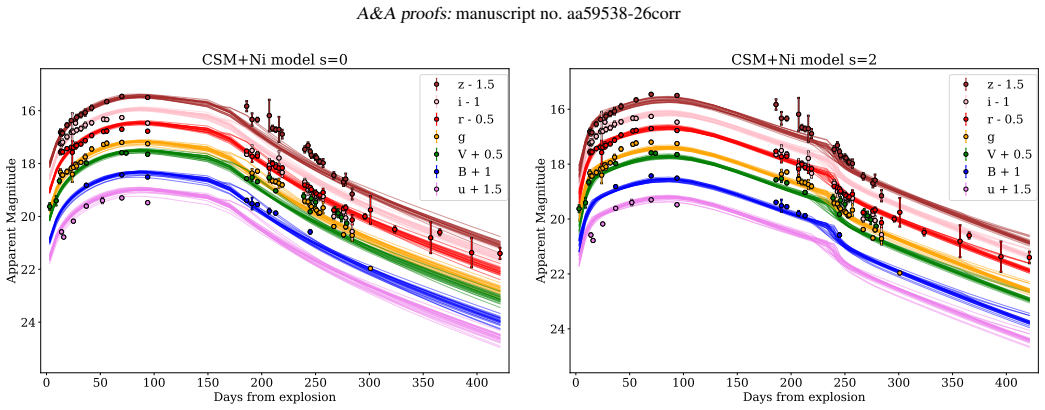
The light curves and spectra are dominated by ejecta-CSM interaction.
What would settle it
Spectra at late times showing no hydrogen lines or light curves inconsistent with interaction-powered emission would undermine the inference that the CSM is hydrogen-rich and external to the progenitor.
Figures
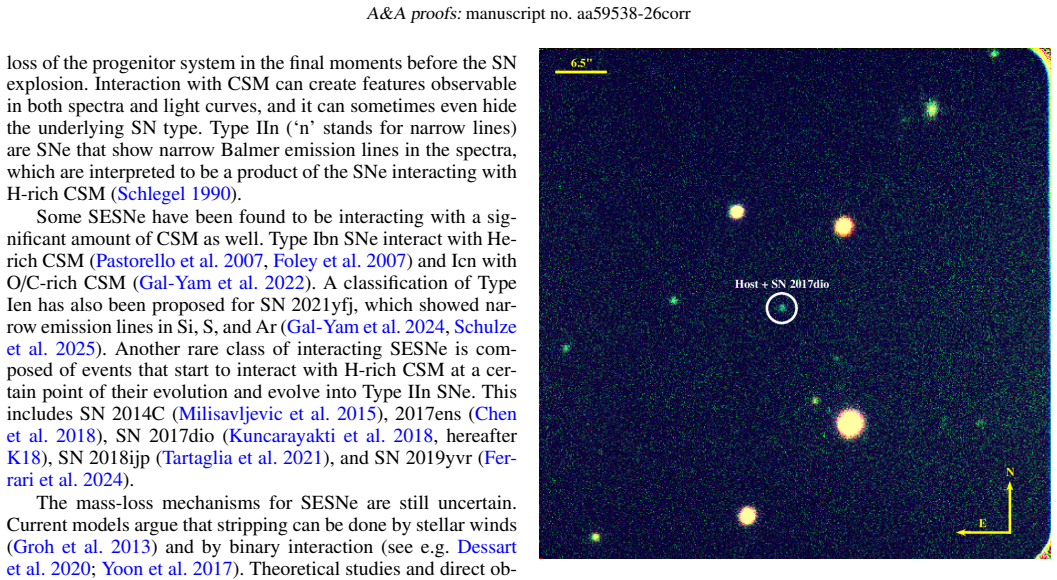
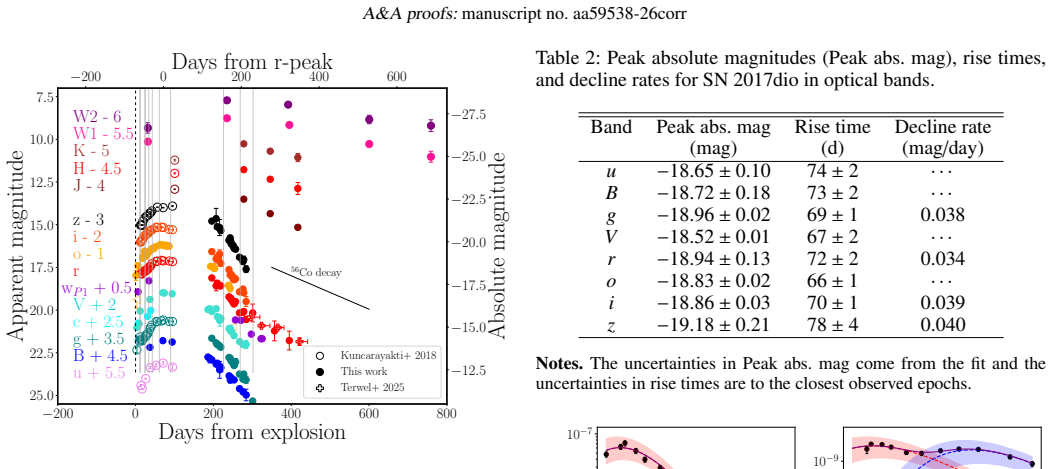
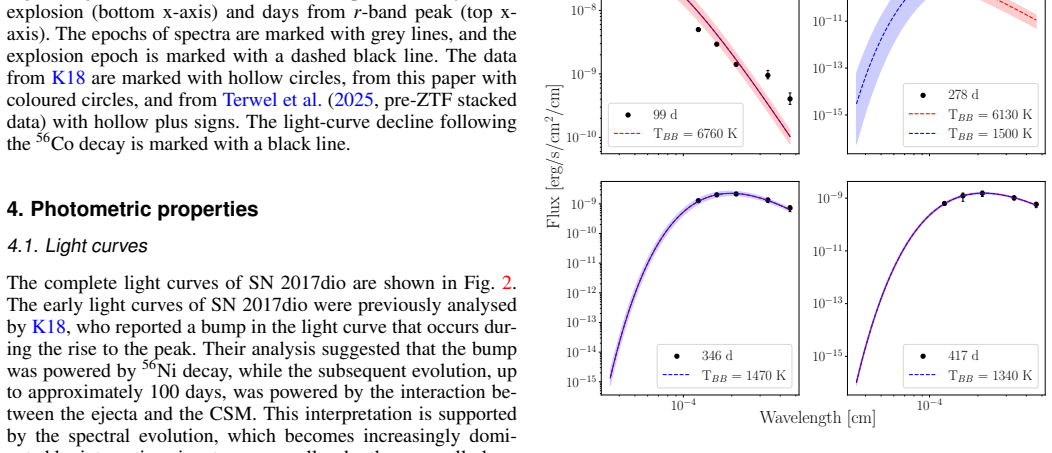
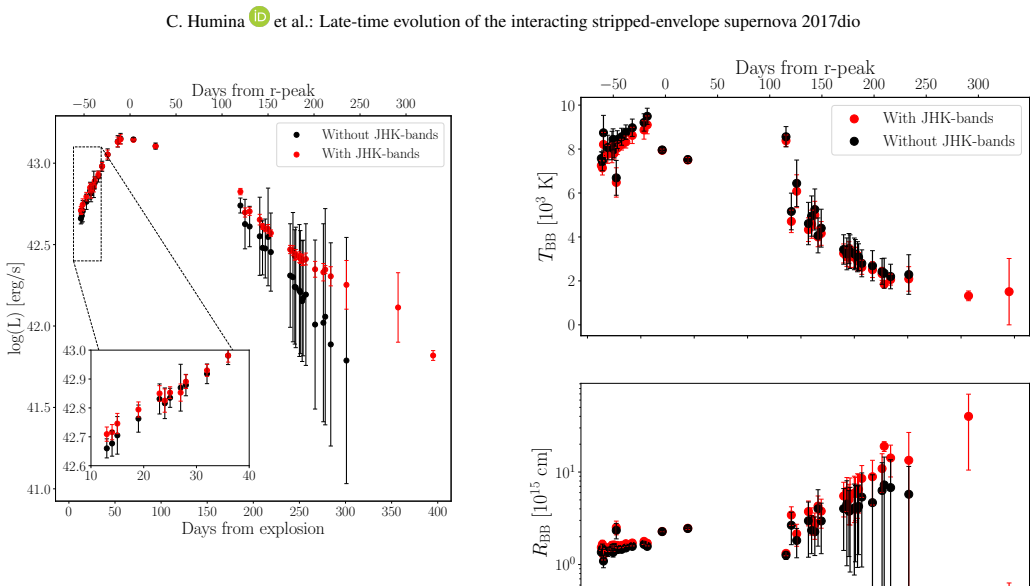
read the original abstract
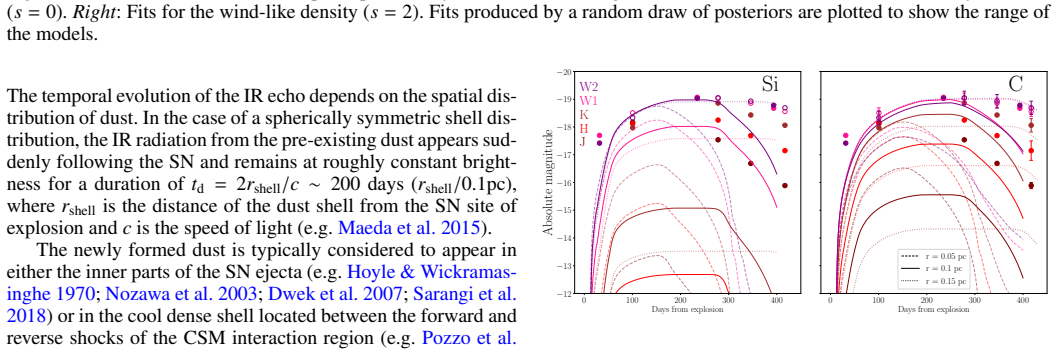
The discovery of stripped-envelope supernovae (SNe) interacting with dense circumstellar medium (CSM) challenges our current understanding of massive star evolution. We present late-time observations of the interacting Type Ic SN 2017dio and investigate its mass-loss mechanism and progenitor channel. We analysed late-time spectra and light curves (LCs) that are dominated by ejecta-CSM interaction. We examined the CSM and the source of the infrared (IR) excess by modelling the radiation produced by the ejecta-CSM interaction and the IR echo from circumstellar dust. In addition, we studied the evolution of spectral features, with a particular emphasis on the Halpha emission line. From the combined analysis of the LCs and spectral properties, we infer that the peak mass-loss rate for the CSM reaches ~0.2 $M_{\odot}/yr$ and that the typical value over most epochs is ~0.06 $M_{\odot}/yr$. The nearby CSM was formed over a period of 4 to 65 years before the explosion. The CSM radius begins at ~$1.3\cdot10^{15}$ cm. The IR excess identified in the LCs is consistent with the radiation from dust with a mass increasing from ~0.001 to ~0.005 $M_{\odot}$ in the case of carbon dust or ~0.005 to ~0.02 $M_{\odot}$ in the case of silicate dust. From IR echo modelling, we estimate an upper limit on the dust mass of $4\cdot10^{-5} M_{\odot}$, which implies an SN progenitor mass-loss rate of $2.4\cdot10^{-5} M_{\odot}/yr$ at the dust evaporation radius determined by the SN peak luminosity (0.017 pc for carbon dust, corresponding to mass loss ~170 years before the explosion). This implies a very rapid increase in the mass-loss rate ahead of the explosion. Although the progenitor of SN 2017dio has lost its helium envelope, it interacted with a hydrogen-rich CSM formed shortly before the explosion, suggesting that this material originated from a companion star rather than the progenitor itself. [Abridged]
Editorial analysis
A structured set of objections, weighed in public.
Referee Report
Summary. The manuscript presents late-time photometric and spectroscopic data for the Type Ic supernova 2017dio. The authors model the light curves and spectra as dominated by ejecta-CSM interaction, deriving a peak mass-loss rate of ~0.2 M⊙ yr⁻¹ and a typical rate of ~0.06 M⊙ yr⁻¹ for hydrogen-rich circumstellar material formed 4–65 years before explosion at a radius of ~1.3×10¹⁵ cm. They additionally model the infrared excess as an echo from circumstellar dust with masses increasing from ~0.001–0.005 M⊙ (carbon) or ~0.005–0.02 M⊙ (silicate), and obtain an upper limit of 4×10^{-5} M⊙ on earlier dust mass implying a progenitor mass-loss rate of 2.4×10^{-5} M⊙ yr⁻¹ ~170 years prior. This leads to the conclusion of a rapid pre-explosion increase in mass loss, with the H-rich CSM attributed to a companion rather than the stripped progenitor itself.
Significance. If the central modeling assumptions hold, the work would be significant for massive-star evolution studies, as it supplies quantitative evidence that hydrogen-rich material can be supplied by a binary companion on short timescales before a stripped-envelope explosion, thereby supporting binary channels over single-star mass loss for at least some Type Ic events.
major comments (3)
- [Abstract] Abstract: The assertion that the late-time LCs and spectra 'are dominated by ejecta-CSM interaction' is stated without quantitative support such as residual analysis after subtracting an interaction template, comparison to ⁵⁶Ni-powered models, or line-profile decomposition. This assumption is load-bearing for all derived quantities including the mass-loss rates, CSM radius, and the rapid-increase conclusion.
- [Radiation and IR-echo modeling] Radiation and IR-echo modeling (described in the analysis sections): Details on the specific radiation-transfer equations, fitting procedure, data selection criteria, and uncertainty estimates for parameters such as the peak Ṁ ~0.2 M⊙ yr⁻¹, typical Ṁ ~0.06 M⊙ yr⁻¹, and dust masses are not supplied, preventing independent verification of the 4–65 yr formation window and the 1.3×10¹⁵ cm radius.
- [IR-echo modelling and conclusions] IR-echo modelling and conclusions: The dust-mass upper limit of 4×10^{-5} M⊙ (and the implied 2.4×10^{-5} M⊙ yr⁻¹ rate at 0.017 pc) is obtained inside the same interaction-dominated framework used for the LC fits; without sensitivity tests to possible contamination by other power sources, the temporal contrast that underpins the 'very rapid increase' and companion-origin claim remains circular.
minor comments (2)
- The abstract is marked 'abridged'; the main text should include a concise summary of the fitting methodology and any adopted priors to improve reproducibility.
- Notation for mass-loss rates and dust masses should be standardized (e.g., consistent use of scientific notation and solar units) throughout the text and figures.
Simulated Author's Rebuttal
We thank the referee for the detailed and constructive report. We address each major comment below. Where the points identify genuine gaps in presentation or analysis, we have revised the manuscript accordingly.
read point-by-point responses
-
Referee: [Abstract] Abstract: The assertion that the late-time LCs and spectra 'are dominated by ejecta-CSM interaction' is stated without quantitative support such as residual analysis after subtracting an interaction template, comparison to ⁵⁶Ni-powered models, or line-profile decomposition. This assumption is load-bearing for all derived quantities including the mass-loss rates, CSM radius, and the rapid-increase conclusion.
Authors: We agree that the abstract presents the dominance as a premise without explicit quantitative backing. The body of the paper infers interaction dominance from the mismatch between observed late-time luminosities and ⁵⁶Ni decay expectations plus the presence of narrow lines, but we acknowledge this is not demonstrated via the specific tests listed. We have revised the abstract to include a one-sentence qualifier and added a dedicated subsection (now Section 3.2) that compares the observed LCs to ⁵⁶Ni-powered models (showing >1 mag excess at +200 d) and performs a simple line-profile decomposition for Hα. These additions make the assumption explicit rather than implicit. revision: yes
-
Referee: [Radiation and IR-echo modeling] Radiation and IR-echo modeling (described in the analysis sections): Details on the specific radiation-transfer equations, fitting procedure, data selection criteria, and uncertainty estimates for parameters such as the peak Ṁ ~0.2 M⊙ yr⁻¹, typical Ṁ ~0.06 M⊙ yr⁻¹, and dust masses are not supplied, preventing independent verification of the 4–65 yr formation window and the 1.3×10¹⁵ cm radius.
Authors: The referee correctly identifies that the methods section is terse on the underlying equations and fitting details. The luminosity is computed from the standard ejecta-CSM interaction formula L = (1/2) Ṁ v_shock² with a thin-shell approximation, and dust masses are obtained via a simple echo model using the observed IR excess; however, the exact functional forms, χ² fitting routine, epoch selection (>+100 d), and MCMC-derived uncertainties were only summarized. We have expanded Section 4 to include the full equations, the data-selection criteria, and the uncertainty estimation procedure, together with the resulting posterior distributions for Ṁ and radius. This revision enables independent reproduction of the 4–65 yr window and 1.3×10¹⁵ cm radius. revision: yes
-
Referee: [IR-echo modelling and conclusions] IR-echo modelling and conclusions: The dust-mass upper limit of 4×10^{-5} M⊙ (and the implied 2.4×10^{-5} M⊙ yr⁻¹ rate at 0.017 pc) is obtained inside the same interaction-dominated framework used for the LC fits; without sensitivity tests to possible contamination by other power sources, the temporal contrast that underpins the 'very rapid increase' and companion-origin claim remains circular.
Authors: We accept that the upper-limit derivation shares the interaction-dominance assumption and that no explicit sensitivity tests were presented. The early-time IR non-detection is used to set the 4×10^{-5} M⊙ limit at the evaporation radius, but the contrast with the later dust masses could weaken if a non-negligible fraction of the optical luminosity were powered by ⁵⁶Ni. We have added a new sensitivity analysis (Section 5.3) that recomputes the early-time dust-mass upper limit under the assumption that up to 30 % of the luminosity could arise from radioactive decay; even under this conservative case the implied progenitor mass-loss rate remains ≲ 3×10^{-5} M⊙ yr⁻¹, preserving the order-of-magnitude increase relative to the later CSM. The companion-origin interpretation is now presented with this caveat explicitly stated. revision: yes
Circularity Check
No significant circularity; modeling derives parameters from data without self-reduction
full rationale
The paper asserts that late-time LCs and spectra are dominated by ejecta-CSM interaction, then applies radiation modeling to derive mass-loss rates (~0.2 M⊙/yr peak), CSM radius (~1.3e15 cm), formation window (4-65 yr pre-explosion), and dust masses. These are forward fits to observed quantities, not reductions of outputs to inputs by construction. The companion-origin inference follows from comparing the recent H-rich CSM timing to the already-stripped He envelope, which is an external interpretation rather than a fitted prediction. No self-citations are load-bearing, no ansatz is smuggled, and no uniqueness theorem is invoked. The derivation chain is self-contained against the data and standard interaction models.
Axiom & Free-Parameter Ledger
free parameters (4)
- peak mass-loss rate
- typical mass-loss rate
- dust mass (carbon)
- dust mass (silicate)
axioms (2)
- domain assumption Light curves and spectra are dominated by ejecta-CSM interaction
- domain assumption IR excess arises from circumstellar dust echo
Reference graph
Works this paper leans on
-
[1]
Kuncarayakti, Hanindyo and Maeda, Keiichi and Ashall, Christopher J. and Prentice, Simon J. and Mattila, Seppo and Kankare, Erkki and Fransson, Claes and Lundqvist, Peter and Pastorello, Andrea and Leloudas, Giorgos and Anderson, Joseph P. and Benetti, Stefano and Bersten, Melina C. and Cappellaro, Enrico and Cartier, Régis and Denneau, Larry and Della Va...
-
[2]
The Origin of the Near-infrared Excess in SN Ia 2012dn: Circumstellar Dust around the Super-Chandrasekhar Supernova Candidate. , keywords =. doi:10.3847/1538-4357/835/2/143 , archivePrefix =. 1612.06632 , primaryClass =
work page internal anchor Pith review Pith/arXiv arXiv doi:10.3847/1538-4357/835/2/143
-
[3]
JWST/MIRI Observations of Newly Formed Dust in the Cold, Dense Shell of the Type IIn SN 2005ip. , keywords =. doi:10.3847/1538-4357/adce77 , archivePrefix =. 2410.09142 , primaryClass =
-
[4]
JWST observations of dust reservoirs in type IIP supernovae 2004et and 2017eaw. , keywords =. doi:10.1093/mnras/stad1681 , archivePrefix =. 2301.10778 , primaryClass =
-
[5]
Dust in Supernovae and Supernova Remnants I: Formation Scenarios. , keywords =. doi:10.1007/s11214-018-0492-7 , adsurl =
-
[7]
Dwek, Eli and Galliano, Frédéric and Jones, Anthony P. , title =. 2007 , month =. doi:10.1086/518430 , url =
-
[8]
and Moodley, Kavilan and Skordis, Constantinos
On the source of the late-time infrared luminosity of SN 1998S and other Type II supernovae. , keywords =. doi:10.1111/j.1365-2966.2004.07951.x , archivePrefix =. astro-ph/0404533 , primaryClass =
-
[9]
Condensation of dust in the ejecta of type II-P supernovae
Condensation of dust in the ejecta of Type II-P supernovae. , keywords =. doi:10.1051/0004-6361/201424969 , archivePrefix =. 1412.5522 , primaryClass =
work page internal anchor Pith review Pith/arXiv arXiv doi:10.1051/0004-6361/201424969
-
[10]
Dust in the Early Universe: Dust Formation in the Ejecta of Population III Supernovae
Dust in the Early Universe: Dust Formation in the Ejecta of Population III Supernovae. , keywords =. doi:10.1086/379011 , archivePrefix =. astro-ph/0307108 , primaryClass =
work page internal anchor Pith review Pith/arXiv arXiv doi:10.1086/379011
-
[11]
IAU Colloquium 120: Structure and Dynamics of the Interstellar Medium , year = 1989, editor =
Dust Condensation in the Ejecta of SN 1987 A. IAU Colloquium 120: Structure and Dynamics of the Interstellar Medium , year = 1989, editor =. doi:10.1007/BFb0114861 , adsurl =
-
[12]
A decade of ejecta dust formation in the Type IIn SN 2005ip
A decade of ejecta dust formation in the Type IIn SN 2005ip. , keywords =. doi:10.1093/mnras/stz679 , archivePrefix =. 1809.09055 , primaryClass =
work page internal anchor Pith review Pith/arXiv arXiv doi:10.1093/mnras/stz679
-
[13]
and Wickramasinghe, N.C , title =
Hoyle, F. and Wickramasinghe, N.C , title =. Nat. , year =
-
[14]
The infrared echo of type II supernovae with circumstellar dust shells. II. A probe into the presupernova evolution of the progenitor star. , keywords =. doi:10.1086/163571 , adsurl =
-
[15]
The infrared echo of a type II supernova with a circumstellar dust shell : applications to SN 1979c and SN 1980k. , keywords =. doi:10.1086/161435 , adsurl =
-
[16]
Confined dense circumstellar material surrounding a regular type II supernova. Nature Phys. , keywords =. doi:10.1038/nphys4025 , archivePrefix =. 1701.02596 , primaryClass =
work page internal anchor Pith review Pith/arXiv arXiv doi:10.1038/nphys4025
-
[17]
The hydrogen-free circumstellar interaction in the Type Ib supernova 2021efd: A clue to the mechanism of the helium-layer stripping. , keywords =. doi:10.1051/0004-6361/202557292 , archivePrefix =. 2512.11447 , primaryClass =
-
[18]
Fundamental properties of core-collapse supernova and GRB progenitors: predicting the look of massive stars before death. , keywords =. doi:10.1051/0004-6361/201321906 , archivePrefix =. 1308.4681 , primaryClass =
work page internal anchor Pith review Pith/arXiv arXiv doi:10.1051/0004-6361/201321906
-
[19]
Type Ib and IIb supernova progenitors in interacting binary systems
Type Ib and IIb Supernova Progenitors in Interacting Binary Systems. , keywords =. doi:10.3847/1538-4357/aa6afe , archivePrefix =. 1701.02089 , primaryClass =
work page internal anchor Pith review Pith/arXiv arXiv doi:10.3847/1538-4357/aa6afe
-
[20]
, keywords =
A new subclass of type II supernovae ?. , keywords =
-
[21]
Analysis of the infrared echo of supernova 1982e in NGC 1332. , keywords =. doi:10.1093/mnras/221.4.789 , adsurl =
-
[22]
Discovery of an IR echo from a supernova dust cloud. , keywords =. doi:10.1038/304709a0 , adsurl =
-
[23]
The size distribution of interstellar grains. , keywords =. doi:10.1086/155591 , adsurl =
-
[24]
Seeing the Collision of a Supernova with its Companion Star
Seeing the Collision of a Supernova with Its Companion Star. , keywords =. doi:10.1088/0004-637X/708/2/1025 , archivePrefix =. 0909.0275 , primaryClass =
work page internal anchor Pith review Pith/arXiv arXiv doi:10.1088/0004-637x/708/2/1025
-
[25]
The Expulsion of Stellar Envelopes in Core-Collapse Supernovae
The Expulsion of Stellar Envelopes in Core-Collapse Supernovae. , keywords =. doi:10.1086/306571 , archivePrefix =. astro-ph/9807046 , primaryClass =
work page internal anchor Pith review Pith/arXiv arXiv doi:10.1086/306571
-
[26]
unWISE: unblurred coadds of the WISE imaging
unWISE: Unblurred Coadds of the WISE Imaging. , keywords =. doi:10.1088/0004-6256/147/5/108 , archivePrefix =. 1405.0308 , primaryClass =
work page internal anchor Pith review Pith/arXiv arXiv doi:10.1088/0004-6256/147/5/108
-
[27]
A WC/WO star exploding within an expanding carbon-oxygen-neon nebula. , keywords =. doi:10.1038/s41586-021-04155-1 , archivePrefix =. 2111.12435 , primaryClass =
-
[28]
HOTPANTS: High Order Transform of PSF ANd Template Subtraction
-
[29]
Deep Full-sky Coadds from Three Years of WISE and NEOWISE Observations
Deep Full-sky Coadds from Three Years of WISE and NEOWISE Observations. , keywords =. doi:10.3847/1538-3881/aa894e , archivePrefix =. 1705.06746 , primaryClass =
work page internal anchor Pith review Pith/arXiv arXiv doi:10.3847/1538-3881/aa894e
-
[30]
A hybrid envelope-stripping mechanism for massive stars from supernova nebular spectroscopy. Nat. Astron. , keywords =. doi:10.1038/s41550-019-0710-6 , archivePrefix =. 1808.04834 , primaryClass =
work page internal anchor Pith review Pith/arXiv arXiv doi:10.1038/s41550-019-0710-6
-
[31]
Radii and Mass-loss Rates of Type IIb Supernova Progenitors
Radii and Mass-loss Rates of Type IIb Supernova Progenitors. , keywords =. doi:10.3847/1538-4357/aa6ea9 , archivePrefix =. 1705.02430 , primaryClass =
work page internal anchor Pith review Pith/arXiv arXiv doi:10.3847/1538-4357/aa6ea9
-
[32]
Gaussian Processes for Machine Learning
-
[33]
Metamorphosis of SN 2014C: Delayed Interaction between a Hydrogen Poor Core-collapse Supernova and a Nearby Circumstellar Shell. , keywords =. doi:10.1088/0004-637X/815/2/120 , archivePrefix =. 1511.01907 , primaryClass =
work page internal anchor Pith review Pith/arXiv arXiv doi:10.1088/0004-637x/815/2/120
-
[34]
Transient Name Server AstroNote , keywords =
Introducing a new supernova classification type: SN Ien. Transient Name Server AstroNote , keywords =
-
[35]
A giant outburst two years before the core-collapse of a massive star
A giant outburst two years before the core-collapse of a massive star. , keywords =. doi:10.1038/nature05825 , archivePrefix =. astro-ph/0703663 , primaryClass =
work page internal anchor Pith review Pith/arXiv arXiv doi:10.1038/nature05825
-
[36]
Foley, Ryan J. and Smith, Nathan and Ganeshalingam, Mohan and Li, Weidong and Chornock, Ryan and Filippenko, Alexei V. , title =. , abstract =. 2007 , month =. doi:10.1086/513145 , url =
-
[37]
Electron scattering wings on lines in interacting supernovae
Electron scattering wings on lines in interacting supernovae. , keywords =. doi:10.1093/mnras/stx3163 , archivePrefix =. 1712.01237 , primaryClass =
work page internal anchor Pith review Pith/arXiv arXiv doi:10.1093/mnras/stx3163
-
[38]
Maximally Dusty Star-forming Galaxies: Supernova Dust Production and Recycling in Local Group and High-redshift Galaxies. , keywords =. doi:10.3847/1538-4357/aae520 , archivePrefix =. 1809.11032 , primaryClass =
work page internal anchor Pith review Pith/arXiv arXiv doi:10.3847/1538-4357/aae520
-
[39]
Physical Properties of Wolf-Rayet Stars. , keywords =. doi:10.1146/annurev.astro.45.051806.110615 , archivePrefix =. astro-ph/0610356 , primaryClass =
-
[40]
The relation between optical extinction and hydrogen column density in the Galaxy. , keywords =. doi:10.1111/j.1365-2966.2009.15598.x , archivePrefix =. 0903.2057 , primaryClass =
-
[41]
Unveiling the nature of SN 2022jli: The first double-peaked stripped-envelope supernova showing periodic undulations and dust emission at late times. , keywords =. doi:10.1051/0004-6361/202452729 , archivePrefix =. 2410.21381 , primaryClass =
-
[42]
A long life of excess: The interacting transient SN 2017hcc. , keywords =. doi:10.1051/0004-6361/202244565 , archivePrefix =. 2210.14076 , primaryClass =
-
[43]
Large Cold Dust Reservoir Revealed in Transitional SN Ib 2014C by James Webb Space Telescope Mid-infrared Spectroscopy. , keywords =. doi:10.3847/1538-4357/adccc0 , archivePrefix =. 2504.14009 , primaryClass =
-
[44]
Mattila, S. and Meikle, W. P. S. and Lundqvist, P. and Pastorello, A. and Kotak, R. and Eldridge, J. and Smartt, S. and Adamson, A. and Gerardy, C. L. and Rizzi, L. and Stephens, A. W. and Van Dyk, S. D. , title =. , volume =. 2008 , month =. doi:10.1111/j.1365-2966.2008.13516.x , url =
-
[45]
Yamanaka, Masayuki and Nagayama, Takahiro , title =. , abstract =. 2025 , month =. doi:10.3847/2041-8213/adfe5f , url =
-
[46]
The shock wave revealed through the fog: The strongly interacting Type IIn SN 2013L
The Carnegie Supernova Project II. The shock wave revealed through the fog: The strongly interacting Type IIn SN 2013L. , keywords =. doi:10.1051/0004-6361/201936654 , archivePrefix =. 2003.09709 , primaryClass =
-
[47]
Fox, Ori D. and Chevalier, Roger A. and Dwek, Eli and Skrutskie, Michael F. and Sugerman, Ben E. K. and Leisenring, Jarron M. , title =. , abstract =. 2010 , month =. doi:10.1088/0004-637X/725/2/1768 , url =
-
[49]
Multi-wavelength Observations of the Enduring Type IIn Supernovae 2005ip and 2006jd
Multi-wavelength Observations of the Enduring Type IIn Supernovae 2005ip and 2006jd. , keywords =. doi:10.1088/0004-637X/756/2/173 , archivePrefix =. 1206.5575 , primaryClass =
work page internal anchor Pith review Pith/arXiv arXiv doi:10.1088/0004-637x/756/2/173
-
[50]
High-resolution spectroscopy of SN 2017hcc and its blueshifted line profiles from post-shock dust formation. , keywords =. doi:10.1093/mnras/staa3047 , archivePrefix =. 2009.14215 , primaryClass =
-
[51]
Rho, J. and Evans, A. and Geballe, T. R. and Banerjee, D. P. K. and Hoeflich, P. and Shahbandeh, M. and Valenti, S. and Yoon, S.-C. and Jin, H. and Williamson, M. and Modjaz, M. and Hiramatsu, D. and Howell, D. A. and Pellegrino, C. and Vinkó, J. and Cartier, R. and Burke, J. and McCully, C. and An, H. and Cha, H. and Pritchard, T. and Wang, X. and Andrew...
-
[52]
submitted to AAS Journals , keywords =
Nebular Phase Evolution of SN 2023ixf (I): From Circumstellar Infrared Echo to the onset of in-situ Dust Formation in a Type II Supernova. submitted to AAS Journals , keywords =. doi:10.48550/arXiv.2603.14137 , archivePrefix =. 2603.14137 , primaryClass =
-
[53]
The metamorphosis of the Type Ib SN 2019yvr: late-time interaction. , keywords =. doi:10.1093/mnrasl/slad195 , archivePrefix =. 2401.15052 , primaryClass =
-
[54]
Reviews of Modern Physics , keywords =
The evolution and explosion of massive stars. Reviews of Modern Physics , keywords =. doi:10.1103/RevModPhys.74.1015 , adsurl =
-
[55]
Production of dust by massive stars at high redshift
Production of dust by massive stars at high redshift. , keywords =. doi:10.1007/s00159-011-0043-7 , archivePrefix =. 1108.0403 , primaryClass =
work page internal anchor Pith review Pith/arXiv arXiv doi:10.1007/s00159-011-0043-7
-
[56]
Supernova 2006aj and the associated X-Ray Flash 060218
Supernova 2006aj and the associated X-Ray Flash 060218. , keywords =. doi:10.1051/0004-6361:20065226 , archivePrefix =. astro-ph/0603495 , primaryClass =
work page internal anchor Pith review Pith/arXiv arXiv doi:10.1051/0004-6361:20065226
-
[57]
Fransson, Claes and Ergon, Mattias and Challis, Peter and Chevalier, Roger and France, Kevin and Kirshner, Robert and Marion, G. and Milisavljevic, Dan and Bufano, Filomena and Friedman, Andrew and Kangas, Tuomas and Larsson, Josefin and Mattila, Seppo and Smith, Nathan and Benetti, Stefano and Chornock, Ryan and Czekala, Ian and Soderberg, Alicia and Sol...
-
[58]
WISeREP - An Interactive Supernova Data Repository
WISeREP An Interactive Supernova Data Repository. , keywords =. doi:10.1086/666656 , archivePrefix =. 1204.1891 , primaryClass =
work page internal anchor Pith review Pith/arXiv arXiv doi:10.1086/666656
-
[59]
RNAAS , year = 2018, month = dec, volume =
SuperBol: A User-friendly Python Routine for Bolometric Light Curves. RNAAS , year = 2018, month = dec, volume =. doi:10.3847/2515-5172/aaf799 , adsurl =
-
[60]
A Study of the Type Ia/IIn Supernova 2005gj from X-ray to the Infrared: Paper I
A Study of the Type Ia/IIn Supernova 2005gj from X-ray to the Infrared: Paper I. submitted to AJ , keywords =. doi:10.48550/arXiv.0706.4088 , archivePrefix =. 0706.4088 , primaryClass =
work page internal anchor Pith review Pith/arXiv arXiv doi:10.48550/arxiv.0706.4088
-
[62]
Physics of the Interstellar and Intergalactic Medium
-
[63]
Nebular emission-line profiles of Type Ib/c supernovae - probing the ejecta asphericity. , keywords =. doi:10.1111/j.1365-2966.2009.15003.x , archivePrefix =. 0904.4632 , primaryClass =
-
[64]
SN 2009ip \'a la PESSTO: No evidence for core-collapse yet
SN 2009ip \`a la PESSTO: no evidence for core collapse yet. , keywords =. doi:10.1093/mnras/stt813 , archivePrefix =. 1303.3453 , primaryClass =
work page internal anchor Pith review Pith/arXiv arXiv doi:10.1093/mnras/stt813
-
[65]
Type IIn Supernova SN 2010jl: Optical Observations for Over 500 Days After Explosion
Type IIn Supernova SN 2010jl: Optical Observations for over 500 Days after Explosion. , keywords =. doi:10.1088/0004-6256/144/5/131 , archivePrefix =. 1208.6078 , primaryClass =
work page internal anchor Pith review Pith/arXiv arXiv doi:10.1088/0004-6256/144/5/131
-
[66]
Optical observations of the luminous Type IIn Supernova 2010jl for over 900 days
Optical observations of the luminous Type IIn Supernova 2010jl for over 900 d. , keywords =. doi:10.1093/mnras/stv2795 , archivePrefix =. 1505.01186 , primaryClass =
work page internal anchor Pith review Pith/arXiv arXiv doi:10.1093/mnras/stv2795
-
[67]
The Palomar Transient Factory Core-collapse Supernova Host-galaxy Sample. I. Host-galaxy Distribution Functions and Environment Dependence of Core-collapse Supernovae. , keywords =. doi:10.3847/1538-4365/abff5e , archivePrefix =. 2008.05988 , primaryClass =
-
[68]
Evidence for Pre-Existing Dust in the Bright Type IIn SN 2010jl
Evidence for Pre-existing Dust in the Bright Type IIn SN 2010jl. , keywords =. doi:10.1088/0004-6256/142/2/45 , archivePrefix =. 1106.0537 , primaryClass =
work page internal anchor Pith review Pith/arXiv arXiv doi:10.1088/0004-6256/142/2/45
-
[69]
The Progenitor of the Type IIb SN 2008ax Revisited
The Progenitor of the Type IIb SN 2008ax Revisited. , keywords =. doi:10.1088/0004-637X/811/2/147 , archivePrefix =. 1509.01588 , primaryClass =
work page internal anchor Pith review Pith/arXiv arXiv doi:10.1088/0004-637x/811/2/147
-
[70]
A Wolf-Rayet-like progenitor of supernova SN 2013cu from spectral observations of a wind
A Wolf-Rayet-like progenitor of SN 2013cu from spectral observations of a stellar wind. , keywords =. doi:10.1038/nature13304 , archivePrefix =. 1406.7640 , primaryClass =
work page internal anchor Pith review Pith/arXiv arXiv doi:10.1038/nature13304
-
[71]
Supernovae Ib and Ic from the explosion of helium stars. , keywords =. doi:10.1051/0004-6361/202038763 , archivePrefix =. 2008.07601 , primaryClass =
-
[72]
Rapid formation of large dust grains in the luminous supernova SN 2010jl
Rapid formation of large dust grains in the luminous supernova 2010jl. , keywords =. doi:10.1038/nature13558 , archivePrefix =. 1407.4447 , primaryClass =
work page internal anchor Pith review Pith/arXiv arXiv doi:10.1038/nature13558
-
[73]
SN 2018ijp: the explosion of a stripped-envelope star within a dense H-rich shell?. , keywords =. doi:10.1051/0004-6361/202039068 , archivePrefix =. 2009.03331 , primaryClass =
-
[74]
, year = 1997, month = jan, volume =
Optical Spectra of Supernovae. , year = 1997, month = jan, volume =. doi:10.1146/annurev.astro.35.1.309 , adsurl =
-
[75]
SN 1985f: Death of a Wolf-Rayet Star. , keywords =. doi:10.1086/184637 , adsurl =
-
[76]
The Properties of NI CO Fe Decay. , keywords =. doi:10.1086/192008 , adsurl =
-
[77]
Initial Performance of the NEOWISE Reactivation Mission
Initial Performance of the NEOWISE Reactivation Mission. , keywords =. doi:10.1088/0004-637X/792/1/30 , archivePrefix =. 1406.6025 , primaryClass =
work page internal anchor Pith review Pith/arXiv arXiv doi:10.1088/0004-637x/792/1/30
-
[78]
A new method for estimating the bolometric properties of Ibc SNe
A new method for estimating the bolometric properties of Ibc supernovae. , keywords =. doi:10.1093/mnras/stt1048 , archivePrefix =. 1306.1488 , primaryClass =
work page internal anchor Pith review Pith/arXiv arXiv doi:10.1093/mnras/stt1048
-
[79]
Analytical Light Curve Models of Super-Luminous Supernovae: chi^2-Minimizations of Parameter Fits
Analytical Light Curve Models of Superluminous Supernovae: ^ 2 -minimization of Parameter Fits. , keywords =. doi:10.1088/0004-637X/773/1/76 , archivePrefix =. 1306.3447 , primaryClass =
work page internal anchor Pith review Pith/arXiv arXiv doi:10.1088/0004-637x/773/1/76
-
[80]
Properties of Newly Formed Dust Grains in The Luminous Type IIn Supernova 2010jl
Properties of Newly Formed Dust Grains in the Luminous Type IIn Supernova 2010jl. , keywords =. doi:10.1088/0004-637X/776/1/5 , archivePrefix =. 1308.0406 , primaryClass =
work page internal anchor Pith review Pith/arXiv arXiv doi:10.1088/0004-637x/776/1/5
-
[81]
Extremely stripped supernova reveals a silicon and sulfur formation site. , keywords =. doi:10.1038/s41586-025-09375-3 , archivePrefix =. 2409.02054 , primaryClass =
-
[82]
The Eleventh and Twelfth Data Releases of the Sloan Digital Sky Survey: Final Data from SDSS-III
The Eleventh and Twelfth Data Releases of the Sloan Digital Sky Survey: Final Data from SDSS-III. , keywords =. doi:10.1088/0067-0049/219/1/12 , archivePrefix =. 1501.00963 , primaryClass =
work page internal anchor Pith review Pith/arXiv arXiv doi:10.1088/0067-0049/219/1/12
-
[83]
Generalized Semi-Analytical Models of Supernova Light Curves
Generalized Semi-analytical Models of Supernova Light Curves. , keywords =. doi:10.1088/0004-637X/746/2/121 , archivePrefix =. 1111.5237 , primaryClass =
work page internal anchor Pith review Pith/arXiv arXiv doi:10.1088/0004-637x/746/2/121
discussion (0)
Sign in with ORCID, Apple, or X to comment. Anyone can read and Pith papers without signing in.