REVIEW 3 major objections 5 minor 52 references
Visual tool use can be learned as a compositional, adaptive capability rather than a fixed set of calling patterns, and the training recipe that achieves it reaches state-of-the-art open-model results across eight visual reasoning benchmark
Reviewed by Pith at T0; open to challenge. T0 means a machine referee read the full paper against a public rubric. the ladder, T0–T4 →
VC-Tooler trains Qwen3-VL-8B on hierarchically synthesized tool trajectories via SFT then GRPO with a judge-based tool reward, reaching open-source SOTA on V* (95.8) and VTC-Bench (35.3) and transferring to 11 unseen tools at inference.
T0 review reviewed 2026-08-04 challenge →
load-bearing objection A well-built training pipeline with a clever relabeling trick, but the adaptive-tool-use claim is supported by a weak proxy: unseen tools are scored on call validity, not on whether the model actually uses their returned images. the 3 major comments →
VC-Tooler: Learning Compositional and Adaptive Visual Tool Use
The pith
A machine-rendered reading of the paper's core claim, the machinery that carries it, and where it could break.
The reading
Core claim
The paper's central claim is that visual tool use is a compositional and adaptive skill: a system should ground each tool call in the current visual state, compose multiple tools in sequence, and re-ground its decisions in the observations those tools return, even when the available tools were never seen during training. VC-Tooler instantiates this by building a hierarchical trajectory bank—plan-then-execute synthesis produces single-tool and multi-tool trajectories, and a reinstantiation step relabels the same visual transition under more than a thousand mock tool schemas—then training in two stages: a cold-start SFT that establishes grounding, composition, and adaptation, followed by reinf
What carries the argument
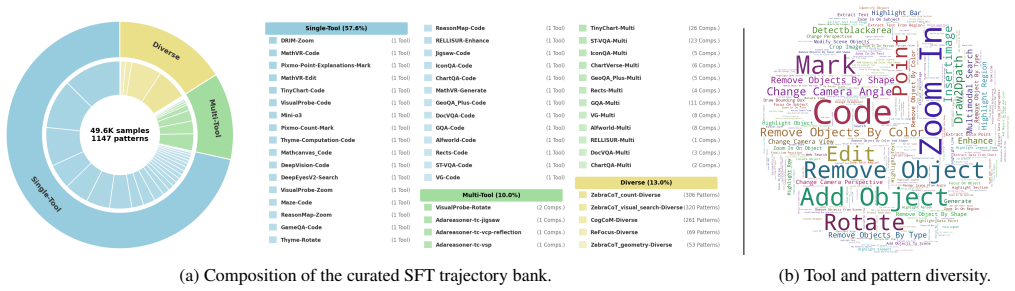
The central mechanism is the diverse-tool-context reinstantiation step: given an observed visual transition (input image, reasoning, output image), a strong VLM is asked to either match the operation to an existing tool or invent a new schema and arguments that realize the same transition. The observation is kept intact, so the model sees many different interfaces for the same underlying visual operation. This is combined with a plan-then-execute synthesizer for single- and multi-tool trajectories, and a two-stage training loop whose RL stage uses a five-dimension tool reward (plan coherence, call efficiency, feedback responsiveness, observation fidelity, visual grounding) to sharpen adaptiv
Load-bearing premise
The load-bearing premise is that relabeling an already-observed visual transition with a new tool schema—keeping the observation intact—teaches a capability that transfers to genuinely novel tools when those tools are actually executed at inference; if that transfer fails, the unseen-tool results reduce to schema-fitting rather than adaptation.
What would settle it
Run VC-Tooler on a held-out set of reinstantiated schemas never seen in training, and execute each call against a real tool environment with actual image transformations. If the schema-level success rate drops to chance or the model fails to call the tool at all when the observation is genuinely new, the adaptation claim collapses. The paper's S10 already shows a partial warning sign: E2 (wrong argument values) is unmoved after RL (682→717), meaning the reward's Visual Grounding dimension is not yet fixing misgrounded calls.
If this is right
- If visual tool use is compositional and adaptive, agentic multimodal models can be trained for arbitrary tool pools from synthesized trajectories, reducing the need for executable environments for every tool.
- The two-stage recipe (SFT plus tool-reward RL) transfers to unseen tools, suggesting that schema-conditioned tool invocation can be learned without per-tool training data.
- The approach improves general-purpose visual reasoning benchmarks, not just tool-use benchmarks, implying that tool-use training is a viable route to stronger perception.
- The RL tool reward, rather than simply encouraging tool calls, is what drives improvement; rewarding mere invocation can hurt performance.
- The model learns task-dependent tool-use strategies—mostly zoom on simple tasks, longer chains on agentic tasks—rather than a single fixed interaction pattern.
Where Pith is reading between the lines
- The reinstantiation assumption deserves scrutiny: because mock-schema trajectories never produce real environment feedback during training, the transfer to unseen tools may reflect schema-fitting to observed observations rather than true adaptation; a test that executes those schemas against real transformations would distinguish.
- The paper's own error analysis (S10) shows E2 (wrong argument values) and E5 (wrong reasoning from valid outputs) barely move after RL; if visual grounding of arguments remains the bottleneck, the next improvement likely comes from richer grounding supervision rather than more RL shaping.
- The 'relabel the transition, reuse the observation' trick may extend to other agentic domains, such as text-based tools or code execution, where interface diversity can be generated cheaply without new executors.
- Since the tool reward is a learned judge, its reliability limits the RL signal; if the judge cannot detect visually misgrounded arguments (E2), the policy may optimize for plausible-looking calls instead of correct ones.
Editorial analysis
A structured set of objections, weighed in public.
Referee Report
Summary. The paper presents VC-Tooler, a two-stage training pipeline (cold-start SFT followed by GRPO) that aims to teach a Qwen3-VL-8B backbone compositional and adaptive visual tool use. Training data is produced by a hierarchical trajectory synthesis pipeline: a plan-then-execute stage generates single- and multi-tool trajectories, and a reinstantiation stage relabels existing visual transitions with 1,000+ novel tool schemas. The paper claims state-of-the-art open-source results on general-purpose and agentic benchmarks (95.8% on V*, 35.3% on VTC-Bench), and zero-shot transfer to 11 unseen tools. The main evidence consists of Table 1, the ablations in Tables 2–3, the tool-call statistics in Section S9, and the error analysis in Section S10.
Significance. If the central claims hold, the hierarchical synthesis plus two-stage training recipe is a practical and reproducible contribution to training VLMs for tool-rich environments. The DirectSFT control in Table 2 is a clean attribution device: it shows the gains come from tool supervision rather than from SFT on the same data alone, and the ST/MT/DTC and reward-design ablations are well posed. However, the paper's distinctive claim—adaptation to genuinely novel tool interfaces—is currently supported only by schema-level success rates and by non-degradation under a mixed tool pool, not by evidence that the model correctly interprets real novel-tool outputs. The reward analysis also shows no improvement in the semantic grounding dimensions. These gaps are fixable with additional experiments, so I view this as a major revision rather than a rejection.
major comments (3)
- [§4.1, Eq. (4); Table S6; Fig. 5] The central 'adaptive visual tool use' claim is not established by the current evidence. In reinstantiation, the post-action observation o_k is kept intact from the original execution, and the 1,000+ mock interfaces are never executed during training. The model therefore learns to associate a new schema string with a pre-supplied observation. At inference, unseen tools are actually executed and return real observations, yet the only reported metric for them (Table S6) is schema-level execution success—how often a call is schema-valid and executes without error—not whether the model correctly interprets the real tool output and uses it to improve the final answer. Fig. 5's Mixed configuration measures overall accuracy, but this only shows that adding unseen tools does not hurt; it does not show that novel outputs are consumed. An answer-level or observation-utilization evaluation on tasks
- [§S10; §S5, Prompt 4] The tool reward's five binary dimensions are claimed to shape accurate tool use, with Visual Grounding targeting E2 (wrong argument values) and Observation Fidelity targeting E5 (incorrect reasoning from a valid tool output). Yet the paper's own error analysis shows E2 682→717 and E5 770→811 after RL, i.e., no improvement on exactly the dimensions that determine semantic correctness. The claim that RL encourages 'accurate … visual tool use' is therefore overstated. More importantly, this pattern raises the question of whether the Qwen3.5-Plus critic provides a reliable training signal for the failure modes that matter most for adaptation. Please report the reward model's agreement with human labels on these dimensions, or otherwise show that the Visual Grounding and Observation Fidelity scores correlate with downstream accuracy, before attributing the RL gains to grounded adaptation.
- [§5.3, Table 1] The 'state-of-the-art among open-source models' claim rests on comparisons in which each baseline is evaluated under its native tool configuration, while VC-Tooler uses a tool pool that includes code execution and an online image-edit model (Qwen-Image). This conflates model capability with the tool environment: a method with access to stronger tools may improve even if its tool-use policy is no better. The ablations in Table 2 are a good start, but a matched tool-pool comparison (same tools, same tool-call budget, same evaluation harness for all methods) is needed to support the SOTA claim as stated. If this is infeasible, the claim should be qualified as 'SOTA among open-source models under each method's native tool environment.'
minor comments (5)
- [Table 1] The column header is misaligned ('HRBench HRBench CharXiv MME-RW VTC-Bench TIR-Bench4K 8K DQ RQ'), making it difficult to map numbers to benchmarks. Please reformat.
- [§5.2 and §S2] The main text lists the seen training tools as zoom, rotate, enhance, code, mark, edit, while §S2 and the planning prompt include multimodal_search as a base training tool. Please clarify whether search is in the training pool.
- [§S6] The statement 'We will release the full dataset composition, source breakdown, and filtering scripts upon acceptance' should be replaced with a concrete data-availability statement in the final version.
- [Fig. 7] The figure lacks a legend explaining the hatched segments and the benchmark-to-bar mapping. The caption says 'per benchmark' but the x-axis is not labeled.
- [§S9, Table S6] The success rate for the 'others' tool is reported (97.1%) but the tool is not described in Table S4. Please define what 'others' covers.
Circularity Check
No significant circularity; the central claims rest on external benchmarks and the flagged passages are metric-validity limitations rather than definitional reductions.
full rationale
The claimed derivation chain is not circular. The central results in Table 1 are measured on external benchmarks (V*, HRBench, CharXiv, MME-RealWorld, VTC-Bench, TIR-Bench) with fixed evaluation protocols, so the SOTA claim does not reduce to the paper's own training objectives. The diverse-context reinstantiation step (§4.1, Eq. 4) does keep the observation o_k from the original execution and therefore limits what the mock-interface trajectories can teach about real novel-tool outputs; and Table S6's 'success' is explicitly schema-level execution success, not correctness of interpreting returned observations. These are legitimate empirical limitations of the adaptation claim, but they are not definitional: the 11 unseen test schemas are not part of the training pool, and schema-valid calls are not guaranteed by construction. Similarly, §S10's finding that RL reduces E4 ('tool result not used') is aligned with the tool reward's design (Prompt 4), so it is a mechanism check rather than independent evidence; the paper's main evidence for the reward's value is the external benchmark gain in Table 3. The single self-citation (Pan et al. 2026) is in related work and is not load-bearing. Sec. 7 acknowledges bounded tool spaces and short interaction horizons. Overall, the suspicious passages concern metric validity and generalization, not circular reduction.
Axiom & Free-Parameter Ledger
free parameters (4)
- Reward weights in Eq. 5 =
0.8 accuracy / 0.2 tool / 0.2 format
- Tool-reward criteria set =
5 binary dimensions averaged uniformly
- Difficulty and relevance filtering thresholds =
solved ≥4/8 attempts → discard; 8 attempts; 70–90% raw-candidate removal
- RL data filtering =
remove samples the base policy fails in 8 attempts; ~28K retained
axioms (6)
- domain assumption ReAct-style interleaved reasoning-and-acting is the correct operationalization of visual tool use (§3).
- domain assumption Large-Qwen trajectories and judgments are valid supervision for small-Qwen tool use.
- domain assumption Answer-conditioned planning does not leak the answer into execution (§4.1).
- ad hoc to paper Schema relabeling with inherited observations preserves the learning signal for adaptation (§4.1, Eq. 4).
- domain assumption LLM-as-judge correctness checks (Qwen-Max) are reliable enough to filter trajectories and score RL answers.
- domain assumption Benchmark scores (V*, HRBench, CharXiv, MME-RW, VTC-Bench, TIR-Bench) measure the claimed capabilities and are not contaminated by the training data sources.
Cite this review
Pith. "Pith review of VC-Tooler: Learning Compositional and Adaptive Visual Tool Use." pith.science (2026). https://pith.science/paper/K6XZZLPB
@misc{pith2026260802217,
  author       = {Pith},
  title        = {Pith review of: VC-Tooler: Learning Compositional and Adaptive Visual Tool Use},
  year         = {2026},
  howpublished = {\url{https://pith.science/paper/K6XZZLPB}},
  note         = {Machine review of arXiv:2608.02217}
}
abstract
Agentic multimodal reasoning extends passive image understanding by allowing VLMs to actively acquire and refine visual evidence through visual tool interactions. Effective visual tool use requires three capabilities: grounding tool calls in visual context, composing tools across multiple steps, and adapting reasoning to tool-returned observations. However, existing approaches largely focus on grounding within fixed tool spaces and rigid invocation patterns, leaving composition and adaptation insufficiently addressed. We present VC-Tooler, which learns visual tool use as a compositional and adaptive capability. To this end, we first build a trajectory bank through a hierarchical synthesis pipeline covering three capability levels: single-tool grounding, multi-tool composition, and diverse tool contexts and interfaces. We then train the model in two stages: a supervised cold start that establishes these capabilities, followed by reinforcement learning that encourages accurate, efficient, and context-aware visual tool use. VC-Tooler achieves state-of-the-art performance among open-source models on both general-purpose and agentic benchmarks, including $95.8\%$ on V* and $35.3\%$ on VTC-Bench, and shows promising transfer under richer tool settings at inference time. Project page: https://w1zheng.github.io/VC-Tooler
Figures




Reference graph
Works this paper leans on
-
[1]
frontal lobe
The unity and diversity of executive functions and their contributions to complex “frontal lobe” tasks: A latent variable analysis , author=. Cognitive psychology , volume=. 2000 , publisher=
2000
-
[2]
arXiv preprint arXiv:2506.23918 , year=
Thinking with images for multimodal reasoning: Foundations, methods, and future frontiers , author=. arXiv preprint arXiv:2506.23918 , year=
-
[3]
arXiv preprint arXiv:2601.12538 , year=
Agentic reasoning for large language models , author=. arXiv preprint arXiv:2601.12538 , year=
-
[4]
arXiv preprint arXiv:2505.15966 , year=
Pixel reasoner: Incentivizing pixel-space reasoning with curiosity-driven reinforcement learning , author=. arXiv preprint arXiv:2505.15966 , year=
-
[5]
Deepeyes: Incentivizing" thinking with images" via reinforcement learning , author=. arXiv preprint arXiv:2505.14362 , year=
-
[6]
arXiv preprint arXiv:2512.17306 , year=
Deep But Reliable: Advancing Multi-turn Reasoning for Thinking with Images , author=. arXiv preprint arXiv:2512.17306 , year=
-
[7]
arXiv preprint arXiv:2508.11630 , year=
Thyme: Think Beyond Images , author=. arXiv preprint arXiv:2508.11630 , year=
-
[8]
arXiv preprint arXiv:2512.02361 , year=
VACoT: Rethinking Visual Data Augmentation with VLMs , author=. arXiv preprint arXiv:2512.02361 , year=
-
[9]
arXiv preprint arXiv:2511.05271 , year=
Deepeyesv2: Toward agentic multimodal model , author=. arXiv preprint arXiv:2511.05271 , year=
-
[10]
arXiv preprint arXiv:2508.05748 , year=
Webwatcher: Breaking new frontier of vision-language deep research agent , author=. arXiv preprint arXiv:2508.05748 , year=
-
[11]
arXiv preprint arXiv:2505.22525 , year=
Thinking with generated images , author=. arXiv preprint arXiv:2505.22525 , year=
-
[12]
arXiv preprint arXiv:2507.16746 , year=
Zebra-cot: A dataset for interleaved vision language reasoning , author=. arXiv preprint arXiv:2507.16746 , year=
-
[13]
arXiv preprint arXiv:2512.16918 , year=
AdaTooler-V: Adaptive Tool-Use for Images and Videos , author=. arXiv preprint arXiv:2512.16918 , year=
-
[14]
arXiv preprint arXiv:2601.18631 , year=
AdaReasoner: Dynamic Tool Orchestration for Iterative Visual Reasoning , author=. arXiv preprint arXiv:2601.18631 , year=
-
[15]
arXiv preprint arXiv:2603.15030 , year=
VTC-Bench: Evaluating Agentic Multimodal Models via Compositional Visual Tool Chaining , author=. arXiv preprint arXiv:2603.15030 , year=
-
[16]
arXiv preprint arXiv:2511.01833 , year=
TIR-Bench: A Comprehensive Benchmark for Agentic Thinking-with-Images Reasoning , author=. arXiv preprint arXiv:2511.01833 , year=
-
[17]
V*: Guided visual search as a core mechanism in multimodal llms , author=
-
[18]
arXiv preprint arXiv:2507.07998 , year=
Pyvision: Agentic vision with dynamic tooling , author=. arXiv preprint arXiv:2507.07998 , year=
-
[19]
arXiv preprint arXiv:2512.18745 , year=
InSight-o3: Empowering Multimodal Foundation Models with Generalized Visual Search , author=. arXiv preprint arXiv:2512.18745 , year=
-
[20]
Farrar, Straus and Giroux , year=
Thinking, fast and slow , author=. Farrar, Straus and Giroux , year=
-
[21]
arXiv preprint arXiv:2507.05255 , year=
Open vision reasoner: Transferring linguistic cognitive behavior for visual reasoning , author=. arXiv preprint arXiv:2507.05255 , year=
-
[22]
Llava-cot: Let vision language models reason step-by-step , author=
-
[23]
R1-onevision: Advancing generalized multimodal reasoning through cross-modal formalization , author=
-
[24]
Through the Lens of Contrast: Self-Improving Visual Reasoning in VLMs , author=
-
[25]
arXiv preprint arXiv:2412.16720 , year=
Openai o1 system card , author=. arXiv preprint arXiv:2412.16720 , year=
-
[26]
arXiv preprint arXiv:2501.12948 , year=
Deepseek-r1: Incentivizing reasoning capability in llms via reinforcement learning , author=. arXiv preprint arXiv:2501.12948 , year=
-
[27]
Apigen: Automated pipeline for generating verifiable and diverse function-calling datasets , author=
-
[28]
arXiv preprint arXiv:2511.15718 , year=
ToolMind Technical Report: A Large-Scale, Reasoning-Enhanced Tool-Use Dataset , author=. arXiv preprint arXiv:2511.15718 , year=
-
[29]
arXiv preprint arXiv:2504.11536 , year=
Retool: Reinforcement learning for strategic tool use in llms , author=. arXiv preprint arXiv:2504.11536 , year=
-
[30]
arXiv preprint arXiv:2602.15763 , year=
Glm-5: from vibe coding to agentic engineering , author=. arXiv preprint arXiv:2602.15763 , year=
-
[31]
Introducing Agentic Vision in Gemini 3 Flash , year =
-
[32]
arXiv preprint arXiv:2210.03629 , year=
React: Synergizing reasoning and acting in language models , author=. arXiv preprint arXiv:2210.03629 , year=
-
[33]
arXiv preprint arXiv:2505.09388 , year=
Qwen3 technical report , author=. arXiv preprint arXiv:2505.09388 , year=
-
[34]
arXiv preprint arXiv:2509.23661 , year=
Llava-onevision-1.5: Fully open framework for democratized multimodal training , author=. arXiv preprint arXiv:2509.23661 , year=
-
[35]
arXiv preprint arXiv:2408.03326 , year=
Llava-onevision: Easy visual task transfer , author=. arXiv preprint arXiv:2408.03326 , year=
-
[36]
arXiv preprint arXiv:2402.03300 , year=
Deepseekmath: Pushing the limits of mathematical reasoning in open language models , author=. arXiv preprint arXiv:2402.03300 , year=
-
[37]
Swift: a scalable lightweight infrastructure for fine-tuning , author=
-
[38]
Proceedings of the Twentieth European Conference on Computer Systems , pages=
Hybridflow: A flexible and efficient rlhf framework , author=. Proceedings of the Twentieth European Conference on Computer Systems , pages=
-
[39]
Divide, conquer and combine: A training-free framework for high-resolution image perception in multimodal large language models , author=
-
[40]
Charxiv: Charting gaps in realistic chart understanding in multimodal llms , author=
-
[41]
Mme-realworld: Could your multimodal llm challenge high-resolution real-world scenarios that are difficult for humans? , author=
-
[42]
Thinking with images , year =
- [43]
-
[44]
arXiv preprint arXiv:2512.17312 , year=
CodeDance: A Dynamic Tool-integrated MLLM for Executable Visual Reasoning , author=. arXiv preprint arXiv:2512.17312 , year=
-
[45]
arXiv preprint arXiv:2601.13606 , year=
ChartVerse: Scaling Chart Reasoning via Reliable Programmatic Synthesis from Scratch , author=. arXiv preprint arXiv:2601.13606 , year=
-
[46]
arXiv preprint arXiv:2509.07969 , year=
Mini-o3: Scaling up reasoning patterns and interaction turns for visual search , author=. arXiv preprint arXiv:2509.07969 , year=
-
[47]
arXiv preprint arXiv:2504.10479 , year=
Internvl3: Exploring advanced training and test-time recipes for open-source multimodal models , author=. arXiv preprint arXiv:2504.10479 , year=
-
[48]
arXiv preprint arXiv:1711.05101 , year=
Decoupled weight decay regularization , author=. arXiv preprint arXiv:1711.05101 , year=
-
[49]
arXiv preprint arXiv:2602.16742 , year=
DeepVision-103K: A Visually Diverse, Broad-Coverage, and Verifiable Mathematical Dataset for Multimodal Reasoning , author=. arXiv preprint arXiv:2602.16742 , year=
-
[50]
arXiv preprint arXiv:2511.21395 , year=
Monet: Reasoning in latent visual space beyond images and language , author=. arXiv preprint arXiv:2511.21395 , year=
-
[51]
arXiv preprint arXiv:2511.19773 , year=
Scaling Agentic Reinforcement Learning for Tool-Integrated Reasoning in VLMs , author=. arXiv preprint arXiv:2511.19773 , year=
-
[52]
arXiv preprint arXiv:2508.02324 , year=
Qwen-image technical report , author=. arXiv preprint arXiv:2508.02324 , year=
This paper was first reviewed by deepseek-v4-flash on August 4, 2026.
discussion (0)
Sign in with ORCID, Apple, or X to comment. Anyone can read and Pith papers without signing in.