REVIEW 2 major objections 5 minor 134 references
Interacting many-body non-Hermitian systems as Markov chains
T0 review · 2 major / 5 minor · reviewed 2026-08-05 · deepseek-v4-flash
Pith's one-line read This paper proposes a general dictionary that recasts interacting non-Hermitian quantum many-body Hamiltonians as continuous-time Markov chains, and shows that the stochastic steady states exhibit Fermi-Dirac-like spatial profiles and parit
desk verdict Useful dictionary, exact spin-flip steady states, but the Fermi-Dirac headline is a mean-field approximation displayed in a regime where its own supplement shows it fails quantitatively. read the letter →
The pith
A machine-rendered reading of the paper's core claim, the machinery that carries it, and where it could break.
The reading
What carries the argument
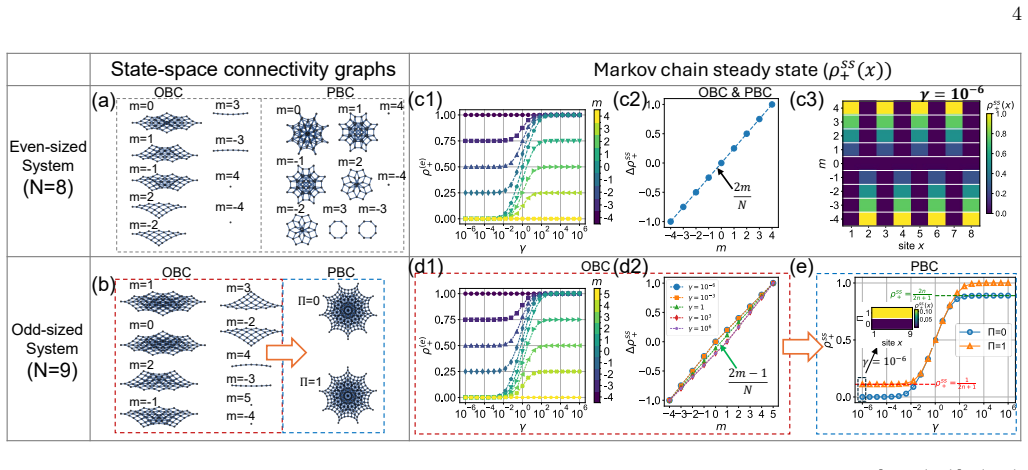
The central object is the Markov-chain Laplacian L = D - H, where H is the original non-Hermitian many-body Hamiltonian and D is a diagonal operator chosen so that every column of L sums to zero. This converts the transition amplitudes of H into probability-conserving rates; the zero-eigenvalue eigenvector of L is the steady state. For the first model the machinery reduces to a K-exclusion (partial asymmetric exclusion) process; for the second, to a kinetically constrained pair-flipping process whose conserved quantities are the Néel invariant m (even N or odd-N OBC) or the parity Π (odd-N PBC).
What would settle it
Exact numerical steady state of the K-exclusion process (e.g., N=10, n=5, nmax=2, λ+=0.1, λ-=1) compared against Eq. (8) would settle the quantitative validity of the Fermi-Dirac form; the supplement's own Fig. S3 indicates visible deviations in this regime. Separately, computing the exact steady state of the correlated spin-flip model for N=8 and fixed m directly tests the linear relation Δρ=2m/N.
Extended reading notes
Core claim
The central claim is that any many-body non-Hermitian Hamiltonian can be reinterpreted as a Markov-chain generator L = D - H, where D is a diagonal operator that enforces probability conservation. This preserves all state transitions while changing the equation of motion from Schrödinger to a master equation, so real non-negative amplitudes evolve as probabilities. In the interacting Hatano-Nelson chain (with site-occupancy cap nmax), the resulting stochastic process is the K-exclusion process, whose open-boundary steady state is shown to be the Fermi-Dirac form ρ(x)=nmax/(1+e^{(x-x0)/k_B T_eff}) with k_B T_eff=1/ln(λ-/λ+). In the correlated spin-flip model, the Laplacian fragments the state
Load-bearing premise
The Fermi-Dirac-like steady-state formula for the interacting Hatano-Nelson chain rests on a mean-field factorization that ignores correlations between neighboring occupations; the supplement itself limits the approximation to weak hopping asymmetry.
Editorial extensions
If this is right
- The interacting Hatano-Nelson chain, viewed stochastically, has a unique zero-mode steady state that all initial conditions converge to, so the Fermi-Dirac-like density profile is a universal attractor for the stochastic process—unlike the quantum case where no such attractor exists.
- The anti-correlated spin-flip model reduces exactly to the nmax=1 interacting Hatano-Nelson model, so its steady state follows the same Fermi-Dirac-like profile with u+/u- playing the role of the asymmetry.
- The correlated spin-flip model exhibits state-space fragmentation: the steady-state profile depends on the initial Néel order m, and the odd/even density contrast grows linearly as 2m/N, so an initial imbalance imprints itself permanently on the final spatial profile.
- Under periodic boundary conditions with odd N, only the parity of the number of + particles survives as a conserved quantity; this yields uniform steady states, one of which cannot reach full polarization no matter how strong the asymmetry.
- The paper argues these results reveal robust signatures of non-Hermitian phenomena in classical stochastic settings such as ecological networks, traffic flow, and social opinion dynamics.
Reading between the lines
- The mapping likely extends beyond the two models: any non-Hermitian many-body Hamiltonian with non-negative off-diagonal transition amplitudes admits a Markov-chain counterpart, so the framework could be used to engineer classical stochastic simulators of many-body non-Hermitian skin effects and related phenomena.
- The Fermi-Dirac steady state implies a dictionary between nonreciprocity strength and an effective temperature in real space; one could test in a simple exclusion experiment whether tuning λ+/λ- across 1 produces negative-temperature distributions.
- For the correlated spin-flip model, the linear relation Δρ=2m/N suggests a robust measurable probe: in an opinion-dynamics or agent-based setting, a persistent even-odd bias encodes the initial imbalance m, providing a form of initial-state memory without energetic barriers.
Editorial analysis
A structured set of objections, weighed in public.
Referee Report
Summary. The paper introduces a mapping between non-Hermitian many-body quantum Hamiltonians and continuous-time Markov chains. Given a Hamiltonian H whose off-diagonal matrix elements are nonnegative, one defines L=D-H with D chosen so that columns sum to zero; the state amplitudes become probabilities and evolve by exp(-Lt). Two models are studied: (i) the interacting Hatano-Nelson model with exclusion, mapped to a K-exclusion process, for which a Fermi-Dirac-like steady-state profile Eq. (8) is derived; (ii) a correlated spin-flip model, whose state space fragments into sectors labelled by a Néel imbalance m (even N, OBC/PBC) or parity Π (odd N, PBC), with exact staggered steady states Eqs. (12)-(15). The paper emphasizes that quantum and stochastic interpretations share transitions but differ in steady-state and dynamical behavior.
Significance. If the Fermi-Dirac claim is properly qualified, the paper is a valuable contribution: it gives a clean dictionary (L=D-H), and the correlated spin-flip steady states are exact and nontrivial. I verified the detailed-balance structure: the weight ψ∝γ^{n_tot/2} balances every single pair-flip edge, so Eqs. (13)-(15) and S53/S64 follow. The state-space fragmentation and boundary-condition dependence are clearly demonstrated. The main weakness is the unsupported quantitative status of Eq. (8) in the strong-asymmetry regime used in the main text.
major comments (2)
- [HN model with exclusion interactions, Eq. (8) and Supplement S1.2, Fig. S3] Equation (8) is stated as an equality, but its derivation uses the mean-field factorization Eq. (S5). Supplement S1.2 itself concludes the approximation is valid when hopping asymmetry is weak, because the error is proportional to (λ_- - λ_+)(ε_{x,x+1} - ε_{x,x-1}). The main text's Fig. 1 uses λ_+=0.1, λ_-=1, nmax=2, a strongly asymmetric regime; the supplement's Fig. S3, at nmax=1, shows visible deviations between exact numerics and the analytic FD form at this ratio. No nmax=2 benchmark is given. Thus the quantitative FD profile (including the value of k_B T_eff) is not supported in the displayed parameter regime and should be presented as a mean-field approximation with its validity condition, or verified numerically in that regime.
- [Markov chain formalism, Eqs. (4)-(7)] The construction L=D-H is only a Markov generator if all off-diagonal matrix elements of H are nonnegative (real) in the chosen basis; otherwise L's off-diagonal entries are positive, corresponding to negative transition rates. The text says 'any given quantum Hamiltonian H' can be mapped. This is too broad; many non-Hermitian many-body Hamiltonians have negative or complex hoppings. The authors should state the positivity condition and clarify whether their formalism is intended for the class of stochastic-rate-compatible Hamiltonians. This does not affect the two examples (whose couplings are nonnegative rates), but it is load-bearing for the claimed generality.
minor comments (5)
- [Eq. (8) and Supplement S1.3] The main text uses x0=n/nmax in Eq. (8), while S1.3 derives x0≈n/nmax+1/2. This shift affects the quantitative profile and should be reconciled.
- [Supplement Fig. S3] Fig. S3 benchmarks only nmax=1. Since main-text Fig. 1 uses nmax=2, an nmax=2 comparison between exact numerics and the analytic form would be helpful, even if only as a supplement.
- [Supplement Eqs. (S15) and (S24)] Two effective temperatures are defined: k_B T^(site)_eff=(λ_-+λ_+)/(2(λ_- - λ_+)) and k_B T^(current)_eff=1/ln(λ_-/λ_+). The main text uses the latter without noting that the two coincide only in the weak-asymmetry limit.
- [Eq. (1)] The boson normalization is nonstandard: \hat b_x|n_x⟩=n_x|n_x-1⟩ without the usual sqrt factor. This convention should be stated explicitly at first use, since it affects all matrix elements.
- [Eq. (4)] The phrase 'considerable freedom' in choosing D should be sharpened: D must be a diagonal matrix with nonnegative entries such that each column of L=D-H sums to zero, so that L is a valid Markov-chain Laplacian.
Circularity Check
No significant circularity: steady states are solved from the generators, self-citations are contextual, and the mean-field caveat on Eq. (8) is a correctness issue, not circularity.
full rationale
The central construction L = D - H is definitional as a mapping, but the paper's claimed results are derived properties of that mapping, not inputs. The interacting Hatano-Nelson steady state in Eq. (8) is obtained in the supplement by writing the exact steady-state condition (S4), applying the explicitly stated mean-field factorization (S5), and then solving the resulting zero-current recursion (S23). The parameters lambda_+, lambda_-, n_max, and the integration constant x0 (fixed by particle-number conservation, S1.1) are all Hamiltonian inputs or conservation-determined; none is fitted to the quantity being predicted. The supplement itself (S1.2) analyzes the validity of the mean-field approximation and shows deviations at strong asymmetry (Fig. S3); the main-text Fig. 1 uses lambda_+/lambda_- = 0.1, which is in that regime. This is a genuine accuracy limitation and a potential correctness concern, but it is not circularity: the claim is a controlled approximation, not a renaming of an input or a fitted parameter presented as a prediction. The correlated spin-flip steady states in Eqs. (12)-(14) and the odd-N/PBC results are analytically derived from the Laplacian via detailed-balance weights, Perron-Frobenius uniqueness, and the exact conserved quantity m (Eq. 11); Delta rho_+^ss = 2m/N follows from those derived formulas rather than being imposed. Self-citations (e.g., refs. [3], [27], [29]) are used for context about quantum Fermi-skin and NHSE profiles, not as the load-bearing justification for the Markov-chain steady states; the key uniqueness theorem cited is the external Perron-Frobenius theorem [133]. I therefore find no step where a prediction reduces by construction to its own inputs, and assign a score of 1 reflecting only the presence of minor, non-load-bearing self-citation and a documented approximation caveat.
Assumptions & free parameters
assumptions (5)
- domain assumption A diagonal matrix D can always be chosen so that L=D-H is a column-stochastic generator whose off-diagonal rates equal the Hamiltonian hopping amplitudes.
- ad hoc to paper Mean-field factorization of two-point correlations, Eq. (S5): Σ_i ψ_i n_i(x)n_i(x±1) ≈ ρ(x)ρ(x±1).
- standard math Finite irreducible Markov generators have a unique zero mode to which all initial states relax (Perron-Frobenius).
- domain assumption Each m-sector (even N) and each parity sector (odd N, PBC) of the correlated spin-flip state space is connected.
- standard math The single-pair-flip graph admits the product-form stationary weight ψ∝γ^{n_tot/2}, which satisfies detailed balance on every edge.
Cite this review
Pith. "Pith review of Interacting many-body non-Hermitian systems as Markov chains." pith.science (2026). https://pith.science/paper/K6Y2OBRO
@misc{pith2026250905411,
  author       = {Pith},
  title        = {Pith review of: Interacting many-body non-Hermitian systems as Markov chains},
  year         = {2026},
  howpublished = {\url{https://pith.science/paper/K6Y2OBRO}},
  note         = {Machine review of arXiv:2509.05411}
}
read the original abstract
Rich phenomenology emerges at the intersection of non-Hermiticity and many-body dynamics, yet physically realizable implementations remain challenging. In this work, we propose a general formalism that maps non-Hermitian many-body Hamiltonians to the Laplacians of Markov chains, such that wavefunction amplitudes are re-interpreted as stochastic many-body configuration probabilities. Despite explicitly preserving all state transition processes and inheriting analogous non-Hermitian localization and state-space fragmentation, our Markov chain processes exhibit distinct steady-state behavior independently of energetic considerations that govern quantum evolution. We demonstrate our framework with two contrasting representative scenarios, one involving asymmetric (biased) propagation with exclusion interactions, and the other involving flipping pairs of adjacent spins (agents). These results reveal robust and distinctive signatures of non-Hermitian phenomena in classical stochastic settings such as ecological and social networks, and provide a versatile framework for studying non-reciprocal many-body dynamics across and beyond physics.
Figures

Reference graph
Works this paper leans on
-
[1]
D. Zou, T. Chen, W. He, J. Bao, C. H. Lee, H. Sun, and X. Zhang, Observation of hybrid higher-order skin- topological effect in non-hermitian topolectrical circuits, Nature Communications12, 7201 (2021)
2021
- [2]
-
[3]
R. Shen, T. Chen, B. Yang, and C. H. Lee, Observa- tion of the non-hermitian skin effect and fermi skin on a digital quantum computer, Nature Communications 16, 1340 (2025)
2025
-
[4]
J. M. Koh, W.-T. Xue, T. Tai, D. E. Koh, and C. H. Lee, Interacting non-hermitian edge and cluster bursts on a digital quantum processor (2025), arXiv:2503.14595 [quant-ph]
arXiv 2025
-
[5]
E. Zhao, Z. Wang, C. He, T. F. J. Poon, K. K. Pak, Y.-J. Liu, P. Ren, X.-J. Liu, and G.-B. Jo, Two-dimensional non-hermitian skin effect in an ultracold fermi gas, Na- ture637, 565 (2025)
2025
-
[6]
Y. Liu, T. Hao, W. Li, J. Capmany, N. Zhu, and M. Li, Observation of parity-time symmetry in microwave pho- tonics, Light: Science & Applications7, 38 (2018)
2018
-
[7]
R. Shen, F. Qin, J.-Y. Desaules, Z. Papi´ c, and C. H. Lee, Enhanced many-body quantum scars from the non- 6 hermitian fock skin effect, Physical Review Letters133, 216601 (2024)
2024
-
[8]
D. Zou, T. Chen, H. Meng, Y. S. Ang, X. Zhang, and C. H. Lee, Experimental observation of exceptional bound states in a classical circuit network, Science Bul- letin69, 2194 (2024)
2024
Show all 134 references
-
[9]
Z. Gu, H. Gao, H. Xue, J. Li, Z. Su, and J. Zhu, Tran- sient non-hermitian skin effect, Nature Communications 13, 7668 (2022)
2022
-
[10]
Ashida, Z
Y. Ashida, Z. Gong, and M. Ueda, Non-hermitian physics, Advances in Physics69, 249 (2020)
2020
-
[11]
E. J. Bergholtz, J. C. Budich, and F. K. Kunst, Ex- ceptional topology of non-hermitian systems, Reviews of Modern Physics93, 015005 (2021)
2021
-
[12]
T. E. Lee, Anomalous edge state in a non-hermitian lattice, Physical review letters116, 133903 (2016)
2016
-
[13]
Z. Gong, Y. Ashida, K. Kawabata, K. Takasan, S. Hi- gashikawa, and M. Ueda, Topological phases of non- hermitian systems, Physical Review X8, 031079 (2018)
2018
-
[14]
Kawabata, K
K. Kawabata, K. Shiozaki, M. Ueda, and M. Sato, Sym- metry and topology in non-hermitian physics, Physical Review X9, 041015 (2019)
2019
-
[15]
Yao and Z
S. Yao and Z. Wang, Edge states and topological invari- ants of non-hermitian systems, Physical review letters 121, 086803 (2018)
2018
-
[16]
Yokomizo and S
K. Yokomizo and S. Murakami, Non-bloch band theory of non-hermitian systems, Physical review letters123, 066404 (2019)
2019
-
[17]
S. Yao, F. Song, and Z. Wang, Non-hermitian chern bands, Physical review letters121, 136802 (2018)
2018
-
[18]
Okuma, K
N. Okuma, K. Kawabata, K. Shiozaki, and M. Sato, Topological origin of non-hermitian skin effects, Physi- cal review letters124, 086801 (2020)
2020
-
[19]
C. H. Lee and R. Thomale, Anatomy of skin modes and topology in non-hermitian systems, Physical Review B 99, 201103 (2019)
2019
-
[20]
F. K. Kunst, E. Edvardsson, J. C. Budich, and E. J. Bergholtz, Biorthogonal bulk-boundary correspondence in non-hermitian systems, Physical review letters121, 026808 (2018)
2018
-
[21]
Xiong, Why does bulk boundary correspondence fail in some non-hermitian topological models, Journal of Physics Communications2, 035043 (2018)
Y. Xiong, Why does bulk boundary correspondence fail in some non-hermitian topological models, Journal of Physics Communications2, 035043 (2018)
2018
-
[22]
F. Song, S. Yao, and Z. Wang, Non-hermitian skin effect and chiral damping in open quantum systems, Physical review letters123, 170401 (2019)
2019
-
[23]
Longhi, Probing non-hermitian skin effect and non- bloch phase transitions, Physical Review Research1, 023013 (2019)
S. Longhi, Probing non-hermitian skin effect and non- bloch phase transitions, Physical Review Research1, 023013 (2019)
2019
-
[24]
L. Xiao, T. Deng, K. Wang, G. Zhu, Z. Wang, W. Yi, and P. Xue, Non-hermitian bulk–boundary correspon- dence in quantum dynamics, Nature Physics16, 761 (2020)
2020
-
[25]
Helbig, T
T. Helbig, T. Hofmann, S. Imhof, M. Abdelghany, T. Kiessling, L. Molenkamp, C. Lee, A. Szameit, M. Greiter, and R. Thomale, Generalized bulk– boundary correspondence in non-hermitian topolectri- cal circuits, Nature Physics16, 747 (2020)
2020
-
[26]
L. Li, C. H. Lee, S. Mu, and J. Gong, Critical non- hermitian skin effect, Nature communications11, 5491 (2020)
2020
-
[27]
Shen and C
R. Shen and C. H. Lee, Non-hermitian skin clusters from strong interactions, Communications Physics5, 238 (2022)
2022
-
[28]
Li and C
L. Li and C. H. Lee, Non-hermitian pseudo-gaps, Sci- ence Bulletin67, 685 (2022)
2022
-
[29]
Shimomura and M
K. Shimomura and M. Sato, General criterion for non- hermitian skin effects and application: Fock space skin effects in many-body systems, Physical Review Letters 133, 136502 (2024)
2024
-
[30]
F. Qin, R. Shen, and C. H. Lee, Non-hermitian squeezed polarons, Physical Review A107, L010202 (2023)
2023
-
[31]
Jiang and C
H. Jiang and C. H. Lee, Dimensional transmutation from non-hermiticity, Physical Review Letters131, 076401 (2023)
2023
-
[32]
Yoshida, S.-B
T. Yoshida, S.-B. Zhang, T. Neupert, and N. Kawakami, Non-hermitian mott skin effect, Physical Review Letters 133, 076502 (2024)
2024
-
[33]
Arouca, C
R. Arouca, C. Lee, and C. Morais Smith, Unconven- tional scaling at non-hermitian critical points, Physical Review B102, 245145 (2020)
2020
-
[34]
C. H. Lee, Many-body topological and skin states with- out open boundaries, Physical Review B104, 195102 (2021)
2021
-
[35]
H. Wang, J. Zhong, and S. Fan, Non-hermitian photonic band winding and skin effects: a tutorial, Advances in Optics and Photonics16, 659 (2024)
2024
-
[36]
R. Lin, T. Tai, L. Li, and C. H. Lee, Topological non- hermitian skin effect, Frontiers of Physics18, 53605 (2023)
2023
-
[37]
F. Qin, R. Shen, L. Li, and C. H. Lee, Kinked linear response from non-hermitian cold-atom pumping, Phys- ical Review A109, 053311 (2024)
2024
-
[38]
F. Qin, Y. Ma, R. Shen, C. H. Lee,et al., Universal com- petitive spectral scaling from the critical non-hermitian skin effect, Physical Review B107, 155430 (2023)
2023
-
[39]
S. Liu, H. Jiang, W.-T. Xue, Q. Li, J. Gong, X. Liu, and C. H. Lee, Non-hermitian entanglement dip from scaling-induced exceptional criticality, arXiv preprint arXiv:2408.02736 (2024)
2024 arXiv
-
[40]
Y. Yang, B. Yang, G. Ma, J. Li, S. Zhang, and C. Chan, Non-abelian physics in light and sound, Science383, eadf9621 (2024)
2024
-
[41]
Gliozzi, G
J. Gliozzi, G. De Tomasi, and T. L. Hughes, Many- body non-hermitian skin effect for multipoles, Physical Review Letters133, 136503 (2024)
2024
-
[42]
G.-G. Liu, S. Mandal, P. Zhou, X. Xi, R. Banerjee, Y.- H. Hu, M. Wei, M. Wang, Q. Wang, Z. Gao,et al., Localization of chiral edge states by the non-hermitian skin effect, Physical Review Letters132, 113802 (2024)
2024
-
[43]
C.-A. Li, B. Trauzettel, T. Neupert, and S.-B. Zhang, Enhancement of Second-Order Non-Hermitian Skin Ef- fect by Magnetic Fields, Phys. Rev. Lett.131, 116601 (2022)
2022
-
[44]
H. Meng, Y. S. Ang, and C. H. Lee, Generalized Bril- louin Zone Fragmentation (2025), arXiv:2508.13275
2025
-
[45]
Non-Hermitian skin effect along hyperbolic geodesics, Phys. Rev. B111, 045420 (2025)
2025
-
[46]
C. H. Lee, Exceptional bound states and negative entan- glement entropy, Physical Review Letters128, 010402 (2022)
2022
-
[47]
Q. Li, H. Jiang, and C. H. Lee, Phase-space gener- alized brillouin zone for spatially inhomogeneous non- hermitian systems, arXiv preprint arXiv:2501.09785 (2025)
2025 arXiv
-
[48]
L. Li, Y. Wei, G. Wu, Y. Ruan, S. Chen, C. H. Lee, and Z. Ni, Exact solutions disentangle higher-order topology in two-dimensional non-Hermitian lattices, Phys. Rev. 7 B111, 075132 (2025)
2025
-
[49]
Zhang, G
X. Zhang, G. Li, Y. Liu, T. Tai, R. Thomale, and C. H. Lee, Tidal surface states as fingerprints of non- hermitian nodal knot metals, Communications Physics 4, 47 (2021)
2021
-
[50]
Fruchart, R
M. Fruchart, R. Hanai, P. B. Littlewood, and V. Vitelli, Non-reciprocal phase transitions, Nature592, 363 (2021)
2021
-
[51]
Hanai, A
R. Hanai, A. Edelman, Y. Ohashi, and P. B. Littlewood, Non-hermitian phase transition from a polariton bose- einstein condensate to a photon laser, Physical review letters122, 185301 (2019)
2019
-
[52]
Hanai, Nonreciprocal frustration: Time crystalline order-by-disorder phenomenon and a spin-glass-like state, Physical Review X14, 011029 (2024)
R. Hanai, Nonreciprocal frustration: Time crystalline order-by-disorder phenomenon and a spin-glass-like state, Physical Review X14, 011029 (2024)
2024
-
[53]
Y. Jin, W. Zhong, R. Cai, X. Zhuang, Y. Pennec, and B. Djafari-Rouhani, Exceptional points and skin modes in non-hermitian metabeams, Applied Physics Letters 121, 022202 (2022)
2022
-
[54]
A. Li, H. Wei, M. Cotrufo, W. Chen, S. Mann, X. Ni, B. Xu, J. Chen, J. Wang, S. Fan, C.-W. Qiu, A. Al` u, and L. Chen, Exceptional points and non-Hermitian photon- ics at the nanoscale, Nat. Nanotechnol.18, 706 (2023)
2023
-
[55]
W. Zhao, Y. Zhang, Z. Gao, D. Peng, J.-l. Kou, Y.- q. Lu, R. El-Ganainy, c. K. ¨Ozdemir, and Q. Zhong, Exceptional points induced by unidirectional coupling in electronic circuits, Nat. Commun.15, 9907 (2024)
2024
-
[56]
Hamazaki, K
R. Hamazaki, K. Kawabata, and M. Ueda, Non- hermitian many-body localization, Physical review let- ters123, 090603 (2019)
2019
-
[57]
Nakagawa, N
M. Nakagawa, N. Kawakami, and M. Ueda, Non- hermitian kondo effect in ultracold alkaline-earth atoms, Physical review letters121, 203001 (2018)
2018
-
[58]
S. Mu, C. H. Lee, L. Li, and J. Gong, Emergent fermi surface in a many-body non-hermitian fermionic chain, Phys. Rev. B102, 081115 (2020)
2020
-
[59]
Qin and L
Y. Qin and L. Li, Occupation-dependent particle sepa- ration in one-dimensional non-hermitian lattices, Phys. Rev. Lett.132, 096501 (2024)
2024
-
[60]
Hamanaka and K
S. Hamanaka and K. Kawabata, Multifractality of the many-body non-Hermitian skin effect, Phys. Rev. B 111, 035144 (2025)
2025
-
[61]
Suthar, Y.-C
K. Suthar, Y.-C. Wang, Y.-P. Huang, H. Jen, and J.-S. You, Non-hermitian many-body localization with open boundaries, Physical Review B106, 064208 (2022)
2022
-
[62]
Y. Qin, Y. S. Ang, C. H. Lee, and L. Li, Many-body crit- ical non-Hermitian skin effect (2025), arXiv:2506.01383
2025
-
[63]
Liang, D
Q. Liang, D. Xie, Z. Dong, H. Li, H. Li, B. Gad- way, W. Yi, and B. Yan, Dynamic signatures of non- hermitian skin effect and topology in ultracold atoms, Phys. Rev. Lett.129, 070401 (2022)
2022
-
[64]
Wan and Z
T. Wan and Z. Yang, Non-hermitian interacting quan- tum walks of correlated photons, Communications Physics8, 131 (2025)
2025
-
[65]
E. P. Kao,An introduction to stochastic processes (Courier Dover Publications, 2019)
2019
-
[66]
Z. Ren, D. Liu, E. Zhao, C. He, K. K. Pak, J. Li, and G.-B. Jo, Chiral control of quantum states in non- hermitian spin–orbit-coupled fermions, Nature Physics 18, 385 (2022)
2022
-
[67]
Wang, Y.-J
H. Wang, Y.-J. Zhao, and X.-W. Xu, Controllable non-Hermitian qubit–qubit coupling in superconducting quantum circuit, APL Quantum1, 10.1063/5.0217493 (2024)
2024 doi
-
[68]
D. C. Ohnmacht, V. Wilhelm, H. Weisbrich, and W. Belzig, Non-Hermitian Topology in Multitermi- nal Superconducting Junctions, Phys. Rev. Lett.134, 156601 (2025)
2025
-
[69]
W. Chen, M. Abbasi, Y. N. Joglekar, and K. W. Murch, Quantum Jumps in the Non-Hermitian Dynamics of a Superconducting Qubit, Phys. Rev. Lett.127, 140504 (2021)
2021
-
[70]
Merris, A survey of graph laplacians, Linear and Mul- tilinear Algebra39, 19 (1995)
R. Merris, A survey of graph laplacians, Linear and Mul- tilinear Algebra39, 19 (1995)
1995
-
[71]
Mirzaev and J
I. Mirzaev and J. Gunawardena, Laplacian dynamics on general graphs, Bulletin of mathematical biology75, 2118 (2013)
2013
-
[72]
Shirazi, G
A. Shirazi, G. R. Jafari, J. Davoudi, J. Peinke, M. R. R. Tabar, and M. Sahimi, Mapping stochastic processes onto complex networks, Journal of Statistical Mechan- ics: Theory and Experiment2009, P07046 (2009)
2009
-
[73]
Radicchi and C
F. Radicchi and C. Castellano, Uncertainty reduction for stochastic processes on complex networks, Physical review letters120, 198301 (2018)
2018
-
[74]
Lotka, Elements of physical biology, Williams and Wilkins (1925)
A. Lotka, Elements of physical biology, Williams and Wilkins (1925)
1925
-
[75]
A. J. Lotka, Fluctuations in the abundance of a species considered mathematically, Nature119, 12 (1927)
1927
-
[76]
Volterra, Fluctuations in the abundance of a species considered mathematically, Nature119, 12 (1927)
V. Volterra, Fluctuations in the abundance of a species considered mathematically, Nature119, 12 (1927)
1927
-
[77]
Royama,Analytical population dynamics, Vol
T. Royama,Analytical population dynamics, Vol. 10 (Springer Science & Business Media, 2012)
2012
-
[78]
Newman, S
K. Newman, S. Buckland, B. J. Morgan, R. King, D. Borchers, D. J. Cole, P. Besbeas, O. Gimenez, and L. Thomas, Modelling population dynamics, Modelling Population Dynamics: Model Formulation, Fitting and Assessment using State-Space Methods. Springer New York, New York, USA , ...
2014
-
[79]
Tuljapurkar,Population dynamics in variable envi- ronments, Vol
S. Tuljapurkar,Population dynamics in variable envi- ronments, Vol. 85 (Springer Science & Business Media, 2013)
2013
-
[80]
J. K. Goeree and C. A. Holt, Stochastic game theory: For playing games, not just for doing theory, Proceed- ings of the National Academy of sciences96, 10564 (1999)
1999
-
[81]
Traulsen and C
A. Traulsen and C. Hauert, Stochastic evolutionary game dynamics, Reviews of nonlinear dynamics and complexity2, 25 (2009)
2009
-
[82]
M. L. Bertotti and M. Delitala, From discrete kinetic and stochastic game theory to modelling complex sys- tems in applied sciences, Mathematical Models and Methods in Applied Sciences14, 1061 (2004)
2004
-
[83]
Whitt, Stochastic-process limits: an introduction to stochastic-process limits and their application to queues, Space500, 391 (2002)
W. Whitt, Stochastic-process limits: an introduction to stochastic-process limits and their application to queues, Space500, 391 (2002)
2002
-
[84]
Borovkov,Stochastic processes in queueing theory, Vol
A. Borovkov,Stochastic processes in queueing theory, Vol. 4 (Springer Science & Business Media, 2012)
2012
-
[85]
D. G. Kendall, Stochastic processes occurring in the the- ory of queues and their analysis by the method of the imbedded markov chain, The Annals of Mathematical Statistics , 338 (1953)
1953
-
[86]
Nelson,Probability, stochastic processes, and queue- ing theory: the mathematics of computer performance modeling(Springer Science & Business Media, 2013)
R. Nelson,Probability, stochastic processes, and queue- ing theory: the mathematics of computer performance modeling(Springer Science & Business Media, 2013)
2013
-
[87]
Sawada, K
T. Sawada, K. Sone, R. Hamazaki, Y. Ashida, and T. Sagawa, Role of topology in relaxation of one- dimensional stochastic processes, Physical Review Let- 8 ters132, 046602 (2024)
2024
-
[88]
Nelson and E
A. Nelson and E. Tang, Nonreciprocity is necessary for robust dimensional reduction and strong responses in stochastic topological systems, Physical Review B110, 155116 (2024)
2024
-
[89]
Agudo-Canalejo and E
J. Agudo-Canalejo and E. Tang, Topological phases in discrete stochastic systems, arXiv preprint arXiv:2406.03925 (2024)
2024
-
[90]
Bak,How nature works: the science of self-organized criticality(Springer Science & Business Media, 2013)
P. Bak,How nature works: the science of self-organized criticality(Springer Science & Business Media, 2013)
2013
-
[91]
Frigg, Self-organised criticality—what it is and what it isn ´t, Studies in History and Philosophy of Science Part A34, 613 (2003)
R. Frigg, Self-organised criticality—what it is and what it isn ´t, Studies in History and Philosophy of Science Part A34, 613 (2003)
2003
-
[92]
Barab´ asi and R
A.-L. Barab´ asi and R. Albert, Emergence of scaling in random networks, science286, 509 (1999)
1999
-
[93]
Toner and Y
J. Toner and Y. Tu, Flocks, herds, and schools: A quan- titative theory of flocking, Physical review E58, 4828 (1998)
1998
-
[94]
D. L. Turcotte, Self-organized criticality, Reports on progress in physics62, 1377 (1999)
1999
-
[95]
P´ osfai and A.-L
M. P´ osfai and A.-L. Barab´ asi,Network science, Vol. 3 (Cambridge University Press Cambridge, UK:, 2016)
2016
-
[96]
Boccaletti, V
S. Boccaletti, V. Latora, Y. Moreno, M. Chavez, and D.- U. Hwang, Complex networks: Structure and dynamics, Physics reports424, 175 (2006)
2006
-
[97]
Castellano, S
C. Castellano, S. Fortunato, and V. Loreto, Statistical physics of social dynamics, Reviews of modern physics 81, 591 (2009)
2009
-
[98]
J. M. Epstein, Generative social science: Studies in agent-based computational modeling, inGenerative So- cial Science(Princeton University Press, 2012)
2012
-
[99]
J. H. Miller and S. E. Page,Complex adaptive systems: an introduction to computational models of social life: an introduction to computational models of social life (Princeton university press, 2009)
2009
-
[100]
Merris, Laplacian matrices of graphs: a survey, Lin- ear algebra and its applications197, 143 (1994)
R. Merris, Laplacian matrices of graphs: a survey, Lin- ear algebra and its applications197, 143 (1994)
1994
-
[101]
This should not be confused with electrical circuit Laplacians [25, 122–127] based differently on Kirchhoff’s law, which can contain higher time derivatives from phase-shift elements such as capacitors and inductors
-
[102]
Hatano and D
N. Hatano and D. R. Nelson, Localization transitions in non-hermitian quantum mechanics, Phys. Rev. Lett. 77, 570 (1996)
1996
-
[103]
Sch¨ utz and S
G. Sch¨ utz and S. Sandow, Non-abelian symmetries of stochastic processes: Derivation of correlation functions for random-vertex models and disordered-interacting- particle systems, Physical Review E49, 2726 (1994)
1994
-
[104]
Cocozza-Thivent, Processus des misanthropes, Zeitschrift f¨ ur Wahrscheinlichkeitstheorie und ver- wandte Gebiete70, 509 (1985)
C. Cocozza-Thivent, Processus des misanthropes, Zeitschrift f¨ ur Wahrscheinlichkeitstheorie und ver- wandte Gebiete70, 509 (1985)
1985
-
[105]
M. R. Evans and B. Waclaw, Condensation in stochastic mass transport models: beyond the zero-range process, Journal of Physics A: Mathematical and Theoretical47, 095001 (2014)
2014
-
[106]
Ayyer and S
A. Ayyer and S. Misra, An exactly solvable asymmetric k-exclusion process, Journal of Physics A: Mathematical and Theoretical57, 315001 (2024)
2024
-
[107]
Schreckenberg, A
M. Schreckenberg, A. Schadschneider, K. Nagel, and N. Ito, Discrete stochastic models for traffic flow, Phys. Rev. E51, 2939 (1995)
1995
-
[108]
I. K. Kaufman, P. V. McClintock, and R. Eisenberg, Coulomb blockade model of permeation and selectivity in biological ion channels, New Journal of Physics17, 083021 (2015)
2015
-
[109]
Supplemental material for ”interacting many-body non- hermitian systems as markov chains” (2025)
2025
-
[110]
K. Cao, Q. Du, and S.-P. Kou, Many-body non- Hermitian skin effect at finite temperatures, Phys. Rev. B108, 165420 (2023)
2023
-
[111]
Kawabata, K
K. Kawabata, K. Shiozaki, and S. Ryu, Many-body topology of non-hermitian systems, Physical Review B 105, 165137 (2022)
2022
-
[112]
Ogata, M
M. Ogata, M. U. Luchini, S. Sorella, and F. F. Assaad, Phase diagram of the one-dimensional t - J model, Phys. Rev. Lett.66, 2388 (1991)
1991
-
[113]
Jayaprakash, H
C. Jayaprakash, H. R. Krishnamurthy, and S. Sarker, Mean-field theory for the t - J model, Phys. Rev. B40, 2610 (1989)
1989
-
[114]
Senko, P
C. Senko, P. Richerme, J. Smith, A. Lee, I. Cohen, A. Retzker, and C. Monroe, Realization of a quantum integer-spin chain with controllable interactions, Phys. Rev. X5, 1 (2015)
2015
-
[115]
Zhang, Thermal entanglement and teleportation in a two-qubit Heisenberg chain with Dzyaloshinski- Moriya anisotropic antisymmetric interaction, Phys
G.-F. Zhang, Thermal entanglement and teleportation in a two-qubit Heisenberg chain with Dzyaloshinski- Moriya anisotropic antisymmetric interaction, Phys. Rev. A75, 034304 (2007)
2007
-
[116]
Schreiber, S
M. Schreiber, S. S. Hodgman, P. Bordia, H. P. L¨ uschen, M. H. Fischer, R. Vosk, E. Altman, U. Schneider, and I. Bloch, Observation of many-body localization of inter- acting fermions in a quasirandom optical lattice, Science 349, 842 (2015)
2015
-
[117]
Moudgalya, B
S. Moudgalya, B. A. Bernevig, and N. Regnault, Quan- tum many-body scars and hilbert space fragmentation: A review of exact results, Reports on Progress in Physics 85, 086501 (2022)
2022
-
[118]
P. Sala, T. Rakovszky, R. Verresen, M. Knap, and F. Pollmann, Ergodicity breaking arising from hilbert space fragmentation in dipole-conserving hamiltonians, Physical Review X10, 011047 (2020)
2020
-
[119]
J. R. French Jr, A formal theory of social power., Psy- chological review63, 181 (1956)
1956
-
[120]
M. H. DeGroot, Reaching a consensus, Journal of the American Statistical association69, 118 (1974)
1974
-
[121]
Sznajd-Weron and J
K. Sznajd-Weron and J. Sznajd, Opinion evolution in closed community, International Journal of Modern Physics C11, 1157 (2000)
2000
-
[122]
Imhof, C
S. Imhof, C. Berger, F. Bayer, J. Brehm, L. W. Molenkamp, T. Kiessling, F. Schindler, C. H. Lee, M. Greiter, T. Neupert,et al., Topolectrical-circuit real- ization of topological corner modes, Nature Physics14, 925 (2018)
2018
-
[123]
C. H. Lee, S. Imhof, C. Berger, F. Bayer, J. Brehm, L. W. Molenkamp, T. Kiessling, and R. Thomale, Topolectrical circuits, Communications Physics1, 39 (2018)
2018
-
[124]
Stegmaier, S
A. Stegmaier, S. Imhof, T. Helbig, T. Hofmann, C. H. Lee, M. Kremer, A. Fritzsche, T. Feichtner, S. Klembt, S. H¨ ofling,et al., Topological defect engineering and p t symmetry in non-hermitian electrical circuits, Physical Review Letters126, 215302 (2021)
2021
-
[125]
Hofmann, T
T. Hofmann, T. Helbig, C. H. Lee, M. Greiter, and R. Thomale, Chiral voltage propagation and calibration in a topolectrical chern circuit, Physical review letters 122, 247702 (2019)
2019
-
[126]
Sahin, M
H. Sahin, M. Jalil, and C. H. Lee, Topolectrical cir- cuits—recent experimental advances and developments, APL Electronic Devices1(2025). 9
2025
-
[127]
Stegmaier, A
A. Stegmaier, A. Fritzsche, R. Sorbello, M. Greiter, H. Brand, C. Barko, M. Hofer, U. Schwingenschl¨ ogl, R. Moessner, C. H. Lee,et al., Topological edge state nu- cleation in frequency space and its realization with flo- quet electrical circuits, arXiv preprint arXiv:2407.101...
2024 arXiv
-
[128]
C. Wu, B. Chen, X. Dai, Y. Yu, and Z.-B. Su, Schwinger-boson mean-field theory of the heisenberg ferrimagnetic spin chain, Physical Review B60, 1057 (1999)
1999
-
[129]
Nickel and S
F. Nickel and S. Heinze, Topological properties of magnet-superconductor hybrid systems due to atomic- scale non-coplanar spin textures, npj Spintron.3, 13 (2025)
2025
-
[130]
G. Go, D. P. Goli, N. Esaki, Y. Tserkovnyak, and S. K. Kim, Scalar spin chirality Nernst effect, Phys. Rev. Res. 7, L022066 (2025)
2025
-
[131]
Oh and N
T. Oh and N. Nagaosa, Phonon Thermal Hall Effect in Mott Insulators via Skew Scattering by the Scalar Spin Chirality, Phys. Rev. X15, 011036 (2025)
2025
-
[132]
G. H. Fredrickson and H. C. Andersen, Kinetic ising model of the glass transition, Physical review letters53, 1244 (1984)
1984
-
[133]
Interacting many-body non-Hermitian processes as Markov chains
R. Bhatia,Matrix analysis, Vol. 169 (Springer Science & Business Media, 2013). 1 Supplemental Online Material for “Interacting many-body non-Hermitian processes as Markov chains” Zichang Hao, Wei Jie Chan, and Ching Hua Lee Department of Physics, National University of Singapo...
2013
-
[134]
Asymptotic steady-state occupations behavior for oddN-sized systems under PBCs, wherel=⌊N/2⌋and γ:=t +/t−
Large system size,l→ ∞, fixedγ̸= 1 Recall that ρss +,Π=0 = √γ(α2l −β 2l) α2l+1 +β 2l+1 , ρ ss +,Π=1 = √γ(α2l +β 2l) α2l+1 −β 2l+1 .(S100) Since|β/α|<1, the terms involvingβ 2l andβ 2l+1 decay exponentially in the large-llimit (withldenoting half the system size): β2l α2l ∼ 1− ...
Reviewed August 5, 2026 · model on record in the stance chip above.
Discussion (0). Continue with ORCID to comment.