Learning finite viscoelasticity with DAVIS: A supervised framework for generalized standard materials
Pith reviewed 2026-06-28 07:50 UTC · model grok-4.3
The pith
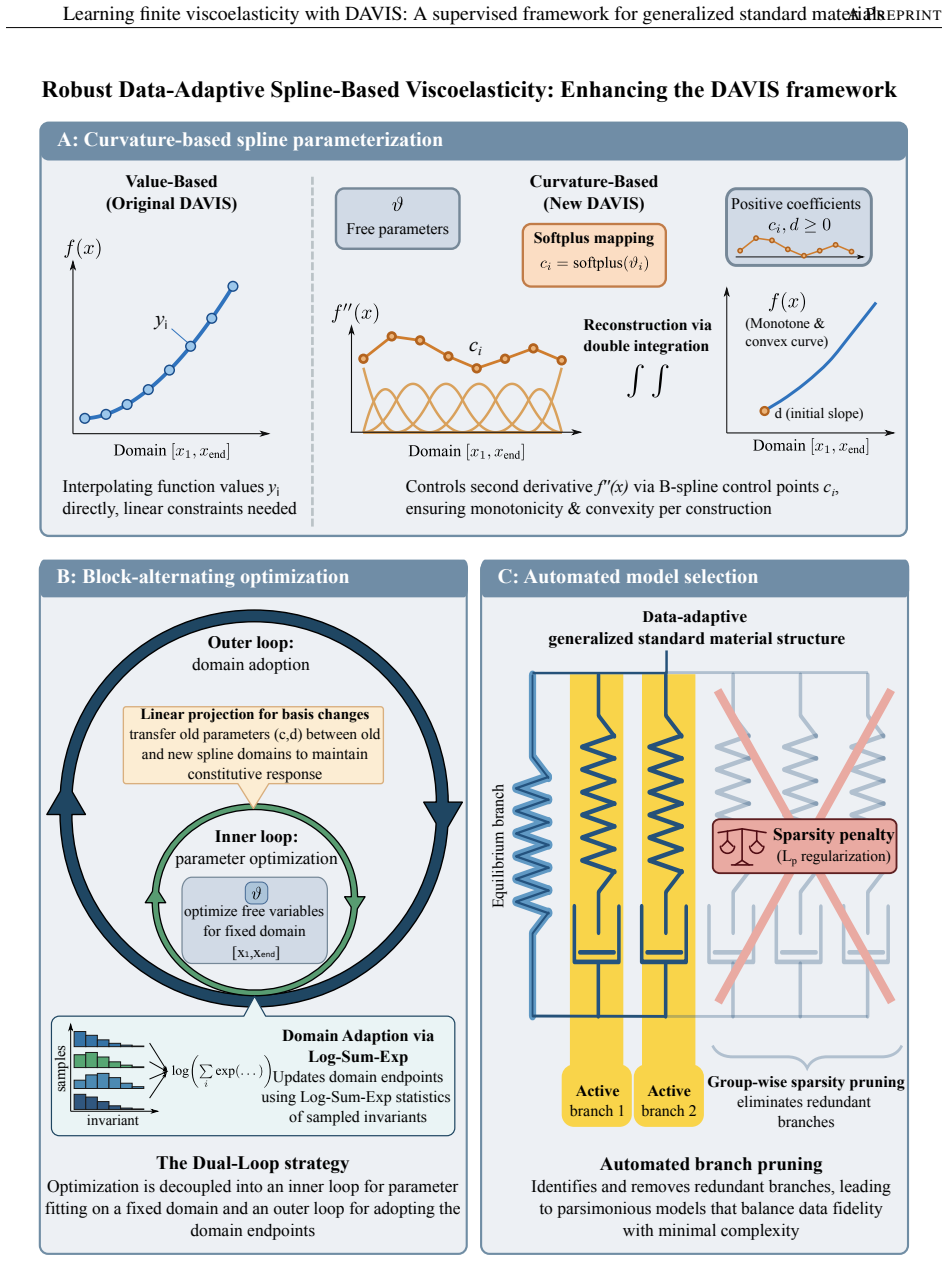
A staggered block-alternating optimization in DAVIS decouples interpolation domains from spline coefficients to remove scaling ambiguities that impair conditioning in viscoelastic inverse problems.
A machine-rendered reading of the paper's core claim, the machinery that carries it, and where it could break.
Core claim
The central claim is that expressing the spline representation through curvature-based variables and employing a staggered, block-alternating strategy for domain endpoints and coefficients together improve the robustness and identifiability of non-equilibrium branches while preserving thermodynamic consistency and the underlying Reese-Govindjee constitutive structure.
What carries the argument
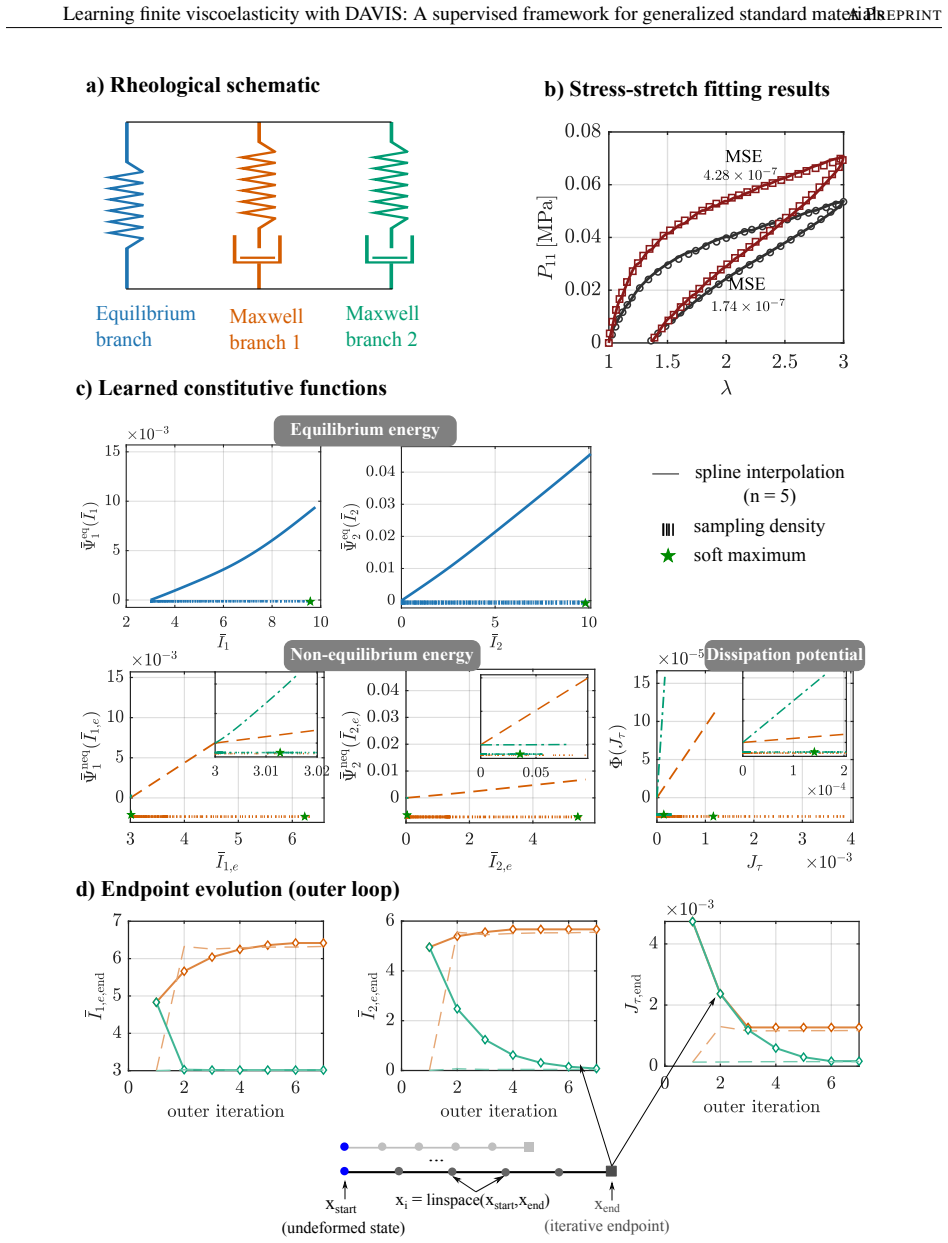
The staggered block-alternating strategy that optimizes spline coefficients for fixed interpolation domains in an inner loop and updates domain endpoints in an outer loop based on smooth statistics of sampled invariants.
If this is right
- The curvature reformulation automatically satisfies monotonicity and convexity requirements without additional constraints during optimization.
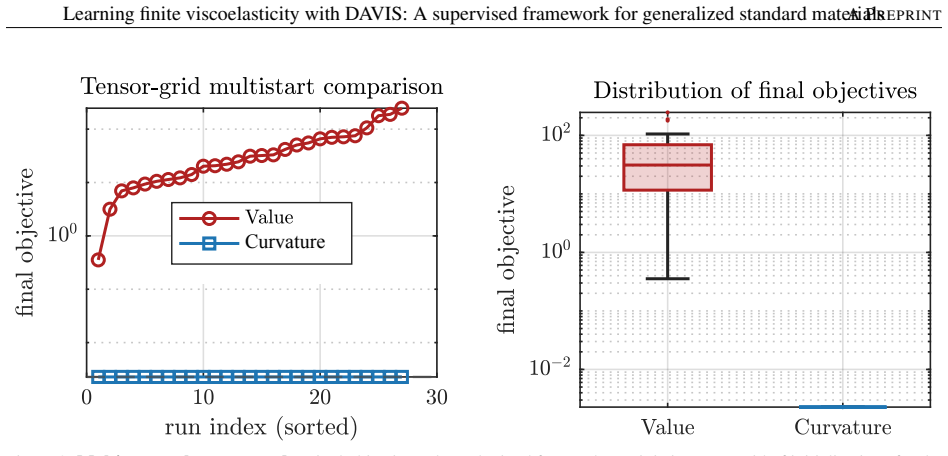
- Decoupling domain adaptation removes the scaling ambiguity that previously impaired numerical conditioning in viscoelastic parameter identification.
- The method remains compatible with finite-element model updating while retaining thermodynamic consistency of the generalized standard materials setting.
- Non-equilibrium branch parameters become more reliably identifiable from loading-unloading response data.
Where Pith is reading between the lines
- The same staggered separation of domain and coefficient fitting could be applied to other spline-based constitutive models outside viscoelasticity.
- Extending the assessment to full-field heterogeneous deformation data would test whether the improved conditioning translates to more complex inverse problems.
- The curvature-based parameterization might reduce the need for manual tuning of interpolation ranges in related data-driven material identification tasks.
Load-bearing premise
Homogeneous uniaxial loading-unloading tests supply sufficient information to demonstrate identifiability and robustness of the non-equilibrium branches in general cases.
What would settle it
Failure to recover consistent, physically plausible non-equilibrium parameters on multi-axial or inhomogeneous deformation data would indicate that the staggered strategy does not resolve the conditioning issues beyond the tested homogeneous cases.
Figures
read the original abstract
This work revisits the recently proposed data-adaptive viscoelasticity (DAVIS) framework, a spline-based formulation of finite viscoelasticity within the generalized standard materials setting. DAVIS enables a data-driven representation of equilibrium and non-equilibrium constitutive functions while retaining thermodynamic consistency and supporting parameter identification via finite element model updating. The present contribution focuses on improving the robustness and identifiability of non-equilibrium branches in generalized Maxwell-type models. To this end, two extensions of the original formulation are introduced. First, the spline representation is reformulated in terms of curvature-based variables, which is especially convenient to enforce monotonicity and convexity constraints by construction through a smooth parameter mapping. Second, the adaptation of interpolation domains is decoupled from the inner parameter identification by means of a staggered, block-alternating strategy: spline coefficients are optimized for fixed domain endpoints, while the endpoints are updated in an outer loop based on smooth statistics of sampled invariants. This separation alleviates an inherent scaling ambiguity between interpolation domains and spline coefficients that can impair conditioning in viscoelastic inverse problems. The underlying constitutive model remains the finite strain viscoelasticity framework of Reese and Govindjee. The proposed identification strategy is assessed for homogeneous uniaxial loading-unloading tests, which facilitates the study of identifiability and robustness of non-equilibrium branches.
Editorial analysis
A structured set of objections, weighed in public.
Referee Report
Summary. The manuscript revisits the DAVIS spline-based formulation of finite viscoelasticity in the generalized standard materials setting, building on the Reese-Govindjee framework. It introduces two extensions: a curvature-based reformulation of the splines to enforce monotonicity and convexity by construction via a smooth mapping, and a staggered block-alternating optimization that fixes domain endpoints while optimizing spline coefficients in an inner loop (with endpoints updated in an outer loop using statistics of sampled invariants). The goal is to resolve a scaling ambiguity between domains and coefficients that impairs conditioning. The strategy is assessed only on homogeneous uniaxial loading-unloading tests for identifiability and robustness of non-equilibrium branches.
Significance. The curvature-based reformulation offers a clean way to embed thermodynamic constraints. If the staggered strategy demonstrably improves conditioning in full finite-element inverse problems with non-homogeneous fields, it would strengthen data-driven identification for viscoelastic materials. The current numerical evidence, however, does not yet establish this benefit.
major comments (1)
- [Abstract] Abstract: The central claim that the staggered, block-alternating strategy alleviates an inherent scaling ambiguity that impairs conditioning in viscoelastic inverse problems is not supported by the reported assessment. The assessment uses only homogeneous uniaxial loading-unloading tests, which permit pointwise evaluation of the stress response without a global finite-element solve. Consequently, the mesh-dependent sensitivities, non-homogeneous strain fields, and multiple load cases that would exercise the claimed conditioning problems are never tested.
Simulated Author's Rebuttal
We thank the referee for the detailed and constructive report. The central concern is that the numerical assessment does not yet demonstrate the claimed improvement in conditioning for full finite-element inverse problems. We address this point directly below and indicate the revisions we will make.
read point-by-point responses
-
Referee: [Abstract] Abstract: The central claim that the staggered, block-alternating strategy alleviates an inherent scaling ambiguity that impairs conditioning in viscoelastic inverse problems is not supported by the reported assessment. The assessment uses only homogeneous uniaxial loading-unloading tests, which permit pointwise evaluation of the stress response without a global finite-element solve. Consequently, the mesh-dependent sensitivities, non-homogeneous strain fields, and multiple load cases that would exercise the claimed conditioning problems are never tested.
Authors: We agree that the reported assessment is restricted to homogeneous uniaxial loading-unloading tests and therefore does not exercise mesh-dependent sensitivities or non-homogeneous strain fields that arise in full finite-element model updating. The scaling ambiguity between interpolation domains and spline coefficients is already visible in the pointwise identification problem, and the staggered strategy demonstrably improves robustness and convergence behavior in that setting. Nevertheless, the stronger claim that the approach alleviates conditioning issues specifically in viscoelastic inverse problems with non-homogeneous fields is not directly supported by the current experiments. We will revise the abstract and the concluding section to clarify the scope of the numerical study, remove the phrasing that implies full inverse-problem conditioning benefits, and explicitly state that extension to non-homogeneous finite-element cases remains future work. revision: yes
Circularity Check
No significant circularity; extensions are independent methodological choices.
full rationale
The paper explicitly retains the Reese-Govindjee finite-strain viscoelasticity framework as its underlying constitutive model via external citation and introduces two new extensions (curvature-based spline variables with smooth monotonicity mapping, and the decoupled staggered block-alternating optimization) as independent contributions. No equation or claim reduces a derived quantity to its own inputs by construction, renames a fitted parameter as a prediction, or relies on a self-citation chain for a uniqueness theorem. The assessment on homogeneous uniaxial tests is presented directly as a means to study identifiability; the derivation chain remains self-contained against the cited external base model without any load-bearing step that equates output to input.
Axiom & Free-Parameter Ledger
free parameters (2)
- spline coefficients
- domain endpoints
axioms (1)
- domain assumption Thermodynamic consistency of the constitutive model within the generalized standard materials setting
Reference graph
Works this paper leans on
-
[1]
& Possart, G
Steinmann, P., Hossain, M. & Possart, G. Hyperelastic models for rubber-like materials: consistent tangent operators and suitability for Treloar’s data.Archive of Applied Mechanics82, 1183–1217 (2012)
2012
-
[2]
& Wriggers, P
Ricker, A. & Wriggers, P. Systematic Fitting and Comparison of Hyperelastic Continuum Models for Elastomers. Archives of Computational Methods in Engineering30(2023)
2023
-
[3]
A Continuum Approach for Engineering(John Wiley & Sons, 2001), second print edn
Holzapfel, G.Nonlinear solid mechanics. A Continuum Approach for Engineering(John Wiley & Sons, 2001), second print edn
2001
-
[4]
& Kaiss, A
Le Tallec, P., Rahier, C. & Kaiss, A. Three-dimensional incompressible viscoelasticity in large strains: Formulation and numerical approximation.Computer Methods in Applied Mechanics and Engineering109, 233–258 (1993)
1993
-
[5]
A physically based method to represent the thermo-mechanical behaviour of elastomers.Acta Mechanica 123, 1–25 (1997)
Lion, A. A physically based method to represent the thermo-mechanical behaviour of elastomers.Acta Mechanica 123, 1–25 (1997)
1997
-
[6]
& Govindjee, S
Reese, S. & Govindjee, S. A theory of finite viscoelasticity and numerical aspects.International Journal of Solids and Structures35, 3455–3482 (1998)
1998
-
[7]
A model of rubber viscoelasticity.Mechanics Research Communications12, 93–99 (1985)
Lubliner, J. A model of rubber viscoelasticity.Mechanics Research Communications12, 93–99 (1985)
1985
-
[8]
& Reese, S
Govindjee, S. & Reese, S. A Presentation and Comparison of Two Large Deformation Viscoelasticity Models. Journal of Engineering Materials and Technology119, 251–255 (1997)
1997
-
[9]
& Diani, J
Gouhier, F. & Diani, J. A comparison of finite strain viscoelastic models based on the multiplicative decomposition. European Journal of Mechanics - A/Solids108, 105424 (2024)
2024
-
[10]
& Ortiz, M
Kirchdoerfer, T. & Ortiz, M. Data-driven computational mechanics.Computer Methods in Applied Mechanics and Engineering304, 81–101 (2016)
2016
-
[11]
N.et al.A Review on Data-Driven Constitutive Laws for Solids.Archives of Computational Methods in Engineering32, 1841–1883 (2025)
Fuhg, J. N.et al.A Review on Data-Driven Constitutive Laws for Solids.Archives of Computational Methods in Engineering32, 1841–1883 (2025)
2025
-
[12]
A., Linden, L., Brummund, J., Metsch, P
Kalina, K. A., Linden, L., Brummund, J., Metsch, P. & Kästner, M. Automated constitutive modeling of isotropic hyperelasticity based on artificial neural networks.Computational Mechanics69, 1–20 (2022)
2022
-
[13]
K., Fernández, M., Martin, R
Klein, D. K., Fernández, M., Martin, R. J., Neff, P. & Weeger, O. Polyconvex anisotropic hyperelasticity with neural networks.Journal of the Mechanics and Physics of Solids159, 104703 (2022)
2022
-
[14]
K.et al.Neural networks meet hyperelasticity: A monotonic approach (2025)
Klein, D. K.et al.Neural networks meet hyperelasticity: A monotonic approach (2025). ArXiv:2501.02670 [cs]
-
[15]
Linden, L.et al.Neural networks meet hyperelasticity: A guide to enforcing physics.Journal of the Mechanics and Physics of Solids179, 105363 (2023)
2023
-
[16]
Thakolkaran, P.et al.Can KAN CANs? Input-convex Kolmogorov-Arnold Networks (KANs) as hyperelastic constitutive artificial neural networks (CANs).Computer Methods in Applied Mechanics and Engineering443, 118089 (2025)
2025
-
[17]
P., Aydin, R
Abdolazizi, K. P., Aydin, R. C., Cyron, C. J. & Linka, K. Constitutive Kolmogorov–Arnold Networks (CKANs): Combining accuracy and interpretability in data-driven material modeling.Journal of the Mechanics and Physics of Solids203, 106212 (2025)
2025
-
[18]
Frankel, A. L., Jones, R. E. & Swiler, L. P. Tensor Basis Gaussian Process Models of Hyperelastic Materials. ArXiv(2019). Abs/1912.10872
-
[19]
& Itskov, M
Abdusalamov, R., Hillgärtner, M. & Itskov, M. Automatic generation of interpretable hyperelastic material models by symbolic regression.International Journal for Numerical Methods in Engineering124, 2093–2104 (2023)
2093
-
[20]
K., Sahli Costabal, F
Taç, V ., Rausch, M. K., Sahli Costabal, F. & Tepole, A. B. Data-driven anisotropic finite viscoelasticity using neural ordinary differential equations.Computer Methods in Applied Mechanics and Engineering411, 116046 (2023)
2023
-
[22]
A., Wiesheier, S., Steinmann, P
Flaschel, M., Moreno-Mateos, M. A., Wiesheier, S., Steinmann, P. & Kuhl, E. Unsupervised Material Fingerprint- ing: Ultra-fast hyperelastic model discovery from full-field experimental measurements (2026). Version Number: 1
2026
-
[23]
& Bathe, K.-J
Sussman, T. & Bathe, K.-J. A model of incompressible isotropic hyperelastic material behavior using spline interpolations of tension–compression test data.Communications in numerical methods in engineering25, 53–63 (2009). 24 Learning finite viscoelasticity with DA VIS: A supervised framework for generalized standard materialsA PREPRINT
2009
-
[24]
A., Açan, A
Dal, H., Denli, F. A., Açan, A. K. & Kaliske, M. Data-driven hyperelasticity, Part I: A canonical isotropic formulation for rubberlike materials.Journal of the Mechanics and Physics of Solids179, 105381 (2023)
2023
-
[25]
Z., Açan, A
Tikeno˘gulları, O. Z., Açan, A. K., Kuhl, E. & Dal, H. Data-driven hyperelasticity, Part II: A canonical framework for anisotropic soft biological tissues.Journal of the Mechanics and Physics of Solids181, 105453 (2023)
2023
-
[26]
Wiesheier, S., Moreno-Mateos, M. A. & Steinmann, P. Versatile data-adaptive hyperelastic energy functions for soft materials.Computer Methods in Applied Mechanics and Engineering430, 117208 (2024)
2024
-
[27]
A., Wiesheier, S., Esmaeili, A., Hossain, M
Moreno-Mateos, M. A., Wiesheier, S., Esmaeili, A., Hossain, M. & Steinmann, P. Biaxial characterization of soft elastomers: experiments and data-adaptive configurational forces for fracture (2025). ArXiv:2505.20244 [cond-mat]
-
[28]
Wiesheier, S., Moreno-Mateos, M. A. & Steinmann, P. Data-adaptive spline surfaces for non-separable hyperelastic energy functions (2026). ArXiv:2604.10059 [cs]
work page internal anchor Pith review Pith/arXiv arXiv 2026
-
[29]
& Nguyen, Q
Halphen, B. & Nguyen, Q. S. Sur les matériaux standard généralisés.Journal de Mécanique14, 39–63 (1975)
1975
-
[30]
Thermodynamik und rheologische Probleme.Ingenieur-Archiv25, 58–70 (1957)
Ziegler, H. Thermodynamik und rheologische Probleme.Ingenieur-Archiv25, 58–70 (1957)
1957
-
[31]
An attempt to generalize Onsager’s principle, and its significance for rheological problems.ZAMP Zeitschrift für Angewandte Mathematik und Physik9, 748–763 (1958)
Ziegler, H. An attempt to generalize Onsager’s principle, and its significance for rheological problems.ZAMP Zeitschrift für Angewandte Mathematik und Physik9, 748–763 (1958)
1958
-
[32]
& Lopez-Pamies, O
Kumar, A. & Lopez-Pamies, O. On the two-potential constitutive modeling of rubber viscoelastic materials. Comptes Rendus. Mécanique344, 102–112 (2016)
2016
-
[33]
Yu, H., Tian, X., E, W. & Li, Q. OnsagerNet: Learning stable and interpretable dynamics using a generalized Onsager principle.Physical Review Fluids6, 114402 (2021)
2021
-
[34]
& Reina, C
Huang, S., He, Z., Chem, B. & Reina, C. Variational Onsager Neural Networks (VONNs): A thermodynamics- based variational learning strategy for non-equilibrium PDEs.Journal of the Mechanics and Physics of Solids163, 104856 (2022)
2022
-
[35]
& De Lorenzis, L
Flaschel, M., Kumar, S. & De Lorenzis, L. Automated discovery of generalized standard material models with EUCLID.Computer Methods in Applied Mechanics and Engineering405, 115867 (2023)
2023
-
[36]
A., Brummund, J., Sun, W
Rosenkranz, M., Kalina, K. A., Brummund, J., Sun, W. & Kästner, M. Viscoelasticty with physics-augmented neural networks: model formulation and training methods without prescribed internal variables.Computational Mechanics74, 1279–1301 (2024)
2024
-
[37]
A., Brummund, J
Kalina, K. A., Brummund, J. & Kästner, M. A physics-augmented neural network framework for finite strain incompressible viscoelasticity.Computer Methods in Applied Mechanics and Engineering455, 118892 (2026)
2026
-
[38]
& Kuhl, E
Holthusen, H. & Kuhl, E. A complement to neural networks for anisotropic inelasticity at finite strains.Computer Methods in Applied Mechanics and Engineering450, 118612 (2026)
2026
-
[39]
& Brepols, T
Holthusen, H., Linka, K., Kuhl, E. & Brepols, T. A generalized dual potential for inelastic Constitutive Artificial Neural Networks: A JAX implementation at finite strains.Journal of the Mechanics and Physics of Solids206, 106337 (2026)
2026
-
[40]
N., Bouklas, N
Upadhyay, K., Fuhg, J. N., Bouklas, N. & Ramesh, K. T. Physics-informed data-driven discovery of constitutive models with application to strain-rate-sensitive soft materials.Computational Mechanics(2024)
2024
-
[41]
& Spearot, D
Upadhyay, K., Subhash, G. & Spearot, D. Visco-hyperelastic constitutive modeling of strain rate sensitive soft materials.Journal of the Mechanics and Physics of Solids135, 103777 (2020)
2020
-
[42]
P., Linka, K
Abdolazizi, K. P., Linka, K. & Cyron, C. J. Viscoelastic constitutive artificial neural networks (vCANNs) – A framework for data-driven anisotropic nonlinear finite viscoelasticity.Journal of Computational Physics499, 112704 (2024)
2024
-
[43]
Wiesheier, S., Moreno-Mateos, M. A. & Steinmann, P. Data-adaptive spline-based viscoelasticity for soft solids. Computer Methods in Applied Mechanics and Engineering451, 118705 (2026)
2026
-
[44]
& Stein, E
Mahnken, R. & Stein, E. A unified approach for parameter identification of inelastic material models in the frame of the finite element method.Computer methods in applied mechanics and engineering136, 225–258 (1996)
1996
-
[45]
& McNeill, S
Sutton, M., Wolters, W., Peters, W., Ranson, W. & McNeill, S. Determination of displacements using an improved digital correlation method.Image and vision computing1, 133–139 (1983)
1983
-
[46]
Experimental Mechanics48, 381–402 (2008)
Avril, S.et al.Overview of Identification Methods of Mechanical Parameters Based on Full-field Measurements. Experimental Mechanics48, 381–402 (2008)
2008
-
[47]
& Gilbert, R
Hartmann, S. & Gilbert, R. Identifiability of material parameters in solid mechanics.Archive of Applied Mechanics 88, 3–26 (2018). 25 Learning finite viscoelasticity with DA VIS: A supervised framework for generalized standard materialsA PREPRINT
2018
-
[48]
& Neff, P
Hartmann, S. & Neff, P. Polyconvexity of generalized polynomial-type hyperelastic strain energy functions for near-incompressibility.International Journal of Solids and Structures40, 2767–2791 (2003)
2003
-
[49]
& Neff, P
Schröder, J. & Neff, P. Invariant formulation of hyperelastic transverse isotropy based on polyconvex free energy functions.International Journal of Solids and Structures40, 401–445 (2003)
2003
-
[50]
Thermodynamic relations for high elastic materials.Transactions of the Faraday Society57, 829–838 (1961)
Flory, P. Thermodynamic relations for high elastic materials.Transactions of the Faraday Society57, 829–838 (1961)
1961
-
[51]
& Stainier, L
Ortiz, M. & Stainier, L. The variational formulation of viscoplastic constitutive updates.Computer Methods in Applied Mechanics and Engineering171, 419–444 (1999)
1999
-
[52]
& Stainier, L
Fancello, E., Ponthot, J.-P. & Stainier, L. A variational formulation of constitutive models and updates in non-linear finite viscoelasticity.International Journal for Numerical Methods in Engineering65, 1831–1864 (2006)
2006
-
[53]
& Stainier, L
Fancello, E., Ponthot, J. & Stainier, L. A variational framework for nonlinear viscoelastic models in finite deformation regime.Journal of Computational and Applied Mathematics215, 400–408 (2008)
2008
-
[54]
Variationally consistent modeling of finite strain plasticity theory with non-linear kinematic hardening
Mosler, J. Variationally consistent modeling of finite strain plasticity theory with non-linear kinematic hardening. Computer Methods in Applied Mechanics and Engineering199, 2753–2764 (2010)
2010
-
[55]
& Lambrecht, M
Miehe, C., Schotte, J. & Lambrecht, M. Homogenization of inelastic solid materials at finite strains based on incremental minimization principles. Application to the texture analysis of polycrystals.Journal of the Mechanics and Physics of Solids50, 2123–2167 (2002)
2002
-
[56]
Platen, J.et al.A nonlinear finite viscoelastic formulation relative to the viscous intermediate configuration applied to plants.International Journal for Numerical Methods in Engineering125, e7483 (2024)
2024
-
[57]
& Hoefnagels, J
Leuschner, M., Fritzen, F., Van Dommelen, J. & Hoefnagels, J. Potential-based constitutive models for cohesive interfaces: Theory, implementation and examples.Composites Part B: Engineering68, 38–50 (2015)
2015
-
[58]
Stewart, E. M. & Anand, L. A large deformation viscoelasticity theory for elastomeric materials and its numerical implementation in the open-source finite element program FEniCSx.International Journal of Solids and Structures 303, 113023 (2024)
2024
-
[59]
K., Franck, C
Li, X., Tao, J., Landauer, A. K., Franck, C. & Henann, D. L. Large-deformation constitutive modeling of viscoelastic foams: Application to a closed-cell foam material.Journal of the Mechanics and Physics of Solids 161, 104807 (2022)
2022
-
[60]
Liu, Z., Ortigosa, R., Gil, A. J. & Bonet, J. Large strain constitutive modelling of soft compressible and incompressible solids: Generalised isotropic and anisotropic viscoelasticity.Journal of the Mechanics and Physics of Solids203, 106194 (2025)
2025
-
[61]
Boor, C.A Practical Guide to Splines(Springer Verlag, 1978)
d. Boor, C.A Practical Guide to Splines(Springer Verlag, 1978)
1978
-
[62]
Butterfield, K. R. The Computation of all the Derivatives of a B-spline Basis.IMA Journal of Applied Mathematics 17, 15–25 (1976)
1976
-
[63]
Silverman, B.Density Estimation for Statistics and Data Analysis(Routledge, 2018), 1 edn
2018
-
[64]
Moreno-Mateos, M. A., Wiesheier, S., Steinmann, P. & Kuhl, E. Learning ultra-compressible hyperelasticity with splines: Constitutive asymmetries and non-unique representations (2026). ArXiv:2604.14264 [cs]
work page internal anchor Pith review Pith/arXiv arXiv 2026
-
[65]
Hossain, M., Vu, D. K. & Steinmann, P. Experimental study and numerical modelling of VHB 4910 polymer. Computational Materials Science59, 65–74 (2012). 26
2012
discussion (0)
Sign in with ORCID, Apple, or X to comment. Anyone can read and Pith papers without signing in.