REVIEW 3 major objections 5 minor 54 references
Getting To Know You: User Attribute Extraction from Dialogues
T0 review · 3 major / 5 minor · reviewed 2026-08-14 · deepseek-v4-flash
Pith's one-line read This paper argues that structured user attributes—triplets like (I, live in, Florida)—can be extracted automatically from ordinary chit-chat, and that a two-stage extractor trained by distant supervision does this better than existing…
desk verdict A useful new task framing with an honest baseline, but the headline claim of extraction is undercut by human evaluation that only scores inferability, not whether attributes are true of the user. read the letter →
The pith
A machine-rendered reading of the paper's core claim, the machinery that carries it, and where it could break.
The reading
What carries the argument
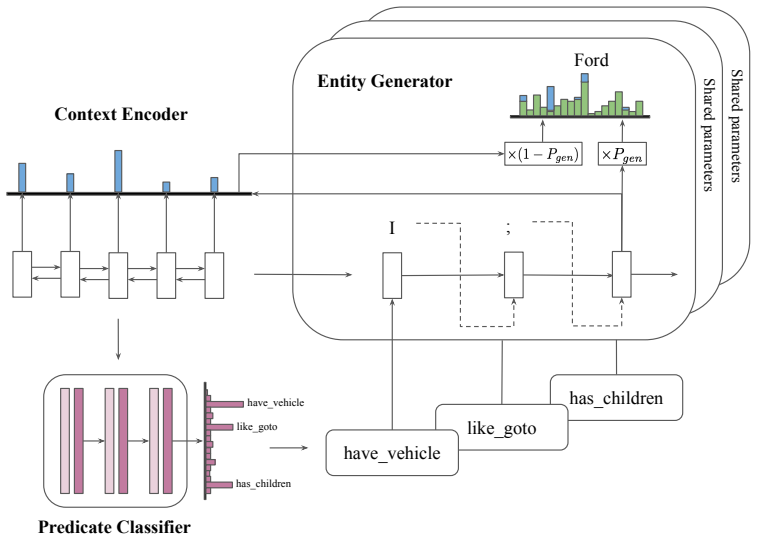
The central machinery is the two-stage attribute extractor, driven by distant supervision from an entailment scorer. The scorer (fine-tuned BERT) converts each user utterance into a training label: the triplet of any persona sentence it entails. The extractor's predicate classifier—a multi-hop memory network over a fixed predicate vocabulary with a sigmoid output—decides which predicates are triggered, possibly none; then a single shared GRU entity generator, initialized with the triggered predicate, decodes the subject and object phrases using a pointer-generator distribution that can copy words from the utterance. The two-stage split is what lets the model abstain, predict multiple attributes for one utterance, and generate attribute values not stored in a fixed memory.
What would settle it
Build a corpus where each speaker's true attributes are known independently, run the extractor on transcripts of their dialogues, and compare its triplets against that ground truth; the central claim fails if precision on these verified attributes is no better than chance, or if human annotators cannot reproduce the entailment labels that generated the training data.
Extended reading notes
Core claim
The paper's central claim is that user attributes can be extracted from chit-chat dialogues by combining two existing resources: Persona-Chat, which supplies conversations and persona sentences, and Dialogue NLI, which supplies structured triplets for those sentences. The authors hypothesize that if a user utterance entails a persona sentence, the sentence's triplet is a valid user attribute; they use a fine-tuned BERT entailment scorer to create distant-supervision labels and train a two-stage extractor on those labels. They report that the resulting model achieves 67.11% on human evaluation, significantly above the 52.01% of the best baseline, and that it can infer attributes the user never states explicitly, such as marital status from the phrase 'my wife can spend it.' They also acknowledge that the distant labels are noisy, estimating around 20% noise in the supervision data.
Load-bearing premise
The method depends on the assumption that when an automated model decides that a user's sentence implies one of the scripted persona sentences, the structured fact attached to that persona sentence is actually true of the user; the paper itself gives a counterexample where a person tired from parties is not necessarily a person who likes parties.
Editorial extensions
If this is right
- Dialogue systems can store extracted triplets as explicit long-term memory, avoiding repeated questions and letting responses be filtered by known user facts.
- Attributes collected across conversations can be aggregated offline into a user profile, which recommender systems can use to cluster users or surface items a user has mentioned.
- Because the model predicts predicates before generating entities, it can return 'none' for uninformative turns, unlike open information extraction systems that always produce a parse.
- Sharing one entity generator across all predicates allows knowledge transfer between attribute types, so a predicate-object combination that was not memorized can still be generated or copied from the utterance.
- The reported oracle study implies that most remaining errors come from the predicate classifier rather than the generator, so improving predicate prediction should improve end-to-end extraction.
Reading between the lines
- Beyond the paper's claims, the same distant-supervision recipe could be applied to task-oriented dialogues, where slot-filling labels already exist, to test whether the predicate-classifier/entity-generator split helps when true attributes are known.
- A stricter test would verify extracted attributes against a questionnaire the speaker answered before the dialogue; the paper's human evaluation asks whether the attribute can be inferred, not whether it is true of the actual speaker, and the two can diverge.
- The fixed predicate vocabulary of 61 relation types limits coverage; automatically clustering or expanding predicates, which the paper mentions only as a suggestion, is the direct next experiment and would show whether the architecture scales beyond the curated ontology.
- If entailment-based labelling systematically confuses correlation with causation—attending parties with liking parties—then the ceiling on attribute quality is set by the entailment scorer, not by the extractor; swapping that scorer for a human-in-the-loop confirmation step would isolate the ceiling.
Signed reviews
Editorial analysis
A structured set of objections, weighed in public.
Referee Report
Summary. The paper introduces the task of extracting structured user attributes—represented as (subject, predicate, object) triplets—from chit-chat dialogues. Because no labeled dataset exists, the authors construct distant supervision by pairing Persona-Chat utterances with persona sentences using a BERT NLI scorer trained on Dialogue NLI: if an utterance entails a persona sentence, the corresponding triplet is treated as a user attribute. The proposed two-stage extractor consists of a memory-network-based multi-label predicate classifier and a shared GRU entity generator with a copy mechanism. The model is compared against Seq2Seq, pointer-generator, key-value memory networks, and two OpenIE systems. Evaluation includes automatic metrics (accuracy, F1, BLEU-1) computed against the distant-supervision labels and a human evaluation in which Turkers judge whether generated attributes can be inferred from the utterance. The model achieves 67.11% human inferability, outperforming the best baseline (KVMN) at 52.01%, while the distant-supervision gold data reaches 79.80%. The paper also discusses downstream applications and limitations.
Significance. If the central claim is established, the paper would be the first to formulate and demonstrate a feasible approach to user attribute extraction from open-domain dialogues, with clear applications to personalized dialogue and recommendation. Concrete strengths include the release of code, the use of an external human evaluation rather than only automatic metrics, thoughtful qualitative comparison with OpenIE systems, and an unusually candid limitations section. However, the significance is currently constrained by an evaluation gap: the human evaluation tests whether attributes are inferable from an utterance, not whether they are true of the user, and the automatic metrics are computed against the same noisy distant-supervision labels used for training. The missing check—evaluating generated attributes against the known ground-truth personas in Persona-Chat—is directly feasible and would substantially strengthen the contribution.
major comments (3)
- [§4.3 Evaluation Metrics, §5.1 Table 3] The human evaluation asks annotators whether attributes "can be inferred from the utterance," which measures plausibility rather than whether the attribute is genuinely true of the user. The paper's headline claim is that the model "extract[s] user attributes," but this protocol cannot support that claim: an attribute can be inferable from a sentence without being a real attribute of the speaker. Since Persona-Chat provides ground-truth personas for each dialogue participant, the authors should additionally evaluate generated attributes against those known persona triplets (for example, by reporting precision/recall on matched predicate-object pairs), or explicitly reframe the claim as extraction of "inferable" attributes. This is the load-bearing evidence for the central claim and needs to be addressed.
- [§2.1 Combination Strategy, §6.2 Current Limitations] The entailment-to-attribute mapping is the core training signal, and the paper itself concedes in Section 6.2 that it is unreliable ("the fact that a person attends many parties does not necessarily mean they like parties"). The authors should quantify the noise in this distant supervision, for example by sampling NLI-assigned triplets and checking them against the actual personas of the Persona-Chat speakers. Without such a calibration, the automatic metrics in Table 3 (ACC, F1, BLEU-1) are best interpreted as self-consistency with the training labels rather than as evidence about attribute correctness; the Gold row's 79.8% human inferability indicates that even the supervision signal is only partially plausible.
- [§5.1 Internal Comparison, Appendix reference] The statement that the human evaluation result is "statistically significant" is not supported by the information in the paper: no test statistic, p-value, confidence interval, or inter-annotator agreement is reported, and the full protocol is deferred to an appendix that is not present in the submitted text. Because the main comparison rests on this 100-sample human evaluation, the manuscript should include the protocol details and significance analysis either in the main text or in a supplementary appendix.
minor comments (5)
- [§3.1 Predicate Classifier, Eq. (1)] Equation (1) writes α_k = Softmax(...) but the text states that Softmax is replaced by a Sigmoid at the last hop; the notation should make this per-hop change explicit to avoid confusion.
- [§4.1 Training Details] The word dropout technique is described qualitatively as "randomly masking a small number" of tokens; please state the masking probability so the training setup is reproducible.
- [§5.1 Table 3] The table does not specify the size of the test set or how the 100 human-evaluated samples were selected among the test utterances; adding this information would clarify the reliability of the reported percentages.
- [§5.2 External Comparison] There is a typo in "relevent" (should be "relevant"); also, the S-OpenIE output "(lol, like, classic cars)" suggests a tokenization artifact that might be worth a footnote for readability.
- [References, §2 Dialogue NLI] The in-text citation "Sean et al. (2018)" appears in the references as "Welleck Sean" with the family name in the wrong position; the standard form is "Welleck et al. (2018)" and the reference should be formatted accordingly.
Circularity Check
No significant circularity: the attribute extractor is trained on externally generated distant-supervision labels and validated by an independent human evaluation.
full rationale
The paper's derivation chain is self-contained and does not reduce to its inputs. Distant-supervision labels are produced in Section 2.1 by an NLI scorer fine-tuned on Dialogue NLI, an external dataset built from Persona-Chat; the attribute extractor is then trained on those labels in Section 3 with the objective in Eq. 8. The central claimed evidence is the human evaluation in Section 5.1, where Turkers independently label whether generated attributes 'can be inferred from the utterance,' which is external to the training loop and not a fitted parameter. The automatic metrics (ACC, F1, BLEU-1) are computed against the distant-supervision labels, but the paper explicitly says they are 'only for reference' because the test data is not human-annotated, so they are not presented as independent predictions. The acknowledged limitation in Section 6.2, that entailment does not always capture real causality (e.g., attending parties does not necessarily mean liking parties), is a validity concern about the training signal, not a circularity of the derivation. No load-bearing claim is justified solely by a self-citation: citations to Dialogue NLI, Persona-Chat, and memory-network architectures are external or motivational, not uniqueness arguments or fitted inputs. The human-evaluation protocol measures inferability rather than ground-truth user attributes, but that is a correctness and evaluation-validity issue outside the circularity definition. Therefore the central claim has independent content and the paper is not circular.
Assumptions & free parameters
free parameters (5)
- Loss weighting lambda =
0.5
- Memory hops K =
3
- Dropout rate =
0.6
- Word dropout rate =
unspecified
- NLI labeling rule =
unspecified
assumptions (4)
- ad hoc to paper If a user utterance entails a persona sentence, the persona sentence's triplet is a valid user attribute.
- domain assumption Persona-Chat conversations are representative of natural user-agent dialogues.
- domain assumption The pre-defined predicate set from Dialogue NLI (about 60 relations) covers the attribute types worth extracting.
- standard math Standard neural components (GRU, memory network, attention, BERT, GloVe) and their training procedures behave as expected.
Cite this review
Pith. "Pith review of Getting To Know You: User Attribute Extraction from Dialogues." pith.science (2026). https://pith.science/paper/KA5YNC7U
@misc{pith2026190804621,
  author       = {Pith},
  title        = {Pith review of: Getting To Know You: User Attribute Extraction from Dialogues},
  year         = {2026},
  howpublished = {\url{https://pith.science/paper/KA5YNC7U}},
  note         = {Machine review of arXiv:1908.04621}
}
read the original abstract
User attributes provide rich and useful information for user understanding, yet structured and easy-to-use attributes are often sparsely populated. In this paper, we leverage dialogues with conversational agents, which contain strong suggestions of user information, to automatically extract user attributes. Since no existing dataset is available for this purpose, we apply distant supervision to train our proposed two-stage attribute extractor, which surpasses several retrieval and generation baselines on human evaluation. Meanwhile, we discuss potential applications (e.g., personalized recommendation and dialogue systems) of such extracted user attributes, and point out current limitations to cast light on future work.
Figures
Reference graph
Works this paper leans on
-
[1]
Anton Alekseev and Sergey I Nikolenko. 2016. Predicting the age of social network users from user-generated texts with word embeddings. In 2016 IEEE Artificial Intelligence and Natural Language Conference (AINL), pages 1--11. IEEE
work page 2016
-
[2]
Gabor Angeli, Melvin Jose Johnson Premkumar, and Christopher D. Manning. 2015. https://doi.org/10.3115/v1/P15-1034 Leveraging linguistic structure for open domain information extraction . In Proceedings of the 53rd Annual Meeting of the Association for Computational Linguistics and the 7th International Joint Conference on Natural Language Processing (Vol...
-
[3]
Cafarella, Stephen Soderland, Matt Broadhead, and Oren Etzioni
Michele Banko, Michael J. Cafarella, Stephen Soderland, Matt Broadhead, and Oren Etzioni. 2007. http://dl.acm.org/citation.cfm?id=1625275.1625705 Open information extraction from the web . In Proceedings of the 20th International Joint Conference on Artifical Intelligence, IJCAI'07, pages 2670--2676, San Francisco, CA, USA. Morgan Kaufmann Publishers Inc
-
[4]
Mathieu Bastian, Matthew Hayes, William Vaughan, Sam Shah, Peter Skomoroch, Hyungjin Kim, Sal Uryasev, and Christopher Lloyd. 2014. Linkedin skills: large-scale topic extraction and inference. In Proceedings of the 8th ACM Conference on Recommender systems, pages 1--8. ACM
work page 2014
-
[5]
Jonathan Berant, Ido Dagan, and Jacob Goldberger. 2011. http://aclweb.org/anthology/P11-1062 Global learning of typed entailment rules . In Proceedings of the 49th Annual Meeting of the Association for Computational Linguistics: Human Language Technologies, pages 610--619. Association for Computational Linguistics
work page 2011
-
[6]
Antoine Bordes, Y-Lan Boureau, and Jason Weston. 2016. Learning end-to-end goal-oriented dialog. arXiv preprint arXiv:1605.07683
arXiv 2016
-
[7]
Robin Burke. 2000. Knowledge-based recommender systems. Encyclopedia of library and information systems, 69(Supplement 32):175--186
work page 2000
-
[8]
Qian Chen, Xiaodan Zhu, Zhen-Hua Ling, Si Wei, Hui Jiang, and Diana Inkpen. 2017. https://doi.org/10.18653/v1/P17-1152 Enhanced lstm for natural language inference . In Proceedings of the 55th Annual Meeting of the Association for Computational Linguistics (Volume 1: Long Papers), pages 1657--1668. Association for Computational Linguistics
Show all 54 references
-
[9]
Morgane Ciot, Morgan Sonderegger, and Derek Ruths. 2013. Gender inference of twitter users in non-english contexts. In Proceedings of the 2013 Conference on Empirical Methods in Natural Language Processing, pages 1136--1145
2013
-
[10]
Luciano Del Corro and Rainer Gemulla. 2013. https://doi.org/10.1145/2488388.2488420 Clausie: Clause-based open information extraction . In Proceedings of the 22Nd International Conference on World Wide Web, WWW '13, pages 355--366, New York, NY, USA. ACM
2013
-
[11]
Jacob Devlin, Ming-Wei Chang, Kenton Lee, and Kristina Toutanova. 2018. Bert: Pre-training of deep bidirectional transformers for language understanding. arXiv preprint arXiv:1810.04805
2018 arXiv
-
[12]
Emily Dinan, Varvara Logacheva, Valentin Malykh, Alexander Miller, Kurt Shuster, Jack Urbanek, Douwe Kiela, Arthur Szlam, Iulian Serban, Ryan Lowe, et al. 2019. The second conversational intelligence challenge (convai2). arXiv preprint arXiv:1902.00098
2019 arXiv
-
[13]
Anthony Fader, Luke Zettlemoyer, and Oren Etzioni. 2014. https://doi.org/10.1145/2623330.2623677 Open question answering over curated and extracted knowledge bases . In Proceedings of the 20th ACM SIGKDD International Conference on Knowledge Discovery and Data Mining, KDD '14,...
2014
-
[14]
Kazuma Hashimoto, Caiming Xiong, Yoshimasa Tsuruoka, and Richard Socher. 2016. A joint many-task model: Growing a neural network for multiple nlp tasks. arXiv preprint arXiv:1611.01587
2016 arXiv
-
[15]
Kristen Johnson and Dan Goldwasser. 2016. https://www.aclweb.org/anthology/C16-1279 `` all I know about politics is what I read in twitter '' : Weakly supervised models for extracting politicians ' stances from twitter . In Proceedings of COLING 2016, the 26th International Co...
2016
-
[16]
Le, Maxim Krikun, Yonghui Wu, Zhifeng Chen, Nikhil Thorat, Fernanda Vi \'e gas, Martin Wattenberg, Greg Corrado, Macduff Hughes, and Jeffrey Dean
Melvin Johnson, Mike Schuster, Quoc V. Le, Maxim Krikun, Yonghui Wu, Zhifeng Chen, Nikhil Thorat, Fernanda Vi \'e gas, Martin Wattenberg, Greg Corrado, Macduff Hughes, and Jeffrey Dean. 2017. http://aclweb.org/anthology/Q17-1024 Google's multilingual neural machine translation...
2017
-
[17]
Chaitanya K Joshi, Fei Mi, and Boi Faltings. 2017. Personalization in goal-oriented dialog. arXiv preprint arXiv:1706.07503
2017 arXiv
-
[18]
Diederik P Kingma and Jimmy Ba. 2014. Adam: A method for stochastic optimization. arXiv preprint arXiv:1412.6980
2014 arXiv
-
[19]
Jiwei Li, Alan Ritter, and Eduard Hovy. 2014. Weakly supervised user profile extraction from twitter. In Proceedings of the 52nd Annual Meeting of the Association for Computational Linguistics (Volume 1: Long Papers), volume 1, pages 165--174
2014
-
[20]
JM Lucas, F Fern \'a ndez, J Salazar, J Ferreiros, and R San Segundo. 2009. Managing speaker identity and user profiles in a spoken dialogue system. Procesamiento del lenguaje natural
2009
-
[21]
Andrea Madotto, ZhaoJiang Lin, Chien-Sheng Wu, and Pascale Fung. 2019. Personalizing dialogue agents via meta-learning. In Proceedings of the 57th Annual Meeting of the Association for Computational Linguistics. Association for Computational Linguistics
2019
-
[22]
Andrea Madotto, Chien-Sheng Wu, and Pascale Fung. 2018. Mem2seq: Effectively incorporating knowledge bases into end-to-end task-oriented dialog systems. In Proceedings of the 56th Annual Meeting of the Association for Computational Linguistics (Volume 1: Long Papers), pages 1468--1478
2018
-
[23]
Mausam, Michael Schmitz, Stephen Soderland, Robert Bart, and Oren Etzioni. 2012. http://aclweb.org/anthology/D12-1048 Open language learning for information extraction . In Proceedings of the 2012 Joint Conference on Empirical Methods in Natural Language Processing and Computa...
2012
-
[24]
Pierre-Emmanuel Mazare, Samuel Humeau, Martin Raison, and Antoine Bordes. 2018. http://aclweb.org/anthology/D18-1298 Training millions of personalized dialogue agents . In Proceedings of the 2018 Conference on Empirical Methods in Natural Language Processing, pages 2775--2779....
2018
-
[25]
Alexander Miller, Adam Fisch, Jesse Dodge, Amir-Hossein Karimi, Antoine Bordes, and Jason Weston. 2016. Key-value memory networks for directly reading documents. arXiv preprint arXiv:1606.03126
2016 arXiv
-
[26]
Kishore Papineni, Salim Roukos, Todd Ward, and Wei-Jing Zhu. 2002. Bleu: a method for automatic evaluation of machine translation. In Proceedings of the 40th annual meeting on association for computational linguistics, pages 311--318. Association for Computational Linguistics
2002
-
[27]
Michael J Pazzani and Daniel Billsus. 2007. Content-based recommendation systems. In The adaptive web, pages 325--341. Springer
2007
-
[28]
Marco Pennacchiotti and Ana-Maria Popescu. 2011. A machine learning approach to twitter user classification. In Fifth International AAAI Conference on Weblogs and Social Media
2011
-
[29]
Jeffrey Pennington, Richard Socher, and Christopher Manning. 2014. Glove: Global vectors for word representation. In Proceedings of the 2014 conference on empirical methods in natural language processing (EMNLP), pages 1532--1543
2014
-
[30]
Daniel Preo t iuc-Pietro, Vasileios Lampos, and Nikolaos Aletras. 2015. An analysis of the user occupational class through twitter content. In Proceedings of the 53rd Annual Meeting of the Association for Computational Linguistics and the 7th International Joint Conference on ...
2015
-
[31]
Delip Rao, David Yarowsky, Abhishek Shreevats, and Manaswi Gupta. 2010. Classifying latent user attributes in twitter. In Proceedings of the 2nd international workshop on Search and mining user-generated contents, pages 37--44. ACM
2010
-
[32]
Badrul M Sarwar, Joseph A Konstan, Al Borchers, Jon Herlocker, Brad Miller, and John Riedl. 1998. Using filtering agents to improve prediction quality in the grouplens research collaborative filtering system. In in the GroupLens Research Collaborative Filtering System???. Proc...
1998
-
[33]
Welleck Sean, Jason Weston, Arthur Szlam, and Kyunghyun Cho. 2018. Dialogue natural language inference. arXiv preprint arXiv:1811.00671
2018 arXiv
-
[34]
Abigail See, Peter J Liu, and Christopher D Manning. 2017. Get to the point: Summarization with pointer-generator networks. In Proceedings of the 55th Annual Meeting of the Association for Computational Linguistics (Volume 1: Long Papers), volume 1, pages 1073--1083
2017
-
[35]
Guan-lin Chao Dilek Hakkani-Tür Semih Yavuz, Abhinav Rastogi. 2018. Deepcopy: Grounded response generation with hierarchical pointer networks. NeurIPS Conversational AI Workshop
2018
-
[36]
Iulian Vlad Serban, Ryan Lowe, Peter Henderson, Laurent Charlin, and Joelle Pineau. 2015. A survey of available corpora for building data-driven dialogue systems. arXiv preprint arXiv:1512.05742
2015 arXiv
-
[37]
Zettlemoyer, and Ido Dagan
Gabriel Stanovsky, Julian Michael, Luke S. Zettlemoyer, and Ido Dagan. 2018. Supervised open information extraction. In NAACL-HLT
2018
-
[38]
Sainbayar Sukhbaatar, Jason Weston, Rob Fergus, et al. 2015. End-to-end memory networks. In Advances in neural information processing systems, pages 2440--2448
2015
-
[39]
Ilya Sutskever, Oriol Vinyals, and Quoc V Le. 2014. http://papers.nips.cc/paper/5346-sequence-to-sequence-learning-with-neural-networks.pdf Sequence to sequence learning with neural networks . In Z. Ghahramani, M. Welling, C. Cortes, N. D. Lawrence, and K. Q. Weinberger, edito...
2014
-
[40]
Shikhar Vashishth, Rishabh Joshi, Sai Suman Prayaga, Chiranjib Bhattacharyya, and Partha Talukdar. 2018. http://aclweb.org/anthology/D18-1157 Reside: Improving distantly-supervised neural relation extraction using side information . In Proceedings of the 2018 Conference on Emp...
2018
-
[41]
Ashish Vaswani, Noam Shazeer, Niki Parmar, Jakob Uszkoreit, Llion Jones, Aidan N Gomez, ukasz Kaiser, and Illia Polosukhin. 2017. http://papers.nips.cc/paper/7181-attention-is-all-you-need.pdf Attention is all you need . In I. Guyon, U. V. Luxburg, S. Bengio, H. Wallach, R. Fe...
2017
-
[42]
Linlin Wang, Zhu Cao, Gerard de Melo, and Zhiyuan Liu. 2016. https://doi.org/10.18653/v1/P16-1123 Relation classification via multi-level attention cnns . In Proceedings of the 54th Annual Meeting of the Association for Computational Linguistics (Volume 1: Long Papers), pages ...
2016 doi
-
[43]
Jason Weston, Emily Dinan, and Alexander H Miller. 2018. Retrieve and refine: Improved sequence generation models for dialogue. arXiv preprint arXiv:1808.04776
2018 arXiv
-
[44]
Thomas Wolf, Victor Sanh, Julien Chaumond, and Clement Delangue. 2019. Transfertransfo: A transfer learning approach for neural network based conversational agents. arXiv preprint arXiv:1901.08149
2019 arXiv
-
[45]
Chien-Sheng Wu, Andrea Madotto, Ehsan Hosseini-Asl, Caiming Xiong, Richard Socher, and Pascale Fung. 2019 a . Transferable multi-domain state generator for task-oriented dialogue systems. In Proceedings of the 57th Annual Meeting of the Association for Computational Linguistic...
2019
-
[46]
Chien-Sheng Wu, Andrea Madotto, Genta Winata, and Pascale Fung. 2018. End-to-end dynamic query memory network for entity-value independent task-oriented dialog. In 2018 IEEE International Conference on Acoustics, Speech and Signal Processing (ICASSP), pages 6154--6158
2018
-
[47]
Chien-Sheng Wu, Richard Socher, and Caiming Xiong. 2019 b . Global-to-local memory pointer networks for task-oriented dialogue. In Proceedings of the 7th International Conference on Learning Representations
2019
-
[48]
Fei Wu and Daniel S. Weld. 2010. http://aclweb.org/anthology/P10-1013 Open information extraction using wikipedia . In Proceedings of the 48th Annual Meeting of the Association for Computational Linguistics, pages 118--127. Association for Computational Linguistics
2010
-
[49]
Yan Xu, Lili Mou, Ge Li, Yunchuan Chen, Hao Peng, and Zhi Jin. 2015. https://doi.org/10.18653/v1/D15-1206 Classifying relations via long short term memory networks along shortest dependency paths . In Proceedings of the 2015 Conference on Empirical Methods in Natural Language ...
2015 doi
-
[50]
Yury Zemlyanskiy and Fei Sha. 2018. Aiming to know you better perhaps makes me a more engaging dialogue partner. CoNLL 2018, page 551
2018
-
[51]
Daojian Zeng, Kang Liu, Siwei Lai, Guangyou Zhou, and Jun Zhao. 2014. http://aclweb.org/anthology/C14-1220 Relation classification via convolutional deep neural network . In Proceedings of COLING 2014, the 25th International Conference on Computational Linguistics: Technical P...
2014
-
[52]
Saizheng Zhang, Emily Dinan, Jack Urbanek, Arthur Szlam, Douwe Kiela, and Jason Weston. 2018. http://aclweb.org/anthology/P18-1205 Personalizing dialogue agents: I have a dog, do you have pets too? In Proceedings of the 56th Annual Meeting of the Association for Computational ...
2018
-
[53]
URL: " 'urlintro :=
ENTRY address author booktitle chapter edition editor howpublished institution journal key month note number organization pages publisher school series title type volume year eprint doi pubmed url lastchecked label extra.label sort.label short.list INTEGERS output.state before...
-
[54]
write newline
" write newline "" before.all 'output.state := FUNCTION n.dashify 't := "" t empty not t #1 #1 substring "-" = t #1 #2 substring "--" = not "--" * t #2 global.max substring 't := t #1 #1 substring "-" = "-" * t #2 global.max substring 't := while if t #1 #1 substring * t #2 gl...
Reviewed August 14, 2026 · model on record in the stance chip above.
Discussion (0). Continue with ORCID to comment.