Revisiting Cherenkov radiation in anisotropic chiral matter: exact calculation reveals threshold-free emission
Pith reviewed 2026-06-27 12:14 UTC · model grok-4.3
The pith
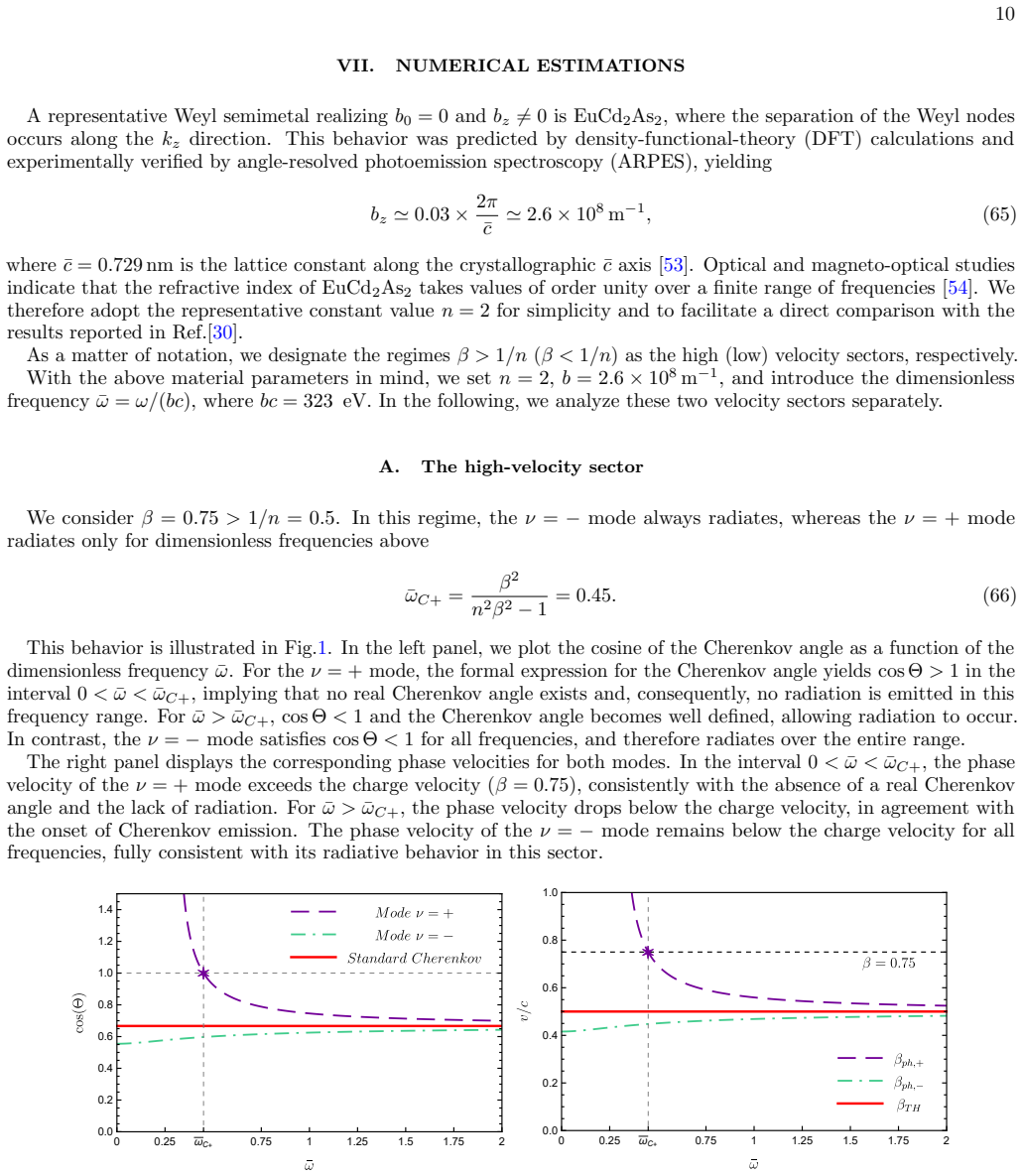
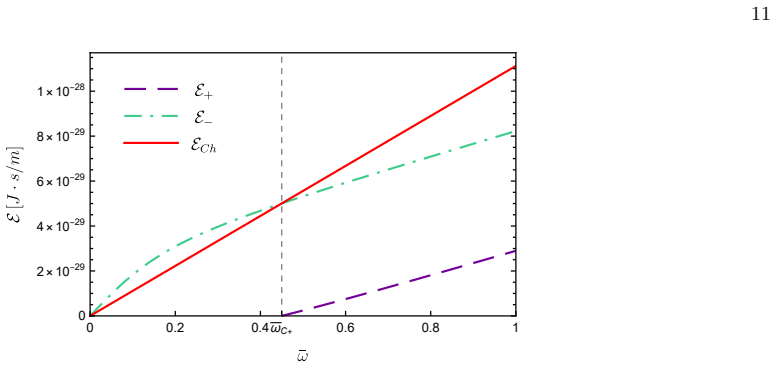
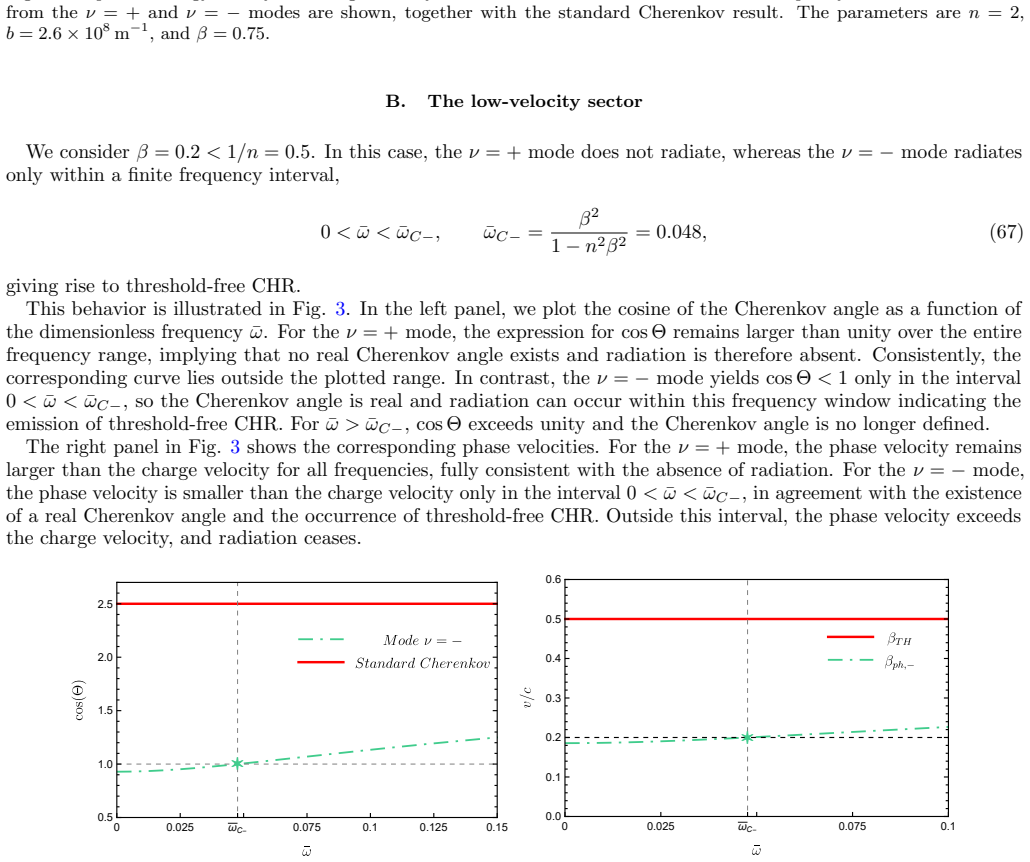
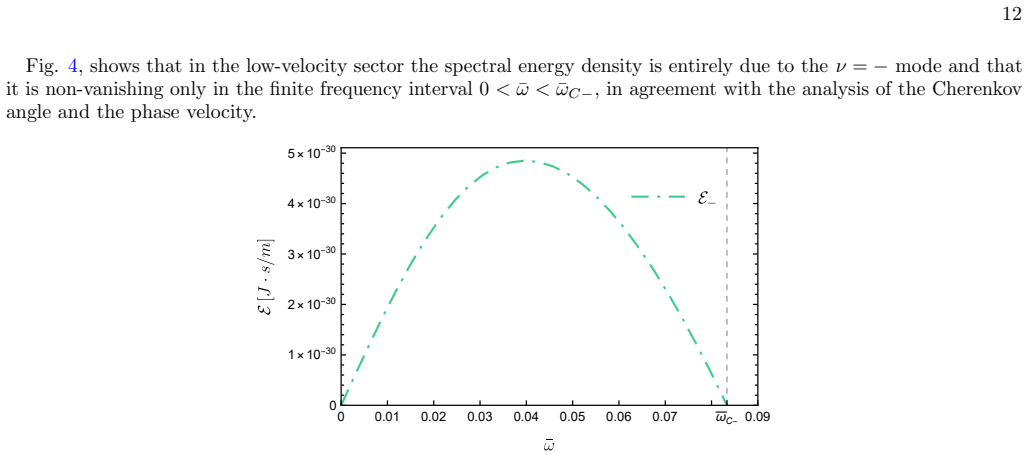
In anisotropic chiral matter, slowly moving charges can produce Cherenkov radiation without a velocity threshold in a limited frequency range.
A machine-rendered reading of the paper's core claim, the machinery that carries it, and where it could break.
Core claim
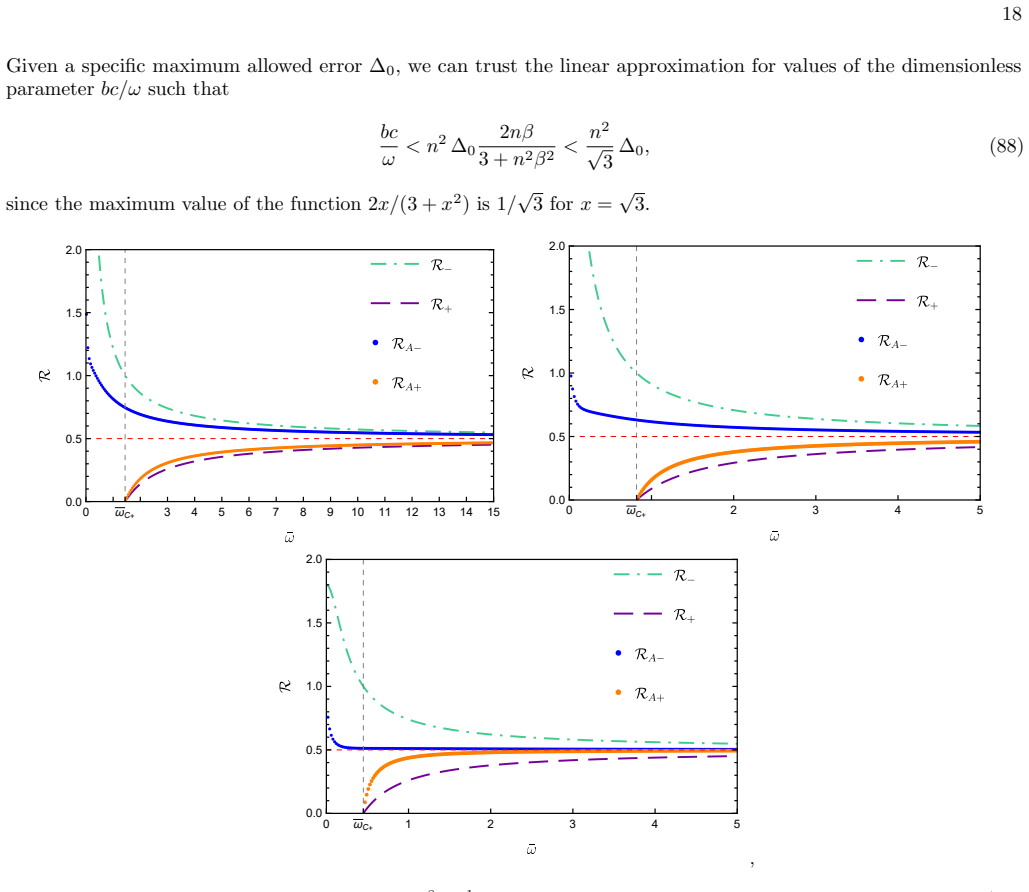
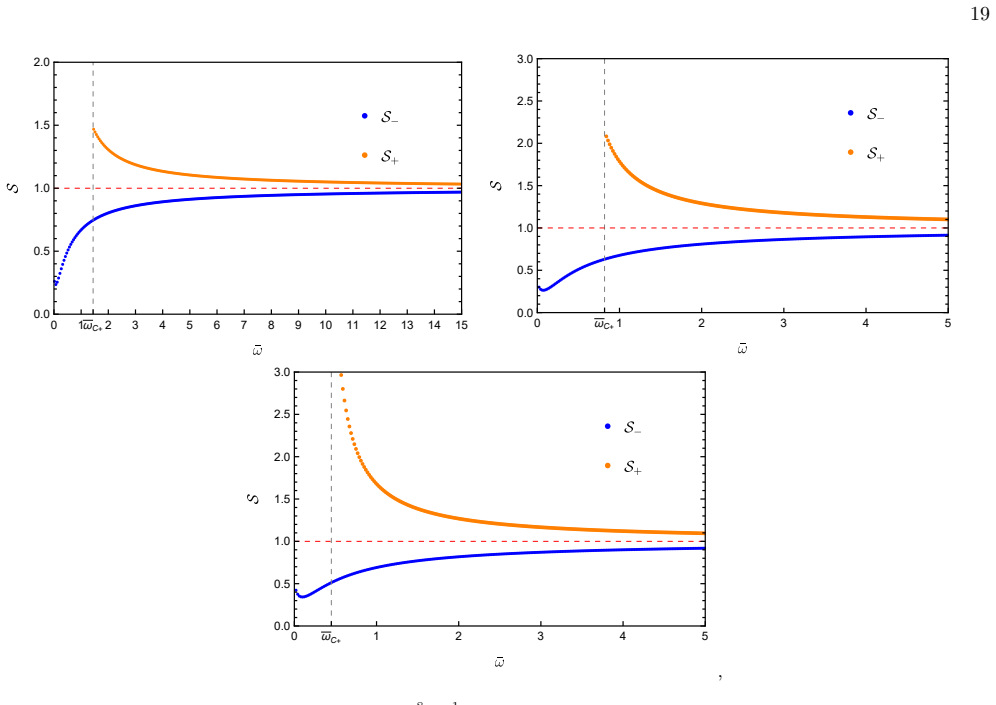
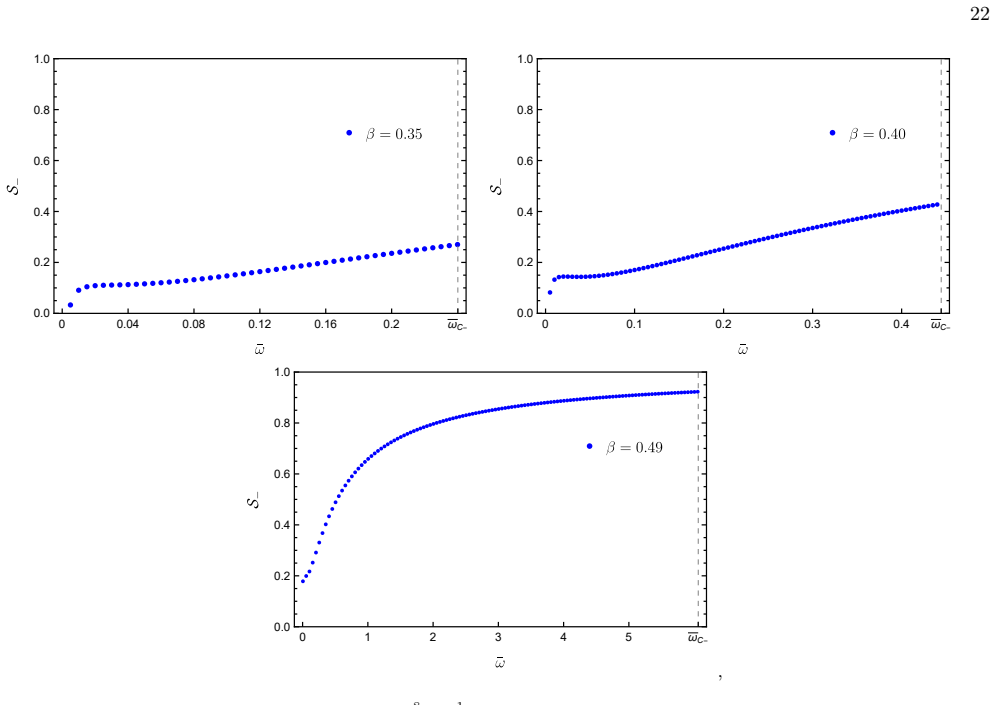
By solving the modified Maxwell's equations with outgoing boundary conditions, the paper establishes that the resulting dispersion relations permit Cherenkov radiation from slowly moving charges without a threshold velocity in one sector of the model, restricted to a particular frequency range. Closed-form expressions for the polarization modes and the space-frequency domain fields are derived, leading to the spectral energy distributions for configurations with zero, one, or two Cherenkov cones.
What carries the argument
Dispersion relations derived from outgoing wave boundary conditions applied to the polarization modes of the modified Maxwell equations in cylindrical coordinates.
If this is right
- Specific angles and frequency ranges allow for zero, one, or two Cherenkov cones.
- The spectral energy distribution of the radiation is calculated in closed form for each case.
- Threshold-free emission by slow charges occurs only within a bounded frequency interval in one sector.
- The exact results allow assessment of the accuracy of a prior approximate Green's function approach.
Where Pith is reading between the lines
- If the linear axion dependence can be realized in a physical system, it would enable new radiation phenomena at low velocities.
- The frequency-limited nature of the effect suggests potential for frequency-selective radiation sources.
- Similar calculations could be performed for other forms of axion angle dependence to see if threshold-free emission persists.
Load-bearing premise
The axion angle must have a linear dependence on position for the modified Maxwell equations to support threshold-free Cherenkov radiation from slow charges.
What would settle it
An experiment observing electromagnetic radiation from a charge moving below the phase velocity in the frequency range where the model predicts emission, or the lack of such radiation, would test the claim.
Figures
read the original abstract
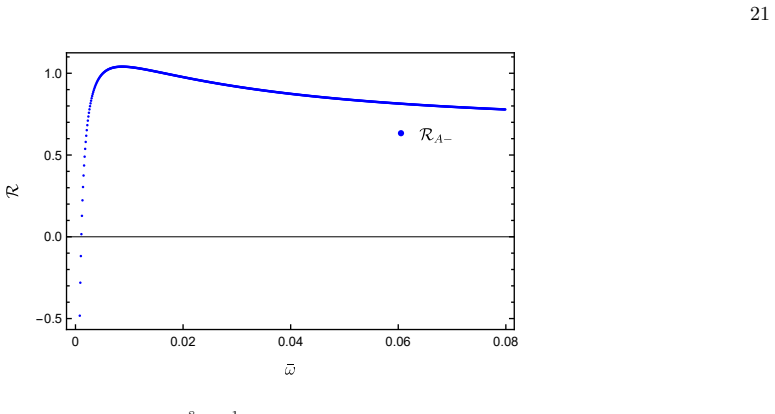
We explore Cherenkov radiation in anisotropic chiral matter within the framework of Carroll-Field-Jackiw electrodynamics, where the axion angle exhibits a linear dependence on position. By deriving closed-form expressions for the polarization modes of electromagnetic fields in cylindrical coordinates and the space-frequency domain, we solve the modified Maxwell's equations. To enforce causality, we impose outgoing wave boundary conditions at a cylindrical surface at infinity, which yields the dispersion relations. Our analysis uncovers the specific angles and frequency ranges that allow for zero, one, or two Cherenkov cones. We also obtain the spectral energy distribution of the radiation in all cases. Notably, one sector of the model exhibits a novel phenomenon: Cherenkov radiation can be generated by slowly moving charges without a threshold, but only within a specific frequency range. This behavior is not observed in standard materials. Using our exact calculations, we also investigate the reliability of an approximate method previously proposed based on the calculation of the Green's function for the system.
Editorial analysis
A structured set of objections, weighed in public.
Referee Report
Summary. The manuscript derives closed-form polarization modes for electromagnetic fields in cylindrical coordinates and the space-frequency domain within Carroll-Field-Jackiw electrodynamics featuring a linearly position-dependent axion angle. It imposes outgoing-wave boundary conditions at a cylindrical surface at infinity to obtain dispersion relations, identifies the angles and frequency ranges permitting zero, one, or two Cherenkov cones, computes the associated spectral energy distributions, and reports a novel sector in which Cherenkov radiation occurs without a velocity threshold for slowly moving charges (restricted to a specific frequency window). The work also assesses the accuracy of a prior approximate Green's-function method against the exact results.
Significance. If the derivations hold, the identification of threshold-free emission in one sector constitutes a genuine departure from standard Cherenkov behavior and could be relevant for analogs in chiral or axion-like media. The provision of exact closed-form modes and dispersion relations, together with the direct comparison to the approximate method, supplies a concrete benchmark that strengthens the result. The consistent use of outgoing boundary conditions to enforce causality is a methodological strength.
major comments (2)
- [Dispersion relations section] The central claim of threshold-free emission rests on the dispersion relations obtained after imposing outgoing-wave conditions (abstract and the section deriving the dispersion relations). The manuscript must explicitly demonstrate that the linear axion profile produces a frequency window in which the phase velocity condition is satisfied for arbitrarily small charge velocities without introducing modes that violate causality or energy positivity.
- [Spectral energy distribution] Table or figure presenting the spectral energy distribution (the section on spectral distributions): the integration over the allowed cone angles for the zero-threshold sector should be shown to remain finite and positive; if the distribution reduces to the standard Frank-Tamm form outside the claimed window, this should be stated explicitly to confirm the novelty is confined to the stated frequency range.
minor comments (3)
- Notation for the axion angle gradient and the cylindrical wave-vector components should be defined once at first use and used consistently thereafter.
- The abstract states that the behavior 'is not observed in standard materials'; a brief sentence contrasting the linear axion profile with the constant-angle case would clarify the distinction.
- Figure captions for the cone-angle plots should include the explicit parameter values (velocity, frequency range) used in each panel.
Simulated Author's Rebuttal
We thank the referee for the positive assessment, the recognition of the methodological strengths, and the recommendation for minor revision. We address each major comment below.
read point-by-point responses
-
Referee: [Dispersion relations section] The central claim of threshold-free emission rests on the dispersion relations obtained after imposing outgoing-wave conditions (abstract and the section deriving the dispersion relations). The manuscript must explicitly demonstrate that the linear axion profile produces a frequency window in which the phase velocity condition is satisfied for arbitrarily small charge velocities without introducing modes that violate causality or energy positivity.
Authors: The outgoing-wave boundary conditions imposed at the cylindrical surface at infinity already enforce causality by construction, as noted in the referee's significance assessment. The resulting dispersion relations in the relevant section explicitly delineate the frequency window in which the phase-velocity condition holds for arbitrarily small velocities, arising from the linear axion profile. To address the request for an explicit demonstration, we will add a short paragraph in the revised manuscript that verifies the absence of causality or energy-positivity violations within this window (via sign checks on frequencies and group velocities). revision: yes
-
Referee: [Spectral energy distribution] Table or figure presenting the spectral energy distribution (the section on spectral distributions): the integration over the allowed cone angles for the zero-threshold sector should be shown to remain finite and positive; if the distribution reduces to the standard Frank-Tamm form outside the claimed window, this should be stated explicitly to confirm the novelty is confined to the stated frequency range.
Authors: The spectral energy distributions are obtained in closed form by integrating the exact polarization-mode expressions over the allowed cone angles. For the zero-threshold sector the integral remains finite and positive because the cone angles are bounded and the energy density expression is nonsingular. We will add an explicit statement in the revised manuscript confirming that, outside the claimed frequency window, the distribution reduces to the standard Frank-Tamm form, thereby confining the novelty to the stated range. revision: yes
Circularity Check
No significant circularity; derivation self-contained from model to results
full rationale
The paper takes the Carroll-Field-Jackiw framework with explicitly chosen linear axion-angle profile as the defining input, derives polarization modes and dispersion relations by solving the resulting position-dependent Maxwell equations under outgoing cylindrical boundary conditions at infinity, and obtains the spectral distributions and the frequency-restricted zero-threshold sector as direct consequences. No parameters are fitted to data subsets and then relabeled as predictions, no self-citation chain supplies the load-bearing uniqueness or ansatz, and the novel emission behavior follows from the dispersion relations without reduction to the inputs by construction. The supplementary check of a prior approximate Green's-function method does not underpin the central claims.
Axiom & Free-Parameter Ledger
axioms (2)
- domain assumption The axion angle exhibits a linear dependence on position.
- domain assumption Outgoing wave boundary conditions at a cylindrical surface at infinity enforce causality and determine the dispersion relations.
Reference graph
Works this paper leans on
-
[1]
P. A. Cherenkov, Visible luminescence of pure liquids under the influence of γ-radiation, Dokl. Akad. Nauk SSSR2, 451 (1934)
1934
-
[2]
Vavilov, Cr acad, sci
S. Vavilov, Cr acad, sci. ussr 2, 457 (1934), inDokl. Akad. Nauk SSSR, Vol. 2 (1934) p. 457
1934
-
[3]
I. M. Frank and I. E. Tamm, Coherent visible radiation of fast electrons passing through matter, Compt. Rend. Acad. Sci. URSS14, 109 (1937)
1937
-
[4]
Ypsilantis and J
T. Ypsilantis and J. Seguinot, Theory of ring imaging Cherenkov counters, Nucl. Instrum. Meth. A343, 30 (1994)
1994
-
[5]
J. J. Aubertet al.(E598), Experimental Observation of a Heavy ParticleJ, Phys. Rev. Lett.33, 1404 (1974)
1974
-
[6]
M. Amenomoriet al.(Tibet ASgamma), First Detection of sub-PeV Diffuse Gamma Rays from the Galactic Disk: Evidence for Ubiquitous Galactic Cosmic Rays beyond PeV Energies, Phys. Rev. Lett.126, 141101 (2021), arXiv:2104.05181 [astro-ph.HE]
arXiv 2021
-
[7]
Adamo, K
G. Adamo, K. F. MacDonald, Y. Fu, C. Wang, D. Tsai, F. J. Garc´ ıa de Abajo, and N. Zheludev, Light well: a tunable free-electron light source on a chip, Physical review letters103, 113901 (2009)
2009
-
[8]
S. Liu, P. Zhang, W. Liu, S. Gong, R. Zhong, Y. Zhang, and M. Hu, Surface polariton cherenkov light radiation source, Physical review letters109, 153902 (2012)
2012
-
[9]
F. Liu, L. Xiao, Y. Ye, M. Wang, K. Cui, X. Feng, W. Zhang, and Y. Huang, Integrated cherenkov radiation emitter eliminating the electron velocity threshold, Nature Photonics11, 289 (2017)
2017
-
[10]
Hachadorian, P
R. Hachadorian, P. Bruza, M. Jermyn, D. Gladstone, B. Pogue, and L. Jarvis, Imaging radiation dose in breast radiotherapy by x-ray ct calibration of cherenkov light, Nature communications11, 2298 (2020)
2020
-
[11]
D. A. Alexander, A. Nomezine, L. A. Jarvis, D. J. Gladstone, B. W. Pogue, and P. Bruza, Color cherenkov imaging of clinical radiation therapy, Light: Science & Applications10, 226 (2021)
2021
-
[12]
T. M. Shaffer, E. C. Pratt, and J. Grimm, Utilizing the power of cerenkov light with nanotechnology, Nature nanotechnology 12, 106 (2017)
2017
-
[13]
X. Wang, L. Li, J. Li, P. Wang, J. Lang, and Y. Yang, Cherenkov luminescence in tumor diagnosis and treatment: A review, inPhotonics, Vol. 9 (MDPI, 2022) p. 390
2022
-
[14]
Kotagiri, G
N. Kotagiri, G. P. Sudlow, W. J. Akers, and S. Achilefu, Breaking the depth dependency of phototherapy with cerenkov radiation and low-radiance-responsive nanophotosensitizers, Nature nanotechnology10, 370 (2015)
2015
-
[15]
Kamkaew, L
A. Kamkaew, L. Cheng, S. Goel, H. F. Valdovinos, T. E. Barnhart, Z. Liu, and W. Cai, Cerenkov radiation induced photodynamic therapy using chlorin e6-loaded hollow mesoporous silica nanoparticles, ACS applied materials & interfaces 8, 26630 (2016)
2016
-
[16]
V. P. Zrelov,Cherenkov radiation in high-energy physics : [by] V. P. Zrelov. Translated from Russian by Y. Oren. Edited by Benny Baruch, U.S. Atomic Energy Commission. AEC-tr-7099 (Jerusalem, Israel Program for Scientific Translations; [available for U.S. Dept. of Commerce, Clearinghouse for Federal Scientific and Technical Information, Springfield, Va.] ...
1970
-
[17]
H. Hu, X. Lin, and Y. Luo, Free-electron radiation engineering via structured environments, arXiv preprint arXiv:2108.06149 10.2528/PIER21081303 (2021)
-
[18]
Skryabin, Y
D. Skryabin, Y. Kartashov, O. Egorov, M. Sich, J. Chana, L. Tapia Rodriguez, P. Walker, E. Clarke, B. Royall, M. Skolnick, et al., Backward cherenkov radiation emitted by polariton solitons in a microcavity wire, Nature communications8, 1554 (2017)
2017
-
[19]
Genevet, D
P. Genevet, D. Wintz, A. Ambrosio, A. She, R. Blanchard, and F. Capasso, Controlled steering of cherenkov surface plasmon wakes with a one-dimensional metamaterial, Nature Nanotechnology10, 804 (2015)
2015
-
[20]
S. N. Galyamin, A. V. Tyukhtin, A. Kanareykin, and P. Schoessow, Reversed cherenkov-transition radiation by a charge crossing a left-handed medium boundary, Physical review letters103, 194802 (2009)
2009
-
[21]
Veselago, The electrodynamics of substances with simultaneously negative values of ϵ and µ, Usp
V. Veselago, The electrodynamics of substances with simultaneously negative values of ϵ and µ, Usp. fiz. nauk92, 517 (1967)
1967
-
[22]
R. A. Shelby, D. R. Smith, and S. Schultz, Experimental verification of a negative index of refraction, science292, 77 (2001)
2001
-
[23]
S. Xi, H. Chen, T. Jiang, L. Ran, J. Huangfu, B.-I. Wu, . f. J. A. Kong, and M. Chen, Experimental verification of reversed cherenkov radiation in left-handed metamaterial, Physical review letters103, 194801 (2009)
2009
-
[24]
Zhang and X
S. Zhang and X. Zhang, Flipping a photonic shock wave, Physics2, 91 (2009)
2009
-
[25]
X. Lu, M. A. Shapiro, I. Mastovsky, R. J. Temkin, M. Conde, J. G. Power, J. Shao, E. E. Wisniewski, and C. Jing, Generation of high-power, reversed-cherenkov wakefield radiation in a metamaterial structure, Physical review letters122, 014801 (2019)
2019
-
[26]
Z. Duan, X. Tang, Z. Wang, Y. Zhang, X. Chen, M. Chen, and Y. Gong, Observation of the reversed cherenkov radiation, Nature Communications8, 14901 (2017). 31
2017
-
[27]
O. J. Franca, L. F. Urrutia, and O. Rodr´ ıguez-Tzompantzi, Reversed electromagnetic Vavilov-ˇCerenkov radiation in naturally existing magnetoelectric media, Phys. Rev. D99, 116020 (2019), arXiv:1905.12088 [cond-mat.mes-hall]
Pith/arXiv arXiv 2019
-
[28]
R. Chen, Z. Gong, Z. Wang, X. Xi, B. Zhang, Y. Yang, B. Zhang, I. Kaminer, H. Chen, and X. Lin, A gain route to reversed cherenkov radiation, Science Advances11, eads5113 (2025)
2025
-
[29]
Zhang, Z
B. Zhang, Z. Gong, R. Chen, X. Chen, Y. Yang, H. Chen, I. Kaminer, and X. Lin, Reversed cherenkov radiation via Fizeau–Fresnel drag, Appl. Phys. Rev.12(2025)
2025
-
[30]
E. Barredo-Alamilla, L. F. Urrutia, and M. M. Ferreira, Jr., Electromagnetic radiation in chiral matter: The Cherenkov case, Phys. Rev. D107, 096024 (2023), arXiv:2305.07963 [hep-ph]
arXiv 2023
-
[31]
O. J. Franca and S. Y. Buhmann, Vavilov-Cherenkov radiation for parallel motion in three-dimensional topological insulators, Phys. Rev. B110, 195150 (2024), arXiv:2405.15906 [cond-mat.mes-hall]
arXiv 2024
-
[32]
Mart´ ınez von Dossow, E
R. Mart´ ınez von Dossow, E. Barredo-Alamilla, M. A. Gorlach, and L. F. Urrutia, Cherenkov radiation in isotropic chiral matter: The space-frequency domain, Physics Letters A556, 130810 (2025)
2025
-
[33]
Colladay and V
D. Colladay and V. A. Kosteleck´ y,CP Tviolation and the standard model, Phys. Rev. D55, 6760 (1997)
1997
-
[34]
Colladay and V
D. Colladay and V. A. Kosteleck´ y, Lorentz-violating extension of the standard model, Phys. Rev. D58, 116002 (1998)
1998
-
[35]
R. Jackiw and V. A. Kostelecky, Radiatively induced Lorentz and CPT violation in electrodynamics, Phys. Rev. Lett.82, 3572 (1999), arXiv:hep-ph/9901358
Pith/arXiv arXiv 1999
-
[36]
R. A. Mart´ ınez von Dossow and L. F. Urrutia, Effective electromagnetic Lagrangians in the derivative expansion method, J. Phys. A58, 145401 (2025), arXiv:2503.22950 [hep-th]
arXiv 2025
-
[37]
C. Adam and F. R. Klinkhamer, Causality and CPT violation from an Abelian Chern-Simons like term, Nucl. Phys. B607, 247 (2001), arXiv:hep-ph/0101087
Pith/arXiv arXiv 2001
-
[38]
V. A. Kostelecky and A. G. M. Pickering, Vacuum photon splitting in Lorentz violating quantum electrodynamics, Phys. Rev. Lett.91, 031801 (2003), arXiv:hep-ph/0212382
Pith/arXiv arXiv 2003
-
[39]
R. Lehnert and R. Potting, Vacuum Cerenkov radiation, Phys. Rev. Lett.93, 110402 (2004), arXiv:hep-ph/0406128
Pith/arXiv arXiv 2004
-
[40]
R. Lehnert and R. Potting, The Cerenkov effect in Lorentz-violating vacua, Phys. Rev. D70, 125010 (2004), [Erratum: Phys.Rev.D 70, 129906 (2004)], arXiv:hep-ph/0408285
Pith/arXiv arXiv 2004
-
[41]
C. Kaufhold and F. R. Klinkhamer, Vacuum Cherenkov radiation and photon triple-splitting in a Lorentz-noninvariant extension of quantum electrodynamics, Nucl. Phys. B734, 1 (2006), arXiv:hep-th/0508074
Pith/arXiv arXiv 2006
-
[42]
D. Colladay, P. McDonald, and R. Potting, Cherenkov Radiation with Massive, CPT-violating Photons, Phys. Rev. D93, 125007 (2016), arXiv:1603.00308 [hep-th]
Pith/arXiv arXiv 2016
-
[43]
Schreck, Vacuum Cherenkov radiation for Lorentz-violating fermions, Phys
M. Schreck, Vacuum Cherenkov radiation for Lorentz-violating fermions, Phys. Rev. D96, 095026 (2017), arXiv:1702.03171 [hep-ph]
Pith/arXiv arXiv 2017
-
[44]
L. Lisboa-Santos, J. a. A. A. S. Reis, M. Schreck, and M. M. Ferreira, Jr., Planar electrodynamics modified by higher- derivative terms, Phys. Rev. D108, 115032 (2023), arXiv:2309.16839 [hep-th]
arXiv 2023
-
[45]
J. O’Connor and B. Altschul, Radiation from an oscillating dipole in the presence of photon-sector CPT and Lorentz violation, Phys. Rev. D109, 045005 (2024), arXiv:2309.05648 [hep-th]
arXiv 2024
-
[46]
P. D. S. Silva, M. M. Ferreira, M. Schreck, and L. F. Urrutia, Magnetic-conductivity effects on electromagnetic propagation in dispersive matter, Phys. Rev. D102, 076001 (2020), arXiv:2006.02022 [hep-th]
arXiv 2020
-
[47]
P. D. S. Silva, L. Lisboa-Santos, M. M. Ferreira, Jr., and M. Schreck, Effects of CPT-odd terms of dimensions three and five on electromagnetic propagation in continuous matter, Phys. Rev. D104, 116023 (2021), arXiv:2109.04659 [hep-th]
arXiv 2021
-
[48]
O. J. Franca and S. Y. Buhmann, Modification of transition radiation by three-dimensional topological insulators, Phys. Rev. B105, 155120 (2022), arXiv:2110.08369 [cond-mat.mes-hall]
arXiv 2022
-
[49]
O. J. Franca and L. F. Urrutia, Radiation from a dipole perpendicular to the interface between two planar semi-infinite magnetoelectric media, Rev. Mex. Fis.68, 060701 (2022), arXiv:2107.06824 [cond-mat.other]
arXiv 2022
-
[50]
P. D. S. Silva, M. J. Neves, and M. M. Ferreira, Jr., Optical properties and energy propagation in a dielectric medium supporting magnetic current, Phys. Rev. B109, 184439 (2024), arXiv:2305.08153 [cond-mat.other]
arXiv 2024
-
[51]
A. Y. Petrov, M. Schreck, and A. R. Vieira, Vacuum cherenkov radiation for nonminimal dimension-5 lorentz violation, The European Physical Journal C86, 30 (2026)
2026
-
[52]
Mart´ ınez von Dossow, E
R. Mart´ ınez von Dossow, E. Barredo-Alamilla, M. A. Gorlach, and L. F. Urrutia, Cherenkov radiation in isotropic chiral matter: Unlocking threshold-free emission, Phys. Rev. D113, 016010 (2026)
2026
-
[53]
J.-R. Soh, F. de Juan, M. G. Vergniory, N. B. M. Schr¨ oter, M. C. Rahn, D. Y. Yan, J. Jiang, M. Bristow, P. Reiss, J. N. Blandy, Y. F. Guo, Y. G. Shi, T. K. Kim, A. McCollam, S. H. Simon, Y. Chen, A. I. Coldea, and A. T. Boothroyd, Ideal weyl semimetal induced by magnetic exchange, Phys. Rev. B100, 201102 (2019)
2019
-
[54]
Nasrallah, D
S. Nasrallah, D. Santos-Cottin, F. Le Mardel´ e, I. Mohelsk´ y, J. Wyzula, L. Akˇ samovi´ c, P. Saˇ cer, J. W. H. Barrett, W. Galloway, K. Rigaux, F. Guo, M. Puppin, I. ˇZivkovi´ c, J. H. Dil, M. Novak, C. C. Homes, M. Orlita, N. Bariˇ si´ c, and A. Akrap, Magneto-optical response of the magnetic semiconductors eucd2X2 (x=p, as, sb), Phys. Rev. B110, L201...
2024
-
[55]
Z. Gong, J. Chen, R. Chen, X. Zhu, C. Wang, X. Zhang, H. Hu, Y. Yang, B. Zhang, H. Chen,et al., Interfacial cherenkov radiation from ultralow-energy electrons, Proceedings of the National Academy of Sciences120, e2306601120 (2023)
2023
-
[56]
Chenet al., Low-Velocity-Favored Transition Radiation, Phys
J. Chenet al., Low-Velocity-Favored Transition Radiation, Phys. Rev. Lett.131, 113002 (2023), arXiv:2212.13066 [physics.optics]
arXiv 2023
-
[57]
Y. Adiv, H. Hu, S. Tsesses, R. Dahan, K. Wang, Y. Kurman, A. Gorlach, H. Chen, X. Lin, G. Bartal, and I. Kaminer, Observation of 2d cherenkov radiation, Physical Review X13, 10.1103/physrevx.13.011002 (2023)
discussion (0)
Sign in with ORCID, Apple, or X to comment. Anyone can read and Pith papers without signing in.