REVIEW 3 major objections 5 minor 21 references
Transformer-Based Neural Network for Transient Detection without Image Subtraction
T0 review · 3 major / 5 minor · reviewed 2026-08-05 · deepseek-v4-flash
Pith's one-line read A transformer can spot real versus bogus supernovae without image subtraction.
desk verdict Solid empirical paper on transformer-based real/bogus classification without difference images; headline numbers are credible, but the off-center benchmark is filtered by DIA detectability, which narrows the 'without subtraction' claim. read the letter →
The pith
A machine-rendered reading of the paper's core claim, the machinery that carries it, and where it could break.
The reading
What carries the argument
The central mechanism is the localized attention module. It augments standard self-attention with a learnable distance-weighting term: the attention logits are multiplied elementwise by exp(αD), where D contains pairwise pixel distances and α is a trainable parameter; this lets the model decide how local the comparison should be. Combined with channel swapping between the search and template feature maps, it turns the network into a dedicated pixel-comparison engine, and the decoder blocks fuse the two streams into a single real/bogus prediction.
What would settle it
Retrain or evaluate the network on a version of the no-Diff dataset where every injected fake with search-image SNR>5 counts as positive, regardless of whether it appears in the difference image, and compare the fake recovery rate; a large drop would show the current result is conditioned on difference-image detectability rather than true off-center robustness.
Extended reading notes
Core claim
Real-bogus classification can be cast as a pixel-by-pixel comparison task between two registered images rather than as a single-image recognition task on a difference image. The network does this with localized attention: a modified attention operation re-weights the softmax attention matrix by a learned exponential of pairwise pixel distances, forcing the model to compare nearby pixels across the search and template stamps. Channel swaps at the end of each encoder block exchange half the feature channels between the two images so downstream blocks learn which spatial and channel features distinguish a genuine transient from a subtraction artifact. Six encoder-decoder stages feed an MLP that
Load-bearing premise
The off-center test keeps only fakes that were bright enough in the difference image, so the high accuracy does not prove the network can catch transients that difference imaging would miss.
Editorial extensions
If this is right
- A survey could classify candidates without running difference imaging at all; the authors report DiffImg takes about 10 minutes per CCD for DES while their network processes 1024 stamps in under 1.4 seconds.
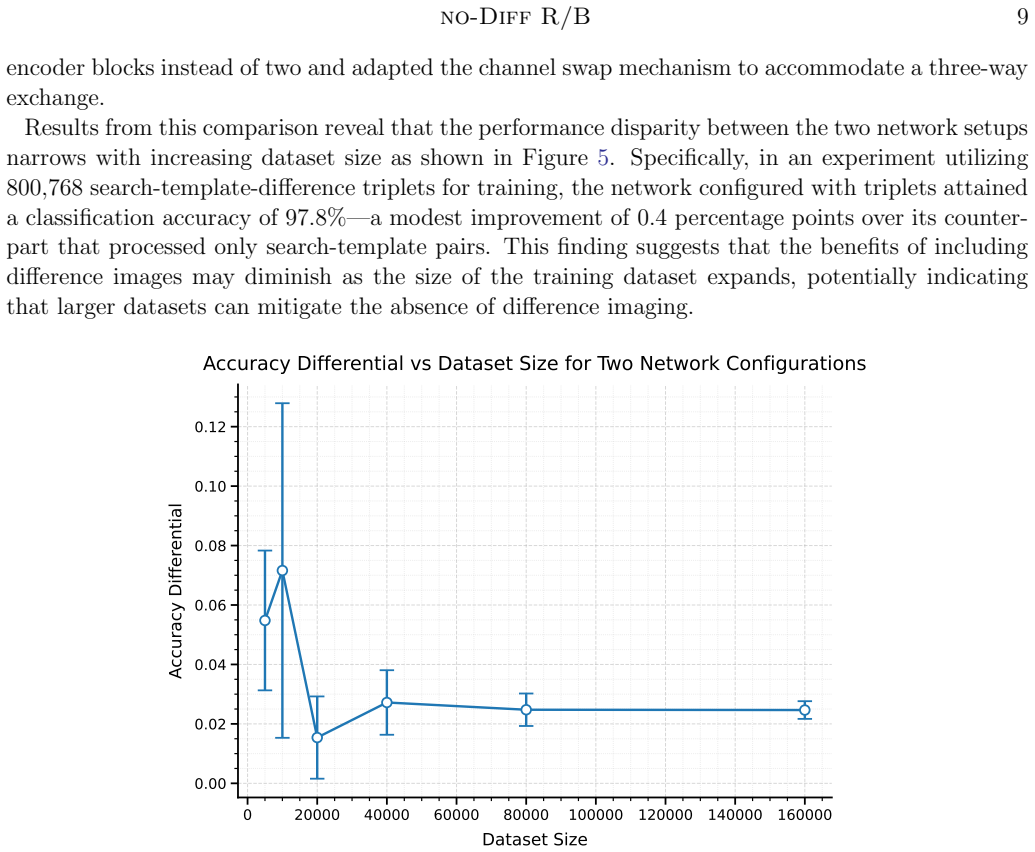
- The utility of the difference image as an input diminishes with training-set size, so larger labeled datasets make the no-subtraction route increasingly attractive.
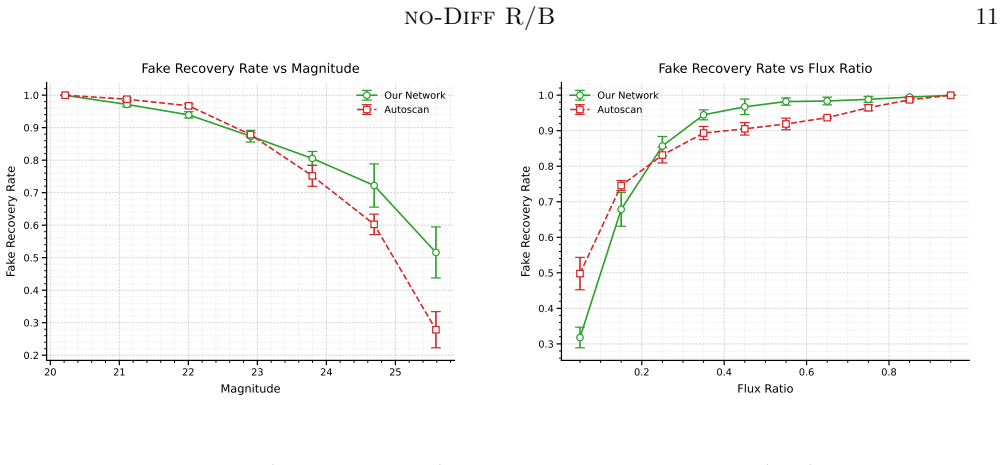
- Performance stays near 97% even when the transient is not centered in the stamp, meaning source extraction from the search image alone can feed the classifier.
- Because the network reads raw fits inputs, it can be inserted directly into existing alert pipelines without special preprocessing.
Reading between the lines
- The same distance-weighted attention design could apply to any task that asks whether two registered images differ for physical reasons, such as change detection in satellite imagery or medical follow-up imaging; the paper does not test these domains.
- A natural next test is to train on positives defined by search-image detections without any difference-image selection; that would show whether the network can catch transients that DIA itself would miss, which the current no-Diff benchmark does not measure.
- If the difference image's marginal value keeps shrinking with data, an ensemble or larger no-Diff model might eventually match or beat the triplet network, making DIA only a verification step rather than a discovery step.
- The channel-swap trick could be read as a learned alternative to subtraction: instead of computing pixel differences, the network learns which feature channels to exchange, so future architectures might derive explicit difference-like operators from the attention weights.
Editorial analysis
A structured set of objections, weighed in public.
Referee Report
Summary. The paper introduces a transformer-based real/bogus classifier for transient detection that operates on search and template images only, omitting the difference image that conventional pipelines require. The architecture combines localized attention with a learned distance weighting, channel swaps between the two input images, and decoder blocks feeding an MLP. On the DES autoScan benchmark the authors report 97.4 ± 0.2% accuracy and 0.993 ROC AUC with search+template inputs, close to the 97.8 ± 0.1% of a triplet network that also receives the difference image. On a custom no-Diff dataset built from search-image source extraction, they report 96.7 ± 0.1% accuracy and 0.993 AUC, and conclude that the difference image provides diminishing value with larger training sets and that the network is robust to off-center transients.
Significance. If the results hold, this work offers a practical route to bypass computationally expensive difference imaging in large surveys such as Rubin/LSST, and the architecture contribution is plausible. The paper has several concrete strengths: five-seed runs with standard errors, a group-based train/test split to avoid leakage, public code and data, a runtime comparison against DiffImg, and a same-condition comparison with a re-trained braai baseline. The main limitation is that the no-Diff benchmark's positive samples are selected by DIA-derived scores and SNR, so the 'without subtraction' claim is only demonstrated for DIA-detectable transients. This is a correctness-risk concern for the paper's strongest conclusion, not an arithmetic error.
major comments (3)
- [§2.2, §4.2] The no-Diff positive set is defined as fakes with 'available autoScan scores and SNR greater than 3.5 from the difference image.' This conditions the benchmark on the very DIA detectability that the paper argues can be bypassed. The reported 96.7 ± 0.1% accuracy therefore measures classification of DIA-detectable transients at off-center positions, not the ability to recover transients that search-image source extraction would find but DIA would miss. Please either construct positives without any DIA-based reference (e.g., search-image-only detections with independent visual labels), report performance on fakes below the DIA SNR threshold, or explicitly re-scope the title and conclusions to 'DIA-detectable transients.'
- [§4.1, Figure 5] The claim that the utility of the difference image 'diminishes' with training-set size rests on a single growth curve of accuracy differential with no error bars, no indication of seed-to-seed variation, and only 10 epochs of training. Because this claim appears in the abstract and conclusions, it is load-bearing. Please add multiple-seed statistics at each dataset size (and ideally a final-epoch or fixed-schedule comparison) or soften the claim to a tentative observation.
- [§4.1, Table 1] The comparison with the CNN baseline of Acero-Cuellar et al. is confounded by dataset size: their 91.1% and 96.1% accuracies are from 100,000 samples, whereas the attention network uses 800,768. The same-condition braai baseline partially addresses this, but the claim that the method 'outperforms traditional approaches' would be substantially stronger if the Acero-Cuellar CNN were retrained on the same 800,768 samples (or the attention network were evaluated on 100,000). Please either add this controlled comparison or note the confound explicitly.
minor comments (5)
- [§3] Typo: 'an multi-layer perceptron' should be 'a multi-layer perceptron'.
- [Table 1] The 'T able 1' rendering is corrupted; fix the table environment so the title appears correctly.
- [§4.2] The ROC AUC is reported as '0.993 ± 0.0'. A non-zero standard deviation should be reported to at least two significant digits, or the uncertainty should be stated as below the printed precision.
- [Figure 5] The y-axis label 'T wo' appears to contain a typo; it should read 'Two Network Configurations'.
- [§2.1] The comparison of input preprocessing approaches (linear, Gaussian, raw FITS) is described in prose only. Consider a small table or figure showing the performance differences, since the choice of raw FITS is part of the method.
Circularity Check
No significant circularity; the benchmark is empirical, and the only mild self-reference is an evaluation filter, not a fitted input.
full rationale
The paper is an empirical benchmark study. The central claims (97.4% accuracy on autoScan and 96.7% on no-Diff) are measured against externally supplied labels: DES autoScan labels from Goldstein et al. (2015) and injected fakes from Kessler et al. (2015). The transformer's output is not constructed from its inputs by definition; it is trained and tested on held-out image pairs. The no-Diff dataset construction in Section 2.2 does keep only positives with available autoScan scores and difference-image SNR>3.5, so the 'without subtraction' result is conditional on DIA-detectability; this is a selection-function limitation that limits generalization to transients DIA would miss, but it is not circular because the labels still come from injected fakes and the network never receives the autoScan score or difference image as an input. The citation of Acero-Cuellar et al. (2023), which shares two co-authors, is used only as a prior benchmark and motivation; it is not load-bearing for the new architecture or its measured performance. No equation or fitted parameter is reused as a prediction, and no uniqueness theorem or ansatz is imported from the authors' prior work. Therefore the derivation chain is self-contained: measured accuracy against external labels, with one evaluation caveat.
Assumptions & free parameters
free parameters (3)
- Network weights and biases =
millions of learned values, not enumerated
- Learnable attention localization weight alpha =
learned, not reported
- Dataset-selection thresholds =
SNR>5 source extraction; SNR>3.5 diff-image cutoff; 20% subsample
assumptions (3)
- domain assumption Search and template stamps are aligned and photometrically comparable before input
- domain assumption autoScan labels are sufficiently reliable
- domain assumption Injected DiffImg fakes represent real transients
Cite this review
Pith. "Pith review of Transformer-Based Neural Network for Transient Detection without Image Subtraction." pith.science (2026). https://pith.science/paper/KADZQBWZ
@misc{pith2026250816844,
  author       = {Pith},
  title        = {Pith review of: Transformer-Based Neural Network for Transient Detection without Image Subtraction},
  year         = {2026},
  howpublished = {\url{https://pith.science/paper/KADZQBWZ}},
  note         = {Machine review of arXiv:2508.16844}
}
read the original abstract
We introduce a transformer-based neural network for the accurate classification of real and bogus transient detections in astronomical images. This network advances beyond the conventional convolutional neural network (CNN) methods, widely used in image processing tasks, by adopting an architecture better suited for detailed pixel-by-pixel comparison. The architecture enables efficient analysis of search and template images only, thus removing the necessity for computationally-expensive difference imaging, while maintaining high performance. Our primary evaluation was conducted using the autoScan dataset from the Dark Energy Survey (DES), where the network achieved a classification accuracy of 97.4% and diminishing performance utility for difference image as the size of the training set grew. Further experiments with DES data confirmed that the network can operate at a similar level even when the input images are not centered on the supernova candidate. These findings highlight the network's effectiveness in enhancing both accuracy and efficiency of supernova detection in large-scale astronomical surveys.
Figures


Figures from the paper (4 more)


Reference graph
Works this paper leans on
-
[1]
2023, The Astronomical Journal, 166, 115
Acero-Cuellar, T., Bianco, F., Dobler, G., et al. 2023, The Astronomical Journal, 166, 115
work page 2023
-
[2]
Alard, C., & Lupton, R. H. 1998, The Astrophysical Journal, 503, 325
work page 1998
- [3]
-
[4]
Bloom, J. S., Richards, J. W., Nugent, P. E., et al. 2012, Publications of the Astronomical Society of the Pacific, 124, 1175
work page 2012
-
[5]
Bramich, D. M. 2008, Monthly Notices of the Royal Astronomical Society: Letters, 386, L77
work page 2008
-
[6]
Brink, H., Richards, J. W., Poznanski, D., et al. 2013, Monthly Notices of the Royal Astronomical Society, 435, 1047
work page 2013
-
[7]
Carion, N., Massa, F., Synnaeve, G., et al. 2020, End-to-End Object Detection with Transformers, computer Vision and Pattern Recognition, arXiv:2005.12872
arXiv 2020
-
[8]
Chen, Z., Zhou, W., Sun, G., et al. 2023, TransientViT: A novel CNN - Vision Transformer hybrid real/bogus transient classifier for the Kilodegree Automatic Transient Survey, instrumentation and Methods for Astrophysics, arXiv:2309.09937 Dan Hendrycks, K. G. 2016, arXiv:1606.08415v5, doi:https://doi.org/10.48550/arXiv.1606.08415
Show all 21 references
-
[9]
2020, An Image is Worth 16x16 Words: Transformers for Image Recognition at Scale, computer Vision and Pattern Recognition, arXiv:2010.11929
Dosovitskiy, A., Beyer, L., Kolesnikov, A., et al. 2020, An Image is Worth 16x16 Words: Transformers for Image Recognition at Scale, computer Vision and Pattern Recognition, arXiv:2010.11929
2020 arXiv
-
[10]
A., Mahabal, A., Masci, F
Duev, D. A., Mahabal, A., Masci, F. J., et al. 2019, Monthly Notices of the Royal Astronomical Society, 489, 3582
2019
-
[11]
A., D’Andrea, C
Goldstein, D. A., D’Andrea, C. B., Fischer, J. A., et al. 2015, The Astronomical Journal, 150, 82
2015
-
[12]
2017, ApJ, 835, 64
Margutti, R. 2017, ApJ, 835, 64
2017
-
[13]
2022, in 2022 IEEE/CVF Conference on Computer Vision and Pattern Recognition (CVPR), 12165–12175
Guo, J., Han, K., Wu, H., et al. 2022, in 2022 IEEE/CVF Conference on Computer Vision and Pattern Recognition (CVPR), 12165–12175
2022
-
[14]
2022, The Astrophysical Journal, 936, 157
Hu, L., Wang, L., Chen, X., & Yang, J. 2022, The Astrophysical Journal, 936, 157
2022
-
[15]
2015, AJ, 150, 172
Kessler, R., Marriner, J., Childress, M., et al. 2015, AJ, 150, 172
2015
-
[16]
2019, Publications of the Astronomical Society of the Pacific, 131, 038002
Mahabal, A., Rebbapragada, U., Walters, R., et al. 2019, Publications of the Astronomical Society of the Pacific, 131, 038002
2019
-
[17]
2016, Publications of the Astronomical Society of Japan, 68, 104
Morii, M., Ikeda, S., Tominaga, N., et al. 2016, Publications of the Astronomical Society of Japan, 68, 104
2016
-
[18]
1999, The Astrophysical Journal, 517, 565
Perlmutter, S., Aldering, G., Goldhaber, G., & et al. 1999, The Astrophysical Journal, 517, 565
1999
-
[19]
G., Filippenko, A
Riess, A. G., Filippenko, A. V., Challis, P., & et al. 1998, The Astronomical Journal, 116, 1009 The Dark Energy Survey Collaboration. 2005, The Dark Energy Survey: More than Dark Energy – An Overview, arXiv e-prints, arXiv:astro-ph/0510346
1998 arXiv
-
[20]
2017, in Advances in Neural Information Processing Systems, ed
Vaswani, A., Shazeer, N., Parmar, N., et al. 2017, in Advances in Neural Information Processing Systems, ed. I. Guyon, U. V. Luxburg, S. Bengio, H. Wallach, R. Fergus, S. Vishwanathan, & R. Garnett, Vol. 30 (Curran Associates, Inc.)
2017
-
[21]
E., Smartt, S
Wright, D. E., Smartt, S. J., Smith, K. W., et al. 2015, Monthly Notices of the Royal Astronomical Society, 449, 451
2015
Reviewed August 5, 2026 · model on record in the stance chip above.
Discussion (0). Sign in to comment.