REVIEW 4 major objections 6 minor 44 references
Multi-Grained Temporal-Spatial Graph Learning for Stable Traffic Flow Forecasting
T0 review · 4 major / 6 minor · reviewed 2026-08-15 · deepseek-v4-flash
Pith's one-line read Traffic forecasts improve when local graph convolution and global transformer attention are adaptively gated together.
desk verdict Reasonable hybrid architecture, but the reported numbers don't agree across tables, so the central outperformance claim is unverifiable as written. read the letter →
The pith
A machine-rendered reading of the paper's core claim, the machinery that carries it, and where it could break.
The reading
What carries the argument
Three components carry the argument. The temporal-spatial encoder stacks 'sandwich' blocks, each placing a 1-D causal convolution followed by gated linear units between two graph convolution layers, producing time-aware local node embeddings $L_t$. The graph transformer encoder augments these embeddings with learnable in-degree/out-degree centrality vectors and injects edge information through averaged shortest-path features $c_{ij}$ added inside the self-attention score before softmax, so attention can retrieve long-range 'invisible' relations between nodes not connected in the road graph. The adaptive fusion module learns a per-feature gate $Gate = \sigma(MLP(\tilde{B}_t) W_g^\top + b_g)$ and forms $H_t = Gate \odot MLP(\tilde{B}_t) + (1 - Gate) \odot MLP(L_t)$, with residual connections around the transformer layer; this gate is the mechanism that balances local and global evidence, and the centrality/edge biases are what make the global branch spatial rather than purely sequential.
What would settle it
A direct re-run of the same protocol (workday-only PeMSD4 and PeMSD8, stations separated by more than 3.5 miles, 60-minute history, 15/30/45-minute targets) that finds any of Graphormer-T, STGCN, or DCRNN matching or beating TSFusion on MAE or RMSE, or an ablation in which removing the gate or the transformer branch leaves the error unchanged, would contradict the central claim.
Extended reading notes
Core claim
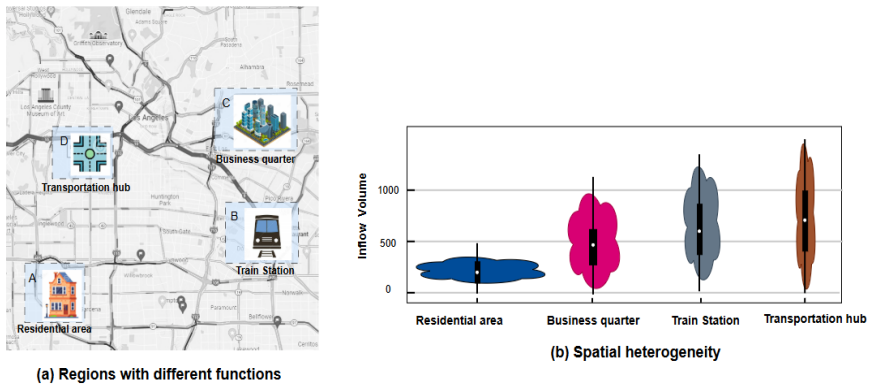
On its own terms, the paper establishes that single-grained encoders are the bottleneck in traffic graph forecasting. A graph convolution branch that message-passes over the pre-defined road network captures local station-to-station dependencies but misses functional similarities between distant stations (e.g., two transportation hubs); a transformer-only model captures global relations but tends to distort geographic structure. TSFusion feeds the local branch's embeddings into a graph transformer whose self-attention is biased by node in/out-degree centralities and shortest-path edge features, then merges the two embeddings with a gate $Gate = \sigma(MLP(\tilde{B}) W_g + b_g)$ and residual combination $H = Gate \odot MLP(\tilde{B}) + (1 - Gate) \odot MLP(L)$. The reported experiments on PeMSD4 and PeMSD8 show TSFusion outperforming HA, ARIMA, LSVR, LSTM, DCRNN, STGCN, and Graphormer-T on MAE and RMSE at all tested horizons, with the gap widest at 45 minutes; ablations show removing the global branch or the gate hurts more than removing the residual connection, and robustness tests show the fused model holds up better than the compared baselines under feature-space noise, missing data, and adversarial attacks.
Load-bearing premise
The claim rests on the experimental comparison being trustworthy: the 10-run averages are presented without error bars, and the ranking of TSFusion over the seven baselines would lose support if run-to-run variance, preprocessing mismatches, or configuration differences between the tables are large enough to reverse the ordering.
Editorial extensions
If this is right
- Hybridizing a local graph-convolution branch with a global graph-transformer branch is, if the reported results hold, a more accurate design for short-term traffic forecasting than using either branch alone.
- The performance gap grows with the forecast horizon, so the global branch contributes most where local persistence is weakest.
- The ablation ordering (global branch and gate matter more than the residual connection) says future architectures should invest in adaptively mixing multi-scale evidence rather than in deeper skip paths.
- The robustness results imply that fusion itself confers some protection against feature-space corruption; the added adversarial training only yields marginal improvement on Gaussian noise and no clear gain on missing data.
Reading between the lines
- Beyond the paper: the same gated local/global fusion recipe should transfer to other spatio-temporal graph forecasting tasks, such as crowd flow, energy demand, or water network prediction, where distant nodes with similar functional roles are common; swapping in another public sensor dataset would test whether the gate learns a nontrivial mix.
- Beyond the paper: the ablation that removing global attention hurts more than removing local aggregation suggests that on these highway networks 'invisible' functional relations carry more signal than geographic proximity; inspecting the learned gate values per station would show whether transfer hubs and business districts systematically receive high global weights.
- Beyond the paper: the robustness comparison includes only STGCN, Graphormer-T, and DCRNN; retraining those baselines with the same adversarial training used for TSFusion-adv would isolate whether the resilience comes from the fusion mechanism or simply from a larger, more expressive model.
- Beyond the paper: since the paper reports 10-run averages without spread, a paired statistical test across seeds for the TSFusion-versus-Graphormer-T gap would tell whether the headline improvement is reliable or within noise.
Signed reviews
Editorial analysis
A structured set of objections, weighed in public.
Referee Report
Summary. The manuscript proposes TSFusion, a hybrid traffic-flow forecasting model that combines a local temporal-spatial graph convolutional encoder with a graph-transformer encoder and adaptively fuses their embeddings through a gated residual mechanism. The model is evaluated on PeMSD4 and PeMSD8 against seven baselines, with MAE/RMSE reported at 15-, 30-, and 45-minute horizons, plus an ablation study and robustness experiments under Gaussian noise, missing data, and adversarial perturbations. The central claim, stated in Section VI, is that TSFusion achieves the best forecasting accuracy among strong baselines and defends against these perturbations in the feature space of the traffic graph dataset.
Significance. If the reported results are reliable, the paper offers a modest but reasonable architectural contribution: fusing local graph-convolutional patterns with global graph-transformer attention through a learned gate is a sensible design, and the multi-horizon comparisons, ablations, and robustness scenarios are the right kind of evidence for a traffic-forecasting paper. The method is not circular: the gated fusion and attention parameters are learned on training data and evaluated on held-out test data, and the paper does not claim a parameter-free derivation. However, the empirical evidence as presented does not yet support the central claim because of internal numerical inconsistencies and the absence of statistical reliability measures; the claimed improvements over the strongest baseline are small relative to the observed inconsistencies across tables.
major comments (4)
- [Table III vs. Table IV] The same condition, PeMSD4 at the 15-minute horizon for the full TSFusion model, is reported as MAE 8.59 / RMSE 20.05 in Table III and as MAE 8.35 / RMSE 19.82 in Table IV. The 0.24 MAE discrepancy is larger than TSFusion's reported margin over Graphormer-T at that horizon (8.78 - 8.59 = 0.19), so the evidence does not establish that TSFusion is the best model at 15 minutes. Please clarify whether the two tables use identical data splits, random seeds, and hyperparameters; if they differ, report both configurations and state which one supports the headline conclusion in Section VI.
- [Section V.B and Table II] Section V.B states that only workday traffic data were used in all experiments and that redundant stations were removed, leaving 307 and 170 stations for PeMSD4 and PeMSD8, yet Table II reports sample sizes of 16,992 and 17,856, which are exactly 288 x 59 and 288 x 62, i.e., all calendar days in the stated two-month intervals. A workday-only filter cannot produce these counts, and the text also says the two datasets span January-February and July-August while Table II says 'Time duration 1 month'. Please reconcile the preprocessing description with the actual samples used, because this determines what generated all subsequent tables and figures.
- [Section V.D] The paper states that each model was evaluated 10 times and the average was taken as the final result, but it reports no standard deviations, confidence intervals, error bars, or significance tests. The reported margins over Graphormer-T are small (0.19 MAE at PeMSD4/15min and 0.36 MAE at PeMSD8/15min), while the ablation variants in Table IV differ from the full model by up to 0.67 MAE, so the claimed consistent outperformance may lie within run-to-run noise. Please add variance information or paired significance tests across the 10 runs for the main comparisons and the ablations.
- [Section V.G and Fig. 6] The robustness analysis is presented only through figures with no numerical values, error bars, or experimental details. In particular, the adversarial attack setup is not specified: there is no perturbation budget, attack algorithm, or iteration count, and the TSFusion-adv variant does not appear in the main tables. As a result, the conclusion's statement that the model 'can defend against' Gaussian noise, missing data, and adversarial attacks is not quantitatively supported. Please report the underlying numbers, the exact attack configuration, and the uncertainty of the robustness estimates.
minor comments (6)
- [Section V.C and Table III] The baseline list in Section V.C names 'DCRNN', but Table III reports 'DCRGNN' for that row; if this is a typo, correct it, and if it is a different model, define it in the baseline description.
- [Eq. (8) and Eq. (9)] Equation (8) says 'the matrix V is the learnable weight matrix,' but Eq. (8) uses V only through the value embeddings defined in Eq. (6), while the output projection multiplied by V appears in Eq. (9); please align the notation to avoid confusing the value matrix with the output projection matrix.
- [Section II.A and references] References [23] and [34] are the same DCRNN paper; please remove the duplicate and renumber accordingly.
- [Section III, Eq. (2)] The notation for the history window is inconsistent: Eq. (2) uses M for the window length while Definition 2 introduces τ+1; please use one symbol throughout.
- [Figures 5 and 6] In the manuscript version provided, Figures 5 and 6 do not render as plots but appear as uninterpretable encoded strings; please ensure the final PDF contains legible figures with axis labels and legends.
- [Section II.B] The sentence 'lots of researchers determine to curve the inherent geographical connections' appears to contain a typo; 'curve' should likely be 'capture' or 'mine'.
Circularity Check
No circularity found: the model is a standard supervised learning pipeline whose predictions are evaluated on held-out data, and no claimed result reduces by construction to a fitted parameter or to a self-citation.
full rationale
This paper reports an empirical graph-learning architecture (TSFusion) trained with an MSE objective (Eq. 11) on training splits of PeMSD4 and PeMSD8 and evaluated on held-out test periods. The gated fusion weights in Eq. 10, the graph-transformer attention parameters, and the adjacency-matrix hyperparameters in Eq. 1 are learned or tuned on training/validation data, not fitted to the test quantities being predicted. The central claim of consistent outperformance rests on test-set comparisons in Fig. 5 and Tables III-IV, which are external to the training objective rather than identities implied by the model definition. No step in the paper defines a claimed result in terms of the target quantity, no fitted parameter is renamed as a prediction, and no load-bearing argument depends on a self-citation or on an author-imported uniqueness theorem. The internal inconsistencies noted by the skeptical reviewer (Table III TSFusion 15-min MAE 8.59 vs Table IV 8.35; workday-only preprocessing vs sample sizes 16,992 and 17,856) are reproducibility and data-hygiene concerns about whether the evidence supports the empirical ranking, but they are not circularity: they do not show that a 'prediction' is equivalent to its inputs by construction. Accordingly, the circularity score is 0.
Assumptions & free parameters
free parameters (3)
- sigma^2 (Gaussian kernel scale) =
not reported
- epsilon (adjacency sparsity threshold) =
not reported
- training and architecture hyperparameters =
not reported
assumptions (5)
- standard math Graph Laplacian normalization in Eq. (4) yields a valid spatial aggregation operator for traffic graphs.
- domain assumption The Gaussian-kernel adjacency in Eq. (1) with tuned sigma^2 and epsilon captures the meaningful spatial dependencies between stations.
- domain assumption A fixed historical window of 60 minutes (12 time steps) is sufficient to forecast 15 to 45 minutes ahead.
- domain assumption The traffic data distribution is stationary enough that training on the first 50 days generalizes to the remaining test days.
- domain assumption The semantic similarity of long-range node pairs can be learned by the graph transformer attention over all node pairs.
Cite this review
Pith. "Pith review of Multi-Grained Temporal-Spatial Graph Learning for Stable Traffic Flow Forecasting." pith.science (2026). https://pith.science/paper/KB3IVXKM
@misc{pith2026250800884,
  author       = {Pith},
  title        = {Pith review of: Multi-Grained Temporal-Spatial Graph Learning for Stable Traffic Flow Forecasting},
  year         = {2026},
  howpublished = {\url{https://pith.science/paper/KB3IVXKM}},
  note         = {Machine review of arXiv:2508.00884}
}
read the original abstract
Time-evolving traffic flow forecasting are playing a vital role in intelligent transportation systems and smart cities. However, the dynamic traffic flow forecasting is a highly nonlinear problem with complex temporal-spatial dependencies. Although the existing methods has provided great contributions to mine the temporal-spatial patterns in the complex traffic networks, they fail to encode the globally temporal-spatial patterns and are prone to overfit on the pre-defined geographical correlations, and thus hinder the model's robustness on the complex traffic environment. To tackle this issue, in this work, we proposed a multi-grained temporal-spatial graph learning framework to adaptively augment the globally temporal-spatial patterns obtained from a crafted graph transformer encoder with the local patterns from the graph convolution by a crafted gated fusion unit with residual connection techniques. Under these circumstances, our proposed model can mine the hidden global temporal-spatial relations between each monitor stations and balance the relative importance of local and global temporal-spatial patterns. Experiment results demonstrate the strong representation capability of our proposed method and our model consistently outperforms other strong baselines on various real-world traffic networks.
Figures


Figures from the paper (3 more)


Reference graph
Works this paper leans on
-
[1]
M. S. Ahmed and A. R. Cook, Analysis of freeway traffic time-series data by using Box-Jenkins techniques , 1979, no. 722
work page 1979
-
[2]
Accurate freeway travel time prediction with state-space neural networks under missing data,
J. Van Lint, S. Hoogendoorn, and H. J. van Zuylen, “Accurate freeway travel time prediction with state-space neural networks under missing data,” Transportation Research Part C: Emerging Technologies, vol. 13, no. 5-6, pp. 347–369, 2005
work page 2005
-
[3]
Multivariate vehicular traffic flow prediction: evalua- tion of arimax modeling,
B. M. Williams, “Multivariate vehicular traffic flow prediction: evalua- tion of arimax modeling,” Transportation Research Record, vol. 1776, no. 1, pp. 194–200, 2001
work page 2001
-
[4]
A survey on graph neural networks in intelligent transportation systems,
H. Li, Y . Zhao, Z. Mao, Y . Qin, Z. Xiao, J. Feng, Y . Gu, W. Ju, X. Luo, and M. Zhang, “A survey on graph neural networks in intelligent transportation systems,” arXiv preprint arXiv:2401.00713 , 2024
arXiv 2024
-
[5]
Graph neural network for traffic forecasting: A survey,
W. Jiang and J. Luo, “Graph neural network for traffic forecasting: A survey,” Expert systems with applications , vol. 207, p. 117921, 2022
2022
-
[6]
Graph neural network for traffic forecasting: The research progress,
W. Jiang, J. Luo, M. He, and W. Gu, “Graph neural network for traffic forecasting: The research progress,” ISPRS International Journal of Geo- Information, vol. 12, no. 3, p. 100, 2023
work page 2023
-
[7]
Modeling and forecasting vehicular traffic flow as a seasonal arima process: Theoretical basis and empirical results,
B. M. Williams and L. A. Hoel, “Modeling and forecasting vehicular traffic flow as a seasonal arima process: Theoretical basis and empirical results,” Journal of transportation engineering, vol. 129, no. 6, pp. 664– 672, 2003
2003
-
[8]
Travel-time prediction with sup- port vector regression,
C.-H. Wu, J.-M. Ho, and D.-T. Lee, “Travel-time prediction with sup- port vector regression,” IEEE transactions on intelligent transportation systems, vol. 5, no. 4, pp. 276–281, 2004
work page 2004
Show all 44 references
-
[9]
Traffic flow forecasting by seasonal svr with chaotic simulated annealing algorithm,
W.-C. Hong, “Traffic flow forecasting by seasonal svr with chaotic simulated annealing algorithm,” Neurocomputing, vol. 74, no. 12-13, pp. 2096–2107, 2011
2011
-
[10]
Traffic flow prediction using adaboost algo- rithm with random forests as a weak learner,
G. Leshem and Y . Ritov, “Traffic flow prediction using adaboost algo- rithm with random forests as a weak learner,” in Proceedings of world academy of science, engineering and technology , vol. 19. Citeseer, 2007, pp. 193–198
2007
-
[11]
A gradient boosting method to improve travel time prediction,
Y . Zhang and A. Haghani, “A gradient boosting method to improve travel time prediction,” Transportation Research Part C: Emerging Technologies, vol. 58, pp. 308–324, 2015
2015
-
[12]
High-order gaussian process dynamical models for traffic flow prediction,
J. Zhao and S. Sun, “High-order gaussian process dynamical models for traffic flow prediction,” IEEE Transactions on Intelligent Transportation Systems, vol. 17, no. 7, pp. 2014–2019, 2016
2014
-
[13]
Short-term traffic state prediction based on temporal–spatial correlation,
T. Pan, A. Sumalee, R.-X. Zhong, and N. Indra-Payoong, “Short-term traffic state prediction based on temporal–spatial correlation,” IEEE Transactions on Intelligent Transportation Systems , vol. 14, no. 3, pp. 1242–1254, 2013
2013
-
[14]
A bayesian network approach to traffic flow forecasting,
S. Sun, C. Zhang, and G. Yu, “A bayesian network approach to traffic flow forecasting,” IEEE Transactions on intelligent transportation systems, vol. 7, no. 1, pp. 124–132, 2006
2006
-
[15]
Traffic flow prediction with big data: A deep learning approach,
Y . Lv, Y . Duan, W. Kang, Z. Li, and F.-Y . Wang, “Traffic flow prediction with big data: A deep learning approach,”Ieee transactions on intelligent transportation systems, vol. 16, no. 2, pp. 865–873, 2014
2014
-
[16]
Long short-term memory neural network for traffic speed prediction using remote microwave sensor data,
X. Ma, Z. Tao, Y . Wang, H. Yu, and Y . Wang, “Long short-term memory neural network for traffic speed prediction using remote microwave sensor data,” Transportation Research Part C: Emerging Technologies , vol. 54, pp. 187–197, 2015
2015
-
[17]
Using lstm and gru neural network methods for traffic flow prediction,
R. Fu, Z. Zhang, and L. Li, “Using lstm and gru neural network methods for traffic flow prediction,” in 2016 31st Youth academic annual conference of Chinese association of automation (YAC) . IEEE, 2016, pp. 324–328
2016
-
[18]
Spatiotemporal recurrent convolutional networks for traffic prediction in transportation networks,
H. Yu, Z. Wu, S. Wang, Y . Wang, and X. Ma, “Spatiotemporal recurrent convolutional networks for traffic prediction in transportation networks,” Sensors, vol. 17, no. 7, p. 1501, 2017
2017
-
[19]
Convolutional lstm network: A machine learning approach for precipitation nowcasting,
X. Shi, Z. Chen, H. Wang, D.-Y . Yeung, W.-K. Wong, and W.-c. Woo, “Convolutional lstm network: A machine learning approach for precipitation nowcasting,” Advances in neural information processing systems, vol. 28, 2015
2015
-
[20]
Deep spatio-temporal residual networks for citywide crowd flows prediction,
J. Zhang, Y . Zheng, and D. Qi, “Deep spatio-temporal residual networks for citywide crowd flows prediction,” in Proceedings of the AAAI conference on artificial intelligence , vol. 31, no. 1, 2017
2017
-
[21]
Short-term forecasting of passenger demand under on-demand ride services: A spatio-temporal deep learning approach,
J. Ke, H. Zheng, H. Yang, and X. M. Chen, “Short-term forecasting of passenger demand under on-demand ride services: A spatio-temporal deep learning approach,” Transportation research part C: Emerging technologies, vol. 85, pp. 591–608, 2017
2017
-
[22]
Short-term traffic flow forecasting with spatial- temporal correlation in a hybrid deep learning framework,
Y . Wu and H. Tan, “Short-term traffic flow forecasting with spatial- temporal correlation in a hybrid deep learning framework,” arXiv preprint arXiv:1612.01022, 2016
2016 arXiv
-
[24]
Attention based spatial- temporal graph convolutional networks for traffic flow forecasting,
S. Guo, Y . Lin, N. Feng, C. Song, and H. Wan, “Attention based spatial- temporal graph convolutional networks for traffic flow forecasting,” in Proceedings of the AAAI conference on artificial intelligence , vol. 33, no. 01, 2019, pp. 922–929
2019
-
[25]
Graph wavenet for deep spatial-temporal graph modeling,
Z. Wu, S. Pan, G. Long, J. Jiang, and C. Zhang, “Graph wavenet for deep spatial-temporal graph modeling,” arXiv preprint arXiv:1906.00121 , 2019
1906 arXiv
-
[26]
Attention is all you need,
A. Vaswani, N. Shazeer, N. Parmar, J. Uszkoreit, L. Jones, A. N. Gomez, Ł. Kaiser, and I. Polosukhin, “Attention is all you need,” Advances in neural information processing systems , vol. 30, 2017
2017
-
[27]
Gman: A graph multi-attention network for traffic prediction,
C. Zheng, X. Fan, C. Wang, and J. Qi, “Gman: A graph multi-attention network for traffic prediction,” in Proceedings of the AAAI conference on artificial intelligence , vol. 34, no. 01, 2020, pp. 1234–1241
2020
-
[28]
Spatial-temporal transformer networks for traffic flow forecasting,
M. Xu, W. Dai, C. Liu, X. Gao, W. Lin, G.-J. Qi, and H. Xiong, “Spatial-temporal transformer networks for traffic flow forecasting,” arXiv preprint arXiv:2001.02908 , 2020
2001 arXiv
-
[29]
A multi-layer model based on transformer and deep learning for traffic flow prediction,
H.-X. Hu, Q. Hu, G. Tan, Y . Zhang, and Z.-Z. Lin, “A multi-layer model based on transformer and deep learning for traffic flow prediction,” IEEE Transactions on Intelligent Transportation Systems , vol. 25, no. 1, pp. 443–451, 2023
2023
-
[30]
Traffic transformer: Capturing the continuity and periodicity of time series for traffic forecasting,
L. Cai, K. Janowicz, G. Mai, B. Yan, and R. Zhu, “Traffic transformer: Capturing the continuity and periodicity of time series for traffic forecasting,” Transactions in GIS , vol. 24, no. 3, pp. 736–755, 2020
2020
-
[31]
Spatial-temporal synchronous graph convolutional networks: A new framework for spatial-temporal network data forecasting,
C. Song, Y . Lin, S. Guo, and H. Wan, “Spatial-temporal synchronous graph convolutional networks: A new framework for spatial-temporal network data forecasting,” in Proceedings of the AAAI conference on artificial intelligence, vol. 34, no. 01, 2020, pp. 914–921
2020
-
[32]
Short-term traffic speed forecasting based on graph attention temporal convolutional networks,
G. Guo and W. Yuan, “Short-term traffic speed forecasting based on graph attention temporal convolutional networks,” Neurocomputing, vol. 410, pp. 387–393, 2020
2020
-
[33]
St-grat: A novel spatio-temporal graph attention networks for accurately forecasting dynamically changing road speed,
C. Park, C. Lee, H. Bahng, Y . Tae, S. Jin, K. Kim, S. Ko, and J. Choo, “St-grat: A novel spatio-temporal graph attention networks for accurately forecasting dynamically changing road speed,” inProceedings of the 29th ACM international conference on information & knowledge man...
2020
-
[34]
Diffusion convolutional re- current neural network: Data-driven traffic forecasting,
Y . Li, R. Yu, C. Shahabi, and Y . Liu, “Diffusion convolutional re- current neural network: Data-driven traffic forecasting,” arXiv preprint arXiv:1707.01926, 2017
2017 arXiv
-
[35]
Learning convolutional neural networks for graphs,
M. Niepert, M. Ahmed, and K. Kutzkov, “Learning convolutional neural networks for graphs,” in Proceedings of The 33rd International Conference on Machine Learning , ser. Proceedings of Machine Learning Research, M. F. Balcan and K. Q. Weinberger, Eds., vol. 48. New York, New Y...
2016
-
[36]
Spatio-temporal graph convolution for skeleton based action recognition,
C. Li, Z. Cui, W. Zheng, C. Xu, and J. Yang, “Spatio-temporal graph convolution for skeleton based action recognition,” Proceedings of the AAAI Conference on Artificial Intelligence, vol. 32, no. 1, Apr. 2018. [Online]. Available: https://ojs.aaai.org/index.php/AAAI/article/view/11776
2018
-
[37]
Convolutional neural networks on graphs with fast localized spectral filtering,
M. Defferrard, X. Bresson, and P. Vandergheynst, “Convolutional neural networks on graphs with fast localized spectral filtering,” in Proceedings of the 30th International Conference on Neural Information Processing Systems, ser. NIPS’16. Red Hook, NY , USA: Curran Associates ...
2016
-
[38]
Spatio-temporal graph convolutional net- works: a deep learning framework for traffic forecasting,
B. Yu, H. Yin, and Z. Zhu, “Spatio-temporal graph convolutional net- works: a deep learning framework for traffic forecasting,” inProceedings of the 27th International Joint Conference on Artificial Intelligence , ser. IJCAI’18. AAAI Press, 2018, p. 3634–3640
2018
-
[39]
Network level spatial temporal traffic forecasting with hierarchical-attention-lstm,
T. Zhang, “Network level spatial temporal traffic forecasting with hierarchical-attention-lstm,” Digital Transportation and Safety , vol. 3, no. 4, pp. 233–245, 2024
2024
-
[40]
Deep multi-view spatial-temporal network for taxi demand prediction,
H. Yao, F. Wu, J. Ke, X. Tang, Y . Jia, S. Lu, P. Gong, J. Ye, D. Chuxing, and Z. Li, “Deep multi-view spatial-temporal network for taxi demand prediction,” in Proceedings of the Thirty-Second AAAI Conference on Artificial Intelligence and Thirtieth Innovative Applications of ...
2018
-
[41]
Batch normalization: accelerating deep net- work training by reducing internal covariate shift,
S. Ioffe and C. Szegedy, “Batch normalization: accelerating deep net- work training by reducing internal covariate shift,” in Proceedings of the 32nd International Conference on International Conference on Machine Learning - Volume 37 , ser. ICML’15. JMLR.org, 2015, p. 448–456
2015
-
[42]
Dropout: a simple way to prevent neural networks from overfit- ting,
N. Srivastava, G. Hinton, A. Krizhevsky, I. Sutskever, and R. Salakhut- dinov, “Dropout: a simple way to prevent neural networks from overfit- ting,” J. Mach. Learn. Res. , vol. 15, no. 1, p. 1929–1958, Jan. 2014
1929
-
[43]
Do transformers really perform badly for graph representation?
C. Ying, T. Cai, S. Luo, S. Zheng, G. Ke, D. He, Y . Shen, and T.-Y . Liu, “Do transformers really perform badly for graph representation?” Advances in neural information processing systems, vol. 34, pp. 28 877– 28 888, 2021
2021
-
[44]
Towards deep learning models resistant to adversarial attacks,
A. Madry, A. Makelov, L. Schmidt, D. Tsipras, and A. Vladu, “Towards deep learning models resistant to adversarial attacks,” in International Conference on Learning Representations , 2018. [Online]. Available: https://openreview.net/forum?id=rJzIBfZAb
2018
-
[45]
Graph foundation models: Concepts, opportunities and challenges,
J. Liu, C. Yang, Z. Lu, J. Chen, Y . Li, M. Zhang, T. Bai, Y . Fang, L. Sun, P. S. Yu et al. , “Graph foundation models: Concepts, opportunities and challenges,” IEEE Transactions on Pattern Analysis and Machine Intelligence, 2025
2025
Reviewed August 15, 2026 · model on record in the stance chip above.
Discussion (0). Continue with ORCID to comment.