REVIEW 4 major objections 5 minor 36 references
Intelligent Incident Hypertension Prediction in Obstructive Sleep Apnea
T0 review · 4 major / 5 minor · reviewed 2026-08-07 · deepseek-v4-flash
Pith's one-line read DCT layer lifts hypertension-risk forecast to 72.88% AUC
desk verdict A legitimate clinical prediction problem and an honest engineering effort, but the DCT-convolution rationale in Eq. (1) is wrong for the standard DCT and the 72.88% AUC claim lacks external validation. read the letter →
The pith
A machine-rendered reading of the paper's core claim, the machinery that carries it, and where it could break.
The reading
What carries the argument
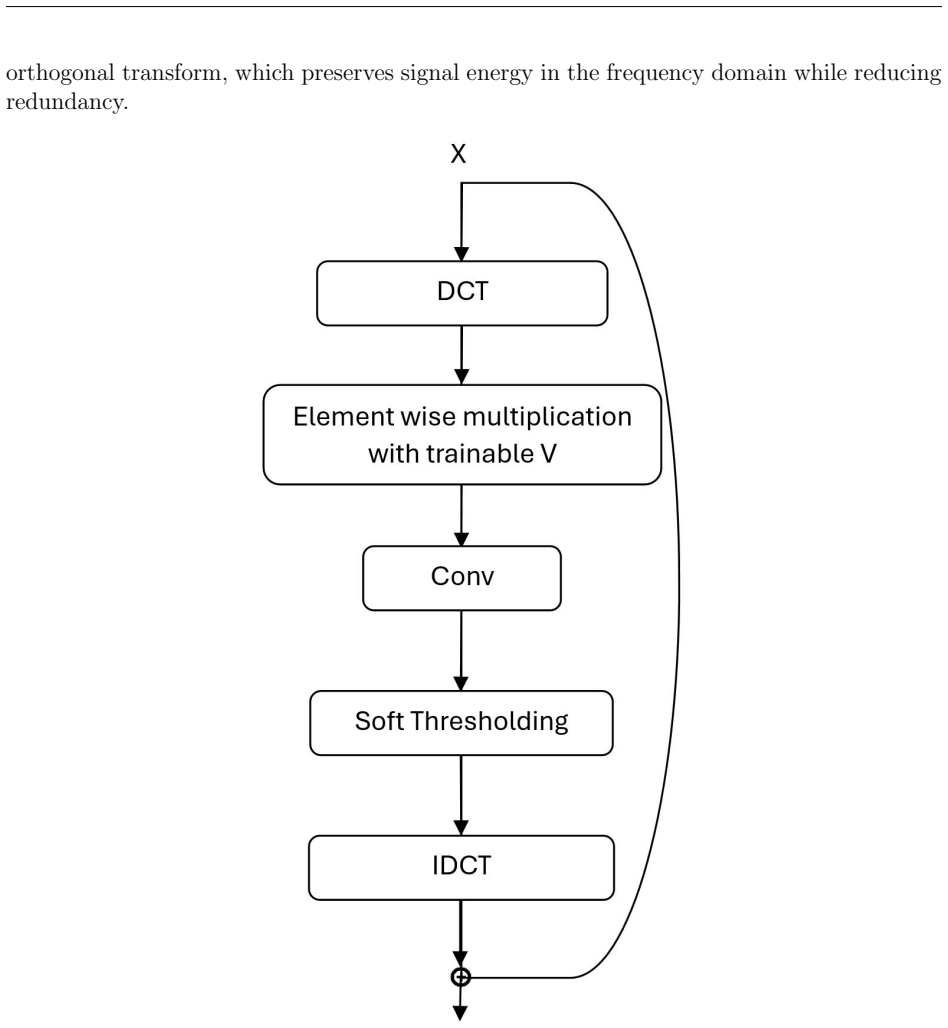
The carrying mechanism is the DCT-based convolution block: a real-valued orthogonal transform applied to 2D feature maps, followed by soft thresholding, $\mathrm{sign}(x)\max(|x|-\tau,0)$, instead of ReLU. It is inserted after blocks 3, 4, 5, or 6 of a truncated EfficientNet-B0 that operates on a pseudo-image whose rows are extracted window features and whose columns are time windows. The DCT is meant to replace complex DFT-domain convolution via element-wise multiplication, while orthogonality decorrelates features and soft thresholding keeps both positive and negative high-amplitude coefficients.
What would settle it
Take any two random sequences and compare the DCT of their convolution against the element-wise product of their individual DCTs: they differ unless special symmetry holds, which would undercut the theoretical rationale. Likewise, replacing the DCT2D block at depth 6 with an identity or a 1x1 convolution in the released code and re-running the same 10-fold cross-validation would show whether the reported 72.88% AUC depends on the DCT transform itself.
Extended reading notes
Core claim
The paper's central claim is that inserting a DCT2D block deep inside a pretrained EfficientNet-B0 improves five-year incident hypertension prediction in moderate-to-severe obstructive sleep apnea. On the Sleep Heart Health Study cohort, the best configuration places the DCT block after the sixth building block and reaches 69.86% accuracy and 72.88% AUC, compared with 71% AUC for cSPPSG and 67% for AHI. The authors attribute the gain to transforming feature maps into a real, orthogonal frequency domain where soft thresholding prunes small noisy coefficients while retaining sign information that ReLU would discard. They also claim to be the first to feed all polysomnography signals jointly rather than a single channel or index.
Load-bearing premise
The load-bearing premise is that convolution can be carried out by element-wise multiplication in the DCT domain the same way it is in the Fourier domain; that identity only holds under special symmetric-convolution conditions the paper does not state, and the authors acknowledge that their limited dataset may limit generalizability.
Editorial extensions
If this is right
- Clinicians could use the model's probability score, rather than the apnea-hypopnea index alone, to decide which OSA patients need closer blood-pressure follow-up over the next five years.
- Combining all polysomnography channels beats single-index baselines, so future risk scores should stop reducing sleep studies to AHI or oxygen-desaturation indices.
- Placing the frequency transform at deeper layers helps more than shallow placement, giving architects a concrete rule for where to insert spectral blocks in transfer-learned CNNs.
- Soft thresholding in the frequency domain can be reused in other medical time-series tasks where keeping the sign of coefficients matters.
- The feature-window pseudo-image format lets pretrained 2D image networks consume heterogeneous physiological signals without processing raw waveforms at full bandwidth.
Reading between the lines
- Ablating the DCT2D block (replacing it with a 1x1 convolution or an identity at the same depth) would separate two explanations: exact frequency-domain convolution versus a learnable spectral feature transform; the paper does not run this control.
- The same recipe could be applied to wearable multi-channel recordings for predicting other cardiometabolic outcomes, where sign-preserving frequency-domain nonlinearities may transfer.
- Evaluating on an external OSA cohort would test whether the DCT layer learns transferable spectral patterns or patterns specific to the Sleep Heart Health Study dataset.
Editorial analysis
A structured set of objections, weighed in public.
Referee Report
Summary. The manuscript proposes a deep learning pipeline for predicting five-year incident hypertension in patients with obstructive sleep apnea (OSA) from polysomnography (PSG) signals. The authors extract window-level features from multiple PSG signals, arrange them as 2D pseudo-images, and feed them into truncated 2D CNN backbones (EfficientNet, MobileNet, ResNet) pre-trained on ImageNet. Their main novelty is a DCT-based convolution block inserted at different depths of EfficientNet-B0, using soft thresholding instead of ReLU in the DCT domain. The best reported configuration (DCT@6) achieves 69.86% accuracy and 72.88% AUC, which the authors claim outperforms existing cSPPSG (71% AUC) and AHI (67% AUC) baselines. The paper also claims to be the first to jointly use all PSG signals for this prediction task.
Significance. If the proposed DCT-based method were valid and its performance confirmed, the paper would address a clinically important prediction problem and demonstrate a useful way to combine multi-channel PSG data in a transfer-learning framework. The authors also make a sensible design choice by extracting clinically meaningful features (respiratory events, HRV, statistical descriptors) before forming the pseudo-image, which could reduce data requirements. However, the central theoretical claim that DCT enables frequency-domain convolution is mathematically unsupported, and the empirical evaluation is weakened by the absence of confidence intervals, post-hoc configuration selection, and the omission of a cited SpO2-only model that reportedly achieves a substantially higher AUC. The paper does not provide code or a detailed experimental protocol, which limits reproducibility. The significance of the contribution, as currently framed, is therefore not established.
major comments (4)
- [Section 3, Eq. (1)] Eq. (1) states the DFT convolution theorem (Y = W * X) and then claims that the DCT can replace the DFT to avoid complex values. For standard DCT types (e.g., DCT-II), element-wise multiplication in the DCT domain does not implement ordinary linear or circular convolution of two arbitrary sequences; it corresponds to symmetric convolution only under specific symmetric extension conditions that the paper neither states nor verifies for the 2D feature maps. Consequently, the described 'DCT-based convolution block' is not a convolution replacement. At best, the layer is a fixed orthogonal transform followed by soft thresholding. Because the first listed contribution and the entire motivation for the DCT layer rest on this equation, this is a load-bearing mathematical error that invalidates the claimed methodological novelty.
- [Section 4.4, Table 4] The comparison with existing methods omits You et al. [36], the SpO2-only model that the paper itself cites as achieving an AUC of 84.3% for the same task (incident hypertension in OSA patients). Including this baseline is necessary for a fair claim of 'surpassing existing models'. The proposed model's 72.88% AUC is considerably lower than this cited result. If the datasets or outcome definitions differ, the authors must state so explicitly and still discuss the comparison; otherwise, the superiority claim in the abstract and conclusion is misleading.
- [Section 4.3, Table 3] The final configuration (DCT@6) is selected after evaluating several DCT insertion depths and multiple window lengths (the text mentions windows from 9 to 60 minutes, with 10 and 60 minute results reported). The differences between the best configurations are small: DCT@5 AUC is 72.79% and DCT@6 AUC is 72.88%, compared with 71.64% for Feature EffNet-B0 at 10 minutes. No confidence intervals, bootstrap estimates, or significance tests are reported, and no multiple-comparison correction is applied to the selection across depths and windows. Without uncertainty quantification, the claim that deeper placement 'yields meaningful gains' is not supported. The authors should report confidence intervals for all reported AUCs and specify a pre-registered or corrected selection procedure.
- [Section 5 (Conclusion)] The conclusion states that the method 'surpasses existing models such as cSPPSG and AHI', but the paper does not validate the model on an independent external cohort. The authors acknowledge the limited dataset size, yet this limitation is structural: without external validation, the generalizability claim remains unsupported, especially given the post-hoc configuration selection. An external validation (or at least a rigorous nested cross-validation with confidence intervals) is needed before the clinical-prediction claim can be taken seriously.
minor comments (5)
- [Section 3, HRV metric description] The text writes 'HR V metrics' in the feature list and later 'HRV metrics'; the former is a typo and should be corrected.
- [Section 4.3, text vs Table 3] The text says DCT@5 gives AUC 72.29%, but Table 3 lists 72.79% for DCT@5. This inconsistency should be corrected.
- [Section 3, soft thresholding discussion] The phrase 'negative-frequency information' is inaccurate because the DCT does not produce negative frequencies; the DCT coefficients are real-valued and can be negative. The intended meaning is 'negative-valued coefficients', and the terminology should be revised.
- [Section 3, Fig. 1] The description of the DCT block in Fig. 1 is incomplete: the figure is not explained in the text, and there are no details on the DCT type (e.g., DCT-II), the normalization, or how the 2D DCT is applied to the feature maps. This level of detail is necessary for reproducibility.
- [Section 4] The experimental setup lacks many standard reporting details: number of subjects, class balance, hyperparameters (learning rate, batch size, epochs), and whether the 10-fold cross-validation was stratified. These should be added.
Circularity Check
No circularity: the PSG-to-prediction pipeline is empirical and self-contained; the DCT convolution issue is a mathematical correctness flaw, not a reduction to inputs.
full rationale
I find no circularity in the derivation sense. The paper's pipeline is an empirical machine-learning construction: polysomnography features are formed into a pseudo-image, passed through a truncated EfficientNet backbone with a DCT block at a chosen depth, and trained to predict incident hypertension. The DCT layer is motivated in Section 3 by Eq. (1), which states the DFT convolution theorem, and the paper then proposes using a real-valued DCT instead of the complex DFT. Whether the standard DCT actually supports the claimed element-wise-multiplication convolution property is a mathematical validity question, not a circularity: the model output is not defined in terms of the target label, nor is any fitted parameter renamed as a prediction. The reported 72.88% AUC is obtained by scanning DCT-block depths on the same evaluation data, which raises model-selection and multiple-testing concerns, but again this is not a circular reduction because the selected configuration is not itself the input to the derivation. The comparison omits the SpO2-only model of Ref. [36], which could weaken the superiority claim, but selective comparison is not circularity. Ref. [27] is a self-citation for the pseudo-image representation, yet the representation is fully described in Section 3 and does not depend on that abstract as a load-bearing theorem. No uniqueness result is imported from the authors' prior work, and no known empirical pattern is merely renamed. I therefore cannot exhibit any step where the paper's own equations make the prediction equal to its input by construction.
Assumptions & free parameters
free parameters (3)
- DCT2D insertion depth =
after 6th EfficientNet block (DCT@6)
- Feature window length =
10 minutes (best AUC 71.64%; 60-minute yields 68.66%)
- Soft thresholding parameter, tau =
not reported
assumptions (4)
- ad hoc to paper DCT satisfies a convolution theorem allowing element-wise multiplication for standard convolution (Section 3, Eq. 1).
- domain assumption ImageNet-pretrained weights of MobileNet, EfficientNet, or ResNet transfer to polysomnography feature pseudo-images.
- domain assumption The SHHS cohort and 10-fold cross-validation provide unbiased estimates after hyperparameter selection.
- domain assumption Preprocessing (artifact removal, bandpass filtering) and windowed features preserve the information needed for hypertension prediction.
Cite this review
Pith. "Pith review of Intelligent Incident Hypertension Prediction in Obstructive Sleep Apnea." pith.science (2026). https://pith.science/paper/KC4R7GVS
@misc{pith2026250520615,
  author       = {Pith},
  title        = {Pith review of: Intelligent Incident Hypertension Prediction in Obstructive Sleep Apnea},
  year         = {2026},
  howpublished = {\url{https://pith.science/paper/KC4R7GVS}},
  note         = {Machine review of arXiv:2505.20615}
}
read the original abstract
Obstructive sleep apnea (OSA) is a significant risk factor for hypertension, primarily due to intermittent hypoxia and sleep fragmentation. Predicting whether individuals with OSA will develop hypertension within five years remains a complex challenge. This study introduces a novel deep learning approach that integrates Discrete Cosine Transform (DCT)-based transfer learning to enhance prediction accuracy. We are the first to incorporate all polysomnography signals together for hypertension prediction, leveraging their collective information to improve model performance. Features were extracted from these signals and transformed into a 2D representation to utilize pre-trained 2D neural networks such as MobileNet, EfficientNet, and ResNet variants. To further improve feature learning, we introduced a DCT layer, which transforms input features into a frequency-based representation, preserving essential spectral information, decorrelating features, and enhancing robustness to noise. This frequency-domain approach, coupled with transfer learning, is especially beneficial for limited medical datasets, as it leverages rich representations from pre-trained networks to improve generalization. By strategically placing the DCT layer at deeper truncation depths within EfficientNet, our model achieved a best area under the curve (AUC) of 72.88%, demonstrating the effectiveness of frequency-domain feature extraction and transfer learning in predicting hypertension risk in OSA patients over a five-year period.
Figures
Reference graph
Works this paper leans on
-
[36]
You, J., Li, J., Li, X., Li, H., Tu, J., Zhang, Y., Gao, J., Wu, J. & Ye, J. Risk- prediction model for incident hypertension in patients with obstructive sleep apnea based on SpO2 signals.2023 45th Annual International Conference Of The IEEE En- gineering In Medicine & Biology Society (EMBC). pp. 1-4 (2023) 11
work page 2023
-
[1]
Peppard, P., Young, T., Palta, M. & Skatrud, J. Prospective study of the association be- tween sleep-disordered breathing and hypertension.New England Journal Of Medicine. 342, 1378-1384 (2000)
work page 2000
-
[2]
Dudenbostel, T. & Calhoun, D. Resistant hypertension, obstructive sleep apnoea and aldosterone.Journal Of Human Hypertension.26, 281-287 (2012)
work page 2012
-
[3]
Genta-Pereira, D., Furlan, S., Omote, D., Giorgi, D., Bortolotto, L., Lorenzi-Filho, G. & Drager, L. Nondipping blood pressure patterns predict obstructive sleep apnea in patients undergoing ambulatory blood pressure monitoring.Hypertension.72, 979-985 (2018)
work page 2018
-
[4]
O’Connor, G., Caffo, B., Newman, A., Quan, S., Rapoport, D., Redline, S., Resnick, H., Samet, J. & Shahar, E. Prospective study of sleep-disordered breathing and hyper- tension: the Sleep Heart Health Study.American Journal Of Respiratory And Critical Care Medicine.179, 1159-1164 (2009)
work page 2009
-
[5]
Mokhlesi, B., Finn, L., Hagen, E., Young, T., Hla, K., Van Cauter, E. & Peppard, P. Obstructive sleep apnea during REM sleep and hypertension. results of the Wisconsin Sleep Cohort.American Journal Of Respiratory And Critical Care Medicine.190, 1158- 1167 (2014) 8
work page 2014
-
[6]
Javaheri, S., Zhao, Y., Punjabi, N., Quan, S., Gottlieb, D. & Redline, S. Slow-wave sleep is associated with incident hypertension: the sleep heart health study.Sleep.41, zsx179 (2018)
work page 2018
- [7]
Show all 36 references
-
[8]
& Others Objective but not subjective short sleep duration is associated with hypertension in obstructive sleep apnea.Hypertension.72, 610-617 (2018)
Ren, R., Covassin, N., Yang, L., Li, Y., Zhang, Y., Zhou, J., Tan, L., Li, T., Li, X., Wang, Y. & Others Objective but not subjective short sleep duration is associated with hypertension in obstructive sleep apnea.Hypertension.72, 610-617 (2018)
2018
-
[9]
& Others Association between treated and untreated obstructive sleep apnea and risk of hypertension.Jama.307, 2169-2176 (2012)
Marin, J., Agusti, A., Villar, I., Forner, M., Nieto, D., Carrizo, S., Barb´ e, F., Vicente, E., Wei, Y., Nieto, F. & Others Association between treated and untreated obstructive sleep apnea and risk of hypertension.Jama.307, 2169-2176 (2012)
2012
-
[10]
Casey Jr, D., Thomas, R., Bhalla, V., Commodore-Mensah, Y., Heidenreich, P., Kolte, D., Muntner, P., Smith Jr, S., Spertus, J., Windle, J. & Others 2019 AHA/ACC clini- cal performance and quality measures for adults with high blood pressure: a report of the American College of...
2019
-
[11]
& Others The sleep heart health study: design, rationale, and methods.Sleep.20, 1077-1085 (1997)
Quan, S., Howard, B., Iber, C., Kiley, J., Nieto, F., O’Connor, G., Rapoport, D., Redline, S., Robbins, J., Samet, J. & Others The sleep heart health study: design, rationale, and methods.Sleep.20, 1077-1085 (1997)
1997
-
[12]
& Redline, S
Zhang, G., Cui, L., Mueller, R., Tao, S., Kim, M., Rueschman, M., Mariani, S., Mobley, D. & Redline, S. The National Sleep Research Resource: towards a sleep data commons. Journal Of The American Medical Informatics Association.25, 1351-1358 (2018)
2018
-
[13]
& Hashemi, M
Kourehpaz, N., Pakdel, F., Katebi, K., Sarbakhsh, P., Baghaei, T., Milani, F. & Hashemi, M. Comparison of Consequences of Operculectomy Using Conventional Sur- gical Knife and Laser: A Systematic Review and Meta-analysis.Crescent Journal Of Medical And Biological Sciences.11
-
[14]
& Katebi, K
Eslami, H., Halimi Milani, F., Salehnia, F., Kourehpaz, N. & Katebi, K. Relationship between sublingual varices and hypertension: a systematic review and meta-analysis. BMC Oral Health.24, 240 (2024)
2024
-
[15]
Rethinking sleep analysis: comment on the AASM manual for the scoring of sleep and associated events.Journal Of Clinical Sleep Medicine.4, 99-103 (2008)
Schulz, H. Rethinking sleep analysis: comment on the AASM manual for the scoring of sleep and associated events.Journal Of Clinical Sleep Medicine.4, 99-103 (2008)
2008
-
[16]
& Adams, R
Appleton, S., Vakulin, A., D’Rozario, A., Vincent, A., Teare, A., Martin, S., Wit- tert, G., McEvoy, R., Catcheside, P. & Adams, R. Quantitative electroencephalography measures in rapid eye movement and nonrapid eye movement sleep are associated with apnea–hypopnea index and n...
2019
-
[17]
& Grun- stein, R
D’Rozario, A., Cross, N., Vakulin, A., Bartlett, D., Wong, K., Wang, D. & Grun- stein, R. Quantitative electroencephalogram measures in adult obstructive sleep ap- nea–potential biomarkers of neurobehavioural functioning.Sleep Medicine Reviews.36 pp. 29-42 (2017)
2017
-
[18]
& Zajamsek, B
Lechat, B., Hansen, K., Melaku, Y., Vakulin, A., Micic, G., Adams, R., Appleton, S., Eckert, D., Catcheside, P. & Zajamsek, B. A novel electroencephalogram-derived measure of disrupted delta wave activity during sleep predicts all-cause mortality risk. Annals Of The American T...
2022
-
[19]
& Others The association between obstructive sleep apnea and sleep spindles in middle-aged and older men: a community-based cohort study.Sleep.45, zsab282 (2022)
Parker, J., Melaku, Y., D’Rozario, A., Wittert, G., Martin, S., Catcheside, P., Lechat, B., Teare, A., Adams, R., Appleton, S. & Others The association between obstructive sleep apnea and sleep spindles in middle-aged and older men: a community-based cohort study.Sleep.45, zsa...
2022
-
[20]
& Danishvar, S
Ardabili, S., Bahmani, S., Lahijan, L., Khaleghi, N., Sheykhivand, S. & Danishvar, S. A novel approach for automatic detection of driver fatigue using EEG signals based on graph convolutional networks.Sensors.24, 364 (2024)
2024
-
[21]
Berger, M., Vakulin, A., Hirotsu, C., Marchi, N., Solelhac, G., Bayon, V., Siclari, F., Haba-Rubio, J., Vaucher, J., Vollenweider, P. & Others Association Between Sleep Mi- crostructure and Incident Hypertension in a Population-Based Sample: The HypnoLaus Study.Journal Of The ...
2022
-
[22]
& Others Prediction model of obstructive sleep apnea–related hypertension: Ma- chine learning–based development and interpretation study.Frontiers In Cardiovascular Medicine.9pp
Shi, Y., Ma, L., Chen, X., Li, W., Feng, Y., Zhang, Y., Cao, Z., Yuan, Y., Xie, Y., Liu, H. & Others Prediction model of obstructive sleep apnea–related hypertension: Ma- chine learning–based development and interpretation study.Frontiers In Cardiovascular Medicine.9pp. 1042996 (2022)
2022
-
[23]
& Sofer, T
Li, R., Rueschman, M., Gottlieb, D., Redline, S. & Sofer, T. A composite sleep and pulmonary phenotype predicting hypertension.EBioMedicine.68(2021)
2021
-
[24]
& Whelton, P
Muntner, P., Carey, R., Gidding, S., Jones, D., Taler, S., Wright Jr, J. & Whelton, P. Potential US population impact of the 2017 ACC/AHA high blood pressure guideline. Circulation.137, 109-118 (2018)
2018
-
[25]
& Harding, S
Calhoun, D. & Harding, S. Sleep and hypertension.Chest.138, 434-443 (2010)
2010
-
[26]
& Cistulli, P
Ucak, S., Dissanayake, H., Sutherland, K., Chazal, P. & Cistulli, P. Heart rate variability and obstructive sleep apnea: Current perspectives and novel technologies.Journal Of Sleep Research.30, e13274 (2021)
2021
-
[27]
& Prasad, B
Milani, O., Nguyen, T., Parekh, A., Cetin, A. & Prasad, B. 0537 incident hypertension prediction in obstructive sleep apnea using machine learning.Sleep.46, A236-A237 (2023)
2023
-
[28]
Pun, C., Chan, S., Yeung, K. & Ho, K. On the design and implementation of FIR and IIR digital filters with variable frequency characteristics.IEEE Transactions On Circuits And Systems II: Analog And Digital Signal Processing.49, 689-703 (2002) 10
2002
-
[29]
Efficientnet: Rethinking model scaling for convolutional neural networks.ArXiv Preprint ArXiv:1905.11946
Tan, M. Efficientnet: Rethinking model scaling for convolutional neural networks.ArXiv Preprint ArXiv:1905.11946. (2019)
2019 arXiv
-
[30]
& Sun, J
He, K., Zhang, X., Ren, S. & Sun, J. Deep residual learning for image recognition. Proceedings Of The IEEE Conference On Computer Vision And Pattern Recognition. pp. 770-778 (2016)
2016
-
[31]
& Tagliasacchi, A
Deng, B., Genova, K., Yazdani, S., Bouaziz, S., Hinton, G. & Tagliasacchi, A. Cvxnet: Learnable convex decomposition.Proceedings Of The IEEE/CVF Conference On Com- puter Vision And Pattern Recognition. pp. 31-44 (2020)
2020
-
[32]
& Ren, J
Li, Y., Yuan, G., Wen, Y., Hu, J., Evangelidis, G., Tulyakov, S., Wang, Y. & Ren, J. Ef- ficientformer: Vision transformers at mobilenet speed.Advances In Neural Information Processing Systems.35pp. 12934-12949 (2022)
2022
-
[33]
Wang, Y., Wang, X., Nishizaki, H. & Li, M. Enhancing Anti-spoofing Countermea- sures Robustness through Joint Optimization and Transfer Learning.ArXiv Preprint ArXiv:2407.20111. (2024)
2024 arXiv
-
[34]
Li, J., Guo, C., Fu, L., Fan, L., Chang, E. & Li, Y. Neural2speech: A Transfer Learn- ing Framework for Neural-Driven Speech Reconstruction.ICASSP 2024-2024 IEEE International Conference On Acoustics, Speech And Signal Processing (ICASSP). pp. 2200-2204 (2024)
2024
-
[35]
Zheng, S. & Wu, D. Semi-supervised domain adaptation for EEG-based sleep stage classification.ICASSP 2024-2024 IEEE International Conference On Acoustics, Speech And Signal Processing (ICASSP). pp. 1776-1780 (2024)
2024
Reviewed August 7, 2026 · model on record in the stance chip above.
Discussion (0). Continue with ORCID to comment.