REVIEW 2 major objections 5 minor 40 references
Enhanced Cooper pairing in nano-patterned metals
T0 review · 2 major / 5 minor · reviewed 2026-08-09 · deepseek-v4-flash
Pith's one-line read Periodic nano-scale holes can raise the superconducting transition temperature of an aluminum film by up to roughly six percent.
desk verdict Plausible and novel phonon-engineering mechanism for Tc, but the headline enhancements rest on a scaling extrapolation with a normalization error that needs a direct check. read the letter →
The pith
A machine-rendered reading of the paper's core claim, the machinery that carries it, and where it could break.
The reading
What carries the argument
The load-bearing object is the Weyl-Vasilev law for elastic eigenmodes with free boundaries, the asymptotic identity $N(\nu)-N_{\mathrm{bulk}}(\nu)=\beta_p L/(2Ac_s)\nu$, which turns a geometric perimeter-to-area ratio into a linear enhancement of the high-energy phonon density of states. The coupling machinery is the Eliashberg function $\alpha^2F(\nu)$, the spectral weight of electron-phonon coupling at frequency $\nu$, computed from finite-element phonon eigenmodes through a unit-cell-averaged phonon propagator and then fed, through $\lambda$ and $\Theta$, into McMillan's formula for $T_c$. A random-plane-wave approximation extends the Weyl correction from the density of states to the cumulative Eliashberg function, so the geometry-induced spectral shift propagates all the way to the transition temperature.
What would settle it
Measure the phonon density of states of patterned and plain aluminum films by inelastic neutron or X-ray scattering and check whether $N(\nu)-N_{\mathrm{bulk}}(\nu)$ follows the Weyl-Vasilev straight line with the predicted slope at high frequencies; then measure $T_c$ in ultra-clean films as a function of the scaling factor $\eta$ and look for the predicted non-monotonic peak before the unit-cell size reaches the coherence length. If the density-of-states difference fails to grow linearly with frequency, or if $T_c$ only decreases with increasing hole size, the central claim is refuted.
Extended reading notes
Core claim
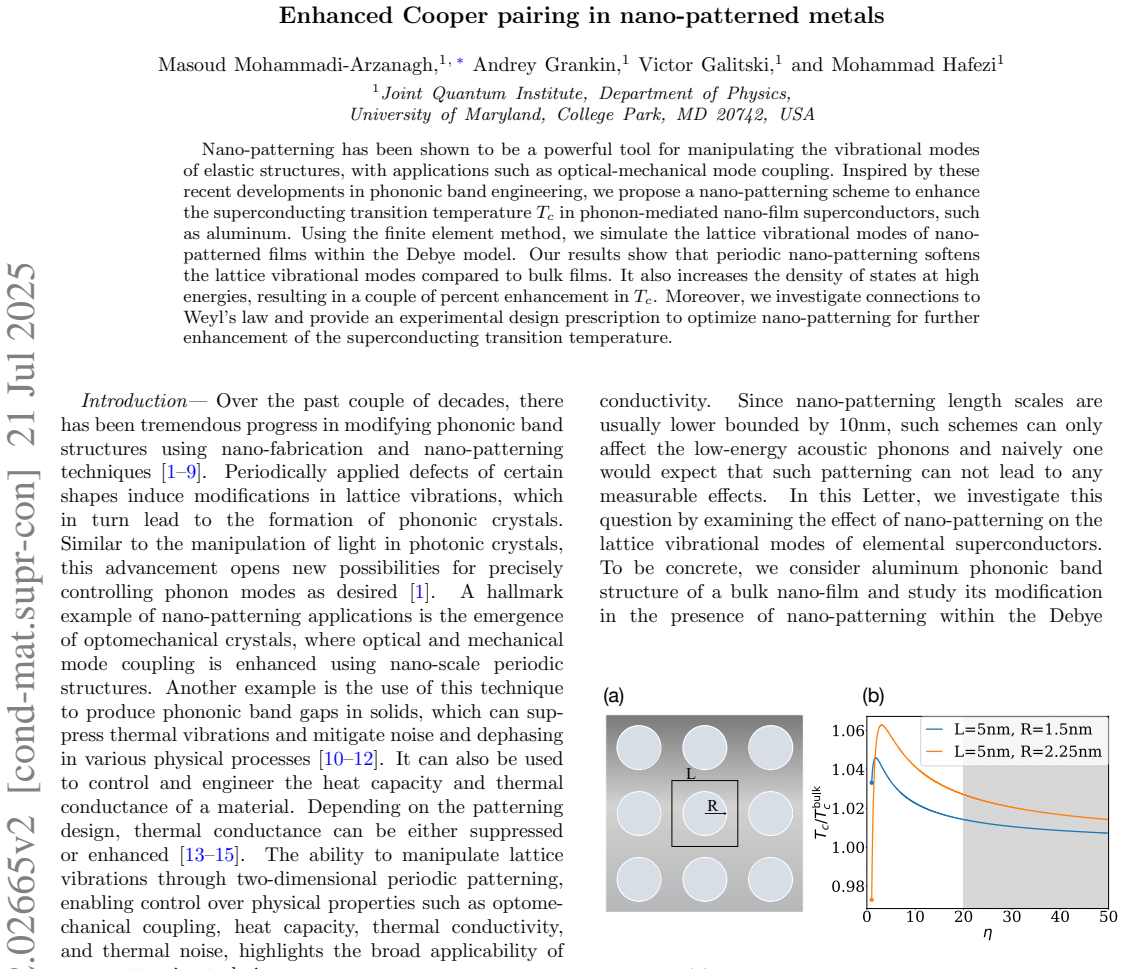
The paper's central claim is that a periodic array of holes changes the phonon spectrum of a superconducting nano-film in a calculable way, and that this change can enhance Cooper pairing. For a Debye-model elastic film with free hole boundaries, the cumulative phonon density of states per unit area acquires the linear high-energy correction $N(\nu)-N_{\mathrm{bulk}}(\nu)=\beta_p L/(2Ac_s)\,\nu$, which the authors verify numerically and attribute to the Weyl-Vasilev law, with $L$ the hole perimeter and $A$ the metal area of the unit cell. The same geometric correction enters the cumulative Eliashberg function, producing a competition between low-energy softening and high-energy enhancement. For base geometries $(L,R)=(5\,\mathrm{nm},1.5\,\mathrm{nm})$ and $(5\,\mathrm{nm},2.25\,\mathrm{nm})$, scaling all lengths by a factor of three gives $\lambda/\lambda_{\mathrm{bulk}}=1.011$ and $1.019$, $\Theta/\Theta_{\mathrm{bulk}}=0.987$ and $0.972$, and transition-temperature enhancements of $4.2\%$ and $6.3\%$. The authors conclude that patterning shape can be optimized, with higher perimeter-squared-to-area ratios, extending to fractal shapes, predicted to give larger enhancements.
Load-bearing premise
The load-bearing premise is that punching holes changes only the lattice vibrations, leaving the electrons' Fermi surface, the coupling strength, and the Coulomb repulsion exactly as in the plain film, and that averaging over one unit cell is valid because a Cooper pair extends over many cells; the authors state that they do not include any effect of nano-patterning on the Coulomb repulsion parameter.
Editorial extensions
If this is right
- For aluminum nanofilms, a few-percent $T_c$ enhancement is achievable by choosing the hole radius and unit-cell size; the scaling curve $T_c(\eta)$ peaks at an optimal factor before the unit cell approaches the coherence length.
- The gain is controlled by the perimeter-squared-to-area ratio, so patterns with higher ratios, such as fractal hole shapes, are predicted to produce larger enhancements provided feature sizes stay above atomic scales.
- The phonon softening and high-energy density-of-states increase should show up directly in the phonon spectrum, not only in the superconducting transition.
- The same scheme transfers to other phonon-mediated superconductors such as niobium, where the absolute enhancement could be larger than in aluminum.
Reading between the lines
- Editorial inference: the Weyl-Vasilev correction also implies a change in low-temperature phonon thermal conductance of patterned films, an independent, non-superconducting observable that could validate the computed phonon spectrum.
- Editorial inference: because the Coulomb repulsion parameter is held fixed, the prediction is most at risk from patterning-induced changes in screening or disorder; a clean experiment varying only hole geometry while holding film quality fixed would isolate the phonon effect.
- Editorial inference: the random-plane-wave argument suggests the enhancement should survive for non-circular hole shapes and possibly aperiodic patterns, as long as the boundary correction keeps its Weyl form; testing this would separate geometric from band-structure effects.
- Editorial inference: the predicted non-monotonic $T_c(\eta)$ curve is a sharp fingerprint of the mechanism; observing its peak and decline as the unit cell grows would support the phonon-softening picture over generic disorder explanations.
Editorial analysis
A structured set of objections, weighed in public.
Referee Report
Summary. The manuscript studies superconducting pairing in aluminum nanofilms patterned with a periodic array of circular holes. Within a continuum Debye model solved by FEM (COMSOL), it computes the phonon band structure, cumulative density of states, and an Eliashberg function (Eq. 10) for unit cells of side L=5 nm with hole radii R=1.5 and 2.25 nm. The authors find low-frequency phonon softening and a high-frequency DOS enhancement consistent with the Weyl-Vasilev law (Eq. 4). They calibrate the effective electron-phonon coupling \tilde{g} to the bulk Al Tc, then use a scaling ansatz (Appendix B) to predict Tc enhancements of 4.2% and 6.3% for the scaled geometries (L,R)=(15,4.5) nm and (15,6.75) nm, and propose that patterns with larger perimeter-squared-to-area ratios yield larger enhancements.
Significance. The paper is significant because it proposes a concrete, experimentally testable route to enhance Tc in an elemental phonon-mediated superconductor by purely geometric patterning, and it connects the effect to a Weyl-law boundary correction. The numerical framework is transparent: FEM phonon band structures, a benchmark against the Weyl-Vasilev law (Fig. 3c), and a Brillouin-zone convergence check (Appendix E) are valuable. The calibration of \tilde{g} against bulk Tc, rather than against patterned targets, is a genuine independent counterfactual, and the predicted 4.2% and 6.3% enhancements are falsifiable. The main weakness is that the quantitative predictions are obtained from a scaling extrapolation whose normalization has not been checked; if this is corrected, the paper could be a solid contribution.
major comments (2)
- [Results and Conclusion; Appendix B; Eq. (4), Eq. (10)] The scaling relation N(ηL,ηR,ν) ∼ N(L,R,ην) is stated for a quantity defined in Eq. (4) as the density of states per unit area. Under that normalization, the Weyl correction for the scaled pattern scales as (ηL)/(2η^2 A c_s)ν = η^{-1} times the base correction at fixed ν, whereas the text's relation evaluates the base at ην and thus effectively grows with η. The relation is therefore only consistent if N is counted per unit cell, not per unit area. The authors do not provide the scaling of Eq. (10) (mode normalizations |α|^2, the BZ area factor (2π/L)^2, and umklapp sums) under (L,R)→(ηL,ηR). Since the quoted λ/λ_bulk = 1.011–1.019 and δTc/Tc = 4.2% and 6.3% are obtained from this extrapolation (Appendix B, Fig. 4) with no direct simulation at the scaled sizes (η=3), the headline enhancements are not yet supported. A direct COMSOL run at η=3 or a careful derivation of the scaling of Eq. (10) is needed.
- [Appendix B; Fig. 4] The high-energy linear fits to the cumulative Eliashberg correction (parameters s and r) are used to extrapolate the Eliashberg function and λ(ν) beyond the frequency range directly simulated and to construct the Tc-versus-η curves in Fig. 1(b). The fit parameters, fit intervals, and any uncertainty estimates are not reported. Because the predicted changes in λ are only about 1–2% and the resulting Tc changes are a few percent, the linear extrapolation is a load-bearing step; a modest change in the slope s, or a breakdown of linearity at higher frequencies, could substantially alter the predicted δTc/Tc. The authors should either provide the fitted parameters with uncertainties and a sensitivity analysis, or replace the extrapolation with direct simulations at the reported scaled geometries.
minor comments (5)
- [Electron-Phonon Coupling; Eq. (7)] The symbol h in hΘ/1.2 is not defined as Planck's constant versus ℏ, and the units of Θ (defined through ζ(ν_D)) are not stated; specifying these would remove ambiguity.
- [Fig. 1 caption; Eq. (4)] The letter L denotes both the side length of the unit cell and the perimeter L=2πR in the caption, while Eq. (4) uses L for the perimeter; this dual notation is confusing and should be resolved.
- [Appendix D; Table I] The Lamé parameters λ_L and μ_L used in Eq. (2) are not listed; the table gives only E and Poisson's ratio, and the phrase 'Elasticity module' should read 'modulus'.
- [Results and Conclusion] The claim that fractal shapes with higher perimeter-squared-to-area ratio would give higher Tc is plausible from Eq. (4) but is not tested; it would be helpful to state explicitly that this is a conjecture.
- [Electron-Phonon Coupling] The statement that the effect of nano-patterning on μ* is not taken into account is an important caveat; since the predicted enhancements are only a few percent, the authors should briefly discuss whether hole-induced changes in the electronic density of states or disorder scattering could affect the comparison with experiment.
Circularity Check
Minor circularity in Appendix C's justification of the constant energy shift; the main Tc prediction is a genuine counterfactual and not fit to patterned targets.
-
renaming known result
[Appendix C, Eqs. (C1)-(C3)]
"Assuming a constant energy shift at high energies ΔEl⃗q=ΔE, the expression simplifies to: N(ν)=Nbulk(ν)+d/hdν Nbulk(ν)ΔE. Using the known bulk expression Nbulk(ν)=πν2/c2s(1+1/κ2), we arrive at the Weyl's formula for the patterned geometry at high energies. This justifies the assumption of a constant energy shift. Equating the proportionality factors gives: ΔE=hcsβpL/(4πA(1+1/κ2))."
The appendix proposes to demonstrate a downward high-energy level shift ΔE. It assumes ΔE_lq=ΔE as a hypothesis, Taylor-expands the Heaviside function, and obtains an expression of the same linear-in-ν form as Weyl's law (Eq. 4). It then 'arrives at Weyl's formula' and equates coefficients to fix ΔE. Thus ΔE is not derived from the phonon problem; it is the known Weyl coefficient βp recast as an energy shift. The statement 'This justifies the assumption of a constant energy shift' is circular: matching the assumed form to the target formula demonstrates only consistency, not the constancy of the shift. This appendix is explanatory rather than load-bearing for the main Tc result, which is computed from Eq. (10) with COMSOL phonon modes and the Appendix B fits.
full rationale
The central Tc prediction is not circular: the only fitted parameter, g~, is calibrated to bulk aluminum Tc and then held fixed for the patterned geometries, so no patterned Tc enters the fit and the enhancement is a genuine counterfactual. The base-geometry Eliashberg functions are computed directly from COMSOL phonon eigenmodes via Eq. (10), and the density-of-states benchmark against Weyl's law uses an independent coefficient βp from plate-vibration experiments [27]. The η=3 headline numbers are obtained by the scaling relations N(ηL,ηR,ν)∼N(L,R,ην) and α2F(ηL,ηR,ν)∼α2F(L,R,ην) combined with numerical fits (s,r) from Appendix B; this extrapolation is a robustness risk (the per-unit-area normalization of Eq. (4) may make the scaling relation dimensionally inconsistent) and deserves a direct COMSOL check, but it is not circular because the fitted parameters do not target the final Tc and McMillan's formula provides an independent transformation. The one genuinely circular passage is Appendix C: the 'constant energy shift' ΔE is assumed, used to reproduce Weyl's formula, and then fixed by equating to the Weyl coefficient, so ΔE is a relabeling of the known law rather than an independent derivation. This appendix is explanatory and not load-bearing for the main result; the self-citation [21] is similarly non-load-bearing, being co-cited with independent references [36–39]. Overall score 2.
Assumptions & free parameters
free parameters (5)
- g~ (effective electron-phonon coupling prefactor) =
not stated; fit to bulk Tc = 1.2 K
- mu* (Coulomb pseudopotential) =
0.1
- s (slope of high-energy linear correction to cumulative Eliashberg function) =
not stated; extracted by numerical linear fitting for each geometry
- r (intercept of high-energy linear correction) =
not stated
- Debye cutoff νD (effective, per geometry) =
νD/νD_bulk = 0.992 and 0.979 for scaled 15 nm geometries
assumptions (6)
- domain assumption Aluminum nano-film is a 2D isotropic continuum elastic medium described by the Debye model with a linear spectrum and a hard cutoff.
- domain assumption Free-surface boundary condition at hole boundaries is the correct mechanical condition.
- domain assumption The phonon-mediated electron-electron interaction can be averaged over the unit cell because the superconducting coherence length (≈100 nm) is much larger than the unit cell (5-15 nm).
- domain assumption Nano-patterning leaves the electronic subsystem unchanged: same Fermi surface, same k_F, same density of states N(0), same electron-phonon coupling g, and same Coulomb pseudopotential μ*.
- standard math Berry's conjecture (random plane wave approximation) holds for high-energy phonon modes in the chaotic patterned cell.
- domain assumption Weyl-Vasilev law (Eq. (4)) with the compact-domain boundary term applies to each cell of the periodic pattern.
Cite this review
Pith. "Pith review of Enhanced Cooper pairing in nano-patterned metals." pith.science (2026). https://pith.science/paper/KCNMDFYD
@misc{pith2026250202665,
  author       = {Pith},
  title        = {Pith review of: Enhanced Cooper pairing in nano-patterned metals},
  year         = {2026},
  howpublished = {\url{https://pith.science/paper/KCNMDFYD}},
  note         = {Machine review of arXiv:2502.02665}
}
abstract
Nano-patterning has been shown to be a powerful tool for manipulating the vibrational modes of elastic structures, with applications such as optical-mechanical mode coupling. Inspired by these recent developments in phononic band engineering, we propose a nano-patterning scheme to enhance the superconducting transition temperature $T_c$ in phonon-mediated nano-film superconductors, such as aluminum. Using the finite element method, we simulate the lattice vibrational modes of nano-patterned films within the Debye model. Our results show that periodic nano-patterning softens the lattice vibrational modes compared to bulk films. It also increases the density of states at high energies, resulting in a couple of percent enhancement in $T_c$. Moreover, we investigate connections to Weyl's law and provide an experimental design prescription to optimize nano-patterning for further enhancement of the superconducting transition temperature.
Figures


Figures from the paper (2 more)


Reference graph
Works this paper leans on
-
[1]
M. Eichenfield, J. Chan, R. M. Camacho, K. J. Vahala, and O. Painter, Optomechanical crystals, nature 462, 78 (2009)
work page 2009
-
[2]
A. H. Safavi-Naeini and O. Painter, Design of optomechan- ical cavities and waveguides on a simultaneous bandgap phononic-photonic crystal slab, Optics express 18, 14926 (2010)
work page 2010
-
[3]
T. J. Kippenberg and K. J. Vahala, Cavity optomechanics: back-action at the mesoscale, science 321, 1172 (2008)
work page 2008
-
[4]
M. Eichenfield, J. Chan, A. H. Safavi-Naeini, K. J. Vahala, and O. Painter, Modeling dispersive coupling and losses of localized optical and mechanical modes in optomechanical crystals, Optics express 17, 20078 (2009)
work page 2009
-
[5]
I. Favero and K. Karrai, Optomechanics of deformable op- tical cavities, Nature Photonics 3, 201 (2009)
work page 2009
-
[6]
R. H. Olsson and I. El-Kady, Microfabricated phononic crystal devices and applications, Measurement science and technology 20, 012002 (2008)
work page 2008
-
[7]
J. O. Vasseur, A.-C. Hladky-Hennion, B. Djafari-Rouhani, F. Duval, B. Dubus, Y. Pennec, and P. Deymier, Waveg- uiding in two-dimensional piezoelectric phononic crystal plates, Journal of applied physics 101 (2007)
work page 2007
- [8]
Show all 40 references
-
[9]
Mohammadi, A
S. Mohammadi, A. A. Eftekhar, A. Khelif, W. D. Hunt, and A. Adibi, Evidence of large high frequency complete phononic band gaps in silicon phononic crystal plates, Ap- plied Physics Letters 92 (2008)
2008
-
[10]
Florez, G
O. Florez, G. Arregui, M. Albrechtsen, R. C. Ng, J. Gomis- Bresco, S. Stobbe, C. M. Sotomayor-Torres, and P. D. Garc ´ ıa, Engineering nanoscale hypersonic phonon trans- port, Nature Nanotechnology 17, 947 (2022)
2022
-
[11]
Sigalas and E
M. Sigalas and E. N. Economou, Band structure of elastic waves in two dimensional systems, Solid state communica- tions 86, 141 (1993)
1993
-
[12]
M. S. Kushwaha, P. Halevi, L. Dobrzynski, and B. Djafari- Rouhani, Acoustic band structure of periodic elastic com- posites, Physical review letters 71, 2022 (1993)
1993
-
[13]
Gorishnyy, C
T. Gorishnyy, C. K. Ullal, M. Maldovan, G. Fytas, and E. Thomas, Hypersonic phononic crystals, Physical review letters 94, 115501 (2005)
2005
-
[14]
Anufriev and M
R. Anufriev and M. Nomura, Phonon engineering for quan- tum hybrid systems, in Quantum Hybrid Electronics and Materials (Springer, 2022) pp. 15–24
2022
-
[15]
Nomura, Phononic band engineering for thermal con- duction control and similarity with photonic band engi- neering, Microsystem Technologies 22, 473 (2016)
M. Nomura, Phononic band engineering for thermal con- duction control and similarity with photonic band engi- neering, Microsystem Technologies 22, 473 (2016)
2016
-
[16]
Abeles, R
B. Abeles, R. W. Cohen, and G. Cullen, Enhancement of superconductivity in metal films, Physical Review Letters 17, 632 (1966)
1966
-
[17]
R. W. Cohen and B. Abeles, Superconductivity in granular aluminum films, Physical Review 168, 444 (1968)
1968
-
[18]
Strongin, O
M. Strongin, O. Kammerer, J. Crow, R. Parks, D. Dou- glass Jr, and M. Jensen, Enhanced superconductivity in layered metallic films, Physical Review Letters 21, 1320 (1968)
1968
-
[19]
Prischepa and V
S. Prischepa and V. Kushnir, Phonon softening in nanos- tructured phonon–mediated superconductors, Journal of Physics: Condensed Matter 35, 313003 (2023)
2023
-
[20]
G. A. Ummarino and A. Zaccone, Quantitative eliashberg theory of the superconductivity of thin films, Journal of Physics: Condensed Matter 37, 065703 (2024)
2024
-
[21]
Grankin, M
A. Grankin, M. Hafezi, and V. Galitski, Enhanced cooper pairing via random matrix phonons in superconducting grains, arXiv preprint arXiv:2408.03927 (2024)
2024 arXiv
-
[22]
Weyl, ¨Uber die asymptotische verteilung der eigenwerte, Nachrichten von der Gesellschaft der Wissenschaften zu G¨ ottingen, Mathematisch-Physikalische Klasse1911, 110 (1911)
H. Weyl, ¨Uber die asymptotische verteilung der eigenwerte, Nachrichten von der Gesellschaft der Wissenschaften zu G¨ ottingen, Mathematisch-Physikalische Klasse1911, 110 (1911)
1911
-
[23]
D. G. Vasil’ev, Asymptotic behavior of the spectrum of a boundary value problem, Trudy Moskovskogo Matem- aticheskogo Obshchestva 49, 167 (1986)
1986
-
[24]
L. D. Landau, L. Pitaevskii, A. M. Kosevich, and E. M. Lifshitz, Theory of elasticity: volume 7 , Vol. 7 (Elsevier, 6 2012)
2012
-
[25]
F. W. Hehl and Y. Itin, The cauchy relations in linear elas- ticity theory, Journal of elasticity and the physical science of solids 66, 185 (2002)
2002
-
[26]
Marsden and T
J. Marsden and T. Hughes, J., r. mathematical foundations of elasticity dover publications (1994)
1994
-
[27]
Bertelsen, C
P. Bertelsen, C. Ellegaard, and E. Hugues, Distribution of eigenfrequencies for vibrating plates, The European Phys- ical Journal B-Condensed Matter and Complex Systems 15, 87 (2000)
2000
-
[28]
Fr¨ ohlich, Electrons in lattice fields, Advances in Physics 3, 325 (1954)
H. Fr¨ ohlich, Electrons in lattice fields, Advances in Physics 3, 325 (1954)
1954
-
[29]
A. A. Abrikosov, L. P. Gorkov, and I. E. Dzyaloshinski, Methods of Quantum Field Theory in Statistical Physics (Courier Corporation, 2012)
2012
-
[30]
Altland and B
A. Altland and B. D. Simons, Condensed matter field the- ory (Cambridge university press, 2010)
2010
-
[31]
L. N. Cooper, Bound electron pairs in a degenerate fermi gas, Physical Review 104, 1189 (1956)
1956
-
[32]
We use cyclic frequency throughout the work
-
[33]
P. B. Allen and R. Dynes, Transition temperature of strong-coupled superconductors reanalyzed, Physical Re- view B 12, 905 (1975)
1975
-
[34]
McMillan, Transition temperature of strong-coupled superconductors, Physical Review 167, 331 (1968)
W. McMillan, Transition temperature of strong-coupled superconductors, Physical Review 167, 331 (1968)
1968
-
[35]
S. K. Bose and J. Kortus, Electron-phonon coupling in metallic solids from density functional theory, Vibronic and Electron-Phonon Interactions and Their Role in Modern Chemistry and Physics , 1 (2009)
2009
-
[36]
A. M. Garc ´ ıa-Garc ´ ıa, J. D. Urbina, E. A. Yuzbashyan, K. Richter, and B. L. Altshuler, Bcs superconductivity in metallic nanograins: Finite-size corrections, low-energy ex- citations, and robustness of shell effects, Physical Review B—Condensed Matter and Materials Physic...
2011
-
[37]
M. C. Gutzwiller, Chaos in classical and quantum mechan- ics, Vol. 1 (Springer Science & Business Media, 2013)
2013
-
[38]
Brack and R
M. Brack and R. Bhaduri, Semiclassical physics, addison and wesley, Reading (1997)
1997
-
[39]
U. Kuhl, H. St¨ ockmann, and R. Weaver, Classical wave experiments on chaotic scattering, Journal of Physics A: Mathematical and General 38, 10433 (2005)
2005
-
[40]
Lopez-Pastor and F
V. Lopez-Pastor and F. Marquardt, Self-learning machines based on hamiltonian echo backpropagation, Physical Re- view X 13, 031020 (2023). Appendix A: The derivation of Eliashberg function In the absence of translation invariance, the phonon propagator and the two body electro...
2023
Reviewed August 9, 2026 · model on record in the stance chip above.
Discussion (0). Continue with ORCID to comment.