REVIEW 3 major objections 4 minor 1 cited by
Quantum Estimation in QED Scattering
T0 review · 3 major / 4 minor · reviewed 2026-08-06 · deepseek-v4-flash
Pith's one-line read The paper shows that the two-particle spin state left by tree-level QED scattering sets strict quantum limits on how precisely one can estimate the centre-of-mass momentum and scattering angle from helicity/polarization measurements…
desk verdict A genuine first computation of QFI for QED scattering kinematics, with a plausible central result and a headline near-backscattering peak that needs sensitivity analysis before it is quoted. read the letter →
The pith
A machine-rendered reading of the paper's core claim, the machinery that carries it, and where it could break.
The reading
What carries the argument
The central object is the four-momentum-filtered two-particle density matrix ρ_out = Π_q S ρ_-∞ S^† Π_q / Tr[Π_q S ρ_-∞ S^† Π_q], which reduces to ratios of tree-level S-matrix elements M_{pλ→qη} in the helicity or polarization basis. The quantum Fisher information matrix is computed from this two-qubit state using the symmetric logarithmic derivative, with the pure-state formula I_{i,j} = 4Re[⟨∂_i ψ|∂_j ψ⟩ − ⟨∂_i ψ|ψ⟩⟨ψ|∂_j ψ⟩] and the mixed-state eigen-decomposition expression. The SLD eigenbasis provides the optimal measurement, while a comparison is made with the classical Fisher information of local helicity/polarization projective measurements.
What would settle it
Compute the same QFIM with one-loop radiative corrections or with a finite-width momentum filter: if the predicted Iθθ ≈ 1.2 × $10^{4}$ $rad^{-2}$ for opposite-helicity Compton backscattering drops by orders of magnitude, the central claim fails. Alternatively, an experiment measuring spin correlations of backscattered Compton pairs could test the predicted SNRθ ≈ $10^{3}$; observing far less information than the quantum Cramér-Rao bound would indicate missing physical effects.
Extended reading notes
Core claim
Working from tree-level QED amplitudes, the paper establishes that the two-qubit state of the scattered electron–muon or electron–photon pair, obtained after an idealized infinitely sharp momentum filter, carries a well-defined quantum Fisher information matrix with respect to the centre-of-mass momentum magnitude p and polar scattering angle θ. For pure initial states, the optimal measurement basis is the eigenbasis of the symmetric logarithmic derivative, and the QFIM gives the quantum Cramér-Rao lower bound on any unbiased estimator based only on internal degrees of freedom. The authors find that helicity/polarization measurements are nearly as informative as the optimal bound for estimating p, but are substantially suboptimal for estimating θ, where entangled (non-local) measurements can do much better. The largest effect appears for an opposite-helicity pure electron–photon initial state: Iθθ reaches about 1.2 × $10^{4}$ $rad^{-2}$ and the single-measurement SNRθ ≈ $10^{3}$ near backscattering θ → π, meaning the scattering angle can be extracted from spin alone to very high precision in this regime.
Load-bearing premise
The whole calculation assumes the outgoing state after filtering is exactly the tree-level QED state at a sharply defined momentum, with no radiative corrections; if a real detector averages over a momentum band or higher-order corrections matter, the predicted sharp QFI features near backscattering could weaken.
Editorial extensions
If this is right
- For mixed initial states, selecting backscattered high-energy electron-muon pairs maximizes the information carried by helicities, giving SNRθ ≈ 10 for a single optimal measurement.
- In pure-state electron-muon scattering, the momentum magnitude p is best estimated at lower energies around half the electron mass, while θ is best estimated at wide angles.
- Local helicity/polarization measurements are close to optimal for estimating p, so no entangled measurement is needed there; for θ the optimal basis is entangled and local measurements can be orders of magnitude worse.
- For opposite-helicity Compton scattering, near-backscattered pairs allow θ to be estimated to about 10^-3 rad precision from one spin measurement, the strongest precision bound found in the paper.
- Fixing one parameter improves the single-parameter bounds, reaching SNR values up to about 66 for θ in mixed-state Compton scattering.
Reading between the lines
- A natural extension the authors do not develop is estimating the QED coupling constant itself: the QFIM with respect to coupling deformations would describe how the particle-state Hilbert space geometry responds to changing the Lagrangian.
- The same four-momentum-filtered QFIM recipe could be applied to other tree-level scattering processes, such as gluon scattering, where the outgoing polarization state is already known to depend on scattering angle and momenta.
- The sharp SNRθ peak near backscattering suggests a possible metrological use of spin-polarization correlations as an angle sensor in Compton regimes, though finite detector bandwidth would smear the ideal momentum filter and likely reduce the peak.
- Because the optimal θ measurement is entangled, practical implementations would require Bell-type measurements on the helicity/polarization of both outgoing particles rather than independent local measurements.
Editorial analysis
A structured set of objections, weighed in public.
Referee Report
Summary. The paper applies quantum estimation theory to tree-level QED scattering. For electron-muon and Compton scattering, Alice prepares either a maximally mixed or a pure initial state, lets the particles scatter, and then filters one outgoing momentum exactly, producing a conditional two-qubit state in the helicity/polarisation basis (Eqs. (21) and (24)). Bob estimates the centre-of-mass momentum magnitude p and polar scattering angle theta by measuring only these internal degrees of freedom. The authors numerically compute the 2x2 quantum Fisher information matrix, the resulting quantum Cramer-Rao bounds and single-measurement signal-to-noise ratios, and compare the optimal (global, entangled) measurement with local helicity/polarisation measurements. The main quantitative finding is that for Compton scattering with opposite-helicity initial states, the SNR for estimating theta reaches about 10^3 as theta approaches pi (Section IV B 2, Fig. 16).
Significance. If the results are robust, this is a useful first systematic study of quantum Fisher information for internal degrees of freedom in QED scattering. The derivation is self-contained and parameter-free: the amplitudes are standard tree-level expressions and no parameters are fitted to the reported numbers. The paper also provides a clear comparison between global optimal measurements and local helicity measurements, showing that local measurements are nearly optimal for p but substantially suboptimal for theta. The main limitation is that the headline numerical results are computed under an idealized sharp momentum filter and at tree level; the authors acknowledge this idealization in footnote 27 but do not quantify how the bounds degrade under realistic filtering or higher-order corrections. With such qualifications supplied, the work would be a valuable contribution to the emerging quantum-information/HEP interface.
major comments (3)
- [IV B 2, Fig. 16] The headline SNR_theta ~ 10^3 for opposite-helicity Compton scattering is computed from the sharply filtered tree-level pure state of Eqs. (21) and (24), and the paper does not quantify how this number degrades under the two idealizations it explicitly acknowledges in footnote 27. A finite acceptance collimator replaces the pure state with a convex mixture over a momentum/angle band; the QFI of that mixture is not equal to the sharp-filter QFI, and any angular structure narrower than the acceptance width is averaged away. Because the maximum is reached on the numerical boundary theta = pi, where the polar coordinate is singular and the plotted values increase toward the boundary, the enhancement may be a boundary cusp rather than a robust encoding. Radiative corrections to the tree-level amplitudes entering Eq. (24) can also modify the derivative with respect to theta near pi and cap or shift the peak. I request either a quantitative sensitivity analysis (e.g., smoothing over a Gaussian acceptance of width comparable to Delta_theta and over a momentum bin) or a reformulation of the claim from 'ultimate bounds' to bounds within the stated tree-level sharp-filter model.
- [III] The numerical implementation is not described to the level required to reproduce the QFIM plots. The text states only the grid spacings Delta_p = 0.01 MeV and Delta_theta = pi/500; there is no discussion of how the derivatives in Eqs. (17) and (18) are approximated, how the zero-eigenvalue terms in the mixed-state expression (17) are regularized when rank(rho) < 4, or how convergence with respect to grid spacing was checked. No code or data files are provided. Given that the central results are numerical maps over p and theta, the absence of these details makes the quantitative claims (including the I_theta,theta ~ 10^4 rad^-2 value in Sec. IV B 2) unverifiable as presented.
- [III] The statement that 'no dependence on phi remains in the output state' is supported only by a numerical check, but the helicity and polarisation bases carry azimuth-dependent phase conventions, and the density matrix of Eq. (21) can acquire phi-dependent relative phases if the total helicity of the final state is not conserved. Since the paper reduces the estimation problem from three parameters to two on the basis of this claim, an analytical demonstration (or an explicit statement of the phase convention under which the numerical check was performed) is needed.
minor comments (4)
- [I, IV A 2, II C] There are minor typographical errors: 'parametres' in the introduction, 'maxium' in Sec. IV A 2, and the phrase 'where |e_plus-minus> are the eigenvalues of L_sigma' in Sec. II C should read 'eigenvectors'. Reference [41] also contains a typo, 'Quantu entanglement'.
- [Figs. 11-16] Several figure captions for Compton scattering refer to the 'electron-muon state' (e.g., Fig. 11), which is inconsistent with the electron-photon process discussed in the text; these captions should be corrected.
- [II D and Eq. (35)] The notation I^(C)_sigma,lambda is used for both the local helicity basis and the generic basis lambda, which is potentially confusing because lambda also labels the initial and final helicity configurations in Eqs. (21)-(24). I suggest a distinct notation for the local basis Fisher information.
- [General] A data and code availability statement, or a supplementary file with the numerical routines and the generated QFIM grids, would substantially improve the reproducibility of the paper's quantitative claims.
Circularity Check
No circularity: the paper's QFIM and SNR values are direct numerical evaluations of standard QFI formulas on standard tree-level QED amplitudes; no fitted parameter is presented as a prediction and the only self-citation is contextual.
full rationale
The derivation chain is self-contained. The output state is obtained by (i) writing the momentum-filtered two-particle state in terms of S-matrix elements (Eqs. (21)-(24)); (ii) evaluating those elements at tree level from the standard QED amplitudes in Eqs. (39)-(42); and (iii) inserting the resulting density matrix into the standard QFIM formula, Eq. (17) for mixed states and Eq. (18) for pure states. The reported SNR values follow from the QCRLB, Eq. (36), and the SNR definition in Eq. (37). No parameter appearing in the final bounds is fitted to the bounds themselves; in particular, the large I_theta,theta ~ 10^4 rad^-2 and SNR_theta ~ 10^3 in Sec. IV B 2 are consequences of the normalized tree-level state of Eq. (24) and the angular derivatives of the Compton amplitudes, not of any parameter extracted from the plotted QFI. The only self-citation, Ref. [26], is invoked in the Introduction as background on tree-level entanglement and is not load-bearing for the estimation calculation. Concerns about idealized sharp momentum filtering and lack of radiative corrections (footnote 27 acknowledges the idealization) are physical-robustness caveats, not circularity, since the paper explicitly derives the bounds from the idealized state it defines. Accordingly, the central claim has independent content and no circular step is exhibited.
Assumptions & free parameters
assumptions (3)
- standard math Quantum Fisher information and SLD formulas (Eqs. 13-19) correctly bound estimation precision for multi-parameter quantum estimation.
- domain assumption Tree-level QED amplitudes from Peskin and Schroeder correctly describe the scattered two-particle state over the parameter range p in [0.01, 5] MeV and theta away from divergences.
- domain assumption The momentum-filtering projection Pi_q (Eq. 21) is an ideal sharp projector onto a single outgoing momentum mode.
Cite this review
Pith. "Pith review of Quantum Estimation in QED Scattering." pith.science (2026). https://pith.science/paper/KDKWGPBS
@misc{pith2026250623197,
  author       = {Pith},
  title        = {Pith review of: Quantum Estimation in QED Scattering},
  year         = {2026},
  howpublished = {\url{https://pith.science/paper/KDKWGPBS}},
  note         = {Machine review of arXiv:2506.23197}
}
read the original abstract
We tackle the issue of estimating dynamical parameters in quantum electrodynamics. We numerically compute the quantum Fisher information matrix (QFIM) of physical parameters in electron-muon and Compton scattering at tree level. In particular, we consider the estimation of centre-of-mass three-momentum magnitude and polar scattering angle through measurements on the internal degrees of freedom (helicity or polarisation) of the scattered particles. Computations are carried out for pure and maximally mixed initial states. The QFIM values are then used to compute the quantum Cram\'er-Rao lower bounds on the estimations at hand. Further, we compare such ultimate bounds to the classical Fisher information of local polarisation or helicity degrees of freedom.
Figures


Figures from the paper (9 more)


Forward citations
Cited by 1 Pith paper
-
Photon-nucleon entanglement in Compton scattering at low and high energies
Photon-nucleon entanglement in polarized Compton scattering is generically present and, for neutrons, strongly controlled by the nucleon electric and magnetic polarizabilities.
Reference graph
Works this paper leans on
-
[1]
Classical Fisher Information In estimation theory we consider a vector of physically observable random variables X = ( X1, X2, . . . , Xn) [28] and define x = ( x1, x2, . . . , xn) to be a vector of values that X take after a single measurement is performed. This measurement process can then be repeated, giving us a set of different x values. The probabil...
-
[2]
Quantum Fisher Information Let us now move on to quantum estimation theory, by considering the case of a quantum state ρ(σ), rather than a classical probability distribution, depending on a parameter σ. The key realisation here is that, once a positive operator valued measure (POVM), i.e., a spe- cific quantum measurement, is set, the Born rule ex- tracts...
-
[3]
M. G. A. Paris, Quantum estimation for quantum tech- nology (2009), arXiv:0804.2981 [quant-ph]
arXiv 2009
-
[4]
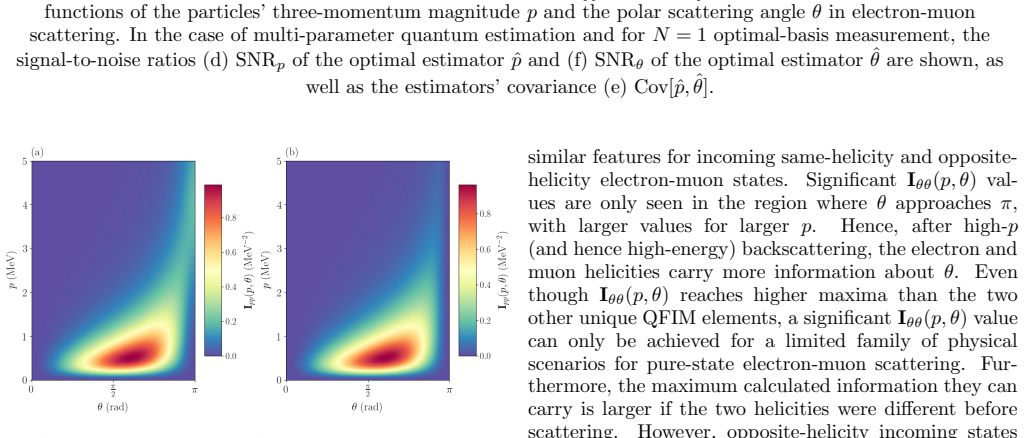
Mixed state A scattered maximally mixed electron-muon state has three unique QFIM elements Ipp(p, θ), Ipθ(p, θ), and Iθθ(p, θ) with similar features (see Fig. 2 (a)-(c)). All three QFIM elements have consistently increasing values as p and θ increase, i.e. the electron and muon helic- ities carry more information about p and θ in a high- momentum, wide-an...
-
[5]
Pure states Under a parity transformation ˆP , the two-particle helicity eigenstates transform as |LL⟩ ˆP ↔ |RR⟩ and |LR⟩ ˆP ↔ |RL⟩. The QED Lagrangian is invariant un- der parity transformation, so the outgoing (scattered) pure quantum states transform as |ψ⟩out,LL ˆP ↔ |ψ⟩out,RR and |ψ⟩out,LR ˆP ↔ |ψ⟩out,RL, up to relative phase terms, where |ψ⟩out,λ is...
-
[6]
The three unique QFIM elements for this scenario are shown in Fig
Mixed states In this section, we present Compton scattering results for an electron and a photon that are initially in a max- imally mixed internal quantum state. The three unique QFIM elements for this scenario are shown in Fig. 10 (a)-(c). The QFIM elements have functions of p and θ with similar features. All three elements have small values in the regi...
-
[7]
Pure states As one should expect, the invariance of QFI and CFI terms under parity transformation ˆP is observed for pure- state Compton scattering, as it is for electron-muon scat- tering. Again, the CFI terms I (C) p,λ (p, θ) and I (C) θ,λ (p, θ) (as- sociated with a measurement of the pure electron-photon state in the helicity/polarisation basis) are n...
-
[8]
J. R. Platt, Strong inference, Science 146, 347 (1964), https://www.science.org/doi/pdf/10.1126/science.146.3642.347
Show all 49 references
-
[9]
Westcott, The parameter estimation problem, IF AC Proceedings Volumes 1, 789 (1960), 1st International IF AC Congress on Automatic and Remote Control, Moscow, USSR, 1960
J. Westcott, The parameter estimation problem, IF AC Proceedings Volumes 1, 789 (1960), 1st International IF AC Congress on Automatic and Remote Control, Moscow, USSR, 1960
1960
-
[10]
Tsang, Resolving starlight: a quantum perspective, Contemporary Physics 60, 279–298 (2019)
M. Tsang, Resolving starlight: a quantum perspective, Contemporary Physics 60, 279–298 (2019)
2019
-
[11]
Giovannetti, S
V. Giovannetti, S. Lloyd, and L. Maccone, Advances in quantum metrology, Nature Photonics5, 222–229 (2011)
2011
-
[12]
Dell’Anna, S
F. Dell’Anna, S. Pradhan, C. D. E. Boschi, and E. Erco- lessi, Quantum fisher information and multipartite en- tanglement in spin-1 chains, Physical Review B 108, 10.1103/physrevb.108.144414 (2023)
2023 doi
-
[13]
Mazza, S
F. Mazza, S. Biswas, X. Yan, A. Prokofiev, P. Steffens, Q. Si, F. F. Assaad, and S. Paschen, Quantum fisher information in a strange metal (2024), arXiv:2403.12779 [cond-mat.str-el]
2024 arXiv
-
[14]
G´ omez and R
C. G´ omez and R. Jimenez, Cosmology from quan- tum information, Physical Review D 102, 10.1103/phys- revd.102.063511 (2020)
2020 doi
-
[15]
Chen and J
L. Chen and J. Feng, Quantum fisher information of a cosmic qubit undergoing non-markovian de sit- ter evolution, Journal of High Energy Physics 2025, 10.1007/jhep06(2025)029 (2025)
2025 doi
-
[16]
Y. R. Zhang, G. R. Jin, J. P. Cao, W. M. Liu, and H. Fan, Unbounded quantum fisher information in two- path interferometry with finite photon number, Journal of Physics A: Mathematical and Theoretical 46, 035302 (2012)
2012
-
[17]
Bak, Information metric and euclidean janus corre- spondence, Physics Letters B 756, 200–204 (2016)
D. Bak, Information metric and euclidean janus corre- spondence, Physics Letters B 756, 200–204 (2016)
2016
-
[18]
Hradil, J
Z. Hradil, J. ˇReh´ aˇ cek, L. S´ anchez-Soto, and B.-G. En- glert, Quantum fisher information with coherence, Op- tica 6, 1437 (2019)
2019
-
[19]
Yahalom, A fluid perspective of relativistic quantum mechanics, Entropy 25, 1497 (2023)
A. Yahalom, A fluid perspective of relativistic quantum mechanics, Entropy 25, 1497 (2023)
2023
-
[20]
M. Blau, K. S. Narain, and G. Thompson, Instantons, the information metric, and the ads/cft correspondence (2001), arXiv:hep-th/0108122 [hep-th]
2001 arXiv
-
[21]
Miyaji, T
M. Miyaji, T. Numasawa, N. Shiba, T. Takayanagi, and K. Watanabe, Distance between quantum states and gauge-gravity duality, Physical Review Letters 115, 10.1103/physrevlett.115.261602 (2015)
2015 doi
-
[22]
Tsuchiya and K
A. Tsuchiya and K. Yamashiro, A geometrical repre- sentation of the quantum information metric in the gauge/gravity correspondence, Physics Letters B 824, 136830 (2022)
2022
-
[23]
Erdmenger, M
J. Erdmenger, M. Gerbershagen, M. P. Heller, and A.-L. Weigel, From complexity geometry to holographic space- time (2022), arXiv:2212.00043 [hep-th]
2022 arXiv
-
[24]
Cervera-Lierta, J
A. Cervera-Lierta, J. I. Latorre, J. Rojo, and L. Rottoli, Maximal Entanglement in High Energy Physics, SciPost Phys. 3, 036 (2017)
2017
-
[25]
Trivella, Holographic computations of the quantum information metric, Classical and Quantum Gravity 34, 105003 (2017)
A. Trivella, Holographic computations of the quantum information metric, Classical and Quantum Gravity 34, 105003 (2017)
2017
-
[26]
Lashkari and M
N. Lashkari and M. Van Raamsdonk, Canonical energy is quantum fisher information, Journal of High Energy Physics 2016, 1–26 (2016)
2016
-
[27]
Banerjee, J
S. Banerjee, J. Erdmenger, and D. Sarkar, Con- necting fisher information to bulk entanglement in holography, Journal of High Energy Physics 2018, 10.1007/jhep08(2018)001 (2018)
2018 doi
-
[28]
Erdmenger, K
J. Erdmenger, K. T. Grosvenor, and R. Jefferson, Infor- mation geometry in quantum field theory: lessons from simple examples, SciPost Phys. 8, 073 (2020)
2020
-
[29]
Dimov, I
H. Dimov, I. N. Iliev, M. Radomirov, R. C. Rashkov, and T. Vetsov, Holographic fisher information metric in schr¨ odinger spacetime (2021), arXiv:2009.01123 [hep-th]
2021 arXiv
-
[30]
Feng and J.-J
J. Feng and J.-J. Zhang, Quantum fisher information as a probe for unruh thermality, Physics Letters B 827, 136992 (2022)
2022
-
[31]
A. Ly, M. Marsman, J. Verhagen, R. Grasman, and E.-J. Wagenmakers, A tutorial on fisher information (2017), arXiv:1705.01064 [math.ST]
2017 arXiv
-
[32]
Cervera-Lierta, Maximal entanglement: Applications in quantum information and particle physics (2019), arXiv:1906.12099 [quant-ph]
A. Cervera-Lierta, Maximal entanglement: Applications in quantum information and particle physics (2019), arXiv:1906.12099 [quant-ph]
2019 arXiv
-
[33]
Fedida and A
S. Fedida and A. Serafini, Tree-level entanglement in quantum electrodynamics, Phys. Rev. D 107, 116007 (2023)
2023
-
[34]
Notice however that, although, one could argue, Bob could obtain direct information on the outgoing momenta through a calorimeter and detector arrays (where time- coincidences would reveal the propagation direction of particle pairs, as customary, for instance, in PET scans), ...
-
[35]
J. L. Devore, Probability and Statistics for Engineering and the Sciences, 8th ed. (Brooks/Cole, 2011) Chap. 6, iSBN-13: 978-0-538-73352-6
2011
-
[36]
C. W. Helstrom, Quantum detection and estimation the- ory, Journal of Statistical Physics 1, 231–252 (1969)
1969
-
[37]
Zieli´ nski, Theory of parameter estimation, Banach Center Publications 41, 209 (1997)
R. Zieli´ nski, Theory of parameter estimation, Banach Center Publications 41, 209 (1997)
1997
-
[38]
As one should expect by symmetry, no dependence on ϕ remains in the output state, even for cases of definite initial helicity or polarisation
and electron-muon scattering calculations, as well as the t-channel divergence at θ = 0 in electron-muon scat- tering. As one should expect by symmetry, no dependence on ϕ remains in the output state, even for cases of definite initial helicity or polarisation. We have tested ...
-
[39]
Pickles, An Introduction to Likelihood Analysis, Con- cepts and techniques in modern geography (Geo Books, 1985)
A. Pickles, An Introduction to Likelihood Analysis, Con- cepts and techniques in modern geography (Geo Books, 1985)
1985
-
[40]
S. M. Kay, Fundamentals of statistical signal processing: estimation theory (Prentice-Hall, Inc., USA, 1993)
1993
-
[41]
Wasserman, All of Statistics: A Concise Course in Statistical Inference , Springer Texts in Statistics (Springer, New York, 2004) Chap
L. Wasserman, All of Statistics: A Concise Course in Statistical Inference , Springer Texts in Statistics (Springer, New York, 2004) Chap. 9
2004
-
[42]
J. Liu, H. Yuan, X.-M. Lu, and X. Wang, Quantum fisher information matrix and multiparameter estima- tion, Journal of Physics A: Mathematical and Theoretical 53, 023001 (2019)
2019
-
[43]
ˇSafr´ anek, Discontinuities of the quantum fisher infor- mation and the bures metric, Phys
D. ˇSafr´ anek, Discontinuities of the quantum fisher infor- mation and the bures metric, Phys. Rev. A 95, 052320 (2017)
2017
-
[44]
J. Liu, J. Chen, X.-X. Jing, and X. Wang, Quantum fisher information and symmetric logarithmic derivative via anti-commutators, Journal of Physics A: Mathemat- ical and Theoretical 49, 275302 (2016)
2016
-
[45]
Qiao, J.-W
C.-K. Qiao, J.-W. Wei, and L. Chen, An overview of the compton scattering calculation, Crystals 11, 525 (2021)
2021
-
[46]
K.-H. Yuan, Z. Zhang, and L. Wang, Signal-to-noise ratio in estimating and testing the mediation effect: Structural 17 equation modeling versus path analysis with weighted composites, Psychometrika 89, 974–1006 (2024)
2024
-
[47]
M. E. Peskin and D. V. Schroeder, An Introduction to Quantum Field Theory(Westview Press, 1995) reading, USA: Addison-Wesley (1995) 842 p
1995
-
[48]
Horodecki, P
R. Horodecki, P. Horodecki, M. Horodecki, and K. Horodecki, Quantu entanglement, Rev. Mod. Phys. 81, 865 (2009)
2009
-
[49]
N´ u˜ nez, A
C. N´ u˜ nez, A. Cervera-Lierta, and J. I. Latorre, Uni- versality of entanglement in gluon dynamics (2025), arXiv:2504.15353 [hep-th]
2025
Reviewed August 6, 2026 · model on record in the stance chip above.
Discussion (0). Continue with ORCID to comment.