REVIEW 6 major objections 4 minor 72 references
This paper claims that adding quantum-gravity and dark-matter corrections to a rotating black hole makes photon trajectories increasingly chaotic as the correction strengths grow.
Reviewed by Pith at T0; open to challenge. T0 means a machine referee read the full paper against a public rubric. the ladder, T0–T4 →
T0 review · deepseek-v4-flash
2026-08-02 04:40 UTC pith:KDR6W4L7
load-bearing objection The abstract says the quantum and PFDM parameters drive photons toward chaos, but the paper's own Lyapunov and KS-entropy curves decay to regular motion, and the printed formulas fail standard Schwarzschild limits – the central claim is contradicted by the paper's own evidence. the 6 major comments →
Probing Quantum Gravity through Chaotic Orbits and Strong-Field Effects in Kerr Black Holes Embedded in Perfect Fluid Dark Matter
The pith
A machine-rendered reading of the paper's core claim, the machinery that carries it, and where it could break.
Core claim
The paper's central claim is that in the quantum-improved Kerr metric surrounded by perfect fluid dark matter, the two extra parameters ω̃ and ζ act as chaos-inducing controls on null geodesics. Starting from a spherically symmetric seed metric with lapse function f(r)=1−2GM/(r+ω̃G)+ζ/r ln(r/|ζ|), the authors apply a standard non-complexification rotation prescription to obtain a Kerr-like rotating metric whose mass profile is m(r)=GM r²/(r²+ω̃G) − (ζ/2) ln(r/|ζ|). They then analyze the photon phase space with Poincaré sections, Lyapunov exponents, Kolmogorov–Sinai entropy, and weighted Birkhoff averages. Their numerical results show that raising ζ or ω̃ deforms and fragments the invariant t
What carries the argument
The machinery is a two-parameter rotating metric (Eqs. 21–22) with mass function m(r)=GM r²/(r²+ω̃G)−(ζ/2)ln(r/|ζ|), which reduces to Kerr when ω̃=ζ=0. The logarithmic PFDM term and the RG-improved coupling G(r)=G/(1+ω̃G/r²) modify the effective potential for photons. The paper uses four complementary diagnostics to classify orbits: Poincaré sections, the largest Lyapunov exponent and fast Lyapunov indicator, Kolmogorov–Sinai entropy (via the sum of positive Lyapunov exponents), and the weighted Birkhoff average with its difference-based chaos indicator (DIC), which provides a fast, quantitative map of regular and chaotic regions in phase space.
Load-bearing premise
The whole argument rests on the unverified assumption that the two-parameter metric obtained by applying the rotation algorithm to the quantum-improved dark-matter seed is a genuine rotating black hole—with a real event horizon for the scanned parameters—whose geodesic flow is non-integrable, so the plotted scattered points are physical chaos rather than projection artifacts.
What would settle it
Integrate the full non-equatorial geodesic equations for the metric (21)–(22) at the parameter values used in Figs. 2–4 and compute the full Lyapunov spectrum or a frequency analysis (e.g., spectral entropy) on a dense grid of initial conditions; if the scattered Poincaré points disappear when the section is taken with a different projection or when the Hamiltonian is numerically verified to be integrable, the chaos claim fails. More directly: check whether ∆(r)=r²+a²−2m(r)r has a positive root for, say, ω̃=0.8, ζ=0.4, a=0.4—if no event horizon exists for the plotted parameters, the orbits are
If this is right
- If the central claim holds, black hole shadows and lensing images computed from this metric will show parameter-dependent signatures: increasing ζ or ω̃ shifts the photon sphere radii and changes the instability timescales of null circular orbits.
- The chaotic transition implies that photon trajectories in strong-field regimes can become unpredictable over long integration times, with implications for ray-tracing and accretion-disk imaging codes.
- Because the equatorial motion is integrable (as the paper notes), the chaos is a genuinely non-equatorial effect; any observational test would need to access off-equatorial photon paths.
- The KS-entropy growth implies faster loss of predictability in the photon flow, which could appear as decorrelation timescales in high-frequency variability from black hole accretion environments.
- The paper explicitly suggests QPO-related observables: parameter-dependent shifts in photon orbital frequencies could show up in quasi-periodic oscillation timing from accreting black holes.
Where Pith is reading between the lines
- A concrete extension would be to compute the shadow boundary and lensing deflection angles from the metric (21)–(22) and compare them with Event Horizon Telescope-like observations to place upper bounds on ω̃ and ζ; the paper's chaos analysis does not itself yield an observational prediction, but it identifies the parameter range where such signatures would be visible.
- There is a quantitative tension between the decreased Lyapunov exponent of the circular orbits (Sec. IV) and the overall growth of phase-space chaos claimed in the abstract; separating these two notions—local circular-orbit instability versus global geodesic chaos—would sharpen the physical interpretation.
- If the chaotic regions are as large as the DIC maps suggest, long-time geodesic integration in this spacetime is genuinely unpredictable, which could affect numerical relativity and plasma-photon interaction simulations that assume stable photon rings.
- The non-integrability of the full four-dimensional flow is asserted but not proved; a Melnikov-type or frequency-analysis calculation on the non-equatorial reduction would settle whether the scattered points are real chaos rather than artifacts of projecting a quasi-periodic higher-dimensional flow onto a two-dimensional surface.
Editorial analysis
A structured set of objections, weighed in public.
Referee Report
Summary. The paper constructs a rotating 'quantum-improved Kerr' metric surrounded by perfect fluid dark matter by applying the Azreg-Aïnou algorithm to a static seed with RG-improved Newton constant, and then studies null geodesic dynamics. The central claim is that increasing the quantum-improvement parameter ω̃ and the PFDM parameter ζ drives photon motion from regular to chaotic, with quantitative support claimed from Poincaré sections, Lyapunov indicators (LLE, FLI), Kolmogorov–Sinai entropy, and weighted Birkhoff averages (WBA/DIC). The paper also derives expressions for the null circular orbit radii, critical impact parameter, and null Lyapunov exponent, and argues for observational implications for shadows and lensing.
Significance. The topic is timely, and the use of multiple independent diagnostics (Poincaré sections, LLE/FLI, KS entropy, WBA/DIC) is in principle a strength. If the claimed regular-to-chaotic transition with ω̃ and ζ were established for a validated black hole spacetime, it would be of interest to the strong-field gravity and quantum-gravity phenomenology communities. However, the manuscript has load-bearing errors: the paper's own Lyapunov and KS-entropy curves indicate convergence to regular motion, contradicting the abstract; the null Lyapunov formula (44) and critical impact parameter (39) fail simple Schwarzschild limits; the rotating spacetime's horizon structure is not checked for the plotted parameters; the chaos diagnostics are based on an under-specified system; and the 'independent' KS entropy is computed from the same largest Lyapunov exponent. These issues collectively invalidate the central claims as presented.
major comments (6)
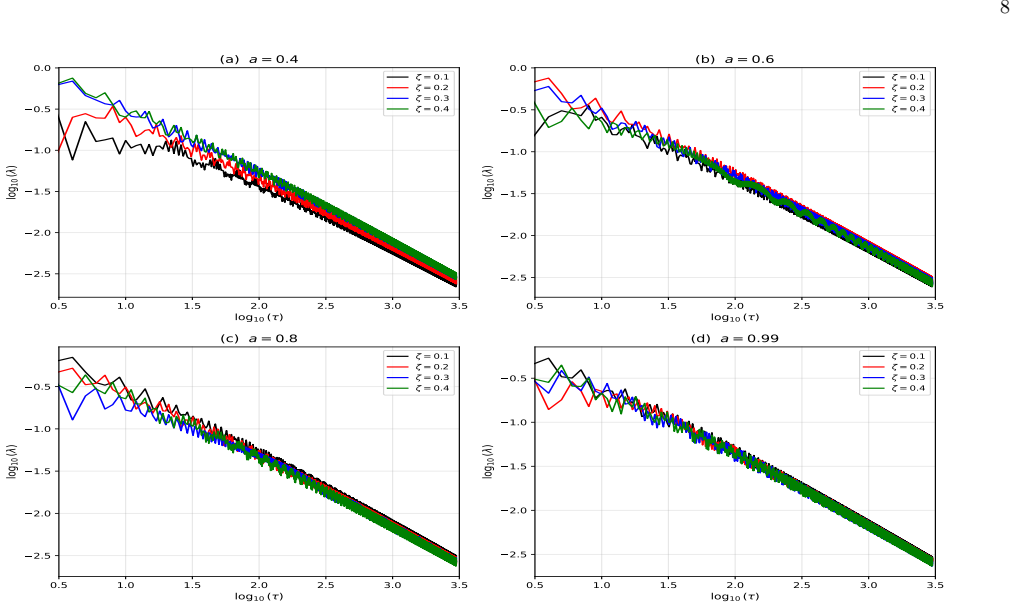
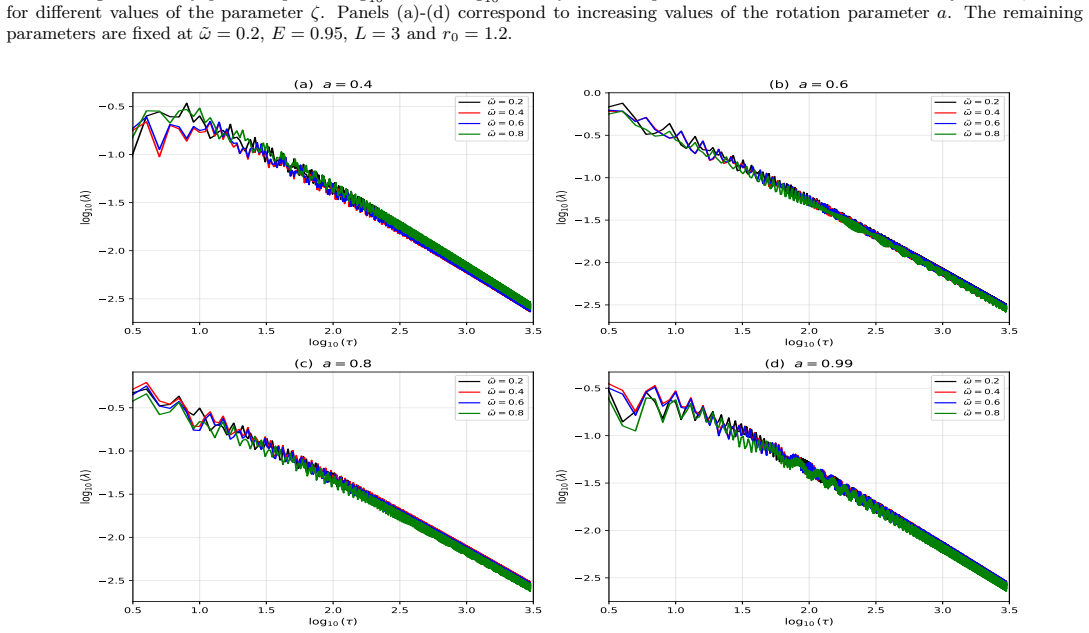
- [Abstract; Secs. IV, VI, VII] The abstract claims a 'transition from regular to chaotic motion' and that ω̃ and ζ 'enhance the sensitivity of photon trajectories to initial conditions.' The paper's own quantitative sections state the opposite: Sec. IV says both parameters 'reduce the instability of black hole spacetime'; Sec. VI reports that the LLE curves 'gradually mov[e] towards the monotic decay' and that 'the similar pattern of gradually monotonic decay in the asymptotic dynamics regime is observed'; Sec. VII describes KS entropy oscillations that 'gradually decrease as the time increases, indicating the transition towards weak chaotic and regular motion.' A Lyapunov exponent decaying to zero and an entropy damping to zero are diagnostics of regular/quasi-periodic motion, not of growing chaos. This is a direct contradiction of the central claim, not a wording issue.
- [Eq. (44), Fig. 1] The null Lyapunov formula (44) fails the Schwarzschild test. Setting a=0, ω̃=ζ=0, m=M, r_c=3M gives 2∆_c − r_c²∆_c'' = −12M² and denominator 2r_c²(r_c²)² = 1458M⁶, hence λ² = −12/(1458M⁴) < 0 with the wrong dimension. The standard Schwarzschild photon-sphere Lyapunov exponent is λ² = 1/(27M²). Therefore Eq. (44) cannot be the expression used to produce the positive λ² values in Fig. 1; either the derivation from Eq. (43) is wrong or the plotted quantity is not the stated one. This invalidates the circular-orbit stability analysis.
- [Eq. (39)] The critical impact parameter formula (39) is also incorrect in the Schwarzschild limit. For a=0 it reduces to |b_c| = r_c√(2Mr_c∆_c)/(2Mr_c−r_c²), which at r_c=3M gives |b_c|=3√2 M, whereas the exact Schwarzschild photon-sphere impact parameter is 3√3 M. The correct circular-orbit relation is b_c = a ± 4r_c√∆_c/∆'_c. Since b_c enters Eq. (44), the numerical Lyapunov values and the photon-sphere plots are affected by this error as well.
- [Sec. II, Eqs. (21)–(23); Fig. 1] The rotating metric is generated from the effective mass (22) without verifying that it solves the Einstein equations with the PFDM energy-momentum tensor, and without checking the horizon condition ∆(r)=0 for the scanned parameters. For the right panel of Fig. 1, M=1, a=0.4, ζ=0.2, ω̃=0.4, numerical evaluation of Eq. (22) gives ∆(r)>0 for all r>0, i.e. no event horizon; for ζ=0.2, ω̃=0.2 a horizon may exist, but the plotted range r_c∈[0.6,2.0] anyway extends below the classical Kerr horizon r₊≈1.92. The authors must restrict to genuinely black-hole parameter sets, state the horizon radii, and show that the spacetime is a valid solution before drawing physical conclusions.
- [Secs. III, V; Eq. (36)] The chaos analysis is under-specified. The Poincaré sections are described as constructed at θ=π/2 with pθ>0 and as using 'the equations of motion given in Eqs. 34-36,' but Eq. (36) is the equatorial radial equation and no equation for θ̇ or the Carter constant is provided. The equatorial reduction of Sec. III is Liouville integrable (one radial degree of freedom with two conserved quantities), so any claim of chaos in the (r,ṙ) sections must come from a full four-dimensional geodesic system that the paper never defines. Without the θ dynamics and the surface-of-section definition, the scattered points in Figs. 2–4 cannot be interpreted as physical chaos.
- [Sec. VII, Eq. (47); Sec. VI, Eq. (45)] The abstract calls the KS entropy 'an independent measure of dynamical complexity,' but Sec. VII explicitly computes h_KS from the largest finite-time Lyapunov exponent via the Pesin form (47). This is the same number relabeled, not independent confirmation. It is also not a correct application of Pesin's theorem, which requires the sum over all positive Lyapunov exponents. Additionally, Eq. (45) defines the LLE from the coordinate-space separation d(τ); the text claims this formula is coordinate-independent, but no such invariance is established for two-particle separations in curved spacetime, and standard results (e.g. Motter 2003) show that naive coordinate-dependent Lyapunov exponents are not invariant.
minor comments (4)
- [Eq. (7)] There is an algebraic error in the second equality of Eq. (7): with G(r)=G/(1+ω̃G/r²), one has 2G(r)M/r = 2GM r/(r²+ω̃G), not 2GM/(r+ω̃G). The later mass function (10) uses the correct form, but the displayed equality in (7) is inconsistent and should be corrected.
- [Throughout] Numerous typos: 'quantum-impoved' (Sec. II heading), 'PDFM' (Figs. 5 and 7 captions), 'quantum-proved' (Sec. VI), 'monotic decay' (Sec. VI), 'Weyl conformal gravity' (Sec. VII, should refer to the present spacetime). These should be fixed.
- [Fig. 1] The y-axis in Fig. 1 is labeled λ²_null, but Eq. (44) gives negative values for the plotted parameter ranges; the figure caption should state explicitly whether the plotted quantity is |λ²|, a corrected formula, or something else.
- [Sec. VIII, Eq. (49)] The WBA observable f(r,p_r)=sin(2π(r+p_r)) mixes a coordinate and a momentum with possibly different physical dimensions; in geometrized units this may be acceptable, but the units should be stated.
Circularity Check
The 'independent' KS-entropy confirmation is the same finite-time Lyapunov observable relabeled via Pesin's theorem.
specific steps
-
self definitional
[Abstract; Sec. VII, Eq. (47) and surrounding text]
"Abstract: 'The KS entropy provides an independent measure of dynamical complexity and confirms the growth of chaotic behavior with increasing quantum and PFDM corrections.' Sec. VII: 'In this study, the KS entropy is calculated based on the largest finite-time Lyapunov exponent, which is determined by analyzing the divergence of initially nearby null geodesics [44, 45]' and Eq. (47): 'hKS = X λi>0 λi.'"
The paper presents KS entropy as an independent confirmation of the Lyapunov-based chaos growth, but Eq. (47) defines h_KS via Pesin's theorem as the sum of positive Lyapunov exponents, and the text states that it is 'calculated based on the largest finite-time Lyapunov exponent.' Therefore the 'independent measure' is the same finite-time divergence observable used for the LLE diagnostic in Sec. VI, relabeled as entropy; it cannot independently confirm the Lyapunov result. Poincaré sections and WBA/DIC remain separate diagnostics, so the circularity is partial rather than total.
full rationale
The metric construction (Eqs. 1-22) is a direct substitution of an RG-running Newton constant into a PFDM seed metric followed by a standard Azreg-Ainou rotation procedure; the null geodesic equations and the null-circular Lyapunov formula (Eqs. 36-44) are derived from the metric without fitted parameters, so no circularity appears there. No curve-fitting is performed, and the paper does not invoke an imported uniqueness theorem or a load-bearing self-citation chain: the self-citations are mostly methodological (Poincaré, Lyapunov, WBA tooling) or used for a parameter range, not as the argument that forces the chaos claim. The one concrete circular step is the KS-entropy 'independent measure': because h_KS is computed from the largest finite-time Lyapunov exponent via Pesin's theorem (Eq. 47), the abstract's claim that KS entropy independently confirms the Lyapunov results is the same number relabeled. This does not destroy the entire paper—Poincaré sections and WBA/DIC maps are genuinely separate diagnostics—but it removes the stated independence of one confirmatory method. Separately, the manuscript contains a consistency problem (the abstract claims a transition to chaos, while Sec. IV says both parameters 'reduce the instability of black hole spacetime' and Secs. VI-VII describe asymptotic monotonic decay toward regular motion); that is a scientific-contradiction issue rather than a circular-derivation issue and therefore does not further raise the circularity score.
Axiom & Free-Parameter Ledger
free parameters (4)
- ω̃ (quantum-improvement parameter) =
scanned 0.0–0.8 (Planck units); O(0.2–0.4) in most runs
- ζ (PFDM parameter) =
scanned 0.1–0.6; |ζ| ≲ M stated as physical bound
- a (rotation parameter) =
0.2–0.99 across figures (0.2–0.4 in Poincaré/DIC runs)
- E, L (photon conserved quantities) =
E = 0.94–0.97, L = 3–4 (figure-dependent)
axioms (8)
- domain assumption RG improvement via G(r) = G/(1+ω̃G/r²) (Eq. 6) captures the leading quantum-gravity correction to the spacetime.
- domain assumption PFDM is described by T^μ_ν = diag(−ρ,−ρ,P,P) with P/ρ = 1/2, yielding the log term in f(r) (Eqs. 2–5, 7).
- ad hoc to paper The Azreg-Aïnou algorithm produces a valid rotating metric that solves the field equations with the same m(r) (Eqs. 15–22).
- standard math Null geodesic motion restricted to θ=π/2 yields the radial equation (Eq. 36).
- domain assumption Two-nearby-trajectory divergence defines coordinate-independent Lyapunov exponents (Sec. VI, Eqs. 45–46).
- domain assumption Pesin's theorem with only the largest finite-time Lyapunov exponent approximates the KS entropy (Eq. 47).
- domain assumption WBA/DIC convergence distinguishes regular from chaotic orbits with the chosen observable f = sin(2π(r+p_r)) (Eqs. 49–53).
- ad hoc to paper A (r, ṙ) Poincaré section with pθ>0 at fixed E, L faithfully represents the 4-D null geodesic flow (Sec. V).
invented entities (1)
-
Quantum-improved Kerr–PFDM background (Eqs. 21–22)
no independent evidence
read the original abstract
We study the nonlinear photon dynamics in quantum improved rotating black hole surrounded by perfect fluid dark matter (PFDM) using several methods of analysis, including Poincar\'e sections, Lyapunov exponents, Kolmogorov-Sinai (KS) entropy and weighted Birkhoff averages (WBA). In particular, we examine the effect of quantum-improved parameter $(\tilde{\omega})$ and PFDM parameter $(\zeta)$ on the null geodesic motion hence stability of circular orbit. Poincar\'e sections illustrate the transition from regular to chaotic motion as these parameters increase, characterized by the deformation and fragmentation of invariant tori and the emergence of scattered chaotic regions in phase space. The stability properties of null circular orbits are quantified through the Lyapunov indicators, revealing that both the quantum improvement parameter and the PFDM parameter enhance the sensitivity of photon trajectories to initial conditions. The KS entropy provides an independent measure of dynamical complexity and confirms the growth of chaotic behavior with increasing quantum and PFDM corrections. Additionally, the WBA method offers a robust quantitative criterion for distinguishing regular and chaotic orbits and allows a detailed mapping of the phase-space structure. The results demonstrate that the combined effects of quantum gravity corrections and PFDM significantly modify the effective potential governing photon motion, leading to a rich mixed phase-space structure with coexisting regular and chaotic regions. These findings underscore the crucial role of quantum and dark matter contributions in shaping photon dynamics near rotating black holes and suggest possible observational implications on black hole shadows and gravitational lensing in strong-field regimes.
Figures




Reference graph
Works this paper leans on
-
[1]
Gravitational radiation from colliding black holes.Phys
Stephen W Hawking. Gravitational radiation from colliding black holes.Phys. Rev. Lett., 26(21):1344, 1971
1971
-
[2]
Black holes and entropy.Phys
Jacob D Bekenstein. Black holes and entropy.Phys. Rev. D, 7(8):2333, 1973
1973
-
[3]
Black hole ther- modynamical entropy.Eur
Constantino Tsallis and Leonardo JL Cirto. Black hole ther- modynamical entropy.Eur. Phys. J. C, 73(7):2487, 2013
2013
-
[4]
Black hole explosions?Nature, 248(5443):30–31, 1974
Stephen W Hawking. Black hole explosions?Nature, 248(5443):30–31, 1974
1974
-
[5]
Black hole explosions as probes of new physics.Phys
Kevin Federico and Stefano Profumo. Black hole explosions as probes of new physics.Phys. Rev. D, 111(6):063006, 2025
2025
-
[6]
Particle creation by black holes
Stephen W Hawking. Particle creation by black holes. Comm. Math. Phys., 43(3):199–220, 1975
1975
-
[7]
Thermodynamics of black holes in anti-de sitter space.Comm
Stephen W Hawking and Don N Page. Thermodynamics of black holes in anti-de sitter space.Comm. Math. Phys., 87(4):577–588, 1983
1983
-
[8]
The large-n limit of superconformal field theories and supergravity.Int
Juan Maldacena. The large-n limit of superconformal field theories and supergravity.Int. j. Theor. Phys., 38(4):1113– 1133, 1999
1999
-
[9]
Phases of r-charged black holes, spinning branes and strongly coupled gauge the- 15 ories.J
Mirjam Cvetic and Steven S Gubser. Phases of r-charged black holes, spinning branes and strongly coupled gauge the- 15 ories.J. High Energy Phys., 1999(04):024–024, 1999
1999
-
[10]
Thermodynamics of kerr-newman-ads black holes and con- formal field theories.Class
Marco M Caldarelli, Guido Cognola, and Dietmar Klemm. Thermodynamics of kerr-newman-ads black holes and con- formal field theories.Class. Quant. Grav., 17(2):399–420, 2000
2000
-
[11]
Disappearance of the black hole singu- larity in loop quantum gravity.Phys
Leonardo Modesto. Disappearance of the black hole singu- larity in loop quantum gravity.Phys. Rev. D, 70(12):124009, 2004
2004
-
[12]
Semiclassical loop quantum black hole
Leonardo Modesto. Semiclassical loop quantum black hole. Int. J. Theor. Phys., 49(8):1649–1683, 2010
2010
-
[13]
Non-singular quantum-inspired gravitational collapse.Phys
Cosimo Bambi, Daniele Malafarina, and Leonardo Modesto. Non-singular quantum-inspired gravitational collapse.Phys. Rev. D, 88(4):044009, 2013
2013
-
[14]
Quantum extension of the kruskal spacetime.Phys
Abhay Ashtekar, Javier Olmedo, and Parampreet Singh. Quantum extension of the kruskal spacetime.Phys. Rev. D, 98(12):126003, 2018
2018
-
[15]
Regular rotating black holes: A review.arXiv preprint arXiv:2208.12713, 2022
Ram´ on Torres. Regular rotating black holes: A review.arXiv preprint arXiv:2208.12713, 2022
arXiv 2022
-
[16]
Reg- ular black holes: a short topic review.Int
Chen Lan, Hao Yang, Yang Guo, and Yan-Gang Miao. Reg- ular black holes: a short topic review.Int. J. Theor. Phys., 62(9):202, 2023
2023
-
[17]
Formation and evaporation of regular black holes
Sean A Hayward. Formation and evaporation of regular black holes. InThe Twelfth Marcel Grossmann Meeting: On Re- cent Developments in Theoretical and Experimental General Relativity, Astrophysics and Relativistic Field Theories (In 3 Volumes), pages 1181–1183. World Scientific, 2012
2012
-
[18]
Black holes in modified gravity (mog).Eur
JW Moffat. Black holes in modified gravity (mog).Eur. Phys. J. C, 75(4):175, 2015
2015
-
[19]
Deflection of light and shadow cast by a dual-charged stringy black hole.Int
Shubham Kala, Saurabh, Hemwati Nandan, and Pra- teek Sharma. Deflection of light and shadow cast by a dual-charged stringy black hole.Int. J. Mod. Phys. A, 35(28):2050177, 2020
2020
-
[20]
Geodesics and bending of light around a BTZ black hole surrounded by quintessential matter.Mod
Shubham Kala, Hemwati Nandan, Prateek Sharma, and Maye Elmardi. Geodesics and bending of light around a BTZ black hole surrounded by quintessential matter.Mod. Phys. Lett. A, 36(31):2150224, 2021
2021
-
[21]
Optical appearance of einstein-æther black hole surrounded by thin disk.Nucl
Hui-Min Wang, Zi-Chao Lin, and Shao-Wen Wei. Optical appearance of einstein-æther black hole surrounded by thin disk.Nucl. Phys. B, 985:116026, 2022
2022
-
[22]
Investigating shadow images and rings of the charged horndeski black hole illuminated by various thin accretions.Eur
Xiao-Jun Gao, Tao-Tao Sui, Xiao-Xiong Zeng, Yu-Sen An, and Ya-Peng Hu. Investigating shadow images and rings of the charged horndeski black hole illuminated by various thin accretions.Eur. Phys. J. C, 83(11):1052, 2023
2023
-
[23]
Fuzzy black hole models inf(G) gravity.Phys
M Yousaf, H Asad, Bander Almutairi, S Hasan, and A S Khan. Fuzzy black hole models inf(G) gravity.Phys. Scr., 99:115270, 2024
2024
-
[24]
Saswati Roy, Shubham Kala, Prasanjit Ghosh, Hemwati Nandan, and Asoke K. Sen. Non-equatorial deflection of light due to Kerr–Newman black hole: a material medium approach.Eur. Phys. J. C, 85(8):925, 2025
2025
-
[25]
Quantum improved regular kerr black holes.Chin
Chiang-Mei Chen, Yi Chen, Akihiro Ishibashi, and Nobuyoshi Ohta. Quantum improved regular kerr black holes.Chin. J. Phys., 92:766–778, 2024
2024
-
[26]
Arpita Jana, Manjari Dutta, and Sunandan Gangopadhyay. Quasi-normal modes of quantum gravity black hole with per- fectly fluid dark matter.arXiv preprint arXiv:2602.02527, 2026
arXiv 2026
-
[27]
Dilara A¸ can Yildiz, Allah Ditta, Asifa Ashraf, Ertan G¨ udekli, Yousef Mohammed Alanazi, and Anvar Reyim- berganov
G. Dilara A¸ can Yildiz, Allah Ditta, Asifa Ashraf, Ertan G¨ udekli, Yousef Mohammed Alanazi, and Anvar Reyim- berganov. Optical properties of Euler–Heisenberg black hole surrounded by perfect fluid dark matter.Phys. Dark Univ., 46:101583, 2024
2024
-
[28]
Observational constraints on QPOs with or- bital motion around charged non-commutative Schwarzschild black hole surrounded by perfect fluid dark matter.Nucl
Asifa Ashraf, Tayyab Naseer, Himanshu Chaudhary, Abdel- malek Bouzenada, Farruh Atamurotov, Batuhan C ¸ il, and Ertan G¨ udekli. Observational constraints on QPOs with or- bital motion around charged non-commutative Schwarzschild black hole surrounded by perfect fluid dark matter.Nucl. Phys. B, 1014:116873, 2025
2025
-
[29]
Mustafa, Tayyab Naseer, S
Aylin Caliskan, G. Mustafa, Tayyab Naseer, S. K. Maurya, Ertan G¨ udekli, Sardor Murodov, and Farruh Atamurotov. Particle dynamics with trajectories and epicyclic oscillations around a piece-wise black hole immersed in dark matter. JHEAp, 44:99–115, 2024
2024
-
[30]
Fractal structures in the deflection of light by a pair of charged black holes.Chaos Sol
Edson E de Souza Filho, Amanda C Mathias, and Ricardo L Viana. Fractal structures in the deflection of light by a pair of charged black holes.Chaos Sol. Fract., 150:111139, 2021
2021
-
[31]
Multifractal chaos in gravitational waves from binary black hole mergers
FM Oliveira, IRAC Lucena, and J G G S Ramos. Multifractal chaos in gravitational waves from binary black hole mergers. Chaos Sol. Fract., 200:116980, 2025
2025
-
[32]
Generating rotating regular black hole solutions without complexification.Physical Review D, 90(6):064041, 2014
Mustapha Azreg-A ¨ ınou. Generating rotating regular black hole solutions without complexification.Physical Review D, 90(6):064041, 2014
2014
-
[33]
Mustapha Azreg-A ¨ ınou. From static to rotating to confor- mal static solutions: rotating imperfect fluid wormholes with (out) electric or magnetic field.The European Physical Jour- nal C, 74(5):2865, 2014
2014
-
[34]
X. Wu, T. Y. Huang, and H. Zhang. Lyapunov indices with two nearby trajectories in a curved spacetime.Phys. Rev. D, 74:083001, 2006
2006
-
[35]
Chaos and dynamics of spinning particles in Kerr spacetime.Gen
Wenbiao Han. Chaos and dynamics of spinning particles in Kerr spacetime.Gen. Rel. Grav., 40:1831–1847, 2008
2008
-
[36]
Chaotic motion of particles in the accelerating and rotating black holes spacetime.JHEP, 09:082, 2016
Songbai Chen, Mingzhi Wang, and Jiliang Jing. Chaotic motion of particles in the accelerating and rotating black holes spacetime.JHEP, 09:082, 2016
2016
-
[37]
Cornish and Gary W
Neil J. Cornish and Gary W. Gibbons. The Tale of two centers.Class. Quant. Grav., 14:1865–1881, 1997
1997
-
[38]
Probing phase structure of black holes with Lyapunov ex- ponents.JHEP, 08:153, 2022
Xiaobo Guo, Yuhang Lu, Benrong Mu, and Peng Wang. Probing phase structure of black holes with Lyapunov ex- ponents.JHEP, 08:153, 2022
2022
-
[39]
Naveena Kumara, Shreyas Punacha, and Md Sabir Ali
A. Naveena Kumara, Shreyas Punacha, and Md Sabir Ali. Lyapunov exponents and phase structure of Lifshitz and hy- perscaling violating black holes.JCAP, 07:061, 2024
2024
-
[40]
Bounds for Lyapunov exponent of circular light orbits in black holes.Eur
Emanuel Gallo and Thomas M¨ adler. Bounds for Lyapunov exponent of circular light orbits in black holes.Eur. Phys. J. C, 85(3):299, 2025
2025
-
[41]
Pradeep Singh, Hemwati Nandan, Shubham Kala, Nidhi Handa, Lokesh Kumar Joshi, and G. Mustafa. Probing strong-gravity chaos and stability of circular photon orbits around the Kerr–Sen black hole.Eur. Phys. J. C, 86(3):286, 2026
2026
-
[42]
Pradeep Singh, Hemwati Nandan, Shubham Kala, Nidhi Handa, Lokesh Kumar Joshi, and G. Mustafa. Geodesics stability of Reissner–Nordstr¨ om black hole spacetime.Phys. Lett. B, 876:140403, 2026
2026
-
[43]
Characteristic lyapunov exponents and smooth ergodic theory.Russian Mathematical Surveys, 32(4):55, 1977
Ya B Pesin. Characteristic lyapunov exponents and smooth ergodic theory.Russian Mathematical Surveys, 32(4):55, 1977
1977
-
[44]
Stability of Equatorial Circular Geodesics for Kerr-newman Spacetime via Lyapunov Expo- nent
Parthapratim Pradhan. Stability of Equatorial Circular Geodesics for Kerr-newman Spacetime via Lyapunov Expo- nent. In13th Marcel Grossmann Meeting on Recent Devel- opments in Theoretical and Experimental General Relativity, Astrophysics, and Relativistic Field Theories, pages 1892– 1894, 2015
2015
-
[45]
New- ton Singh
Monimala Mondal, Farook Rahaman, and Ksh. New- ton Singh. Lyapunov exponent ISCO and Kolmogorov Senai entropy for Kerr Kiselev black hole.Eur. Phys. J. C, 81(1):84, 2021
2021
-
[46]
Yousaf, Farruh Atamurotov, and G
Pradeep Singh, Shubham Kala, Hemwati Nandan, M. Yousaf, Farruh Atamurotov, and G. Mustafa. Probing strong-gravity chaos in rotating Kerr–Bertotti–Robinson black holes.Chaos, Solitons & Fractals, 208:118379, 2026
2026
-
[47]
Ergodic theory of chaos and strange attractors.Reviews of modern physics, 57(3):617, 1985
J-P Eckmann and David Ruelle. Ergodic theory of chaos and strange attractors.Reviews of modern physics, 57(3):617, 1985
1985
-
[48]
Springer Science & Business Media, 2012
Isaac P Cornfeld, Sergei Vasilevich Fomin, and Yakov Grigor’ev ˇ ıc Sinai.Ergodic theory, volume 245. Springer Science & Business Media, 2012
2012
-
[49]
Measuring quasiperiodicity.Europhysics Letters, 114(4):40005, 2016
Suddhasattwa Das, Chris B Dock, Yoshitaka Saiki, Mar- tin Salgado-Flores, Evelyn Sander, Jin Wu, and James A Yorke. Measuring quasiperiodicity.Europhysics Letters, 114(4):40005, 2016
2016
-
[50]
Birkhoff averages and the break- down of invariant tori in volume-preserving maps.Physica D: Nonlinear Phenomena, 428:133048, 2021
JD Meiss and E Sander. Birkhoff averages and the break- down of invariant tori in volume-preserving maps.Physica D: Nonlinear Phenomena, 428:133048, 2021
2021
-
[51]
Birkhoff averages and rota- tional invariant circles for area-preserving maps.Physica D: Nonlinear Phenomena, 411:132569, 2020
Evelyn Sander and JD Meiss. Birkhoff averages and rota- tional invariant circles for area-preserving maps.Physica D: Nonlinear Phenomena, 411:132569, 2020
2020
-
[52]
Distinguishing between regular and chaotic orbits of flows by the weighted birkhoff average.Physica D: Nonlinear Phenomena, 449:133749, 2023
Nathan Duignan and James D Meiss. Distinguishing between regular and chaotic orbits of flows by the weighted birkhoff average.Physica D: Nonlinear Phenomena, 449:133749, 2023. 16
2023
-
[53]
pynamicalsys: A python toolkit for the anal- ysis of dynamical systems.Chaos, Solitons and Fractals, 201(3):117269–117269, 2025
Matheus Rolim Sales, Leonardo Costa de Souza, Daniel Borin, Michele Mugnaine, Ricardo Luiz Viana, Ibere Luiz Caldas, Edson Denis Leonel, Christos Antonopou- los, et al. pynamicalsys: A python toolkit for the anal- ysis of dynamical systems.Chaos, Solitons and Fractals, 201(3):117269–117269, 2025
2025
-
[54]
Yousaf, Farruh Atamurotov, and G
Shubham Kala, Pradeep Singh, Hemwati Nandan, M. Yousaf, Farruh Atamurotov, and G. Mustafa. In- frared signatures of asymptotically safe gravity on chaos with weighted Birkhoff average in the Kerr black hole.Phys. Lett. B, 879:140597, 2026
2026
-
[55]
Computation of lyapunov ex- ponents in general relativity.Phys
Xin Wu and Tian-yi Huang. Computation of lyapunov ex- ponents in general relativity.Phys. Lett. A, 313(1-2):77–81, 2003
2003
-
[56]
Lyapunov timescales and black hole binaries.Class
Neil J Cornish and Janna Levin. Lyapunov timescales and black hole binaries.Class. Quant. Grav., 20(9):1649–1660, 2003
2003
-
[57]
Lya- punov exponents to test general relativity.Phys
Alexander Deich, Nicol´ as Yunes, and Charles Gammie. Lya- punov exponents to test general relativity.Phys. Rev. D, 110(4):044033, 2024
2024
-
[58]
Relativistic chaos is coordinate invariant
Adilson E Motter. Relativistic chaos is coordinate invariant. Phys. Rev. Lett., 91(23):231101, 2003
2003
-
[59]
Chaos around holographic regge trajectories
Pallab Basu, Diptarka Das, Archisman Ghosh, and Leopoldo A Pando Zayas. Chaos around holographic regge trajectories. J. High Energy Phys., 2012(5):1–21, 2012
2012
-
[60]
Stability and chaos in nonstandard hamiltonian planetary dynamics.Chaos Sol
Rami Ahmad El-Nabulsi, Waranont Anukool, Chinnasamy Thangaraj, and Raja Valarmathi. Stability and chaos in nonstandard hamiltonian planetary dynamics.Chaos Sol. Fract., 202:117410, 2026
2026
-
[61]
Robust chaos in the generalized ceil map.Chaos Sol
Sishu Shankar Muni. Robust chaos in the generalized ceil map.Chaos Sol. Fract., 206:117913, 2026
2026
-
[62]
Quintessence and black holes.Classical and Quantum Gravity, 20(6):1187–1197, 2003
VV1966820 Kiselev. Quintessence and black holes.Classical and Quantum Gravity, 20(6):1187–1197, 2003
2003
-
[63]
VV Kiselev. Quintessential solution of dark matter rotation curves and its simulation by extra dimensions.arXiv preprint gr-qc/0303031, 2003
Pith/arXiv arXiv 2003
-
[64]
Study of circular geodesics and shadow of rotating charged black hole surrounded by perfect fluid dark matter immersed in plasma.Classical and Quantum Gravity, 39(7):075005, 2022
Anish Das, Ashis Saha, and Sunandan Gangopadhyay. Study of circular geodesics and shadow of rotating charged black hole surrounded by perfect fluid dark matter immersed in plasma.Classical and Quantum Gravity, 39(7):075005, 2022
2022
-
[65]
Kerr–anti- de sitter/de sitter black hole in perfect fluid dark matter background.Classical and Quantum Gravity, 35(11):115003, 2018
Zhaoyi Xu, Xian Hou, and Jiancheng Wang. Kerr–anti- de sitter/de sitter black hole in perfect fluid dark matter background.Classical and Quantum Gravity, 35(11):115003, 2018
2018
-
[66]
Stability, quasinormal modes in a charged black hole in perfect fluid dark matter.Classical and Quantum Gravity, 41(1):015018, 2024
Anish Das, Anirban Roy Chowdhury, and Sunandan Gan- gopadhyay. Stability, quasinormal modes in a charged black hole in perfect fluid dark matter.Classical and Quantum Gravity, 41(1):015018, 2024
2024
-
[67]
Renormalization group improved black hole space-times.Phys
Alfio Bonanno and Martin Reuter. Renormalization group improved black hole space-times.Phys. Rev. D, 62:043008, 2000
2000
-
[68]
Qed coupled to qeg.Journal of High Energy Physics, 2011(5):119, 2011
Ulrich Harst and Martin Reuter. Qed coupled to qeg.Journal of High Energy Physics, 2011(5):119, 2011
2011
-
[69]
Upper bound on the abelian gauge coupling from asymptotic safety.Journal of High Energy Physics, 2018(1):30, 2018
Astrid Eichhorn and Fleur Versteegen. Upper bound on the abelian gauge coupling from asymptotic safety.Journal of High Energy Physics, 2018(1):30, 2018
2018
-
[70]
Quantum improved charged black holes.Physical Review D, 104(6):066016, 2021
Akihiro Ishibashi, Nobuyoshi Ohta, and Daiki Yamaguchi. Quantum improved charged black holes.Physical Review D, 104(6):066016, 2021
2021
-
[71]
Shadow of Bonanno-Reuter black hole in plasma medium: Insights from EHT Sgr A* observations
Shubham Kala. Shadow of Bonanno-Reuter black hole in plasma medium: Insights from EHT Sgr A* observations. Nucl. Phys. B, 1025:117407, 2026
2026
-
[72]
Modeling the Sgr A* Black Hole Immersed in a Dark Matter Spike.Astrophys
Sourabh Nampalliwar, Saurabh Kumar, Kimet Jusufi, Qiang Wu, Mubasher Jamil, and Paolo Salucci. Modeling the Sgr A* Black Hole Immersed in a Dark Matter Spike.Astrophys. J., 916(2):116, 2021
2021
discussion (0)
Sign in with ORCID, Apple, or X to comment. Anyone can read and Pith papers without signing in.