REVIEW 4 major objections 4 minor 71 references
CORAL: Learning Amyloid Fibril Ligand Docking with Cooperative Binding Rewards
T0 review · 4 major / 4 minor · reviewed 2026-08-01 · deepseek-v4-flash
Pith's one-line read CORAL learns amyloid fibril–ligand docking by rewarding cooperative ligand stacking, where general-purpose dockers fail.
desk verdict The core idea is compelling and worth testing, but the headline numbers rest on a synthetic test set that probably overlaps the training set, so the paper needs a clean independent evaluation before its claims can be trusted. read the letter →
The pith
A machine-rendered reading of the paper's core claim, the machinery that carries it, and where it could break.
The reading
What carries the argument
The key machinery is a composite 'cooperative binding reward' optimized through online reinforcement learning on a flow-matching generative model. The reward combines R_bind (protein–ligand binding affinity plus a scaled ligand–ligand stacking energy, with the scaling factor f=0.005 bridging gas-phase molecular-mechanics stacking to solution-phase cooperativity) with R_sym = −RMSD(T x_k, x_{k+1}), which penalizes deviations from the ~4.8 Å rigid-body repeat between neighbouring chains. The same periodicity is injected earlier as a Cα–Cα distance constraint in the model's pair representation, so the network sees the fibril architecture before generating poses.
What would settle it
Take the next ten fibril–ligand complexes solved by cryo-EM after CORAL's training cutoff, run CORAL without retraining, and measure the fraction of top poses within 5 Å of the deposited ligand. If that fraction drops to the baseline range (near 0–6% in this paper's table) rather than remaining near 50%, the claim that CORAL captures cooperative fibril binding would be refuted.
Extended reading notes
Core claim
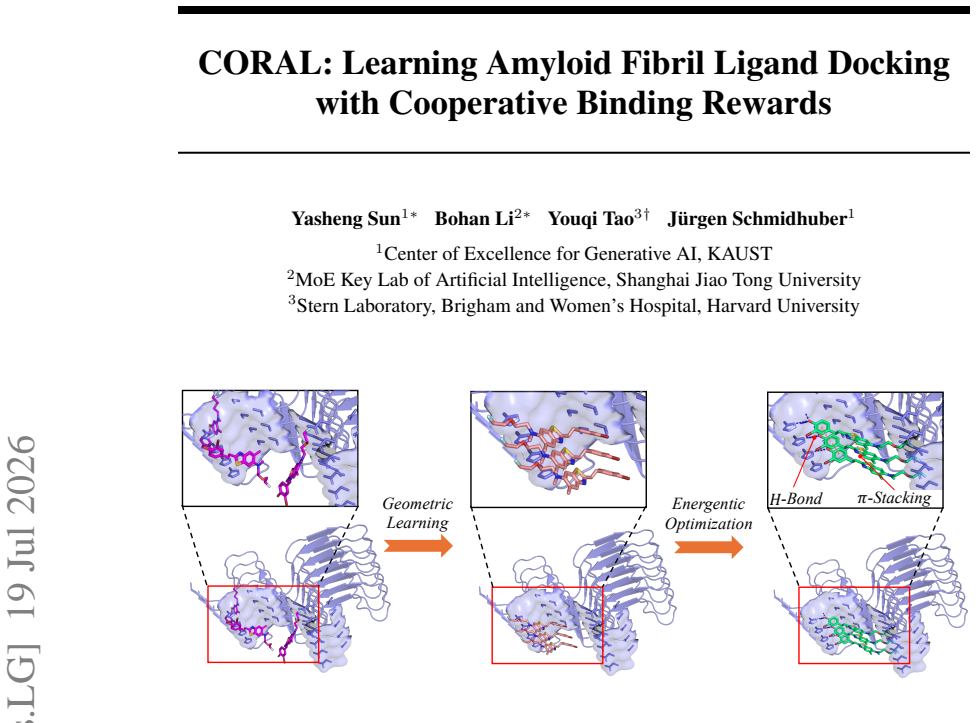
The central discovery, on the paper's own terms, is that the periodic cooperative binding of amyloid fibrils—repeated ligand copies stacked about 4.8 Å apart along the groove—can be encoded directly into a generative docking model. The model co-folds several copies of the protein monomer and ligand, receives the inter-chain repeat as a structural constraint, and is fine-tuned by reinforcement learning with a composite reward: protein–ligand binding affinity plus a scaled ligand–ligand stacking energy plus a symmetry penalty for consistency between neighbouring poses. The paper claims this produces median RMSD 3.84 Å and 68.4% Hit@5Å on its synthetic benchmark, 50.0% Hit@5Å on cryo-EM-derived
Load-bearing premise
The load-bearing premise is that the synthetic reference poses—built by generating ligand conformers, replicating them along the fibril axis, discarding clashes, and filtering by an LLM judge, affinity scoring, and human review—are valid, unbiased ground truth for training and evaluating a docking model, even though they are not independently confirmed by experimental structures.
Editorial extensions
If this is right
- Amyloid fibril docking can be trained without co-crystal structures: the paper's synthetic stacking poses plus an energetic reward provide supervision that experimental scarcity blocks.
- The learned poses carry thermodynamic signal: CORAL's docking scores rank α-synuclein fibril ligands by measured binding affinity, which would enable virtual screening of tracers and drug candidates.
- Because the reward encodes a physical principle—periodic cooperative stacking—rather than memorized complexes, the approach should transfer to newly solved fibril structures and other amyloid proteins.
- The two-stage recipe of supervised geometric warm-up followed by online reinforcement learning can be applied to other structure-generation tasks where a global prior must be refined by a task-specific reward.
Reading between the lines
- A strong test would be to rebuild the synthetic benchmark with a different conformer generator and without LLM/expert filtering; if CORAL's lead over baselines shrinks, much of the reported gain may come from the curation pipeline rather than the cooperative reward.
- The reward's scaling factor f=0.005 is derived from a cooperative-binding model; measuring pairwise stacking free energies experimentally for a few ligand series would directly test whether this constant is transferable across chemotypes.
- The same periodicity-prior plus stacking-reward design could be applied to other periodic protein assemblies (e.g., collagen or engineered repeat proteins), where ligands bind in repeating grooves.
- Because the RL stage is trained and evaluated on rollouts drawn from similar fibril types, the generalization gap to fibril folds absent from training may be larger than current numbers suggest; testing on unseen polymorphs would quantify this.
Editorial analysis
A structured set of objections, weighed in public.
Referee Report
Summary. The paper proposes CORAL, a deep-learning docking framework for amyloid fibril–ligand complexes. It uses a Pairformer–diffusion architecture augmented with explicit fibril-periodicity constraints (a ~4.8 Å inter-chain contact prior and a pocket prior), warms up the model on a synthetically curated set of stacking poses, and then fine-tunes it with online reinforcement learning under a composite reward combining AutoDock Vina protein–ligand affinity, MMFF94 ligand–ligand stacking energy, and a symmetry-consistency term. The authors report improved pose accuracy over seven docking baselines on a synthetic benchmark (AmyDock-Synthetic, 68.4% Hit@5 Å), on 18 cryo-EM complexes (AmyDock-CryoEM, 50.0% Hit@5 Å), and a significant binding-affinity correlation on αSyn-Bind (Spearman ρ=0.419, p=0.004). They claim this is the first deep-learning-based docking framework tailored to amyloid fibril–ligand complexes.
Significance. If the empirical claims were sound, the work would be a useful step: amyloid fibrils are a practically important but structurally neglected target class, and the idea of explicitly encoding the periodic cross-β geometry and cooperative stacking in a generative docking model is well motivated. The two-stage training recipe, the constraint embedder, and the RL reward design are clearly described, and the qualitative failure analysis is thoughtful. However, the central pose-quality claim rests on a synthetic benchmark that is generated by the same curation pipeline as the training data, with no demonstrated train/test separation. The only independent set contains 18 complexes and is reported without error bars or per-target statistics. As presented, the evidence does not support the headline conclusions.
major comments (4)
- [§3.3, §4.1, Table 1] AmyDock-Synthetic is used both as the warm-up training distribution and as the headline evaluation set, but the manuscript never states that the 57 evaluation pairs were excluded from the warm-up set. §A.2 describes one pipeline that produces both the ~2,000 warm-up poses and the 57-pair benchmark. The only explicit exclusion statement in §4.1 concerns ligands removed from RL rollouts, not from supervised pre-training. Since the model is explicitly trained to reproduce the symmetric axial stacking geometries that this same pipeline generates, the 68.4% Hit@5 and the ablations in Table 2 may largely measure memorization of pipeline-typical poses rather than docking accuracy. The paper must provide an explicit train/validation/test split, verify that no AmyDock-Synthetic pair or fibril appears in the warm-up set, and ideally include an independently generated synthetic benchmark.
- [Table 1, §4.1] AmyDock-CryoEM is the only independent evaluation set, but with 18 complexes and no confidence intervals, error bars, or per-target results, a 50.0% Hit@5 rate (9 of 18 successes) has a wide binomial uncertainty. The manuscript also does not state whether these 18 PDB entries or their ligands appear in the generic docking pre-training corpus (PLINDER, Binding MOAD, HiQBind, SPINDR) or in the warm-up data. This set cannot carry the quantitative claim alone. Per-complex RMSDs, bootstrap or otherwise calibrated confidence intervals, and a statement of target/ligand overlap with all training stages are needed.
- [§B.1, Table 3, Eq. (8)] The symmetry-reward weight λ is reported to have been 'tuned on a held-out subset of fibrils,' but the identity of that subset is not specified relative to AmyDock-Synthetic and AmyDock-CryoEM. If the held-out fibrils overlap the evaluation sets, the reported results are further double-dipped. In addition, the scaling factor f=0.005 in Eq. (8) is justified only by a qualitative cancellation argument; no sensitivity analysis over f or λ is reported. Please specify the held-out set precisely and provide robustness checks over both hyperparameters.
- [§4.2, Eq. (8)] The αSyn-Bind correlation is computed between 'predicted binding scores' and experimental log(Kd/M), but the scoring function is never defined. If the score is Rbind = ΔG_PL + f·Estack from Eq. (8), then this is the same quantity that the RL stage is rewarded to optimize, making the significant Spearman ρ a partial consistency check rather than an independent demonstration that the learned poses capture binding energetics. The paper should state exactly which score is used and, if it is the RL reward, temper the claim accordingly and ideally report correlations for all methods with the same fixed scoring function.
minor comments (4)
- [Figure 1 caption] Typo: 'Energentic Optimization' should be 'Energetic Optimization.'
- [§4.1/§A.2] The dataset release status is unclear: the benchmark is described as 'curated' and 'expert-validated' but the appendix says the data 'will be released alongside the dataset,' with no release URL or version. For reproducibility, code and data should be made available.
- [Table 1] No variances or multiple-seed results are reported for any method. Since RL and diffusion sampling are stochastic, a single run for each baseline is insufficient to establish the reported margins.
- [§B.2] The derivation of f from Eq. (21) is stated but not quantified; the claim that desolvation and entropic costs cancel 99–99.5% of the gas-phase energy is reproduced from Smith et al. but no calculation or reference equation is given for the fibril setting. Please provide at least a representative numerical estimate.
Circularity Check
Headline AmyDock-Synthetic result is evaluated on poses produced by the same agent pipeline that generated the warm-up training set, with no demonstrated train/eval separation; the cooperative geometry is simultaneously injected as training-label construction, reward, and evaluation criterion.
-
fitted input called prediction
[§3.3, §4.1, §A.2 (AmyDock-Synthetic train/test conflation)]
"yielding the AmyDock-Synthetic training set used in the warm-up stage. ... AmyDock-Synthetic generates reference poses through an agent-based sampling pipeline; after plausibility screening, binding-affinity scoring, and expert validation, the set comprises 57 fibril–ligand pairs ... For a fair comparison, each baseline is also fine-tuned on AmyDock-Synthetic, as is our approach."
The 57-pair AmyDock-Synthetic evaluation set is constructed by the same DrugFlow conformer generation, axial replication, collision filtering, LLM screening, and expert validation pipeline used to build the ~2,000 Pose warm-up training set. The only explicit exclusion statement in §4.1 concerns the RL roll-out inputs ('any ligand appearing in our evaluation sets is explicitly removed'), not the supervised warm-up data. Moreover, §4.1 says baselines are fine-tuned on AmyDock-Synthetic while Table 1 evaluates on AmyDock-Synthetic. Thus the headline 68.4% Hit@5Å can be a memorization/re-test of the training distribution rather than an independent docking prediction.
-
self definitional
[§3.3 reward definition; §A.2 synthetic stack construction; §4.2 RMSD evaluation]
"Rsym = −RMSD(T xk, xk+1) penalises deviations from the inter-chain rigid-body transformation T (a ∼4.8 Å translation along the fibril axis) that should map ligand xk at chain k onto xk+1 at chain k+1. ... Each conformer is then replicated along the fibril axis according to the inter-chain translation, producing a symmetric stacking arrangement that mimics the cooperative binding mode."
The synthetic ground-truth poses are generated by applying the axial replication translation T to a conformer, the reward explicitly trains the model to minimize RMSD with respect to that same T, and the evaluation metric is RMSD against those same replicated references. The periodic stacking that CORAL is said to 'learn' is therefore partly installed by construction: the model is directly rewarded for obeying the exact transformation used to build the evaluation labels. This does not falsify the physical prior, but it weakens the claim that cooperative periodicity was discovered rather than prescribed.
full rationale
The most load-bearing evidence for CORAL's central claim—'higher-quality poses than existing docking baselines'—is Table 1, where the strongest numbers (68.4% Hit@5Å, median RMSD 3.84 Å) come from AmyDock-Synthetic. The paper describes AmyDock-Synthetic both as the warm-up training set and as the evaluation set, and the curation pipeline for the evaluation pairs is identical to the training-pose pipeline. No statement anywhere shows that the 57 evaluated pairs were excluded from the ~2,000 warm-up poses; the only removal statement is for RL rollouts (§4.1). In addition, §4.1 states that baselines are 'also fine-tuned on AmyDock-Synthetic, as is our approach,' while Table 1 reports results on AmyDock-Synthetic. That conflation means the headline quantitative gap can be substantially explained by distribution memorization. The second circularity is more architectural: the Rsym reward and the synthetic label construction both encode the same axial 4.8 Å translation, and the evaluation RMSD measures agreement with that construction, so the model is rewarded for reproducing the exact geometry being scored. At the same time, the paper does contain independent external evidence: AmyDock-CryoEM is a small but experimentally derived set (18 complexes), and αSyn-Bind uses external Kd measurements, so the central claim is not entirely forced by construction. There is no significant load-bearing self-citation: the Schmidhuber citations are background references, and the key prior citations (Smith et al., DrugFlow, DiffusionNFT) are external. Overall, the synthetic evaluation is partially circular and sits at the center of the paper's strongest quantitative claim, warranting a score of 7 rather than a higher score reserved for fully definitional derivations.
Assumptions & free parameters
free parameters (2)
- f (gas-to-solution scaling for MMFF94 stacking energy) =
0.005
- lambda (symmetry reward weight) =
0.01
assumptions (4)
- domain assumption Amyloid fibrils are periodic assemblies with ~4.8 Å inter-chain Cα spacing and cross-β groove binding sites.
- domain assumption Cooperative ligand stacking along the fibril axis is the dominant binding mode, captured by MMFF94 gas-phase stacking energy scaled by f=0.005.
- ad hoc to paper The synthetic pipeline (DrugFlow conformers + symmetric replication + clash filters + LLM + expert review) produces reference poses representative of true amyloid–ligand binding.
- domain assumption AutoDock Vina and MMFF94 energies are valid on amyloid fibril targets.
Cite this review
Pith. "Pith review of CORAL: Learning Amyloid Fibril Ligand Docking with Cooperative Binding Rewards." pith.science (2026). https://pith.science/paper/KDVZRWFS
@misc{pith2026260717412,
  author       = {Pith},
  title        = {Pith review of: CORAL: Learning Amyloid Fibril Ligand Docking with Cooperative Binding Rewards},
  year         = {2026},
  howpublished = {\url{https://pith.science/paper/KDVZRWFS}},
  note         = {Machine review of arXiv:2607.17412}
}
abstract
A hallmark of neurodegenerative diseases such as Alzheimer's and Parkinson's is the aberrant aggregation of proteins into amyloid fibrils, and small molecules that selectively bind to these fibrils hold promise as diagnostics, imaging probes, and therapeutics. Predicting how such ligands bind to fibril targets, however, presents two fundamental challenges. First, resolved co-crystal structures of amyloid-ligand complexes are exceptionally scarce; even with recent advances in cryo-EM only a handful have been structurally characterized, making supervised training of docking models impractical for this target class. Second, amyloid fibrils present a binding mode fundamentally different from globular proteins: ligands intercalate into longitudinal cross-$\beta$ grooves and stack cooperatively along the fibril axis, a geometry that existing docking models are not designed to capture. To address these challenges, we present CORAL (COopeRative Amyloid Ligand docking), a reinforcement learning framework that trains a generative docking model to produce ligand pose distributions tailored to the cross-$\beta$ groove geometry. Our reward explicitly incorporates cooperative ligand-ligand stacking energy alongside protein-ligand docking affinity, directly capturing the distinctive binding geometry of amyloid fibrils. We further introduce a curated evaluation set of amyloid-ligand complexes constructed from model-generated poses validated by domain experts. Experiments on both experimentally resolved structures and this evaluation set demonstrate improved pose quality and binding affinity correlation over existing docking baselines.
Figures


Figures from the paper (9 more)




Reference graph
Works this paper leans on
-
[1]
NeurIPS Workshop on Deep Generative Models and Downstream Applications , year=
Classifier-free diffusion guidance , author=. NeurIPS Workshop on Deep Generative Models and Downstream Applications , year=
-
[2]
Chemical Reviews , volume=
Ligands for protein fibrils of amyloid- , -synuclein, and tau , author=. Chemical Reviews , volume=. 2025 , publisher=
2025
-
[3]
Chemical Society Reviews , volume=
A closer look at amyloid ligands, and what they tell us about protein aggregates , author=. Chemical Society Reviews , volume=. 2024 , publisher=
2024
-
[4]
Structure , volume=
Molecular rules governing the structural polymorphism of amyloid fibrils in neurodegenerative diseases , author=. Structure , volume=. 2023 , publisher=
2023
-
[5]
Stacked binding of a
Merz, Gregory E and Chalkley, Matthew J and Tan, Stephanie K and Tse, Eric and Lee, Joyce and Prusiner, Stanley B and Paras, Nick A and DeGrado, William F and Southworth, Daniel R and others , journal=. Stacked binding of a. 2023 , publisher=
2023
-
[6]
Kunach, Peter and Vaquer-Alicea, Jaime and Smith, Matthew S and Monistrol, Jim and Hopewell, Robert and Shoichet, Brian K and Rosa-Neto, Pedro and Diamond, Marc I and Shahmoradian, Sarah H and others , journal=. Cryo-. 2024 , publisher=
2024
-
[7]
Docking for molecules that bind in a symmetric stack with
Smith, Matthew S and Knight, Ian S and Kormos, Rian C and Pepe, Joseph G and Kunach, Peter and Diamond, Marc I and Shahmoradian, Sarah H and Irwin, John J and DeGrado, William F and Shoichet, Brian K , journal=. Docking for molecules that bind in a symmetric stack with. 2024 , publisher=
2024
-
[8]
Biochemistry , volume=
A cooperative model for symmetric ligand binding to protein fibrils , author=. Biochemistry , volume=. 2025 , publisher=
2025
Show all 71 references
-
[9]
Proceedings of the National Academy of Sciences , volume=
Binding adaptability of chemical ligands to polymorphic -synuclein amyloid fibrils , author=. Proceedings of the National Academy of Sciences , volume=. 2024 , publisher=
2024
-
[10]
Generating the polymorph landscapes of amyloid fibrils using
Guo, Liangyue and Yu, Qilin and Wang, Di and Wu, Xiaoyu and Wolynes, Peter G and Chen, Mingchen , journal=. Generating the polymorph landscapes of amyloid fibrils using. 2025 , publisher=
2025
-
[11]
Non-standard proteins in the lens of
Wojciechowska, Alicja W and Wojciechowski, Jakub W and Kotulska, Malgorzata , journal=. Non-standard proteins in the lens of. 2024 , doi=
2024
-
[12]
2010 , publisher=
Trott, Oleg and Olson, Arthur J , journal=. 2010 , publisher=
2010
-
[13]
2021 , publisher=
Eberhardt, Jerome and Santos-Martins, Diogo and Tillack, Andreas F and Forli, Stefano , journal=. 2021 , publisher=
2021
-
[14]
Journal of Molecular Biology , volume=
Development and validation of a genetic algorithm for flexible docking , author=. Journal of Molecular Biology , volume=. 1997 , publisher=
1997
-
[15]
Glide: a new approach for rapid, accurate docking and scoring
Friesner, Richard A and Banks, Jay L and Murphy, Robert B and Halgren, Thomas A and Klicic, Jasna J and Mainz, Daniel T and Repasky, Matthew P and Knoll, Eric H and Shelley, Mee and Perry, Jason K and others , journal=. Glide: a new approach for rapid, accurate docking and sco...
2004
-
[16]
Lessons learned in empirical scoring with
Koes, David R and Baumgartner, Matthew P and Camacho, Carlos J , journal=. Lessons learned in empirical scoring with. 2013 , publisher=
2013
-
[17]
2021 , publisher=
McNutt, Andrew T and Francoeur, Paul and Aggarwal, Rishal and Masuda, Tomohide and Meli, Rocco and Ragoza, Matthew and Sunseri, Jocelyn and Koes, David Ryan , journal=. 2021 , publisher=
2021
-
[18]
2018 , publisher=
Krivak, Radoslav and Hoksza, David , journal=. 2018 , publisher=
2018
-
[19]
Stark, Hannes and Ganea, Octavian-Eugen and Pattanaik, Lagnajit and Barzilay, Regina and Jaakkola, Tommi , booktitle=
-
[20]
Lu, Wei and Wu, Qifeng and Zhang, Jixian and Rao, Jiahua and Li, Chengtao and Zheng, Shuangjia , booktitle=
-
[21]
Zhang, Yangtian and Cai, Huiyu and Shi, Chence and Zhong, Bozitao and Tang, Jian , booktitle=
-
[22]
Zhou, Gengmo and Gao, Zhifeng and Ding, Qiankun and Zheng, Hang and Xu, Hongteng and Wei, Zhewei and Zhang, Linfeng and Ke, Guolin , booktitle=
-
[23]
Pei, Qizhi and Gao, Kaiyuan and Wu, Lijun and Zhu, Jinhua and Xia, Yingce and Xie, Shufang and Qin, Tao and He, Kun and Liu, Tie-Yan and Yan, Rui , booktitle=
-
[24]
International Conference on Learning Representations , year=
Corso, Gabriele and St. International Conference on Learning Representations , year=
-
[25]
International Conference on Learning Representations , year=
Deep confident steps to new pockets: strategies for docking generalization , author=. International Conference on Learning Representations , year=
-
[26]
2024 , publisher=
Lu, Wei and Zhang, Jixian and Huang, Weifeng and Zhang, Ziqiao and Jia, Xiangyu and Wang, Zhenyu and Shi, Leilei and Li, Chengtao and Wolynes, Peter G and Zheng, Shuangjia , journal=. 2024 , publisher=
2024
-
[27]
Nature Machine Intelligence , volume=
State-specific protein--ligand complex structure prediction with a multi-scale deep generative model , author=. Nature Machine Intelligence , volume=. 2024 , publisher=
2024
-
[28]
2025 , publisher=
Morehead, Alex and Cheng, Jianlin , journal=. 2025 , publisher=
2025
-
[29]
Highly accurate protein structure prediction with
Jumper, John and Evans, Richard and Pritzel, Alexander and Green, Tim and Figurnov, Michael and Ronneberger, Olaf and Tunyasuvunakool, Kathryn and Bates, Russ and. Highly accurate protein structure prediction with. Nature , volume=. 2021 , publisher=
2021
-
[30]
Accurate structure prediction of biomolecular interactions with
Abramson, Josh and Adler, Jonas and Dunger, Jack and Evans, Richard and Green, Tim and Pritzel, Alexander and Ronneberger, Olaf and Willmore, Lindsay and Ballard, Andrew J and Bambrick, Joshua and others , journal=. Accurate structure prediction of biomolecular interactions wi...
2024
-
[31]
Generalized biomolecular modeling and design with
Krishna, Rohith and Wang, Jue and Ahern, Woody and Sturmfels, Pascal and Daber, Preetham and Graves, Sydney E and Derry, Joshua Z and Barnett, Graeme and Bera, Asim and Baker, David and others , journal=. Generalized biomolecular modeling and design with. 2024 , publisher=
2024
-
[32]
2024 , publisher=
Boitreaud, Jacques and Dent, Jack and McPartlon, Matthew and Meier, Josh and Reis, Victor R and Rogozhnikov, Alex and Wu, Kevin , journal=. 2024 , publisher=
2024
-
[33]
2024 , doi=
Wohlwend, Jeremy and Corso, Gabriele and Passaro, Saro and Reveiz, Mateo and Leidal, Ken and Swiderski, Wojtek and Portnoi, Tally and Chinn, Itamar and Silterra, Jacob and Jaakkola, Tommi and Barzilay, Regina , journal=. 2024 , doi=
2024
-
[34]
arXiv preprint arXiv:2508.17815 , year=
Multi-domain Distribution Learning for De Novo Drug Design , author=. arXiv preprint arXiv:2508.17815 , year=
-
[35]
2025 , doi=
Passaro, Saro and Corso, Gabriele and Wohlwend, Jeremy and Reveiz, Mateo and Thaler, Stephan and Somnath, Vignesh Ram and Getz, Noah and Portnoi, Tally and Roy, Julien and Stark, Hannes and Kwabi-Addo, David and Beaini, Dominique and Jaakkola, Tommi and Barzilay, Regina , jour...
2025
-
[36]
Le Guilloux, Vincent and Schmidtke, Peter and Tuffery, Pierre , journal=
-
[37]
International Conference on Learning Representations , year=
Flow matching for generative modeling , author=. International Conference on Learning Representations , year=
-
[38]
International Conference on Learning Representations , year=
Flow straight and fast: learning to generate and transfer data with rectified flow , author=. International Conference on Learning Representations , year=
-
[39]
International Conference on Learning Representations , year=
Training diffusion models with reinforcement learning , author=. International Conference on Learning Representations , year=
-
[40]
2024 , publisher=
Buttenschoen, Martin and Morris, Garrett M and Deane, Charlotte M , journal=. 2024 , publisher=
2024
-
[41]
and Wu, Y
Shao, Zhihong and Wang, Peiyi and Zhu, Qihao and Xu, Runxin and Song, Junxiao and Bi, Xiao and Zhang, Haowei and Zhang, Mingchuan and Li, Y.K. and Wu, Y. and others , journal=
-
[42]
arXiv preprint arXiv:2501.12948 , year=
-
[43]
Advances in Neural Information Processing Systems , year=
Direct preference optimization: your language model is secretly a reward model , author=. Advances in Neural Information Processing Systems , year=
-
[44]
Shen, Haozhan and others , journal=
-
[45]
Xue, Zeyue and Wu, Jie and Gao, Yu and Kong, Fangyuan and Zhu, Lingting and Chen, Mengzhao and Liu, Zhiheng and Liu, Wei and Guo, Qiushan and Huang, Weilin and others , journal=
-
[46]
Liu, Jie and Liu, Gongye and Liang, Jiajun and Li, Yangguang and Liu, Jiaheng and Wang, Xintao and Wan, Pengfei and Zhang, Di and Ouyang, Wanli , booktitle=
-
[47]
Gu, Siyi and Xu, Minkai and Powers, Alexander and Nie, Weili and Geffner, Tomas and Kreis, Karsten and Leskovec, Jure and Vahdat, Arash and Ermon, Stefano , booktitle=
-
[48]
Transactions on Machine Learning Research , year=
Decomposed direct preference optimization for structure-based drug design , author=. Transactions on Machine Learning Research , year=
-
[49]
Advances in Neural Information Processing Systems , year=
Antigen-specific antibody design via direct energy-based preference optimization , author=. Advances in Neural Information Processing Systems , year=
-
[50]
Wang, Ziwen and Fan, Jiajun and Guo, Ruihan and Nguyen, Thao and Ji, Heng and Liu, Ge , journal=
-
[51]
Nature Machine Intelligence , year=
Assessing the potential of deep learning for protein--ligand docking , author=. Nature Machine Intelligence , year=
-
[52]
Representation of van der
Halgren, Thomas A , journal=. Representation of van der. 1992 , publisher=
1992
-
[53]
Journal of Medicinal Chemistry , volume=
Design, synthesis, and characterization of 3-(benzylidene)indolin-2-one derivatives as ligands for -synuclein fibrils , author=. Journal of Medicinal Chemistry , volume=. 2015 , publisher=
2015
-
[54]
Zheng, Kaiwen and Chen, Huayu and Ye, Haotian and Wang, Haoxiang and Zhang, Qinsheng and Jiang, Kai and Su, Hang and Ermon, Stefano and Zhu, Jun and Liu, Ming-Yu , booktitle=
-
[55]
Cell , volume=
The expanding amyloid family: structure, stability, function, and pathogenesis , author=. Cell , volume=. 2021 , publisher=
2021
-
[56]
Towards end-to-end automation of
Lu, Chris and Lu, Cong and Lange, Robert Tjarko and Yamada, Yutaro and Hu, Shengran and Foerster, Jakob and Ha, David and Clune, Jeff , journal=. Towards end-to-end automation of. 2026 , publisher=
2026
-
[57]
Nature , volume=
Autonomous chemical research with large language models , author=. Nature , volume=. 2023 , publisher=
2023
-
[58]
Annual Review of Biophysics and Biomolecular Structure , volume=
Calculation of protein-ligand binding affinities , author=. Annual Review of Biophysics and Biomolecular Structure , volume=. 2007 , doi=
2007
-
[59]
Challenges in sample preparation and structure determination of amyloids by cryo-
Zielinski, Mara and R. Challenges in sample preparation and structure determination of amyloids by cryo-. Journal of Biological Chemistry , volume=. 2021 , publisher=
2021
-
[60]
bioRxiv , year=
Durairaj, Janani and Adeshina, Yusuf and Cao, Zhonglin and Zhang, Xuejin and Oleinikovas, Vladas and Duignan, Thomas and McClure, Zachary and Robin, Xavier and Studer, Gabriel and Kovtun, Daniel and Rossi, Emanuele and Zhou, Guoqing and Veccham, Srimukh Prasad and Isert, Cleme...
-
[61]
and Smith, Richard D
Hu, Liegi and Benson, Mark L. and Smith, Richard D. and Lerner, Michael G. and Carlson, Heather A. , journal=. Binding. 2005 , doi=
2005
-
[62]
Digital Discovery , year=
A workflow to create a high-quality protein--ligand binding dataset for training, validation, and prediction tasks , author=. Digital Discovery , year=
-
[63]
arXiv preprint arXiv:2504.10564 , year=
Cremer, Julian and Irwin, Ross and Tibo, Alessandro and Janet, Jon Paul and Olsson, Simon and Clevert, Djork-Arn. arXiv preprint arXiv:2504.10564 , year=
-
[64]
IEEE/ACM Transactions on Computational Biology and Bioinformatics , volume=
Filipovi. IEEE/ACM Transactions on Computational Biology and Bioinformatics , volume=. 2020 , doi=
2020
-
[65]
Acta Crystallographica Section A: Crystal Physics, Diffraction, Theoretical and General Crystallography , volume=
A solution for the best rotation to relate two sets of vectors , author=. Acta Crystallographica Section A: Crystal Physics, Diffraction, Theoretical and General Crystallography , volume=. 1976 , publisher=
1976
-
[66]
arXiv preprint arXiv:1511.09249 , year=
On Learning to Think: Algorithmic Information Theory for Novel Combinations of Reinforcement Learning Controllers and Recurrent Neural World Models , author=. arXiv preprint arXiv:1511.09249 , year=
-
[67]
arXiv preprint arXiv:1802.08864 , year=
One Big Net For Everything , author=. arXiv preprint arXiv:1802.08864 , year=
-
[68]
Neural Computation , volume=
Learning complex, extended sequences using the principle of history compression , author=. Neural Computation , volume=
-
[69]
Proteins: Structure, Function, and Bioinformatics , volume=
Improving the prediction of protein secondary structure in three and eight classes using recurrent neural networks and profiles , author=. Proteins: Structure, Function, and Bioinformatics , volume=
-
[70]
Bioinformatics , volume=
Fast model-based protein homology detection without alignment , author=. Bioinformatics , volume=
-
[71]
Advances in Neural Information Processing Systems (NeurIPS) , volume=
Protein contact prediction from amino acid co-evolution using convolutional networks for graph-valued images , author=. Advances in Neural Information Processing Systems (NeurIPS) , volume=
Reviewed August 1, 2026 · model on record in the stance chip above.
Discussion (0). Sign in to comment.