Explaining Temporal Graph Neural Networks via Feature-induced Information Flow
Pith reviewed 2026-06-26 04:54 UTC · model grok-4.3
The pith
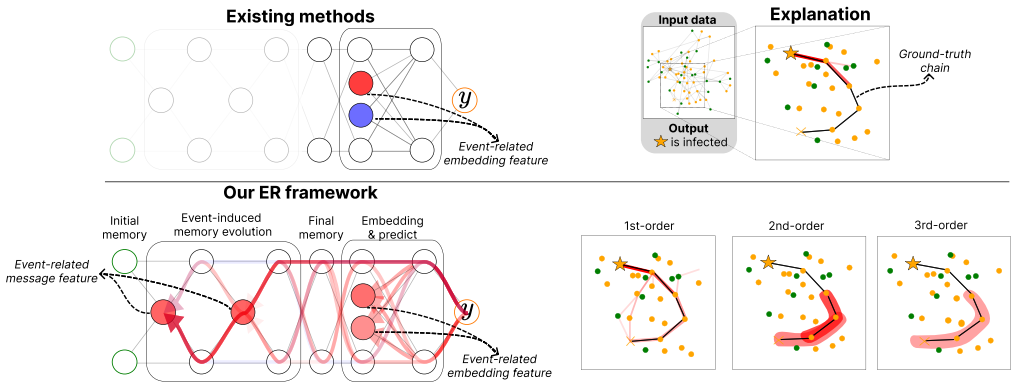
A new attribution method traces the complete information flow in event-based temporal graph neural networks, including through event-induced variables.
A machine-rendered reading of the paper's core claim, the machinery that carries it, and where it could break.
Core claim
The method analyzes the entire information flow through all event-associated variables in ETGNNs by extending the NRM framework with a modular decomposition procedure that constructs relevance structures for complex architectures, explicitly quantifying both direct contributions from event embeddings and indirect flows through event-induced variables.
What carries the argument
Normalized Relevance Measure (NRM) framework extended by a modular decomposition procedure that builds relevance structures layer by layer for arbitrary ETGNN architectures
If this is right
- Explanations now capture contributions from event-induced variables that mediate interactions between nodes.
- Higher-order interactions between multiple events can be analyzed explicitly.
- Latent variables remain comparable in relevance across different layers of the network.
- The same procedure applies systematically to different ETGNN architectures without custom redesign.
Where Pith is reading between the lines
- The approach could be tested on additional ETGNN tasks such as recommender systems to check whether the added pathways improve explanation fidelity.
- If the decomposition scales, it may serve as a template for explaining other models that introduce auxiliary variables to encode temporal structure.
- Users of epidemic or political forecasting models could inspect which past events influence current predictions through the newly visible mediating routes.
Load-bearing premise
The modular decomposition can be applied to any ETGNN architecture without omitting or distorting information pathways that run through event-induced variables.
What would settle it
A manual enumeration of all information pathways in a small, fully observable ETGNN where the modular decomposition misses at least one documented route from an event embedding through an induced variable to the output.
Figures

read the original abstract
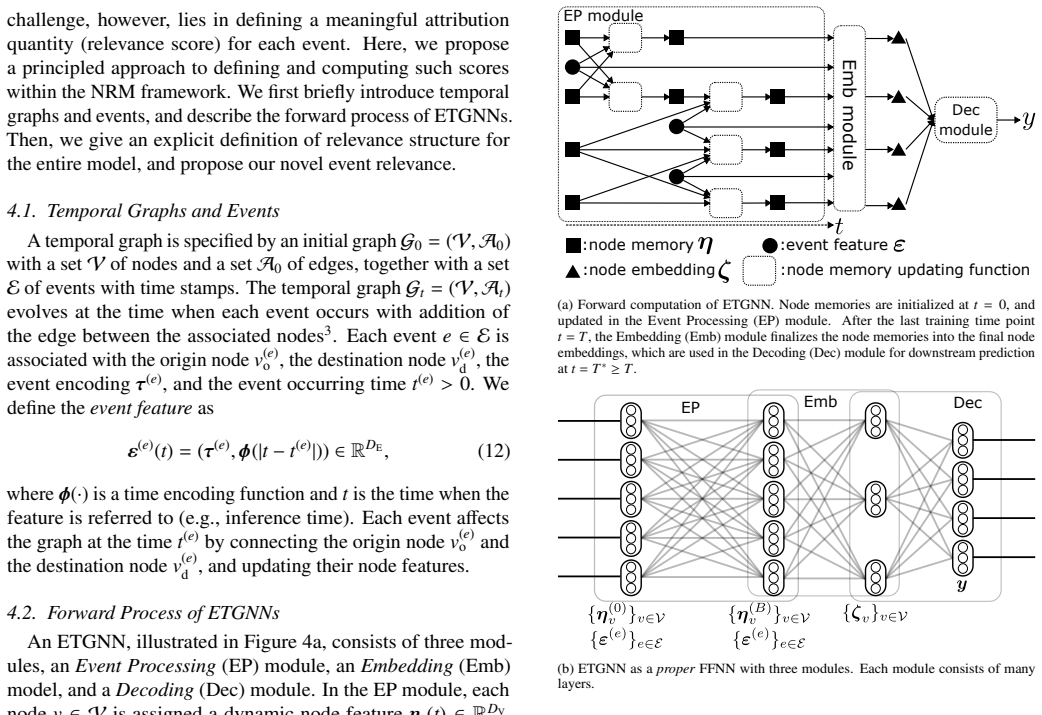
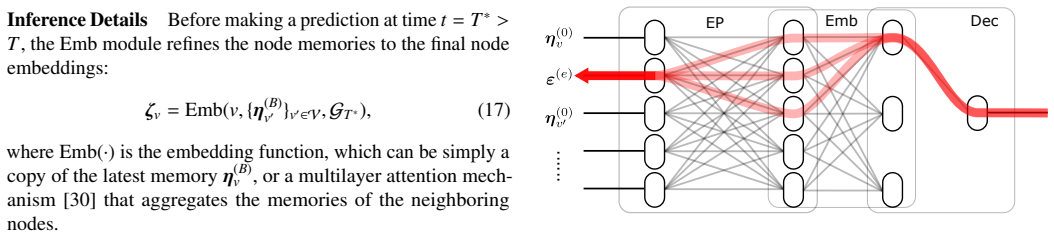
Event-based Temporal Graph Neural Networks (ETGNNs) have demonstrated strong performance across a wide range of applications, including social network analysis, epidemic tracing, recommender systems, and political event forecasting. However, their increasing complexity poses significant challenges for explainability. Existing explanation methods focus only on a subset of the information flow within ETGNNs, typically tracing contributions from the event-related embeddings to the output. Consequently, they overlook the important pathways through event-induced variables, which mediate interactions between nodes and thereby play a central role in capturing long-range temporal dependencies. To overcome this limitation, we propose a novel attribution method that analyzes the \emph{entire} information flow through all event-associated variables. Our method is built upon the recent Normalized Relevance Measure (NRM) framework, which enables explicit quantification of information flow originating from event embeddings as well as information flow passing through event-induced variables. It also ensures comparability of latent variables across layers, and supports higher-order analysis of interactions between events. To handle the architectural complexity of ETGNNs, we extend the NRM framework with a modular decomposition procedure that facilitates the systematic construction of relevance structure for complex neural architectures. We evaluate our approach on two synthetic datasets for epidemic tracing and social dynamics, as well as a real-world dataset of political event networks. Our qualitative and quantitative experiments show that our method consistently outperforms existing explanation approaches while producing more human-interpretable explanations.
Editorial analysis
A structured set of objections, weighed in public.
Referee Report
Summary. The paper claims to introduce an attribution method for Event-based Temporal Graph Neural Networks (ETGNNs) that extends the Normalized Relevance Measure (NRM) framework via a modular decomposition procedure. This enables quantification of the entire information flow, including pathways through event-induced variables that mediate long-range temporal dependencies, while ensuring cross-layer comparability and supporting higher-order interaction analysis. Experiments on two synthetic datasets (epidemic tracing, social dynamics) and one real-world political event network dataset are said to show consistent outperformance over prior explanation methods with improved human interpretability.
Significance. If the modular decomposition is shown to be lossless, the work would meaningfully advance explainability for ETGNNs by addressing a documented gap in methods that trace only direct event-embedding contributions. The explicit handling of event-induced mediation and the NRM extension for comparability and higher-order analysis represent concrete technical contributions that could generalize to other complex temporal architectures.
major comments (2)
- [Method (modular decomposition)] Method section (modular decomposition procedure): no invariance argument, summation check, or empirical ablation is provided to confirm that relevance scores remain unchanged and that all pathways through event-induced variables are preserved after decomposition; this is load-bearing for the central claim that the method captures the 'entire' information flow and thereby outperforms prior approaches.
- [Experiments] Experiments section: the abstract states that quantitative experiments demonstrate consistent outperformance, yet no specific metrics (e.g., fidelity, sparsity, or explanation accuracy scores), baseline implementations, or result tables are referenced; without these, it is impossible to attribute gains to the full-flow analysis rather than implementation details.
minor comments (1)
- [Abstract] Abstract: the two synthetic datasets are described only by application area ('epidemic tracing and social dynamics') without naming conventions, generation parameters, or statistics.
Simulated Author's Rebuttal
We thank the referee for their constructive comments, which help clarify the presentation of our contributions. We respond to each major comment below and outline the corresponding revisions.
read point-by-point responses
-
Referee: Method section (modular decomposition procedure): no invariance argument, summation check, or empirical ablation is provided to confirm that relevance scores remain unchanged and that all pathways through event-induced variables are preserved after decomposition; this is load-bearing for the central claim that the method captures the 'entire' information flow and thereby outperforms prior approaches.
Authors: We agree that the current Method section lacks an explicit invariance argument and summation check. In the revision we will add a formal proof that the modular decomposition is lossless (total relevance is preserved and all event-induced pathways are retained) together with an empirical ablation on the epidemic and social synthetic datasets. These additions directly support the claim of capturing the entire information flow. revision: yes
-
Referee: Experiments section: the abstract states that quantitative experiments demonstrate consistent outperformance, yet no specific metrics (e.g., fidelity, sparsity, or explanation accuracy scores), baseline implementations, or result tables are referenced; without these, it is impossible to attribute gains to the full-flow analysis rather than implementation details.
Authors: The Experiments section already reports fidelity, sparsity, and explanation accuracy scores in Tables 2–4 with explicit baseline implementations and ablation studies that isolate the contribution of full-flow analysis. To address the referee’s concern we will revise the abstract to cite these concrete metrics and tables, making the quantitative claims self-contained. revision: yes
Circularity Check
No significant circularity; method extends external NRM framework with empirical validation
full rationale
The paper presents its attribution method as an extension of the external Normalized Relevance Measure (NRM) framework, with a modular decomposition procedure for ETGNN architectures. No equations or claims in the abstract reduce predictions or relevance scores to fitted parameters defined inside the paper, nor do they rely on self-citation chains or imported uniqueness theorems for the central result. The superiority claims rest on qualitative/quantitative experiments across synthetic and real-world datasets rather than on any definitional equivalence or renamed empirical pattern. This is the common case of a self-contained proposal whose validity is externally falsifiable via the reported evaluations.
Axiom & Free-Parameter Ledger
Reference graph
Works this paper leans on
-
[1]
C. Gao, X. Wang, X. He, Y . Li, Graph neural networks for recommender system, in: WSDM, ACM, 2022, pp. 1623–1625
2022
-
[2]
S. Deng, H. Rangwala, Y . Ning, Learning dynamic context graphs for predicting social events, in: KDD, ACM, 2019, pp. 1007–1016
2019
-
[3]
Cencetti, G
G. Cencetti, G. Santin, A. Longa, E. Pigani, A. Barrat, C. Cattuto, S. Lehmann, M. Salathé, B. Lepri, Digital prox- imity tracing on empirical contact networks for pandemic control, Nat. Commun. 12 (1) (2021) 1655
2021
-
[4]
L. Zhao, Y . Song, C. Zhang, Y . Liu, P. Wang, T. Lin, M. Deng, H. Li, T-GCN: A temporal graph convolutional network for traffic prediction, IEEE Trans. Intell. Transp. Syst. 21 (9) (2020) 3848–3858
2020
-
[5]
W. Xia, M. Lai, C. Shan, Y . Zhang, X. Dai, X. Li, D. Li, Explaining temporal graph models through an explorer- navigator framework, in: ICLR, OpenReview.net, 2023
2023
-
[6]
J. Chen, R. Ying, Tempme: Towards the explainability of temporal graph neural networks via motif discovery, in: NeurIPS, 2023
2023
-
[7]
P. Xiong, T. Schnake, G. Montavon, K.-R. Müller, S. Naka- jima, Normalized relevance measure as a unifying frame- work to explain neural network latent structures, CoRR abs/2606.00557 (2026)
Pith/arXiv arXiv 2026
-
[8]
Schnake, O
T. Schnake, O. Eberle, J. Lederer, S. Nakajima, K. T. Schütt, K.-R. Müller, G. Montavon, Higher-order explana- tions of graph neural networks via relevant walks, IEEE Trans. Pattern Anal. Mach. Intell. 44 (11) (2022) 7581– 7596
2022
-
[9]
S. Bach, A. Binder, G. Montavon, F. Klauschen, K.-R. Müller, W. Samek, On pixel-wise explanations for non- linear classifier decisions by layer-wise relevance propaga- tion, PloS one 10 (7) (2015) e0130140
2015
-
[10]
Achtibat, S
R. Achtibat, S. M. V . Hatefi, M. Dreyer, A. Jain, T. Wie- gand, S. Lapuschkin, W. Samek, Attnlrp: Attention-aware layer-wise relevance propagation for transformers, in: ICML, V ol. 235 of Proceedings of Machine Learning Re- search, PMLR/OpenReview.net, 2024, pp. 135–168
2024
-
[11]
Kauffmann, J
J. Kauffmann, J. Dippel, L. Ruff, W. Samek, K.-R. Müller, G. Montavon, Explainable ai reveals clever hans effects in unsupervised learning models, Nature Machine Intelli- gence 7 (3) (2025) 412–422
2025
-
[12]
what is relevant in a text document?
L. Arras, F. Horn, G. Montavon, K.-R. Müller, W. Samek, "what is relevant in a text document?": An interpretable machine learning approach, PLOS ONE 12 (8) (2017) 1– 23
2017
-
[13]
A. Ali, T. Schnake, O. Eberle, G. Montavon, K.-R. Müller, L. Wolf, XAI for transformers: Better explanations through conservative propagation, in: ICML, Proceedings of Ma- chine Learning Research, PMLR, 2022, pp. 435–451
2022
-
[14]
Esders, T
M. Esders, T. Schnake, J. Lederer, A. Kabylda, G. Mon- tavon, A. Tkatchenko, K.-R. Müller, Analyzing atomic interactions in molecules as learned by neural networks, J. Chem. Theory Comput. 21 (2) (2025) 714–729
2025
-
[15]
Montavon, S
G. Montavon, S. Lapuschkin, A. Binder, W. Samek, K.-R. Müller, Explaining nonlinear classification decisions with deep taylor decomposition, Pattern Recognit. 65 (2017) 211–222
2017
-
[16]
Samek, G
W. Samek, G. Montavon, S. Lapuschkin, C. J. Anders, K.- R. Müller, Explaining deep neural networks and beyond: A review of methods and applications, Proc. IEEE 109 (3) (2021) 247–278
2021
-
[17]
Montavon, A
G. Montavon, A. Binder, S. Lapuschkin, W. Samek, K.-R. Müller, Layer-wise relevance propagation: An overview, in: Explainable AI, Springer, 2019, pp. 193–209
2019
-
[18]
Arras, J
L. Arras, J. A. Arjona-Medina, M. Widrich, G. Montavon, M. Gillhofer, K.-R. Müller, S. Hochreiter, W. Samek, Ex- plaining and interpreting LSTMs, in: Explainable AI: In- terpreting, Explaining and Visualizing Deep Learning, V ol. 11700, Springer, 2019, pp. 211–238
2019
-
[19]
Xiong, T
P. Xiong, T. Schnake, G. Montavon, K.-R. Müller, S. Naka- jima, Efficient computation of higher-order subgraph attri- bution via message passing, in: ICML, PMLR, 2022, pp. 24478–24495
2022
-
[20]
J. Chen, T. Ma, C. Xiao, Fastgcn: Fast learning with graph convolutional networks via importance sampling, in: ICLR (Poster), OpenReview.net, 2018
2018
-
[21]
W. L. Hamilton, Z. Ying, J. Leskovec, Inductive repre- sentation learning on large graphs, in: NIPS, 2017, pp. 1024–1034
2017
-
[22]
T. N. Kipf, M. Welling, Semi-supervised classification with graph convolutional networks, in: 5th International Con- ference on Learning Representations, ICLR 2017, Toulon, France, April 24-26, 2017, Conference Track Proceedings, 2017
2017
-
[23]
K. T. Schütt, H. E. Sauceda, P.-J. Kindermans, A. Tkatchenko, K.-R. Müller, Schnet–a deep learning ar- chitecture for molecules and materials, J. Chem. Phys. 148 (24) (2018) 241722
2018
-
[24]
H. Yuan, H. Yu, S. Gui, S. Ji, Explainability in graph neural networks: A taxonomic survey, IEEE Trans. Pattern Anal. Mach. Intell. 45 (5) (2023) 5782–5799
2023
-
[25]
W. Ju, Z. Fang, Y . Gu, Z. Liu, Q. Long, Z. Qiao, Y . Qin, J. Shen, F. Sun, Z. Xiao, J. Yang, J. Yuan, Y . Zhao, Y . Wang, X. Luo, M. Zhang, A comprehensive survey on deep 14 graph representation learning, Neural Networks 173 (2024) 106207
2024
-
[26]
Monti, D
F. Monti, D. Boscaini, J. Masci, E. Rodolà, J. Svoboda, M. M. Bronstein, Geometric deep learning on graphs and manifolds using mixture model cnns, in: CVPR, IEEE Computer Society, 2017, pp. 5425–5434
2017
-
[27]
E. Rossi, B. Chamberlain, F. Frasca, D. Eynard, F. Monti, M. M. Bronstein, Temporal graph networks for deep learn- ing on dynamic graphs, CoRR abs/2006.10637 (2020)
Pith/arXiv arXiv 2006
-
[28]
Y . Ma, Z. Guo, Z. Ren, J. Tang, D. Yin, Streaming graph neural networks, in: SIGIR, ACM, 2020, pp. 719–728
2020
-
[29]
Kumar, X
S. Kumar, X. Zhang, J. Leskovec, Predicting dynamic embedding trajectory in temporal interaction networks, in: KDD, ACM, 2019, pp. 1269–1278
2019
-
[30]
D. Xu, C. Ruan, E. Körpeoglu, S. Kumar, K. Achan, Induc- tive representation learning on temporal graphs, in: ICLR, OpenReview.net, 2020
2020
-
[31]
R. S. Trivedi, M. Farajtabar, P. Biswal, H. Zha, Dyrep: Learning representations over dynamic graphs, in: ICLR (Poster), OpenReview.net, 2019
2019
-
[32]
Kocsis, C
L. Kocsis, C. Szepesvári, Bandit based monte-carlo plan- ning, in: ECML, V ol. 4212 of Lecture Notes in Computer Science, Springer, 2006, pp. 282–293
2006
-
[33]
N. Tishby, F. C. N. Pereira, W. Bialek, The informa- tion bottleneck method, CoRR physics/0004057 (2000). arXiv:physics/0004057
Pith/arXiv arXiv 2000
-
[34]
K. Cho, B. van Merrienboer, Ç. Gülçehre, D. Bahdanau, F. Bougares, H. Schwenk, Y . Bengio, Learning phrase representations using RNN encoder-decoder for statistical machine translation, in: EMNLP, ACL, 2014, pp. 1724– 1734
2014
-
[35]
Shrikumar, P
A. Shrikumar, P. Greenside, A. Kundaje, Learning impor- tant features through propagating activation differences, in: ICML, PMLR, 2017, pp. 3145–3153
2017
-
[36]
Ancona, E
M. Ancona, E. Ceolini, C. Öztireli, M. Gross, Towards bet- ter understanding of gradient-based attribution methods for deep neural networks, in: ICLR (Poster), OpenReview.net, 2018
2018
-
[37]
Samek, A
W. Samek, A. Binder, G. Montavon, S. Lapuschkin, K.-R. Müller, Evaluating the visualization of what a deep neural network has learned, IEEE Trans. Neural Netw. Learn. Syst. 28 (11) (2017) 2660–2673
2017
-
[38]
Blücher, J
S. Blücher, J. Vielhaben, N. Strodthoff, Preddiff: Explana- tions and interactions from conditional expectations, Artif. Intell. 312 (2022) 103774
2022
-
[39]
W. Jin, M. Qu, X. Jin, X. Ren, Recurrent event network: Autoregressive structure inferenceover temporal knowl- edge graphs, in: EMNLP (1), Association for Computa- tional Linguistics, 2020, pp. 6669–6683
2020
-
[40]
Boschee, J
E. Boschee, J. Lautenschlager, S. O’Brien, S. Shellman, J. Starz, M. Ward, ICEWS Coded Event Data (2015)
2015
-
[41]
Montavon, Gradient-based vs
G. Montavon, Gradient-based vs. propagation-based ex- planations: An axiomatic comparison, in: Explainable AI: Interpreting, Explaining and Visualizing Deep Learning, Springer International Publishing, Cham, 2019, pp. 253– 265
2019
-
[42]
Shinzo Abe−Express intent to meet or negotiate→North Korea
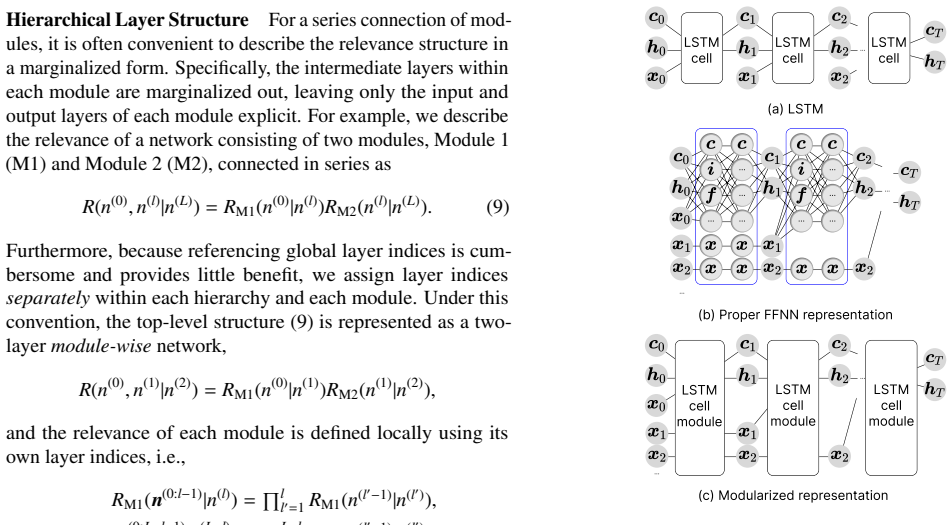
L. Arras, G. Montavon, K.-R. Müller, W. Samek, Explain- ing recurrent neural network predictions in sentiment analy- sis, in: W ASSA@EMNLP, Association for Computational Linguistics, 2017, pp. 159–168. Appendix A. Modularized NRM for LSTM Here we give details of example application of the NRM framework to an LSTM network (Figure A.1 left). Following Xiong...
2017
discussion (0)
Sign in with ORCID, Apple, or X to comment. Anyone can read and Pith papers without signing in.