REVIEW 5 major objections 6 minor 29 references
HarmonE: A Self-Adaptive Approach to Architecting Sustainable MLOps
T0 review · 5 major / 6 minor · reviewed 2026-08-15 · deepseek-v4-flash
Pith's one-line read A control loop lets MLOps pipelines cut energy use by 54.5% while keeping 95% of accuracy.
desk verdict HarmonE is a sensible integrated architecture for energy-aware MLOps, but the headline 54.5% energy saving is partly enforced by an unreported reference threshold, and the evaluation lacks the parameter reporting and baseline rigor to back it. read the letter →
The pith
A machine-rendered reading of the paper's core claim, the machinery that carries it, and where it could break.
The reading
What carries the argument
The load-bearing mechanism is the dynamic energy threshold of Eq. (3), $\tau_{E_{i+1}}=\tau_{E_i}+\delta(\bar{E}_{ref}-\bar{E}_i)$, which converts the architect's sustainability goal into an evolving adaptation boundary. When observed normalized energy $\bar{E}_i$ stays above the reference $\bar{E}_{ref}$, the threshold drops and the next violation forces a model switch or retraining; when energy is below the reference, the boundary loosens and transient spikes are tolerated. This is paired with the composite performance score $S_i$ (Eq. 1) and its exponential moving average (Eq. 2), which rank candidate models during adaptation, and with a drift threshold $\tau_{drift}$ that triggers versioned-model reuse or retraining. Together these pieces turn a static MLOps pipeline into a closed-loop controller.
What would settle it
Run HarmonE on the same PeMS traffic-flow task with the controller parameters ($\bar{E}_{ref}$, $\beta$, $\gamma$, $\delta$, $S_{min}$, $\tau_{drift}$) set to neutral values chosen before inspecting the test set, and measure the energy-accuracy trade-off. If the energy saving relative to LSTM+PRT falls substantially below 54.5% or the accuracy ratio drops below 95%, the central claim fails. A simpler check is to read the actual values from the paper's companion materials; if $\bar{E}_{ref}$ was set near the LSTM baseline's consumption, the comparison is biased.
Extended reading notes
Core claim
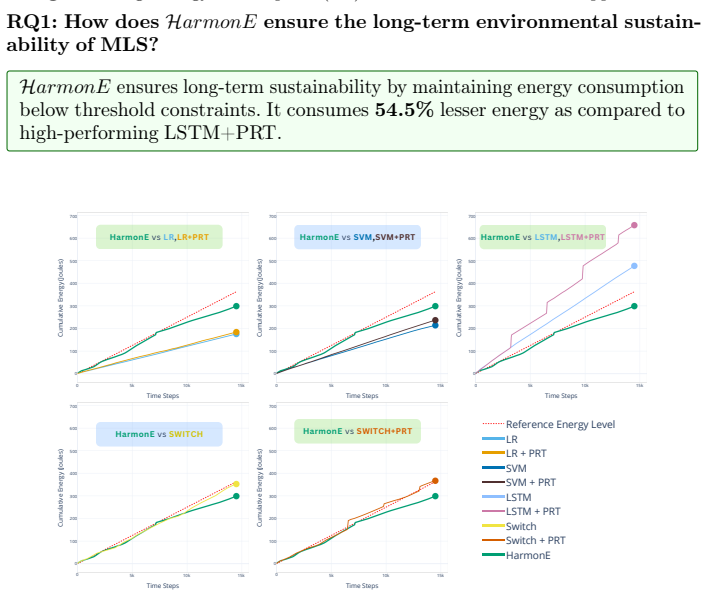
On the paper's own terms, HarmonE shows that a self-adaptive MLOps pipeline can meet explicit sustainability goals by treating energy as a controlled variable rather than a side effect. At each monitoring interval the system computes a composite score $S_i=\beta A_i+(1-\beta)(1-\bar{E}_i)$, smooths it as an exponential moving average, and maintains a dynamic energy threshold $\tau_{E_{i+1}}=\tau_{E_i}+\delta(\bar{E}_{ref}-\bar{E}_i)$ that tightens when energy exceeds a design-time reference. Exceeding this threshold, or a drift threshold, triggers one of three tactics: switching to a lighter or more accurate model from a repository, retraining, or reusing a versioned model trained on a similar distribution. In the reported traffic-flow experiment, this mechanism yields an average energy of 20.62 mJ and $R^2=0.8628$, versus 45.35 mJ and $R^2=0.9085$ for LSTM+PRT; the paper states this as 54.5% lower energy at 95.0% of the baseline's accuracy, with inference time reduced from 4.05 ms to 1.89 ms. It also reports that the adaptation logic itself consumes only 1.37% of total system energy.
Load-bearing premise
The central assumption is that the reference energy level and the threshold parameters were fixed at design time without tuning on the test data; the paper does not report their values, so the headline 54.5% saving could be an artifact of calibration rather than a general property of the architecture.
Editorial extensions
If this is right
- Fixed-interval retraining (LR+PRT, SVM+PRT, LSTM+PRT, Switch+PRT) retrains four times per run regardless of need; HarmonE's triggered adaptations achieve comparable accuracy with fewer, well-timed interventions.
- The approach keeps energy below the reference level over long horizons; in the experiment HarmonE's cumulative energy curve stays under the design-time reference while single-model baselines either overshoot it or sacrifice accuracy.
- Model switching alone (Switch) is not enough: without retraining, the system defaults to the heavy LSTM and reaches only $R^2=0.8445$; HarmonE's combination of switching, selective retraining, and versioned reuse is what sustains both accuracy and energy goals.
- The adaptation overhead is small enough for practical use: about 17.9 ms per MAPE-K invocation and 1.37% of total energy, so the sustainability gain is not offset by the controller's own cost.
Reading between the lines
- If the dynamic-threshold mechanism generalizes, the same control-theoretic update could be applied to other sustainability dimensions, such as memory, monetary cost, or carbon emissions, by substituting each dimension's normalized metric for $\bar{E}_i$ and keeping a reference level.
- The reported 54.5% saving is relative to a reference energy level; a stronger evaluation would report the controller parameters and a sensitivity analysis of the saving as the reference moves, since the threshold update can be tuned to force a low-energy operating point.
- The drift-and-reuse idea suggests a testable extension: in domains with recurring distributions (e.g., daily or weekly patterns in sensing data), versioned model reuse may dominate retraining, and the savings could be predicted from the periodicity of the drift signal.
- Because the evaluation uses one sensor node and one time-series task, applying HarmonE to vision or NLP would require redefining accuracy, energy, and drift metrics; the architecture is domain-agnostic but each new domain needs its own decision map.
Signed reviews
Editorial analysis
A structured set of objections, weighed in public.
Referee Report
Summary. The paper proposes HarmonE, an architectural approach that augments an MLOps pipeline with a MAPE-K self-adaptation loop to manage sustainability trade-offs, primarily energy consumption versus prediction accuracy. The approach defines sustainability goals and adaptation thresholds at design time via a Decision Map, monitors runtime metrics (accuracy, normalized energy, drift), and triggers model switching, selective retraining, or versioned-model reuse. The evaluation uses a traffic-flow prediction scenario on PeMS data with a spectrum of three models (LR, SVM, LSTM) and compares HarmonE against eight baselines including periodic retraining and a switching-based approach. The headline results are a 54.5% energy reduction versus LSTM+PRT, 95% of LSTM+PRT's R2 accuracy, and 53.4% lower inference time. The paper also reports that the MAPE-K loop itself consumes only about 1.37% of total system energy. The central claims are that HarmonE achieves a favorable accuracy-energy trade-off while triggering fewer, more context-aware adaptations than periodic retraining.
Significance. If the reported results are robust and reproducible, HarmonE would be a useful contribution to sustainable MLOps: it combines an architectural Decision Map with a control-theoretic dynamic threshold, and it provides open-source code and a public dataset. The paper's framing around multi-dimensional sustainability (technical, environmental, economic, social) is relevant and timely. However, the significance currently rests on an evaluation whose main quantitative claims are not yet supported: the energy-saving mechanism is partially engineered through an unreported reference level, the strongest baseline is described as defaulting to the heaviest model, and the retraining protocol is ambiguous. Because these issues directly affect the 54.5%/95% headline numbers, the contribution cannot yet be assessed as a general property of the architecture rather than a tuned artifact.
major comments (5)
- [§3.3, Eq. (3) and §5, RQ1] The central energy-saving claim is not yet established as an emergent property of HarmonE because the dynamic threshold update in Eq. (3) enforces a cap near the reference level E_ref: whenever E_i > E_ref, the threshold τ_E is tightened, forcing adaptation to a lower-energy model. The paper does not report E_ref, δ, β, γ, S_min, τ_drift, ε, or the monitoring interval, and Table 2 contains no sensitivity analysis. Without these values and a study varying E_ref (and δ), the 54.5% reduction versus LSTM+PRT could be a direct consequence of choosing a low reference level rather than a robust property of the architecture. Please report the full parameter configuration and show how the energy-accuracy trade-off changes across a range of E_ref values.
- [§4.2 and §5, RQ2] The Switch baseline is described in §4.2 as switching among LR, SVM, and LSTM based on uncertainties detected by the Managing System, but §5, RQ2 explains that it 'defaults to the heavier LSTM model without retraining smaller models when drift occurs.' This makes Switch a weak comparator: it is essentially HarmonE with retraining and versioned-model reuse disabled, and with the decision logic possibly degraded. A fairer baseline would be an energy-aware switching strategy that also has access to the same model spectrum but without HarmonE's design-time thresholds and versioning, to isolate the contribution of the proposed control mechanism. As reported, the comparison to Switch and Switch+PRT does not separate the benefits of threshold-based control from the benefits of simply having a model-switching capability.
- [§4.2 and §5] The retraining procedure is ambiguous and could confound the comparison with periodic retraining. The paper states: 'Retraining, whether periodic or triggered (HarmonE), is performed using 1200 samples, consistent with the original training window size.' If those 1200 samples are the same original training data, retraining cannot adapt to the induced drift and HarmonE's drift-triggered retraining is not faithfully implemented. If they are a sliding window of the latest 1200 test samples, then the number of samples used differs from the original 1200-sample training set, and the amount of data consumed by retraining should be reported in the comparison. Please clarify which data are used and how the comparison to periodic retraining handles the different data usage.
- [§5, Table 2 and Figure 5] No error bars, confidence intervals, or significance tests are reported for any of the quantitative claims. Each approach was run five times, and Figure 5 shows some run-to-run variation (explicitly for Switch+PRT), but Table 2 reports only point estimates. Given that the difference between HarmonE (20.62 mJ) and Switch+PRT (25.32 mJ) is about 18.6%, the reader cannot assess whether this gap is meaningful relative to measurement noise. Please report standard deviations or confidence intervals for energy, R2, and inference time, and, if possible, a statistical comparison across the five runs.
- [§5, RQ3 and Table 2] The adaptation counts in Table 2 are not broken down by type (switching events S, retraining events R, version-repo accesses V), although Figure 4 shows these as separate categories. This makes it difficult to evaluate RQ3: for example, HarmonE's 12 adaptations are described as efficient, but the reader cannot tell how many were model switches versus retrains versus versioned-model reuses, nor how many of the 12 were triggered by energy violations versus drift. A breakdown would strengthen the claim that adaptation decisions are selective and context-aware.
minor comments (6)
- [§4.2 and Table 2] Table 2 leaves the '# Adaptations' column empty for LR, LR+PRT, SVM, SVM+PRT, LSTM, and LSTM+PRT. Either fill in the values (e.g., '0' or 'N/A') or add a footnote explaining why they are omitted, for example that periodic retraining runs are counted as four retraining events.
- [§3.3 and §5] The notation for accuracy is inconsistent: the text uses 'R2' and 'R2 score' while the tables and figures use 'R2'. Please standardize the notation (e.g., 'R²' or 'R2') throughout.
- [§3.3 and §4.1] The paper says KL divergence is computed between recently observed true values and a reference distribution, following [18], but it does not specify how the reference distribution is chosen or how the 5-timestep input window is incorporated into the drift metric. A brief operational definition would help reproducibility.
- [§5, Figure 6] Figure 6 includes a 'Reference Energy Level' red line, but the actual value of E_ref is not reported in the text or captions. Since this value is central to the energy control mechanism, it should be disclosed (even in a reproducibility appendix).
- [§4.2] The sentence 'To ensure consistent and reliable results, each baseline experiment is repeated independently five times, following established guidelines for empirical software engineering [29]' is a reasonable practice, but the paper should specify whether the five runs used different random seeds or the same seed, and whether stochastic elements (e.g., ε-greedy exploration) were rerandomized across runs.
- [§6, Threats to Validity] The paper discusses internal, construct, and external validity but does not address the main threat: the sensitivity of the results to the unreported controller parameters. A paragraph on parameter sensitivity (or a pointer to a sensitivity analysis) would directly address the concern that the reported trade-off is tuned.
Circularity Check
No significant circularity: HarmonE's energy and accuracy results are empirically measured outcomes of its control design, not quantities defined into existence by its inputs or by self-citations.
full rationale
The paper's central claim is an empirical comparison against baselines. The dynamic energy threshold in Eq. (3) does bias the controller toward lower energy, but the reported 54.5% reduction relative to LSTM+PRT is not identical to that update rule: it also depends on the model spectrum, drift schedule, retraining policy, and the measured energy of the uncapped baseline. The 95% accuracy retention (R2 0.8628 vs 0.9085) is not enforced by the energy threshold and is an independent empirical result. The only self-citations (e.g., [3], [27]) are used as background motivation and are not load-bearing derivations; no uniqueness theorem or proof is imported from them. The unreported values of E_ref, beta, gamma, delta, S_min, and tau_drift are a reproducibility and generalizability concern, not a circularity, because the paper does not define the reported energy or accuracy numbers in terms of those parameters. The ambiguity about the 1200-sample retraining window affects the fairness of the baseline comparison but does not make the result equivalent to an input. Under the required standard of exhibiting a specific reduction, no circular step can be identified.
Assumptions & free parameters
free parameters (8)
- beta (accuracy-energy weight in Eq. 1)
- gamma (EMA smoothing factor, Eq. 2)
- delta (energy threshold decay factor, Eq. 3)
- E_ref (reference energy level, Eq. 3)
- S_min (minimum acceptable EMA performance)
- tau_drift (drift threshold)
- epsilon (exploration probability)
- Monitoring interval length
assumptions (5)
- domain assumption MAPE-K loop is an appropriate architectural pattern for self-adaptive MLOps
- domain assumption The linear combination of normalized accuracy and energy (Eq. 1) captures the sustainability trade-off
- ad hoc to paper The energy threshold update rule (Eq. 3) maintains energy near the reference level
- domain assumption KL divergence between recent and reference true-value distributions is a valid drift indicator for regression tasks
- domain assumption The Digital Twin simulation with synthetic scale-and-shift drift is representative of real-world traffic conditions
Cite this review
Pith. "Pith review of HarmonE: A Self-Adaptive Approach to Architecting Sustainable MLOps." pith.science (2026). https://pith.science/paper/KEUGDGKY
@misc{pith2026250513693,
  author       = {Pith},
  title        = {Pith review of: HarmonE: A Self-Adaptive Approach to Architecting Sustainable MLOps},
  year         = {2026},
  howpublished = {\url{https://pith.science/paper/KEUGDGKY}},
  note         = {Machine review of arXiv:2505.13693}
}
read the original abstract
Machine Learning Enabled Systems (MLS) are becoming integral to real-world applications, but ensuring their sustainable performance over time remains a significant challenge. These systems operate in dynamic environments and face runtime uncertainties like data drift and model degradation, which affect the sustainability of MLS across multiple dimensions: technical, economical, environmental, and social. While Machine Learning Operations (MLOps) addresses the technical dimension by streamlining the ML model lifecycle, it overlooks other dimensions. Furthermore, some traditional practices, such as frequent retraining, incur substantial energy and computational overhead, thus amplifying sustainability concerns. To address them, we introduce HarmonE, an architectural approach that enables self-adaptive capabilities in MLOps pipelines using the MAPE-K loop. HarmonE allows system architects to define explicit sustainability goals and adaptation thresholds at design time, and performs runtime monitoring of key metrics, such as prediction accuracy, energy consumption, and data distribution shifts, to trigger appropriate adaptation strategies. We validate our approach using a Digital Twin (DT) of an Intelligent Transportation System (ITS), focusing on traffic flow prediction as our primary use case. The DT employs time series ML models to simulate real-time traffic and assess various flow scenarios. Our results show that HarmonE adapts effectively to evolving conditions while maintaining accuracy and meeting sustainability goals.
Figures


Figures from the paper (4 more)



Reference graph
Works this paper leans on
-
[1]
Amershi, S., Begel, A., Bird, C., DeLine, R., Gall, H., Kamar, E., Nagappan, N., Nushi, B., Zimmermann, T.: Software engineering for machine learning: A case study. In: 2019 IEEE/ACM 41st International Conference on Software Engineering: Software Engineering in Practice (ICSE-SEIP) (2019) 16 Bhatt et al
work page 2019
-
[2]
In: 2015 IEEE/ACM 37th IEEE International Conference on Software Engineering
Becker, C., Chitchyan, R., Duboc, L., Easterbrook, S., Penzenstadler, B., Seyff, N., Venters, C.C.: Sustainability design and software: The karlskrona manifesto. In: 2015 IEEE/ACM 37th IEEE International Conference on Software Engineering. vol. 2 (2015)
work page 2015
-
[3]
Bhatt, H., Arun, S., Kakran, A., Vaidhyanathan, K.: Towards architecting sustainable mlops: A self-adaptation approach. In: ICSA-C (2024)
work page 2024
-
[4]
arXiv preprint arXiv:2502.17646 (2025)
Bhatt, H., Vaidhyanathan, K., Biju, R., Gangadharan, D., Trestian, R., Shah, P., et al.: Architecting digital twins for intelligent transportation systems. arXiv preprint arXiv:2502.17646 (2025)
arXiv 2025
-
[5]
arXiv preprint arXiv:1908.09791 (2019)
Cai, H., Gan, C., Wang, T., Zhang, Z., Han, S.: Once-for-all: Train one network and specialize it for efficient deployment. arXiv preprint arXiv:1908.09791 (2019)
arXiv 2019
-
[6]
In: Proceedings of the 4th Workshop on Machine Learning and Systems
Chadli, K., Botterweck, G., Saber, T.: The environmental cost of engineering machine learning-enabled systems: A mapping study. In: Proceedings of the 4th Workshop on Machine Learning and Systems. EuroMLSys ’24, Association for Computing Machinery, New York, NY, USA (2024)
work page 2024
-
[7]
Costello, K., Rimol, M.: Gartner identifies the top strategic technology trends for 2021
work page 2021
-
[8]
Franklin, G., Powell, J., Workman, M.: Digital Control of Dynamic Systems-Third Edition (2022)
work page 2022
Show all 29 references
-
[9]
In: Proceedings of the ACM/IEEE 44th International Conference on Software Engineering: New Ideas and Emerging Results (2022)
Gerostathopoulos, I., Raibulet, C., Lago, P.: Expressing the adaptation intent as a sustainability goal. In: Proceedings of the ACM/IEEE 44th International Conference on Software Engineering: New Ideas and Emerging Results (2022)
2022
-
[10]
arXiv preprint arXiv:1510.00149 (2015)
Han, S., Mao, H., Dally, W.J.: Deep compression: Compressing deep neural networks with pruning, trained quantization and huffman coding. arXiv preprint arXiv:1510.00149 (2015)
2015 arXiv
-
[11]
In: Proceedings of the 46th International Conference on Software Engineering: Software Engineering in Society
Järvenpää, H., Lago, P., Bogner, J., Lewis, G., Muccini, H., Ozkaya, I.: A synthesis of green architectural tactics for ml-enabled systems. In: Proceedings of the 46th International Conference on Software Engineering: Software Engineering in Society. ICSE-SEIS’24, Association ...
2024
-
[12]
Kephart,J.O.,Chess,D.M.:Thevisionofautonomiccomputing.Computer 36(1)(2003)
2003
-
[13]
In: 2023 38th IEEE/ACM International Conference on Automated Software Engineering (ASE)
Kulkarni, S., Marda, A., Vaidhyanathan, K.: Towards self-adaptive machine learning- enabled systems through qos-aware model switching. In: 2023 38th IEEE/ACM International Conference on Automated Software Engineering (ASE). IEEE (2023)
2023
-
[14]
In: 2023 38th IEEE/ACM International Conference on Automated Software Engineering (ASE) (2023)
Kulkarni, S., Marda, A., Vaidhyanathan, K.: Towards self-adaptive machine learning- enabled systems through qos-aware model switching. In: 2023 38th IEEE/ACM International Conference on Automated Software Engineering (ASE) (2023)
2023
-
[15]
The annals of mathematical statistics 22(1) (1951)
Kullback, S., Leibler, R.A.: On information and sufficiency. The annals of mathematical statistics 22(1) (1951)
1951
-
[16]
In: 2019 IEEE/ACM 41st International Conference on Software Engineering: Software Engineering in Society (ICSE-SEIS)
Lago, P.: Architecture design decision maps for software sustainability. In: 2019 IEEE/ACM 41st International Conference on Software Engineering: Software Engineering in Society (ICSE-SEIS). IEEE (2019)
2019
-
[17]
In: 2023 IEEE 20th International Conference on Software Architecture Companion (ICSA-C)
Leest, J., Gerostathopoulos, I., Raibulet, C.: Evolvability of machine learning-based systems: An architectural design decision framework. In: 2023 IEEE 20th International Conference on Software Architecture Companion (ICSA-C). IEEE (2023)
2023
-
[18]
In: 2022 IEEE/ACM 1st International Workshop on Software Engineering for Responsible Artificial Intelligence (SE4RAI) (2022)
Lewis,G.A.,Echeverría,S.,Pons,L.,Chrabaszcz,J.:Augur:Asteptowardsrealisticdrift detection in production ml systems. In: 2022 IEEE/ACM 1st International Workshop on Software Engineering for Responsible Artificial Intelligence (SE4RAI) (2022)
2022
-
[19]
IEEE Industrial Electronics Magazine15(2) (2021)
Maschler, B., Weyrich, M.: Deep transfer learning for industrial automation: A review and discussion of new techniques for data-driven machine learning. IEEE Industrial Electronics Magazine15(2) (2021)
2021
-
[20]
Briefings in bioinformatics19(6) (2018)
Miotto, R., Wang, F., Wang, S., Jiang, X., Dudley, J.T.: Deep learning for healthcare: review, opportunities and challenges. Briefings in bioinformatics19(6) (2018)
2018
-
[21]
Communications of the ACM 63(12) (2020) HarmonE: A Self-Adaptive Approach to Architecting Sustainable MLOps 17
Schwartz, R., Dodge, J., Smith, N.A., Etzioni, O.: Green ai. Communications of the ACM 63(12) (2020) HarmonE: A Self-Adaptive Approach to Architecting Sustainable MLOps 17
2020
-
[22]
University of California, Berkeley
Shankar, S., Garcia, R., Hellerstein, J.M., Parameswaran, A.G.: Operationalizing machine learning. University of California, Berkeley
-
[23]
In: 2022 48th Euromicro Conference on Software Engineering and Advanced Applications (SEAA) (2022)
Shivashankar, K., Martini, A.: Maintainability challenges in ml: A systematic literature review. In: 2022 48th Euromicro Conference on Software Engineering and Advanced Applications (SEAA) (2022)
2022
-
[24]
Strubell, E., Ganesh, A., McCallum, A.: Energy and policy considerations for modern deeplearningresearch.ProceedingsoftheAAAIConferenceonArtificialIntelligence(09)
-
[25]
In: 2022 IEEE 12th Annual Computing and Communication Workshop and Conference (CCWC) (2022)
Symeonidis, G., Nerantzis, E., Kazakis, A., Papakostas, G.A.: Mlops - definitions, tools and challenges. In: 2022 IEEE 12th Annual Computing and Communication Workshop and Conference (CCWC) (2022)
2022
-
[26]
In: 2020 22nd International Symposium on Symbolic and Numeric Algorithms for Scientific Computing (SYNASC)
Tamburri, D.A.: Sustainable mlops: Trends and challenges. In: 2020 22nd International Symposium on Symbolic and Numeric Algorithms for Scientific Computing (SYNASC)
2020
-
[27]
arXiv preprint arXiv:2404.11411 (2024)
Tedla, M., Kulkarni, S., Vaidhyanathan, K.: Ecomls: A self-adaptation approach for architecting green ml-enabled systems. arXiv preprint arXiv:2404.11411 (2024)
2024 arXiv
-
[28]
In: 2022 International Conference on ICT for Sustainability (ICT4S) (2022)
Verdecchia, R., Cruz, L., Sallou, J., Lin, M., Wickenden, J., Hotellier, E.: Data-centric green ai an exploratory empirical study. In: 2022 International Conference on ICT for Sustainability (ICT4S) (2022)
2022
-
[29]
Springer Science & Business Media (2012)
Wohlin, C., Runeson, P., Höst, M., Ohlsson, M., Regnell, B., Wesslén, A.: Experimentation in software engineering. Springer Science & Business Media (2012)
2012
Reviewed August 15, 2026 · model on record in the stance chip above.
Discussion (0). Continue with ORCID to comment.