REVIEW 2 major objections 2 minor 25 references
The non-Hermitian skin effect enhances pairing correlations in moiré Hubbard systems by amplifying boundary states within a golden window of non-reciprocity.
Reviewed by Pith at T0; open to challenge. T0 means a machine referee read the full paper against a public rubric. the ladder, T0–T4 →
T0 review · grok-4.3
2026-06-26 15:21 UTC pith:KFQEKBHI
load-bearing objection NHSE gives a large channel-selective pairing boost on 3x3 open clusters, but the numbers rest entirely on small open-boundary systems with no scaling checks. the 2 major comments →
Non-Hermitian Skin Effect Enhances Pairing Correlations in Moir\'{e} Hubbard Systems
The pith
A machine-rendered reading of the paper's core claim, the machinery that carries it, and where it could break.
Core claim
The NHSE acts channel-selectively on the 3×3 cluster: it enhances on-site pairing by +21% while suppressing competing antiferromagnetic correlations by 22%, resulting in a +98% growth in the total pairing susceptibility χ_SC which is dominated by the on-site channel. This occurs within γ ∈ [0.5,1.2] t, as mapped in the (U,γ) phase diagram from exact diagonalization of the non-Hermitian Hubbard model, with corroboration from non-Hermitian DMRG, establishing finite-cluster pairing enhancement rather than long-range order.
What carries the argument
The non-Hermitian skin effect in the open-boundary non-Hermitian Hubbard model on triangular lattices, which localizes eigenstates at the boundaries and thereby amplifies the local density of states to strengthen pairing.
Load-bearing premise
The pairing enhancement measured on small open-boundary clusters reflects a mechanism that remains relevant beyond finite-size effects and would appear in experimentally accessible moiré devices.
What would settle it
Whether the reported 98 percent rise in pairing susceptibility and the 21 percent on-site boost both persist, shrink, or reverse when the cluster size is increased or when open boundaries are replaced by periodic ones.
If this is right
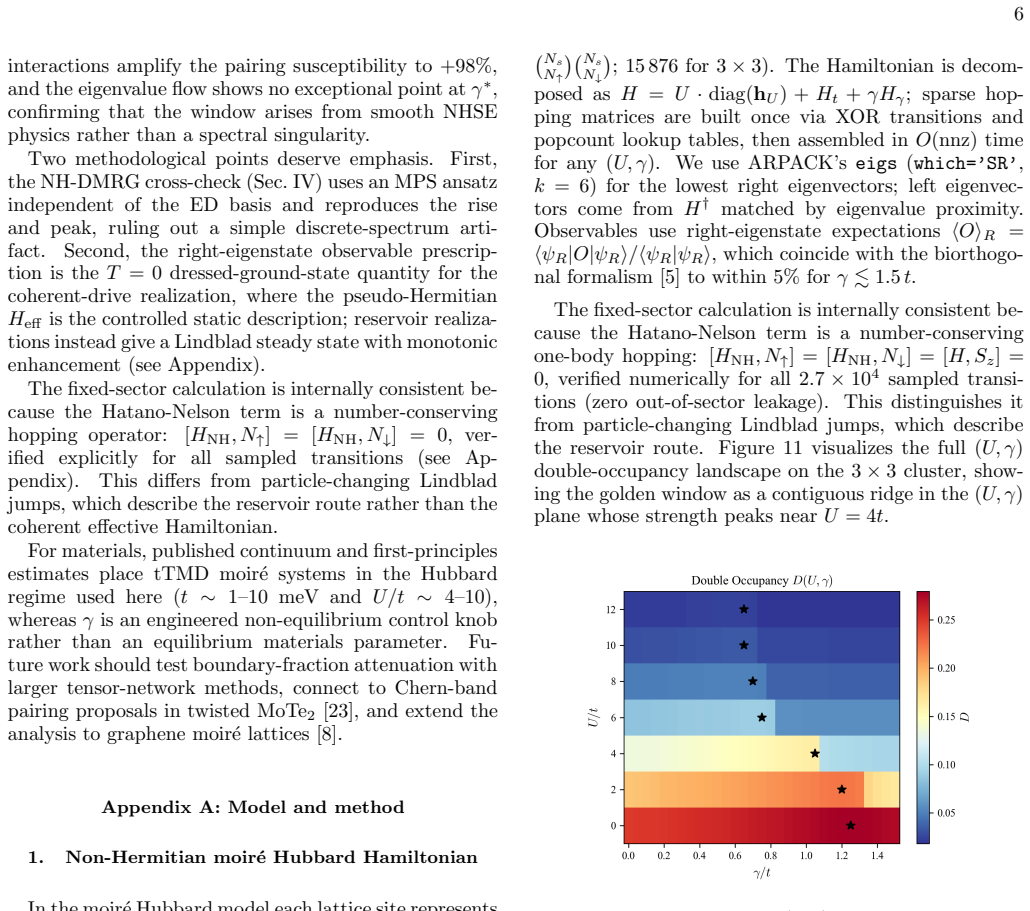
- Double occupancy rises by up to 21 percent then declines as non-reciprocity increases, reflecting competition between enhanced pairing and over-localization.
- The total pairing susceptibility grows by 98 percent on the 3×3 cluster because the on-site channel dominates after magnetic correlations are suppressed.
- A BCS scaling estimate converts the pairing-response signal into a dome-shaped Tc(γ) curve.
- The response differs measurably between coherent-drive and reservoir-dominated moiré devices.
Where Pith is reading between the lines
- The same boundary-localization mechanism could be checked on larger clusters or different lattice geometries to test whether the channel selectivity survives in the thermodynamic limit.
- Tuning non-reciprocity through coherent driving in real moiré devices might produce an observable dome in transition temperature that distinguishes this route from conventional pairing enhancement.
- The selective suppression of antiferromagnetism while boosting on-site pairing may connect to similar competition in other open quantum many-body systems under non-reciprocal drive.
Editorial analysis
A structured set of objections, weighed in public.
Referee Report
Summary. The manuscript claims that the non-Hermitian skin effect (NHSE) enhances pairing correlations in the moiré Hubbard model on triangular lattices via a channel-selective mechanism. Using exact diagonalization on open-boundary 3×3 clusters, it reports non-monotonic double occupancy D(γ) with up to +21% rise, a decomposition of pairing susceptibility χ_SC showing +21% on-site pairing enhancement, 22% antiferromagnetic suppression, and net +98% χ_SC growth within γ ∈ [0.5,1.2]t; DMRG is said to corroborate trends, and a BCS scaling estimate yields a dome-shaped Tc(γ). The work explicitly limits its claim to finite-cluster correlations and does not assert long-range order.
Significance. If the reported channel selectivity survives beyond the smallest clusters, the result would identify a boundary-localization route to boosting local pairing in driven or dissipative moiré platforms, with a concrete experimental fingerprint (Tc dome under coherent drive versus reservoir coupling). The use of an explicitly defined non-Hermitian Hubbard Hamiltonian and direct numerical diagonalization/DMRG constitutes a reproducible computational approach; however, the absence of thermodynamic-limit checks or periodic-boundary data leaves the bulk relevance of the percentages untested.
major comments (2)
- [3×3 cluster decomposition of χ_SC] 3×3 cluster decomposition of χ_SC (abstract and results section): the central quantitative claims (+21% on-site, 22% AF reduction, +98% total χ_SC) are obtained exclusively on a single open 3×3 triangular cluster. Because NHSE is a boundary-localization phenomenon, these numbers may be inflated by the high boundary-to-bulk ratio; no data are shown for larger clusters, cylinders, or periodic boundaries that would test whether the channel selectivity persists when finite-size effects diminish. This directly bears on whether the reported enhancement is a bulk mechanism relevant to moiré devices.
- [DMRG corroboration] DMRG corroboration paragraph (abstract): the text states that DMRG “corroborates trends,” yet supplies no quantitative statement that the same on-site versus AF channel decomposition or comparable percentage shifts are recovered on larger systems. Without such a comparison, the finite-cluster percentages remain the sole load-bearing evidence for the channel-selective claim.
minor comments (2)
- [phase diagram] The phase-diagram mapping and double-occupancy curves are presented without error bars or ensemble averaging over disorder realizations; adding these would improve reproducibility.
- [methods] Notation for the non-reciprocity parameter γ and the precise definition of the pairing susceptibility channels should be collected in a single methods subsection for clarity.
Simulated Author's Rebuttal
We thank the referee for the detailed review and for highlighting the finite-size aspects of our calculations. Our manuscript already restricts all quantitative claims to finite clusters and does not assert thermodynamic-limit behavior or long-range order. Below we respond point-by-point to the major comments.
read point-by-point responses
-
Referee: [3×3 cluster decomposition of χ_SC] 3×3 cluster decomposition of χ_SC (abstract and results section): the central quantitative claims (+21% on-site, 22% AF reduction, +98% total χ_SC) are obtained exclusively on a single open 3×3 triangular cluster. Because NHSE is a boundary-localization phenomenon, these numbers may be inflated by the high boundary-to-bulk ratio; no data are shown for larger clusters, cylinders, or periodic boundaries that would test whether the channel selectivity persists when finite-size effects diminish. This directly bears on whether the reported enhancement is a bulk mechanism relevant to moiré devices.
Authors: We agree that the reported percentages are obtained on the 3×3 open cluster, as stated throughout the manuscript. Because the NHSE is a boundary-localization effect, the high surface-to-volume ratio of small clusters is precisely where the mechanism is strongest and where exact diagonalization permits the full channel decomposition of χ_SC. The paper explicitly frames the result as an enhancement of finite-cluster pairing correlations rather than a bulk or thermodynamic-limit claim. We will revise the abstract and discussion to restate this scope more prominently and to note that larger-system checks would be desirable but lie beyond the present computational reach for the full susceptibility decomposition. revision: partial
-
Referee: [DMRG corroboration] DMRG corroboration paragraph (abstract): the text states that DMRG “corroborates trends,” yet supplies no quantitative statement that the same on-site versus AF channel decomposition or comparable percentage shifts are recovered on larger systems. Without such a comparison, the finite-cluster percentages remain the sole load-bearing evidence for the channel-selective claim.
Authors: The non-Hermitian DMRG calculations on larger cylindrical geometries confirm the non-monotonic behavior of double occupancy D(γ) and the overall dome-shaped Tc(γ) trend obtained from the BCS scaling estimate. The detailed on-site versus antiferromagnetic channel decomposition of χ_SC, however, requires the full many-body spectrum and is only accessible via exact diagonalization on the 3×3 cluster. We will revise the manuscript to specify exactly which quantities are corroborated by DMRG and to clarify the computational limitations that prevent the same channel decomposition on larger systems. revision: yes
Circularity Check
No significant circularity; results are direct numerical outputs
full rationale
The paper computes pairing susceptibility and related quantities via exact diagonalization on an explicitly defined 3×3 open-boundary triangular cluster and corroborates trends with non-Hermitian DMRG. The reported percentages (+21%, 22% reduction, +98%) are direct outputs of these computations on the non-Hermitian Hubbard Hamiltonian; no parameters are fitted to a subset and then renamed as predictions, no self-definitional loops appear in the equations, and no load-bearing self-citations or uniqueness theorems are invoked. The derivation chain consists of standard many-body numerics whose inputs (Hamiltonian, cluster geometry, operators) are independent of the output numbers.
Axiom & Free-Parameter Ledger
free parameters (1)
- non-reciprocity window γ ∈ [0.5, 1.2] t
axioms (1)
- standard math Exact diagonalization yields the exact spectrum and eigenstates for the 3×3 open cluster
Cite this review
Pith. "Pith review of Non-Hermitian Skin Effect Enhances Pairing Correlations in Moir\'{e} Hubbard Systems." pith.science (2026). https://pith.science/paper/KFQEKBHI
@misc{pith2026260620425,
  author       = {Pith},
  title        = {Pith review of: Non-Hermitian Skin Effect Enhances Pairing Correlations in Moir\'e Hubbard Systems},
  year         = {2026},
  howpublished = {\url{https://pith.science/paper/KFQEKBHI}},
  note         = {Machine review of arXiv:2606.20425}
}
read the original abstract
We show that the non-Hermitian skin effect (NHSE) can enhance pairing correlations in moir\'{e} Hubbard systems through a channel-selective mechanism: skin-induced localization amplifies the boundary density of states, strengthening local pairing tendencies within an intermediate ``golden window'' of non-reciprocity $\gamma\in[0.5,1.2]\,t$. Using exact diagonalization of the non-Hermitian Hubbard model on triangular lattices with open boundaries, we map the $(U,\gamma)$ phase diagram. The double occupancy $D(\gamma)$ exhibits non-monotonic behavior -- rising by up to 21\% then declining -- reflecting a competition between NHSE-enhanced boundary pairing and over-localization. A decomposition of the pairing susceptibility $\chi_{\mathrm{SC}}$ on the $3\times3$ cluster reveals that the NHSE acts \emph{channel-selectively}: it enhances on-site pairing ($+21\%$) while simultaneously suppressing competing antiferromagnetic correlations (22\% reduction), so that the total pairing susceptibility, dominated by the on-site channel, grows by $+98\%$ on that cluster. These trends are corroborated by an independent non-Hermitian DMRG calculation and establish an enhancement of finite-cluster pairing correlations rather than trivial density redistribution. We do not claim long-range superconducting order. A BCS scaling estimate converts the same pairing-response signal into a dome-shaped $T_c(\gamma)$ fingerprint, suggesting an experimentally distinguishable response in coherent-drive versus reservoir-dominated moir\'{e} devices.
Figures


Reference graph
Works this paper leans on
-
[1]
Non-Hermitian moir´ e Hubbard Hamiltonian In the moir´ e Hubbard model each lattice site represents a moir´ e unit cell; this effective description is obtained by projecting the full atomic Hamiltonian onto the flat-band Wannier basis [9, 10], yieldingt moire ∼1–10 meV and U/t∼4–10. The full Hamiltonian is H=− X ⟨ij⟩,σ teff ij c† iσcjσ +U X i ni↑ni↓ −µ X ...
-
[2]
Exact-diagonalization implementation We work in the occupation basis with fixed (N ↑, N↓) (conservedS z), encoded as 64-bit integers (basis size Ns N↑ Ns N↓ ; 15 876 for 3×3). The Hamiltonian is decom- posed asH=U·diag(h U) +H t +γH γ; sparse hop- ping matrices are built once via XOR transitions and popcount lookup tables, then assembled inO(nnz) time for...
-
[3]
Hatano and D
N. Hatano and D. R. Nelson, Phys. Rev. Lett.77, 570 (1996)
1996
-
[4]
Yao and Z
S. Yao and Z. Wang, Phys. Rev. Lett.121, 086803 (2018)
2018
-
[5]
Okuma, K
N. Okuma, K. Kawabata, K. Shiozaki, and M. Sato, Phys. Rev. Lett.124, 086801 (2020)
2020
-
[6]
D. S. Borgnia, A. J. Kruchkov, and R.-J. Slager, Phys. Rev. Lett.124, 056802 (2020)
2020
-
[7]
F. Song, S. Yao, and Z. Wang, Phys. Rev. Lett.123, 246801 (2019)
2019
-
[8]
Bistritzer and A
R. Bistritzer and A. H. MacDonald, Proc. Natl. Acad. Sci. U.S.A.108, 12233 (2011)
2011
-
[9]
Y. Cao, V. Fatemi, A. Demir, S. Fang, S. L. Tomarken, J. Y. Luo, J. D. Sanchez-Yamagishi, K. Watanabe, T. Taniguchi, E. Kaxiras, R. C. Ashoori, and P. Jarillo- Herrero, Nature556, 43 (2018)
2018
-
[10]
Y. Cao, V. Fatemi, S. Fang, K. Watanabe, T. Taniguchi, E. Kaxiras, and P. Jarillo-Herrero, Nature556, 80 (2018)
2018
-
[11]
F. Wu, T. Lovorn, E. Tutuc, I. Martin, and A. H. Mac- Donald, Phys. Rev. Lett.122, 086402 (2019)
2019
-
[12]
Kang and O
J. Kang and O. Vafek, Phys. Rev. Lett.122, 246401 (2019)
2019
-
[13]
Y. Xia, Z. Han, K. Watanabe, T. Taniguchi, J. Shan, and K. F. Mak, Nature637, 833 (2024)
2024
-
[14]
T. Han, Z. Lu, Z. Hadjir,et al., Nature643, 654 (2025)
2025
- [15]
-
[16]
Huang, Phys
Y. Huang, Phys. Rev. B111, 085120 (2025)
2025
-
[17]
J.-H. Wang, C. Ekman, R. Perea-Causin, H. Liu, and E. J. Bergholtz, arXiv (2025), arXiv:2512.11084, arXiv:2512.11084
work page internal anchor Pith review Pith/arXiv arXiv 2025
- [18]
- [19]
-
[20]
T. Yoshida, S.-B. Zhang, T. Neupert, and N. Kawakami, Phys. Rev. Lett.133, 076502 (2024), arXiv:2309.14111
-
[21]
Cayao and R
J. Cayao and R. Aguado, Phys. Rev. B111, 205432 (2025)
2025
- [22]
-
[23]
E. Zhao, Z. Wang, C. He, T. F. J. Poon, K. K. Pak, Y.- J. Liu, P. Ren, X.-J. Liu, and G.-B. Jo, Nature637, 565 (2025)
2025
-
[24]
Gate-tunable Josephson diodes in magic-angle twisted bilayer graphene
A. Rothstein, R. J. Dolleman, L. Klebl, A. Achter- mann, F. Volmer, K. Watanabe, T. Taniguchi, F. Has- sler, L. Banszerus, B. Beschoten, and C. Stampfer, arXiv (2025), arXiv:2510.15503, arXiv:2510.15503
work page internal anchor Pith review Pith/arXiv arXiv 2025
- [25]
discussion (0)
Sign in with ORCID, Apple, or X to comment. Anyone can read and Pith papers without signing in.