REVIEW 2 major objections 5 minor 60 references
A lightweight UAV detector keeps small objects visible by symmetric sampling and scale-aware fusion that switches with model size.
Reviewed by Pith at T0; open to challenge. T0 means a machine referee read the full paper against a public rubric. the ladder, T0–T4 →
T0 review · grok-4.5
2026-07-11 21:30 UTC pith:KFQPUSJJ
load-bearing objection Solid engineering paper: two practical modules and a usable mul/add fusion heuristic that actually move the lightweight UAV detector frontier, with clean ablations and open code. the 2 major comments →
FRFDet: Efficient UAV Small Object Detection with Symmetric Sampling and Scalable Fusion
The pith
A machine-rendered reading of the paper's core claim, the machinery that carries it, and where it could break.
Core claim
The paper establishes that small-object detection in UAV imagery improves when feature sampling is made approximately symmetric (via IBS) and when cross-scale fusion is chosen according to model capacity (multiplication for narrow models, addition for wider ones via SFRCF). These two design choices together yield state-of-the-art accuracy among lightweight single-stage detectors at low parameter, FLOP and latency cost.
What carries the argument
Inverse Bidirectional Sampling (IBS) — a learnable expansion-compression unit plus spatial reordering that is inverted for upsampling — and Scale-Feature Relationship Cross-Fusion (SFRCF), which selects inter-group multiplication or addition according to model width.
Load-bearing premise
The claim that multiplication suits compact models and addition suits wider ones is a general capacity effect, not an artifact of the YOLO-based architecture, training recipe, or the three UAV datasets used to observe the trend.
What would settle it
Train a non-YOLO backbone family of matching widths on the same UAV splits and check whether the multiplication-versus-addition preference reverses or disappears; if it does, the scale-dependent fusion rule is architecture-specific rather than general.
Editorial analysis
A structured set of objections, weighed in public.
Referee Report
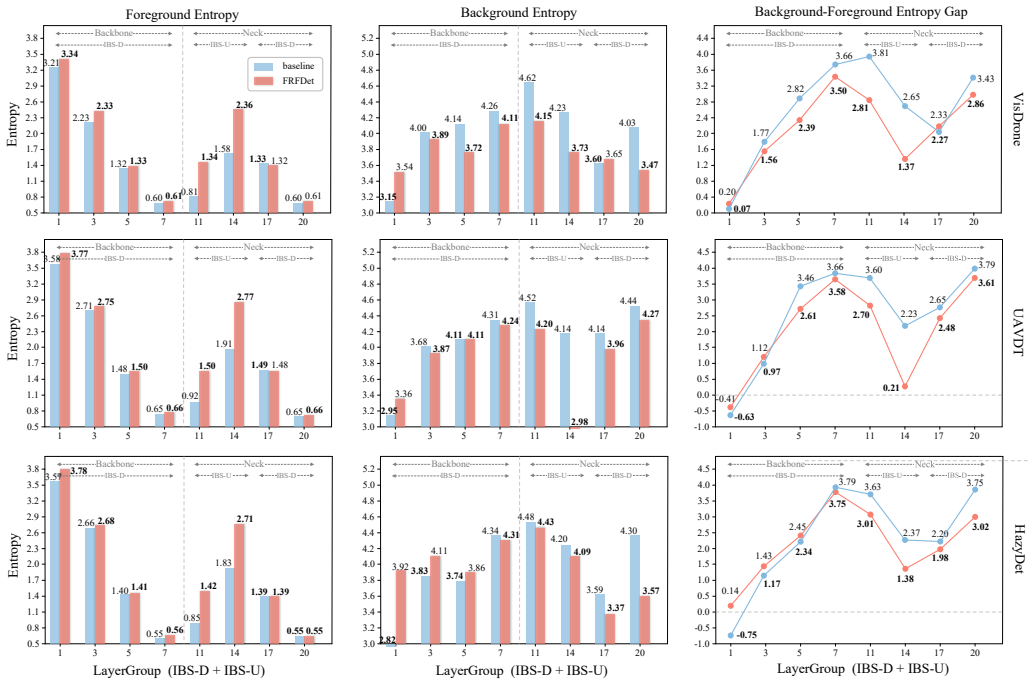
Summary. The paper proposes FRFDet, a lightweight single-stage detector for UAV small-object detection built on a YOLO11-style pipeline. It introduces two modules: Inverse Bidirectional Sampling (IBS), a learnable symmetric expansion–compression and reorg operator for down- and up-sampling that aims to preserve fine spatial detail and reduce background redundancy (Eqs. 1–2 and Appendix B), and Scale-Feature Relationship Cross-Fusion (SFRCF), a group-wise fusion head that uses inter-group multiplication for compact models and addition for wider ones (Eqs. 3–5, Fig. 5). Experiments on VisDrone, UAVDT, HazyDet, and MS COCO report competitive or SOTA AP among lightweight real-time detectors at modest parameter/FLOP/FPS cost, with component ablations (Table V), residual and kernel controls (Tables VII–VIII, XI), and entropy analyses (Figs. 6–7) supporting the claimed gains.
Significance. If the reported gains hold under independent reimplementation, the work is a solid, practical contribution to resource-constrained UAV detection: two plug-and-play modules, multi-benchmark evidence including adverse weather (HazyDet), transfer to COCO, and open code. The scale-dependent fusion observation (mul for compact, add for wide) is an interesting empirical design heuristic within the YOLO11-derived family and is backed by controlled width/depth sweeps and entropy diagnostics. Strengths include matched-protocol lightweight comparisons, residual/kernel ablations, and public code. The contribution is incremental rather than foundational, but well suited to the applied CV / remote-sensing detection literature.
major comments (2)
- Section III.C and Fig. 5 (with Appendix A / Table VI): the claim that multiplicative fusion is preferred for compact models and additive for larger ones is presented as a capacity-dependent phenomenon driven by quadratic interaction growth (Eqs. 4–5). All scaling evidence is internal to the FRFDet/YOLO11-derived family (fixed depth 0.5, width 0.25–1.5). The paper should either (i) state this scope limitation explicitly in the abstract and conclusion, or (ii) add at least one external backbone/neck control (e.g., a non-YOLO lightweight detector) so the design rule is not over-generalized beyond the architecture family used to discover it. This does not overturn the SOTA tables but is load-bearing for the interpretive claim about SFRCF.
- Tables I–IV and implementation details (§IV.B): several SOTA comparisons mix 640×640 YOLO-style models with high-resolution two-stage or multi-scale methods (1333×800, 2666×1600) and cluster-cropped settings. While the paper marks “o / ca / dc” and reports its own high-res and cropped variants, a short protocol-matched subset (same input size, same training epochs, same backbone family) would make the “SOTA among lightweight detectors” claim cleaner and reduce the risk that gains are partly protocol-driven. The core lightweight numbers (FRFDet-T/S vs YOLO11/RemDet) already look solid; the request is for clearer isolation rather than new experiments that change the conclusion.
minor comments (5)
- Fig. 2 and §III.B: the “inverse” / bidirectional symmetry of IBS is clear from the red arrows and Eqs. 1–2, but the residual asymmetry (residual kept in IBS-D, removed in IBS-U; Table VIII) should be stated once in the main text, not only in the appendix.
- Table I: FPS for several competitors is missing (“–”); either measure under the same RTX 4090 / batch-1 protocol or drop FPS from those rows to avoid incomplete efficiency claims.
- Notation: C_in / C_mid / C_out and the expansion ratio r appear in Appendix B but are only lightly introduced in the main text; a one-line definition near Eq. (1) would help.
- Typos / consistency: “UA V” spacing, “overlooks” (III.C), and occasional “from-scratch” vs “from scratch” should be cleaned for camera-ready.
- Appendix D entropy analysis is valuable; a brief pointer in §IV.D that the entropy gap supports the redundancy-suppression claim would better connect the appendix to the main narrative.
Circularity Check
No significant circularity: empirical architecture proposal with independent multi-benchmark measurements
full rationale
FRFDet is a standard empirical CV paper proposing two modules (IBS via symmetric expansion-compression + reorganization, SFRCF via scale-dependent mul/add fusion) and evaluating them on public external benchmarks (VisDrone val, UAVDT, HazyDet, MS COCO). Performance claims (SOTA among lightweight detectors, ablations in Table V, scaling in Fig. 5/Appendix A, entropy analysis in Figs. 6-7) are measured quantities, not algebraic consequences of fitted inputs or self-defined quantities. The mul-for-compact / add-for-wide rule is an observation from controlled width/depth sweeps inside the YOLO11-derived family, then adopted as a design choice; it is not presented as a first-principles derivation that forces the reported APs. Self-citations (e.g., RemDet) appear only as comparison baselines, not as load-bearing uniqueness theorems or smuggled ansatze. No equation reduces to its own input by construction, no parameter fitted on a subset is relabeled a prediction of a related quantity, and no central claim rests solely on an unverified self-citation chain. The derivation chain is therefore self-contained against external data.
Axiom & Free-Parameter Ledger
free parameters (3)
- IBS expansion ratio r =
2
- width and depth scaling factors =
see Table VI
- fusion operator choice (mul vs add) =
mul for T/S, add for L/X
axioms (3)
- domain assumption Objects smaller than 32×32 pixels are progressively degraded by conventional down-sampling and occupy <8 % of UAV image area.
- ad hoc to paper Inter-group multiplicative fusion produces an interaction space that grows as C_in² while additive fusion grows linearly.
- standard math Shannon entropy of discretized feature values measures foreground saliency versus background redundancy.
invented entities (2)
-
Inverse Bidirectional Sampling (IBS)
no independent evidence
-
Scale-Feature Relationship Cross-Fusion (SFRCF)
no independent evidence
read the original abstract
Small object detection in Unmanned Aerial Vehicle (UAV) imagery remains challenging under adverse conditions, including complex weather, low illumination, and sensor noise. These challenges mainly stem from severe background clutter, fine-grained detail degradation, and suboptimal semantic-spatial feature fusion, which jointly hinder robust small-object representation. To this end, we propose FRFDet, a lightweight yet effective single-stage detector tailored for UAV-based small object detection. FRFDet proposes two plug-and-play modules: Inverse Bidirectional Sampling (IBS) and Scale-Feature Relationship Cross-Fusion (SFRCF). IBS preserves critical spatial details via channel expansion-compression and bidirectional pattern reconstruction, improving feature alignment. SFRCF explicitly models scale-dependent fusion behaviors, revealing that inter-group element-wise multiplication favors compact models, while inter-group additive fusion benefits larger architectures. Extensive experiments on VisDrone, UAVDT, HazyDet, and MS COCO demonstrate that FRFDet achieves state-of-the-art performance among lightweight detectors with low computational cost, compact parameters, and fast inference, making it well suited for resource-constrained UAV platforms.
Figures




Reference graph
Works this paper leans on
-
[1]
Faster r-cnn: Towards real-time object detection with region proposal networks,
S. Ren, K. He, R. Girshick, and J. Sun, “Faster r-cnn: Towards real-time object detection with region proposal networks,”IEEE transactions on pattern analysis and machine intelligence, vol. 39, no. 6, pp. 1137–1149, 2016
2016
-
[2]
Yolov7: Trainable bag-of-freebies sets new state-of-the-art for real-time object detectors,
C.-Y . Wang, A. Bochkovskiy, and H.-Y . M. Liao, “Yolov7: Trainable bag-of-freebies sets new state-of-the-art for real-time object detectors,” inProceedings of the IEEE/CVF conference on computer vision and pattern recognition, 2023, pp. 7464–7475
2023
-
[3]
An image is worth 16x16 words: Transformers for image recognition at scale,
A. Dosovitskiy, “An image is worth 16x16 words: Transformers for image recognition at scale,”arXiv preprint arXiv:2010.11929, 2020
Pith/arXiv arXiv 2010
-
[4]
Swin transformer: Hierarchical vision transformer using shifted windows,
Z. Liu, Y . Lin, Y . Cao, H. Hu, Y . Wei, Z. Zhang, S. Lin, and B. Guo, “Swin transformer: Hierarchical vision transformer using shifted windows,” inProceedings of the IEEE/CVF international conference on computer vision, 2021, pp. 10 012–10 022
2021
-
[5]
Detrs beat yolos on real-time object detection,
Y . Zhao, W. Lv, S. Xu, J. Wei, G. Wang, Q. Dang, Y . Liu, and J. Chen, “Detrs beat yolos on real-time object detection,” inProceedings of the IEEE/CVF Conference on Computer Vision and Pattern Recognition, 2024, pp. 16 965–16 974
2024
-
[6]
Mamba: Linear-time sequence modeling with selective state spaces,
A. Gu and T. Dao, “Mamba: Linear-time sequence modeling with selective state spaces,”arXiv preprint arXiv:2312.00752, 2023
Pith/arXiv arXiv 2023
-
[7]
Microsoft coco: Common objects in context,
T.-Y . Lin, M. Maire, S. Belongie, J. Hays, P. Perona, D. Ramanan, P. Doll ´ar, and C. L. Zitnick, “Microsoft coco: Common objects in context,” inComputer Vision–ECCV 2014: 13th European Conference, Zurich, Switzerland, September 6-12, 2014, Proceedings, Part V 13. Springer, 2014, pp. 740–755
2014
-
[8]
Refining activation down- sampling with softpool,
A. Stergiou, R. Poppe, and G. Kalliatakis, “Refining activation down- sampling with softpool,” inProceedings of the IEEE/CVF International Conference on Computer Vision (ICCV), October 2021, pp. 10 357– 10 366
2021
-
[9]
Feature selective anchor-free module for single-shot object detection,
C. Zhu, Y . He, and M. Savvides, “Feature selective anchor-free module for single-shot object detection,” inProceedings of the IEEE/CVF conference on computer vision and pattern recognition, 2019, pp. 840– 849
2019
-
[10]
Adaptive sparse convolutional networks with global context enhancement for faster object detection on drone images,
B. Du, Y . Huang, J. Chen, and D. Huang, “Adaptive sparse convolutional networks with global context enhancement for faster object detection on drone images,” inProceedings of the IEEE/CVF conference on computer vision and pattern recognition, 2023, pp. 13 435–13 444
2023
-
[11]
Remdet: Rethinking efficient model design for uav object detection,
C. Li, R. Zhao, Z. Wang, H. Xu, and X. Zhu, “Remdet: Rethinking efficient model design for uav object detection,” inProceedings of the AAAI Conference on Artificial Intelligence, vol. 39, no. 5, 2025, pp. 4643–4651
2025
-
[12]
Slicing aided hyper inference and fine-tuning for small object detection,
F. C. Akyon, S. O. Altinuc, and A. Temizel, “Slicing aided hyper inference and fine-tuning for small object detection,” in2022 IEEE international conference on image processing (ICIP). IEEE, 2022, pp. 966–970
2022
-
[13]
Ufpmp-det: Toward accurate and efficient object detection on drone imagery,
Y . Huang, J. Chen, and D. Huang, “Ufpmp-det: Toward accurate and efficient object detection on drone imagery,” inProceedings of the AAAI conference on artificial intelligence, vol. 36, no. 1, 2022, pp. 1026–1033
2022
-
[14]
A global-local self-adaptive network for drone-view object detection,
S. Deng, S. Li, K. Xie, W. Song, X. Liao, A. Hao, and H. Qin, “A global-local self-adaptive network for drone-view object detection,” IEEE Transactions on Image Processing, vol. 30, pp. 1556–1569, 2020
2020
-
[15]
Hrdnet: High-resolution detection network for small objects,
Z. Liu, G. Gao, L. Sun, and Z. Fang, “Hrdnet: High-resolution detection network for small objects,” in2021 IEEE international conference on multimedia and expo (ICME). IEEE, 2021, pp. 1–6
2021
-
[16]
Visdrone-det2019: The vision meets drone object detection in image challenge results,
D. Du, P. Zhu, L. Wen, X. Bian, H. Lin, Q. Hu, T. Peng, J. Zheng, X. Wang, Y . Zhanget al., “Visdrone-det2019: The vision meets drone object detection in image challenge results,” inProceedings of the IEEE/CVF international conference on computer vision workshops, 2019, pp. 0–0
2019
-
[17]
The unmanned aerial vehicle benchmark: Object detection and tracking,
D. Du, Y . Qi, H. Yu, Y . Yang, K. Duan, G. Li, W. Zhang, Q. Huang, and Q. Tian, “The unmanned aerial vehicle benchmark: Object detection and tracking,” inProceedings of the European conference on computer vision (ECCV), 2018, pp. 370–386
2018
-
[18]
Hazydet: Open-source benchmark for drone- view object detection with depth-cues in hazy scenes,
C. Feng, Z. Chen, R. Kou, G. Gao, C. Wang, X. Li, X. Shu, Y . Dai, Q. Fu, and J. Yang, “Hazydet: Open-source benchmark for drone- view object detection with depth-cues in hazy scenes,”arXiv preprint arXiv:2409.19833, 2024
Pith/arXiv arXiv 2024
-
[19]
Focal loss for dense object detection,
T.-Y . Lin, P. Goyal, R. Girshick, K. He, and P. Doll ´ar, “Focal loss for dense object detection,” inProceedings of the IEEE international conference on computer vision, 2017, pp. 2980–2988
2017
-
[20]
Bridging the gap between anchor-based and anchor-free detection via adaptive training sample selection,
S. Zhang, C. Chi, Y . Yao, Z. Lei, and S. Z. Li, “Bridging the gap between anchor-based and anchor-free detection via adaptive training sample selection,” inProceedings of the IEEE/CVF conference on computer vision and pattern recognition, 2020, pp. 9759–9768
2020
-
[21]
Disentangle your dense object detector,
Z. Chen, C. Yang, Q. Li, F. Zhao, Z.-J. Zha, and F. Wu, “Disentangle your dense object detector,” inProceedings of the 29th ACM interna- tional conference on multimedia, 2021, pp. 4939–4948
2021
-
[22]
Reppoints: Point set representation for object detection,
Z. Yang, S. Liu, H. Hu, L. Wang, and S. Lin, “Reppoints: Point set representation for object detection,” inProceedings of the IEEE/CVF international conference on computer vision, 2019, pp. 9657–9666
2019
-
[23]
Fcos: Fully convolutional one- stage object detection,
Z. Tian, C. Shen, H. Chen, and T. He, “Fcos: Fully convolutional one- stage object detection,” inProceedings of the IEEE/CVF international conference on computer vision, 2019, pp. 9627–9636
2019
-
[24]
Centernet: Keypoint triplets for object detection,
K. Duan, S. Bai, L. Xie, H. Qi, Q. Huang, and Q. Tian, “Centernet: Keypoint triplets for object detection,” inProceedings of the IEEE/CVF international conference on computer vision, 2019, pp. 6569–6578
2019
-
[25]
Generalized focal loss: Learning qualified and distributed bounding boxes for dense object detection,
X. Li, W. Wang, L. Wu, S. Chen, X. Hu, J. Li, J. Tang, and J. Yang, “Generalized focal loss: Learning qualified and distributed bounding boxes for dense object detection,”Advances in neural information processing systems, vol. 33, pp. 21 002–21 012, 2020
2020
-
[26]
Tood: Task- aligned one-stage object detection,
C. Feng, Y . Zhong, Y . Gao, M. R. Scott, and W. Huang, “Tood: Task- aligned one-stage object detection,” in2021 IEEE/CVF International Conference on Computer Vision (ICCV). IEEE Computer Society, 2021, pp. 3490–3499
2021
-
[27]
End-to-end object detection with transformers,
N. Carion, F. Massa, G. Synnaeve, N. Usunier, A. Kirillov, and S. Zagoruyko, “End-to-end object detection with transformers,” in European conference on computer vision. Springer, 2020, pp. 213– 229
2020
-
[28]
Deformable detr: Deformable transformers for end-to-end object detection,
X. Zhu, W. Su, L. Lu, B. Li, X. Wang, and J. Dai, “Deformable detr: Deformable transformers for end-to-end object detection,”arXiv preprint arXiv:2010.04159, 2020
Pith/arXiv arXiv 2010
-
[29]
Yolov6 v3. 0: A full-scale reloading,
C. Li, L. Li, Y . Geng, H. Jiang, M. Cheng, B. Zhang, Z. Ke, X. Xu, and X. Chu, “Yolov6 v3. 0: A full-scale reloading,”arXiv preprint arXiv:2301.05586, 2023
Pith/arXiv arXiv 2023
-
[30]
Yolov9: Learning what you want to learn using programmable gradient information,
C.-Y . Wang, I.-H. Yeh, and H.-Y . Mark Liao, “Yolov9: Learning what you want to learn using programmable gradient information,” inEuro- pean conference on computer vision. Springer, 2024, pp. 1–21
2024
-
[31]
Yolov10: Real-time end-to-end object detection,
A. Wang, H. Chen, L. Liu, K. CHEN, Z. Lin, J. Han, and g. ding, “Yolov10: Real-time end-to-end object detection,” inAdvances in Neural Information Processing Systems, A. Globerson, L. Mackey, D. Belgrave, A. Fan, U. Paquet, J. Tomczak, and C. Zhang, Eds., vol. 37. Curran Associates, Inc., 2024, pp. 107 984–108 011. [Online]. Available: https://proceedings...
2024
-
[32]
Ultralytics yolo11,
G. Jocher and J. Qiu, “Ultralytics yolo11,” 2024. [Online]. Available: https://github.com/ultralytics/ultralytics
2024
-
[33]
Yolov12: Attention-centric real-time object detectors,
Y . Tian, Q. Ye, and D. Doermann, “Yolov12: Attention-centric real-time object detectors,”arXiv preprint arXiv:2502.12524, 2025
Pith/arXiv arXiv 2025
-
[34]
Gold- yolo: Efficient object detector via gather-and-distribute mechanism,
C. Wang, W. He, Y . Nie, J. Guo, C. Liu, Y . Wang, and K. Han, “Gold- yolo: Efficient object detector via gather-and-distribute mechanism,” Advances in Neural Information Processing Systems, vol. 36, 2024
2024
-
[35]
Hyper-yolo: When visual object detection meets hypergraph computation,
Y . Feng, J. Huang, S. Du, S. Ying, J.-H. Yong, Y . Li, G. Ding, R. Ji, and Y . Gao, “Hyper-yolo: When visual object detection meets hypergraph computation,”IEEE Transactions on Pattern Analysis and Machine Intelligence, 2024
2024
-
[36]
Clustered object de- tection in aerial images,
F. Yang, H. Fan, P. Chu, E. Blasch, and H. Ling, “Clustered object de- tection in aerial images,” inProceedings of the IEEE/CVF international conference on computer vision, 2019, pp. 8311–8320
2019
-
[37]
Density map guided object detection in aerial images,
C. Li, T. Yang, S. Zhu, C. Chen, and S. Guan, “Density map guided object detection in aerial images,” inproceedings of the IEEE/CVF conference on computer vision and pattern recognition workshops, 2020, pp. 190–191
2020
-
[38]
Coarse-grained density map guided object detection in aerial images,
C. Duan, Z. Wei, C. Zhang, S. Qu, and H. Wang, “Coarse-grained density map guided object detection in aerial images,” inProceedings of the IEEE/CVF International Conference on Computer Vision, 2021, pp. 2789–2798
2021
-
[39]
Querydet: Cascaded sparse query for accelerating high-resolution small object detection,
C. Yang, Z. Huang, and N. Wang, “Querydet: Cascaded sparse query for accelerating high-resolution small object detection,” inProceedings of the IEEE/CVF Conference on computer vision and pattern recognition, 2022, pp. 13 668–13 677
2022
-
[40]
Esod: Efficient small object detection on high-resolution images,
K. Liu, Z. Fu, S. Jin, Z. Chen, F. Zhou, R. Jiang, Y . Chen, and J. Ye, “Esod: Efficient small object detection on high-resolution images,”IEEE Transactions on Image Processing, 2024
2024
-
[41]
Feature pyramid networks for object detection,
T.-Y . Lin, P. Doll´ar, R. Girshick, K. He, B. Hariharan, and S. Belongie, “Feature pyramid networks for object detection,” inProceedings of the IEEE conference on computer vision and pattern recognition, 2017, pp. 2117–2125
2017
-
[42]
Efficientdet: Scalable and efficient object detection,
M. Tan, R. Pang, and Q. V . Le, “Efficientdet: Scalable and efficient object detection,” inProceedings of the IEEE/CVF conference on computer vision and pattern recognition, 2020, pp. 10 781–10 790
2020
-
[43]
Ultralytics yolov8,
G. Jocher, A. Chaurasia, and J. Qiu, “Ultralytics yolov8,” 2023. [Online]. Available: https://github.com/ultralytics/ultralytics
2023
-
[44]
Dtssnet: Dynamic training sample selection network for uav object detection,
L. Chen, C. Liu, W. Li, Q. Xu, and H. Deng, “Dtssnet: Dynamic training sample selection network for uav object detection,”IEEE Transactions on Geoscience and Remote Sensing, 2024
2024
-
[45]
Yolc: You only look clusters for tiny object detection in aerial images,
C. Liu, G. Gao, Z. Huang, Z. Hu, Q. Liu, and Y . Wang, “Yolc: You only look clusters for tiny object detection in aerial images,”IEEE Transactions on Intelligent Transportation Systems, 2024
2024
-
[46]
A lightweight fusion strategy with enhanced inter-layer feature correlation for small object detection,
Y . Xiao, T. Xu, X. Yu, Y . Fang, and J. Li, “A lightweight fusion strategy with enhanced inter-layer feature correlation for small object detection,” IEEE Transactions on Geoscience and Remote Sensing, 2024
2024
-
[47]
Global-local fusion with semantic information-guidance for accurate small object detection in uav aerial images,
Y . Chen, Z. Ye, H. Sun, T. Gong, S. Xiong, and X. Lu, “Global-local fusion with semantic information-guidance for accurate small object detection in uav aerial images,”IEEE Transactions on Geoscience and Remote Sensing, 2025
2025
-
[48]
Explaining neural scaling laws,
Y . Bahri, E. Dyer, J. Kaplan, J. Lee, and U. Sharma, “Explaining neural scaling laws,”Proceedings of the National Academy of Sciences, vol. 121, no. 27, p. e2311878121, 2024
2024
-
[49]
Conditional-pooling for improved data transmission,
E. Bayraktar and C. B. Yigit, “Conditional-pooling for improved data transmission,”Pattern Recognition, p. 109978, 2023. [Online]. Available: https://www.sciencedirect.com/science/article/pii/ S0031320323006763
2023
-
[50]
Carafe: Content-aware reassembly of features,
J. Wang, K. Chen, R. Xu, Z. Liu, C. C. Loy, and D. Lin, “Carafe: Content-aware reassembly of features,” inProceedings of the IEEE/CVF international conference on computer vision, 2019, pp. 3007–3016
2019
-
[51]
Learning to upsample by learning to sample,
W. Liu, H. Lu, H. Fu, and Z. Cao, “Learning to upsample by learning to sample,” inProceedings of the IEEE/CVF International Conference on Computer Vision, 2023, pp. 6027–6037
2023
-
[52]
Afpn: Asymptotic feature pyramid network for object detection,
G. Yang, J. Lei, Z. Zhu, S. Cheng, Z. Feng, and R. Liang, “Afpn: Asymptotic feature pyramid network for object detection,” in2023 IEEE International Conference on Systems, Man, and Cybernetics (SMC). IEEE, 2023, pp. 2184–2189
2023
-
[53]
Centralized feature pyramid for object detection,
Y . Quan, D. Zhang, L. Zhang, and J. Tang, “Centralized feature pyramid for object detection,”IEEE Transactions on Image Processing, 2023
2023
-
[54]
S. Bai, Y . Cai, R. Chen, K. Chen, X. Chen, Z. Cheng, L. Deng, W. Ding, C. Gao, C. Ge, W. Ge, Z. Guo, Q. Huang, J. Huang, F. Huang, B. Hui, S. Jiang, Z. Li, M. Li, M. Li, K. Li, Z. Lin, J. Lin, X. Liu, J. Liu, C. Liu, Y . Liu, D. Liu, S. Liu, D. Lu, R. Luo, C. Lv, R. Men, L. Meng, X. Ren, X. Ren, S. Song, Y . Sun, J. Tang, J. Tu, J. Wan, P. Wang, P. Wang,...
Pith/arXiv arXiv 2025
-
[55]
Glm-4.1 v-thinking: Towards versatile mul- timodal reasoning with scalable reinforcement learning,
W. Hong, W. Yu, X. Gu, G. Wang, G. Gan, H. Tang, J. Cheng, J. Qi, J. Ji, L. Panet al., “Glm-4.1 v-thinking: Towards versatile mul- timodal reasoning with scalable reinforcement learning,”arXiv preprint arXiv:2507.01006, 2025
Pith/arXiv arXiv 2025
-
[56]
Perceive anything: Recognize, explain, cap- tion, and segment anything in images and videos,
W. Lin, X. Wei, R. An, T. Ren, T. Chen, R. Zhang, Z. Guo, W. Zhang, L. Zhang, and H. Li, “Perceive anything: Recognize, explain, cap- tion, and segment anything in images and videos,”arXiv preprint arXiv:2506.05302, 2025
Pith/arXiv arXiv 2025
-
[57]
Personalq: Select, quantize, and serve personalized diffusion models for efficient inference,
Q. Wang, Q. Guo, Y . Sun, J. Yang, D. Zhang, S. Pang, and Q. Guo, “Personalq: Select, quantize, and serve personalized diffusion models for efficient inference,”arXiv preprint arXiv:2603.22943, 2026. A. ARCHITECTURALSCALINGANALYSIS: WIDTH AND DEPTHFACTORS We construct FRFDet models at different scales by adjusting the width and depth factors, as summarize...
arXiv 2026
-
[58]
Discretization into histogram bins: Divide the value range ofxintoKequally spaced binsB 1, B2, ..., BK, and compute the bin countsc: cj = #{x i ∈B j}, j= 1,2, ..., K(18)
-
[59]
Probability normalization: pi = ci PK j=1 cj +ϵ , ϵ >0(19) Here, we setϵto1×10 −9
-
[60]
LayerGroup (IBS- D+IBS-U)
Entropy computation: H(x) =− KX i=1 pi ·log 2(pi), pi >0(20) 1 3 5 7 0.5 0.8 1.1 1.4 1.7 2.0 2.3 2.6 2.9 3.2 3.5 3.8 Foreground Entropy 3.34 2.33 0.60 Entropy 1.32 2.23 1.33 3.21 0.61 11 14 17 20 2.36 0.60 1.33 1.58 1.32 0.61 1.34 0.81 Backbone Neck IBS-D IBS-U IBS-D 1 3 5 7 3.0 3.2 3.4 3.6 3.8 4.0 4.2 4.4 4.6 4.8 5.0 5.2 Background Entropy 3.54 3.89 4.26...
discussion (0)
Sign in with ORCID, Apple, or X to comment. Anyone can read and Pith papers without signing in.