REVIEW 3 major objections 5 minor 43 references
ConBatch-BAL: Batch Bayesian Active Learning under Budget Constraints
T0 review · 3 major / 5 minor · reviewed 2026-08-06 · deepseek-v4-flash
Pith's one-line read This paper claims that adding two simple budget-allocation heuristics on top of the Batch-BALD acquisition function makes batch Bayesian active learning practical under varying annotation costs and budget limits, and that on geolocated…
desk verdict Honest, useful empirical study of two simple budget-aware Batch-BALD wrappers; the new datasets are the real contribution, but the missing random-score ablation leaves the central claim under-supported. read the letter →
The pith
A machine-rendered reading of the paper's core claim, the machinery that carries it, and where it could break.
The reading
What carries the argument
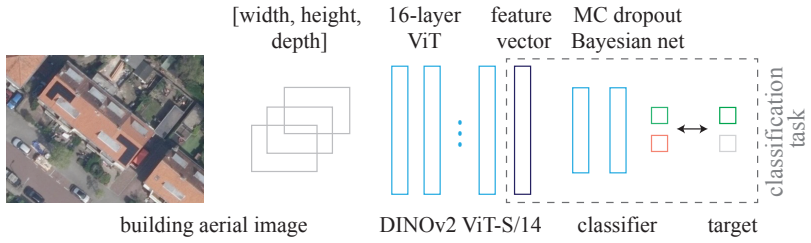
The load-bearing components are the two budget-allocation heuristics and the acquisition function they wrap. Dynamic thresholding ConBatch-BAL maintains an adaptive cost threshold $c_{th}=c_{max}/(n_{max}-(i-1))$ that rebalances the remaining budget across remaining batch steps, while greedy ConBatch-BAL selects the highest mutual-information sample among those affordable under the current remaining budget. Both score candidates with the Batch-BALD acquisition function, mutual information between batch predictions and model parameters, computed via joint entropy minus expected conditional entropy. Uncertainty comes from a Monte Carlo dropout Bayesian neural network, treated as an approximate posterior, operating on 384-dimensional DINOv2 features extracted from the aerial images. The cost configurations—distance, distance-return, and area cost—encode how a selected set maps to annotation expenditure, and they turn batch selection into a knapsack-style problem that the heuristics solve sequentially.
What would settle it
Re-run the same benchmark protocol with uncertainty computed by a stronger approximate inference method, such as stochastic-gradient MCMC or deep ensembles, replacing MC dropout, and measure whether ConBatch-BAL still beats random selection on build6k and nieman17k. If the gap shrinks to near zero, the budget heuristics add little; if it persists, MC-dropout noise is not the driver.
Extended reading notes
Core claim
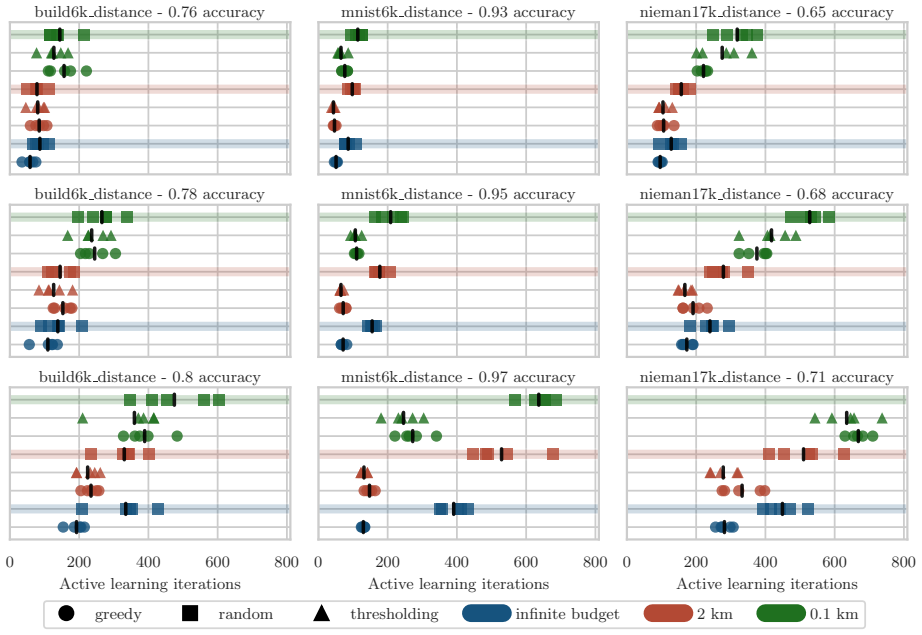
At its core, the paper establishes that the combinatorial problem of selecting a batch of samples under a budget—where the cost of a sample may depend on previously chosen samples and the uncertainty metric is joint mutual information—can be handled by two straightforward sequential heuristics with no exact optimization. The dynamic thresholding strategy sets an initial per-step cost threshold equal to the total budget divided by the maximum batch size, and after each selection resets the threshold to the remaining budget divided by the remaining steps. The greedy strategy simply restricts attention at each step to samples whose cost does not exceed the remaining budget. Both retain the Batch-BALD mutual information score as the acquisition metric computed on a Monte Carlo dropout BNN fed with frozen DINOv2 embeddings. The paper's central empirical claim is that in the distance cost configuration on the released building datasets, these heuristics reduce the number of active learning iterations needed to hit accuracy targets by 20–43% (build6k) and 50–80% (nieman17k) relative to random acquisition, and that constrained runs with a 2 km budget outperform the unconstrained random baseline on all datasets.
Load-bearing premise
The argument assumes that the mutual-information scores from a Monte Carlo dropout network on frozen DINOv2 features rank annotation value correctly on these noisy aerial building images; if that ranking is unreliable, the reported advantage over random selection could vanish regardless of the budget heuristics.
Editorial extensions
If this is right
- Under a 2 km batch distance constraint, both ConBatch-BAL strategies reach the tested accuracy targets in fewer active learning iterations than the unconstrained random baseline on all three datasets.
- The advantage over random selection grows at higher accuracy targets and is largest on the cleaner mnist6k benchmark, whereas the noisier building datasets narrow the gap.
- In the area-cost configuration, greedy ConBatch-BAL generally beats dynamic thresholding because thresholds can lock out costly but informative samples; mnist6k is the exception where thresholding wins.
- For the distance-return configuration, the same ordering holds but all strategies need more iterations because the return trip tightens the budget.
- Effectiveness relative to random selection persists across batch sizes of 2, 5, and 10 on build6k.
Reading between the lines
- If the 2 km finding generalizes, city-scale building surveys can budget drone flights by local travel radius rather than per-building fees, since informative buildings appear to cluster within a few kilometers.
- The framework's separation of acquisition function from cost model suggests the same two heuristics could be dropped onto other acquisition metrics such as BADGE or k-BALD, or onto non-geospatial cost models like per-image expert review time or API pricing.
- Because the authors only retrain a small BNN on frozen DINOv2 features, the reported iteration savings may mostly reflect the quality of the uncertainty signal; a test with stronger posterior approximations would show whether the heuristics themselves or the MC-dropout ranking drive the gains.
- The dynamic thresholding failure mode on build6k area-cost—missing informative expensive samples—suggests a natural hybrid: run greedy when informative samples are spatially concentrated, and thresholding when they are dispersed.
Editorial analysis
A structured set of objections, weighed in public.
Referee Report
Summary. This paper proposes two heuristics for batch Bayesian active learning under annotation budget constraints: dynamic thresholding ConBatch-BAL and greedy ConBatch-BAL, both built on the Batch-BALD mutual-information acquisition function with Monte Carlo dropout BNNs. The budget is modeled as a cost constraint on the batch (e.g., total travel distance or summed area-based costs). The authors benchmark the two strategies against random selection on three datasets—two new geolocated aerial-image building datasets (build6k, nieman17k) and a geolocated MNIST variant—under three cost configurations and multiple budgets, reporting that the proposed strategies reach accuracy targets with fewer active learning iterations than random selection, sometimes even outperforming the unconstrained random baseline. They also release the two building datasets, the DINOv2 embeddings, and code for reproducibility.
Significance. If the empirical claims hold, the paper makes two useful contributions: a simple, practical recipe for incorporating budget constraints into Batch-BALD-style acquisition, and two new real-world geolocated building datasets for cost-sensitive active learning research. The experimental scope is broad: three datasets, three cost models, several budget levels, two additional batch sizes, and five seeds per condition, with code and data released. The strengths are the resource contribution and the transparent reproducibility statement. The main open question is whether the reported gains come from the Bayesian mutual-information ranking or simply from the budget-aware spatial selection mechanics; the paper does not yet provide the control experiment needed to separate these, and the statistical evidence is limited to five seeds without significance tests.
major comments (3)
- [Section 4.1, Algorithm 1] In Algorithm 1, the early-exit condition is "∀x ∈ Dpool \ Ai−1, c(x) > cmax", but the inner selection loop only considers candidates with c(x) ≤ cth. If there exists a candidate with cth < c(x) ≤ cmax and no candidate with c(x) ≤ cth, the foreach set is empty and the subsequent argmax is taken over an empty set, so the algorithm is undefined. The stopping condition should be stated with respect to cth, or the algorithm should include an explicit branch for the case where no candidate is affordable under the current threshold (e.g., relaxing the threshold or terminating). This is a correctness issue in a central contribution and should be fixed in the pseudocode and discussed in the text.
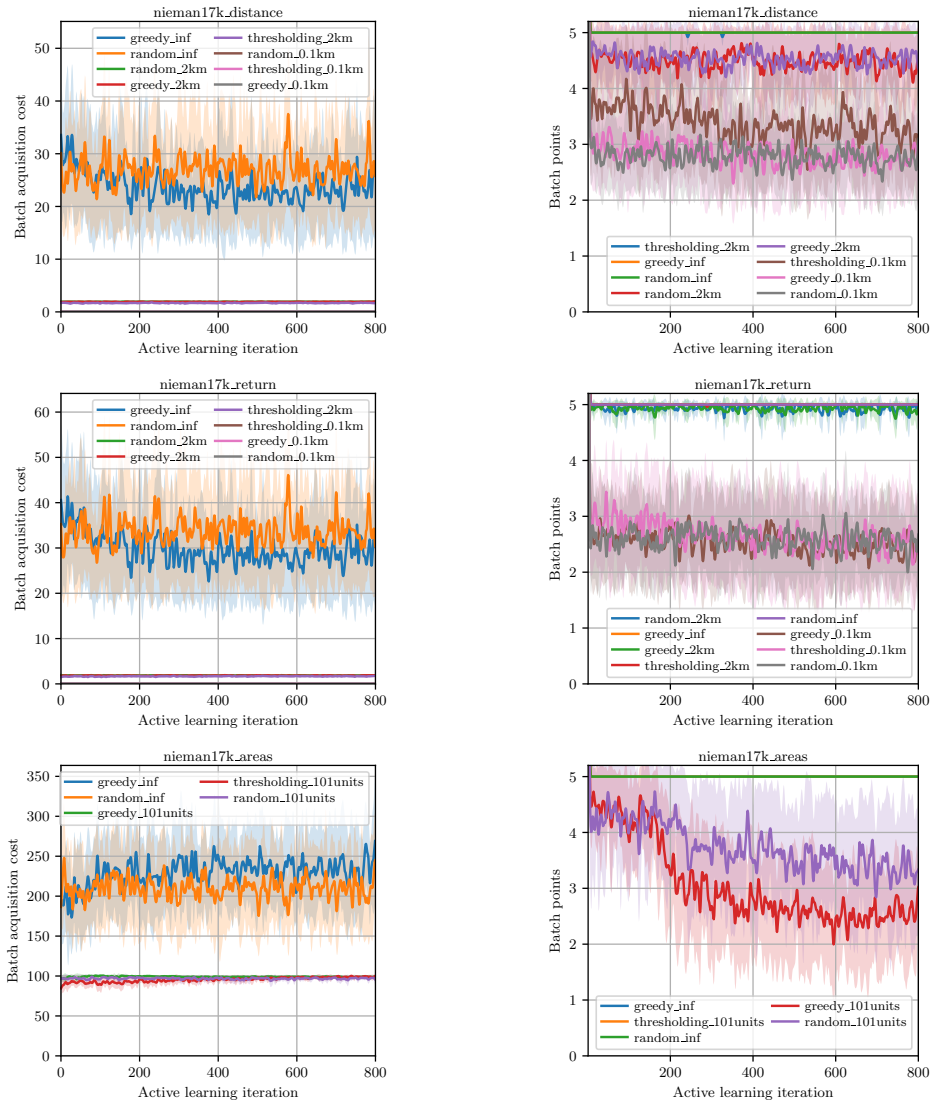
- [Section 6; Appendix C.4; Section 7.1] The paper attributes the observed reductions in active learning iterations to the Bayesian mutual-information ranking, but it compares only against random selection and unconstrained Batch-BALD. Under strict budgets, the random baseline acquires very few points per batch (Appendix C.4, Fig. 15), so any strategy that selects nearby affordable points—even with uninformative scores—could beat random. The limitations section (7.1) itself concedes that the MC-dropout uncertainty estimates "might not be as informative." To make the central claim credible, the authors should add a control baseline that uses the same budget/spatial selection mechanics (greedy or thresholding) with random acquisition scores; if such a baseline matches the ConBatch-BAL results, the advantage is not due to the uncertainty ranking.
- [Section 6; Figures 3-4; Appendix C.2] The headline reductions (e.g., 20-43% and 50-80% fewer iterations) are computed from means over only 5 seeds, with no significance tests or confidence intervals reported. The accuracy targets (e.g., 0.76/0.78/0.80 for build6k; 0.93/0.95/0.97 for mnist6k) are chosen without a stated rule, and the number of iterations-to-target is sensitive to the target's position relative to the learning-curve plateau. The authors should report per-condition variance, perform paired significance tests or bootstrap intervals, and either justify the targets or show the comparison over a range of targets.
minor comments (5)
- [Abstract / Section 8] The abstract and conclusion state that the strategies can "even outperform the unconstrained baseline solutions," but the results in Figure 7a show dynamic thresholding underperforming random selection under the same budget in the area-cost configuration on build6k; please qualify this claim to the configurations and strategies for which it holds.
- [Section 5; Figure 2b] The cost models are described verbally, but the incremental cost c(x) used in Algorithms 1 and 2 is not formally defined for the distance and distance-return configurations (e.g., distance to the previously selected point); a precise definition would improve reproducibility.
- [Appendix B.2] Hyperparameters are tuned on build6k under an infinite budget and then fixed across all datasets and configurations; please comment on the sensitivity of the conclusions to this choice.
- [Section 4; Section 4.1] There are minor typographical issues: "ConBatch- BAL" appears with an extra space in Section 4, and the sentence "The steps for implementing this active learning strategy 2 are outlined in Algorithm 2" is awkwardly worded.
- [Section 4.1, footnote] The complexity expression "O(|Dpool|·T·K nmax)" is ambiguous; please clarify whether K is raised to the power nmax or multiplied.
Circularity Check
No significant circularity: ConBatch-BAL heuristics are not derived from the evaluation metric, and the acquisition scoring is imported from external work (Batch-BALD, MC-dropout); the empirical claims rest on new datasets and benchmark comparisons, not on fitted or self-referential constructs.
full rationale
The paper's derivation chain is self-contained and non-circular. The acquisition function is the Batch-BALD mutual information (Eq. 3-4), attributed to the external prior work of Kirsch et al. [20]; the uncertainty estimates come from Monte Carlo dropout, attributed to Gal and Ghahramani [13]. Algorithms 1 and 2 are explicit heuristic procedures for imposing budget constraints on this external acquisition score; no parameter is fitted to the reported evaluation metric (number of active learning iterations to reach a fixed accuracy target). The ConBatch-BAL strategies maximize mutual information, not the evaluation target, so the reported reductions in iterations are not forced by construction. The hyperparameters are tuned once on build6k under an infinite budget and then held fixed across all datasets and constraints, which is a standard experimental configuration choice rather than a fitted-input-as-prediction pattern. There is no load-bearing self-citation: none of the reference list is authored by the present paper's authors, and no uniqueness theorem or prior result by the same group is invoked to forbid alternative designs. The main weakness identified in the skeptic summary, namely that the budget/spatial mechanics may be responsible for the gains rather than the mutual-information scores, is a missing-ablation concern about attribution, not circularity: the random baseline is an independent stochastic acquisition process, and the paper explicitly concedes in Section 7.1 that MC-dropout uncertainty estimates 'might not be as informative.' That concession weakens the strength of the central interpretive claim but does not make the derivation equivalent to its inputs. Therefore, no circular step can be exhibited under the required standard, and the appropriate score is 0.
Assumptions & free parameters
free parameters (2)
- Accuracy targets per dataset =
build6k: 0.76, 0.78, 0.80; mnist6k: 0.93, 0.95, 0.97; nieman17k: 0.65, 0.68, 0.71
- BNN hyperparameters =
2 hidden layers, width 256, dropout 0.1, 100 forward passes, 5 batch steps
assumptions (4)
- domain assumption Batch-BALD mutual information is an effective acquisition score for ranking annotation value.
- domain assumption Monte Carlo dropout provides a valid approximate Bayesian posterior.
- domain assumption Frozen DINOv2 embeddings retain sufficient information for energy-efficiency and typology classification from aerial images.
- domain assumption Annotation cost is well modeled by travel distance, distance with return, or area-based cost.
Cite this review
Pith. "Pith review of ConBatch-BAL: Batch Bayesian Active Learning under Budget Constraints." pith.science (2026). https://pith.science/paper/KG6TUVBB
@misc{pith2026250704929,
  author       = {Pith},
  title        = {Pith review of: ConBatch-BAL: Batch Bayesian Active Learning under Budget Constraints},
  year         = {2026},
  howpublished = {\url{https://pith.science/paper/KG6TUVBB}},
  note         = {Machine review of arXiv:2507.04929}
}
read the original abstract
Varying annotation costs among data points and budget constraints can hinder the adoption of active learning strategies in real-world applications. This work introduces two Bayesian active learning strategies for batch acquisition under constraints (ConBatch-BAL), one based on dynamic thresholding and one following greedy acquisition. Both select samples using uncertainty metrics computed via Bayesian neural networks. The dynamic thresholding strategy redistributes the budget across the batch, while the greedy one selects the top-ranked sample at each step, limited by the remaining budget. Focusing on scenarios with costly data annotation and geospatial constraints, we also release two new real-world datasets containing geolocated aerial images of buildings, annotated with energy efficiency or typology classes. The ConBatch-BAL strategies are benchmarked against a random acquisition baseline on these datasets under various budget and cost scenarios. The results show that the developed ConBatch-BAL strategies can reduce active learning iterations and data acquisition costs in real-world settings, and even outperform the unconstrained baseline solutions.
Figures


Figures from the paper (16 more)






Reference graph
Works this paper leans on
-
[28]
Batch multi-fidelity active learning with budget constraints
Shibo Li, Jeff M Phillips, Xin Yu, Robert Kirby, and Shandian Zhe. Batch multi-fidelity active learning with budget constraints. Advances in Neural Information Processing Systems , 35: 995–1007, 2022
work page 2022
-
[27]
Georg Krempl, Daniel Kottke, and Vincent Lemaire. Optimised probabilistic active learning (OPAL) for fast, non-myopic, cost-sensitive active classification. Machine Learning, 100:449– 476, 2015
work page 2015
-
[25]
Active learning for cost-sensitive classification
Akshay Krishnamurthy, Alekh Agarwal, Tzu-Kuo Huang, Hal Daum´ e III, and John Langford. Active learning for cost-sensitive classification. Journal of Machine Learning Research, 20(65): 1–50, 2019
work page 2019
-
[1]
Samuel Budd, Emma C Robinson, and Bernhard Kainz. A survey on active learning and human-in-the-loop deep learning for medical image analysis.Medical image analysis, 71:102062, 2021
work page 2021
-
[2]
Active learning for improved semi-supervised semantic segmentation in satellite images
Shasvat Desai and Debasmita Ghose. Active learning for improved semi-supervised semantic segmentation in satellite images. In Proceedings of the IEEE/CVF Winter Conference on Applications of Computer Vision , pages 553–563, 2022
work page 2022
-
[3]
Active learning for structural reliability: Survey, general framework and benchmark
Maliki Moustapha, Stefano Marelli, and Bruno Sudret. Active learning for structural reliability: Survey, general framework and benchmark. Structural Safety, 96:102174, 2022
work page 2022
-
[4]
Deep Bayesian active learning with image data
Yarin Gal, Riashat Islam, and Zoubin Ghahramani. Deep Bayesian active learning with image data. In International Conference on Machine Learning , pages 1183–1192. PMLR, 2017
work page 2017
-
[5]
Bayesian neural networks and density networks
David JC MacKay. Bayesian neural networks and density networks. Nuclear Instruments and Methods in Physics Research Section A: Accelerators, Spectrometers, Detectors and Associated Equipment, 354(1):73–80, 1995
work page 1995
Show all 43 references
-
[6]
Bayesian learning for neural networks , volume 118
Radford M Neal. Bayesian learning for neural networks , volume 118. Springer Science & Business Media, 2012
2012
-
[7]
Deep Bayesian active learning-to-rank with relative annotation for estimation of ulcerative colitis severity
Takeaki Kadota, Hideaki Hayashi, Ryoma Bise, Kiyohito Tanaka, and Seiichi Uchida. Deep Bayesian active learning-to-rank with relative annotation for estimation of ulcerative colitis severity. Medical Image Analysis, 97:103262, 2024
2024
-
[8]
Active learning with convolutional neural networks for hyperspectral image classification using a new Bayesian approach
Juan Mario Haut, Mercedes E Paoletti, Javier Plaza, Jun Li, and Antonio Plaza. Active learning with convolutional neural networks for hyperspectral image classification using a new Bayesian approach. IEEE Transactions on Geoscience and Remote Sensing, 56(11):6440–6461, 2018
2018
-
[9]
Deep Bayesian active learning for natural language processing: Results of a large-scale empirical study
Aditya Siddhant and Zachary C Lipton. Deep Bayesian active learning for natural language processing: Results of a large-scale empirical study. arXiv preprint arXiv:1808.05697 , 2018
2018 arXiv
-
[10]
Challenges in Markov chain Monte Carlo for Bayesian neural networks
Theodore Papamarkou, Jacob Hinkle, M Todd Young, and David Womble. Challenges in Markov chain Monte Carlo for Bayesian neural networks. Statistical Science, 37(3):425–442, 2022
2022
-
[11]
A complete recipe for stochastic gradient MCMC
Yi-An Ma, Tianqi Chen, and Emily Fox. A complete recipe for stochastic gradient MCMC. Advances in Neural Information Processing Systems , 28, 2015
2015
-
[12]
Bayesian model comparison and backprop nets
David MacKay. Bayesian model comparison and backprop nets. Advances in Neural Informa- tion Processing Systems, 4, 1991
1991
-
[13]
Dropout as a Bayesian approximation: Representing model uncertainty in deep learning
Yarin Gal and Zoubin Ghahramani. Dropout as a Bayesian approximation: Representing model uncertainty in deep learning. In International Conference on Machine Learning , pages 1050–1059. PMLR, 2016
2016
-
[14]
Deep Bayesian active learning, A brief survey on recent advances
Salman Mohamadi and Hamidreza Amindavar. Deep Bayesian active learning, A brief survey on recent advances. arXiv preprint arXiv:2012.08044 , 2020. 14
2012 arXiv
-
[15]
A survey on Bayesian deep learning
Hao Wang and Dit-Yan Yeung. A survey on Bayesian deep learning. ACM Computing Surveys, 53(5):1–37, 2020
2020
-
[16]
A review of uncertainty quantification in deep learning: Techniques, applications and challenges
Moloud Abdar, Farhad Pourpanah, Sadiq Hussain, Dana Rezazadegan, Li Liu, Mohammad Ghavamzadeh, Paul Fieguth, Xiaochun Cao, Abbas Khosravi, U Rajendra Acharya, et al. A review of uncertainty quantification in deep learning: Techniques, applications and challenges. Information f...
2021
-
[17]
Uncertainty in deep learning
Yarin Gal. Uncertainty in deep learning . PhD thesis, University of Cambridge, 2016
2016
-
[18]
A mathematical theory of communication
Claude Elwood Shannon. A mathematical theory of communication. The Bell System Technical Journal, 27(3):379–423, 1948
1948
-
[19]
Elementary applied statistics
Linton G Freeman. Elementary applied statistics . John Wiley & Sons, 1975
1975
-
[20]
Batchbald: Efficient and diverse batch acquisition for deep Bayesian active learning
Andreas Kirsch, Joost Van Amersfoort, and Yarin Gal. Batchbald: Efficient and diverse batch acquisition for deep Bayesian active learning. Advances in Neural Information Processing Systems, 32, 2019
2019
-
[21]
Speeding up BatchBALD: A k-BALD family of approximations for active learning
Andreas Kirsch. Speeding up BatchBALD: A k-BALD family of approximations for active learning. arXiv preprint arXiv:2301.09490 , 2023
2023 arXiv
-
[22]
Deep batch active learning by diverse, uncertain gradient lower bounds
Jordan T Ash, Chicheng Zhang, Akshay Krishnamurthy, John Langford, and Alekh Agar- wal. Deep batch active learning by diverse, uncertain gradient lower bounds. arXiv preprint arXiv:1906.03671, 2019
1906 arXiv
-
[23]
Bayesian batch active learning as sparse subset approximation
Robert Pinsler, Jonathan Gordon, Eric Nalisnick, and Jos´ e Miguel Hern´ andez-Lobato. Bayesian batch active learning as sparse subset approximation. Advances in Neural Infor- mation Processing Systems, 32, 2019
2019
-
[24]
Stochastic batch acquisition: A simple baseline for deep active learning
Andreas Kirsch, Sebastian Farquhar, Parmida Atighehchian, Andrew Jesson, Frederic Branchaud-Charron, and Yarin Gal. Stochastic batch acquisition: A simple baseline for deep active learning. arXiv preprint arXiv:2106.12059 , 2021
2021 arXiv
-
[26]
Learning cost-sensitive active classifiers
Russell Greiner, Adam J Grove, and Dan Roth. Learning cost-sensitive active classifiers. Artificial Intelligence, 139(2):137–174, 2002
2002
-
[29]
Aid: A benchmark data set for performance evaluation of aerial scene classification
Gui-Song Xia, Jingwen Hu, Fan Hu, Baoguang Shi, Xiang Bai, Yanfei Zhong, Liangpei Zhang, and Xiaoqiang Lu. Aid: A benchmark data set for performance evaluation of aerial scene classification. IEEE Transactions on Geoscience and Remote Sensing , 55(7):3965–3981, 2017. 15
2017
-
[30]
xView: Objects in context in overhead imagery
Darius Lam, Richard Kuzma, Kevin McGee, Samuel Dooley, Michael Laielli, Matthew Klaric, Yaroslav Bulatov, and Brendan McCord. xView: Objects in context in overhead imagery. arXiv preprint arXiv:1802.07856 , 2018
2018 arXiv
-
[31]
Dota: A large-scale dataset for object detection in aerial images
Gui-Song Xia, Xiang Bai, Jian Ding, Zhen Zhu, Serge Belongie, Jiebo Luo, Mihai Datcu, Marcello Pelillo, and Liangpei Zhang. Dota: A large-scale dataset for object detection in aerial images. In Proceedings of the IEEE Conference on Computer Vision and Pattern Recognition , pag...
2018
-
[32]
SPAGRI-AI: Smart precision agriculture dataset of aerial images at different heights for crop and weed detection using super-resolution
Martin Jonak, Jan Mucha, Stepan Jezek, Daniel Kovac, and Kornel Cziria. SPAGRI-AI: Smart precision agriculture dataset of aerial images at different heights for crop and weed detection using super-resolution. Agricultural Systems, 216:103876, 2024
2024
-
[33]
Estimating building energy efficiency from street view imagery, aerial imagery, and land surface temperature data
Kevin Mayer, Lukas Haas, Tianyuan Huang, Juan Bernab´ e-Moreno, Ram Rajagopal, and Martin Fischer. Estimating building energy efficiency from street view imagery, aerial imagery, and land surface temperature data. Applied Energy, 333:120542, 2023
2023
-
[34]
Review of 50 years of EU energy efficiency policies for buildings
Marina Economidou, Valeria Todeschi, Paolo Bertoldi, Delia D’Agostino, Paolo Zangheri, and Luca Castellazzi. Review of 50 years of EU energy efficiency policies for buildings. Energy and buildings, 225:110322, 2020
2020
-
[35]
The relationship be- tween operational energy demand and embodied energy in Dutch residential buildings
A Koezjakov, D Urge-Vorsatz, W Crijns-Graus, and M Van den Broek. The relationship be- tween operational energy demand and embodied energy in Dutch residential buildings. Energy and Buildings , 165:233–245, 2018
2018
-
[36]
PDOK - Publieke Dienstverlening Op de Kaart
PDOK. PDOK - Publieke Dienstverlening Op de Kaart. https://www.pdok.nl/, 2024. Ac- cessed: 2024-09-27
2024
-
[37]
Dinov2: Learning robust visual features without supervision
Maxime Oquab, Timoth´ ee Darcet, Th´ eo Moutakanni, Huy Vo, Marc Szafraniec, Vasil Khali- dov, Pierre Fernandez, Daniel Haziza, Francisco Massa, Alaaeldin El-Nouby, et al. Dinov2: Learning robust visual features without supervision. arXiv preprint arXiv:2304.07193 , 2023
2023 arXiv
-
[38]
Understanding architecture age and style through deep learning
Maoran Sun, Fan Zhang, Fabio Duarte, and Carlo Ratti. Understanding architecture age and style through deep learning. Cities, 128:103787, 2022
2022
-
[39]
Bayesian learning via stochastic gradient Langevin dynamics
Max Welling and Yee W Teh. Bayesian learning via stochastic gradient Langevin dynamics. In Proceedings of the 28th International Conference on Machine Learning (ICML-11) , pages 681–688, 2011
2011
-
[40]
Stochastic gradient hamiltonian monte carlo
Tianqi Chen, Emily Fox, and Carlos Guestrin. Stochastic gradient hamiltonian monte carlo. In International Conference on Machine Learning , pages 1683–1691, 2014
2014
-
[41]
Cycli- cal stochastic gradient MCMC for Bayesian deep learning
Ruqi Zhang, Chunyuan Li, Jianyi Zhang, Changyou Chen, and Andrew Gordon Wilson. Cycli- cal stochastic gradient MCMC for Bayesian deep learning. arXiv preprint arXiv:1902.03932 , 2019
1902 arXiv
-
[42]
3D BAG viewer
3D BAG. 3D BAG viewer. https://3dbag.nl/en/viewer, 2024. Accessed: 2024-09-27
2024
-
[43]
R VO - Rijksdienst voor Ondernemend Nederland
R VO. R VO - Rijksdienst voor Ondernemend Nederland. https://www.rvo.nl/, 2024. Ac- cessed: 2024-09-27. 16 A Building datasets curation process We leverage open data sources and web services available in the Netherlands to create the released building datasets. Specifically, w...
2024
Reviewed August 6, 2026 · model on record in the stance chip above.
Discussion (0). Continue with ORCID to comment.