Generalized nonparametric regression in reproducing kernel Hilbert spaces: Consistency and rates of convergence
Pith reviewed 2026-06-26 06:37 UTC · model grok-4.3
The pith
Regularized M-estimation in reproducing kernel Hilbert spaces yields consistent estimators with sharp convergence rates via an explicit bias-variance decomposition.
A machine-rendered reading of the paper's core claim, the machinery that carries it, and where it could break.
Core claim
Under mild conditions on the loss function, the regularized M-estimator in an RKHS exists and is measurable. Sharp rates follow from an asymptotic linearisation of the objective, with an explicit bias-variance split governed by a novel complexity measure. The variance is independent of misspecification while the bias is governed by the source condition parameter. In tensor product Sobolev spaces these rates connect to dominating mixed smoothness and thereby circumvent the curse of dimensionality.
What carries the argument
The novel complexity measure that governs the explicit bias-variance decomposition in the convergence rates for regularized M-estimators.
If this is right
- Consistency holds for convex and non-convex losses including bounded robust losses.
- Rates connect tensor product Sobolev spaces to spaces with dominating mixed smoothness.
- The methodology allows asymptotic linearisation without closed-form solutions or global Lipschitz assumptions.
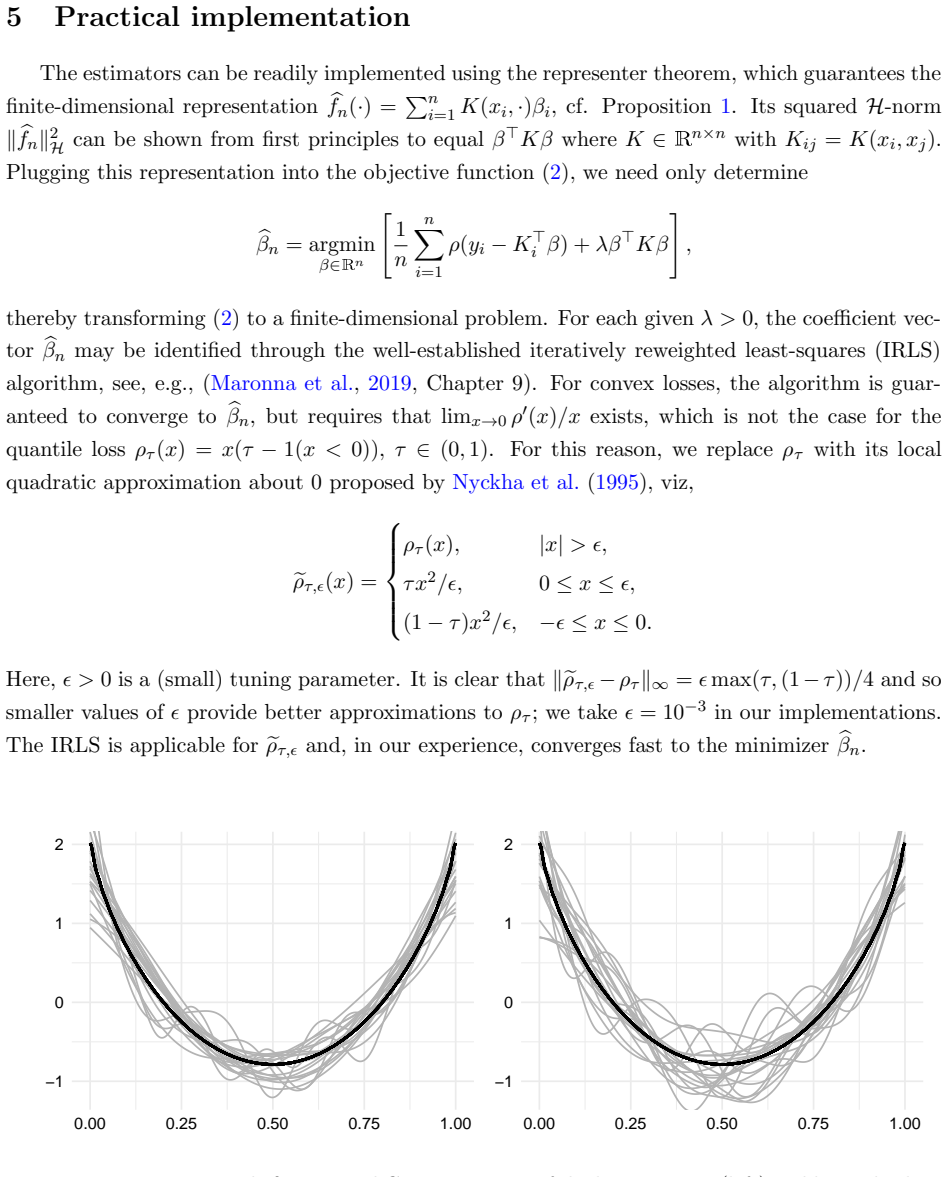
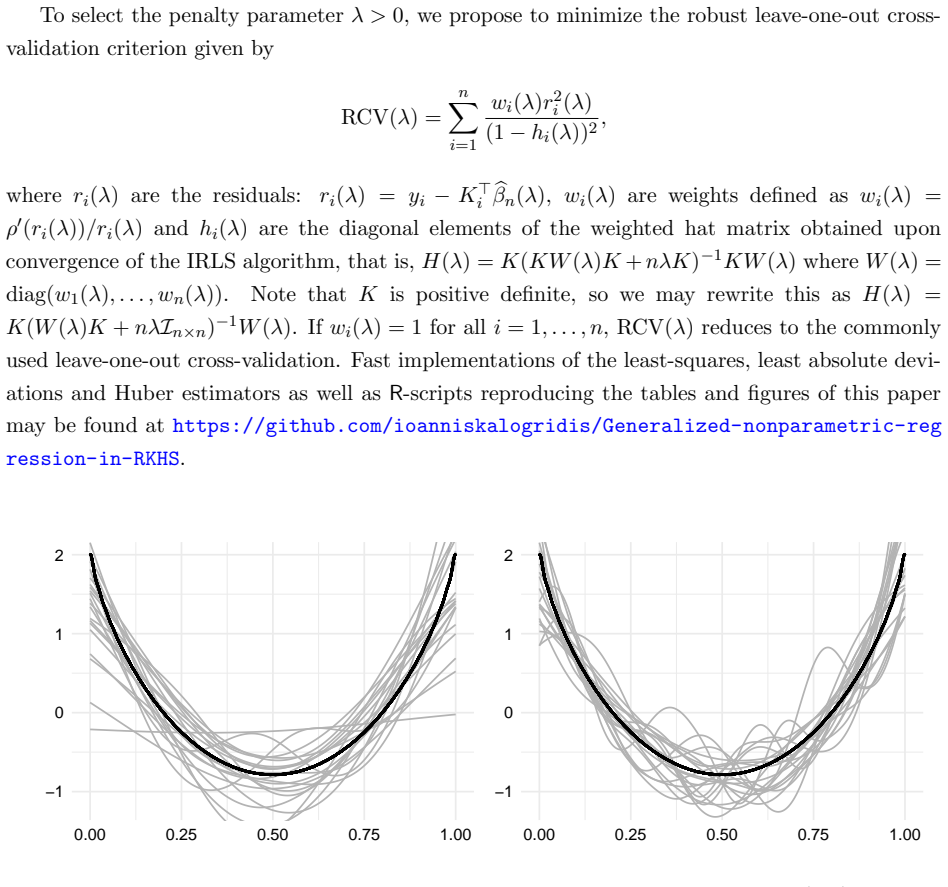
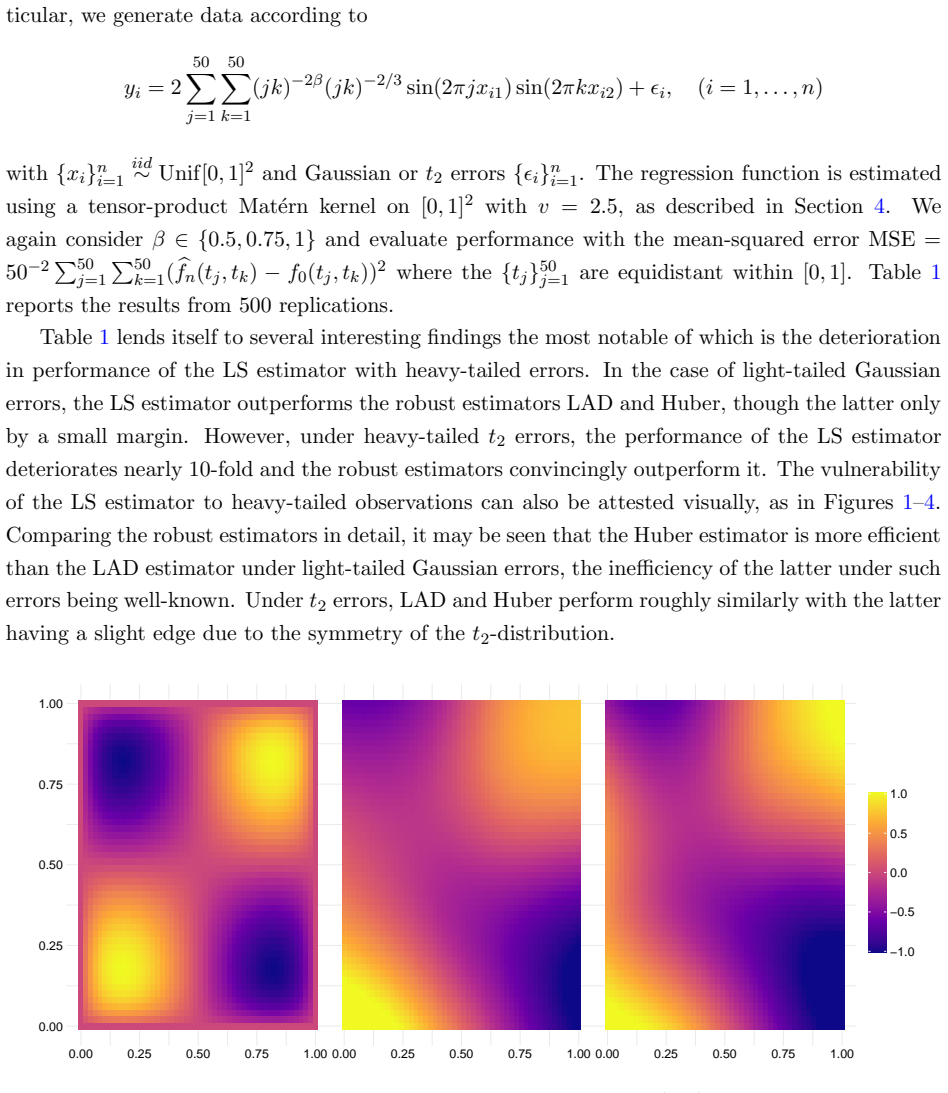
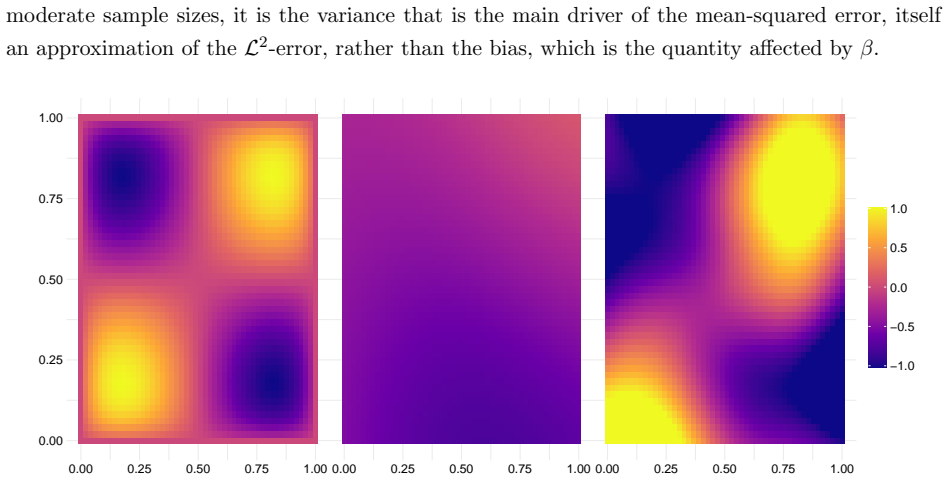
- Estimators can be implemented in C++ with supporting numerical experiments.
Where Pith is reading between the lines
- Similar bias-variance splits may apply to other function spaces beyond Sobolev.
- The independence of variance from misspecification could simplify model checking in practice.
- Extensions to non-regularized settings or different regularizers might follow from the linearisation technique.
Load-bearing premise
The loss function satisfies mild conditions that guarantee existence, measurability, and permit an asymptotic linearisation of the objective.
What would settle it
A counterexample where the variance term of the estimator depends on the degree of misspecification would disprove the claimed independence.
Figures
read the original abstract
We develop a comprehensive theory for regularized M-estimation in reproducing kernel Hilbert spaces. Under mild conditions on the loss we establish existence and measurability of the estimator, covering a wide range of convex and non-convex losses, including bounded robust losses. We further prove sharp rates of convergence with an explicit bias-variance decomposition governed by a novel complexity measure. We show that the variance is independent of misspecification, while the bias depends on a source condition parameter known in the learning literature. For tensor product Sobolev spaces we obtain new rates that connect to spaces of functions with dominating mixed smoothness, substantially extending existing results and explaining why these estimators circumvent the curse of dimensionality. Our methodology, combining elements from both functional analysis and empirical process theory, allows for an asymptotic linearisation of the objective function that avoids both closed-form solutions and global Lipschitz assumptions, and may be of independent interest. The estimators are implemented in C++ and theory is supported by numerical experiments.
Editorial analysis
A structured set of objections, weighed in public.
Referee Report
Summary. The manuscript develops a comprehensive theory for regularized M-estimation in reproducing kernel Hilbert spaces. Under mild conditions on the loss function it establishes existence, measurability, and consistency of the estimator for both convex and non-convex losses (including bounded robust losses). It proves sharp rates of convergence together with an explicit bias-variance decomposition governed by a novel complexity measure; the variance term is stated to be independent of misspecification while the bias depends on a source-condition parameter. For tensor-product Sobolev spaces the paper derives new rates that connect to spaces of dominating mixed smoothness and thereby avoid the curse of dimensionality. The key technical device is an asymptotic linearisation of the regularized objective that combines functional analysis and empirical-process arguments and does not require closed-form solutions or global Lipschitz conditions.
Significance. If the central derivations hold, the work supplies a unified framework for nonparametric M-estimation in RKHS that covers non-convex losses, furnishes an explicit bias-variance split, and yields dimension-independent rates via mixed-smoothness spaces. The asymptotic-linearisation technique may be of independent methodological interest. The combination of functional-analytic and empirical-process tools, together with the novel complexity measure, strengthens the literature on kernel methods beyond the usual convex, Lipschitz setting.
major comments (2)
- [Abstract / methodology paragraph] Abstract / methodology paragraph: the claim that the variance term in the bias-variance decomposition is independent of misspecification rests on an asymptotic linearisation that is asserted to hold under only mild loss conditions. For non-convex losses the linearisation is necessarily local around the population minimizer; because that minimizer itself shifts with the degree of misspecification, the leading stochastic term (and hence the variance) can inherit dependence on misspecification unless the paper supplies uniform control on the Hessian or an explicit decoupling argument. The manuscript must state the precise conditions that guarantee this independence and verify them for the bounded robust losses cited.
- [Section introducing the complexity measure (exact section number not visible in abstract)] The novel complexity measure is introduced as governing the rates; the manuscript should clarify whether this measure is defined independently of the estimator or whether its construction implicitly uses properties of the regularized M-estimator, as any circularity would undermine the claimed parameter-free character of the variance term.
minor comments (1)
- The abstract states that numerical experiments support the theory; a short description of the experimental design, loss functions tested, and observed rates would help readers assess the practical reach of the results.
Simulated Author's Rebuttal
We thank the referee for the careful reading and constructive comments. We address each major comment below.
read point-by-point responses
-
Referee: [Abstract / methodology paragraph] Abstract / methodology paragraph: the claim that the variance term in the bias-variance decomposition is independent of misspecification rests on an asymptotic linearisation that is asserted to hold under only mild loss conditions. For non-convex losses the linearisation is necessarily local around the population minimizer; because that minimizer itself shifts with the degree of misspecification, the leading stochastic term (and hence the variance) can inherit dependence on misspecification unless the paper supplies uniform control on the Hessian or an explicit decoupling argument. The manuscript must state the precise conditions that guarantee this independence and verify them for the bounded robust losses cited.
Authors: The asymptotic linearisation holds under loss conditions that provide uniform Hessian control in a neighborhood of the population minimizer whose size is independent of misspecification; for the bounded robust losses this follows from global Lipschitz continuity together with a uniform bound on the second derivative. These conditions are already stated in the paper but we will add an explicit remark in the bias-variance section that isolates the decoupling argument and verifies it for the cited robust losses. revision: yes
-
Referee: [Section introducing the complexity measure (exact section number not visible in abstract)] The novel complexity measure is introduced as governing the rates; the manuscript should clarify whether this measure is defined independently of the estimator or whether its construction implicitly uses properties of the regularized M-estimator, as any circularity would undermine the claimed parameter-free character of the variance term.
Authors: The complexity measure is constructed solely from the RKHS geometry and the population risk (via entropy integrals over sublevel sets of the risk) and makes no reference to any estimator or sample. We will insert a short clarifying sentence in the section that introduces the measure to state this independence explicitly. revision: yes
Circularity Check
No circularity; derivations rely on external functional analysis and empirical process theory
full rationale
The paper's central results—an asymptotic linearisation of the regularized M-estimator, existence/measurability under mild loss conditions, and an explicit bias-variance decomposition governed by a novel complexity measure—are presented as obtained by combining standard tools from functional analysis and empirical process theory. The source condition is explicitly described as known in the learning literature rather than derived internally, and the complexity measure is introduced as new rather than fitted or self-referential. No self-citation load-bearing steps, self-definitional reductions, or renamings of known results appear in the provided claims or abstract. The derivation chain is therefore self-contained against external benchmarks and does not reduce to its own inputs by construction.
Axiom & Free-Parameter Ledger
axioms (1)
- domain assumption Mild conditions on the loss function
invented entities (1)
-
Novel complexity measure
no independent evidence
Reference graph
Works this paper leans on
-
[1]
(1965).Lectures on Elliptic Boundary Value Problems, D
Agmon, S. (1965).Lectures on Elliptic Boundary Value Problems, D. Van Nostrand Company, Princeton
1965
-
[2]
and Wu, Y
Bai, Z.D. and Wu, Y. (1994). Limiting behavior of M-estimators of regression coefficients in high dimensional linear models I. Scale-dependent case J. Multivariate Anal. (51), 211–239
1994
-
[3]
and Thomas-Agnan, C
Berlinet, A. and Thomas-Agnan, C. (2004).Reproducing Kernel Hilbert Spaces in Probability and
2004
-
[4]
and Zhou, D.X
Cucker, F. and Zhou, D.X. (2005).Learning Theory: An Approximation Theory Viewpoint, Cam- bridge University Press
2005
-
[5]
and De Vito, E
Caponnetto, A. and De Vito, E. (2007). Optimal rates for the regularized least-squares algorithm, Found. Comput. Math. (7), 331–368
2007
-
[6]
and Pichler, A
Dommel, P. and Pichler, A. (2025). On the approximation of kernel functions, J. Mach. Learn. Res. (26), 1–30
2025
-
[7]
(1977) Splines minimizing rotation-invariant semi-norms in Sobolev spaces, in:
Duchon, J. (1977) Splines minimizing rotation-invariant semi-norms in Sobolev spaces, in:
1977
-
[8]
Splines Minimizing Rotation-Invariant Semi-Norms in
Schempp, W. and Zeller, K. (eds), Constructive Theory of Functions of Several Variables, Lecture Notes in Mathematics (571), Springer, Berlin, Heidelberg.doi:10.1007/BFb0086566
-
[9]
and Steinwart, I
Eberts, M. and Steinwart, I. (2013). Optimal regression rates for SVMs using Gaussian kernels, Electron. J. Stat. (7), 1–42
2013
-
[10]
and Steinwart, I
Farooq, M. and Steinwart, I. (2019). Learning rates for kernel-based expectile regression, Mach. Learn. (108), 203–227
2019
-
[11]
and Steinwart, I
Fischer, S. and Steinwart, I. (2020). Sobolev norm learning rates for regularized least-squares algorithms, J. Mach. Learn. Res. (21), 1–38
2020
-
[12]
and Eubank, R
Hsing, T. and Eubank, R. (2015).Theoretical Foundations of Functional Data Analysis, with an Introduction to Linear Operators, Wiley. 29
2015
-
[13]
and Ronchetti, E.M
Huber, P.J. and Ronchetti, E.M. (2009).Robust Statistics, 2nd edition, Wiley
2009
-
[14]
Kalogridis, I. (2022). Asymptotics for M-type smoothing splines with non-smooth objective func- tions, TEST (31), 373–389
2022
-
[15]
and Van Aelst, S
Kalogridis, I. and Van Aelst, S. (2023). Robust optimal estimation of location from discretely sampled functional data, Scand. J. Stat (50), 411–451
2023
-
[16]
and Talagrand, M
Ledoux, M. and Talagrand, M. (1991).Probability in Banach Spaces: Isoperimetry and Processes
1991
-
[17]
and Zhu, J
Li, Y., Liu, Y. and Zhu, J. (2007). Quantile regression in reproducing kernel Hilbert spaces, J. Amer. Statist. Assoc. (102), 255–268
2007
-
[18]
Lin, Y. (2000). Tensor product space ANOVA models, Ann. Statist. (28), 734–755
2000
-
[19]
and Salibi´ an-Barrera, M
Maronna, R.A., Martin, D.R., Yohai, V.J. and Salibi´ an-Barrera, M. (2019).Robust Statistics: Theory and Methods (with R), 2nd edition, Wiley
2019
-
[20]
and O’Connell, M
Nyckha, D., Gray, G., Haaland, P., Martin, D. and O’Connell, M. (1995). A nonparametric re- gression approach to syringe grading for quality improvement, J. Amer. Statist. Assoc. (90), 1171–1178. R Core Team (2026).R: A Language and Environment for Statistical Computing, R Foundation for Statistical Computing, Vienna, Austria,https://www.R-project.org/
1995
-
[21]
and Wets, R
Rockafellar, R.T. and Wets, R. J.-B. (1998).Variational Analysis, Springer
1998
-
[22]
and Harchaoui, Z
Scetbon, M. and Harchaoui, Z. (2021). A spectral analysis of dot-product kernels, Proc. Mach. Learn. Res. (130), 3394–3402. Sch¨ olkopf, B. and Smola, A.J. (2002).Learning with Kernels: Support Vector Machines, Regular- ization, Optimization, and Beyond, MIT Press
2021
-
[23]
and Ullrich, T
Sickel, W. and Ullrich, T. (2009). Tensor products of Sobolev–Besov spaces and applications to approximation from the hyperbolic cross, J. Approx. Theory (161), 748–786
2009
-
[24]
and Zhou, D.-X
Smale, S. and Zhou, D.-X. (2005). Shannon sampling II: Connections to learning theory, Appl. Comput. Harmon. Anal. (19), 285–302
2005
-
[25]
and Christmann, A
Steinwart, I. and Christmann, A. (2008).Support Vector Machines, Springer
2008
-
[26]
and Scovel, C
Steinwart, I. and Scovel, C. (2012). Mercer’s theorem on general domains: On the interaction between measures, kernels and RKHSs, Constr. Approx. (35), 363–417. 30
2012
-
[27]
(2019).Function Spaces with Dominating Mixed Smoothness, European Mathematical Society
Triebel, H. (2019).Function Spaces with Dominating Mixed Smoothness, European Mathematical Society. van de Geer, S. (2000).Empirical Processes in M-estimation, Cambridge University Press. van der Vaart, A.W. and Wellner, J.A. (1996).Weak Convergence and Empirical Processes. Springer
2019
-
[28]
(2019).High-Dimensional Statistics: A Non-Asymptotic Viewpoint, Cambridge University Press
Wainwright, M.J. (2019).High-Dimensional Statistics: A Non-Asymptotic Viewpoint, Cambridge University Press
2019
-
[29]
(2005).Scattered Data Approximation, Cambridge University Press
Wendland, H. (2005).Scattered Data Approximation, Cambridge University Press
2005
-
[30]
and Lin, Q
Zhang, H., Li, Y., Lu, W. and Lin, Q. (2023). On the optimality of misspecified kernel ridge regression, Proc. Mach. Learn. Res. (202), 41331–41353. 31
2023
discussion (0)
Sign in with ORCID, Apple, or X to comment. Anyone can read and Pith papers without signing in.