Security Metrics for Nonlinear Optical Light Sources from Interferometric Field Reconstruction
Pith reviewed 2026-06-29 12:09 UTC · model grok-4.3
The pith
Including coherence time in nonlinear optical signals lowers the Holevo bound by 2.6 to 5.8 percent.
A machine-rendered reading of the paper's core claim, the machinery that carries it, and where it could break.
Core claim
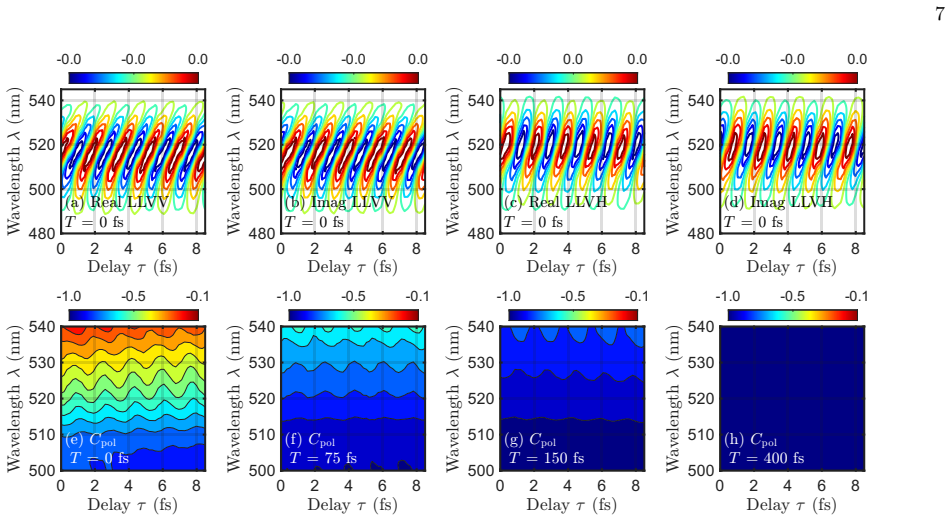
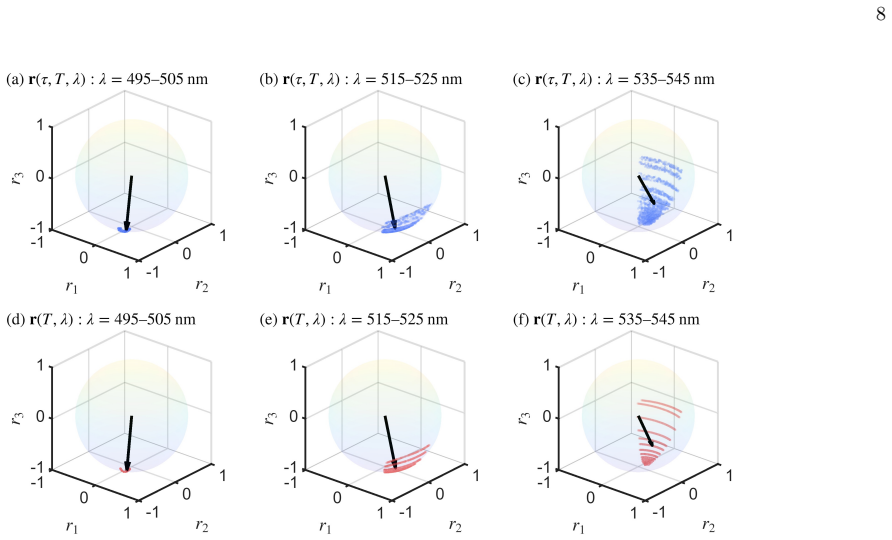
Polarization-resolved interferometric measurements together with a microscopic nonlinear response model for the Bloch vector reconstruct effective single-photon polarization density matrices from four-wave-mixing signal fields. The Holevo bound and effective secret-bit rates are then computed as functions of coherence time, population time, and detection wavelength. Incorporating the coherence-time degree of freedom lowers the Holevo bound by approximately 2.6-5.8% across the various excitonic resonances, indicating reduced distinguishability of the polarization states when the full multidimensional parameter space is sampled. Control of the population time via spin-dependent evolution yield
What carries the argument
Effective single-photon polarization density matrices reconstructed from measured signal fields via the microscopic nonlinear response model for the Bloch vector, which support direct calculation of the Holevo bound.
If this is right
- Spectral regions tied to single-exciton and biexciton resonances define complementary operating regimes for secure communication.
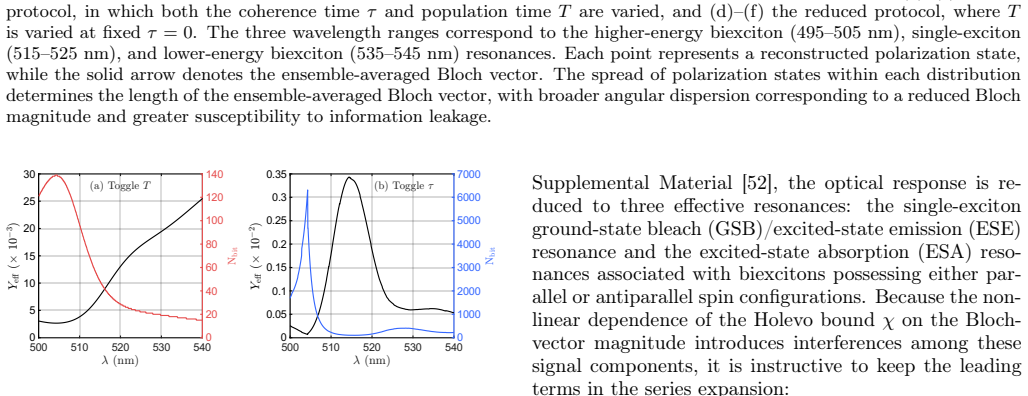
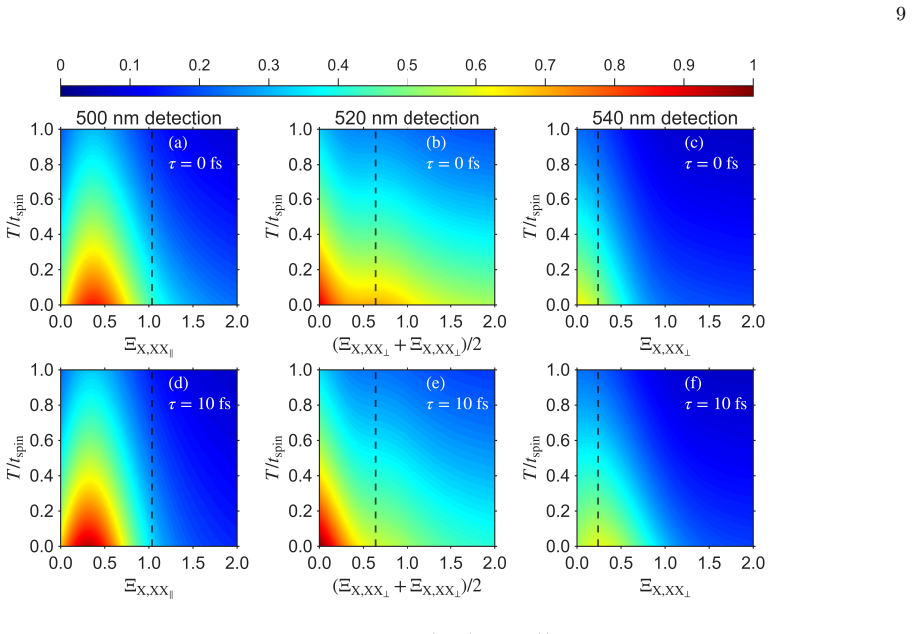
- Manipulation of population time produces substantially higher secret-bit rates than manipulation of coherence time.
- The secret-bits-per-pulse metric permits rapid assessment of secure throughput for candidate materials without photon-number-resolved detection.
- Sampling the full multidimensional parameter space reduces polarization-state distinguishability relative to fixed-parameter cases.
Where Pith is reading between the lines
- The interferometric reconstruction approach could be applied to other nonlinear optical materials to screen for sources with lower state distinguishability.
- Multidimensional control of coherence and population times might be combined with other quantum encoding schemes to further limit information leakage.
- Material engineering that tunes spin-dependent evolution could systematically improve the secret-bit rates achievable from such light sources.
Load-bearing premise
The microscopic nonlinear response model for the Bloch vector accurately allows inference of effective single-photon polarization density matrices from the measured signal fields.
What would settle it
Direct measurement of single-photon polarization states with photon-number-resolving detectors that shows large deviation from the inferred density matrices would demonstrate that the calculated Holevo bounds and secret-bit rates do not describe the physical system.
Figures
read the original abstract
Nonlinear optical light sources enable the generation of photons with quantum states that are intrinsically linked to underlying material dynamics, rather than imposed through external modulation. Here we investigate fundamental quantum communication metrics of four-wave-mixing signal fields generated by the two-dimensional perovskite (PEA)2PbI4. Using polarization-resolved interferometric measurements together with a microscopic nonlinear response model for the Bloch vector, we reconstruct effective single-photon polarization density matrices inferred from the experimental signal fields and evaluate the corresponding Holevo bound and effective secret-bit rates as a function of the coherence time, population time, and detection wavelength. We find that incorporating the coherence-time degree of freedom systematically lowers the Holevo bound by approximately 2.6-5.8% across the various excitonic resonances, indicating reduced distinguishability of the polarization states when the full multidimensional parameter space is sampled. To connect the polarization-state indistinguishability with experimentally achievable throughput, we further introduce an effective secret-bits-per-pulse metric that enables rapid evaluation of secure information throughput for candidate materials without requiring photon-number-resolved detection. For the present system, control of the population time via spin-dependent evolution yields substantially higher secret-bit rates than manipulation of the coherence time, while spectral regions associated with single-exciton and biexciton resonances define complementary operating regimes for secure communication. More broadly, this work positions nonlinear spectroscopy as a framework for exploring how emergent optical materials can generate and structure quantum states in ways that are advantageous for established quantum communication schemes.
Editorial analysis
A structured set of objections, weighed in public.
Referee Report
Summary. The manuscript claims that polarization-resolved interferometric measurements combined with a microscopic nonlinear response model for the Bloch vector allow reconstruction of effective single-photon polarization density matrices from four-wave-mixing signal fields in (PEA)2PbI4. From these matrices the authors compute Holevo bounds as a function of coherence time, population time and detection wavelength, reporting a systematic 2.6-5.8% lowering of the bound when the coherence-time degree of freedom is included, and introduce an effective secret-bits-per-pulse metric that indicates higher rates under population-time control via spin-dependent evolution than under coherence-time manipulation.
Significance. If the classical-to-quantum mapping is valid, the work supplies a concrete, experimentally accessible route to security metrics for material-based photon sources that avoids photon-number-resolved detection. The new secret-bits-per-pulse figure of merit is a practical addition that could be applied to other nonlinear materials. The reported numerical reductions and the identification of complementary single-exciton versus biexciton operating regimes constitute falsifiable predictions that future photon-counting experiments could test directly.
major comments (1)
- [Reconstruction of density matrices (abstract and methods section describing the Bloch-vector model)] Reconstruction of density matrices (abstract and methods section describing the Bloch-vector model): the central Holevo bounds and secret-bit rates are computed from effective single-photon polarization states inferred from classically measured signal fields. The manuscript states that the matrices are “effective” and “inferred” but supplies no cross-check against photon-number statistics, second-order correlation functions, or full quantum state tomography. Because the 2.6-5.8% reduction and the population-time versus coherence-time comparison rest entirely on these inferred states, an explicit validation or error-propagation analysis of the mapping is required before the quantitative claims can be accepted.
minor comments (2)
- [Definition of secret-bits-per-pulse metric] Notation for the secret-bits-per-pulse metric is introduced without an explicit equation number; adding one would improve traceability when the metric is later compared across wavelengths.
- [Figures presenting Holevo bounds versus coherence time] Figure captions should state the number of independent experimental runs and the criterion used to select the excitonic resonances shown.
Simulated Author's Rebuttal
We thank the referee for the constructive feedback and the recommendation of major revision. We address the single major comment point by point below, agreeing that additional analysis is warranted to support the quantitative claims.
read point-by-point responses
-
Referee: Reconstruction of density matrices (abstract and methods section describing the Bloch-vector model): the central Holevo bounds and secret-bit rates are computed from effective single-photon polarization states inferred from classically measured signal fields. The manuscript states that the matrices are “effective” and “inferred” but supplies no cross-check against photon-number statistics, second-order correlation functions, or full quantum state tomography. Because the 2.6-5.8% reduction and the population-time versus coherence-time comparison rest entirely on these inferred states, an explicit validation or error-propagation analysis of the mapping is required before the quantitative claims can be accepted.
Authors: We agree that the quantitative results (2.6-5.8% Holevo reduction and secret-bit rate comparisons) depend on the effective polarization density matrices obtained from the Bloch-vector model applied to measured four-wave-mixing fields. The mapping is justified by the microscopic derivation of the nonlinear response, which links classical field amplitudes to polarization operator expectation values in the low-excitation regime, consistent with prior validations of the same model for (PEA)2PbI4 excitonic dynamics. Full photon-number-resolved tomography or g(2) measurements are outside the scope of the current interferometric setup. However, we acknowledge the referee's point and will add an explicit error-propagation analysis in the revised manuscript: a new subsection will quantify how experimental noise in the interferometric signals and uncertainties in Bloch-vector parameters propagate to the reconstructed matrix elements and ultimately to the Holevo bound and secret-bits-per-pulse metric. This will include Monte-Carlo sampling of matrix perturbations within measured error bars to confirm the robustness of the reported percentage reductions. revision: yes
Circularity Check
No significant circularity; derivation applies standard QIT quantities to model-reconstructed states
full rationale
The paper reconstructs effective polarization density matrices from measured fields using a Bloch-vector nonlinear response model, then computes Holevo bounds and defines an effective secret-bits-per-pulse metric from those matrices. No equation reduces to its input by construction, no parameter is fitted on a subset and renamed a prediction, and no load-bearing step rests on a self-citation chain or imported uniqueness theorem. The central numerical claims (2.6-5.8% Holevo reduction, population-time vs coherence-time comparison) are direct evaluations of standard quantum-information functionals on the inferred states rather than tautological redefinitions of the reconstruction step itself. The mapping from classical fields to quantum states is an external modeling assumption whose validity is separate from circularity.
Axiom & Free-Parameter Ledger
axioms (1)
- domain assumption The Bloch vector model for the microscopic nonlinear response accurately maps measured signal fields to single-photon polarization density matrices.
Reference graph
Works this paper leans on
-
[1]
M. Yuan, L. N. Quan, R. Comin, G. Walters, R. Saba- tini, O. Voznyy, S. Hoogland, Y. Zhao, E. M. Beaure- gard, P. Kanjanaboos, Z. Lu, D. H. Kim, and E. H. Sar- gent, Perovskite energy funnels for efficient light-emitting diodes, Nat. Nanotechnol.11, 872 (2016)
2016
-
[2]
M. D. Smith, B. A. Connor, and H. I. Karunadasa, Tuning the Luminescence of Layered Halide Perovskites, Chem. Rev.119, 3104 (2019)
2019
-
[3]
Y. Gao, E. Shi, S. Deng, S. B. Shiring, J. M. Snaider, C. Liang, B. Yuan, R. Song, S. M. Janke, A. Liebman- Peláez, P. Yoo, M. Zeller, B. W. Boudouris, P. Liao, C. Zhu, V. Blum, Y. Yu, B. M. Savoie, L. Huang, and L. Dou, Molecular engineering of organic–inorganic hy- brid perovskites quantum wells, Nat. Chem.11, 1151 (2019)
2019
-
[4]
L. Lei, D. Seyitliyev, S. Stuard, J. Mendes, Q. Dong, X. Fu, Y.-A. Chen, S. He, X. Yi, L. Zhu, C.-H. Chang, H. Ade, K. Gundogdu, and F. So, Efficient Energy Fun- neling in Quasi-2D Perovskites: From Light Emission to Lasing, Adv. Mater.32, 1906571 (2020)
2020
-
[5]
A. L. Alvarado-Leaños, D. Cortecchia, C. N. Saggau, S. Martani, G. Folpini, E. Feltri, M. D. Albaqami, L. Ma, and A. Petrozza, Lasing in Two-Dimensional Tin Per- ovskites, ACS Nano16, 20671 (2022)
2022
-
[6]
X. Wang, L. Jin, A. Sergeev, W. Liu, S. Gu, N. Li, K. Fan, S.-c. Chen, K. S. Wong, X. Sun, and N. Zhao, Quasi-2D Dion-Jacobson phase perovskites as a promis- ing material platform for stable and high-performance lasers, Sci. Adv.9, eadj3476 (2023)
2023
-
[7]
J. Ma, C. Fang, C. Chen, L. Jin, J. Wang, S. Wang, J. Tang, and D. Li, Chiral 2D Perovskites with a High Degree of Circularly Polarized Photoluminescence, ACS Nano13, 3659 (2019)
2019
-
[8]
S. Liu, M. Kepenekian, S. Bodnar, S. Feldmann, M. W. Heindl, N. Fehn, J. Zerhoch, A. Shcherbakov, A. Pöthig, Y. Li, U. W. Paetzold, A. Kartouzian, I. D. Sharp, 15 C. Katan, J. Even, and F. Deschler, Bright circularly po- larized photoluminescence in chiral layered hybrid lead- halide perovskites, Sci. Adv.9, eadh5083 (2023)
2023
-
[9]
S. Liu, X. Wang, Y. Dou, Q. Wang, J. Kim, C. Sle- bodnick, Y. Yan, and L. Quan, Direct Observation of Circularly Polarized Nonlinear Optical Activities in Chi- ral Hybrid Lead Halides, J. Am. Chem. Soc.146, 11835 (2024)
2024
-
[10]
C. Chen, L. Gao, W. Gao, C. Ge, X. Du, Z. Li, Y. Yang, G. Niu, and J. Tang, Circularly polarized light detection using chiral hybrid perovskite, Nat. Commun.10, 1927 (2019)
1927
-
[11]
S. He, W. Lin, D. Yu, J. Shi, Z. Yin, C. Sun, H. Liu, C. Zhang, J. Yuan, S. Bai, S. Xiao, G. Long, M. Yuan, Y. Jiang, Y. Chen, and Q. Song, Perovskite spin light- emitting diodes with simultaneously high electrolumines- cence dissymmetry and high external quantum efficiency, Nat. Commun.16, 2201 (2025)
2025
-
[12]
B. Li, Y. Li, W. Yuan, X. Zhang, S. Tao, H. Zhan, Z.- g. Yu, K. Wang, J. liu, L. Wang, and C. Qin, Chiral Quasi-2D Perovskites Based Single Junction Spin-Light- Emitting Diodes, Adv. Funct. Mater.35, 2415433 (2025)
2025
-
[13]
P. W. Martin and C. G. Bischak, Remote control: Steer- ing chiroptical activity in perovskites via chiral additives, Matter8, 102297 (2025)
2025
-
[14]
Y. Dong, M. P. Hautzinger, M. A. Haque, and M. C. Beard, Chirality-Induced Spin Selectivity in Hybrid Organic-Inorganic Perovskite Semiconductors, Annu. Rev. Phys. Chem.76, 519 (2025)
2025
-
[15]
M. H. Elkins, R. Pensack, A. H. Proppe, O. Voznyy, L. N. Quan, S. O. Kelley, E. H. Sargent, and G. D. Sc- holes, Biexciton Resonances Reveal Exciton Localization in Stacked Perovskite Quantum Wells, The Journal of Physical Chemistry Letters8, 3895 (2017)
2017
-
[16]
Thouin, S
F. Thouin, S. Neutzner, D. Cortecchia, V. A. Dragomir, C. Soci, T. Salim, Y. M. Lam, R. Leonelli, A. Petrozza, A. R. S. Kandada, and C. Silva, Stable biexcitons in two-dimensional metal-halide perovskites with strong dy- namic lattice disorder, Phys. Rev. Mater.2, 034001 (2018)
2018
-
[17]
Giovanni, W
D. Giovanni, W. K. Chong, Y. Y. F. Liu, H. A. Dewi, T. Yin, Y. Lekina, Z. X. Shen, N. Mathews, C. K. Gan, and T. C. Sum, Coherent Spin and Quasiparticle Dy- namics in Solution-Processed Layered 2D Lead Halide Perovskites, Adv. Sci.5, 1800664 (2018)
2018
-
[18]
S. A. Bourelle, R. Shivanna, F. V. A. Camargo, S. Ghosh, A. J. Gillett, S. P. Senanayak, S. Feldmann, L. Eyre, A. Ashoka, T. W. J. van de Goor, H. Abolins, T. Win- kler, G.Cerullo, R.H.Friend,andF.Deschler,HowExci- ton Interactions Control Spin-Depolarization in Layered Hybrid Perovskites, Nano Lett.20, 5678 (2020)
2020
-
[19]
K. A. Koch, E. Rojas-Gatjens, M. Gómez-Dominguez, J.-P. Correa-Baena, C. Silva-Acuña, and A. R. Sri- mathKandada, Spectroscopicsignatures ofbiexcitons: A case study in Ruddlesden–Popper lead-halides, J. Chem. Phys.163, 034202 (2025)
2025
-
[20]
S. B. Todd, D. B. Riley, A. Binai-Motlagh, C. Clegg, A. Ramachandran, S. A. March, J. M. Hoffman, I. G. Hill, C. C. Stoumpos, M. G. Kanatzidis, Z.-G. Yu, and K. C. Hall, Detection of Rashba spin splitting in 2D organic-inorganic perovskite via precessional carrier spin relaxation, APL Materials7, 081116 (2019)
2019
-
[21]
W. Tao, Q. Zhou, and H. Zhu, Dynamic polaronic screening for anomalous exciton spin relaxation in two-dimensional lead halide perovskites, Sci. Adv.6, eabb7132 (2020)
2020
-
[22]
X. Chen, H. Lu, K. Wang, Y. Zhai, V. Lunin, P. C. Ser- cel, and M. C. Beard, Tuning Spin-Polarized Lifetime in Two-Dimensional Metal–Halide Perovskite through Ex- citon Binding Energy, J. Am. Chem. Soc.143, 19438 (2021)
2021
-
[23]
M.-S. Song, H. Wang, Z.-F. Hu, Y.-P. Zhang, T.-Y. Liu, and H.-Y. Wang, The Role of Polaronic States on the Spin Dynamics in Solution-Processed Two-Dimensional Layered Perovskite with Different Layer Thickness, Adv. Sci.10, 2302554 (2023)
2023
-
[24]
T. Qin, X. Zhang, H. Liu, Y. Wei, H. Huang, B. Xiang, M. Zhang, Z. Wang, Z. Tang, and Q. Xiong, Coherent Exciton Spin Relaxation Dynamics and Exciton Polaron Character in Layered Two-Dimensional Lead-Halide Per- ovskites, ACS Nano19, 4186 (2025)
2025
-
[25]
A. Soni, C. Yang, Y.-T. Yang, C. Lin, L. Dou, and L. Wang, Mechanistic Insight into Tunable Spin Re- laxation in Two-Dimensional Type-II Ligand-Perovskite Heterostructures, J. Am. Chem. Soc.147, 41845 (2025)
2025
-
[26]
Romano, M
V. Romano, M. Hörmann, A. Stadlbauer, E. Mosconi, L. Gregori, F. De Angelis, F. Deschler, G. Cerullo, and F. V. A. Camargo, Cation Tuning of Polaron Barriers in Layered Perovskites for Optical Spin Lifetime Control, ACS Energy Letters10, 4636 (2025)
2025
-
[27]
P.W.ShorandJ.Preskill,SimpleProofofSecurityofthe BB84 Quantum Key Distribution Protocol, Phys. Rev. Lett.85, 441 (2000)
2000
-
[28]
C. H. Bennett and G. Brassard, Quantum cryptogra- phy: Public key distribution and coin tossing, Theoreti- cal Computer Science560, 7 (2014)
2014
-
[29]
S. Feng, Z. Gan, C. J. Gloor, W. You, and A. M. Moran, Nonlinear optical quantum communication with a two- dimensional perovskite light source, J. Chem. Phys.164, 074203 (2026)
2026
-
[30]
J. J. Baumberg, D. D. Awschalom, and N. Samarth, Femtosecond Faraday rotation in spin-engineered het- erostructures, J. Appl. Phys.75, 6199 (1994)
1994
-
[31]
S. A. Bourelle, F. V. A. Camargo, S. Ghosh, T. Neu- mann, T. W. J. van de Goor, R. Shivanna, T. Winkler, G. Cerullo, and F. Deschler, Optical control of exciton spin dynamics in layered metal halide perovskites via po- laronic state formation, Nat. Commun.13, 3320 (2022)
2022
-
[32]
Sutcliffe and J
J. Sutcliffe and J. O. Johansson, A femtosecond magnetic circular dichroism spectrometer, Rev. Sci. Instrum.92, 113001 (2021)
2021
-
[33]
A. S. Holevo, The capacity of the quantum channel with general signal states, IEEE Transactions on Information Theory44, 269 (1998)
1998
-
[34]
Hwang, Quantum Key Distribution with High Loss: Toward Global Secure Communication, Phys
W.-Y. Hwang, Quantum Key Distribution with High Loss: Toward Global Secure Communication, Phys. Rev. Lett.91, 057901 (2003)
2003
-
[35]
H.-K. Lo, X. Ma, and K. Chen, Decoy State Quantum Key Distribution, Phys. Rev. Lett.94, 230504 (2005)
2005
-
[36]
Wang, Beating the Photon-Number-Splitting At- tack in Practical Quantum Cryptography, Phys
X.-B. Wang, Beating the Photon-Number-Splitting At- tack in Practical Quantum Cryptography, Phys. Rev. Lett.94, 230503 (2005)
2005
-
[37]
Devetak and A
I. Devetak and A. Winter, Distillation of secret key and entanglement from quantum states, Proc. R. Soc. A461, 207 (2005)
2005
-
[38]
Scarani, H
V. Scarani, H. Bechmann-Pasquinucci, N. J. Cerf, M. Dušek, N. Lütkenhaus, and M. Peev, The security of practical quantum key distribution, Rev. Mod. Phys. 16 81, 1301 (2009)
2009
-
[39]
Moran, Elucidating phonon dephasing mechanisms in layered perovskites with coherent Raman spectroscopies, J
Z.Gan, C.J.Gloor, L.Yan, X.Zhong, W.You,andA.M. Moran, Elucidating phonon dephasing mechanisms in layered perovskites with coherent Raman spectroscopies, J. Chem. Phys.161, 074202 (2024)
2024
-
[40]
S. Feng, C. J. Badalis, C. J. Gloor, X. Zhong, Z. Gan, W. You, and A. M. Moran, Nonlinear optical signatures of spin relaxation in 2D perovskites, J. Chem. Phys.162, 134202 (2025)
2025
-
[41]
Z. Gan, S. Feng, C. J. Gloor, X. Zhong, W. You, and A. M. Moran, Motional narrowing of spin relaxation in 2D perovskites by correlated exciton fluctuations, J. Chem. Phys.163, 164203 (2025)
2025
-
[42]
Brixner, T
T. Brixner, T. Mančal, I. V. Stiopkin, and G. R. Flem- ing, Phase-stabilized two-dimensional electronic spec- troscopy, J. Chem. Phys.121, 4221 (2004)
2004
-
[43]
M. L. Cowan, J. P. Ogilvie, and R. J. D. Miller, Two- dimensional spectroscopy using diffractive optics based phased-lockedphotonechoes,Chem.Phys.Lett.386,184 (2004)
2004
-
[44]
A. M. Moran, J. B. Maddox, J. W. Hong, J. Kim, R. A. Nome, G. C. Bazan, S. Mukamel, and N. F. Scherer, Optical coherence and theoretical study of the excitation dynamics of a highly symmetric cyclophane- linked oligophenylenevinylene dimer, J. Chem. Phys. 124, 194904 (2006)
2006
-
[45]
J. D. Hybl, A. Albrecht Ferro, and D. M. Jonas, Two- dimensional Fourier transform electronic spectroscopy, J. Chem. Phys.115, 6606 (2001)
2001
-
[46]
P. C. Sercel, J. L. Lyons, D. Wickramaratne, R. Vaxen- burg, N. Bernstein, and A. L. Efros, Exciton Fine Struc- ture in Perovskite Nanocrystals, Nano Lett.19, 4068 (2019)
2019
-
[47]
Posmyk, N
K. Posmyk, N. Zawadzka, M. Dyksik, A. Surrente, D. K. Maude, T. Kazimierczuk, A. Babiński, M. R. Molas, W. Paritmongkol, M. Mączka, W. A. Tisdale, P. Pło- chocka, and M. Baranowski, Quantification of Exciton FineStructureSplittinginaTwo-DimensionalPerovskite Compound, J. Phys. Chem. Lett.13, 4463 (2022)
2022
-
[48]
Posmyk, M
K. Posmyk, M. Dyksik, A. Surrente, D. K. Maude, N. Za- wadzka, A. Babiński, M. R. Molas, W. Paritmongkol, M. Mączka, W. A. Tisdale, P. Plochocka, and M. Bara- nowski, Exciton Fine Structure in 2D Perovskites: The Out-of-Plane Excitonic State, Adv. Opt. Mater.12, 2300877 (2024)
2024
-
[49]
O. F. Williams, N. Zhou, J. Hu, Z. Ouyang, A. Kumbhar, W. You, and A. M. Moran, Imaging Excited State Dy- namicsinLayered2DPerovskiteswithTransientAbsorp- tion Microscopy, J. Phys. Chem. A123, 11012 (2019)
2019
-
[50]
D. L. Andrews and T. Thirunamachandran, On three- dimensional rotational averages, J. Chem. Phys.67, 5026 (1977)
1977
-
[51]
S.Mukamel,Principles of Nonlinear Optical Spectroscopy (Oxford University Press, New York, 1995)
1995
-
[52]
See Supplemental Material for details of the security- metric implementation, the full response-function deriva- tion of the Bloch vector, the approximations leading to the reduced model, and additional experimental data sets
-
[53]
M. A. Nielsen and I. L. Chuang,Quantum Computation and Quantum Information, 10th ed. (Cambridge Univer- sity Press, Cambridge, United Kingdom, 2010)
2010
-
[54]
Gisin, G
N. Gisin, G. Ribordy, W. Tittel, and H. Zbinden, Quan- tum cryptography, Reviews of Modern Physics74, 145 (2002)
2002
-
[55]
Collini and G
E. Collini and G. D. Scholes, Coherent Intrachain Energy Migration in a Conjugated Polymer at Room Tempera- ture, Science323, 369 (2009)
2009
-
[56]
A. S. Sardjan, F. P. Westerman, J. P. Ogilvie, and T. L. C. Jansen, Observation of Ultrafast Coher- ence Transfer and Degenerate States with Polarization- Controlled Two-Dimensional Electronic Spectroscopy, J. Phys. Chem. B124, 9420 (2020)
2020
-
[57]
D. F. V. James, P. G. Kwiat, W. J. Munro, and A. G. White, Measurement of qubits, Phys. Rev. A64, 052312 (2001)
2001
discussion (0)
Sign in with ORCID, Apple, or X to comment. Anyone can read and Pith papers without signing in.