REVIEW 3 major objections 4 minor 149 references
Developing a self-consistent AGB wind model: II. Non-classical, non-equilibrium polymer nucleation in a chemical mixture
T0 review · 3 major / 4 minor · reviewed 2026-08-14 · deepseek-v4-flash
Pith's one-line read By dropping equilibrium, monomer-only growth, and bulk-material energies from dust nucleation, this paper finds that monomer restriction underpredicts large clusters and delays formation, and that Al2O3 — not TiO2 — seeds dust first…
desk verdict A genuine methods advance in dust nucleation modeling: the monomer-vs-polymer comparison is solid and reproducible, but the favored-precursor ranking depends on assumptions the authors themselves flag as unverified. read the letter →
The pith
A machine-rendered reading of the paper's core claim, the machinery that carries it, and where it could break.
The reading
What carries the argument
The carrying mechanism is a homomolecular polymer nucleation network. Each formula unit (TiO2, MgO, SiO, Al2O3) defines a ladder of cluster species, and any two clusters $C_N$ and $C_M$ can merge into $C_{N+M}$ with a growth rate from hard-sphere collision theory, $k^+_{N,M} = \pi(r_N + r_M)^2 \sqrt{8 k_B T / \pi \mu_{N,M}}$, while the reverse dissociation rate is set by detailed balance using the cluster's Gibbs free energy at standard pressure, $k^-_{N,M} = k^+_{N,M} \frac{P^\circ}{k_B T} \exp\left(\frac{G^\circ_{N+M} - G^\circ_M - G^\circ_N}{k_B T}\right)$. The Gibbs free energies come from B3LYP density functional theory with vibrational analysis instead of bulk-extrapolated surface energies, which is what produces non-monotonic stability patterns such as (MgO)9 being more abundant than (MgO)10. Two network setups bracket the chemistry: closed networks that assume every metal atom starts in the monomer, isolating the intrinsic nucleation efficiency of each candidate, and a comprehensive network grafted onto a reduced AGB wind chemical network — extended with Ti, Al, and Mg reactions — that starts from atoms and decides whether the monomers can form at all.
What would settle it
Measure or recompute the rate coefficients for the two reactions that are the only available paths to the Al2O3 monomer, AlO + AlO + M -> Al2O2 + M and Al2O2 + O + M -> Al2O3 + M, at 1500-2500 K. If experiment or higher-level theory places these rates orders of magnitude above the combustion-derived values used here, the comprehensive model's failure to form Al2O3 is the data gap the paper claims; if the rates are right, the claim that Al2O3 is the first condensate in AGB winds fails, because its monomer cannot arise from an atomic gas and, by the model's own logic, only TiO2 clusters would seed dust.
Extended reading notes
Core claim
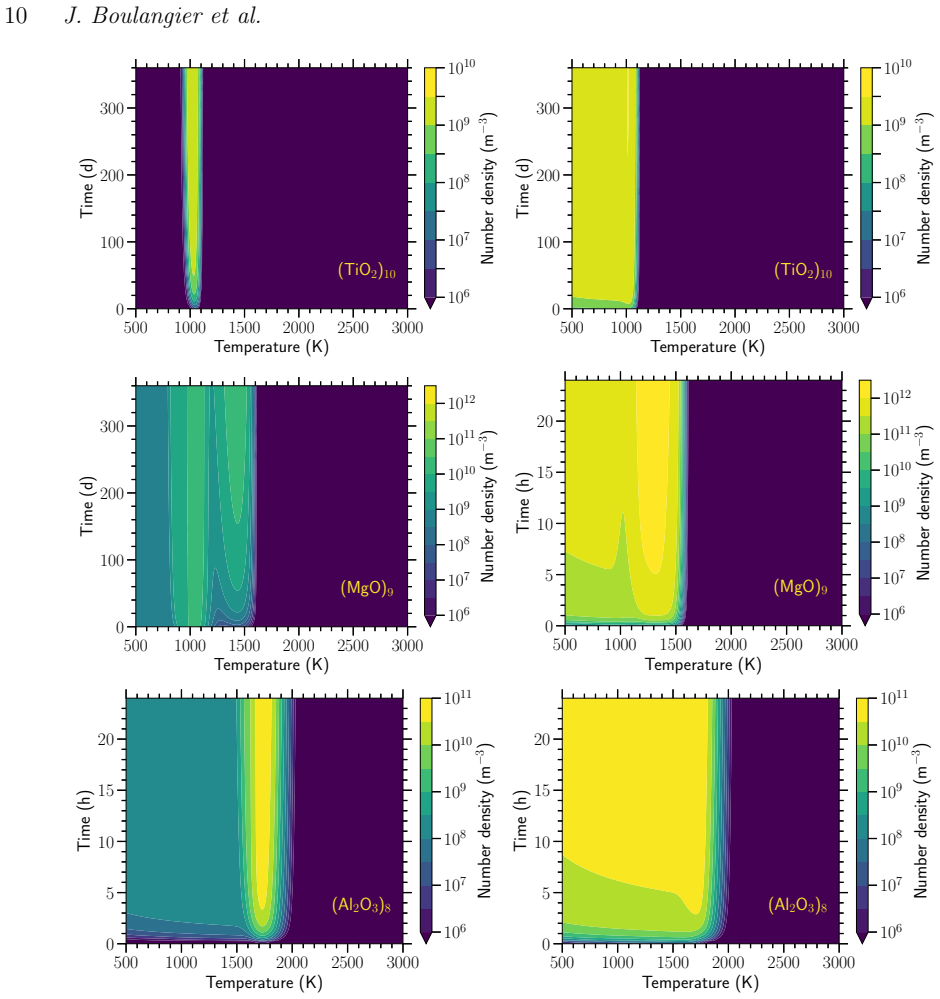
On the paper's own terms, the discovery is a set of consequences of removing the equilibrium and monomer restrictions from AGB dust nucleation. Monomer-restricted growth depletes the monomer pool as soon as small clusters form, quenching further growth at low temperatures, whereas polymer nucleation lets clusters keep merging, so the monomer description underpredicts large clusters and overpredicts formation times; the difference is large for (MgO)9 (roughly 180 days versus a few hours to converge) and (TiO2)10 (60 days versus under 20 days). In the closed models, where the monomer is assumed present, (Al2O3)8 forms in about 5-10 hours at 1800-2400 K (more than 90 per cent of available Al at the most favorable conditions), ahead of (MgO)9 at 1500-1700 K and (TiO2)10 at 1000-1200 K, while SiO clusters do not form at all in the relevant range. In the comprehensive network starting from atoms, all Mg stays atomic and Al2O3 cannot assemble its monomer, so only (TiO2)10 forms; most Al remains atomic with at most 1 per cent in AlO, AlH, Al(OH)2, and Al(OH)3. The authors nonetheless conclude that Al2O3 is the prime candidate, citing presolar corundum grains, dust observed near the star at 1500-2000 K where TiO2 clusters cannot yet exist, and their judgment that the available Al-oxide rate coefficients, taken from combustion chemistry and dominated by high barriers, are the missing link.
Load-bearing premise
Every cluster in the model grows by combining whole copies of one fixed molecule (Al2O3, TiO2, MgO, or SiO) through barrierless hard-sphere collisions, and the paper itself concedes that nucleation by monomer-multiples of a fixed stoichiometry "is not established either" (Sec. 6.1.1); if real dust forms through mixed-species or non-stoichiometric steps, or through reactions with activation barriers, the identity of the first condensate and the temperature at which it appears could both change.
Editorial extensions
If this is right
- Current AGB wind models that keep monomer-only equilibrium nucleation will underestimate the abundance of large clusters and overestimate their formation times, because monomer depletion quenches growth once small clusters form; allowing polymer collisions raises dust yields and shortens formation times.
- If Al2O3 monomers are present, dust seeds appear within hours at 1800-2400 K, which is high enough to explain dust observed at 1.5-2 stellar radii in oxygen-rich winds, where temperatures exceed the 1000-1200 K at which TiO2 clusters can form.
- From an initially atomic mixture, TiO2 is the only viable first condensate among the four candidates, since magnesium never leaves the atomic phase and Al2O3's monomer cannot be assembled with currently available rate data.
- Equilibrium abundance ratios are not reached within one year across much of the temperature range, so steady-state nucleation rates are generally invalid and time-dependent descriptions are necessary.
- Rough extrapolation of the largest clusters to seed-sized particles yields normalized seed abundances of order $3\times10^{-11}$ to $8\times10^{-11}$ per hydrogen, well above the $10^{-16}$ threshold that dynamical models say is needed to drive an AGB wind.
Reading between the lines
- A direct test of the paper's own logic: if new Al-oxide rate data lets the comprehensive network form (Al2O3)8 at 1800-2400 K, the Al2O3-first ranking is confirmed; if it still fails, the presolar and hot-dust evidence would instead point toward the heteromolecular pathways (such as MgAl2O4 spinel) that this paper deliberately sets aside.
- Because the paper shows the hard-sphere collision rates exceed RRKM rates for Al2O3 dimerization by roughly an order of magnitude, the reported formation temperatures and abundances are probably optimistic upper bounds; the qualitative ordering — Al2O3 hottest, then MgO, then TiO2 — is more robust than the exact thresholds.
- The monomer-depletion bottleneck is generic: any environment where condensation outruns monomer resupply — brown dwarf atmospheres, supernova ejecta, combustion — will misbehave under monomer-only nucleation, so the polymer treatment transfers well beyond AGB winds.
- Coupling this nucleation network into a hydrodynamical wind trajectory is the natural next step; the paper's grid is in temperature and density, and its own extrapolation suggests seed abundances would be ample, but only a full dynamical coupling can test whether the Al2O3-versus-TiO2 outcome survives the true cooling and shock history of the outflow.
Signed reviews
Editorial analysis
A structured set of objections, weighed in public.
Referee Report
Summary. The paper develops a time-dependent, non-equilibrium chemical-kinetics nucleation model for AGB winds, applied to TiO2, MgO, SiO, and Al2O3. Growth rate coefficients are hard-sphere collision rates (Eq. 11) and destruction rates are obtained from detailed balance using DFT-based Gibbs free energies (Eq. 16). Two classes of models are studied: closed nucleation networks, in which the monomer is assumed present and the system contains only one nucleating species, and a comprehensive network starting from an atomic composition and including a large gas-phase reaction network. The main findings are that monomer-restricted growth underpredicts large clusters at low temperatures and overpredicts formation times; that in the closed models (Al2O3)8 forms fastest and at the highest temperatures (1800-2400 K), making Al2O3 the favoured first condensate; and that in the comprehensive atomic network only TiO2 clusters form, with Al and Mg remaining essentially atomic. The authors conclude that the absence of Al2O3 in the comprehensive model is likely due to incomplete Al reaction data and explicitly argue, based on presolar grains and observations, that Al2O3 remains the prime candidate.
Significance. The central methodological contribution is a transparent, parameter-free nucleation framework that replaces classical steady-state nucleation with polymer growth and quantum-chemical cluster energetics. The comparison of monomer vs polymer growth yields a clear, qualitative result: monomer-only models underestimate large-cluster abundances at low temperatures and overestimate formation times, which is directly relevant to existing AGB wind models. The model makes falsifiable predictions: in an initially atomic mixture, only TiO2 clusters form among the four candidates, while Al2O3 nucleates efficiently if its monomer is assumed present. The paper is unusually open about its limitations, and the release of homogenized thermochemical data and code, including Gibbs free energies for the clusters, is a significant strength that will allow independent checks. The two legs of the central claim rest on assumptions that are acknowledged but not quantitatively tested, which is why the work needs revision rather than acceptance as is.
major comments (3)
- [2.2, 3.1, 6.1.1] The assumption that nucleation is homomolecular and proceeds by integer multiples of a fixed stoichiometric monomer is load-bearing for both parts of the central claim: the closed-model preference for Al2O3 and the comprehensive-model conclusion that only TiO2 clusters form. The paper itself states in Sec. 6.1.1 that 'the fact that nucleation occurs via the addition of monomer-multiples with a fixed stoichiometry is not established either.' If, for example, AlxOy species with x:y not equal to 2:3 (such as AlO or Al2O2) can attach to growing clusters, or if heteromolecular clusters like MgAl2O4 form efficiently, the identity and temperature threshold of the first dust precursor could change. The authors should add a sensitivity test that relaxes the fixed-stoichiometry restriction for at least one candidate (e.g., allowing AlO or Al2O2 addition to Al2O3 clusters) and report how the formation threshold and cluster distribution shift, or provide a quantitative argument for why such pathways cannot compete.
- [6.1.1, Fig. 6] The growth rates used throughout the paper are geometric hard-sphere collision rates (Eq. 11). Figure 6 shows that for Al2O3 dimerization this approximation overestimates the RRKM/Lindemann rate by roughly an order of magnitude. Because the closed-model conclusion that (Al2O3)8 forms rapidly at 1800-2400 K depends directly on the magnitude of k+ in Eq. (11), an order-of-magnitude overestimate in k+ could materially change the formation-temperature boundary and the convergence times reported in Sec. 4.1.4. The paper acknowledges this qualitatively but does not propagate the uncertainty. I request a simple sensitivity run: repeat the closed polymer-nucleation model for Al2O3 with k+ reduced by a factor of 10 (or with the RRKM rate of Sharipov & Loukhovitski 2018) and report the resulting (Al2O3)8 abundance map and time evolution. This would establish whether the qualitative ranking of candidates is robust.
- [4.2.4, 5.2, 6.1.2] The abstract and Sec. 5.2 present the comprehensive-model result as 'only TiO2-clusters form' while simultaneously concluding that Al2O3 is the prime candidate. The manuscript is transparent that the Al2O3 preference is based on external evidence rather than the model, but the phrasing in the abstract and summary can be read as a model prediction. Since the authors themselves attribute the non-formation of Al2O3 to incomplete Al reaction data, the paper should state more crisply that the comprehensive-model prediction is conditional on the adopted network, that the absence of Al2O3 is not a falsification of Al2O3 nucleation, and that the Al2O3-favouring conclusion is an inference from the closed models plus observational evidence. This distinction is essential for readers assessing the strength of the paper's main claim.
minor comments (4)
- [4.1.5, Eqs. (13)-(16)] The comparison with equilibrium abundance ratios in Sec. 4.1.5 uses Eq. (15), which is derived from the same Gibbs free energies that set the destruction rate coefficients in Eq. (16). The comparison therefore tests kinetic convergence toward the equilibrium implied by the model's own thermodynamics, not the validity of the thermodynamics. This should be stated explicitly in the text to avoid the impression of an independent equilibrium check.
- [Appendix D, Table D2] Table D2 is difficult to parse because the legend uses 'CCCBDB' both as a source name and as an entry, and several entries contain '?' without a reference (e.g., SO, NO2). The authors should either provide the missing references or mark these entries as unverified. This matters because reversed rate coefficients for the comprehensive network depend on these thermochemical data.
- [6.2.2] In the extrapolation from (Al2O3)8 to (Al2O3)1000, the factor relating cluster sizes is 8/1000 = 125, not 100 as stated in the text. The difference is small compared to the other uncertainties, but the arithmetic should be corrected or stated as 'roughly 100' with the exact factor.
- [Abstract, Sec. 1] The opening statement that 'various nucleation theories exist, yet all assume chemical equilibrium, growth restricted by monomers' is too strong, since the paper itself cites works (e.g., Sarangi & Cherchneff 2015; Gobrecht et al. 2016) that abandon equilibrium. Please qualify this statement so it refers to the most commonly used nucleation prescriptions in AGB wind models.
Circularity Check
No significant circularity: the kinetic predictions follow from independent DFT thermochemistry and geometric cross sections, with no parameter fitted to the cluster abundances.
full rationale
The paper's central derivations are self-contained. Growth rate coefficients are computed from geometric cross sections and Maxwell-Boltzmann collision rates (Eqs. 10�11), and destruction coefficients are obtained from detailed balance using DFT-based Gibbs free energies of isolated clusters (Eqs. 13�16). These free energies are calculated or gathered from literature quantum-chemical data and are not adjusted to reproduce the cluster abundances that the paper reports. The closed-model result that Al2O3 nucleates fastest at 1800�2400 K is explicitly conditional on the monomer being present (Sec. 4.1.4 and 5.1); the comprehensive-model result that only TiO2 clusters form is traced by the authors to incomplete Al-reaction data (Secs. 4.2.4, 5.2, 6.1.2), not to a fitted parameter. The comparison of monomer versus polymer nucleation shows that the monomer description depletes monomers and quenches growth, which the paper itself labels as 'by design' (Sec. 4.1.1); this is a model property rather than a circular prediction. The equilibrium comparison in Sec. 4.1.5 uses the same Gibbs free energies, but it is presented as a consistency check of whether the kinetic system has reached equilibrium, not as an independent validation. The acknowledged limitations in Sec. 6.1.1, including the unverified assumption of homomolecular fixed-stoichiometry growth, are correctness risks explicitly flagged by the authors and do not make the derivation circular. The companion-paper citation (Boulangier et al. 2019) supplies the underlying gas-phase network as an input but is not used as a load-bearing justification of the nucleation conclusions.
Assumptions & free parameters
free parameters (3)
- Maximum cluster size =
N=10 for TiO2, MgO, SiO; N=8 for Al2O3
- Initial monomer abundance fraction in closed models =
1.0
- Initial Al2O3 abundance in the 1% scenario =
0.01 of available Al
assumptions (7)
- standard math Detailed balance and microscopic reversibility determine destruction rate coefficients from equilibrium constants (Eq. 13-16).
- standard math The cluster distribution is dilute, so the ideal-solution Gibbs free energy expression applies (App. A).
- domain assumption Clusters are spheres with radius r_N = N^{1/3} r1, i.e., volume scales linearly with cluster size (Eq. 11).
- domain assumption Nucleation is homogeneous and homomolecular, with growth by fixed-stoichiometry monomer multiples (Sec. 2.2, Sec. 3.1).
- domain assumption Cluster destruction is spontaneous unimolecular breakup, not collisionally induced, and clusters relax to their lowest energy configuration between events (Sec. 2.2).
- domain assumption B3LYP/6-311+G* density functional theory provides adequate Gibbs free energies for all clusters and molecules (Sec. 3.6.2).
- ad hoc to paper The augmented Boulangier et al. (2019) reaction network is sufficient to model monomer formation for Ti, Mg, Si, and Al (Sec. 3.4, App. F).
Cite this review
Pith. "Pith review of Developing a self-consistent AGB wind model: II. Non-classical, non-equilibrium polymer nucleation in a chemical mixture." pith.science (2026). https://pith.science/paper/KGF6RWUO
@misc{pith2026190809633,
  author       = {Pith},
  title        = {Pith review of: Developing a self-consistent AGB wind model: II. Non-classical, non-equilibrium polymer nucleation in a chemical mixture},
  year         = {2026},
  howpublished = {\url{https://pith.science/paper/KGF6RWUO}},
  note         = {Machine review of arXiv:1908.09633}
}
abstract
Unravelling the composition and characteristics of gas and dust lost by asymptotic giant branch (AGB) stars is important as these stars play a vital role in the chemical life cycle of galaxies. The general hypothesis of their mass loss mechanism is a combination of stellar pulsations and radiative pressure on dust grains. However, current models simplify dust formation, which starts as a microscopic phase transition called nucleation. Various nucleation theories exist, yet all assume chemical equilibrium, growth restricted by monomers, and commonly use macroscopic properties for a microscopic process. Such simplifications for initial dust formation can have large repercussions on the type, amount, and formation time of dust. By abandoning equilibrium assumptions, discarding growth restrictions, and using quantum mechanical properties, we have constructed and investigated an improved nucleation theory in AGB wind conditions for four dust candidates, TiO$_2$, MgO, SiO and Al$_2$O$_3$. This paper reports the viability of these candidates as first dust precursors and reveals implications of simplified nucleation theories. Monomer restricted growth underpredicts large clusters at low temperatures and overpredicts formation times. Assuming the candidates are present, Al$_2$O$_3$ is the favoured precursor due to its rapid growth at the highest considered temperatures. However, when considering an initially atomic chemical mixture, only TiO$_2$-clusters form. Still, we believe Al$_2$O$_3$ to be the prime candidate due to substantial physical evidence in presolar grains, observations of dust around AGB stars at high temperatures, and its ability to form at high temperatures and expect the missing link to be insufficient quantitative data of Al-reactions.
Figures


Figures from the paper (5 more)


Reference graph
Works this paper leans on
-
[1]
write newline
" write newline "" before.all 'output.state := FUNCTION fin.entry write newline FUNCTION new.block output.state before.all = 'skip after.block 'output.state := if FUNCTION new.sentence output.state after.block = 'skip output.state before.all = 'skip after.sentence 'output.state := if if FUNCTION not #0 #1 if FUNCTION and 'skip pop #0 if FUNCTION or pop #1...
-
[2]
L., 1997, @doi [New Astron.] 10.1016/S1384-1076(97)00010-9 , 2, 181
Abel T., Anninos P., Zhang Y., Norman M. L., 1997, @doi [New Astron.] 10.1016/S1384-1076(97)00010-9 , 2, 181
-
[3]
F., St-Amant A., 1999, @doi [J
Archibong E. F., St-Amant A., 1999, @doi [J. Phys. Chem. A] 10.1021/jp983695n , 103, 1109
-
[4]
J., Scott P., 2009, @doi [ARA & A] 10.1146/annurev.astro.46.060407.145222 , 47, 481
Asplund M., Grevesse N., Sauval A. J., Scott P., 2009, @doi [ARA & A] 10.1146/annurev.astro.46.060407.145222 , 47, 481
arXiv 2009
-
[5]
Atkinson R., et al., 2004, @doi [Atmos. Chem. Phys.] 10.5194/acp-4-1461-2004 , 4, 1461
-
[6]
Bauschlicher C. W., Schwenke D. W., 2017, @doi [Chem. Phys. Lett.] 10.1016/J.CPLETT.2016.11.003 , 683, 62
-
[7]
Becke A. D., 1993, @doi [J. Chem. Phys.] 10.1063/1.464304 , 98, 1372
doi:10.1063/1.464304 1993
-
[8]
Becker K., Fink E., Leiss A., Schurath U., 1978, @doi [Chem. Phys. Lett.] 10.1016/0009-2614(78)85694-2 , 54, 191
Show all 149 references
-
[9]
D., Bremer G., Elke D., 1975, @doi [Z
Beckmann A., B \" o klen K. D., Bremer G., Elke D., 1975, @doi [Z. Phys. A Atoms Nucl.] 10.1007/BF01408140 , 272, 143
1975 doi
-
[10]
T., DesJardin P
Bojko B. T., DesJardin P. E., Washburn E. B., 2014, @doi [Combust. Flame] 10.1016/J.COMBUSTFLAME.2014.06.011 , 161, 3211
2014 doi
-
[11]
J., Stroud R
Bose M., Floss C., Stadermann F. J., Stroud R. M., Speck A. K., 2010a, in Lunar Planet. Sci. Conf.. p. 1812, https://ui.adsabs.harvard.edu// \# abs/2010LPI....41.1812B
-
[12]
J., 2010b, @doi [ApJ] 10.1088/0004-637X/714/2/1624 , 714, 1624
Bose M., Floss C., Stadermann F. J., 2010b, @doi [ApJ] 10.1088/0004-637X/714/2/1624 , 714, 1624
-
[13]
J., Stroud R
Bose M., Floss C., Stadermann F. J., Stroud R. M., Speck A. K., 2012, @doi [Geochim. Cosmochim. Acta] 10.1016/j.gca.2012.06.027 , 93, 77
2012 doi
-
[14]
J., Decin L., de Koter A., 2019, @doi [MNRAS] 10.1093/mnras/sty2560 , 482, 5052
Boulangier J., Clementel N., van Marle A. J., Decin L., de Koter A., 2019, @doi [MNRAS] 10.1093/mnras/sty2560 , 482, 5052
2019 doi
-
[15]
T., G \' o mez Mart \' i n J
Bromley S. T., G \' o mez Mart \' i n J. C., Plane J. M. C., 2016, @doi [Phys. Chem. Chem. Phys.] 10.1039/c6cp03629e , 18, 26913
2016 doi
-
[16]
, http://www.osti.gov/servlets/purl/925269-199FKl/
Burcat A., Ruscic B., 2005, Technical report, Third millenium ideal gas and condensed phase thermochemical database for combustion (with update from active thermochemical tables). , http://www.osti.gov/servlets/purl/925269-199FKl/ . Argonne National Laboratory (ANL), Argonne, ...
2005 doi
-
[17]
L., McClean R
Campbell M. L., McClean R. E., 1993, @doi [J. Phys. Chem.] 10.1021/j100132a024 , 97, 7942
1993 doi
-
[18]
M., Diomede P., Longo S., 2007, @doi [A & A] 10.1051/0004-6361:20077600 , 470, 811
Capitelli M., Coppola C. M., Diomede P., Longo S., 2007, @doi [A & A] 10.1051/0004-6361:20077600 , 470, 811
2007 doi
-
[19]
Catoire L., Legendre J.-F., Giraud M., 2003, @doi [J. Propuls. power] https://doi.org/10.2514/2.6118 , 19, 196
2003 doi
-
[20]
Chase M. W. J., 1998, @doi [Phys. Chem. Ref. Data] 10.18434/T42S31 , 9
1998 doi
-
[21]
R., Dixon D
Chen M., Felmy A. R., Dixon D. A., 2014, @doi [J. Phys. Chem. A] 10.1021/jp412820z , 118, 3136
2014 doi
-
[22]
G., Huss G
Choi B. G., Huss G. R., Wasserburg G. J., Gallino R., 1998, @doi [Science] 10.1126/SCIENCE.282.5392.1284 , 282, 1284
1998
-
[23]
22, ASM Handb
Clouet E., 2009, in Furrer D., Semiatin S., eds, , Vol. 22, ASM Handb. Fundam. Model. Met. Process. Vol. 22A. ASM International, Chapt. Modeling o, pp 203--217, https://arxiv.org/pdf/1001.4131v2.pdf
2009 arXiv
-
[24]
Phys.] 10.1080/00268970500179651 , 103, 2483
Cor \` a F., 2005, @doi [Mol. Phys.] 10.1080/00268970500179651 , 103, 2483
2005 doi
-
[25]
97-4, pp 1 -- 266
DeMore W., et al., 1997, JPL Publ. 97-4, pp 1 -- 266
1997
-
[26]
Decin L., et al., 2017, @doi [A & A] 10.1051/0004-6361/201730782 , 608, 55
2017 doi
-
[27]
Decin L., Danilovich T., Gobrecht D., Plane J. M. C., Richards A. M. S., Gottlieb C. A., Lee K. L. K., 2018, @doi [ApJ] 10.3847/1538-4357/aaab6a , 855, 113
2018 doi
-
[28]
A., Schneider R., Ventura P., La Franca F., Valiante R., Marini E., Di Criscienzo M., 2017, @doi [MNRAS] 10.1093/mnras/stx387 , 467, 4431
Dell'Agli F., Garc \' i a-Hern \' a ndez D. A., Schneider R., Ventura P., La Franca F., Valiante R., Marini E., Di Criscienzo M., 2017, @doi [MNRAS] 10.1093/mnras/stx387 , 467, 4431
2017 doi
-
[29]
Demyk K., van Heijnsbergen D., von Helden G., Meijer G., 2004, @doi [A & A] 10.1051/0004-6361:20034117 , 420, 547
2004 doi
-
[30]
Depew K., Speck A., Dijkstra C., 2006, ApJ, 640, 971
2006
-
[31]
K., Tanaka H., 2013, @doi [J
Diemand J., Ang \' e lil R., Tanaka K. K., Tanaka H., 2013, @doi [J. Chem. Phys.] 10.1063/1.4818639 , 139, 074309
2013 doi
-
[32]
R., Chow Y., Woodley S
Farrow M. R., Chow Y., Woodley S. M., 2014, @doi [Phys. Chem. Chem. Phys.] 10.1039/C4CP01825G , 16, 21119
2014 doi
-
[33]
S., Gail H.-P., 2006, @doi [A & A] 10.1051/0004-6361:20041198 , 447, 553
Ferrarotti A. S., Gail H.-P., 2006, @doi [A & A] 10.1051/0004-6361:20041198 , 447, 553
2006 doi
-
[34]
C., 2013, @doi [ApJ] 10.1088/2041-8205/773/2/L25 , 773, L25
Forrey R. C., 2013, @doi [ApJ] 10.1088/2041-8205/773/2/L25 , 773, L25
2013 doi
-
[35]
J., et al., 2013, Gaussian 09, Revision E.01 , http://gaussian.com/
Frisch M. J., et al., 2013, Gaussian 09, Revision E.01 , http://gaussian.com/
2013
-
[36]
A., Zobov N
Furtenbacher T., Szidarovszky T., Hrub \' y J., Kyuberis A. A., Zobov N. F., Polyansky O. L., Tennyson J., Cs \' a sz \' a r A. G., 2016, @doi [J. Phys. Chem. Ref. Data] 10.1063/1.4967723 , 45, 043104
2016 doi
-
[37]
Gail H.-P., Sedlmayr E., 1988, A & A, 206, 153
1988
-
[38]
Gail H.-P., Sedlmayr E., 1999, A & A, 347, 594
1999
-
[39]
R., et al., 2017, @doi [J
Gamache R. R., et al., 2017, @doi [J. Quant. Spectrosc. Radiat. Transf.] 10.1016/J.JQSRT.2017.03.045 , 203, 70
2017 doi
-
[40]
C., Abel T., 2008, @doi [MNRAS] 10.1111/j.1365-2966.2008.13224.x , 388, 1627
Glover S. C., Abel T., 2008, @doi [MNRAS] 10.1111/j.1365-2966.2008.13224.x , 388, 1627
2008
-
[42]
Gobrecht D., Cherchneff I., Sarangi A., Plane J. M. C., Bromley S. T., 2016, @doi [A & A] 10.1051/0004-6361/201425363 , 585, A6
2016 doi
-
[43]
T., 2017, @doi [ApJ] 10.3847/1538-4357/aa6db0 , 840, 117
Gobrecht D., Cristallo S., Piersanti L., Bromley S. T., 2017, @doi [ApJ] 10.3847/1538-4357/aa6db0 , 840, 117
2017 doi
-
[44]
T., 2018, @doi [Chem
Gobrecht D., Decin L., Cristallo S., Bromley S. T., 2018, @doi [Chem. Phys. Lett.] 10.1016/J.CPLETT.2018.09.018 , 711, 138
2018 doi
-
[45]
Gordon I., et al., 2017, @doi [J. Quant. Spectrosc. Radiat. Transf.] 10.1016/J.JQSRT.2017.06.038 , 203, 3
2017 doi
-
[46]
Goumans T. P. M., Bromley S. T., 2012, @doi [MNRAS] 10.1111/j.1365-2966.2011.20255.x , 420, no
2012
-
[47]
R., Prieto J., Seifried D., Simoncini E., Gianturco F
Grassi T., Bovino S., Schleicher D. R., Prieto J., Seifried D., Simoncini E., Gianturco F. A., 2014, @doi [MNRAS] 10.1093/mnras/stu114 , 439, 2386
2014 doi
-
[48]
Grassi T., Bovino S., Haugb lle T., Schleicher D. R. G., 2017, @doi [MNRAS] 10.1093/mnras/stw2871 , 466, 1259
2017 doi
-
[49]
, https://ui.adsabs.harvard.edu/abs/2004agbs.book.....H
Habing H., Olofsson H., 2004, Asymptotic giant branch stars , @doi 10.1007/978-1-4757-3876-6. , https://ui.adsabs.harvard.edu/abs/2004agbs.book.....H
2004 doi
-
[50]
Haris K., Kramida A., 2017, @doi [ApJS] 10.3847/1538-4365/aa86ab , 233, 16
2017 doi
-
[51]
M., 2001, @doi [A & A] 10.1051/0004-6361:20000206 , 366, 229
Helling C., Winters J. M., 2001, @doi [A & A] 10.1051/0004-6361:20000206 , 366, 229
2001 doi
-
[52]
Helling C., Woitke P., 2006, @doi [A & A] 10.1051/0004-6361:20054598 , 455, 325
2006 doi
-
[53]
Vol.3: Electronic spectra and electronic structure of polyatomic molecules
Herzberg G., 1966, Molecular spectra and molecular structure. Vol.3: Electronic spectra and electronic structure of polyatomic molecules . Van Nostrand Reinhold Company, https://ui.adsabs.harvard.edu/abs/1966msms.book.....H
1966
-
[54]
Higuchi Y., Fukuda Y., Fujita Y., Yamakita N., Imajo T., 2008, @doi [Chem. Phys. Lett.] 10.1016/J.CPLETT.2007.12.067 , 452, 245
2008 doi
-
[55]
H \" o fner S., Bladh S., Aringer B., Ahuja R., 2016, @doi [A & A] 10.1051/0004-6361/201628424 , 594, A108
2016 doi
-
[56]
A., Yang V., Yetter R
Huang Y., Risha G. A., Yang V., Yetter R. A., 2009, @doi [Combust. Flame] 10.1016/J.COMBUSTFLAME.2008.07.018 , 156, 5
2009 doi
-
[57]
P., Herzberg G., 1979, in , Mol
Huber K. P., Herzberg G., 1979, in , Mol. Spectra Mol. Struct.. Van Nostrand Reinhold Company, New York, pp 8--689, @doi 10.1007/978-1-4757-0961-2_2 , https://ui.adsabs.harvard.edu/ \
1979 doi
-
[58]
D., 2007, @doi [Comput
Hunter J. D., 2007, @doi [Comput. Sci. Eng.] 10.1109/MCSE.2007.55 , 9, 90
2007 doi
-
[59]
D., Huss G
Hutcheon I. D., Huss G. R., Fahey A. J., Wasserburg G. J., 1994, @doi [ApJ] 10.1086/187319 , 425, L97
1994 doi
-
[60]
M., Gyngard F., 2009, Technical report, The presolar grain database , http://presolar.wustl.edu/ pgd
Hynes K. M., Gyngard F., 2009, Technical report, The presolar grain database , http://presolar.wustl.edu/ pgd. . Laboratory for Space Sciences and Department of Physics, http://presolar.wustl.edu/ pgd
2009
-
[61]
Z., 2013, Fundamentals of Atmospheric Modeling , 2nd edn
Jacobson M. Z., 2013, Fundamentals of Atmospheric Modeling , 2nd edn. Cambridge University Press, New York ( @eprint arXiv arXiv:1011.1669v3 ), @doi 10.1017/CBO9781107415324.004
2013 arXiv
-
[62]
Springer, Berlin
Janev R., Langer W., Evans K., 1987, Elementary processes in Hydrogen-Helium plasmas - Cross sections and reaction rate coefficients . Springer, Berlin
1987
-
[63]
S., Chang C., Sedlmayr E., S \" u lzle D., 2000, @doi [J
Jeong K. S., Chang C., Sedlmayr E., S \" u lzle D., 2000, @doi [J. Phys. B At. Mol. Opt. Phys.] 10.1088/0953-4075/33/17/319 , 33, 3417
2000 doi
-
[64]
S., Winters J
Jeong K. S., Winters J. M., Le Bertre T., Sedlmayr E., 2003, @doi [A & A] 10.1051/0004-6361:20030693 , 407, 191
2003 doi
-
[65]
Johns J. W. C., Priddle S. H., Ramsay D. A., 1963, @doi [Discuss. Faraday Soc.] 10.1039/df9633500090 , 35, 90
1963 doi
-
[66]
Johnson R. D. I., 2018, NIST Computational Chemistry Comparison and Benchmark Database NIST Standard Reference Database Number 101 , @doi 10.18434/T47C7Z , http://cccbdb.nist.gov/
2018 doi
-
[67]
L., 2002, Atomic and Molecular Clusters , 1st edn
Johnston R. L., 2002, Atomic and Molecular Clusters , 1st edn. Master's Series in Physics and Astronomy, CRC Press, @doi 10.1201/9781420055771 , https://www.taylorfrancis.com/books/9781420055771
2002
-
[68]
Kami \' n ski T., et al., 2016, @doi [A & A] 10.1051/0004-6361/201628664 , 592, A42
2016 doi
-
[69]
Kami \' n ski T., et al., 2017, @doi [A & A] 10.1051/0004-6361/201629838 , 599, A59
2017 doi
-
[70]
I., 2010, @doi [MNRAS] 10.1111/j.1365-2966.2009.16198.x , 403, 1413
Karakas A. I., 2010, @doi [MNRAS] 10.1111/j.1365-2966.2009.16198.x , 403, 1413
2010
-
[71]
C., 2007, @doi [Publ
Karakas A., Lattanzio J. C., 2007, @doi [Publ. Astron. Soc. Aust.] 10.1071/AS07021 , 24, 103
2007 doi
-
[72]
Khouri T., et al., 2016, @doi [A & A] 10.1051/0004-6361/201628435 , 591, A70
2016 doi
-
[73]
Khouri T., Vlemmings W. H. T., Olofsson H., Ginski C., De Beck E., Maercker M., Ramstedt S., 2018, @doi [A & A] 10.1051/0004-6361/201833643 , 620, 75
2018 doi
-
[74]
M., Gail H.-P., Sedlmayr E., 1997, A & A, 320, 553
K \" o hler T. M., Gail H.-P., Sedlmayr E., 1997, A & A, 320, 553
1997
-
[75]
Kramida A., Ralchenko Y., Reader J., NIST ASD Team (2018) 2018, @doi [Natl. Inst. Stand. Technol.] 10.18434/T4W30F
2018 doi
-
[76]
Kurucz R., 1992, Rev. Mex. Astron. y Astrofis., 23
1992
-
[77]
T., 2017, @doi [Nanoscale] 10.1039/C6NR05788H , 9, 1049
Lamiel-Garcia O., Cuko A., Calatayud M., Illas F., Bromley S. T., 2017, @doi [Nanoscale] 10.1039/C6NR05788H , 9, 1049
2017 doi
-
[78]
P., et al., 2015, @doi [Atmos
Langowski M. P., et al., 2015, @doi [Atmos. Chem. Phys] 10.5194/acp-15-273-2015 , 15, 273
2015 doi
-
[79]
T., 2015, @doi [A & A] 10.1051/0004-6361/201424621 , 575, A11
Lee G., Helling C., Giles H., Bromley S. T., 2015, @doi [A & A] 10.1051/0004-6361/201424621 , 575, A11
2015 doi
-
[80]
Lee G. K. H., Blecic J., Helling C., 2018, @doi [A & A] 10.1051/0004-6361/201731977 , 614, 126
2018 doi
-
[81]
Mag.] 10.1080/14786430600767743 , 86, 5053
Lepinoux J., 2006, @doi [Philos. Mag.] 10.1080/14786430600767743 , 86, 5053
2006 doi
-
[82]
Li R., Cheng L., 2012, @doi [Comput. Theor. Chem.] 10.1016/J.COMPTC.2012.07.027 , 996, 125
2012 doi
-
[83]
E., Rothman L
Li G., Gordon I. E., Rothman L. S., Tan Y., Hu S.-M., Kassi S., Campargue A., Medvedev E. S., 2015, @doi [ApJS] 10.1088/0067-0049/216/1/15 , 216, 15
2015 doi
-
[84]
CRC Press, http://staff.ustc.edu.cn/ luo971/2010-91-CRC-BDEs-Tables.pdf
Luo Y., 2007, Comprehensive Handbook of Chemical Bond Energies . CRC Press, http://staff.ustc.edu.cn/ luo971/2010-91-CRC-BDEs-Tables.pdf
2007
-
[85]
C., Zalubas R., 1979, @doi [J
Martin W. C., Zalubas R., 1979, @doi [J. Phys. Chem. Ref. Data] 10.1063/1.555608 , 8, 817
1979 doi
-
[86]
C., Zalubas R., 1983, @doi [J
Martin W. C., Zalubas R., 1983, @doi [J. Phys. Chem. Ref. Data] 10.1063/1.555685 , 12, 323
1983 doi
-
[87]
L., Shalashilin D., Plane J
Mart \' i nez-N \' u \ n ez E., Whalley C. L., Shalashilin D., Plane J. M. C., 2010, @doi [J. Phys. Chem. A] 10.1021/jp102454j , 114, 6472
2010 doi
-
[88]
J., Cordiner M
McElroy D., Walsh C., Markwick A. J., Cordiner M. A., Smith K., Millar T. J., 2013, @doi [A & A] 10.1051/0004-6361/201220465 , 550, A36
2013 doi
-
[89]
McKinnon R., Vogelsberger M., Torrey P., Marinacci F., Kannan R., 2018, @doi [MNRAS] 10.1093/mnras/sty1248 , 478, 2851
2018 doi
-
[90]
J., Huss G
McSween H. J., Huss G. R., 2010, Cosmochemistry . Cambridge University Press, @doi 10.1111/j.1945-5100.2011.01192.x , https://books.google.be/books?id=385nPZOXmYAC
2010
-
[91]
E., 1993, in Gallagher J
Moore C. E., 1993, in Gallagher J. W., ed., , CRC Ser. Eval. Data At. Phys.. CRC Press, Boca Raton, FL
1993
-
[92]
N., Messenger S., 2009, Identification of an Extremely 18O-rich Presolar Silicate Grain in Acfer 094 , https://ui.adsabs.harvard.edu/ \# abs/2009M & PSA..72.5376N/abstract
Nguyen A. N., Messenger S., 2009, Identification of an Extremely 18O-rich Presolar Silicate Grain in Acfer 094 , https://ui.adsabs.harvard.edu/ \# abs/2009M & PSA..72.5376N/abstract
2009
-
[93]
R., Alexander C
Nittler L. R., Alexander C. M. O., Gao X., Walker R. M., Zinner E. K., 1994, @doi [Nature] 10.1038/370443a0 , 370, 443
1994 doi
-
[94]
R., Alexander C
Nittler L. R., Alexander C. M. O., Gao X., Walker R. M., Zinner E., 1997, @doi [ApJ] 10.1086/304234 , 483, 475
1997 doi
-
[95]
R., Alexander C
Nittler L. R., Alexander C. M. O., Gallino R., Hoppe P., Nguyen A. N., Stadermann F. J., Zinner E. K., 2008, ApJ, 682, 1450
2008
-
[96]
Norris B. R. M., et al., 2012, @doi [Nature] 10.1038/nature10935 , 484, 220
2012 doi
-
[97]
Ohnaka K., Weigelt G., Hofmann K.-H., 2016, @doi [A & A] 10.1051/0004-6361/201628229 , 589, A91
2016 doi
-
[98]
E., 2006, A guide to NumPy
Oliphant T. E., 2006, A guide to NumPy
2006
-
[99]
T., Yurchenko S
Patrascu A. T., Yurchenko S. N., Tennyson J., 2015, @doi [MNRAS] 10.1093/mnras/stv507 , 449, 3613
2015 doi
-
[100]
Patzer A. B. C., Gauger A., Sedlmayr E., 1998, A & A, 337, 847
1998
-
[101]
B., Chang C., Sedlmayr E., S \" u lzle D., 2005, @doi [Eur
Patzer A. B., Chang C., Sedlmayr E., S \" u lzle D., 2005, @doi [Eur. Phys. J. D] 10.1140/epjd/e2005-00026-8 , 32, 329
2005 doi
-
[102]
G., 1971, @doi [ApJ] 10.1086/151129 , 169, 185
Phillips J. G., 1971, @doi [ApJ] 10.1086/151129 , 169, 185
1971 doi
-
[103]
Plane J. M. C., 2013, @doi [Philos. Trans. A. Math. Phys. Eng. Sci.] 10.1098/rsta.2012.0335 , 371, 20120335
2013
-
[104]
Plane J. M. C., Helmer M., 1995, @doi [Faraday Discuss.] 10.1039/fd9950000411 , 100, 411
1995 doi
-
[105]
Plane J. M. C., Whalley C. L., 2012, @doi [J. Phys. Chem. A] 10.1021/jp211526h , 116, 6240
2012 doi
-
[106]
Plane J. M. C., Feng W., Dawkins E. C. M., 2015, @doi [Chem. Rev.] 10.1021/cr500501m , 115, 4497
2015 doi
-
[107]
G., 2016, @doi [A & A] 10.1051/0004-6361/201527209 , 595, A130
Popovas A., J rgensen U. G., 2016, @doi [A & A] 10.1051/0004-6361/201527209 , 595, A130
2016 doi
-
[108]
Posch T., Kerschbaum F., Mutschke H., Fabian D., Dorschner J., Hron J., 1999, A & A, 352, 609
1999
-
[109]
W., Wassenhove G
Poulaert G., Brouillard F., Claeys W., McGowan J. W., Wassenhove G. V., 1978, @doi [J. Phys. B At. Mol. Phys.] 10.1088/0022-3700/11/21/006 , 11, L671
1978 doi
-
[110]
C., 1989, J
Ritter D., Weisshaar J. C., 1989, J. Phys. Chem, 93, 1576
1989
-
[111]
P., et al., 2013, @doi [A & A] 10.1051/0004-6361/201322068 , 558, A33
Robitaille T. P., et al., 2013, @doi [A & A] 10.1051/0004-6361/201322068 , 558, A33
2013 doi
-
[112]
J., Plane J
Rollason R. J., Plane J. M. C., 2001, @doi [Phys. Chem. Chem. Phys.] 10.1039/b105673p , 3, 4733
2001 doi
-
[113]
Rothman L., et al., 2010, @doi [J. Quant. Spectrosc. Radiat. Transf.] 10.1016/J.JQSRT.2010.05.001 , 111, 2139
2010 doi
-
[114]
B., 2012, @doi [J
Saloman E. B., 2012, @doi [J. Phys. Chem. Ref. Data] 10.1063/1.3656882 , 41, 013101
2012 doi
-
[115]
Sarangi A., Cherchneff I., 2015, @doi [A & A] 10.1051/0004-6361/201424969 , 575, A95
2015 doi
-
[116]
M., Starik A
Savel'ev A. M., Starik A. M., 2018, @doi [Combust. Flame] 10.1016/J.COMBUSTFLAME.2018.06.017 , 196, 223
2018 doi
-
[117]
S., Loukhovitski B
Sharipov A. S., Loukhovitski B. I., 2018, Combust. Explos., 11
2018
-
[118]
S., Starik A
Sharipov A. S., Starik A. M., 2016, @doi [Chem. Phys.] 10.1016/J.CHEMPHYS.2015.11.009 , 465-466, 9
2016 doi
-
[119]
Sharipov A., Titova N., Starik A., 2011, @doi [J. Phys. Chem. A] 10.1021/jp111826y , 115, 4476
2011 doi
-
[120]
S., Titova N
Sharipov A. S., Titova N. S., Starik A. M., 2012, @doi [Combust. Theory Model.] 10.1080/13647830.2012.663102 , 16, 842
2012
-
[121]
Chemie Int
Sierka M., et al., 2007, @doi [Angew. Chemie Int. Ed.] 10.1002/anie.200604823 , 46, 3372
2007 doi
-
[122]
C., Levan P
Sloan G. C., Levan P. D., Little-Marenin I. R., 1996, @doi [ApJ] 10.1086/177243 , 463, 310
1996 doi
-
[123]
C., Kraemer K
Sloan G. C., Kraemer K. E., Goebel J. H., Price S. D., 2003, ApJ, 594, 483
2003
-
[124]
H., 2018, @doi [MNRAS] 10.1093/mnras/sty2060 , 480, 5580
Sluder A., Milosavljevi \' c M., Montgomery M. H., 2018, @doi [MNRAS] 10.1093/mnras/sty2060 , 480, 5580
2018 doi
-
[125]
K., Barlow M
Speck A. K., Barlow M. J., Sylvester R. J., Hofmeister A. M., 2000, @doi [A & AS] 10.1051/aas:2000274 , 146, 437
2000 doi
-
[126]
M., Kuleshov P
Starik A. M., Kuleshov P. S., Sharipov A. S., Titova N. S., Tsai C.-J., 2014, @doi [Combust. Flame] 10.1016/J.COMBUSTFLAME.2013.12.007 , 161, 1659
2014 doi
-
[127]
M., Savel'ev A
Starik A. M., Savel'ev A. M., Titova N. S., 2015, @doi [Combust. Explos. Shock Waves] 10.1134/S0010508215020057 , 51, 197
2015 doi
-
[128]
M., Nittler L
Stroud R. M., Nittler L. R., Alexander C. M. O., 2004, @doi [Science] 10.1126/science.1101099 , 305, 1455
2004 doi
-
[129]
M., Nittler L
Stroud R. M., Nittler L. R., Alexander C. M. O., Zinner E., 2007, Lunar Planet. Sci. Conf., p. 2203
2007
-
[130]
R., Girshick S
Suh S.-M., Zachariah M. R., Girshick S. L., 2001, @doi [J. Vac. Sci. Technol. A Vacuum, Surfaces, Film.] 10.1116/1.1355757 , 19, 940
2001 doi
-
[131]
T., Catoire L., Legrand B., G \" o kalp I., Paillard C., 2003, @doi [Combust
Swihart M. T., Catoire L., Legrand B., G \" o kalp I., Paillard C., 2003, @doi [Combust. Flame] 10.1016/S0010-2180(02)00426-1 , 132, 91
2003 doi
-
[132]
Takigawa A., Tachibana S., Nagahara H., Ozawa K., 2015, @doi [ApJS] 10.1088/0067-0049/218/1/2 , 218
2015 doi
-
[133]
K., Tanaka H., Yamamoto T., Kawamura K., 2011, @doi [J
Tanaka K. K., Tanaka H., Yamamoto T., Kawamura K., 2011, @doi [J. Chem. Phys.] 10.1063/1.3593459 , 134, 204313
2011 doi
-
[134]
D., 1998, @doi [J
Teyssandier F., Allendorf M. D., 1998, @doi [J. Electrochem. Soc.] 10.1149/1.1838613 , 145, 2167
1998 doi
-
[135]
A., et al., 2018, @doi [ArXiv] 10.3847/1538-3881/aabc4f , 156, 123
The Astropy Collaboration T. A., et al., 2018, @doi [ArXiv] 10.3847/1538-3881/aabc4f , 156, 123
2018 doi
-
[136]
Toxvaerd S., 2015, @doi [J. Chem. Phys.] 10.1063/1.4933065 , 143, 154705
2015 doi
-
[137]
R., Grosheintz L., Rimmer P
Tsai S.-M., Lyons J. R., Grosheintz L., Rimmer P. B., Kitzmann D., Heng K., 2017, @doi [ApJS] 10.3847/1538-4365/228/2/20 , 228, 20
2017 doi
- [138]
-
[139]
Vidler M., Tennyson J., 2000, @doi [J. Chem. Phys.] 10.1063/1.1321769 , 113, 9766
2000 doi
-
[140]
Wakelam V., et al., 2012, @doi [ApJS] 10.1088/0067-0049/199/1/21 , 199, 21
2012 doi
-
[141]
B., Trivedi J
Washburn E. B., Trivedi J. N., Catoire L., Beckstead M. W., 2008, @doi [Combust. Sci. Technol.] 10.1080/00102200802125594 , 180, 1502
2008 doi
-
[142]
L., Plane J
Whalley C. L., Plane J. M. C., 2010, @doi [Faraday Discuss.] 10.1039/c003726e , 147, 349
2010 doi
-
[143]
L., Mart \' i n J
Whalley C. L., Mart \' i n J. C. G., Wright T. G., Plane J. M. C., 2011, @doi [Phys. Chem. Chem. Phys.] 10.1039/c0cp02637a , 13, 6352
2011 doi
-
[144]
Woitke P., 2006a, @doi [A & A] 10.1051/0004-6361:20054202 , 452, 537
-
[145]
Woitke P., 2006b, @doi [A & A] 10.1051/0004-6361:20066322 , 460, 9
-
[146]
N., Bernath P., M \" u ller H
Wong A., Yurchenko S. N., Bernath P., M \" u ller H. S. P., McConkey S., Tennyson J., 2017, @doi [MNRAS] 10.1093/mnras/stx1211 , 470, 882
2017 doi
-
[147]
N., Williams H., Leyland P
Yurchenko S. N., Williams H., Leyland P. C., Lodi L., Tennyson J., 2018, @doi [MNRAS] 10.1093/mnras/sty1524 , 479, 1401
2018 doi
-
[148]
Zeidler S., Posch T., Mutschke H., 2013, @doi [A & A] 10.1051/0004-6361/201220459 , 553, 81
2013 doi
-
[149]
Zhao-Geisler R., K \" o hler R., Kemper F., Kerschbaum F., Mayer A., Quirrenbach A., Lopez B., 2015, @doi [Publ. Astron. Soc. Pacific] 10.1086/682261 , 127, 732
2015 doi
-
[150]
A., Meijer G., von Helden G., 2003, @doi [Phys
van Heijnsbergen D., Demyk K., Duncan M. A., Meijer G., von Helden G., 2003, @doi [Phys. Chem. Chem. Phys.] 10.1039/b212654k , 5, 2515
2003 doi
Reviewed August 14, 2026 · model on record in the stance chip above.
Discussion (0). Continue with ORCID to comment.