REVIEW 2 cited by
Spectrum estimation of a quantum state can be done with o(d²) copies, beating Keyl–Werner and full tomography.
Reviewed by Pith at T0; open to challenge. T0 means a machine referee read the full paper against a public rubric. the ladder, T0–T4 →
Spectrum estimation of a d-dimensional quantum state is possible with o(d²) copies—specifically O(d² (log log d / log d)²)—beating Keyl–Werner and full tomography.
T0 review reviewed 2026-07-30 challenge →
load-bearing objection First o(d²) entangled spectrum estimation; relative-error tomography is the real engine, and the proof chain holds up under scrutiny.
The Keyl-Werner algorithm is not optimal for spectrum estimation
The pith
A machine-rendered reading of the paper's core claim, the machinery that carries it, and where it could break.
The reading
Core claim
There is an algorithm that, given n = O(d² · (log log d)² / (ε⁴ (log d)²)) copies of a state ρ, outputs an estimate of its spectrum that is ε-close in total variation with high probability. For constant ε this is asymptotically fewer copies than Keyl–Werner’s Θ(d²), so spectrum estimation is strictly cheaper than full state tomography.
What carries the argument
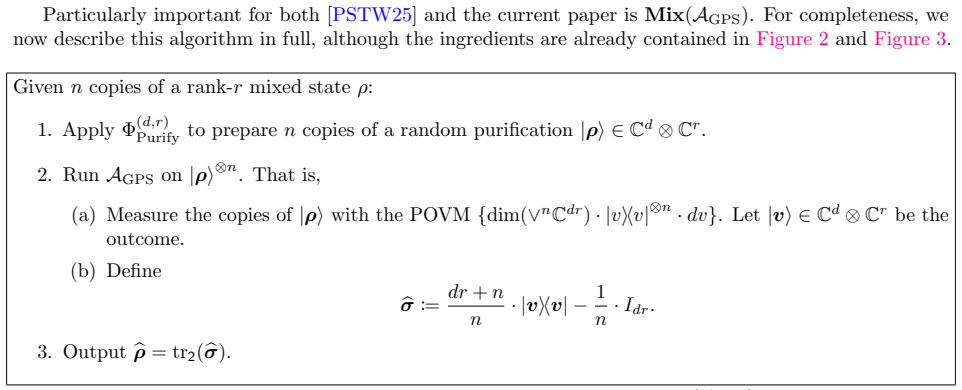
A relative-error tomography guarantee for Mix(AGPS): with high probability, for every pure state |w⟩ the error |⟨w|(ρ̂−ρ)|w⟩| is at most C √(d/n · (⟨w|ρ|w⟩ + d/n)). The bound is proved by establishing sub-gamma concentration of every observable under the estimator and then controlling a suitably rescaled operator-norm error.
Load-bearing premise
The bucketing step must succeed with the stated relative-error bound; if that simultaneous directional concentration fails, the sample-complexity improvement does not go through.
What would settle it
Exhibit a family of states on which every algorithm requires Ω(d² / polylog(d)) copies to achieve constant total-variation spectrum error, or show that the relative-error bound for Mix(AGPS) fails on a concrete net of directions.
If this is right
- For constant accuracy, spectrum estimation is possible with o(d²) copies while full tomography still needs Θ(d²).
- The same relative-error bound yields PCA in Bures distance with the optimal O(kd/ε²) copies and χ²-divergence tomography with O(√(r d³)/ε) copies.
- Any unitarily invariant property (rank, purity, von Neumann or Rényi entropy) can inherit the improved sample complexity.
- The classical local-moment-matching paradigm now has a working quantum analogue once relative-error tomography is available.
Where Pith is reading between the lines
- The ε⁻⁴ dependence is likely an artifact of current bucketing-plus-moment-matching; an ε⁻² algorithm would match the classical sorted-distribution optimum up to logs.
- The same relative-error technology should improve other tasks that only need coarse directional information, such as mixedness testing or support-size estimation in the quantum setting.
- If the sub-gamma parameters can be sharpened further, the remaining log-log factors may disappear, matching the conjectured d² / log²(d) barrier.
Editorial analysis
A structured set of objections, weighed in public.
Circularity Check
No significant circularity: sample-complexity upper bounds are derived from concentration and moment-matching inequalities, not forced by definition or self-citation.
full rationale
This is a theoretical algorithm paper. Theorem 1.1 (and the restated Thm 5.9) is an upper bound obtained by chaining: Mix(AGPS) sub-gamma observable concentration (Prop. 4.1/4.7) → relative-error tomography (Thm 4.8/1.3) → bucketing guarantees (Lemma 5.3) → sub-normalized moment estimators (Lemma 5.6, from AISW20) → local moment matching (Thm 5.8, black-box from PTTW25) with explicit parameter choices B=Θ(ε²K²/d), K=O(log d/log log d). None of these steps defines the claimed sample complexity in terms of itself, fits a free parameter to the target quantity, or imports a uniqueness theorem that forbids alternatives. Self-citations (PTTW25, PSTW25, OW16, AISW20, BOW19, GPS24b, TWZ25) supply prior lemmas used under stated hypotheses; they do not make the o(d²) conclusion true by construction. Corollaries on Bures PCA and χ² tomography likewise follow from the same relative-error bound plus triangle/interlacing inequalities. Residual risk is ordinary proof correctness (e.g. the MGF identity in Lemma 4.3), not circularity. Score 0 is appropriate.
Axiom & Free-Parameter Ledger
axioms (5)
- domain assumption Mix(AGPS) via the random purification channel yields an unbiased mixed-state estimator whose plug-in observables concentrate as claimed (PSTW25 / TWZ25 / GPS24).
- domain assumption Acharya–Issa–Shende–Wagner variance bounds for weak-Schur / p#_k moment estimators (AISW20 Lemma 9), extended to subnormalized states.
- domain assumption Local moment matching recovers a sorted vector in [0,B]^d from noisy power sums with the error of PTTW25 Theorem 7.1 / HJW18-style guarantees.
- standard math Standard sub-gamma MGF definition and tail bounds (e.g. Boucheron–Lugosi–Massart); Chiribella’s theorem for Hayashi measurement moments; Cauchy interlacing / Ky Fan for eigenvalue comparisons.
- ad hoc to paper Parameter regime ε ∈ (0,1), K = O(log d / log log d), B = Θ(ε² K² / d), n = Θ(d/(B ε²)) chosen so all error terms are O(ε).
invented entities (2)
-
Relative-error tomography guarantee (Thm 1.3 / 4.8)
no independent evidence
-
Mix(AGPS)-based bucketing + subnormalized moment estimator pipeline (Fig. 5, Defs. 5.2 and 5.5)
no independent evidence
Cite this review
Pith. "Pith review of The Keyl-Werner algorithm is not optimal for spectrum estimation." pith.science (2026). https://pith.science/paper/KGHNHXQT
@misc{pith2026260727117,
  author       = {Pith},
  title        = {Pith review of: The Keyl-Werner algorithm is not optimal for spectrum estimation},
  year         = {2026},
  howpublished = {\url{https://pith.science/paper/KGHNHXQT}},
  note         = {Machine review of arXiv:2607.27117}
}
abstract
We give an algorithm which, given $n = O(d^2 \cdot (\log\log(d)/\log(d))^2)$ copies of $\rho$, estimates the eigenvalues of $\rho$ to constant error in total variation distance. Thus, we can learn the eigenvalues of a quantum state with fewer copies than the $\Theta(d^2)$ needed to run full state tomography. This is the first improvement to spectrum estimation over the influential Keyl-Werner algorithm, which uses $n = \Theta(d^2)$ copies, thereby resolving a question raised by Keyl and Werner in 2001 and refuting a 2016 conjecture of Wright. Our main technical tool is a new tomography guarantee, where the error of tomography in a particular direction $|w\rangle$ scales with $\langle w | \rho |w\rangle$ for all directions simultaneously. From this stronger "relative-error" bound, we recover better algorithms for principal component analysis in Bures distance and tomography in $\chi^2$-divergence as corollaries.
Figures




Forward citations
Cited by 2 Pith papers
-
The Sample Complexity of Fidelity Estimation to a Known Rank-$r$ Reference State Is $\widetilde{\Theta}(r^2/\varepsilon^2)$
Fidelity estimation to a known rank-r reference state requires Theta-tilde(r^2/epsilon^2) copies, closing the factor-r gap between known upper and lower bounds.
-
Spectrum Estimation is Almost as Hard as Tomography
Spectrum estimation, von Neumann entropy estimation, and rank testing of d-dimensional quantum states each require d^{2−o(1)} copies at constant precision — nearly as many as full tomography.
Reference graph
Works this paper leans on
-
[1]
On Quantum Estimation, Quantum Cloning and Finite Quantum de Finetti Theorems , ISBN=
Chiribella, Giulio , year=. On Quantum Estimation, Quantum Cloning and Finite Quantum de Finetti Theorems , ISBN=. doi:10.1007/978-3-642-18073-6_2 , booktitle=
-
[2]
2024 , eprint=
Principal eigenstate classical shadows , author=. 2024 , eprint=
2024
-
[3]
2013 , publisher=
Concentration Inequalities: A Nonasymptotic Theory of Independence , author=. 2013 , publisher=
2013
-
[4]
Thomas D. Ahle , keywords =. Sharp and simple bounds for the raw moments of the binomial and Poisson distributions , journal =. 2022 , issn =. doi:https://doi.org/10.1016/j.spl.2021.109306 , url =
arXiv 2022
-
[5]
Specializations of MacMahon symmetric functions and the polynomial algebra , journal =. 2002 , note =. doi:https://doi.org/10.1016/S0012-365X(01)00263-1 , url =
-
[6]
A survey on the complexity of learning quantum states , volume =
Anshu, Anurag and Arunachalam, Srinivasan , year =. A survey on the complexity of learning quantum states , volume =. Nature Reviews Physics , publisher =. doi:10.1038/s42254-023-00662-4 , number =
-
[7]
Fisher, R. A. and Corbet, A. Steven and Williams, C. B. , year =. The Relation Between the Number of Species and the Number of Individuals in a Random Sample of an Animal Population , volume =. The Journal of Animal Ecology , publisher =. doi:10.2307/1411 , number =
-
[8]
Expositiones Mathematicae , volume =
Rajendra Bhatia and Tanvi Jain and Yongdo Lim , keywords =. Expositiones Mathematicae , volume =. 2019 , issn =. doi:https://doi.org/10.1016/j.exmath.2018.01.002 , url =
-
[9]
2026 , eprint=
Random dimension reduction and learning symmetric properties of quantum states , author=. 2026 , eprint=
2026
-
[10]
On active and passive testing , volume =
Alon, Noga and Hod, Rani and Weinstein, Amit , date-added =. On active and passive testing , volume =. Combinatorics, Probability and Computing , number =
-
[11]
Strong random unitaries and fast scrambling , year =
Schuster, Thomas and Ma, Fermi and Lombardi, Alex and Brandao, Fernando and Huang, Hsin-Yuan , booktitle = qip26, date-added =. Strong random unitaries and fast scrambling , year =
-
[12]
Inverse-free quantum state estimation with
Chen, Kean , date-added =. Inverse-free quantum state estimation with
-
[13]
A list of complexity bounds for property testing by quantum sample-to-query lifting , year =
Chen, Kean and Wang, Qisheng and Zhang, Zhicheng , date-added =. A list of complexity bounds for property testing by quantum sample-to-query lifting , year =
-
[14]
Towards sample-optimal learning of bosonic Gaussian quantum states , year =
Chen, Senrui and Mele, Francesco Anna and Fanizza, Marco and Li, Albert and Mann, Zachary and Huang, Hsin-Yuan and Chen, Yanbei and Preskill, John , date-added =. Towards sample-optimal learning of bosonic Gaussian quantum states , year =
-
[15]
Optimal learning of quantum channels in diamond distance , year =
Mele, Antonio Anna and Bittel, Lennart , date-added =. Optimal learning of quantum channels in diamond distance , year =
-
[16]
Random dilation superchannel , year =
Yoshida, Satoshi and Niwa, Ryotaro and Murao, Mio , date-added =. Random dilation superchannel , year =
-
[17]
Random Stinespring superchannel: converting channel queries into dilation isometry queries , year =
Girardi, Filippo and Mele, Francesco Anna and Zhao, Haimeng and Fanizza, Marco and Lami, Ludovico , date-added =. Random Stinespring superchannel: converting channel queries into dilation isometry queries , year =
-
[18]
Random purification channel for passive
Mele, Francesco Anna and Girardi, Filippo and Chen, Senrui and Fanizza, Marco and Lami, Ludovico , date-added =. Random purification channel for passive
-
[19]
A random purification channel for arbitrary symmetries with applications to fermions and bosons , year =
Walter, Michael and Witteveen, Freek , date-added =. A random purification channel for arbitrary symmetries with applications to fermions and bosons , year =
-
[20]
Random purification channel made simple , year =
Girardi, Filippo and Mele, Francesco Anna and Lami, Ludovico , date-added =. Random purification channel made simple , year =
-
[21]
Quantum generalizations of the polynomial hierarchy with applications to QMA (2) , volume =
Gharibian, Sevag and Santha, Miklos and Sikora, Jamie and Sundaram, Aarthi and Yirka, Justin , date-added =. Quantum generalizations of the polynomial hierarchy with applications to QMA (2) , volume =. Computational Complexity , number =
-
[22]
Sequential measurements, disturbance and property testing , year =
Harrow, Aram and Lin, Cedric and Montanaro, Ashley , booktitle = soda07, date-added =. Sequential measurements, disturbance and property testing , year =
-
[23]
Quantum algorithms to solve the hidden shift problem for quadratics and for functions of large
R. Quantum algorithms to solve the hidden shift problem for quadratics and for functions of large
-
[24]
Dimension independent and computationally efficient shadow tomography , year =
Sinha, Pulkit , booktitle = stoc25, date-added =. Dimension independent and computationally efficient shadow tomography , year =
-
[25]
Mixed state tomography reduces to pure state tomography , year =
Pelecanos, Angelos and Spilecki, Jack and Tang, Ewin and Wright, John , date-added =. Mixed state tomography reduces to pure state tomography , year =
-
[26]
Optimal algorithms for learning quantum phase states , year =
Arunachalam, Srinivasan and Bravyi, Sergey and Dutt, Arkopal and Yoder, Theodore , booktitle = tqc23, date-added =. Optimal algorithms for learning quantum phase states , year =
-
[27]
Learning stabilizer states by Bell sampling , year =
Montanaro, Ashley , date-added =. Learning stabilizer states by Bell sampling , year =
-
[28]
Product testing with single-copy measurements , year =
Beckey, Jacob and Coffman, Luke and Shlosberg, Ariel and Schatzki, Louis and Leditzky, Felix , date-added =. Product testing with single-copy measurements , year =
-
[29]
Exponential separations between learning with and without quantum memory , year =
Chen, Sitan and Cotler, Jordan and Huang, Hsin-Yuan and Li, Jerry , booktitle = focs21, date-added =. Exponential separations between learning with and without quantum memory , year =
-
[30]
Approximate orthogonality of permutation operators, with application to quantum information , volume =
Harrow, Aram , date-added =. Approximate orthogonality of permutation operators, with application to quantum information , volume =. Letters in Mathematical Physics , number =
-
[31]
Local random quantum circuits are approximate polynomial-designs , volume =
Brandao, Fernando and Harrow, Aram and Horodecki, Micha. Local random quantum circuits are approximate polynomial-designs , volume =. Communications in Mathematical Physics , number =
-
[32]
A Mathematical Introduction to Compressive Sensing , year =
Foucart , Simon and Rauhut, Holger , date-added =. A Mathematical Introduction to Compressive Sensing , year =
-
[33]
Efficient approximate unitary designs from random Pauli rotations , year =
Haah, Jeongwan and Liu, Yunchao and Tan, Xinyu , booktitle = focs24, date-added =. Efficient approximate unitary designs from random Pauli rotations , year =
-
[34]
Explicit orthogonal and unitary designs , year =
O'Donnell, Ryan and Servedio, Rocco A and Paredes, Pedro , booktitle = focs23, date-added =. Explicit orthogonal and unitary designs , year =
-
[35]
Local test for unitarily invariant properties of bipartite quantum states , year =
Chen, Kean and Wang, Qisheng and Zhang, Zhicheng , date-added =. Local test for unitarily invariant properties of bipartite quantum states , year =
-
[36]
Conjugate queries can help , year =
Tang, Ewin and Wright, John and Zhandry, Mark , date-added =. Conjugate queries can help , year =
-
[37]
Bernstein-type bounds for beta distribution , volume =
Skorski, Maciej , date-added =. Bernstein-type bounds for beta distribution , volume =. Modern Stochastics: Theory and Applications , number =
-
[38]
Michael Walter , date-added =. Lecture
-
[39]
Randomizing quantum states: Constructions and applications , volume =
Hayden, Patrick and Leung, Debbie and Shor, Peter and Winter, Andreas , date-added =. Randomizing quantum states: Constructions and applications , volume =. Communications in Mathematical Physics , number =
-
[40]
Upper and lower bounds on quantum codes , year =
Smith, Graeme Stewart Baird , date-added =. Upper and lower bounds on quantum codes , year =
-
[41]
Lecture on quantum error correction , year =
Peter Shor , date-added =. Lecture on quantum error correction , year =
-
[42]
Musto, Benjamin and Vicary, Jamie , date-added =. Quantum. Quantum Information and Computation , number =
-
[43]
Why two qubits are special , volume =
Vollbrecht, Karl and Werner, Reinhard , date-added =. Why two qubits are special , volume =. Journal of Mathematical Physics , number =
-
[44]
Non-binary unitary error bases and quantum codes , year =
Emanuel Knill , date-added =. Non-binary unitary error bases and quantum codes , year =
-
[45]
Rigidity of superdense coding , volume =
Nayak, Ashwin and Yuen, Henry , date-added =. Rigidity of superdense coding , volume =. ACM Transactions on Quantum Computing , number =
-
[46]
All teleportation and dense coding schemes , volume =
Werner, Reinhard , date-added =. All teleportation and dense coding schemes , volume =. Journal of Physics A: Mathematical and General , number =
-
[47]
No more perfect codes: classification of perfect quantum codes , year =
Li, Zhuo and Xing, Lijuan , date-added =. No more perfect codes: classification of perfect quantum codes , year =
-
[48]
John Wright , date-added =. Lecture
-
[49]
Are controlled unitaries helpful? , year =
Tang, Ewin and Wright, John , date-added =. Are controlled unitaries helpful? , year =
-
[50]
Amplitude amplification and estimation require inverses , year =
Tang, Ewin and Wright, John , date-added =. Amplitude amplification and estimation require inverses , year =
-
[51]
The state hidden subgroup problem and an efficient algorithm for locating unentanglement , year =
Bouland, Adam and Giurgic. The state hidden subgroup problem and an efficient algorithm for locating unentanglement , year =
-
[52]
A quantum algorithm for the quantum
Berg, Sonya , date-added =. A quantum algorithm for the quantum
-
[53]
Instance-Optimal Quantum State Certification with Entangled Measurements , year =
O'Donnell, Ryan and Wadhwa, Chirag , date-added =. Instance-Optimal Quantum State Certification with Entangled Measurements , year =
-
[54]
Personal communication , year =
Chen, Sitan and Li, Jerry , date-added =. Personal communication , year =
-
[55]
Tight Bound for Quantum Unitary Time-Reversal , year =
Chen, Kean and Yu, Nengkun and Zhang, Zhicheng , date-added =. Tight Bound for Quantum Unitary Time-Reversal , year =
-
[56]
Quantum majority vote , year =
Buhrman, Harry and Linden, Noah and Man. Quantum majority vote , year =
-
[57]
Optimal quantum purity amplification , year =
Li, Zhaoyi and Fu, Honghao and Isogawa, Takuya and Chuang, Isaac , date-added =. Optimal quantum purity amplification , year =
-
[58]
Gelfand-
Grinko, Dmitry and Burchardt, Adam and Ozols, Maris , date-added =. Gelfand-
-
[59]
The mixed
Nguyen, Quynh , booktitle = qip24, date-added =. The mixed
-
[60]
Singleton bounds for entanglement-assisted classical and quantum error correcting codes , volume =
Mamindlapally, Manideep and Winter, Andreas , date-added =. Singleton bounds for entanglement-assisted classical and quantum error correcting codes , volume =. IEEE Transactions on Information Theory , number =
-
[61]
Pauli manipulation detection codes and applications to quantum communication over adversarial channels , year =
Bergamaschi, Thiago , booktitle = eurocrypt24, date-added =. Pauli manipulation detection codes and applications to quantum communication over adversarial channels , year =
-
[62]
How to generate random matrices from the classical compact groups , volume =
Mezzadri, Francesco , date-added =. How to generate random matrices from the classical compact groups , volume =. Notices of the American Mathematical Society , number =
-
[63]
Query-optimal estimation of unitary channels in diamond distance , year =
Haah, Jeongwan and Kothari, Robin and O'Donnell, Ryan and Tang, Ewin , booktitle = focs23, date-added =. Query-optimal estimation of unitary channels in diamond distance , year =
-
[64]
Black holes as mirrors: quantum information in random subsystems , volume =
Hayden, Patrick and Preskill, John , date-added =. Black holes as mirrors: quantum information in random subsystems , volume =. Journal of high energy physics , number =
-
[65]
On the list decodability of random linear codes with large error rates , year =
Wootters, Mary , booktitle = stoc13, date-added =. On the list decodability of random linear codes with large error rates , year =
-
[66]
A mathematical theory of communication , volume =
Shannon, Claude , date-added =. A mathematical theory of communication , volume =. The Bell system technical journal , number =
-
[67]
Algebraic geometry codes , volume =
H. Algebraic geometry codes , volume =. Handbook of coding theory , pages =
-
[68]
Modular curves,
Tsfasman, Michael and Vl. Modular curves,. Mathematische Nachrichten , number =
-
[69]
Essential coding theory , year =
Guruswami, Venkatesan and Rudra, Atri and Sudan, Madhu , date-added =. Essential coding theory , year =
-
[70]
Estimate of the number of signals in error correcting codes , volume =
Varshamov, Rom , date-added =. Estimate of the number of signals in error correcting codes , volume =. Proceedings of the USSR Academy of Sciences , pages =
-
[71]
Approaching the quantum singleton bound with approximate error correction , year =
Bergamaschi, Thiago and Golowich, Louis and Gunn, Sam , booktitle = stoc24, date-added =. Approaching the quantum singleton bound with approximate error correction , year =
-
[72]
Approximate quantum error-correcting codes and secret sharing schemes , year =
Cr. Approximate quantum error-correcting codes and secret sharing schemes , year =
-
[73]
Approximate quantum error correction can lead to better codes , volume =
Leung, Debbie and Nielsen, Michael and Chuang, Isaac and Yamamoto, Yoshihisa , date-added =. Approximate quantum error correction can lead to better codes , volume =. Physical Review A , number =
-
[74]
A Survey of Quantum Property Testing , year =
Montanaro, Ashley and de Wolf, Ronald , date-added =. A Survey of Quantum Property Testing , year =. Theory of Computing , pages =
-
[75]
Multi-parameter estimation beyond quantum Fisher information , volume =
Demkowicz-Dobrza. Multi-parameter estimation beyond quantum Fisher information , volume =. Journal of Physics A: Mathematical and Theoretical , number =
-
[76]
On quantumness in multi-parameter quantum estimation , volume =
Carollo, Angelo and Spagnolo, Bernardo and Dubkov, Alexander and Valenti, Davide , date-added =. On quantumness in multi-parameter quantum estimation , volume =. Journal of Statistical Mechanics: Theory and Experiment , number =
-
[77]
Upper bounds on the Holevo Cram 'er-Rao bound for multiparameter quantum parametric and semiparametric estimation , year =
Albarelli, Francesco and Tsang, Mankei and Datta, Animesh , date-added =. Upper bounds on the Holevo Cram 'er-Rao bound for multiparameter quantum parametric and semiparametric estimation , year =
-
[78]
A new approach to the
Matsumoto, Keiji , date-added =. A new approach to the. Journal of Physics A: Mathematical and General , number =
-
[79]
Attaining the ultimate precision limit in quantum state estimation , volume =
Yang, Yuxiang and Chiribella, Giulio and Hayashi, Masahito , date-added =. Attaining the ultimate precision limit in quantum state estimation , volume =. Communications in Mathematical Physics , number =
-
[80]
Quantum local asymptotic normality based on a new quantum likelihood ratio , volume =
Yamagata, Koichi and Fujiwara, Akio and Gill, Richard , date-added =. Quantum local asymptotic normality based on a new quantum likelihood ratio , volume =. The Annals of Statistics , number =
This paper was first reviewed by grok-4.5 on July 30, 2026.
discussion (0)
Sign in with ORCID, Apple, or X to comment. Anyone can read and Pith papers without signing in.